Posted on

Outdoor American flags for exposed coastal homes

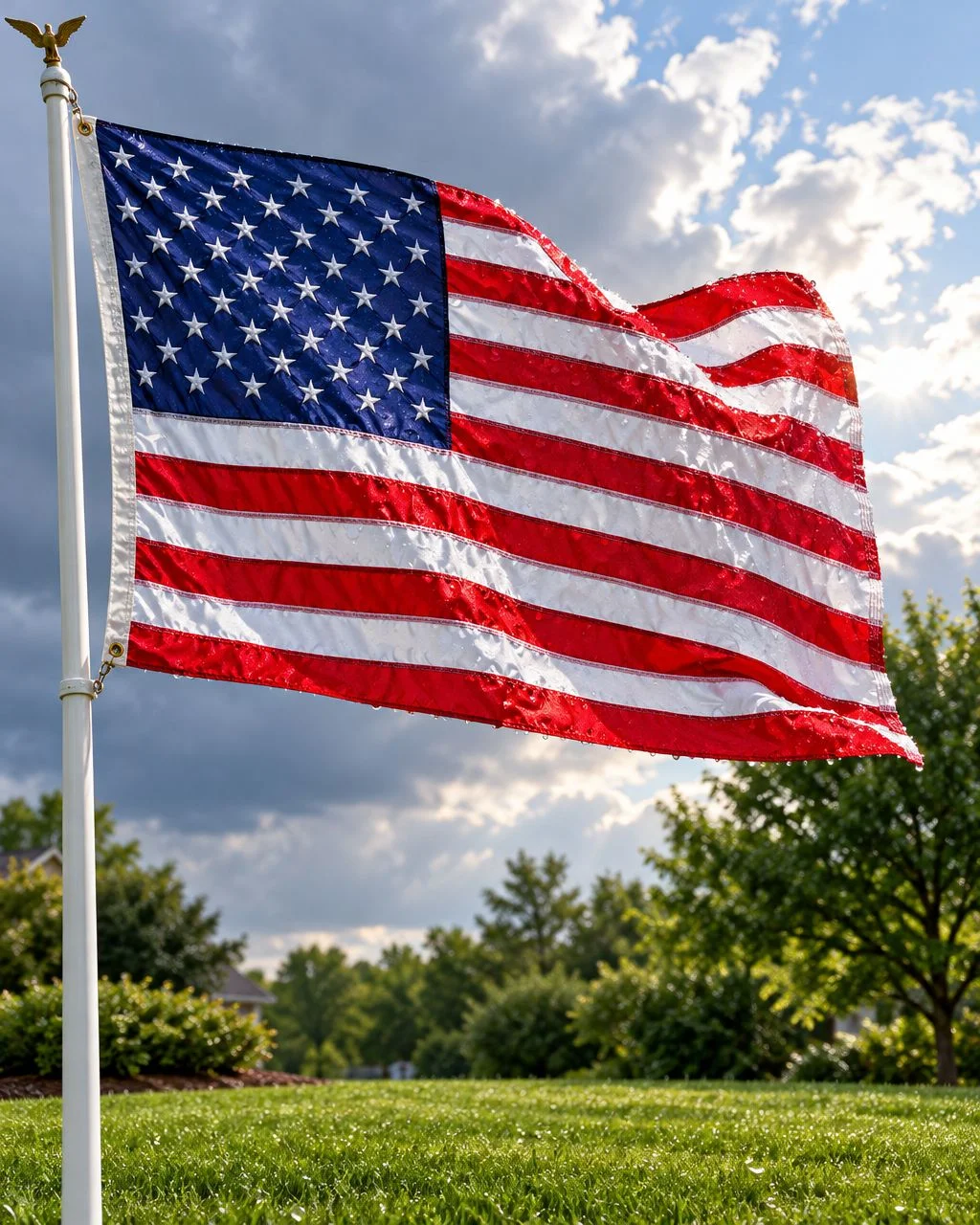
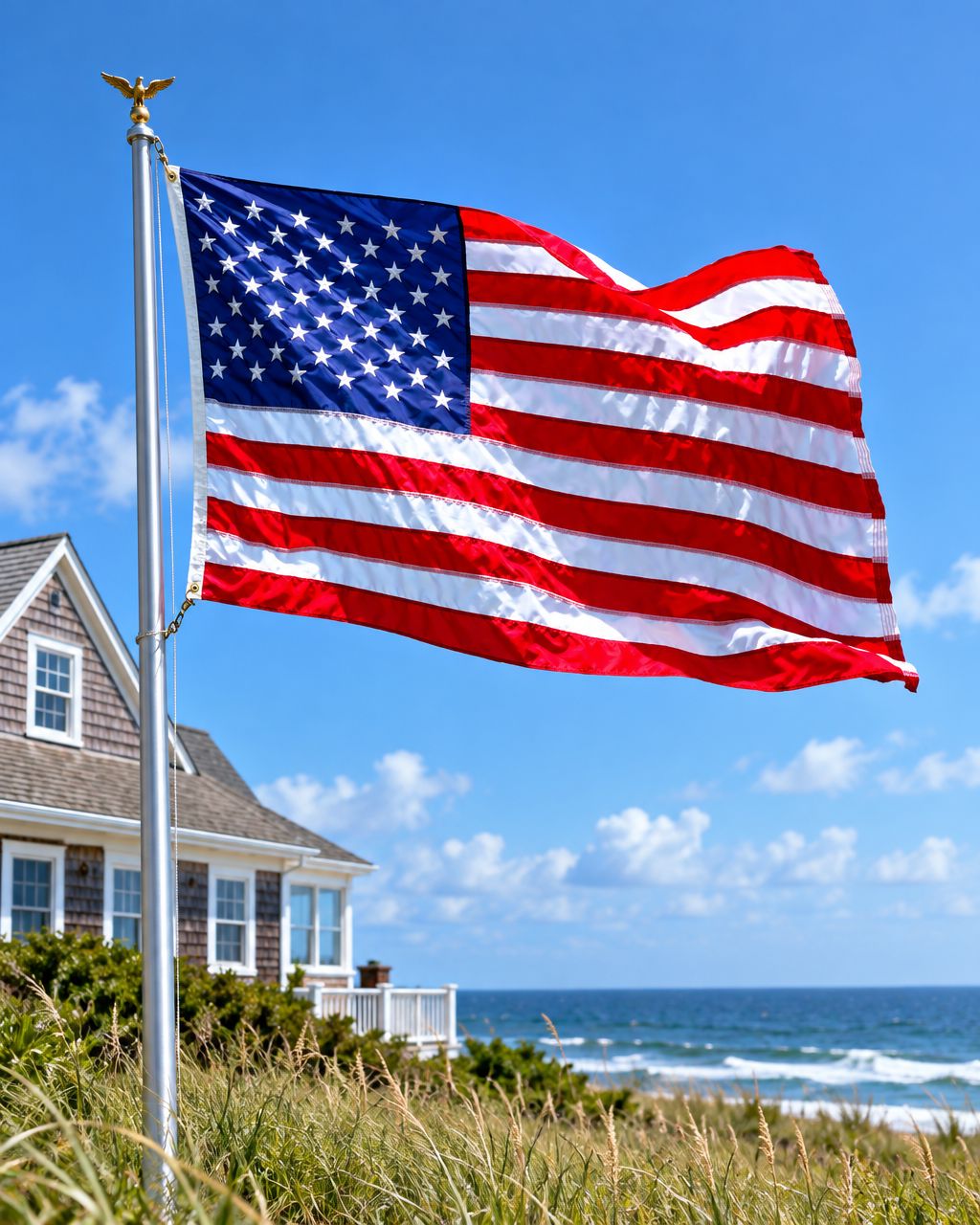
Heavy-duty American flag with embroidered stars flying on a flagpole at an exposed coastal home overlooking the ocean

An exposed coastal home is the hardest place in America to keep an American flag looking proud, and the flag that lasts there is a heavy-duty 2-ply polyester American flag sized to your pole, rigged so it can furl, and brought in when the weather turns ugly. Salt air, steady wind and full sun will chew up a thin printed flag inside a single season. This guide walks through what actually holds up at the coast, which size fits your pole, and the habits that keep a brand-new flag from shredding at the fly end.

Quick answer
  • A 2-ply polyester commercial American flag is the coastal workhorse; printed flags fray fastest.
  • Match flag size to pole: a 3×5 ft flag suits a pole near 20 feet.
  • Four rows of stitching on the fly end is the construction detail to look for.
  • Nylon suits sheltered coastal yards: it flies in light wind and dries fast after spray.
  • Inspect the fly end monthly and retire the flag before it shreds.

Ultimate Flags flag sale banner

Why coastal wind is harder on a flag

On a typical inland lot a flag meets gusts. On the coast it meets a steady load, all day and all night, and that load carries salt. Wind does most of the cutting: every flutter works the cloth at the fly end like a hinge, and the stitching there is the first thing to let go. Salt then grinds into the fibers, and the sun bleaches whatever is left.

That is why construction matters more than design here. A fully sewn flag with embroidered stars puts thread where a printed flag puts ink, and thread handles the hinge motion far better. The store's commercial 2-ply polyester flag, for example, carries four rows of stitching on the fly end plus reinforced fly corners — precisely the spots salt wind attacks first.

How do you choose an outdoor American flag for an exposed coastal home?

Work down the table before you shop. Fabric decides how long the flag lives; everything else decides how it looks.

Flag type Best for at the coast How it holds up Watch out for
2-ply polyester, sewn, commercial grade Steady ocean wind on an exposed pole Open-weave 2-ply bunting sheds wind load; four-row fly-end stitching resists fraying Heavier cloth wants a sturdy pole
Nylon, embroidered Breezy but sheltered yards; spots that dry slowly Light, flies in soft wind, dries fast after spray Thin nylon frays sooner in constant hard wind
Printed polyester Covered porches and short-term display The cheapest way to fly the design Ink and thin cloth fade and tear fastest in salt sun
Cotton, sewn Indoor and ceremonial display Classic look, rich colors Holds moisture; mildew risk at the shore

If your pole stands in open view of the water with nothing to break the wind, the commercial 2-ply polyester flag is the honest pick — its open weave reduces wind resistance, so the same wind that shreds thinner cloth rolls right through it. If your flag hangs in a sheltered yard or on a house-mounted pole, the embroidered nylon is lighter, dries quickly after sea spray, and still reads as a quality sewn flag. Cotton is a museum piece at the shore; keep it indoors where you can enjoy the stitching.
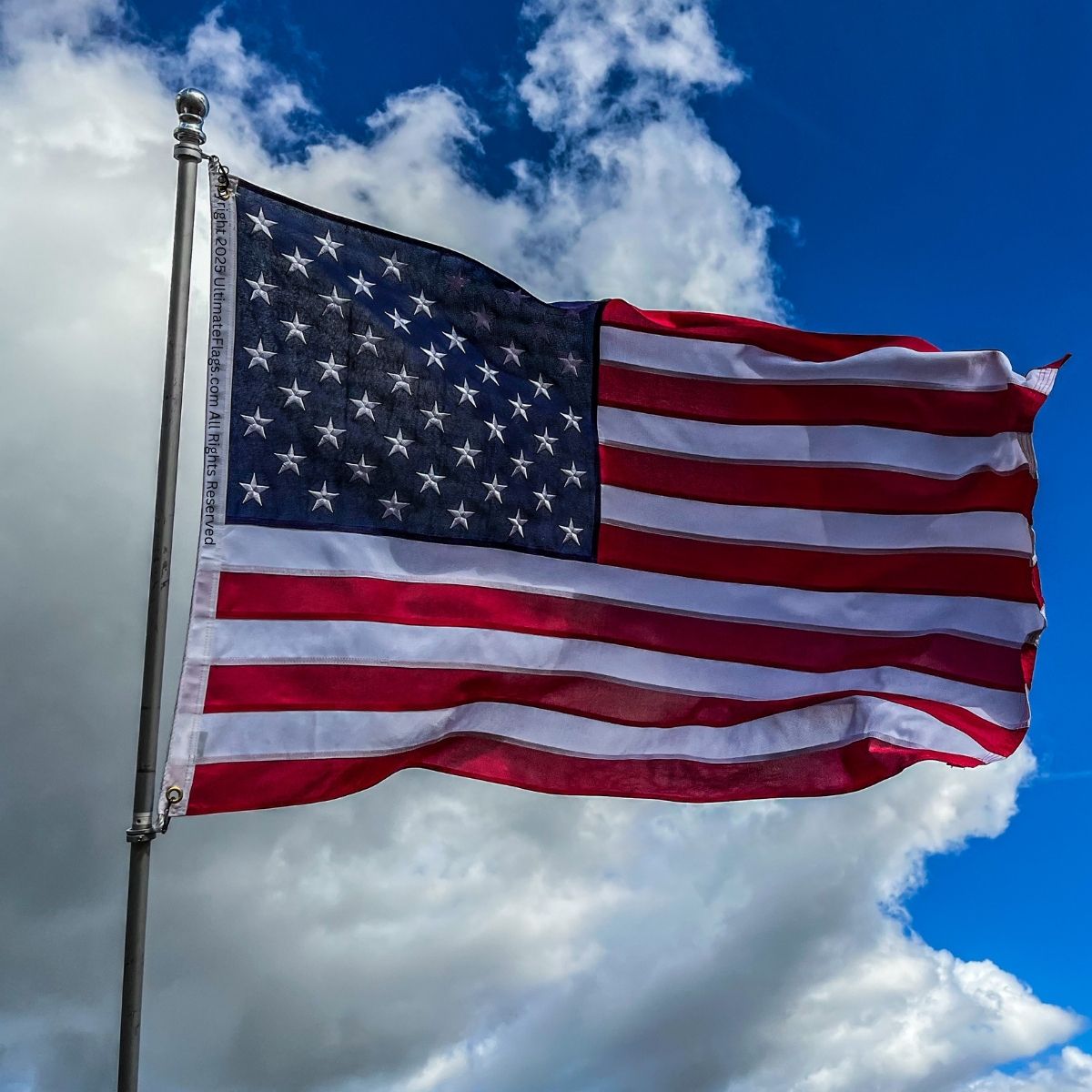
Heavy-duty 2-ply polyester American flag with embroidered stars flying against a blue coastal skyFlag Sale – Shop Now!
Heavy-duty 2-ply polyester commercial American flag flying outdoors. The open-weave bunting and four-row fly-end stitching are the coastal details that matter.

Match the flag size to your pole and the exposure

The store's own sizing guidance is a good anchor: the flagpole should be about four times the fly length of the flag. A 3×5 foot flag suits a pole near 20 feet, and a 5×8 belongs on something close to 32 feet. Oversizing the flag is the fastest way to bend hardware, and coastal wind multiplies every sizing mistake.

Add two coastal adjustments to that rule. Downsize one step when the pole sits fully exposed, and choose a house-mounted pole at roofline height when the wind funnels between dunes or buildings. A properly sized flag that furls gracefully outlasts a proud oversized one that never stops snapping.

Rigging and placement that protect the fly end

  • Let it furl. A rotating mount or spinning pole lets the flag turn with the wind instead of wringing itself on a fixed heading.
  • Check the hardware. Salt corrodes plain steel snaps and clips. Rinse them with fresh water now and then, and replace anything rusting before it fails.
  • Keep the fly end clear. Never let the cloth touch roof shingles, railings or shrubs. That rubbing point is where most fly ends start to go.
  • Take it down in named storms. No flag is built for a hurricane. A small tear becomes a full shred in one bad blow.
  • Rinse the flag itself. A fresh-water rinse removes salt before it works into the stitching, and it dries on the pole in an hour of sun.

None of this costs much. It is the difference between a flag you replace when it fades and one you replace when it tears.

Embroidered nylon American flag with sewn stripes flying on a pole against a blue skyShop Now
Embroidered nylon American flag with sewn stripes, made in America — the lighter choice for breezy rather than storm-exposed sites.

What wears out first on a coastal flag

  • The fly end. Cloth and stitching at the free end take the hinge load. Separate threads or a started tear mean the flag is telling you something.
  • The header and grommets. The heading carries the whole flag's weight in wind; look for a strong header, solid brass grommets and, on larger sizes, a rope-loop header for high-wind poles.
  • The red stripes. Red fades before blue or white in strong sun, which is why dye quality matters more at the shore than anywhere else.
  • Damp fold lines. A flag furled wet and left furled grows mildew lines along the folds. Dry it before you store it, every time.

Walk past the pole once a month. Trim a small fray while it is small, and retire the flag when a stripe tears or the fly end lets go.

Common mistakes coastal homeowners make

  • Buying a printed flag for an ocean view. It looks right in the listing photo and frays in the first month of steady wind.
  • Oversizing against the pole. A flag bigger than the pole can carry wears out the flag and the hardware together.
  • Flying from a fixed mount in open wind. Without rotation, the flag wrings the same section of cloth all season.
  • Leaving it up through storms. The flag is not the thing to prove tough that day.
  • Using cotton outdoors. Cotton soaks up salt spray and holds it, and mildew follows.

When you are ready to Shop Ultimate Flags, compare the commercial 2-ply polyester and the embroidered nylon side by side, match the size to your pole, and check the fly-end stitching before anything else. Ultimate Flags carries both constructions made in America, in sizes from 12×18 inch up to 30×50 feet, so the same build covers a porch mount and a tall country pole.

Related questions about coastal flags

Can nylon flags handle beach wind?

Lightly, yes. Nylon is light and dries fast, which is why it flies well in gentle coastal breezes, but constant hard wind at a fully exposed site works on thin nylon sooner than on 2-ply polyester. Match the fabric to the exposure, not just to the look.

How do you keep a flag from fading at the coast?

Limit what the sun and salt can do. Choose sewn construction with deep, colorfast dye — the store describes its 2-ply fabric as having deeper, brighter colors with excellent wash-fastness and light-fastness — rinse the flag occasionally, and rotate two flags through the season if the pole sits in full sun.

When should you replace a coastal flag?

When the fly end frays past trimming, when a stripe tears, or when the header or grommets start to pull. There is no calendar date; a monthly look at the pole tells you more than any rule of thumb.

FAQ

What is the best outdoor American flag for an exposed coastal home?

A heavy-duty 2-ply polyester commercial flag with sewn stripes, embroidered stars and four rows of stitching on the fly end is the best choice. Its open-weave bunting reduces wind resistance, and the reinforced fly end is built for steady coastal wind.

Is nylon or polyester better for a beach house flag?

Polyester, if the pole is fully exposed: 2-ply polyester sheds wind load and resists fraying best. Nylon suits sheltered yards, flies in lighter wind and dries quickly after sea spray.

What size American flag fits a 20-foot flagpole?

About 3×5 feet. The flagpole should be roughly four times the fly length of the flag, so a 3×5 foot flag suits a pole near 20 feet and a 5×8 flag wants about 32 feet.

How often should you replace a flag at the coast?

Replace it when the fly end frays past trimming or a stripe tears, not on a calendar. Inspect the flag about once a month; steady salt wind can retire a thin printed flag in a single season.

Can I leave my American flag out during a storm?

No. Take the flag down during named storms and high-wind warnings. No outdoor flag construction is built for hurricane conditions, and one bad blow can shred even a heavy sewn flag.

Where can I buy heavy-duty outdoor American flags?

Ultimate Flags sells commercial 2-ply polyester and embroidered nylon American flags made in America, in sizes from 12×18 inch up to 30×50 feet. Match the size to your pole and check the fly-end stitching before you buy.

One last thing

The commercial 2-ply flag exists because of wind: the open weave, the four-row fly end and the rope-loop header options were all designed for tall, hard-working poles weather like yours. Ask for that construction by name when you shop, and the coast stops eating your flags.

Related guides
Posted on

How do you read inscriptions on Civil War flags?

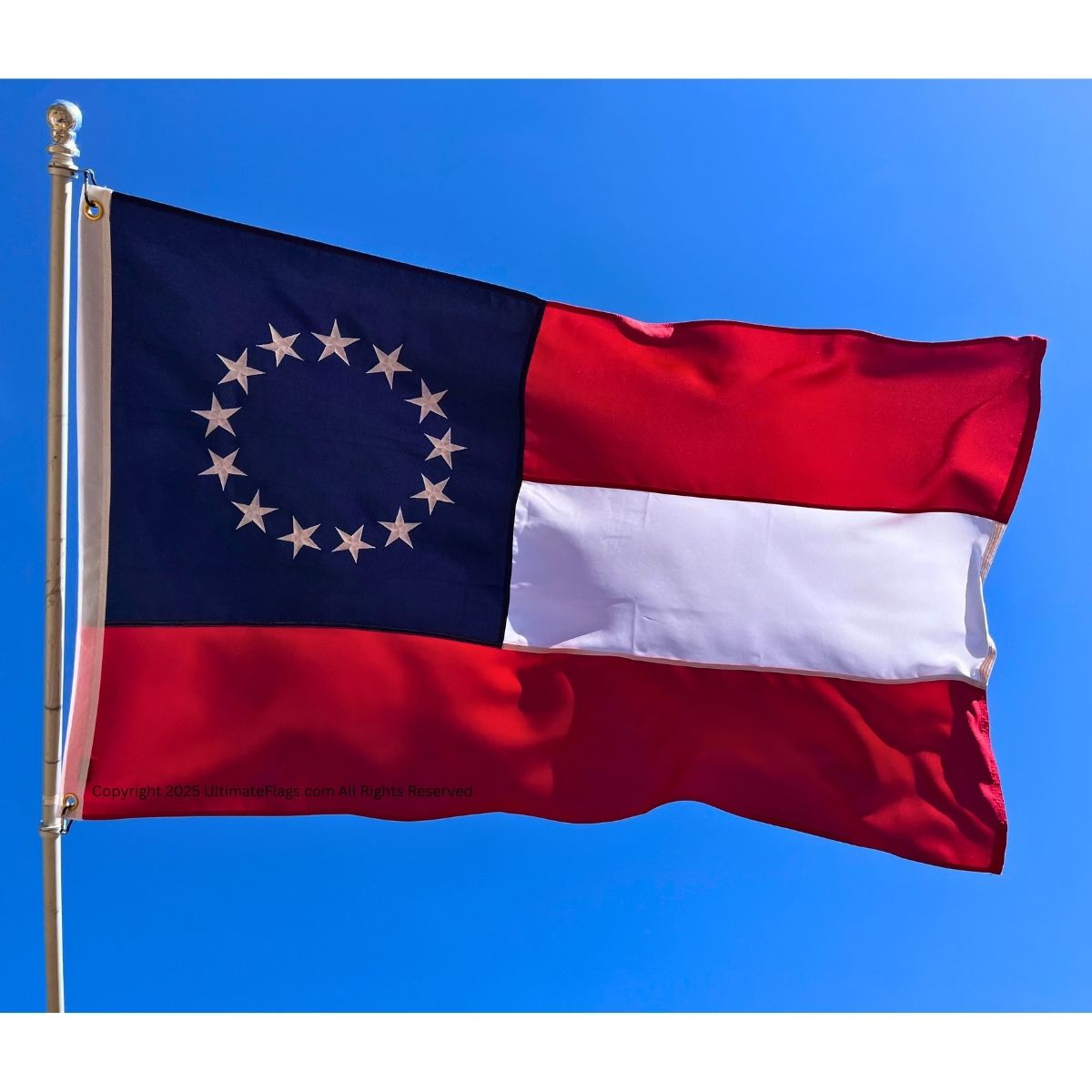
1st national flag 13 stars and bars double nylon embroidered flag 2x3 3x5 4x6 5x8 6x10 8x12 10x15 ft

Reading inscriptions on a Civil War flag comes down to sorting the text into one of four kinds — a unit designation, a battle honor, a presentation inscription or an issue marking — then transcribing it exactly and checking it against regimental records. Get that order right and a marked flag can usually tell you the army it served with, the years it was carried and often the exact regiment. Get it wrong and a modern reproduction ends up captioned as a wartime original. Today most of the records you need to check against are digitized, so the verification step is faster than it has ever been.

TL;DR
  • Four inscription types: unit designation, battle honor, presentation text, issue marking.
  • Transcribe wording exactly, abbreviations included, before searching any records.
  • Battle honors list the battles a unit fought while carrying that flag.
  • Star counts and flag patterns date a flag when lettering is missing.
  • Confirm every match in regimental records — the flag alone never settles it.

Ultimate Flags flag sale banner

How do you read inscriptions on Civil War flags?

Start by naming the kind of text you are looking at, because each kind answers a different question and each one is verified differently.

Inscription type What it looks like What it tells you
Unit designation "4th N.C. Inf." lettered on a regimental color The exact regiment or command that carried it
Battle honor Embroidered or painted place names The battles fought under that specific flag
Presentation inscription Names, a date and often a motto Who gave the flag, to whom and when
Issue marking Depot stamps, maker initials, stenciled numbers Which sew shop or quartermaster issued it

A flag can carry one of these or all four, and they were added at different times by different hands. Read them as layers, not as a single caption.

Unit designations: the wording that names the regiment

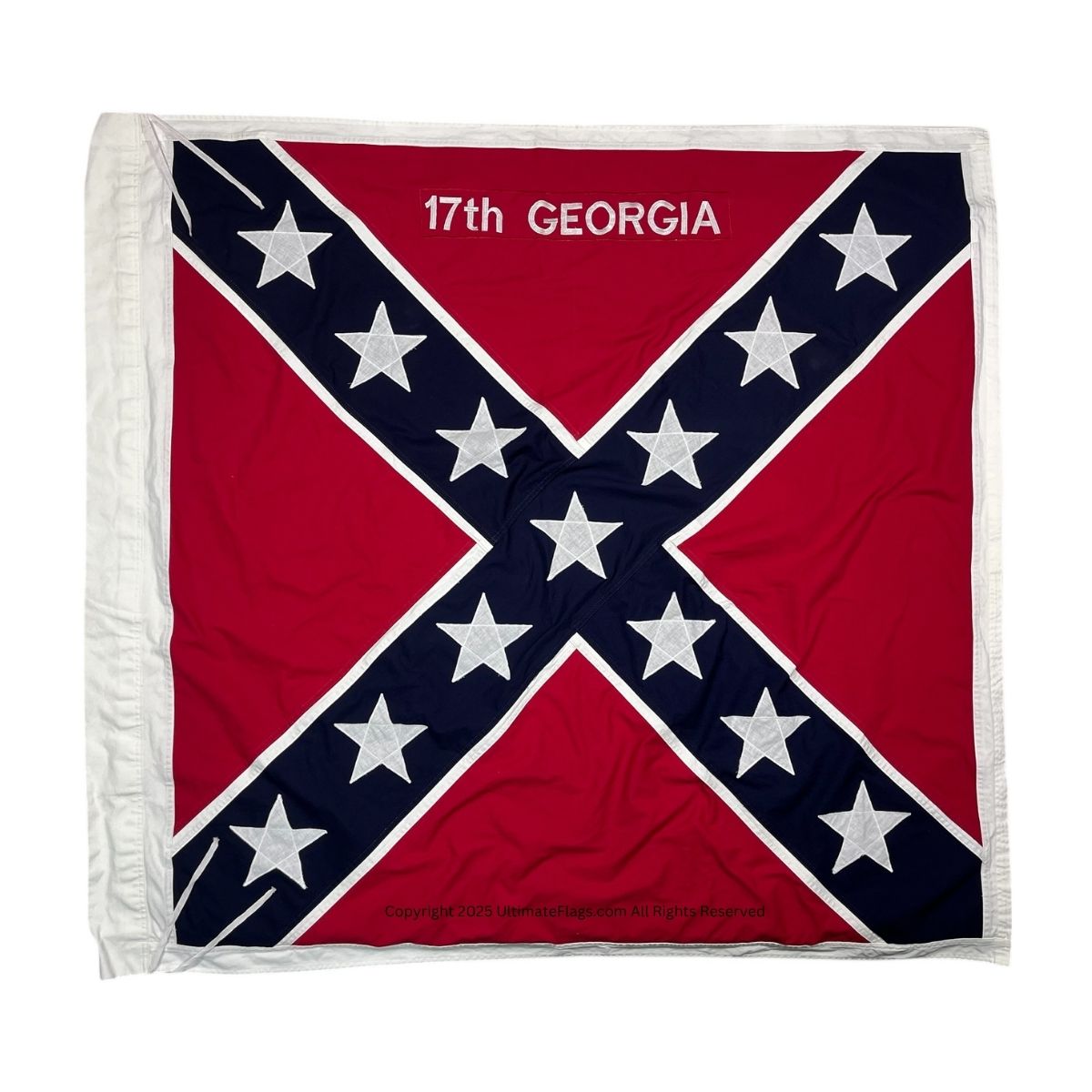
A regimental color usually announces itself. Federal regiments painted or embroidered their designation on both the blue regimental color and the Stars and Stripes they carried beside it — a marking such as "4th N.C. Inf." names the unit directly, and "Co. A" narrows it to one company. Confederate battle flags in the Eastern theater were often lettered the same way, and headquarters flags carry the general's name.

Transcribe the wording exactly as written, abbreviations and spelling quirks included, because the wartime records use those same forms. "N.C." reads as North Carolina in the muster rolls; modernizing it before you search costs you the match. Painted lettering also fades differently from the fabric — text that is barely visible head-on can stand out under angled light, so photograph before you conclude that a flag is unmarked.

Star counts and patterns: reading a flag with no lettering at all

When a flag carries no text, the pattern itself does the talking. The Confederate first national, the Stars and Bars, was adopted in March 1861 with seven stars for the first seven seceded states and settled at thirteen covering the eleven seceded states plus Kentucky and Missouri. Union flags date by star count: 34 stars from 1861, 35 after West Virginia joined in 1863, 36 in 1864-65. Shape narrows the army — a square battle flag with a white border belongs to the Army of Northern Virginia from late 1861, while rectangular battle flags served the Army of Tennessee and the Trans-Mississippi.


13-star Stars and Bars nylon embroidered reproduction flag with embroidered stars and sewn stripesBuy This Flag- Click Here
A 13-star first national — the star count is the inscription: thirteen stars place the design in the later war years, after the original seven of March 1861.

Battle honors: the place names that record the fighting

Battle honors are the strongest inscriptions a battle flag can carry. These are place names — Williamsburg, Seven Pines, Sharpsburg, Fredericksburg, Chancellorsville, Gettysburg — embroidered, painted or stenciled on the field to record the battles where the unit fought under that flag. The set of honors belongs to one regiment or battery, so the list often identifies the unit on its own: a square cotton flag marked "Williamsburg" and "Seven Pines" points to a regiment that fought in the 1862 Peninsula Campaign under the Army of Northern Virginia.

Read honors as a sequence, not a summary. Honors were added at different times, often by different hands, and an 1862-issued flag carrying a Gettysburg honor is not a contradiction — it is a flag that stayed in service into July 1863. That sequence is also why an honor list is rarely complete: regiments sometimes lost the flag before the latest honors could be added.

Presentation inscriptions: who gave the flag and when

Many regimental colors were not government issue at all. Ladies' aid societies, town councils and local donors commissioned and presented flags to regiments, and those presentation flags carry the richest inscriptions of the war: the regiment's name, the presenting organization, the date, and often a motto or a Bible verse. A presentation inscription is dated primary evidence — it pins the flag to a specific day and place.

These inscriptions repay archival work. Presentations were civic events, reported in local newspapers with the wording quoted, so digitized newspaper archives can turn a transcription into a full story: who sewed it, who spoke at the ceremony and which company accepted it. When a collector documents a presentation flag, that newspaper report is the source that makes the flag's caption airtight.

Maker and issue markings: the smallest inscriptions, the sharpest dating

The least glamorous inscriptions are the most useful for separating period flags from later copies. Army depots stamped or stenciled issue markings, sew shops left maker initials, and quartermaster records tie issued flags to dates and quantities. The Army of Northern Virginia's battle flags came through a depot system from 1862, so construction details and depot markings together bracket a flag's origin tightly. Reproduction makers do not replicate wear patterns or depot stamps, which is one reason examiners check the back of the flag and the hoist before they trust any lettering on the front.


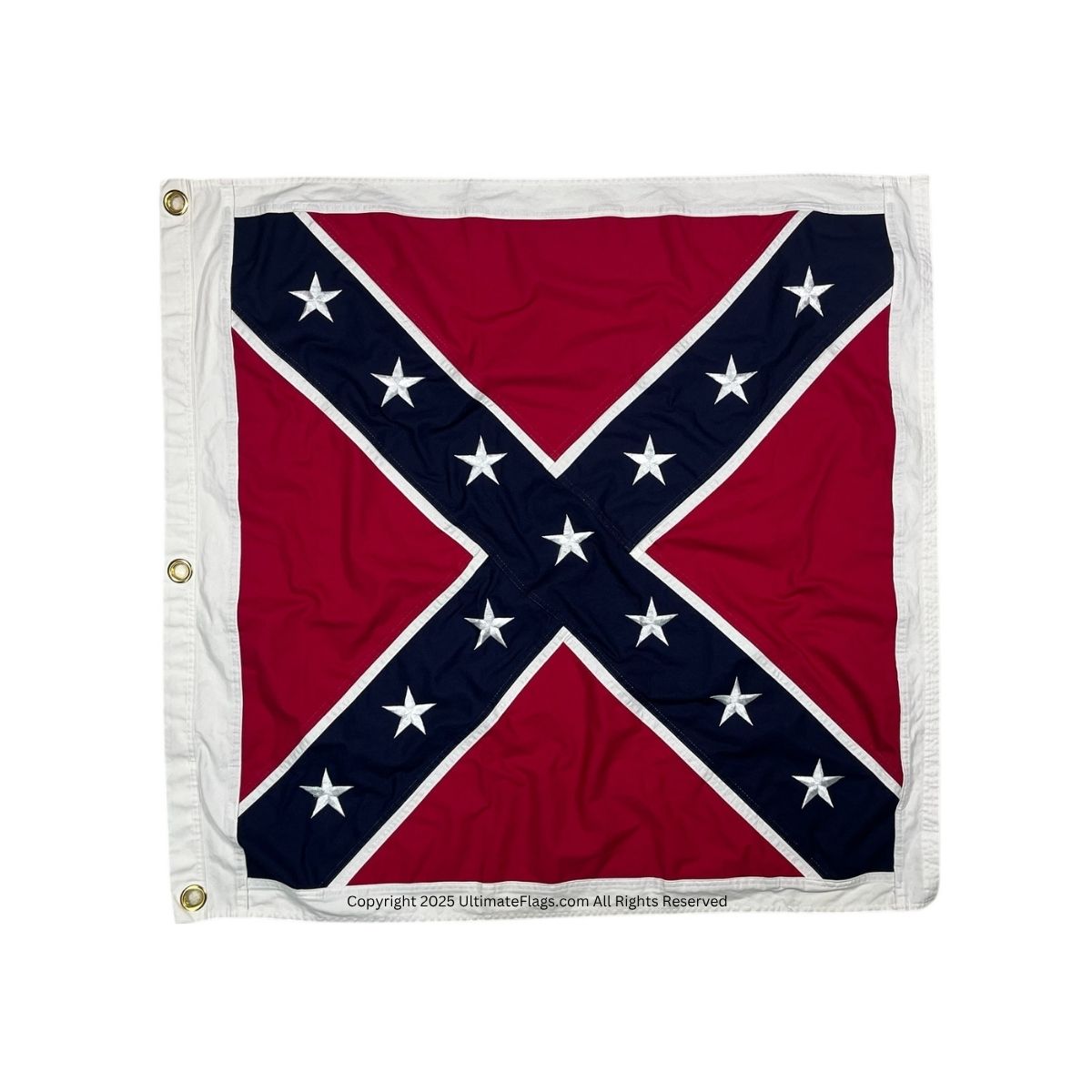
Square 38-inch artillery battle flag reproduction with embroidered stars and a white borderShop Now
A square 38-inch artillery battle flag with its white border. Shape and size identify branch and army before you read a single letter.

How to transcribe and verify an inscription in five steps

  1. Photograph in angled light. Raking light across the fabric brings out painted lettering that is invisible head-on, and the photos become your working copy.
  2. Transcribe exactly. Copy every character, abbreviation and misspelling. Never clean up the wording before you search — the records match the original forms.
  3. Date the pattern first. Star count, flag shape and construction narrow the years before any record search, and they tell you which records to search.
  4. Search the records. The Official Records of the War of the Rebellion, state adjutant-general reports, regimental histories and newspaper archives for presentation ceremonies each confirm a different inscription type.
  5. Compare with surviving originals. The Smithsonian's collection and state battle-flag museums publish photographs you can match lettering styles and honors against.

When the inscription runs out — a flag with only partial lettering, or honors that stop mid-list — the five-clue method for matching a Civil War flag to its unit and battle picks up where the text leaves off, adding pattern, star count and construction to the search.

Choosing a reproduction with inscriptions that hold up

A reproduction with lettering has one more accuracy test than a plain flag: the wording has to match a documented original. Before buying, check that the unit designation, honor list or presentation text on the flag traces to a real record, not to a generic design. Sewn cotton with embroidered stars reads closest to the period look, and the lettering should be stitched or painted cleanly enough to transcribe at arm's length. When you are ready to Shop Ultimate Flags, compare the lettered designs against the records the same way you would check an original — that check takes minutes, and it is the difference between a flag with a story and a flag with decoration.

What an inscription can and cannot tell you

  • It can name the unit, but not always the whole service. An honor list records battles fought under that flag; battles fought under an earlier or later flag stay off it.
  • It can date a presentation, not a battle. A presentation inscription fixes the flag's start date; the honors sequence is what tracks the service afterward.
  • It does not prove authenticity by itself. Lettering can be added later, and wartime inscriptions have been copied onto reproductions — construction and markings carry the authenticity case.
  • It can be incomplete. Painted text fades, embroidery wears, and some regiments simply never marked their flags.

Related questions about Civil War flag inscriptions

Why do some Civil War flags have no inscriptions at all?

Plain issue flags were common. National colors often carried no marking beyond the stars, depots issued battle flags unmarked until the army added designations, and painted lettering on hard-used flags wore away long before the fabric did. An unmarked flag is normal, not suspicious.

What do the place names embroidered on a battle flag mean?

They are battle honors — the record of the engagements where the regiment fought while carrying that flag, added one battle at a time. A run of names such as Sharpsburg and Fredericksburg maps the unit's service and often identifies it outright.

Are inscriptions on reproductions historically accurate?

On well-made reproductions, yes — the lettering copies a documented original, inscription for inscription. On poor ones, wording is invented or misplaced. Check the flag's text against regimental records before buying, and treat any design no record supports as decoration, not history.

FAQ

How do you read inscriptions on Civil War flags?

Sort the text into its type — unit designation, battle honor, presentation inscription or issue marking — transcribe it exactly, then verify it against regimental records such as the Official Reports and state adjutant reports. The inscription type tells you which record confirms it.

What were Civil War flags usually inscribed with?

Regimental designations such as a unit number and state, battle honors listing the battles fought under the flag, presentation inscriptions naming the donors and date, and depot or maker markings. Larger flags carried several of these at once.

What do battle honors on a Civil War flag mean?

They are place names such as Sharpsburg or Gettysburg embroidered or painted on the flag to record the battles fought while carrying it. The full honor list belongs to one unit and often identifies the regiment on its own.

How do you date a Civil War flag with no writing on it?

Read the pattern instead: seven stars date an early 1861 first national, thirteen stars the later war, 34 to 36 stars bracket Union flags from 1861 to 1865, and a square battle flag with a white border points to the Army of Northern Virginia from late 1861.

Were Civil War flags inscribed by the government?

Not always. Regiments, army depots and private donors all added lettering, and presentation flags from ladies’ societies carried the most elaborate inscriptions of all. Depot markings identify the government-issued pieces.

How do you verify an inscription on a flag you want to buy?

Transcribe the wording exactly, date the flag’s pattern and star count, then search regimental records and newspaper archives for a match. A buyer can check most unit designations and presentation texts online in under an hour.

One last thing

Honors were added battle by battle, often by different hands years apart — so an 1862-issued flag carrying an honor earned in 1864 is not a fake; it is a flag that stayed in service. That single fact trips up more new collectors than any other, and it is why the records, not the lettering alone, always get the final word on a Civil War flag.

Posted on

How do you display Civil War flags with historical context?

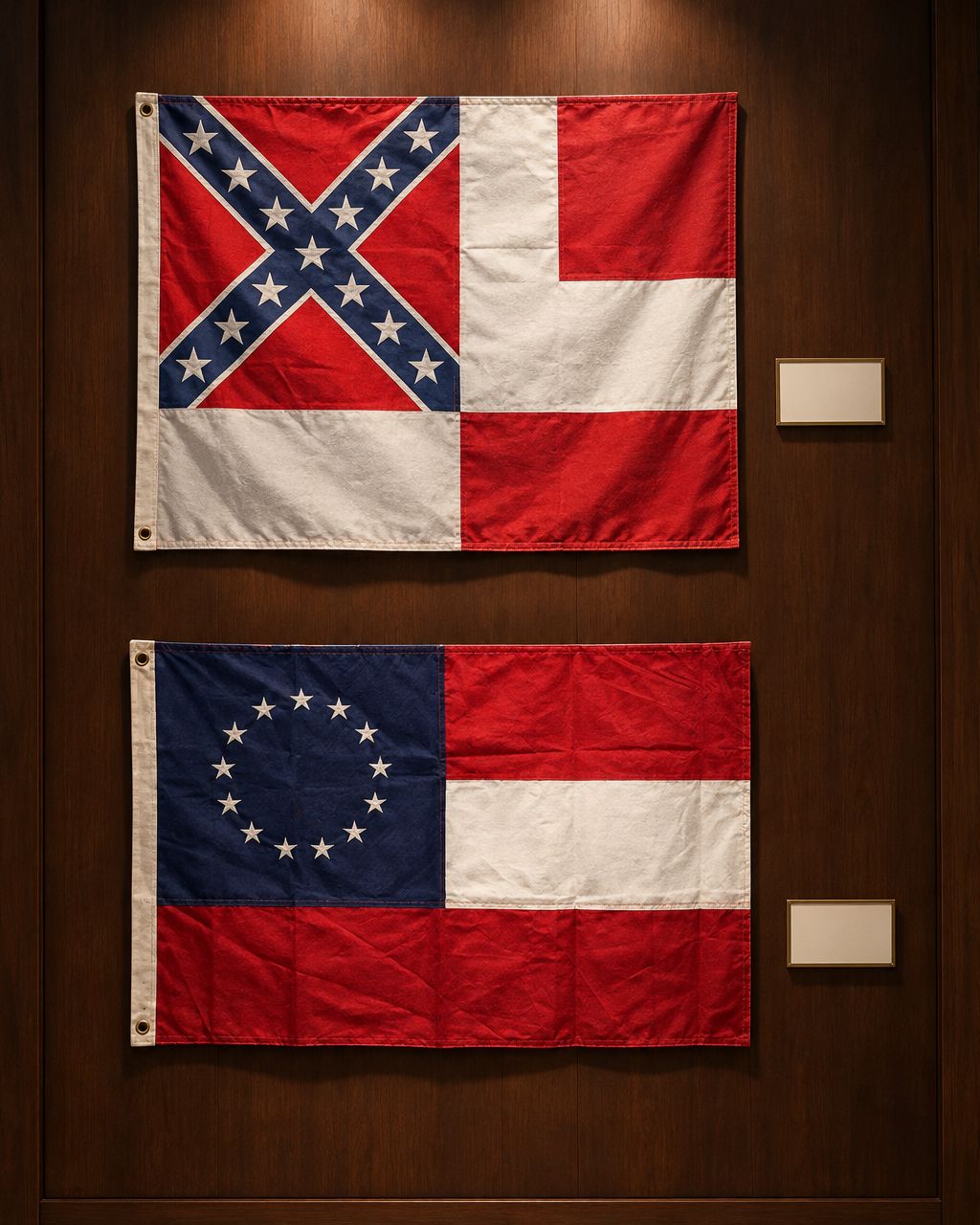
Two Civil War era reproduction flags with label cards mounted on a wooden museum display wall

When you display Civil War flags with historical context, you do three things: date the design to its correct window, name the army or unit that carried it, and mount and label it so a visitor can read that story at a glance. A Civil War flag is a dated document made of cloth — the pattern tells you the year, and the year tells you the story — so the display work is mostly research, not decoration. Done right, a 3×5 reproduction on a wall reads like a museum caption; done wrong, the same flag is just colored fabric.

TL;DR
  • Date the design first: three Confederate national flags and several battle flag patterns each belong to specific years.
  • Label every displayed flag with design, army, period and reproduction status.
  • Hang heavy cotton flat and indoors; 3×5 nylon flags handle poles and outdoor duty.
  • Add period pieces — maps, documents, photos — so the flag sits in a story, not a void.

Ultimate Flags flag sale banner

How do you display Civil War flags with historical context?

Work the four steps in order — date, name, mount, surround. Each display setting asks a slightly different question of the same flag, and the table below shows how the answer changes.

Display setting What context has to answer Common setup
Home wall or office Which design, which years, why you chose it Flat-mounted flag, small printed label, indirect light
Museum-style exhibit or heritage room Unit attribution and the design's documented history Framed or stretched mount, typed caption card, controlled lighting
Reenactment camp What the unit actually carried in the field Pole or lance flag sized to the impression, camp-appropriate cotton
Classroom A dated, neutral teaching aid Small flat display, a caption tying the flag to specific events

Read the table left to right and the pattern is clear: the flag rarely changes, the context does. A 3×5 nylon reproduction that flies on a porch in June hangs flat behind glass in a classroom with a different caption underneath, and both are correct.

Step 1: Date the design before anything touches a wall

Every Civil War era design belongs to a window, and the window is the first line of the caption. The Stars and Bars, adopted in March 1861 with seven stars and later thirteen, served as the first Confederate national flag until May 1863. The Stainless Banner replaced it from May 1863, and the Third National — the Blood-Stained Banner, with the battle flag in the canton and a red bar ending the white field — was adopted on March 4, 1865, in the war's final weeks. Battle flags ran on their own track: the Army of Northern Virginia issued its nearly square flag with a white border from late 1861, while rectangular versions of the Southern Cross served with the Army of Tennessee, the Trans-Mississippi departments and the navy.

Union flags date by star count. A 34-star United States flag covers 1861 to 1863, after Kansas statehood; 35 stars run from 1863, when West Virginia joined; 36 stars arrive in 1864 with Nevada. Getting the star count wrong is the fastest way to hang a 1864 flag next to a 1861 uniform and call it a matched set.


13-star Stars and Bars nylon embroidered reproduction flag with embroidered stars and sewn stripesBuy This Flag- Click Here
First National “Stars and Bars” reproduction, 13-star version — the pattern displayed for 1861-1863, before the Stainless Banner replaced it in May 1863.

Step 2: Name the army, the unit or the era on a label

A caption card does more context work than any frame. Four lines are enough: the design's name, the army or unit type that carried it, the years it was official, and one plain sentence noting it is a modern reproduction. "First National 'Stars and Bars,' 13-star version, 1861-1863. Modern sewn-nylon reproduction" reads clean and honest on a 4×6 card, and it answers every question a guest is going to ask before they ask it.

Attribution is where care pays. A square battle flag with a white border points to the Army of Northern Virginia; a rectangle points to the western armies or the navy; a first national with seven stars dates to early 1861 and thirteen stars to the later war. If you cannot attribute a specific regiment, attribute the army and the years — that is still context, and it is still true. Museum practice runs the same way: battlefield parks caption by pattern and period, not by guesswork.

Step 3: Mount by fabric and weight

Cotton reproductions — especially the 52-inch square battle flags — are heavy, and they belong flat: stretched on a frame, hung from a sleeve on an indoor pole, or mounted with the hoist hidden behind the display. Nylon printed and embroidered flags in 3×5 feet are light enough for standard grommet hanging and are the practical choice anywhere the flag might see a pole.

Light is the other mounting decision. Direct sunlight fades cotton dyes within a season and bleaches nylon over a couple of years, so keep fabric out of south-facing windows and light displays with low-heat LED fixtures instead. If the display lives near a doorway or a porch, expect damp, and dry cotton completely before it goes back on the wall — mildew starts in folded, damp cloth faster than most owners expect.

Step 4: Surround the flag with period pieces

Context multiplies when the flag shares the wall with its era. A square battle flag beside a framed 1862 map of Virginia, a 35-star United States flag above a case of period documents, a Stars and Bars over a shelf of regimental histories — each pairing answers the visitor's next question before it is asked. Photographs, currency, sheet music and campaign ribbons all work; the rule is that every piece carries a date and a connection to the flag's story.

Collectors who photograph a finished wall and share the pairing online usually get more questions than the display itself, and social media management tools compared on image scheduling help keep those posts consistent.

When you are ready to Shop Ultimate Flags, pick the design first and let the caption and the neighboring pieces carry the history. Ultimate Flags lists each Civil War flag's pattern, construction and size on the product page, so half the research on your caption card is already done before the flag ships.


Third National Confederate flag reproduction flying outdoors on a pole against a blue skyFlag Sale – Shop Now!
A Third National — the Blood-Stained Banner — flying outdoors. Adopted March 4, 1865, it was the Confederacy’s last national flag.

Where display practice comes from

The museum-style caption is not an invention of flag sellers. Many battle flags were captured in the field and held by the federal government for decades; Congress authorized their return in 1905, and the transfers carried on for years, with heritage groups founded in the 1890s driving much of the preservation work. Surviving originals cluster in state museums today, and those museums set the display standard: dated designs, plain captions, controlled light and no editorializing. A home display that follows the same four rules is borrowing practice that is more than a century old.

That standard matters because Civil War flags carry weight for a lot of visitors. Treat the flag as dated historical material — which is exactly what it is — and the display works for the collector, the reenactor and the schoolteacher alike. Advocacy belongs on no caption card.

Why context varies from one display to the next

  • Audience. A heritage room full of collectors wants attribution and period detail; a classroom wants dates and a plain, factual story.
  • Flag generation. A first national, a battle flag and a Third National each pull a different year range onto the caption, and the surrounding pieces should match that range.
  • Space and light. A 52-inch square cotton flag needs more wall and less sun than a 3×5 nylon; the room decides the mount.
  • Flying or flat. A flag on a pole at a reenactment carries context through the impression around it; a flat wall display carries it through the caption and the neighboring pieces.
  • Framing and tone. Museums caption factually and let the dates do the talking — the same treatment keeps a home or school display historical rather than political.

Related questions about displaying Civil War flags

Can I fly a Civil War flag outside my home?

Yes. These flags are legal to display in the United States and fly regularly at museums, battlefield parks, reenactments and commemorations as historical material. For outdoor duty, nylon handles rain and dries fast; save cotton for dry days and indoor walls.

What size Civil War flag works best indoors?

A 3×5 feet reproduction suits most walls and standard hangers, and a 52-inch square cotton battle flag gives the Army of Northern Virginia look in a camp or heritage room. Original regimental colors ran larger still — near six feet — because they had to be seen across a battlefield.

How do I keep a cotton reproduction from fading?

Keep it out of direct sunlight, light it with low-heat LED, and rotate which flag is on display every few months. Dry the fabric completely before storage, and fold it loosely or roll it rather than creasing the same lines year after year.

FAQ

How do you display a Civil War flag with historical context?

Date the design, name the army or unit on a label card, mount by fabric weight and add period pieces around it. A 3×5 reproduction with a four-line caption reads as history rather than decoration.

What are the three Confederate national flags and their dates?

The Stars and Bars served from March 1861 to May 1863, the Stainless Banner from May 1863 to March 1865, and the Third National from March 4, 1865 to the war’s end. Each belongs to its own caption window.

Is it legal to display Confederate Civil War flags?

Yes. They are legal to display in the United States and appear in museums, battlefield parks, reenactments and historical collections as historical material.

What size Civil War flag is best for an indoor display?

A 3×5 feet reproduction suits most walls, and a 52-inch square cotton battle flag gives the Army of Northern Virginia look. Original regimental colors ran near six feet.

What should a label next to a Civil War flag say?

The design’s name, the army or unit type that carried it, the years it was official, and a note that it is a modern reproduction.

How do you light a Civil War flag display?

Use low-heat LED fixtures aimed at an angle, keep the flag out of direct window sun, and check the fabric a couple of times a year for fading or damp.

Can Civil War flags be used in a classroom?

Yes, as dated historical material. Pair the flag with a caption tying it to specific events and treat the topic factually, the way battlefield parks do.

One last thing

The Third National was official for roughly five weeks — adopted March 4, 1865, it was still the national flag when the armies surrendered that April — which makes it the shortest-lived national design of the war. Date the flags on your wall and stories like that fall out for free; the caption card, not the frame, is what turns a reproduction into history.

Posted on

Which Revolutionary War flags belong in a reenactment display?

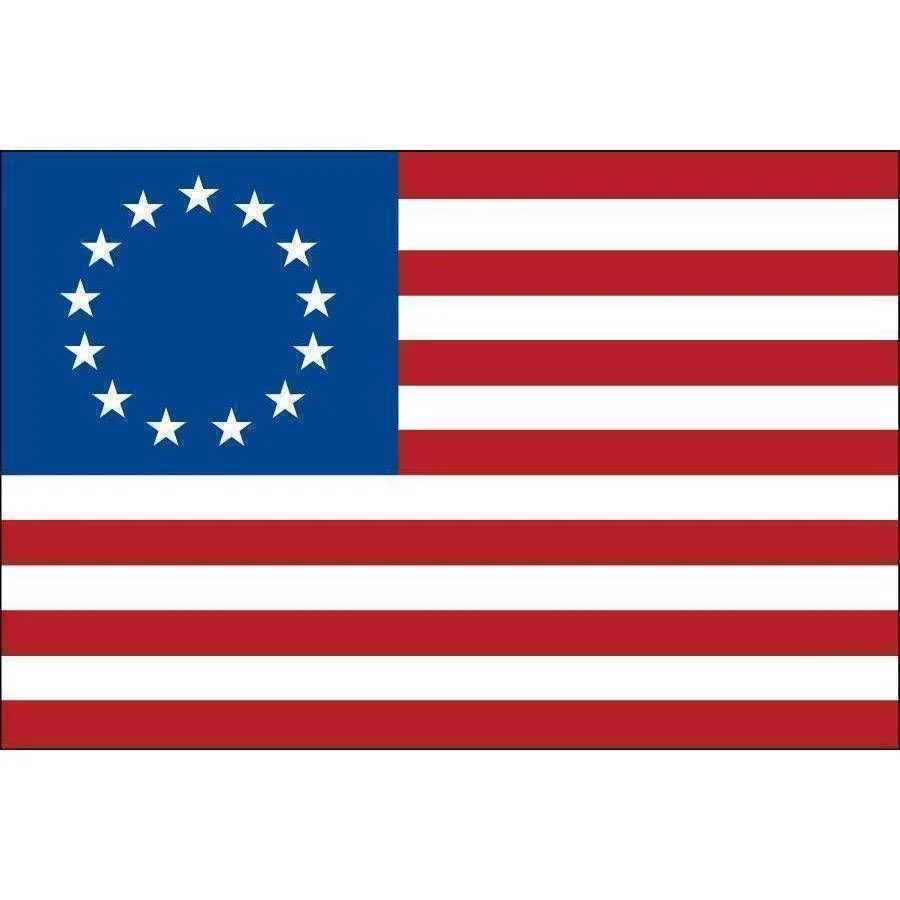
Betsy Ross 13-star nylon American flag with embroidered stars and sewn stripes

A Revolutionary War reenactment display works best with three to six period flags chosen for the units on the field: the Grand Union colors of the Continental forces from 1775-1776, the Gadsden and Culpeper rattlesnake flags of the early militia, and the 13-star Betsy Ross pattern adopted on June 14, 1777. Match each design to the unit it belongs with, size it to the pole or camp it flies over, and keep every flag documented so the display holds up to a knowing eye. The six flags below are the ones reenactment groups and living-history displays reach for first.

Quick answer
  • Grand Union, Gadsden, Culpeper, Betsy Ross, Bennington and Serapis are the six core Revolutionary War display flags.
  • Match each design to its unit and year: Continental colors from 1775-1776, militia flags from 1775, Congress’s standard from 1777.
  • The 13-star, 13-stripe design became the national flag on June 14, 1777.
  • Cotton reads period-correct in camp; nylon flies lighter and dries faster outdoors.
  • July 4, 2026 marks America’s 250th anniversary, a natural year to add a display flag.

Ultimate Flags flag sale banner

Why the flags matter in a reenactment display

Flags are the fastest thing a visitor reads at a reenactment. Before anyone studies a coat or a musket, they see what is flying over camp, and every design on the field carries a date. A 1775 militia impression flying a flag Congress adopted in 1777 quietly contradicts itself; the right flag makes the whole camp read true. That is also why serious living-history groups document their colors — every design below traces to dated, published records you can check before you buy.

Which Revolutionary War flags belong in a reenactment display?

Flag First flown What it looks like Best display use
Grand Union December 1775 13 red and white stripes with a British Union Jack canton Continental camps, 1775-1776 impressions
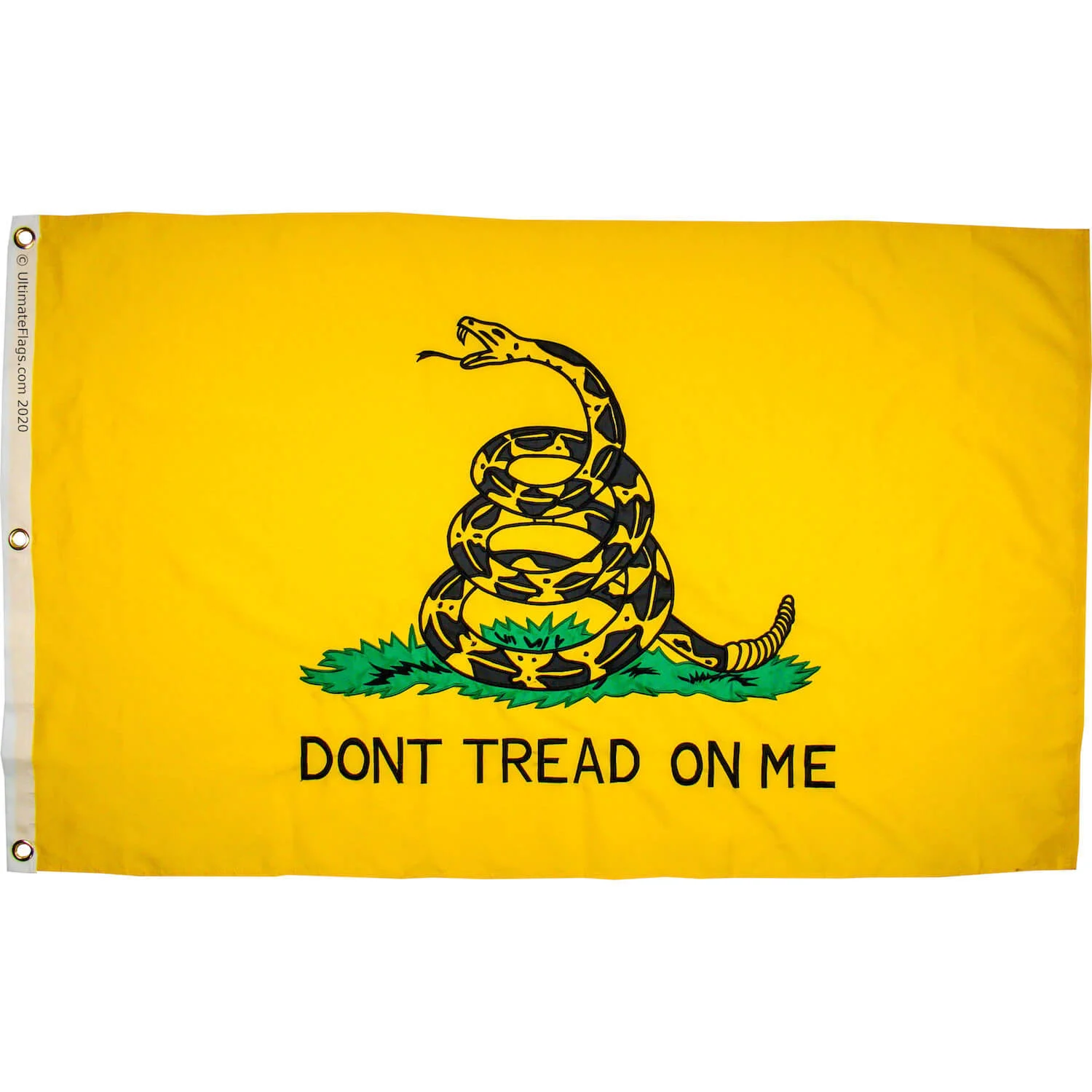
Gadsden Late 1775 Yellow field, coiled rattlesnake, DONT TREAD ON ME Naval themes and gateway display
Culpeper 1775 White field, coiled rattlesnake, LIBERTY OR DEATH Virginia militia and minutemen impressions
Betsy Ross 13-star June 14, 1777 13 stars in a circle on 13 stripes Continental line camps and the patriotic centerpiece
Bennington 1777 Stars arched over a large 76 on 13 stripes New England militia displays
Serapis 1779 Blue, white and red stripes with multi-pointed stars Naval and John Paul Jones displays

Read the table as a timeline and the answer builds itself: the rattlesnake flags and the Grand Union belong to the war's opening years, the 13-star flag to 1777 and after, and the Serapis flag to the navy's most famous fight of 1779.

The six display flags, one by one

Grand Union: the Continental forces' first colors

The Grand Union was the first flag raised over the Continental forces, hoisted in December 1775. Its 13 red and white stripes announced the united colonies, while the Union Jack in the canton still acknowledged the Crown — which is exactly what dates it to before independence. For a 1775-1776 Continental camp, the Grand Union is the period-correct choice, and it makes a striking contrast flying beside the later 13-star design.

Gadsden and Culpeper: the rattlesnake flags of 1775

The rattlesnake became the colonies' defiant emblem in 1775, and two militia designs carry it best. The Gadsden flag — a coiled timber rattlesnake on yellow with the words DONT TREAD ON ME — is the cleanest, most recognizable single flag of the war. The Culpeper flag of the Virginia minutemen adds LIBERTY OR DEATH, the phrase made famous by Patrick Henry in 1775, above its own coiled snake. Either one anchors a militia impression; together they bracket the war's first year.

Betsy Ross 13-star: the flag of 1777

On June 14, 1777, the Continental Congress resolved that the flag of the United States be 13 stripes and 13 stars. The circle-of-13-stars design associated with Betsy Ross is the most familiar version of that standard, and it is the centerpiece flag for any camp from 1777 to the war's end in 1783. If a display flies only one flag, this is the one.


Betsy Ross 13-star nylon American flag with embroidered stars and sewn stripes, shown flatBuy This Flag- Click Here
The 13-star Betsy Ross pattern in sewn nylon — the camp standard for displays from 1777 to 1783.

Bennington: the 76 flag of New England

The Bennington design places arched stars over a large 76 for 1776, set on 13 stripes. Tradition ties it to the militia that fought at Bennington in August 1777, and the bold 76 makes it read at a distance no other period flag matches. It suits New England militia impressions and any display that wants a distinctly Independence-era banner.

Serapis: the naval flag of 1779

The Serapis flag takes its name from the British warship John Paul Jones captured in September 1779, when his own colors had gone overboard and a hastily made American ensign flew over the prize. Its blue, white and red stripes and multi-pointed stars make it one of the most striking early American designs. Naval impressions and maritime displays reach for it first.

Matching the flag to your impression

  • Continental line, 1777 onward: Betsy Ross 13-star as the camp standard.
  • Early-war militia, 1775-1776: Culpeper for Virginia units, Gadsden for a broad militia or naval theme, Grand Union for Continental camps.
  • Naval or maritime display: Serapis flag, with a Gadsden alongside.
  • Anniversary or heritage display: the Betsy Ross or Bennington design as the centerpiece, ringed by the earlier flags.

Sizing and construction for field use

A 3×5 ft flag is the practical standard for reenactment poles, porch displays and most camp setups; larger sizes suit taller poles and gateway positions. Construction matters as much as size. Cotton has the period look and handles camp display beautifully, while nylon flies lighter in a breeze and dries faster after rain — the better all-day outdoor choice. Check the attachment too: pole sleeves suit indoor and camp poles, and grommets suit rope halyards on taller poles.

When you are ready to Shop Ultimate Flags, compare the sewn and printed versions of the same design side by side — the stitching is the difference you can see at arm's length. Ultimate Flags carries hard-to-find historic designs, from the Grand Union to the Serapis pattern, alongside the familiar standards.

Common display mistakes to avoid

  • Flying a 1777 flag at a 1775 impression. The rattlesnake flags and Grand Union predate the national standard; keep the timeline honest.
  • One undersized flag on a tall pole. A 3×5 ft flag disappears on a 25-foot pole — step the size up with the pole height.
  • No documentation on display. A small caption card naming the design and its year turns a decoration into an exhibit.
  • Printed flags where the crowd stands close. Sewn and embroidered flags reward close inspection; print works better at distance.

America 250 commemorative flag with the 250th anniversary emblem on a navy field, shown flatShop Now
The America 250 commemorative flag marks 250 years of American independence in 2026.

The 250th anniversary makes 2026 the year to add one

July 4, 2026 marks 250 years since the Declaration of Independence, and commemorative displays are already built around that date. A Revolutionary War flag display gains a natural centerpiece this year: fly the 13-star design as the flag of 1777-1783, or add a commemorative anniversary banner beside the period colors. Either way, the designs above are the same ones museums and living-history groups are putting up for the anniversary.

Related questions about Revolutionary War display flags

How many flags should a reenactment camp display?

Three to six works best for most camps: one camp standard, one or two unit flags, and a national color. More than that and the timeline gets hard for visitors to follow.

What size flag works for a camp or tent display?

A 3×5 ft flag fits most reenactment poles and camp entrances. Save larger sizes for tall poles and gateway displays where the flag will not crowd the camp.

Were these flags the official flags of the Continental Army?

No. Congress set the national design on June 14, 1777, but armies and militia units carried many local and personal standards throughout the war. That variety is why matching each flag to its unit and year matters so much in a display.

FAQ

Which Revolutionary War flags belong in a reenactment display?

The core six are the Grand Union from December 1775, the Gadsden and Culpeper rattlesnake flags of 1775, the Betsy Ross 13-star design adopted June 14, 1777, the Bennington 76 flag of 1777, and the Serapis naval flag of 1779.

What is the Grand Union flag?

The Grand Union was the first flag of the Continental forces, raised in December 1775. It shows 13 red and white stripes with a British Union Jack in the canton, which dates it to before independence.

When did the 13-star flag become the national flag?

The Continental Congress resolved on June 14, 1777 that the United States flag would carry 13 stripes and 13 stars. The circle-of-stars design associated with Betsy Ross is the best-known version.

What flag should a 1775 militia impression fly?

The Culpeper flag with LIBERTY OR DEATH for Virginia minutemen, or the Gadsden rattlesnake flag for a broader militia or naval theme. Both designs date to 1775.

What size flag is right for a reenactment pole?

A 3×5 ft flag is the standard for most reenactment poles and camp displays, with larger sizes reserved for tall poles and gateway positions.

Is cotton or nylon better for a reenactment flag?

Cotton has the period-correct look for camp display, while nylon flies lighter, holds up outdoors and dries faster after rain. Choose cotton for authenticity in camp and nylon for all-day flying.

One last thing

The Grand Union still carries the Union Jack in its canton — which is exactly what makes it unmistakably a flag of 1775-1776, flown before independence settled the design. Fly it beside the Betsy Ross pattern and your camp tells the whole story of 1775 to 1783 without a single sign.

Related guides
Posted on

Which American flag attachment fits your pole?

48 star cotton American flag with embroidered stars and sewn stripes

Brass grommets on a reinforced heading fit most outdoor American flags and nearly every standard flagpole. A pole sleeve suits indoor flags and house-mounted poles. Sewn tabs work on fixed wall brackets. If you are shopping American flags for sale, heading-and-grommet is the attachment to default to for a yard pole, and a 3×5 ft grommet flag is the proven match for a 20-foot pole. This guide covers each attachment, the pole heights it suits, and the checks that keep a flag flying straight instead of wrapping or tearing loose.

TL;DR
  • Heading and brass grommets fit most American flags for sale and nearly every outdoor pole.
  • Pole sleeves suit indoor flags and house mounts, where a clean look matters more than quick swaps.
  • Size the flag at about one-quarter of pole height: a 3×5 ft flag for a 20-foot pole.
  • A flag left up overnight must be properly illuminated, per the U.S. Flag Code.

Ultimate Flags flag sale banner

Which American flag attachment fits your pole?

The answer comes down to how your pole holds a flag. Rope-and-cleat poles and most residential yard poles take heading and grommets. Indoor flagpoles, parade poles and many house mounts take a pole sleeve. Stationary wall brackets usually take heading and tabs. Here is the quick comparison, then each attachment in detail.

Attachment How it connects Best for Watch for
Heading and grommets Brass grommets on the hoist edge, clipped or roped to the pole Outdoor yard poles, rope-and-cleat systems, nearly every standard pole Weak heading stitching is the first thing wind tears out
Pole sleeve (pole hem) Sewn tube the pole slides through Indoor flags, parade poles, house-mount poles Slower to change; can bunch in strong wind
Heading and tabs Small sewn loops that hold the flag on a stationary bracket Fixed porch and wall bracket mounts Only fits poles designed for tabs

The other half of the fit is size. The common industry rule sizes the flag at roughly one-quarter to one-third of the pole's height, so a 20-foot pole wants a 3×5 ft flag, and a 5- or 6-foot house-mount pole wants a 2.5×4 ft or 3×5 ft flag. Flag sizing charts published across the flag industry, including retailer guides like Flag and Banner and Eder Flag, converge on that ratio, and a 3×5 ft flag on a 20-foot pole is the pairing they name most often.

Grommets: the standard for outdoor American flags

A grommet flag has a sewn fabric heading across the hoist edge with two brass grommets set into it, one near the top and one near the bottom. You clip those grommets to the pole's snaps or run the halyard rope through them. It is the attachment used on the overwhelming majority of outdoor American flags because it handles three things at once: wind load, quick flag changes, and compatibility with almost every pole sold.

When you compare grommet flags, check the heading before the stars:

  • Stitching. The heading should be sewn with multiple rows of stitching. A single row is where wind finds its first tear.
  • Grommet material. Brass resists rust; thin plated steel does not. Rust stains the white stripes and seizes the clips.
  • Fabric weight. Nylon flies in light wind and dries fast; heavier 2-ply polyester suits steady, stronger wind.
  • Reinforced fly end. The far end takes the most wear. A four-row fly hem adds seasons, not just looks.

One etiquette note that surprises new buyers: the U.S. Flag Code (4 U.S.C. § 6(a), published by Cornell's Legal Information Institute) treats sunrise-to-sunset as the customary display window, and allows around-the-clock display only when the flag is properly illuminated during the hours of darkness. If you plan to leave your flag up overnight, plan the light along with the pole.

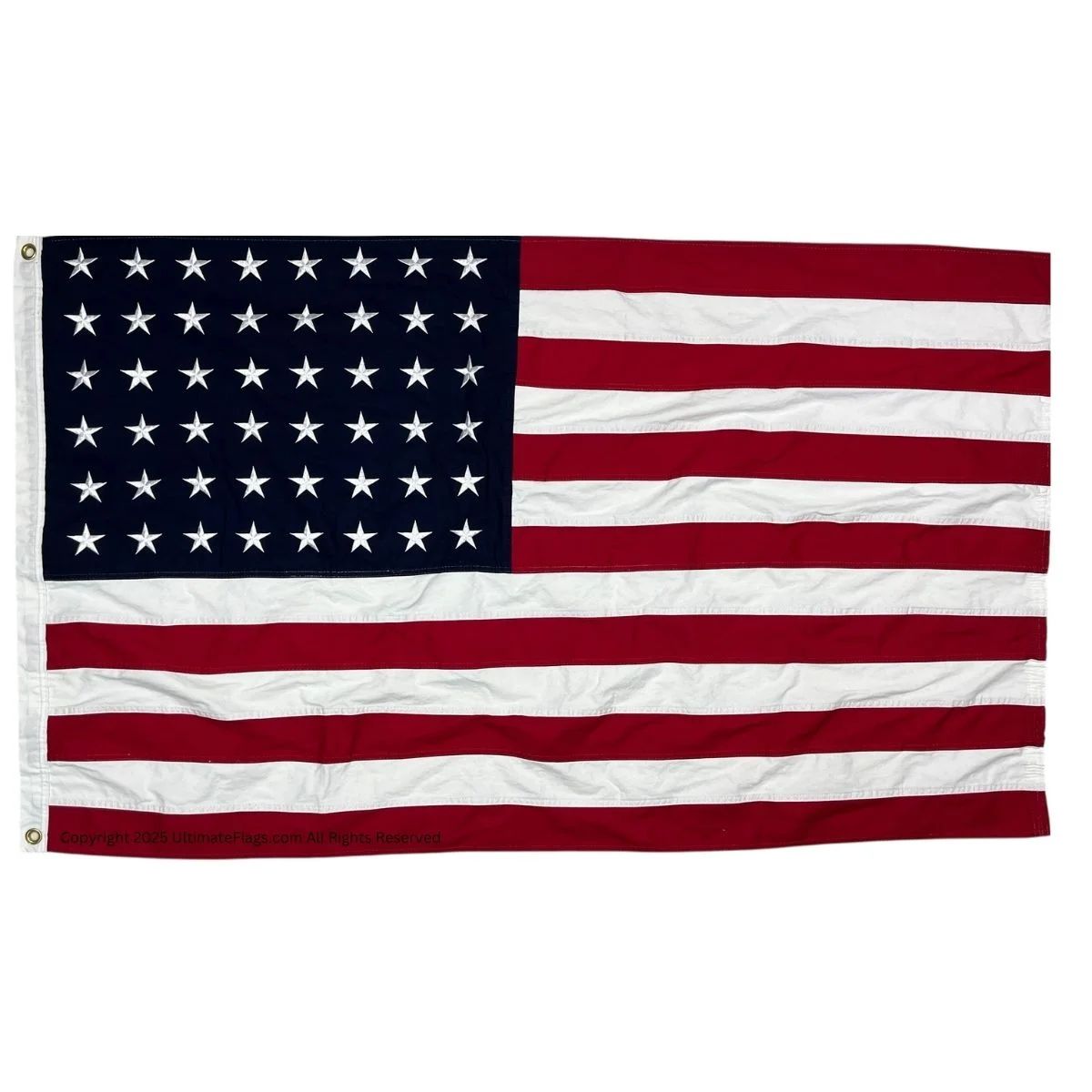
48 star cotton American flag with embroidered stars and sewn stripesShop Now

Historic 48-star cotton flag with embroidered stars and sewn stripes, sized 3×5, 4×6 and 5×8 ft.

Pole sleeve: the clean fit for indoor and house-mount poles

A pole sleeve — flagmakers also call it a pole hem — is a sewn tube running down the hoist edge. The pole slides through it, and a tab or stitch at the bottom keeps the flag from spinning off. There are no clips to rattle against the pole and no visible hardware, which is why sleeve flags dominate indoor displays, parade sets and porch-mounted poles where looks matter.

The trade-off is speed and wind. Changing a sleeve flag means sliding the whole flag off and on, so a sleeve suits a flag you fly for weeks at a time. In sustained strong wind, the fabric bunches against the pole instead of spilling around clips, which concentrates stress. That is why sleeve flags are standard for ceremonies and home decor, while grommet flags stay standard for tall outdoor poles.

A sleeve still needs the same construction checks as a grommet flag: a fully sewn tube with reinforced ends, and material matched to where the pole lives. Cotton flags drape beautifully indoors but are not built for weather — a point the Old and historic USA flags category makes plain, since its product pages mark cotton designs for indoor and ceremonial use and point long-term outdoor flying to nylon.

Old USA flags: 48 star historical American flag reproductionFlag Sale – Shop Now!

Historic USA designs, from 48-star reproductions to earlier eras, in grommet and display formats.

Match the attachment to pole height and mounting

Work through three questions in order — mounting first, then height, then material.

1. What holds the pole? A ground-set yard pole with a rope and cleat or snap hooks takes grommet flags. A wall or porch bracket that the pole sits in takes either type, depending on the bracket's clips. An indoor pole with a finial takes a sleeve. If your pole shipped with hardware, match the flag to that hardware rather than replacing it.

2. How tall is the pole? Apply the one-quarter rule. Industry sizing charts put a 3×5 ft flag on a 20-foot pole, a 2.5×4 ft or 3×5 ft flag on 5- to 6-foot house-mount poles, and proportionally larger flags on taller poles. The 48-star cotton flag shown above, for example, comes in 3×5, 4×6 and 5×8 ft sizes — the same flag serves a 20-foot pole at 3×5 and a taller pole at 5×8.

3. Where does it fly? Wind and sun decide the fabric. Nylon suits light-to-moderate wind and dries quickly after rain. Heavier 2-ply polyester suits steady wind along open ground and water. Cotton is an indoor and ceremonial fabric. If your flag has already been through weather, the care routine matters as much as the purchase — see how do you care for outdoor American flags after rain for the dry-down and fly-end checks that extend flag life.

Quick checklist before you buy

  • Attachment first. Grommets for outdoor poles, sleeves for indoor and house mounts, tabs only for bracket systems built for them.
  • Heading stitching. Multiple sewn rows across the heading, not one.
  • Brass grommets. On any flag meant to live outside.
  • Size ratio. Flag length about one-quarter of pole height; 3×5 ft for a 20-foot pole.
  • Fabric to conditions. Nylon for general outdoor use, 2-ply polyester for strong steady wind, cotton indoors.
  • Night lighting. Add illumination if the flag stays up after sunset, per the Flag Code.

Every Ultimate Flags listing names its attachment in the product description — heading and grommets, pole sleeve, or tab construction — so match that line to your pole before you order. If a listing does not say, ask before buying rather than guessing at hardware that will not connect.

FAQ

What attachment do most American flags come with?

Most outdoor American flags come with a sewn heading and two brass grommets. That combination clips onto nearly every standard yard pole, which is why it is the default when you shop American flags for sale.

What size flag fits a 20-foot pole?

A 3×5 ft flag fits a 20-foot pole under the one-quarter rule, which sizes the flag at roughly one-quarter to one-third of pole height. Sizing charts allow up to a 4×6 ft flag on that pole for more visibility.

Can I put a grommet flag on a pole sleeve pole?

Usually yes, using pole-adapting clips that grip the grommets and ride inside the sleeve channel. The fit is less clean than a true sleeve flag, so it suits temporary use better than display.

What is a pole sleeve on a flag?

A pole sleeve, also called a pole hem, is a sewn tube along the flag’s hoist edge that the pole slides through. It holds the flag without clips and is standard on indoor, parade and house-mount flags.

Can I fly the American flag at night?

Yes, if it is properly illuminated during the hours of darkness, per the U.S. Flag Code (4 U.S.C. § 6(a)). Without a light, the customary window is sunrise to sunset.

Does the attachment affect how long a flag lasts?

Yes. Stress concentrates wherever the flag attaches, so weak heading stitching and rusted grommets fail first. Multi-row heading stitching and brass grommets add the most life for a flag flown outdoors daily.

One last thing

The attachment rarely fails — the heading does. Even a correctly matched flag tears out at the heading stitching first, because that strip carries the flag's entire weight in wind. Before each season, run a thumb along the heading and the fly end; loose threads there mean the flag needs reinforcement or retirement long before the stars show wear. And if you are buying a cotton historic design like the 48-star flag above, display it indoors: the cotton that makes it beautiful on a ceremony pole is exactly what keeps it off a weather pole.

Related guides

Posted on

How do you care for outdoor American flags after rain?

American flag with rain droplets drying on a white pole after a storm, sky clearing behind it

Bring a rain-soaked American flag down, let it dry completely, and wash off the grime the rain left behind — that three-part routine is the whole answer to caring for outdoor American flags after rain. The step you cannot skip is the drying: a flag folded or bunched up while damp grows mildew, and mildew eats fabric. The U.S. Flag Code, 4 U.S.C. § 6(c), allows a flag to stay out in bad weather only when it is an all-weather flag, and even a storm-rated flag deserves a fly-end check once the clouds clear.

Quick answer
  • Take the flag down, shake off the water and let it dry fully before storing.
  • Wash gently by hand in mild soap and lukewarm water; skip bleach.
  • Drape the flag wide to dry — never leave it bunched against the pole.
  • Check for a musty smell or specks after every multi-day wet stretch.
  • In rainy regions, embroidered nylon dries fastest; 2-ply polyester handles wind and sun best.

Ultimate Flags flag sale banner

How do you care for outdoor American flags after rain?

Work in this order — down, dry, clean, inspect, rehang. Most rain damage is really storage damage: the rain softened the cloth, and somebody folded it damp into a drawer or left it wadded on the pole. Five steps keep that from happening.

  1. Bring the flag down. Give it a gentle shake to throw off standing water and any twigs or leaves the storm delivered.
  2. Let it dry completely. Drape it over a clean railing or clothesline, or lay it flat, so air moves through the whole cloth. Spread out, not folded.
  3. Clean off what the rain left behind. Bird droppings, road dust and pollen stick to wet fabric and stain as they dry.
  4. Check for mildew. Sniff for a musty smell and look for gray or greenish specks, especially along the folds and the fly end.
  5. Inspect and rehang. Look over the stitching, grommets and fly end, then raise it again on a dry day.
2-ply poly embroidered American flag with sewn stripes flying on an outdoor poleShop Now
A 2-ply poly embroidered outdoor American flag from Ultimate Flags — a heavy sewn construction that rides out repeated storms better than thin cloth.

Why drying matters more than the rain itself

Rainwater itself rarely hurts a flag. What hurts is the hours afterward: damp cloth folded against damp cloth holds moisture for days, and that is exactly the conditions mildew needs. Once mildew takes hold, the musty smell never fully washes out and the fabric underneath is already weakened.

Fabric decides how long this takes. Nylon absorbs very little water, so an embroidered nylon flag dries in a few hours on a breezy day. A 2-ply polyester flag is heavier and holds more water, so it needs more time spread out. Cotton blends hold water the longest of all, which is one reason cotton is a fair-weather and indoor display fabric rather than a permanent outdoor one.

The practical rule: never store a flag you cannot honestly call bone-dry. If you would not fold it and put it away, do not fold it and put it away.

How to clean an American flag after rain

Hand washing is the safe default for every outdoor flag, and it takes about fifteen minutes of actual work.

  • Fill a basin or bathtub with lukewarm water and a small amount of mild soap — dish soap or a gentle laundry detergent both work.
  • Submerge the flag and swish it gently for a few minutes, then let stubborn spots soak briefly.
  • Rub soiled areas with your fingers or a soft cloth. Bird droppings and mud usually lift without scrubbing.
  • Rinse in clean water until no suds remain.
  • Air dry flat or draped, as above. Never twist or wring a flag — wringing stresses seams and distorts the fly end.

A washing machine is acceptable only when the flag's care instructions allow it, ideally in a mesh bag on the gentle cycle, and always air-dried afterward. Skip chlorine bleach entirely: it weakens fibers and can yellow the white stripes you are trying to brighten. Wash a permanently displayed flag a couple of times a year — grime holds moisture against the dye, and a clean flag keeps its color noticeably longer.

Mildew after rain: what to look for and what to do

The nose knows first. A flag that smells musty after a wet week is growing mildew whether or not you can see it. Visible mildew shows up as gray, green or black specks, most often along fold lines and the hem where moisture sat longest.

For early mildew, the same gentle wash above plus a day drying in open sunlight usually handles it — sunlight is a natural mildew killer. Work mild soap into the affected spots, rinse well, and dry spread out rather than folded. Cotton flags deserve extra gentleness here, because aggressive scrubbing can permanently damage the weave.

Mildew that survives a wash and a sunny dry-down has rooted into the fibers. At that point the flag is on borrowed time; plan a replacement and store the next one dry from the start.

The mistake that ruins more flags than the rain does

Leaving a soaked flag wadded on the pole. Wet nylon in the sun with no air moving through it can develop water stains and uneven fading within a day or two, and the creases where the wet fabric pressed against itself become the weak points that fray first. If a storm hits while you are away, the flag is not ruined — but the first thing you do when you get home is spread it out to dry, not leave it hanging in its own wad waiting for the next shower.

Nylon embroidered American flag with embroidered stars flying against a blue skyBuy This Flag- Click Here
An embroidered nylon American flag — the fabric that sheds rain and dries fastest, which makes it the easy choice in wet climates.

When rain should change what you buy

If a flag spends every wet season looking bedraggled, the fabric may simply be mismatched to your weather. Here is how the common constructions behave once the rain starts:

Fabric Best for After-rain behavior Watch out for
Embroidered nylon Humid and rainy regions, light wind Sheds water, dries in hours Wears faster in hard wind
2-ply polyester Open, windy, full-sun sites Heavier when wet, dries slower Needs a real breeze to fly
Printed polyester or nylon Seasonal and part-time display Fine when taken in between uses Thinnest cloth; fades first
Cotton blends Indoor and fair-weather display Holds water longest Not for permanent outdoor use

For a yard in the Gulf Coast states, the Pacific Northwest or anywhere afternoon storms are routine, the embroidered nylon above is the low-drama choice: it dries before mildew can get started. In a windy plains or coastal yard, accept the slower dry-down of 2-ply polyester in exchange for its longer life in the weather you actually have. For sizing — matching flag dimensions to a home pole — the checklist in How do you choose outdoor American flags for your home? covers pole heights and clearances in detail.

The decision to fly or lower during a storm is separate from fabric, and the rain-day rules in What do you do with an American flag on a rainy day? walk through the Flag Code side of that question.

How do you dry a wet American flag fast?

Air only. Drape the flag as wide as the cloth will go — over two points rather than one if you have them — in a spot with a breeze, and most nylon flags are dry within a few hours. Keep it out of a hot dryer: high heat can damage the cloth and the stitching, and a dryer drum tangles a flag into exactly the kind of wad you are trying to avoid.

Should I bring my flag inside every time it rains?

Not if it is a genuine all-weather flag — the Flag Code's bad-weather allowance exists for nylon and polyester outdoor flags, which are built to get wet. Do bring it in for severe storms, when the wind load or lightning risk is the bigger problem, and get in the habit of taking any flag down for the season's first hard freeze if you leave it up year-round. The habit that matters is the post-rain one: dry it before it is stored.

How do I keep my outdoor flag from getting musty?

Dry fully, then store in a breathable container. A cotton pillowcase or a ventilated storage bag beats an airtight plastic bin, which traps any residual moisture against the fabric. Wash the flag twice a year, and always after a visibly dirty or droppings-hit week, so the grime that feeds mildew never gets a running start.

When you are ready to Shop Ultimate Flags, the embroidered nylon and 2-ply polyester outdoor flags are the two constructions that handle repeat rain best, and both come in the standard home sizes.

FAQ

What should I do with my American flag after it rains?

Bring it down, shake off the water and let it dry completely before folding or storing. Wash off any bird droppings, dust or pollen the wet fabric picked up, then check the fly end and seams before rehanging.

Can an American flag stay up in the rain?

Under the U.S. Flag Code, 4 U.S.C. § 6(c), a flag should not be displayed in bad weather unless it is an all-weather flag. Outdoor nylon and polyester flags generally qualify, but no flag should ride out a severe storm.

How do I get water stains out of an American flag?

Hand wash the flag in lukewarm water with mild soap, working the stained areas gently with your fingers, then rinse and air dry flat. Water stains are usually mineral and grime deposits, which a gentle wash lifts.

How long does a wet flag take to dry?

An embroidered nylon flag dries in a few hours on a breezy day when draped wide. Heavier 2-ply polyester takes longer, and cotton takes longest of all — which is why cotton is a fair-weather fabric.

Can I put a wet American flag in the dryer?

No. Dryer heat can damage the cloth and stitching, and the tumbling tangles the flag. Air dry it draped wide over a railing or laid flat instead.

How do I get the musty smell out of a flag?

Wash it gently with mild soap, then dry it spread out in open sunlight, which kills mildew. A smell that survives a wash and a sunny dry-down means mildew has rooted in the fibers and the flag is ready for replacement.

What is the best flag fabric for a rainy climate?

Embroidered nylon is the best choice for rainy climates because it absorbs little water and dries fast, before mildew can start. 2-ply polyester lasts longer in wind and sun but dries more slowly after each storm.

One last thing

The most valuable thirty seconds after any storm is the fly-end check. The fly end takes every gust and every soaked-then-snapping cycle, and a fray you catch today is a five-minute trim; a fray you notice next month has already run a foot up the stripe. Ultimate Flags buyers who dry, wash and inspect on this schedule routinely get seasons of extra life from the same flag — and if your flag is already past that point, a fresh one costs less than the winter of mildew you are currently storing in the closet.

Related guides

Posted on

Best fade-resistant outdoor American flags

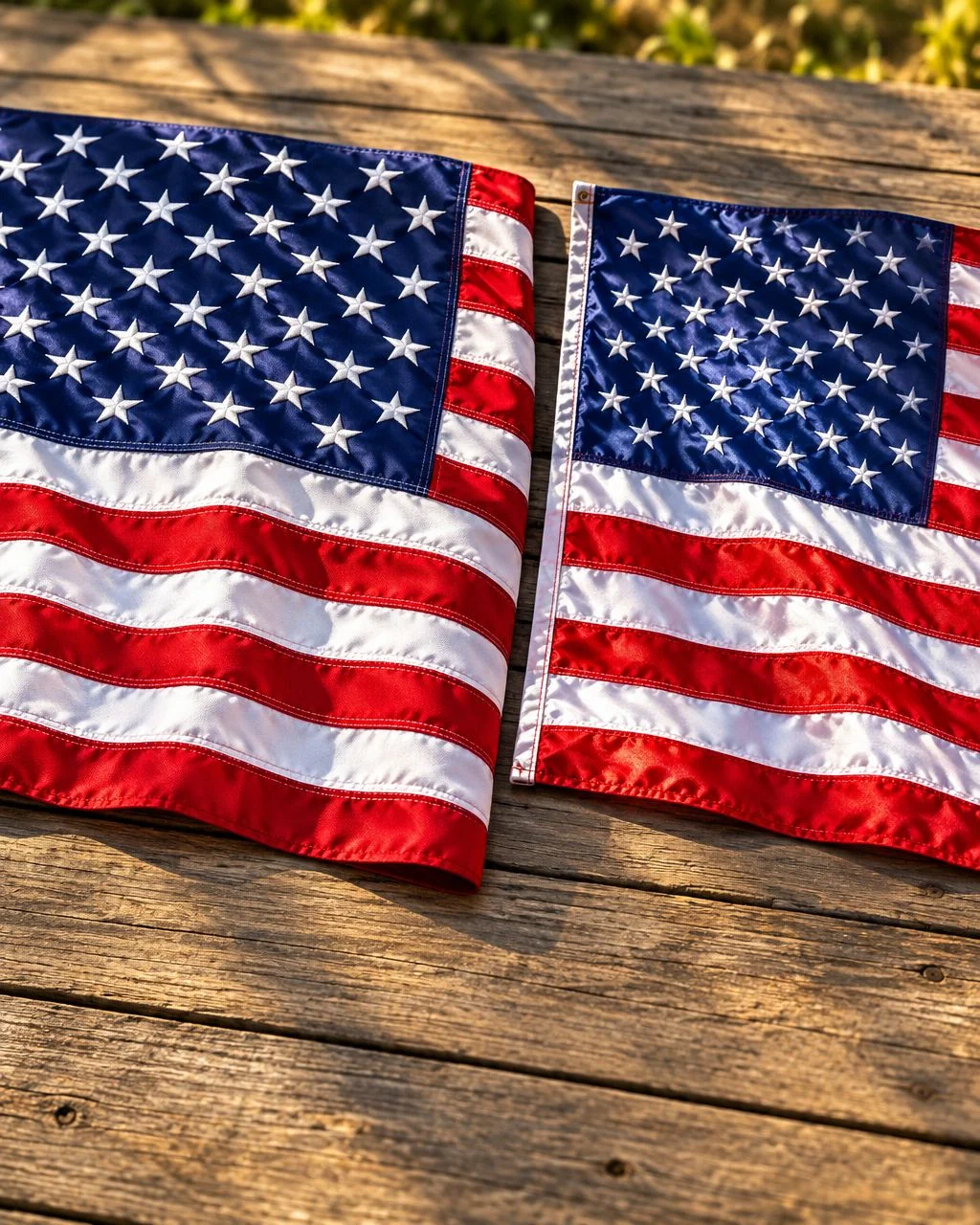
Two American flags with embroidered stars and sewn stripes laid on a wooden surface in sunlight, comparing heavy 2-ply polyester and lighter nylon fabrics

Best overall for fade resistance: a 2-ply spun polyester American flag, because its heavier weave is the fabric feature most consistently tied to slower color loss in all-day sun. Best for light-wind porches: an embroidered nylon flag, which flies in the faintest breeze and dries fast after rain. Best budget option: a printed polyester flag, the right pick when you would rather replace it sooner than spend more up front.

Quick answer
  • 2-ply spun polyester is the best outdoor American flag for all-day sun.
  • Embroidered nylon wins for light wind and fast drying after rain.
  • Printed flags fade first because the ink sits on the surface.
  • Red stripes show sun fade before the blue canton on most flags.
  • Match the flag to your wind and sun before comparing prices.

Ultimate Flags flag sale banner

Why fade resistance matters more than thread counts

A flag spends its life being slowly sandblasted by sunlight. Ultraviolet light breaks down dye molecules and fabric fibers at the same time, and the side of the flag facing the sun takes the worst of it. That is why the question buyers ask first — how long will the colors last — is really a question about fabric, not about stitching counts or branding.

The honest answer is that every outdoor flag fades eventually. The question worth asking is which fabric fades slowest in your particular yard: a flag on a shaded, breezy porch ages nothing like a flag on an open pole in a field with southern exposure. This guide ranks the common fabric-and-construction combinations by how well they hold their color, so you can match the flag to the sun it will actually live in.

What makes the best fade-resistant outdoor American flag

Before the ranking, here is what the comparison weighs. Any flag judged on these five points holds color longer than one chosen from a photo alone.

  • Fabric weight and plies. A 2-ply flag uses two yarns twisted together, which makes a heavier, more opaque cloth. More fabric between the dye and the sun means slower fade.
  • Dye penetration. Woven fabrics hold dyed yarn, so color sits throughout the thread. Printed designs put ink on the surface, where the sun reaches it directly.
  • Wind fit. A flag that flaps violently in too much wind wears thin at the fly end first, and thin fabric fades fast. A flag matched to its breeze keeps its coating of fiber longer.
  • Fly-end construction. The fly end takes the most abuse. Reinforced rows of stitching there keep the flag's shape, which matters because a sagging, threadbare fly end reads as faded even when the color is fine.
  • Realistic replacement plan. Fade resistance buys time, not immortality. The best setup is the fabric that gives you the longest acceptable-looking life per dollar in your exposure.

Fade-resistant outdoor American flags at a glance

Flag type Best for Standout feature Key limitation
2-ply spun polyester, embroidered Open yards with all-day sun Heaviest, most opaque weave Heavier; needs a decent breeze to fly well
Embroidered nylon Porches and light-wind spots Flies in the faintest breeze, dries quickly Lighter cloth; fades sooner in full sun than 2-ply
Printed polyester or nylon Budget and seasonal displays Lowest cost per flag Ink sits on the surface, so it fades first
Poly-cotton outdoor blend Traditional look, part-time display Cotton's rich, vintage appearance Absorbs water; not for constant all-weather use

1. 2-ply spun polyester: best fade resistance for all-day sun

This is the flag you put on the pole that never gets a break. Spun polyester is woven from finer, twisted yarns in a denser weave than standard polyester, and 2-ply construction doubles that up into a heavy cloth that feels closer to cotton than to a sail. The extra thickness is exactly what slows the sun down: color in a woven, dyed fabric runs through the yarn, so there is simply more dyed fiber for ultraviolet light to work through before the flag looks washed out.

The embroidered versions carry that advantage onto the design itself. Embroidered stars and sewn stripes are made from dyed thread stitched through the cloth, not ink laid on top of it, which is why an embroidered 50-star canton keeps its definition long after a printed one has gone pinkish at the edges.

2-ply spun polyester pros:

  • Heaviest common flag fabric, so it blocks the most sun per square inch
  • Dyed yarn carries color through the thread, not just across the surface
  • Embroidered stars and sewn stripes hold sharp detail for years
  • Handles rough, windy sites better than lighter cloth

2-ply spun polyester cons:

  • Needs a reasonable breeze to fly fully; it can look droopy on still mornings
  • Heavier weight puts more load on hardware, so check your pole's rating
  • Costs more up front than printed flags of the same size

Best for: open lawns, coastal and plains wind, and any display that faces unshaded sun for most of the day.

2-ply poly embroidered American flag with sewn stripes and embroidered stars flying on an outdoor poleShop Now
A 2-ply poly embroidered outdoor American flag with sewn stripes and embroidered stars, the construction ranked best for all-day sun.

2. Embroidered nylon: best for light wind and quick drying

Nylon is the lightweight champion. It unfurls in a breeze barely strong enough to move a trash bag, which makes it the right flag for porches, courtyards and anywhere the wind arrives politely rather than in gusts. It also sheds water: nylon absorbs little moisture, so after a rain it dries in short order instead of staying heavy and damp against your pole.

On fade resistance, nylon sits a clear second to 2-ply polyester. The cloth is thinner, so the sun works through it faster, and on most flags the red stripes show fading before the blue canton does. The embroidery helps — embroidered stars and lettering keep their color and relief long after flat printed areas have dulled — but if your display gets twelve hours of direct sun, the polyester option above is the more fade-resistant choice.

Embroidered nylon pros:

  • Flies in the lightest breeze of any common flag fabric
  • Dries quickly after rain, which discourages mildew and water staining
  • Embroidered details stay sharp and dimensional for years
  • Available in a full size run, from 3×5 ft up through 6×10 ft and beyond

Embroidered nylon cons:

  • Thinner cloth fades sooner than 2-ply polyester in identical full-sun sites
  • Too light for very windy exposures, where it will wear at the fly end

Best for: shaded or half-shaded porches, light-wind neighborhoods, and buyers who want a sharp-looking flag on display every day without heavy wind load.

Nylon embroidered American flag with embroidered stars flying against a blue skyBuy This Flag- Click Here
An embroidered nylon American flag flying in a light breeze, the fabric ranked best for porches and quick drying.

3. Printed polyester: best budget pick for seasonal and part-time display

A printed flag gets its design from ink laid on the surface of the cloth, and that is the whole story of its fade resistance. The sun works on that ink directly, with no thickness of dyed yarn in the way, so a printed flag shows fade before a dyed-and-sewn flag in the same spot — usually on the red stripes first.

That limitation is also why it earns a place in this ranking. For a lake house you visit on weekends, a holiday display, or a banner that comes down between occasions, a printed flag gives you a bright, complete design at the lowest cost, and the sun simply never accumulates enough hours to matter. Buy it for part-time duty, plan to replace it sooner under permanent display, and it is the most sensible flag on this list.

Printed polyester pros:

  • Lowest cost per flag, which makes replacements painless
  • Bright, complete design including fine details printing handles well
  • Light in weight, easy to fly on short poles and porch mounts

Printed polyester cons:

  • Surface ink fades first in steady sun; weakest fade resistance here
  • Thinner cloth wears faster in wind than sewn or 2-ply flags

Best for: seasonal displays, vacation homes and any flag that spends more time stored than flying.

Why flags fade and what actually slows it

  • Ultraviolet hours. The total sun the flag absorbs is the biggest factor. A south-facing pole with no shade accumulates UV hours several times faster than a porch flag.
  • Fabric thickness. Thicker, tighter weaves shade their own dye. This is the core advantage of the 2-ply polyester ranked first above.
  • Dye method. Woven, dyed yarn keeps color through the thread; printed ink sits on the surface where light hits it directly.
  • Wind abrasion. A flag flapping in too much wind thins its own fabric, and thin spots fade first. Right-sizing the flag to the pole and site slows this down.
  • Cleanliness. Dust, pollen and road film hold moisture and grime against the dye. A flag brought down and washed gently a couple of times a year keeps its color noticeably longer.

For the sizing half of that equation — matching flag dimensions to a home pole — the practical checklist in How do you choose outdoor American flags for your home? covers pole heights and clearances in detail.

When you are ready to Shop Ultimate Flags Store, the embroidered nylon and 2-ply polyester outdoor flags shown above are the two constructions this ranking would put on a permanently displayed pole.

How we ranked

The ranking weighs fade resistance first, everyday flyability second and cost last. 2-ply spun polyester leads because fabric thickness and dyed-through yarn are the two features most consistently tied to slow color loss in continuous sun. Embroidered nylon follows for its flyability and fast drying, accepting a shorter life in full sun. Printed polyester ranks third on fade resistance alone but wins the value slot for part-time displays. No ranking here depends on any single retailer's claims; it rests on how each construction is made.

Which fade-resistant outdoor American flag should you choose?

If your flag flies in open, unshaded sun all day, choose the 2-ply spun polyester embroidered flag — it is the most fade-resistant construction commonly sold. If your porch sees light wind and some shade, choose the embroidered nylon. If the flag comes down between weekends or seasons, the printed polyester is the honest budget pick. Match the fabric to the sun first, the wind second, and the purchase order writes itself.

FAQ

What is the best fade-resistant outdoor American flag?

A 2-ply spun polyester American flag with embroidered stars and sewn stripes is the best fade-resistant choice for all-day sun. Its heavy, tightly woven cloth shades its own dyed yarn, so color lasts longer than on lighter fabrics.

Is nylon or polyester better for a flag that fades?

Polyester resists fade better because it is woven thicker, while nylon is lighter and flies in less wind. For a full-sun, open-yard display choose 2-ply polyester; for a breezy shaded porch, embroidered nylon is the smarter match.

Do embroidered flags fade less than printed flags?

Yes. Embroidered designs are stitched from dyed thread through the cloth, while printed designs are ink on the surface where the sun hits them directly. On printed flags the red areas usually show fading first.

What color fades first on an American flag?

On most outdoor flags the red stripes fade before the blue canton, because red dyes break down faster under ultraviolet light. Checking the red stripes is the quickest way to judge how a flag is aging.

How long does an outdoor American flag stay colorful?

It depends on sun hours, wind and fabric more than on any fixed schedule. A 2-ply polyester flag in a harsh full-sun site and a printed flag on a shaded porch can age at similar rates, so match fabric to exposure instead of counting months.

What size American flag should I fly at home?

A common pairing is a 3×5 ft flag on a 20-foot pole, with larger flags for taller poles. Measure your pole and clearance first, then pick the size that flies without snagging, as covered in the pole-fitting guide linked above.

How do I make my American flag fade less?

Choose a heavier dyed fabric, wash the flag gently a couple of times a year to remove grime, and take it down in the worst afternoon sun if you can. Bringing a flag indoors during storms also protects both color and fabric.

One last thing

The most fade-resistant thing about a flag is not on the flag at all — it is the habit of taking it down. Washing a flag gently twice a year and storing it dry removes the grime that grinds dye away, and no fabric on this list survives a bad pole fit no matter how good its cloth is. Buy the 2-ply polyester for the sunny pole, inspect the fly end monthly, and the colors you buy will still read true when the next buying season comes around.

Related guides

Posted on

How do you research symbols on Revolutionary War flags?

Embroidered pine tree flag and yellow Gadsden rattlesnake flag folded on a collector's wooden table with a magnifying glass and a rolled document

Researching the symbols on Revolutionary War flags comes down to three habits: find the dated source that names or shows the flag, match each symbol to the unit or cause that carried it, and only then hold a modern reproduction up against what the record supports. Work in that order and the pine tree, the rattlesnake and the stars and stripes stop being a pile of patriotic guesses and become dateable, checkable designs — which is exactly what you want before you buy one.

Quick answer
  • Start with dated sources: the 1775 cruisers flag and the 1777 Flag Resolution.
  • Match every symbol to the unit or cause that carried it.
  • The pine tree with An Appeal to Heaven served Washington’s cruisers from 1775.
  • The rattlesnake grew from Franklin’s 1754 Join, or Die cartoon.
  • No original Gadsden flag survives — every one sold today is a reproduction.

Ultimate Flags flag sale banner

Why Revolutionary War flag symbols are worth the homework

The Revolution produced its flags fast, locally and under pressure, and the symbols they carried were arguments made in cloth. A pine tree was not decoration — it stood for New England's timber and, in one famous reading, for an ancient liberty that English kings were said to have respected. A rattlesnake made the colonists' point about being left alone: it warns before it strikes. When you know what each image meant and when it was used, a flag becomes a dated document you can check.

That checking habit pays off twice. For a collector, it is the difference between a display that reads true and one that quietly mixes centuries. For a teacher, a parent or a history buff putting together a room, it is what lets you write a caption you can defend. And for a buyer, it protects you from listings that attach a famous story to a design that never carried one.

Ultimate Flags carries reproductions of these documented designs, from Washington's Cruisers flags to embroidered Gadsden banners, and this guide walks through the research method the store's own products are built on.

How do you research symbols on Revolutionary War flags?

Start with the date and the source, not the story you have heard. Five steps cover nearly every flag you will run across.

1. Start with the dated source, not the legend

The strongest sources are the ones written while the war was happening: letters describing a flag, resolutions adopting one, and museum records of flags that survived. The June 14, 1777 Flag Resolution of Congress is the classic example — it describes thirteen stripes alternating red and white with thirteen white stars on a blue field, and it says nothing about how the stars are arranged. A primary source like that settles more questions in one paragraph than a week of internet arguments.

Aim for at least one source per flag: a resolution, a letter, a period drawing or a museum catalog entry. Note the source and the date it supports, because that note is what your caption — or your collector's card — will stand on.

2. Match the symbol to who flew it

The same animal or tree can belong to different units, navies and militias, and the meaning shifts with each. The table below pulls together the most documented Revolutionary War flag symbols and where the record shows them.

Symbol Documented for Where the record shows it
Pine tree with "An Appeal to Heaven" Washington's cruisers, 1775-76 Colonel Joseph Reed's October 1775 flag description and the fleet's commissions
Coiled rattlesnake, "Don't Tread on Me" Continental Navy colors, 1775 Christopher Gadsden's recorded presentation of the design to Congress and Commodore Hopkins
Rattlesnake with "Liberty or Death" Culpeper Minute Men, 1775 Banners credited to the Culpeper County, Virginia battalion
Thirteen stripes and thirteen stars The Continental Congress, June 14, 1777 The Flag Resolution, which left the star arrangement open
Crescent over "LIBERTY" Colonel Moultrie's South Carolina troops, 1776 Moultrie's own account of designing the flag for Fort Sullivan

Read down that middle column and the research method answers itself: a symbol means what its carriers used it to mean, and the record names the carriers.

3. Compare surviving and documented examples

Some originals survive, and they are worth more than a thousand reproductions of reproductions. A flag tied by tradition to the Battle of Bennington on August 16, 1777 is preserved at the Bennington Museum in Vermont, stars and the year "76" across its canton. The Washington's Headquarters standard is documented in period drawings. Comparing a documented example with the reproduction you are considering tells you in seconds whether the maker followed the record or improvised.

When no original survives, the documentation stands in. No founding-era Gadsden flag is known to exist today, so the design rests on 1775-76 written accounts — which is plenty to research, as long as the seller and the buyer both treat the written record as the standard.

4. Separate what is documented from what is traditional

The most respected flag stories and the shakiest ones wear the same clothes. The Betsy Ross origin tale is the famous case: historians trace it to a story her grandson told in 1870, and the historical record neither proves nor disproves it. Tradition can still matter — the Bennington flag's battle story is exactly that — but a careful researcher writes "tradition holds" where the record goes quiet, and so should the caption on your wall.

5. Check a reproduction against the record before you buy

Once you know the documented design, the last step takes five minutes: read the listing, count the stars, check the motto's spelling, and compare the layout with your source. A reproduction that follows the record is a piece of history you can defend; one that does not is a decoration — and might still be nice, but you should know which one you are buying.

When you are ready to Shop Ultimate Flags, the rattlesnake designs covered below are the easiest place to put the method to work, because their documentation is unusually strong.

The pine tree and "An Appeal to Heaven"

In October 1775, as George Washington readied a small fleet of armed cruisers to hunt British supply ships, Colonel Joseph Reed described a flag for the vessels: a pine tree on a white field with the words "An Appeal to Heaven" alongside. The design served the cruisers through the fleet's 1776 service, and the pine tree itself reached back decades — Massachusetts had used a pine tree on its naval colors since at least the 1680s, and New England's great timber trade had made the tree a regional badge long before that.

The motto did heavy lifting. "An Appeal to Heaven," from a phrase John Locke used about the right of a people to resist tyranny when courts and kings offered no remedy, made the flag a statement of conscience as much as a naval ensign. That combination — a New England symbol carrying a philosophical argument — is why the design reads so strongly on a modern reproduction.

Washington's Cruiser flag reproduction with an embroidered pine tree and An Appeal to Heaven mottoShop Now
Washington’s Cruisers design as a modern double-nylon embroidered reproduction. The documented 1775 elements are the pine tree and the motto.

The rattlesnake and "Don't Tread on Me"

The snake's paperwork goes back further than the war itself. Benjamin Franklin's "Join, or Die" cartoon ran in the Pennsylvania Gazette on May 9, 1754, showing the colonies as the segments of a cut rattlesnake, and the image made the snake an American symbol twenty years before the first shot at Lexington. By late 1775 an essay published in the Pennsylvania Journal and attributed to Franklin was praising the rattlesnake's virtues at length: it never begins an attack, it gives fair warning, and it never surrenders.

The famous yellow banner followed. Christopher Gadsden, a South Carolina patriot, is recorded presenting the design — a coiled rattlesnake on a yellow field with "Don't Tread on Me" — to the Continental Congress and to Commodore Esek Hopkins, the Navy's first commander, in 1775-76. The rattlesnake also flew in other outfits: the First Navy Jack paired it with thirteen red and white stripes, and a banner credited to the Culpeper Minute Men of 1775 combined the snake with Patrick Henry's "Liberty or Death."

One research note saves collectors real money: no original Gadsden flag is known to survive, so the design's authority rests entirely on those 1775-76 accounts. That is enough — but it means the wording and layout on any "authentic" claim should be checked against the accounts, not against the seller's confidence.

Yellow Gadsden flag reproduction with a sewn embroidered rattlesnake and Don't Tread on Me letteringBuy This Flag- Click Here
The 1775 Gadsden design as an embroidered nylon reproduction. The documented elements are the coiled rattlesnake, the yellow field and the motto.

What the 1777 Flag Resolution actually says

After a year of fighting under a patchwork of local banners, Congress settled the national colors. The resolution of June 14, 1777 reads that the flag be thirteen stripes, alternate red and white, with thirteen stars, white, on a blue field, representing a new constellation. Two details reward careful readers: it does not name a star arrangement, and it does not tie the design to any single battle.

That open arrangement explains why period and early flags show the thirteen stars in circles, in staggered rows and in other patterns. The 1777 document licenses them all equally — which means a reproduction with a circle of thirteen stars is not more correct than one with rows; both satisfy the record. What the resolution does pin down is the count: thirteen stripes, thirteen stars, as of June 1777.

Why the same symbol shows up on different flags

  • There was no central flag office. Congress adopted national colors in 1777, but armies, navies and militias sourced flags locally before and after, so designs multiplied.
  • Symbols were regional before they were national. The pine tree was New England's; the crescent was South Carolina's; the rattlesnake traveled with the Navy and the militias.
  • Mottos did the arguing. "An Appeal to Heaven" and "Don't Tread on Me" are positions, not decoration, and units chose the argument they wanted to make.
  • Postwar retellings reorganized the story. Nineteenth-century accounts attached stories to designs, which is why every modern buyer should weigh the dated record over the repeated legend.

Common mistakes when researching flag symbols

  • Mistaking a story for a source. "Everyone knows" is not documentation. The Betsy Ross tale and several battle stories rest on tradition, not on 1770s paper.
  • Dating a symbol to its most famous flag. The rattlesnake was twenty years old when the Gadsden design appeared; the pine tree was older still. Check the symbol's first documented use, not the flag that made it famous.
  • Reading one flag as the whole war. No single design represented the Revolutionary cause through the war. The Grand Union carried the British union in its canton well into 1776, and the national stars and stripes postdate the fighting's first year.
  • Trusting a listing over the record. A product title is not a historical source. Five minutes with a resolution or a museum catalog settles what a listing may not.

FAQ

What does the pine tree mean on Revolutionary War flags?

The pine tree stood for New England, whose timber and naval colors had used the tree for decades, and it carried the motto ‘An Appeal to Heaven’ on the flags of Washington’s cruisers in 1775-76. Colonel Joseph Reed’s October 1775 description is the key dated source.

Why is there a rattlesnake on Revolutionary War flags?

The rattlesnake warned before it struck and never surrendered, which made it a favorite American symbol from Franklin’s 1754 Join, or Die cartoon onward. By 1775 it flew on naval colors and militia banners, including the Gadsden design and the Culpeper Minute Men’s flag.

Did the 1777 Flag Resolution say how to arrange the stars?

No. The June 14, 1777 resolution specified thirteen stripes and thirteen white stars on a blue field but left the star arrangement open, which is why period flags show circles, rows and other patterns.

Is there an original Gadsden flag from 1775?

No founding-era original is known to survive. The design rests on written accounts of Christopher Gadsden’s 1775-76 presentations to Congress and Commodore Hopkins, so every Gadsden flag sold today is a reproduction of a documented design.

Is the Betsy Ross story documented?

The story comes from testimony her grandson presented in 1870, and historians find no conclusive evidence supporting or denying it. The circle-of-stars pattern itself is consistent with the open arrangement the 1777 resolution allows.

What is the best source to check a Revolutionary War flag against?

Use a dated primary source: a flag resolution, a period letter or description, or a museum catalog of a surviving flag. One dated source per flag is the standard a careful collector or teacher applies.

How do I know if a reproduction is historically accurate?

Compare its design element by element with the documented source — star count, motto wording, layout and colors. A reproduction that matches the record is accurate to the design, whatever its fabric or age.

One last thing

The rattlesnake's longest paper trail belongs to a cartoon, not a flag: Franklin drew "Join, or Die" in 1754 for a newspaper, twenty-one years before the war it is now remembered for. That is the quiet lesson of researching Revolutionary War flags — the symbols were already old arguments when the war borrowed them, and the dated sources are what let you tell the difference between a design the era used and a story the era never heard of.

Historical basis for this guide: the June 14, 1777 Flag Resolution (Continental Congress, via the National Archives); Colonel Joseph Reed's October 1775 flag description for Washington's cruisers; the Pennsylvania Gazette's May 9, 1754 "Join, or Die" cartoon and the 1775 Pennsylvania Journal rattlesnake essay attributed to Franklin; the Bennington Museum's record of the Bennington battle flag tradition.

Related guides

Posted on

Historical Reproduction Confederate Flags: How to Document an Accurate Copy

Square Confederate battle flag reproduction with embroidered stars flying on a pole against a blue sky

Historical Confederate flag reproductions range from casual printed banners to sewn copies built to match the exact flags that flew between 1861 and 1865. This guide shows you how to document a reproduction before you buy it: the design dates to check, the square sizes that identify each branch of the army, the unit honors that make a flag historically specific, and the construction details that separate a faithful copy from a lookalike. If you already know the design you want, browse our Confederate flags for sale.

TL;DR
  • Documenting a reproduction means checking design dates, size, unit honors and construction against historical records.
  • The first National flag, the Stars and Bars, carried 7 stars in March 1861 and 13 by 1863.
  • Army of Northern Virginia battle flags were square: roughly 48-52 inches for infantry, 36-38 for artillery, 30-32 for cavalry.
  • Cotton suits indoor and ceremonial display; sewn nylon handles outdoor weather.
  • Check embroidered stars, correct sizes and documented honors before buying.
Ultimate Flags flag sale banner

Why documentation matters

Reproduction quality varies more in this category than in almost any other. A printed rectangle with a saltire and thirteen stars will look right in a photo and wrong in your hands. A documented copy, by contrast, matches a real flag in the design that unit carried, the size that army's regulations or surviving examples support, and the construction method a period flagmaker would have used.

Documentation also protects you from the most common trap in this category: flags with borrowed or invented details. Battle honors sewn on a flag that a unit never carried, a rectangular "ANV" flag, or a Stars and Bars with the wrong star count are easy to produce and hard for a new collector to catch. The checks below take about ten minutes and catch nearly all of them.

What documented means for a Confederate flag reproduction

A documented reproduction is one you can trace back to a historical source: a surviving original, a photographic record of one, or an official-issue description in the war records. Museums and serious collectors apply a simple standard, and you can borrow it. For each detail on the flag, there should be an answer to the question, what evidence says the original looked like this?

That standard applies to four things in particular:

  • Design and date — which of the three national designs or battle flag patterns it is, and when that design was in use.
  • Size and shape — the dimensions a real unit's flag would have been.
  • Unit honors and markings — any battle names, regimental numbers or campaign ribbons sewn on the field.
  • Construction — materials, stitching and mounting that match how the flag was made to be used.

You do not need a museum archive to run these checks. The main facts are settled history, published in the official records and in standard flag references, and a good store prints its own documentation on each product page. What matters is that you check rather than assume.

Match the design to its date

The Confederacy used three national flags in sequence, and each has a date range you can verify:

  1. First National — the Stars and Bars, March 1861 to May 1863. Adopted in March 1861 with seven stars for the seven initial states. Additional stars were added as states joined, reaching thirteen by late 1861. Its red, white and blue layout with a circle of stars on three broad stripes is why it was repeatedly mistaken for the Union Stars and Stripes in the field.
  2. Second National — the Stainless Banner, May 1863 to March 1865. A white field with the battle flag in the canton. Adopted on May 1, 1863, to fix the confusion problem; the all-white field later earned it the nickname that stuck after flags were furled or soiled in the field.
  3. Third National — the Blood-Stained Banner, March 4, 1865. The same white field with a red vertical bar added at the fly so the flag would not read as a white surrender flag.

The battle flag itself — the Southern Cross with the saltire and stars — was adopted for the Army of Northern Virginia in late 1861, after the confusion at the First Battle of Manassas on July 21, 1861 made the problem unmistakable. General P.G.T. Beauregard pushed the change after his own headquarters flag was mistaken for a Union one. William Porcher Miles's rejected earlier design became the basis of the cross.

When you shop, date your flag first. A thirteen-star Stars and Bars is correct for late 1861 through 1863; a seven-star version is a March-to-summer-1861 flag. A white-field national flag with no red bar belongs to 1863-1865. A reproduction that mixes details from different years is not wrong to exist, but it is a display flag, not a documented one.

Check the size and shape against the unit type

Size is where reproductions most often drift, because many modern manufacturers simply make every flag 3×5 feet. The original Army of Northern Virginia battle flags were square, and the Richmond depot issued them in three size bands by branch: about 48 to 52 inches square for infantry regiments, 36 to 38 inches for artillery batteries, and roughly 30 to 32 inches for cavalry. A 52-inch by 52-inch flag with a pole sleeve and ties is the infantry format; a 38-inch square is the artillery format.

Rectangular battle flags existed too, but they belong to other commands — armies and departments west of Virginia issued rectangular patterns, and naval and later-period flags moved to rectangles as well. So the shape itself is a dating and attribution clue: a square battle flag points to the Army of Northern Virginia, while a rectangle points elsewhere or later.

Square Confederate artillery battle flag, 38 by 38 inches, sewn cotton with embroidered stars and a white border

A cotton artillery-format reproduction at the correct 38-inch square, with embroidered stars and the white border trim of the Southern Cross.

The same logic applies to national flags. The Stars and Bars was a rectangular flag at 3×5-scale proportions in period use; the Stainless and Blood-Stained Banners were larger-scale rectangles. If a store sells a "square Stars and Bars," that combination has no period basis.

Verify unit honors before you buy an honors flag

Battle honors are the most collectible feature on a reproduction and the easiest to fake. Real unit flags carried the names of engagements sewn or painted on them, usually in the saltire arms or above and below the cross. The names must match the unit's actual service record.

Take the 4th North Carolina Infantry as a worked example. Its flag carried Williamsburg and Seven Pines honors, and the unit's record supports exactly those: the regiment fought in the attack at Seven Pines, served through the Seven Days battles at Malvern Hill, held the Sunken Road at Antietam, fought all three days at Chancellorsville, was at Gettysburg on July 1, 1863, and went on through Spotsylvania, Petersburg and Appomattox. A flag bearing those two honors in that unit's name is documented. The same two names on a Tennessee regiment's flag would not be.

Two quick checks keep you safe with honors flags:

  • Does the honor list match the unit's documented battles? Regiments have published service records; a two-minute search settles it.
  • Is the flag attributed to a specific regiment at all? A generic honors flag with famous battle names and no unit attribution is decoration. Some collectors buy those knowingly for display; just do not document it as anything else.
52 by 52 inch cotton reproduction of the 4th North Carolina Infantry battle flag with Williamsburg and Seven Pines battle honors sewn on

A 52 by 52 inch cotton reproduction of the 4th North Carolina Infantry flag, with its Williamsburg and Seven Pines honors sewn on.

Read the construction, not the sales copy

Construction tells you what a flag is meant for, and it is the one thing you can judge from photos and product pages without any special expertise:

  • Printed versus sewn. Printed flags have the design dyed or printed into the fabric. Sewn flags have appliquéd stripes and embroidered stars, which read visibly raised in close-up photos. Sewn construction is the documented-reproduction standard.
  • Cotton versus nylon. Cotton has the period-correct texture and drape and is the reenactor and ceremonial choice. It should not live outdoors in rain. Nylon and double-nylon flags are the outdoor-grade versions; double-nylon (two-ply) embroidered flags are the heaviest-duty sewn option.
  • Mounting. Period infantry flags carried a pole sleeve and ties rather than grommets, because they were carried on a staff, not flown from a halyard. Grommets are the practical choice for a porch pole. Either is fine — but if you want the documented field format, sleeve and ties is it.
  • Reverse side. On a properly made sewn flag, the design reads mirror-reversed from the back. That is standard construction, not a defect. A double-sided flag that reads correctly both ways is a modern convenience format, not a period copy.

None of this means one option is better overall. A cotton sleeve-and-ties flag documents a field flag; a double-nylon grommeted flag flies year-round. Match the construction to the purpose you have.

A comparison of reproduction types

Option Best for Key limitation
Printed nylon battle flag Casual display, campsite or truck use Not a documented construction; printed face
Sewn cotton, sleeve and ties Reenactment, museums, indoor memorials Damaged by outdoor rain and sun
Double-nylon embroidered Outdoor flying on a permanent pole Heavier and costlier than printed
Unit honors cotton reproduction Collectors documenting a specific regiment Honors must match the unit's record

Common mistakes buyers make

  • Buying 3×5 feet for everything. If you want a documented ANV format, the square sizes above are the point. A 3×5 rectangle is a display format that simply did not exist for ANV infantry flags.
  • Hanging cotton outside. Cotton is a wet-towel problem in the rain. Outdoor display calls for sewn nylon.
  • Expecting double-sided text. Mirror-reversed lettering on the reverse is correct construction on sewn flags.
  • Confusing national and battle flags. The Stars and Bars and the battle flag are different flags with different histories; most "first Confederate flag" searches actually want the Stars and Bars, while most collector reproductions are battle flags.
  • Trusting the word authentic without details. Authentic means nothing by itself. Sizes, dates, honors and construction are the details that either are documented or are not.

Where a documented flag fits in a collection

Collectors usually build around one of two axes: the national-flag sequence (Stars and Bars, Stainless Banner, Blood-Stained Banner) or unit flags of a particular army or state. Documented reproductions work for both, and they pair well with display practices that respect the historical context — a caption with the design's date range and unit attribution turns a wall of flags into an exhibit. Museums handle the same material this way, and the same caption discipline works at home.

If you are comparing documented designs side by side, Ultimate Flags keeps its rebel and Confederate flag collection organized by design and format, with each flag's construction and size listed on its own page. For the outdoor flag itself, the double-nylon embroidered flags are the workhorses; for shelf, office or museum-style display, the cotton sleeve-and-ties formats carry the documented details.

FAQ

What does documented mean for a Confederate flag reproduction?

It means every key detail — design, date, size, honors and construction — can be traced to a historical source such as a surviving original or the official records. A documented flag lists those details for you to check.

What size was the original Confederate battle flag?

The Army of Northern Virginia battle flag was square: about 48-52 inches for infantry, 36-38 inches for artillery, and roughly 30-32 inches for cavalry. Rectangular battle flags belonged to other commands and later periods.

Why did the Confederacy replace its national flag twice?

The Stars and Bars was repeatedly mistaken for the Union flag, so the white-field Stainless Banner was adopted on May 1, 1863. A red bar was added on March 4, 1865 to keep the all-white field from reading as a surrender flag.

Can a cotton reproduction fly outdoors?

Not reliably. Cotton absorbs rain and dries stiff, which shortens its life sharply. Cotton is the indoor, ceremonial and reenactment choice; outdoor display calls for sewn nylon or double-nylon.

What is the difference between the Stars and Bars and the battle flag?

The Stars and Bars was the first national flag, adopted in March 1861 with a circle of stars on three stripes. The battle flag is the square Southern Cross adopted in late 1861 after confusion at First Manassas.

Are unit battle honors on reproductions historically accurate?

They can be, when the honors match the unit’s documented service. For example, the 4th North Carolina Infantry’s flag carried Williamsburg and Seven Pines honors, which the regiment’s record supports. Always check the honors against the unit’s battles.

What should a buyer check before ordering?

Four things: the design’s date range, the size and shape against the unit type, whether any honors match the unit’s record, and whether the construction — cotton or nylon, sewn or printed, sleeve or grommets — matches how you plan to use it.

Related guides

Posted on

How did Confederacy flags change during the Civil War?

Stars and Bars first national Confederate flag with a circle of thirteen stars on three broad stripes, hanging on a wooden wall

Confederate national flags went through three designs in four years: the Stars and Bars flew from March 1861 to May 1863, the Stainless Banner from May 1863 until March 1865, and the Blood-Stained Banner for the Confederacy's final weeks in 1865. The changes were driven by one practical problem — each flag was too easy to mistake for something else, first the United States flag and then a flag of truce. For collectors and reenactors buying Confederate reproductions, those dates and reasons are what separate an accurate display from a generic one. You can compare all three national flags and the battle flag in our Confederate flags for sale.

Quick answer
  • Three national flags served the Confederacy: Stars and Bars, Stainless Banner, Blood-Stained Banner.
  • Stars and Bars: March 1861 to May 1863, dropped because it resembled the Stars and Stripes.
  • Stainless Banner: adopted May 1, 1863, white field with the battle flag in the canton.
  • Blood-Stained Banner: March 1865, red bar added so a hanging flag could not read as truce.

Ultimate Flags flag sale banner

Why did the Confederacy keep changing its national flag?

The Confederate Congress did not redesign its national flags out of fashion. Each change answered a failure in the field or the harbor, and the record of why each flag fell is what makes the three designs easy to date.

The Stars and Bars confused soldiers on the battlefield. Adopted in March 1861, the first national flag carried a circle of white stars on a blue canton over three broad stripes — red, white, red. At First Manassas in July 1861, the resemblance to the United States flag caused deadly confusion between the lines. The battle flag grew out of that problem as a field flag, and the national design lost its job little by little afterward.

The Stainless Banner was too easy to mistake for a flag of truce. The second national flag, adopted by the Confederate Congress on May 1, 1863, placed the battle flag on a plain white field. When the wind dropped, a furled or hanging Stainless Banner showed mostly white — and a white flag is what armies read as surrender. The same whiteness was criticized in print at the time for exactly that reason.

The Blood-Stained Banner added a red bar to fix the truce problem. In March 1865 the Confederate Congress adopted the third national flag: the same white field and canton with a vertical red bar on the fly end. The record of the design notes the red was added so the flag could never be mistaken for a flag of truce, but the Confederacy had weeks left, and the third flag barely reached the field before the war ended in April 1865.

How did Confederacy flags change during the Civil War? A timeline

Flag Adopted Replaced Design Why it changed
Stars and Bars March 1861 — 7, later 13 stars on a blue canton over red-white-red stripes Dropped after First Manassas (July 1861) showed it was too easy to mistake for the US flag
Stainless Banner May 1, 1863 Stars and Bars Battle flag on a white field, official ratio 2:1 White field read as a flag of truce when hanging or furled
Blood-Stained Banner March 4, 1865 Stainless Banner White field, battle-flag canton, vertical red bar on the fly Red bar added so the flag could not be mistaken for a truce flag
Stars and Bars first national flag reproduction with thirteen stars in a circleShop Now

The Stars and Bars: March 1861 to May 1863

The first national flag was the product of hurry. Congress adopted it in March 1861, when seven states made up the Confederacy, so the original canton carried seven stars; the design later flew with thirteen stars as more states were added. Three broad stripes — red, white, red — ran down the field. It looked enough like the Stars and Stripes that at First Manassas in July 1861 officers could not always tell the lines apart, and the search for a field flag that would not be confused led directly to the battle flag.

If you are buying a reproduction for an early-war display, the star count is the dating feature. Seven stars belong to the first months of 1861; thirteen cover the eleven seceded states plus Kentucky and Missouri. A Stars and Bars flag in sewn cotton is the period-correct way to represent 1861 to early 1863 — cotton carries the matte drape the originals had, and it hangs right in a camp or office setting.

The Stainless Banner: May 1863 to March 1865

The second national flag put the battle flag — the Southern Cross with its thirteen stars — on a plain white field. The official ratio was 2:1, but flags produced by the Richmond Clothing Depot used the navy's 1.5:1 ratio, so surviving examples vary.

Its first official use was solemn: the flag draped the coffin of General Thomas J. "Stonewall" Jackson as it lay in state in the Virginia Capitol on May 12, 1863, which earned it the nickname the Jackson Flag. Its working life carried the same problem the first flag had — visibility, this time not of the wrong army but of the wrong message. A mostly white flag hanging still in no wind read as surrender, and the criticism came in the open during the war itself.

Stainless Banner second national flag reproduction with battle flag canton on a white fieldShop Now – Buy any 2, get 3rd Free

The Blood-Stained Banner: March 1865 to the war's end

The third national flag added a vertical red bar on the fly, half the flag's length, on a white field with the battle-flag canton. The design record states plainly that the red was added so the flag could never be mistaken for a flag of truce. The flag was adopted in March 1865, and the Confederacy dissolved in April 1865 — the third design flew for weeks, not years, which is why original examples and even faithful reproductions are far rarer than the other two.

Which flags belong in a complete Confederate display?

A collector who wants the full story needs more than one flag. The three national flags tell the political story; the battle flag tells the field story, and it was never a national flag at all. A well-built display runs the three national designs in order, dates them, and hangs a separate battle flag alongside to show the difference.

  • Stars and Bars reproduction for the 1861-1863 window — check the star count against your display date.
  • Stainless Banner reproduction for 1863-1865 — the white field is the point, and it photographs well beside the battle flag it borrowed.
  • Blood-Stained Banner reproduction for 1865 — the red bar is the dating feature.
  • Battle flag in the correct shape for the army you are representing: square with a white border for the Army of Northern Virginia, rectangular for the western armies.

You can shop our sewn cotton Confederate flags in all four designs, and the same store carries the printed nylon versions if the display moves outdoors.

Common questions about the three Confederate national flags

Did the battle flag ever serve as the national flag?

No. The battle flag was a field flag issued to the armies, and the Confederacy's national flags were separate designs. The battle flag appears in the cantons of the second and third national flags, which is where the mix-up starts.

Why does the Stainless Banner have a nickname?

Its first official use was to drape Stonewall Jackson's coffin in the Virginia Capitol in May 1863, and the "Jackson Flag" name followed from that. The other nickname, the Stainless Banner, refers to the unstained white field.

What should a collector check before buying a reproduction?

Three things: the star count matches the period the display represents, the ratio matches the design's official or depot-correct proportions, and the seller states fabric and finishing on the listing. A sewn cotton reproduction with embroidered stars reads period-correct; a printed banner is a fine lightweight alternative for outdoor use.

FAQ

How many national flags did the Confederacy have?

Three: the Stars and Bars (1861-1863), the Stainless Banner (1863-1865) and the Blood-Stained Banner (March 1865 to the war's end in April 1865). Each design answered a practical failure of the one before it.

Why was the first Confederate national flag replaced?

Because it was too easy to mistake for the United States flag. At First Manassas in July 1861 the resemblance caused deadly confusion, and the battle flag was designed as the field flag that would not be confused.

What was the Stainless Banner?

The Confederacy's second national flag, adopted May 1, 1863 — the battle flag on a plain white field. Its first official use draped Stonewall Jackson's coffin on May 12, 1863, earning it the nickname Jackson Flag.

Why did the third Confederate flag have a red bar?

So it could not be mistaken for a flag of truce. A white flag with no red read as surrender when it hung or furled, so the March 1865 design added a vertical red bar on the fly end.

How long did the Blood-Stained Banner actually fly?

Weeks. Adopted in March 1865, it was still new when the Confederacy dissolved in April 1865, which makes surviving originals and faithful reproductions the rarest of the three.

What is the correct star count for a Stars and Bars reproduction?

Seven stars belong to the design's first months in 1861, and thirteen to its later period through May 1863, covering the eleven seceded states plus Kentucky and Missouri. Match the count to the date your display represents.

Where can I buy accurate Confederate national flag reproductions?

From sellers that document design, star count, fabric and finishing on every listing. Ultimate Flags carries the three national flag designs plus the battle flag in sewn cotton and printed nylon.

How many national flags did the Confederacy have?

Three: the Stars and Bars (1861-1863), the Stainless Banner (1863-1865) and the Blood-Stained Banner (March 1865 to April 1865). Each design answered a practical failure of the one before it.

Why was the first Confederate national flag replaced?

Because it was too easy to mistake for the United States flag. At First Manassas in July 1861 the resemblance caused deadly confusion, and the battle flag grew out of that problem.

What was the Stainless Banner?

The second national flag, adopted May 1, 1863 — the battle flag on a plain white field. Its first official use draped Stonewall Jackson’s coffin on May 12, 1863, which earned it the nickname Jackson Flag.

Why did the third Confederate flag have a red bar?

So it could not be mistaken for a flag of truce. The March 1865 design added a vertical red bar on the fly end of an otherwise white flag.

How long did the Blood-Stained Banner actually fly?

Weeks. Adopted in March 1865, it was still new when the Confederacy dissolved in April 1865, which makes surviving examples the rarest of the three designs.

What is the correct star count for a Stars and Bars reproduction?

Seven stars belong to early 1861 and thirteen to the design’s later period through May 1863, covering the eleven seceded states plus Kentucky and Missouri.

One last thing

The Stars and Bars was pulled from the field not because it failed as a symbol but because it failed as a signal — the same reason the Stainless Banner gave way to a red bar. Each Confederate national flag is a record of what went wrong with the last one, and a display that dates them correctly tells that story in order.

Related guides

Posted on

Why do Confederate battle flags have different shapes?

Why do Confederate battle flags have different shapes?

Confederate battle flags came in different shapes because there was never one official battle flag for the Confederate war effort. Each army issued its own: the Army of Northern Virginia carried a nearly square flag with a white border from late 1861, while the Army of Tennessee, the Trans-Mississippi departments and the navy flew rectangular versions of the same Southern Cross design. When you shop Confederate battle flags, the shape is the fastest way to tell which army a reproduction honors — so match the shape to the unit before you buy.

Quick answer
  • There was never one official Confederate battle flag: each army issued its own.
  • Square with a white border means the Army of Northern Virginia, issued from late 1861.
  • Rectangular versions served with the Army of Tennessee, the Trans-Mississippi and the navy.
  • Original infantry flags ran 48 inches square, artillery 36 and cavalry 30.
  • The modern 3×5 rectangle follows the post-war reunion flag, not the square original.

Ultimate Flags flag sale banner

Why the shape question matters to a buyer

Shape is not a style choice on these flags — it is a date and a unit rolled into one piece of cloth. Pick the wrong shape for a display or an impression and the flag contradicts the story next to it. Pick the right one and the whole setup reads true to people who know the material. That is why collectors and reenactors argue about shapes at all: the differences were real, they were deliberate, and they survived in the originals.

Why do Confederate battle flags have different shapes?

Because the Confederate army never adopted a single official battle flag. Each army and corps designated its own pattern, and the shapes grew apart from there. The National Park Service's study of Southern battle flags puts it plainly: the Confederate Army never had an official battle flag — instead, each army or corps had a designated one. Shape is therefore a unit marker, not a national standard.

Flag Carried by Shape Period
Battle flag with white border Army of Northern Virginia Nearly square, 48/36/30 inches by branch Late 1861 to 1865
1864-pattern battle flag Army of Tennessee Rectangular 1864 to 1865
Second naval jack Confederate navy Rectangular 1863 to 1865
Corps flags Hardee's corps and others Blue with white disc, no cross Varies by corps

Read the table left to right and the question answers itself: three armies, a navy and a set of corps flags, none of them centrally standardized. The square and the rectangle are the two survivors, but they were choices made by different quartermasters, not one design committee.

The square flag: the Army of Northern Virginia

William Porcher Miles of South Carolina drew the Southern Cross design in 1861 as a proposed national flag, and his drawing was rectangular. The Confederate Congress passed on it. The design found a second life after First Manassas in July 1861, where the Confederacy's first national flag resembled the United States flag so closely that gun smoke made the two nearly impossible to tell apart, and General Beauregard wanted a field flag that never could be confused with the enemy's colors.

Generals Johnston and Beauregard and Quartermaster-General Cabell approved the new battle flag at Fairfax Court House in September 1861. Johnston suggested making it square rather than rectangular, chiefly to save cloth, and he set a size for each branch of the army: 48 inches square for infantry, 36 for artillery and 30 for cavalry. A modern 3×5 display flag is smaller and longer by comparison, which is worth knowing when a listing describes a 52-inch square cotton reproduction as large — by the 1861 standard, it is.

The white border was not decoration either. Units painted their battle honors on it, regiment by regiment, which is why surviving Army of Northern Virginia originals read like service records. Thirteen stars on the blue saltire became the settled count, covering the eleven seceded states plus Kentucky and Missouri.


Square artillery battle flag reproduction with a white border, shown flat to illustrate its shapeShop Now
Square example: a 38 × 38-inch cotton artillery reproduction with a white border. Match a reproduction to the specific unit and period you are documenting.

The rectangular flags: the western armies and the navy

The Army of Tennessee went through at least eight different designs over the course of the war, according to the National Park Service's survey. Its 1864 pattern battle flag was rectangular and clearly based on the Army of Northern Virginia's square, and the departments west of the Mississippi used rectangular patterns as well. The Confederate navy flew its own rectangular cousin of the design, the second naval jack, from 1863 until 1865.

One detail worth settling for collectors: a popular claim holds that the naval jack used a lighter blue than the army's battle flag. Museum research on surviving exhibits points the other way — the jack's dark blue matches the battle flag's. If a seller's description leans on a lighter-blue navy story, that is a dating claim to check, not a fact to assume.

Not every cross-less flag is an error, either. Some units carried designs with no cross at all — Hardee's corps flew a blue flag with a plain white disc. When a shape or pattern looks off, the flag may be exactly right for a different unit.

After the war the rectangle won the popularity contest. Veterans' reunions standardized on the rectangular version because manufacturers could mass produce it more easily, and that rectangle — not the square original — is what most people picture when the design comes to mind.

Why there was never one official battle flag

Three practical reasons stacked up.

  • The flag belonged to the armies, not the government. It was adopted at army level in September 1861 and was never made a national flag, though the design was later folded into the cantons of the second and third national flags, adopted in May 1863 and March 1865.
  • Supply lines were separate. The Richmond quartermaster outfitted the Army of Northern Virginia while the western armies sourced flags closer to home, so patterns and shapes drifted apart.
  • The armies learned by experiment. The Army of Tennessee in particular kept redesigning as command and circumstances changed, which is why its flags passed through so many patterns.

What shape should a reproduction be?

Let the unit decide. A nearly square cotton flag with a white border, around 52 inches, is the period-correct choice for an Army of Northern Virginia camp display, a heritage exhibit or a collector's wall. A 3×5 rectangle is the familiar modern form, and it is the practical pick for marching, porch poles and everyday display. Both reproduce documented designs, and neither is more legitimate than the other — they answer different questions.

Reproduction Best for Key limitation
Square cotton flag with white border, about 52 inches Army of Northern Virginia camp displays and collections Heavier fabric; reads as a display piece, not a porch flag
Rectangular 3×5 flag, sewn or printed Everyday display, marching and the familiar look Smaller and longer than the original issue

When you are ready to shop rebel flags for sale, compare the square and rectangular versions of the same design side by side and pick by unit, not by habit. Ultimate Flags carries battle flag patterns in both constructions, which is the easiest way to see what the shape change actually does to the look.


Rectangular North Carolina battle flag reproduction with NC lettering and dated scrolls, shown flatShop Now
Rectangular example: the store’s 3 × 5-foot North Carolina cotton reproduction. This photo illustrates the rectangular format, not an identification of a particular wartime army’s issued pattern.

Related questions about battle flag shapes

Was the rectangular rebel flag a naval jack?

It matches the second Confederate naval jack, which was rectangular and flew from 1863 to 1865, and it also resembles the Army of Tennessee's 1864 pattern. The common rectangular flag of today traces to both, and to the post-war reunion flags.

Which shape came first?

The square came first. The Army of Northern Virginia issued square battle flags from late 1861, while the well-known rectangular versions date to 1863 for the navy and 1864 for the Army of Tennessee.

Why do modern reproductions usually come rectangular?

Post-war veterans' reunions favored the rectangle because manufacturers could mass produce it, and the modern display business inherited that standard. Square reproductions are still made for buyers who want the Army of Northern Virginia look.

FAQ

Why do Confederate battle flags have different shapes?

Because each Confederate army issued its own battle flag. The Army of Northern Virginia flew a nearly square flag with a white border from late 1861, while the Army of Tennessee, the Trans-Mississippi and the navy used rectangular versions.

What shape was the original Confederate battle flag?

The original designer’s drawing was rectangular, but General Johnston had it made square to save cloth, and the Army of Northern Virginia issued it that way from September 1861. Infantry flags ran 48 inches square.

Was the Confederate battle flag ever a national flag?

No. It was adopted at army level and never made a national flag, although the design was placed in the canton of the second and third Confederate national flags in 1863 and 1865.

What sizes did the square battle flags come in?

48 inches square for infantry, 36 for artillery and 30 for cavalry, as set when the flag was approved in September 1861.

Is a rectangular battle flag wrong for an Army of Northern Virginia display?

Yes, if accuracy is the goal. The Army of Northern Virginia carried square flags with white borders, while rectangles served with the Army of Tennessee, the Trans-Mississippi and the navy.

Can you display a Confederate battle flag today?

Yes. The flag is legal to display in the United States and appears in museums, battlefield parks, reenactments and historical collections as historical material.

One last thing

The square was a quartermaster's economy measure, not a design statement — Johnston cut the corners to save cloth, and the army he was supplying happened to be the one whose flags drew the most attention after the war. Buy the shape the unit actually carried, and the reproduction tells the true story.

Related guides

Posted on

Civil War flags for sale: a reenactor’s reproduction checklist

17th infantry georgia flag cotton 52 inch x 52 inch with pole hem sleeve / ties

A reenactor's Civil War flag checklist comes down to six checks: match the design to the right army and year, pick the shape and size the unit actually carried, choose fabric that survives the field, inspect the hoist and finishing, verify the stars and wording against the historical record, then buy from a seller that documents what it lists. Civil War flags for sale range from accurate sewn cotton reproductions to lightweight printed banners, and the right pick depends on whether the flag is marching with you or hanging in camp. You can compare both in our Civil War flags for sale.

Quick answer
  • Match the flag pattern to the army and the years you portray — never just to the movie version.
  • Square with a white border means the Army of Northern Virginia; rectangles served farther west.
  • Cotton sewn reproductions read period-correct in camp; nylon suits wet-weather marching.
  • Original battle flags ran near four feet square — a modern 3×5 display flag is smaller by design.

Ultimate Flags flag sale banner

Why the flag you carry matters on the field

A Civil War regiment's colors were not decoration. Regiments on both sides carried their flags into every engagement because gun smoke hid whole brigades, and the colors were the one thing a scattered company could rally on. Carrying them was an honored, dangerous post — color bearers fell in such numbers that capturing an enemy's flag earned a soldier the Medal of Honor, and dozens of Civil War medals were awarded for exactly that act.

That history is why the hobby judges flags closely. A veteran reenactor reading your camp is reading the flag first, and the details that matter — pattern, shape, star count, fabric — are the same details a historian uses to date the originals.

The originals themselves have a story worth knowing before you buy. Many battle flags were captured in the field and held by the federal government for decades. Congress authorized the return of captured Confederate flags in 1905, and the transfers carried on over the following years; Georgia's battle flags came home in 1916, and heritage groups such as the United Daughters of the Confederacy, formed in 1894, and the Sons of Confederate Veterans, organized in 1896, drove much of the preservation work that keeps those flags in state museums today.

The six checks before you buy a reproduction

Work the checks in order. Each one narrows what to look for before money changes hands.

Step 1: Match the design to the army and the year

The Confederacy carried three national flags plus the battle flag, and each belongs to a specific window. The Stars and Bars, adopted in March 1861 with seven stars and later thirteen, served until May 1863, when the Stainless Banner replaced it; the Blood-Stained Banner followed in March 1865. The square Southern Cross battle flag with a white border was issued by the Army of Northern Virginia from late 1861, while rectangular battle flags served in the Army of Tennessee and the Trans-Mississippi.

  • Portraying 1861 or 1862? The Stars and Bars or a first-issue battle flag fits.
  • Portraying the Army of Northern Virginia in 1862-1865? Square battle flag, white border.
  • Portraying the western armies? Rectangular battle flag patterns.
  • Union impressions need a 34, 35 or 36 star Stars and Stripes plus a blue regimental color.

Step 2: Check the shape and size against period issue

Original Army of Northern Virginia battle flags were issued close to four feet on the side — not the familiar 3×5 ratio. Union regimental colors ran larger still, around six feet, because they had to be seen across a battlefield. Modern reproductions are sold in standard display sizes, and that is fine: a 3×5 flag is what most events allow and what most flag belts and lances are cut for. Just know the difference, because a 52-inch square cotton battle flag reads noticeably more period-correct in camp photos than a 3×5 rectangle of the same design.

Square artillery battle flag reproduction with white borderShop Now

Step 3: Pick fabric for the field, not the shelf

Fabric decides how the flag behaves on the field more than anything else.

  • Cotton sewn: the period-correct look, with the drape and matte finish of the originals. Heavier, and it dries slowly after rain.
  • Nylon: light, quick to dry and bright in the wind. The look is more modern, which is why many reenactors pair a nylon marching flag with a cotton camp flag.
  • Printed polyester: the lightest thing to pack, fine as a backup or for travel.

Today most reputable sellers state the fabric plainly on the product page. If a listing does not say, ask before you buy.

Step 4: Inspect the hoist and finishing

The hoist is the edge that attaches to your lance or pole. Carried flags usually take a pole sleeve with ties; displayed flags take grommets. Check that hems are double-stitched, that stars are sewn or embroidered rather than printed when the listing promises it, and that the flag's finishing matches how you will actually carry it. A sleeve-and-tie cotton battle flag is built for a lance; a grommeted printed banner is built for a pole kit.

Step 5: Verify the stars, wording and honors against the record

A reproduction earns its keep by matching the documented design. Count the canton — thirteen stars is the settled Confederate battle flag count — and check any unit wording or battle honors against the historical record, the same way you would identify an original. The five-step method for matching Civil War flags to a unit and battle covers that verification in detail, from pattern and wording through to the regimental records in the Official Records of the War of the Rebellion.

Step 6: Buy from a seller that documents the design

A good listing names the pattern, the army it belonged to, the size, the fabric and the finishing. Vague listings are where impression mistakes start. When you are ready to shop Civil War reproduction flags, compare the cotton and nylon versions of the same design side by side and pick by use, not by habit.

Which reproduction to pick, at a glance

Option Best for Key limitation
Cotton sewn battle flag, about 52 inches square Main camp display and Army of Northern Virginia impressions Heaviest fabric; needs drying after damp weather
Nylon printed battle flag, 3×5 ft Marching, lances and wet-weather events Lighter, more modern look than period cotton
Cotton Stars and Bars national flag Early-war Confederate impressions, 1861-1863 Wrong flag for 1863-1865 events
Printed polyester national or regional flag, 3×5 ft Backup flag and travel kit Least period-correct hand feel
North Carolina cotton battle flag reproduction with lettering and dated scrollsFlag Sale – Shop Now!

Common mistakes reenactors make with Civil War flags

  • Flying the battle flag as a national flag. The battle flag never was the Confederacy's national flag, and the mix-up starts with the first national flag being pulled from field use after First Manassas in July 1861, when its resemblance to the Union's caused deadly confusion.
  • Wrong star count for the year. A seven-star Stars and Bars belongs to early 1861; thirteen stars cover the eleven seceded states plus Kentucky and Missouri.
  • A rectangle where a square belongs, or the reverse. Shape is the fastest tell of which army a battle flag served in.
  • Packing a damp cotton flag away. Cotton that goes into a kit wet comes out with mildew and permanent stains.
  • Treating a 3×5 as the regulation size. It is the modern display standard, not the period issue size.

Related questions about Civil War flags for reenacting

What flag did most Confederate soldiers actually fight under?

The battle flag, not a national flag. After July 1861 the first national flag was withdrawn from field use because it was too easy to mistake for the Union's, and the battle flags of the three main armies became the flags soldiers rallied on.

Is a printed flag acceptable for reenacting?

Yes, for field use. A printed nylon or polyester flag is what many reenactors march with because it is light and dries fast, while sewn cotton reproductions are saved for camp display, photographs and headquarters scenes where period look matters most.

What happened to the original flags after the war?

Many were captured and held by the War Department for decades. Congress authorized their return in 1905, the transfers carried on over the following years, and Georgia's battle flags came home in 1916 — which is why surviving originals cluster in state museums rather than private hands.

FAQ

What size Civil War flag is best for reenacting?

A 3×5 feet reproduction is the practical standard for marching, and a larger square cotton flag near 52 inches is the period-correct choice for an Army of Northern Virginia camp display. Original regimental colors were larger still, near six feet.

Cotton or nylon Civil War flag for reenacting?

Cotton for camp and photos, nylon for the march. Cotton sewn reproductions carry the period look, while nylon handles rain, dries fast and weighs less on a lance all day.

What is the difference between the Stars and Bars and the battle flag?

The Stars and Bars was the Confederacy's first national flag, adopted in March 1861 with a circle of stars on three broad stripes. The battle flag is the Southern Cross field flag with a star-studded diagonal cross, and it was never a national flag.

How big were original Civil War battle flags?

Army of Northern Virginia battle flags were issued close to four feet square with a white border, and Union regimental colors ran near six feet so they could be seen across a battlefield. Modern 3×5 reproductions are a display convention, not a period size.

What star count should a Confederate reproduction have?

Thirteen stars on a battle flag canton is the settled, correct count. On the Stars and Bars national flag, seven stars belong to early 1861 and thirteen to the design's later period through 1863.

Can I fly a Civil War flag today?

Yes. Civil War flags are legal to display in the United States and are flown at museums, battlefields, reenactments and historic commemorations. The flag is historical material, and the reenacting community treats it that way.

Where is the best place to buy Civil War flag reproductions?

From a seller that documents pattern, size, fabric and finishing on every listing, and that offers both sewn cotton and printed nylon so you can match the flag to the use. Ultimate Flags Store carries all four Civil War flag generations plus the battle flag patterns in both constructions.

What size Civil War flag is best for reenacting?

A 3×5 feet reproduction is the practical standard for marching, and a square cotton flag near 52 inches is the period-correct choice for an Army of Northern Virginia camp display. Original regimental colors ran near six feet.

Cotton or nylon Civil War flag for reenacting?

Cotton for camp and photos, nylon for the march. Sewn cotton carries the period look, while nylon handles rain, dries fast and weighs less on a lance all day.

What is the difference between the Stars and Bars and the battle flag?

The Stars and Bars was the Confederacy’s first national flag, adopted in March 1861. The battle flag is the Southern Cross field flag, and it was never a national flag.

How big were original Civil War battle flags?

Army of Northern Virginia battle flags were issued close to four feet square with a white border, and Union regimental colors ran near six feet. A modern 3×5 flag is a display convention, not a period size.

What star count should a Confederate reproduction have?

Thirteen stars is the settled battle flag count. On the Stars and Bars, seven stars belong to early 1861 and thirteen to the design’s later period through 1863.

Can I fly a Civil War flag today?

Yes. Civil War flags are legal to display in the United States and are flown at museums, battlefields, reenactments and commemorations as historical material.

One last thing

The square battle flag with a white border was a quartermaster's decision, not a national one — it was issued by a single army to solve a battlefield recognition problem, and it worked so well that the rectangular versions out west are the exception people argue about. Buy the flag the unit would have recognized, and the impression argues for itself.

Related guides