When you display Civil War flags with historical context, you do three things: date the design to its correct window, name the army or unit that carried it, and mount and label it so a visitor can read that story at a glance. A Civil War flag is a dated document made of cloth — the pattern tells you the year, and the year tells you the story — so the display work is mostly research, not decoration. Done right, a 3×5 reproduction on a wall reads like a museum caption; done wrong, the same flag is just colored fabric.
- Date the design first: three Confederate national flags and several battle flag patterns each belong to specific years.
- Label every displayed flag with design, army, period and reproduction status.
- Hang heavy cotton flat and indoors; 3×5 nylon flags handle poles and outdoor duty.
- Add period pieces — maps, documents, photos — so the flag sits in a story, not a void.

How do you display Civil War flags with historical context?
Work the four steps in order — date, name, mount, surround. Each display setting asks a slightly different question of the same flag, and the table below shows how the answer changes.
| Display setting | What context has to answer | Common setup |
|---|---|---|
| Home wall or office | Which design, which years, why you chose it | Flat-mounted flag, small printed label, indirect light |
| Museum-style exhibit or heritage room | Unit attribution and the design's documented history | Framed or stretched mount, typed caption card, controlled lighting |
| Reenactment camp | What the unit actually carried in the field | Pole or lance flag sized to the impression, camp-appropriate cotton |
| Classroom | A dated, neutral teaching aid | Small flat display, a caption tying the flag to specific events |
Read the table left to right and the pattern is clear: the flag rarely changes, the context does. A 3×5 nylon reproduction that flies on a porch in June hangs flat behind glass in a classroom in 2026 with a different caption underneath, and both are correct.
Step 1: Date the design before anything touches a wall
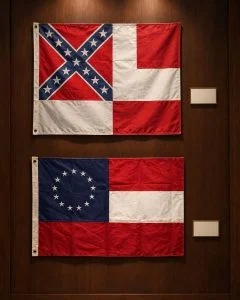
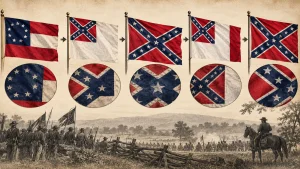
Every Civil War era design belongs to a window, and the window is the first line of the caption. The Stars and Bars, adopted in March 1861 with seven stars and later thirteen, served as the first Confederate national flag until May 1863. The Stainless Banner replaced it from May 1863, and the Third National — the Blood-Stained Banner, with the battle flag in the canton and a red bar ending the white field — was adopted on March 4, 1865, in the war's final weeks. Battle flags ran on their own track: the Army of Northern Virginia issued its nearly square flag with a white border from late 1861, while rectangular versions of the Southern Cross served with the Army of Tennessee, the Trans-Mississippi departments and the navy.
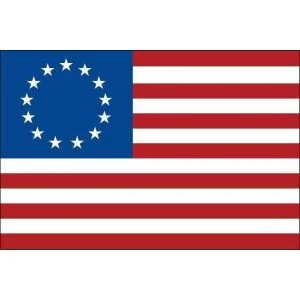
Union flags date by star count. A 34-star United States flag covers 1861 to 1863, after Kansas statehood; 35 stars run from 1863, when West Virginia joined; 36 stars arrive in 1864 with Nevada. Getting the star count wrong is the fastest way to hang a 1864 flag next to a 1861 uniform and call it a matched set.

Step 2: Name the army, the unit or the era on a label
A caption card does more context work than any frame. Four lines are enough: the design's name, the army or unit type that carried it, the years it was official, and one plain sentence noting it is a modern reproduction. "First National 'Stars and Bars,' 13-star version, 1861-1863. Modern sewn-nylon reproduction" reads clean and honest on a 4×6 card, and it answers every question a guest is going to ask before they ask it.
Attribution is where care pays. A square battle flag with a white border points to the Army of Northern Virginia; a rectangle points to the western armies or the navy; a first national with seven stars dates to early 1861 and thirteen stars to the later war. If you cannot attribute a specific regiment, attribute the army and the years — that is still context, and it is still true. Museum practice runs the same way: battlefield parks caption by pattern and period, not by guesswork.
Step 3: Mount by fabric and weight
Cotton reproductions — especially the 52-inch square battle flags — are heavy, and they belong flat: stretched on a frame, hung from a sleeve on an indoor pole, or mounted with the hoist hidden behind the display. Nylon printed and embroidered flags in 3×5 feet are light enough for standard grommet hanging and are the practical choice anywhere the flag might see a pole.
Light is the other mounting decision. Direct sunlight fades cotton dyes within a season and bleaches nylon over a couple of years, so keep fabric out of south-facing windows and light displays with low-heat LED fixtures instead. If the display lives near a doorway or a porch, expect damp, and dry cotton completely before it goes back on the wall — mildew starts in folded, damp cloth faster than most owners expect.
Step 4: Surround the flag with period pieces
Context multiplies when the flag shares the wall with its era. A square battle flag beside a framed 1862 map of Virginia, a 35-star United States flag above a case of period documents, a Stars and Bars over a shelf of regimental histories — each pairing answers the visitor's next question before it is asked. Photographs, currency, sheet music and campaign ribbons all work; the rule is that every piece carries a date and a connection to the flag's story.
When you are ready to Shop Ultimate Flags, pick the design first and let the caption and the neighboring pieces carry the history. Ultimate Flags lists each Civil War flag's pattern, construction and size on the product page, so half the research on your caption card is already done before the flag ships.

Where display practice comes from
The museum-style caption is not an invention of flag sellers. Many battle flags were captured in the field and held by the federal government for decades; Congress authorized their return in 1905, and the transfers carried on for years, with heritage groups founded in the 1890s driving much of the preservation work. Surviving originals cluster in state museums today, and those museums set the display standard: dated designs, plain captions, controlled light and no editorializing. A home display that follows the same four rules is borrowing practice that is more than a century old.
That standard matters because Civil War flags carry weight for a lot of visitors. Treat the flag as dated historical material — which is exactly what it is — and the display works for the collector, the reenactor and the schoolteacher alike. Advocacy belongs on no caption card.
Why context varies from one display to the next
- Audience. A heritage room full of collectors wants attribution and period detail; a classroom wants dates and a plain, factual story.
- Flag generation. A first national, a battle flag and a Third National each pull a different year range onto the caption, and the surrounding pieces should match that range.
- Space and light. A 52-inch square cotton flag needs more wall and less sun than a 3×5 nylon; the room decides the mount.
- Flying or flat. A flag on a pole at a reenactment carries context through the impression around it; a flat wall display carries it through the caption and the neighboring pieces.
- Framing and tone. Museums caption factually and let the dates do the talking — the same treatment keeps a home or school display historical rather than political.
Related questions about displaying Civil War flags
Can I fly a Civil War flag outside my home?
Yes. These flags are legal to display in the United States and fly regularly at museums, battlefield parks, reenactments and commemorations as historical material. For outdoor duty, nylon handles rain and dries fast; save cotton for dry days and indoor walls.
What size Civil War flag works best indoors?
A 3×5 feet reproduction suits most walls and standard hangers, and a 52-inch square cotton battle flag gives the Army of Northern Virginia look in a camp or heritage room. Original regimental colors ran larger still — near six feet — because they had to be seen across a battlefield.
How do I keep a cotton reproduction from fading?
Keep it out of direct sunlight, light it with low-heat LED, and rotate which flag is on display every few months. Dry the fabric completely before storage, and fold it loosely or roll it rather than creasing the same lines year after year.
FAQ
How do you display a Civil War flag with historical context?
Date the design, name the army or unit on a label card, mount by fabric weight and add period pieces around it. A 3×5 reproduction with a four-line caption reads as history rather than decoration.
What are the three Confederate national flags and their dates?
The Stars and Bars served from March 1861 to May 1863, the Stainless Banner from May 1863 to March 1865, and the Third National from March 4, 1865 to the war’s end. Each belongs to its own caption window.
Is it legal to display Confederate Civil War flags?
Yes. They are legal to display in the United States and appear in museums, battlefield parks, reenactments and historical collections as historical material.
What size Civil War flag is best for an indoor display?
A 3×5 feet reproduction suits most walls, and a 52-inch square cotton battle flag gives the Army of Northern Virginia look. Original regimental colors ran near six feet.
What should a label next to a Civil War flag say?
The design’s name, the army or unit type that carried it, the years it was official, and a note that it is a modern reproduction.
How do you light a Civil War flag display?
Use low-heat LED fixtures aimed at an angle, keep the flag out of direct window sun, and check the fabric a couple of times a year for fading or damp.
Can Civil War flags be used in a classroom?
Yes, as dated historical material. Pair the flag with a caption tying it to specific events and treat the topic factually, the way battlefield parks do.
One last thing
The Third National was official for roughly five weeks — adopted March 4, 1865, it was still the national flag when the armies surrendered that April — which makes it the shortest-lived national design of the war. Date the flags on your wall and stories like that fall out for free; the caption card, not the frame, is what turns a reproduction into history.