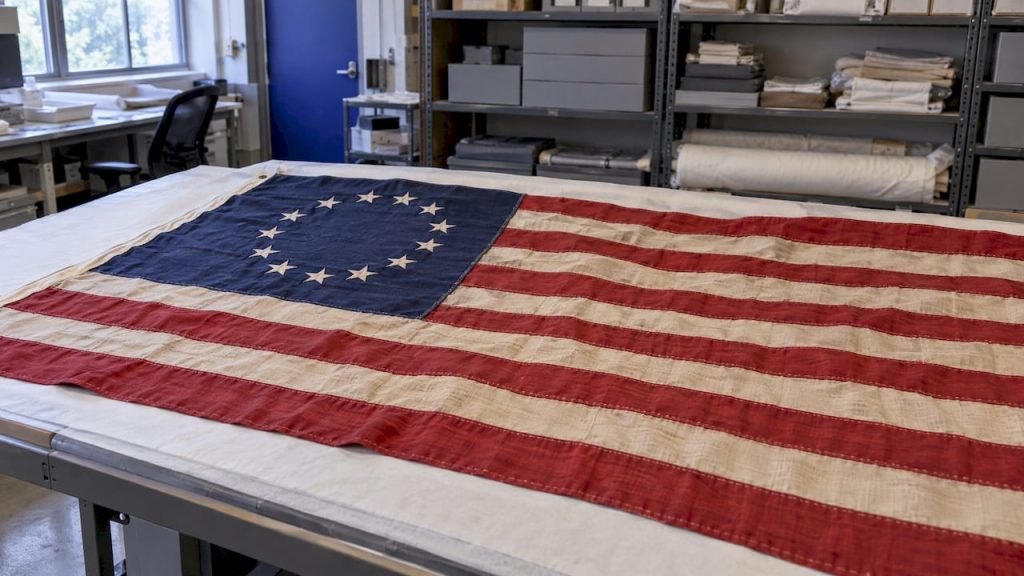
The 13 star flag is not one design but a family of them. The stars have appeared in a circle, in staggered rows, in a medallion and in the shape of one great star, and every arrangement tells a different part of the story of a young nation. If you want to fly one, the Betsy Ross circle is the best known, and our Betsy Ross flags are a natural place to start. Below, we walk through each variant so you know what you are hanging and why it matters.
TL;DR
- The Flag Resolution of June 14, 1777 called for 13 white stars in a blue field but never said how to arrange them, so many patterns followed.
- The two most common early layouts are rows: 4-5-4 and 3-2-3-2-3. The circle, known as the Betsy Ross pattern, is the most recognized today.
- Other historic variants include the medallion and the Great Star, both popular in later commemorative flags.
- Thirteen-star flags were official from 1777 to 1795, then lived on as Navy boat ensigns and commemorative flags.
- Ultimate Flags carries 13 star USA flags and Betsy Ross flags for display, reenactment and collecting.
Table of Contents
- Where the 13 stars began
- The row patterns: 4-5-4 and 3-2-3-2-3
- The Betsy Ross circle
- The medallion and the Great Star
- A quick comparison
- How long the 13 star flag flew
- What the colors and stars mean
- Choosing the right variant to fly
- Our view
- Bring a 13 star flag home
- FAQ
- Sources
Where the 13 stars began
On June 14, 1777, the Continental Congress resolved that the flag of the United States would have thirteen stripes, alternate red and white, and a union of thirteen white stars in a blue field, representing a new Constellation. The stars and stripes stood for the thirteen original colonies.
Notice what the resolution leaves out: the layout. According to the North American Vexillological Association’s Ted Kaye, there was no standardized pattern for any U.S. flag until 1912. Flag makers, ship captains and artists arranged thirteen stars as they saw fit. That freedom is why collectors speak of variants at all. The Museum of the American Revolution’s exhibition on 13-star flags, curated by specialist Jeff R. Bridgman, showed thirty-two different patterns.
The row patterns: 4-5-4 and 3-2-3-2-3
The earliest depictions of the flag lined the stars up in rows. The two most commonly found arrangements are 4-5-4 and 3-2-3-2-3. The earliest artist renderings, 1779 Dutch drawings of John Paul Jones’s ships, show one of each, with eight-pointed stars.
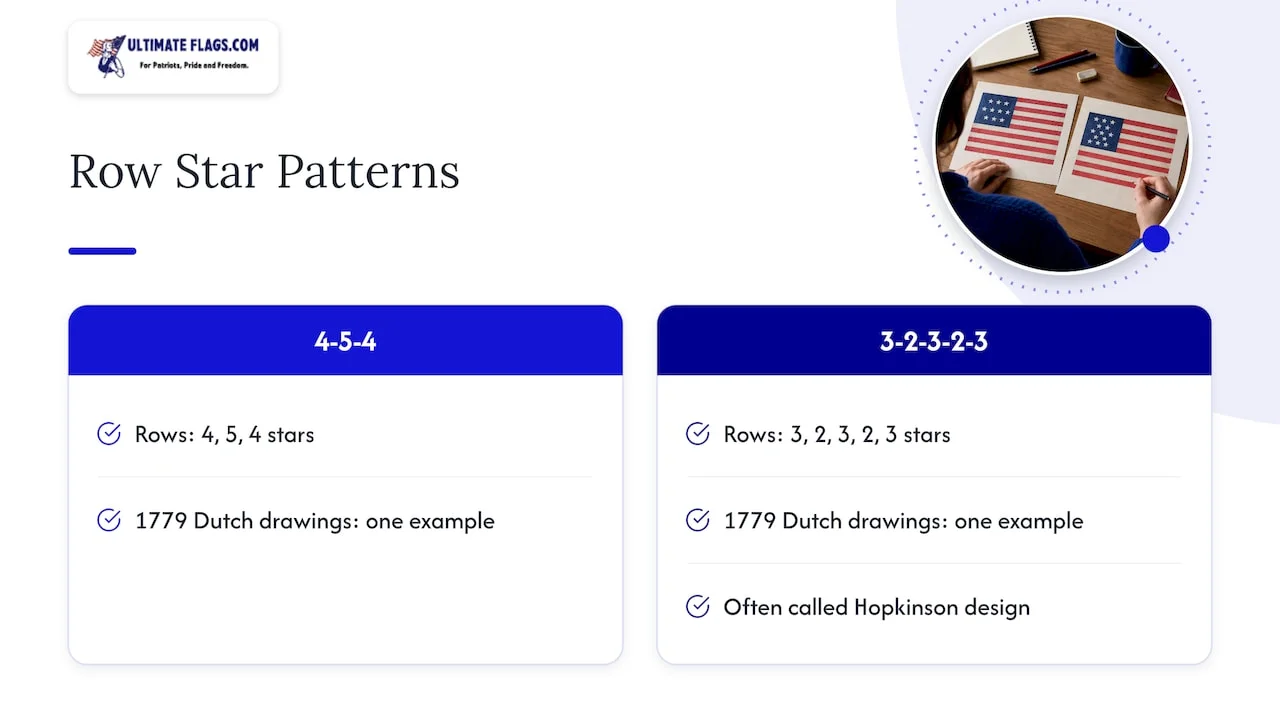
The 3-2-3-2-3 layout is often called the Francis Hopkinson design, after the Congress member credited by many with shaping the first flag. Kaye notes that circular versions only began to appear in 1782, which means the rows came first.
If you want the look closest to what Revolutionary soldiers and sailors would have seen in print, a row-pattern flag is the choice. Our 13 star old USA flag selection is built for exactly that kind of historical display.
The Betsy Ross circle
Thirteen stars in a ring, a symbol of equal states with none above another. An eyewitness to the 1777 surrender at Saratoga described stars disposed in a circle, symbolizing the perpetuity of the Union, and William Barton’s 1782 Great Seal design called the circle a symbol of eternity.
The name is the tangled part. The legend says Betsy Ross sewed the first flag for George Washington. Historians regard the tale as mostly fictionalized, and her only documented Revolutionary connection to flag making is a 1777 payment for ship’s colours. The story rests on an 1870 paper by her grandson William Canby, which does not describe the circle. The pairing of Ross and the ring took hold with Charles Weisgerber’s 1893 painting, a canvas nine feet by twelve shown at the Columbian Exposition in Chicago.
None of this dims the pattern. The circle has been a beloved emblem of American unity for well over a century, and Bridgman’s research indicates that actual Betsy Ross flags are typically Gilded Age pieces rather than Revolutionary relics. That is a proud heritage of its own: a symbol so cherished that each generation sewed it again.
We offer the pattern in several constructions:
- Sewn and embroidered nylon, made in USA
- Cotton, sewn and embroidered, made in USA
- Printed nylon for outdoor use, 3 x 5 ft
For the full account of the legend, read the Betsy Ross flag and its revolutionary history.
The medallion and the Great Star
Two later variants reward the collector’s eye.
The medallion places a center star inside a wreath of eight stars, with one star in each corner of the canton. It emerged during the Civil War and was popular at the 1876 Centennial.
The Great Star, sometimes called the Grand Luminary, arranges the stars into one large five-pointed star. The Museum of the American Revolution features an early-nineteenth-century flag in this pattern. It reads as a constellation in the most literal sense, a banner that seems to whisper the very word Congress chose.
A quick comparison
| Variant | Layout | Best known for |
|---|---|---|
| Rows, 4-5-4 | Three staggered rows | Earliest depictions, 1779 drawings |
| Rows, 3-2-3-2-3 | Five rows, Hopkinson design | Earliest depictions, Hopkinson attribution |
| Circle | Thirteen stars in a ring | Unity and eternity; Betsy Ross name |
| Medallion | Center star, wreath of eight, four corners | Civil War era, 1876 Centennial |
| Great Star | Stars forming one large star | Early nineteenth century |
How long the 13 star flag flew
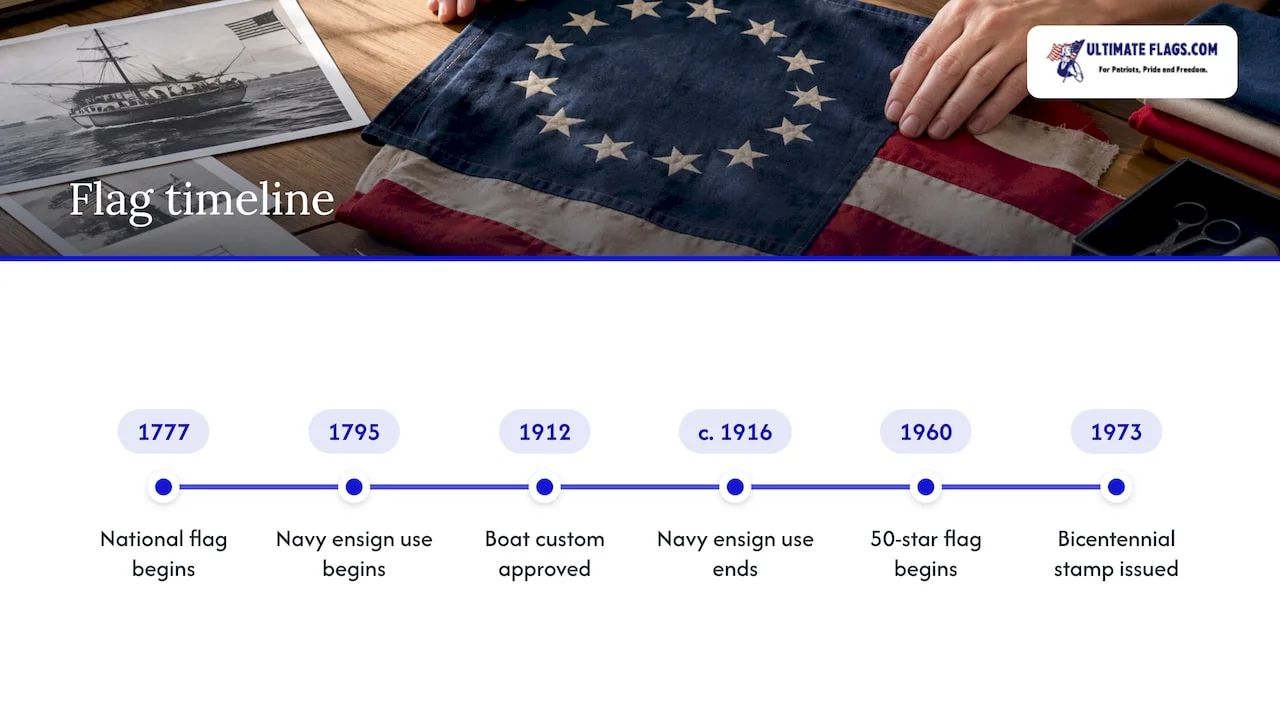
The design was the national flag from 1777 until 1795. After that it did not vanish. U.S. Navy small boats flew it as an ensign from 1795 until about 1916, and President Taft’s Executive Order 1637 of October 29, 1912 formally approved the 13-star custom for boat flags. Commemorative versions were made throughout the 19th and 20th centuries.
The national flag itself has changed since: 26 modifications since 1777, with the 50-star version in use longest, since 1960. In 1818 Congress fixed the stripes at thirteen and tied the stars to the number of states. The 13-star flag even returned for the bicentennial, appearing beside the 50-star flag on a 10-cent stamp issued December 8, 1973.
What the colors and stars mean
The resolution called the stars a new constellation. The stripes stand for the first thirteen colonies, and the traditional meanings of the colors are white for purity and innocence, red for hardiness and valor, blue for vigilance, perseverance and justice.
Choosing the right variant to fly
- For a home flagpole or porch: a sewn nylon Betsy Ross flag is built for outdoor display. Pair it with the right pole from our flagpoles and hardware, and see our guide to flagpole types and footing rules.
- For reenactment or a classroom: pick a row pattern, which matches the earliest illustrations.
- For a collection: gather several layouts side by side and let the differences tell the story.
- For events and parades: a circle is instantly recognized at a distance.
Our view
Every 13 star flag is a conversation with 1776. The circle, the rows, the medallion and the Great Star are all honest expressions of the same conviction: thirteen colonies, one new constellation.
We have been selling flags online longer than anyone in America, and we believe a good history display begins with knowing what you are flying. Choose the pattern that speaks to you, and fly it with pride.
John Hough
Bring a 13 star flag home
Ultimate Flags offers 13 star USA flags and Betsy Ross flags in nylon and cotton, along with poles and hardware to fly them. Browse the 13 star USA flag collection or see everything in our flag collections.

FAQ
Did the original U.S. flag have 13 stars?
Yes. The Flag Resolution of June 14, 1777 set the union at thirteen white stars in a blue field. They represented the thirteen original colonies.
Was the Betsy Ross circle the first arrangement?
Probably not. NAVA’s Peter Ansoff concludes it is probably not the case that circles were used during the Revolutionary War, as 18th-century depictions show rows or irregular patterns. The circle was popularized in 1893 and remains the best-loved variant.
Are 13 star flags rare?
No. They were made over a longer period than any other starry national ensign, according to Cooper’s Smithsonian guide. Authentic Revolutionary originals are the scarce ones.
Can I fly a 13 star flag today?
Yes, as a historic or commemorative display. Outdoor nylon versions suit a home flagpole, and our Betsy Ross collection includes several.
Sources
- Resolved, That the flag of the United States, Smithsonian National Postal Museum
- The Stars and Stripes, Forever, U.S. Department of State
- FQ&A: United States National Flag, NAVA
- Thirteen-Star Flags, Cooper
- Triskaidekaphilia in Philadelphia, The Magazine Antiques
- Stars and Stripes: The Progression of the American Flag, Museum of the American Revolution
- Betsy Ross flag, Wikipedia
- Hopkinson and Betsy Ross Flags, Peter Ansoff
- Why the American Flag Has Had so Many Different Star Configurations, Sarah Archer
- Today Is Flag Day, whitehouse.gov archive