
 BUY Rebel Flags For Sale
How many states were in the Confederacy? Ask three people and you may hear three answers: seven, eleven or thirteen. All three are right, depending on when you are counting and how you count. The stars on Confederate flags tell the story.

The First Seven States
The Confederate Battle Flag carries 13 stars for 13 states, but the Confederacy started with seven. South Carolina seceded first, on December 20, 1860. Five more states followed in January 1861: Mississippi, Florida, Alabama, Georgia and Louisiana. Texas passed its secession ordinance on February 1.
Delegates from the first six states met in Montgomery, Alabama, on February 4, 1861, with Texas delegates arriving soon after. Together these seven states formed the Confederate States of America. Jefferson Davis was elected provisional President on February 9 and took office on February 18, more than two weeks before Abraham Lincoln was inaugurated on March 4.
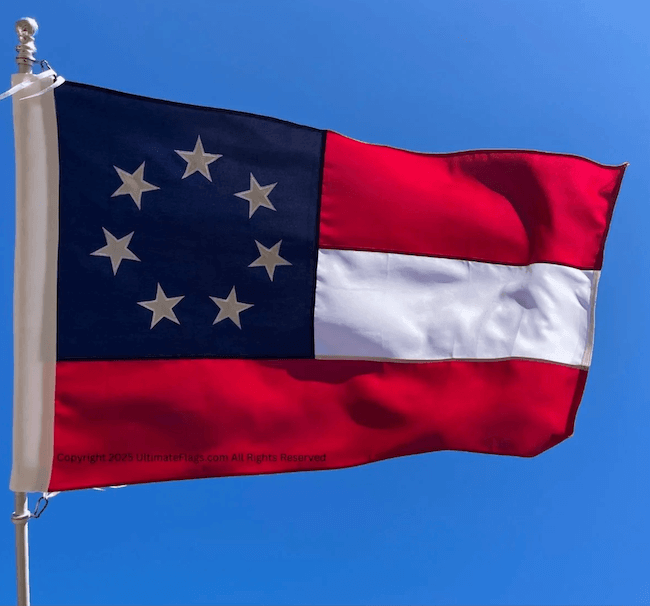
The first national flag, the Stars and Bars, was raised in Montgomery on March 4, 1861, with seven stars in its circle. As more states joined, more stars were added.
Eleven States After Fort Sumter
After the firing on Fort Sumter in April 1861 and Lincoln’s call for 75,000 troops to put down the seceded states, four more states refused to take up arms against their neighbors. Between mid-April and early June 1861, Virginia, Arkansas, Tennessee and North Carolina left the Union and joined the Confederacy. That brought the total to 11 Confederate States, and the capital moved from Montgomery to Richmond.
Four slave states, Delaware, Kentucky, Maryland and Missouri, stayed in the Union, at least officially. Two of them would not stay settled for long.
Missouri: The Twelfth Star
Missouri tried to stay neutral. That ended in May 1861 when Union troops under Captain Nathaniel Lyon surrounded and captured the pro-Southern state militia at Camp Jackson outside St. Louis. Fighting broke out across the state. Governor Claiborne Fox Jackson and the elected state government were driven from the capital, and the Missouri State Guard took the field against Union forces.
Meeting in exile at Neosho in late October 1861, members of the Missouri legislature passed an ordinance of secession. The Confederate Congress admitted Missouri as the twelfth state on November 28, 1861.
Kentucky: The Thirteenth Star
Kentucky’s story ran almost the opposite way. The state had declared itself neutral. In early September 1861, Confederate General Leonidas Polk moved into Kentucky and occupied Columbus on the Mississippi River. Union General Ulysses S. Grant answered by seizing Paducah a few days later. Because the Confederates had entered first, the Unionist legislature in Frankfort sided with the North.
Many Kentuckians were furious. In November 1861, Southern-minded delegates met at Russellville, declared Kentucky independent and formed a provisional Confederate state government under George W. Johnson. Kentucky was admitted to the Confederacy on December 10, 1861, making a total of 13 Confederate states.

Seven, Eleven or Thirteen?
In short, Missouri and Kentucky were claimed by both North and South, and both sent representatives to both the U.S. and Confederate Congresses. Because Union armies held most of their territory, many history books count only 11 Confederate states. But the Confederate government counted 13, and that is why the Battle Flag, the Second National and the Third National flags all carry 13 stars.
- 7 states: the original Confederacy formed in Montgomery in February 1861.
- 11 states: after Virginia, Arkansas, Tennessee and North Carolina joined in spring 1861.
- 13 states: after Missouri and Kentucky were admitted in late 1861.
Find flags from every stage of the story in our Confederate flag collection.
Thanks for reading. Please share our posts with your friends and family so they too can learn more about Southern Heritage and History.
Brought to you by: Ultimate Flags