Posted on

Rally Flags for Organizers: Avoid Protocol and Safety Gaps

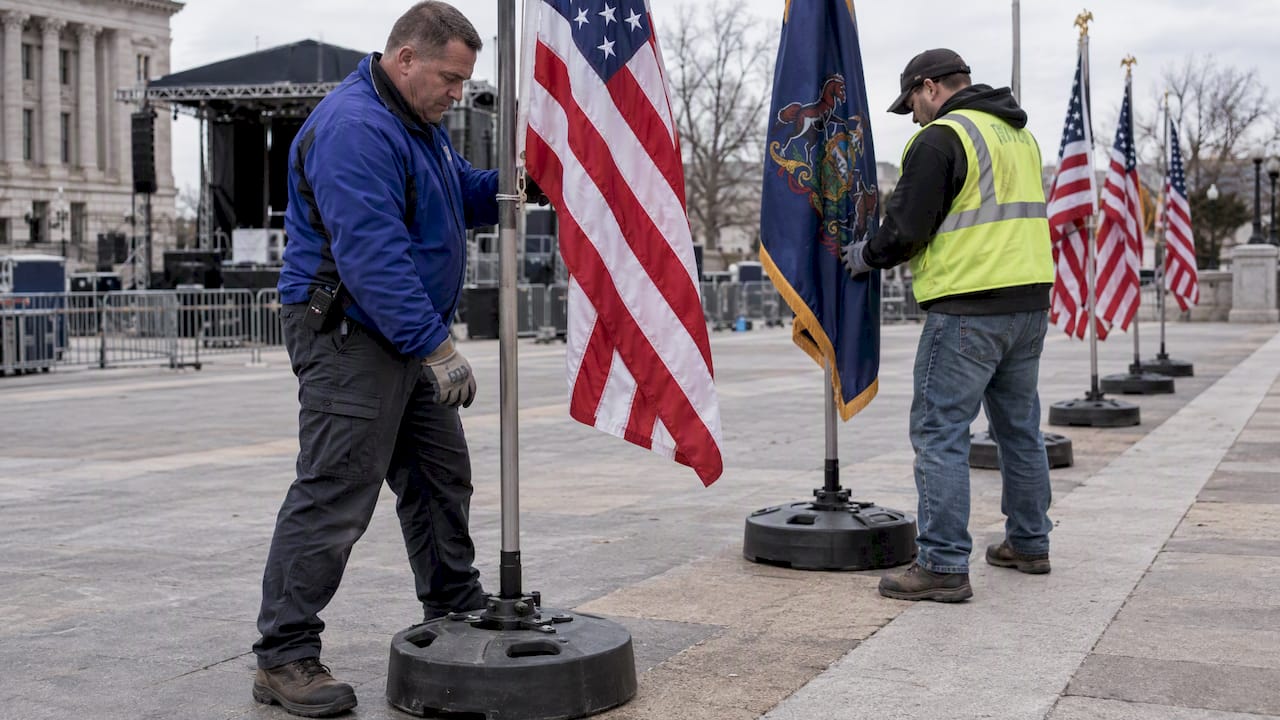
Stewards position flags beside a clear rally route

Treat flags as both a symbol and a safety asset: follow display protocol, weave them into your site and safety plan, assign a person to each duty, and verify placement before the gates open. Every flag at your rally carries meaning and risk in equal measure, and the sections below walk through the roles, rules, and checklists that keep both intact.


TL;DR:

  • The U.S. flag may remain aloft overnight only with adequate illumination; otherwise, lower it at sunset and raise it again the next morning.
  • Some municipal guidance may set emergency lanes at 20 feet; keep poles, bases, and guy lines off accessible routes and away from viewing platforms.
  • Assign a crew member to verify red flag placement before every stage and log checks by radio; a missing flag can halt operations.
  • Choose nylon for light to moderate wind, polyester for sustained heavy wind, and cotton for ceremonial displays that will see less outdoor use.
  • Permit requirements vary by jurisdiction; confirm height approvals for tall poles, obtain written consent on private land, and keep every approval on site.

Ultimate Flags
Find Flags for Your Rally
Ultimate Flags offers a wide selection of flags, banners, poles, and hardware for organizers choosing what to display at their event.

Browse flags and accessories

Table of Contents

Team Roles and Responsibilities for Flag Handling and Event Safety

A rally succeeds or stumbles on the strength of its roles, not its slogans. We’ve found that the organizers who sleep best the night before are the ones who named names early: a permit lead who owns every form and deadline, a Chief Safety Officer who answers for the whole grounds, a marshal lead who commands the volunteers on the ropes, a communications lead running the radio net, and a flag coordinator whose entire job is the banners themselves. FIA rally safety guidelines call for exactly this kind of designated ownership, naming a Chief Safety Officer and stage commanders who produce and keep the safety dossier current.

The flag coordinator’s brief runs wider than most organizers expect:

  • Procurement and sizing, so every flag on the field matches in scale and quality.
  • Mounting and rigging, confirming poles, halyards, and grommets hold under wind load.
  • Pre-event inspection, checking for tears, faded color, or weak stitching before setup.
  • Illumination sign-off, verifying any flag flown after sunset has adequate lighting.
  • Spare-flag management, keeping replacements staged and ready within reach.

Equipment matters as much as titles. Give your marshals and flag crew distinct tabards so attendees and law enforcement can spot authority at a glance, hand every lead a charged radio on a dedicated channel, and build a laminated checklist that travels with the flag coordinator from first pole to last. Coordinate early with local authorities and any safety officer assigned to your permit, since someone outside your team often needs to sign off on final flag placement before the rally opens.

Pro Tip: Assign a single radio channel exclusively to flag and stage verification so safety calls never get lost in general event chatter.

Flag Etiquette and Display Protocol: Position of Honor, Order, and Illumination

Respect for a flag is not an abstraction. It shows up in where you hang it, how high, and whether a light reaches it after dark. The U.S. Flag Code states that the American flag should fly from sunrise to sunset, though it may remain aloft around the clock if properly illuminated through the night.

Federal law requires illumination for overnight display, meaning any rally running past dusk needs a lighting plan for its flags, not just its stage.

When flags share a line, the order is not a matter of taste. The national flag occupies the center and highest point among any grouping, and no other flag, political, organizational, or historical, may fly above it or to its own right when staffs stand side by side. For a linear arrangement, the national flag anchors the center; in a semicircle, it takes the middle position facing the audience; in a procession, it leads or holds the position of honor on the marching right.

A few practical rules keep a display dignified rather than chaotic:

  • Never raise another flag higher than the national flag on the same pole or line.
  • Match sizes across a row of flags to avoid implying one group outranks another.
  • Lower and furl flags gently; never let fabric drag or touch the ground.
  • Retire torn or faded flags rather than flying damaged material at the event.

International gatherings follow a parallel logic. United Nations flag protocol sets out ordering rules for rows, circles, and semicircles at multilateral events, built on the same principle: equality in size, clarity in placement, and no symbol allowed to overshadow another without reason. For deeper guidance on display and care, our flag etiquette guide walks through the Flag Code provision by provision.

Site Plan and Safety Plan: Placing Flags Within Operational Safety

A flag pole planted in the wrong spot is not a protocol error. It is a hazard. Every rally needs a site plan that treats flags as physical objects with footprints, guy lines, and sightline consequences, not just as symbols hung for effect.

Your site plan should account for:

  1. Accessible travel routes that remain unobstructed by poles, bases, or trailing halyards.
  2. Emergency access lanes wide enough for responders to move freely, with municipal guidance often specifying a 20-foot minimum.
  3. Sanitation facilities positioned clear of flag lines and crowd funnels.
  4. Marshal locations marked on the schematic, matching the positions laid out in rally safety templates.
  5. Radio checkpoints where stage or zone leads confirm status throughout the day.

Red flags and other safety flags demand their own layer of verification. The FIA’s safety guidelines treat these as mission-critical equipment: safety crews must physically confirm red-flag locations before each stage runs, and missing or misplaced flags can halt a stage outright. Apply the same discipline to a rally setting.

  • Place red or safety flags at every point where a marshal needs to signal a stop or hazard.
  • Assign a specific crew member to verify each flag’s position during setup.
  • Record every verification as a checklist item tied to a radio confirmation.
  • Repeat the check at any shift change among marshals.

Whoever holds the Chief Safety Officer role should be the final signature on this verification, documented the same way a rally safety plan template requires stage schematics and marshal positions to be documented before a single vehicle or marcher moves.

Flag Types, Sizes, Materials, and Arrangement Best Practices

The flag you choose shapes how your message reads from fifty feet away, and it determines whether that same flag survives a windy afternoon. Handheld flags, typically small enough for a single marshal or attendee to carry comfortably, work best for crowd-level visibility and movement through a procession. Staff-mounted flags suit fixed display lines along a stage or entrance. Larger flags, hoisted on taller poles, anchor the visual center of a rally and read clearly from a distance.

Matching sizes across a line of flags is not cosmetic. International flag-protocol guidance stresses that identical sizing across a display preserves equality among the groups or nations represented, avoiding any appearance that one symbol was given preference over another.

Material choice depends on how hard the flag will work that day:

  • Nylon holds color vividly and performs well in light to moderate wind, a strong choice for most rally settings.
  • Polyester resists fading and tearing under sustained heavy wind, useful for exposed or coastal sites.
  • Cotton offers a traditional appearance for ceremonial or historical displays but wears faster under repeated outdoor use.

When mounting multiple flags on a single staff line, give each pole enough spacing that fabric cannot tangle in a gust, and stagger halyard lengths slightly so flags do not strike adjacent poles. For a procession, space flag bearers at consistent intervals so the line reads as deliberate rather than ragged.

Logistics: Mounting, Storage, Transport, and a Spare-Gear Checklist

Getting a flag to the field in good condition takes as much planning as flying it once it arrives. Store flags folded, dry, and away from direct sunlight between uses, since UV exposure and dampness both accelerate fading and rot. Transport them flat or loosely rolled in a dedicated case rather than crumpled in a general equipment bin, a habit that preserves both fabric and dignity.
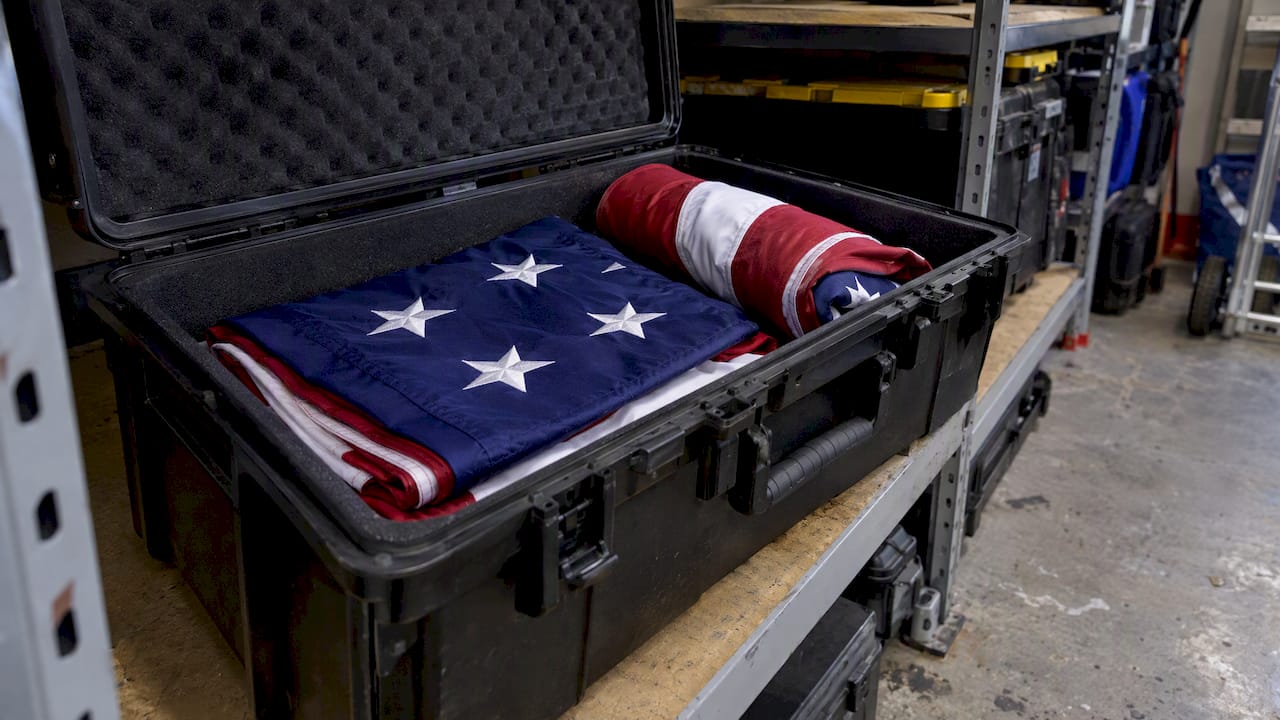
Folded flags stored inside a transport case

Illumination deserves a deliberate decision, not an afterthought. A small spotlight aimed upward at the flag satisfies the Flag Code’s overnight display requirement, and battery-powered LED units offer a safe option where running electrical cable across a crowded site is impractical. If no illumination can be arranged, the fallback is simple: lower the flag at sunset and raise it again the next morning.

Build a spare-gear kit before the first pole goes up:

  1. Extra halyards and clips, since these fail more often than the flags themselves.
  2. Replacement grommets and a basic repair kit for minor tears.
  3. At least one spare pole per display line, in case of a break or bend.
  4. Backup flags matched in size and design to every flag flying that day.

Pro Tip: Label your spare-gear case clearly and store it with the flag coordinator, not in a general supply tent, so a torn flag can be swapped in minutes, not after a search.

Accessibility and Inclusivity: Routes, Viewing Areas, and Clear Communication

An accessible rally is a better rally for every attendee, not a compliance checkbox tucked at the end of planning. Guidance from the NYC Mayor’s Office for People with Disabilities calls for accessible travel paths, accessible portable toilets, and designated viewing areas built into the site plan from the start, not added after the layout is finalized.

Flag placement and accessibility intersect more than most organizers expect. A pole base or trailing halyard across a walkway becomes a trip hazard or a blockage for a wheelchair user, and a tall flag line positioned carelessly can cut off sightlines from an accessible viewing platform.

  • Route accessible paths around, never through, flag lines and pole clusters.
  • Position accessible viewing platforms with a clear sightline to the stage, unobstructed by flag poles.
  • Keep accessible restroom facilities clear of guy lines and flag-crew staging areas.
  • Post signage directing attendees to accessible routes and facilities from every entrance.

Communicate these features out loud as well as on paper. An access check announced at the start of the event, paired with printed info sheets covering interpreter availability and service-animal guidance, measurably reduces the number of on-site requests for help later in the day.

Timeline and Event-Day Checklist: Setup, Verification, Running, and Teardown

A rally runs smoothest when every flag-related task has a time slot, not just a place on a list. Permits and the finalized site plan should be locked well before event day, with marshal training and an equipment check scheduled in the final days beforehand.

On the day itself, follow a sequence rather than reacting as issues surface:

  1. Hoist flags during initial setup, checking each for damage before raising.
  2. Verify red and safety flag placement at every stage or zone before opening.
  3. Confirm each verification over radio, logged by the Chief Safety Officer or designated lead.
  4. Run the event with periodic spot checks on flag condition and illumination as daylight fades.
  5. Lower flags respectfully at teardown, folding each according to its own protocol rather than stuffing them into bags.

A few closing habits separate a smooth wrap-up from a scramble:

  • Retire any flag damaged beyond repair rather than reusing it at the next event.
  • Collect spare gear and count it against the original inventory.
  • Hold a short debrief with the flag coordinator and marshal lead while the day is still fresh.
  • Note any placement or illumination issue for correction before the next rally.

Practical Buying and Spec Guidance for Rally Organizers

Choosing the right flag before the event saves every headache described above. We’ve spent years supplying organizers who need flags that survive wind, sun, and repeated handling, not just a single afternoon on a shelf. Reinforced grommets matter more at a rally than almost anywhere else, since repeated raising and lowering is exactly where cheaper stitching fails first. UV-resistant dye holds color through a full season of outdoor use, and a weight of fabric suited to your typical wind conditions keeps a flag from thrashing itself apart by midday.

Pole kits deserve the same scrutiny as the flags themselves:

  • Request reinforced hardware at the pole-to-base connection, the point under the most strain.
  • Ask about quick-release fittings when flags need fast swapping between stages or speakers.
  • Confirm halyard material rated for outdoor use rather than indoor display cord.
Spec consideration Why it matters for rallies
Reinforced grommets Withstand repeated raising and lowering without tearing
UV-resistant dye Holds color through extended outdoor exposure
Quick-release pole fittings Speed up swaps between stage segments or speakers

For a deeper walk through fabric choices and sizing, our flag qualities and uses guide breaks down the tradeoffs, and the full flag collections catalog covers the range organizers typically need in one order.

Guidelines for Obtaining Permits and Permissions for Flag Displays

Permission to fly a flag at a public rally rarely comes from a single office, and the requirements shift by jurisdiction, so build in time to track down every signature you need. Most municipalities require a general event permit before any staging, sound, or display equipment goes up, and that permit application is where you first flag your intent to display national, state, or organizational flags.

Some locations layer on separate approvals for structures over a certain height, which can include tall flagpoles, so check with your local permitting office whether your poles trigger that threshold. If your rally sits on private property, the property owner’s written consent functions as your baseline permission, though you may still need a public-assembly permit if the crowd spills onto sidewalks or streets.

Submit your site plan alongside your permit application whenever possible. Reviewers move faster when they can see exactly where flags, emergency lanes, and accessible routes sit relative to each other, rather than approving a layout they have to imagine. Build in a buffer before your target date, since permit offices in many jurisdictions take weeks rather than days to return a decision, and a flagged issue on first submission can cost you another full review cycle. Keep a copy of every approval on-site during the event itself, since a safety officer or local authority may ask to see it.
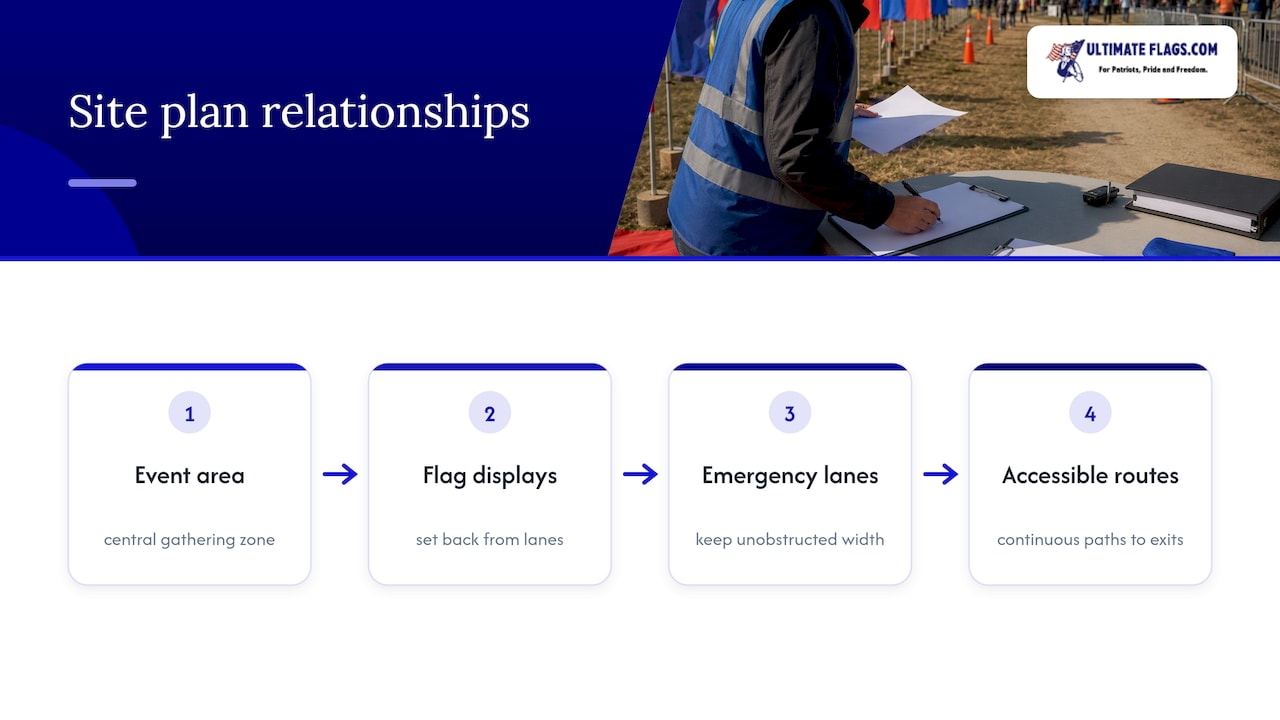
Site plan showing flags and clear access routes

Common Challenges and Troubleshooting Tips for Flag Setup

Wind is the most persistent adversary at any outdoor rally, and it rarely cooperates with a printed schedule. A sudden gust can snap a cheap halyard or tip a poorly anchored pole base, so weight every base generously beyond what seems necessary and inspect anchor points again an hour before doors open, not just the night before.

Tangled lines rank close behind as a recurring frustration, especially on a staff line carrying several flags at once. Space poles generously and stagger halyard lengths so fabric cannot catch a neighboring pole mid-gust, and assign one marshal to walk the line every hour checking for snags.

Fading light catches organizers off guard more often than it should. A rally that runs long without an illumination plan in place either violates the overnight display expectation set out in the Flag Code or forces a last-minute scramble for lighting. Decide your illumination approach during initial planning, not at dusk.

Damaged flags happen, usually from wind, handling, or an unexpected rip during transport. This is exactly why a spare kit belongs with the flag coordinator from the first hour of setup rather than buried in a general supply tent. A five-minute swap beats an empty pole or, worse, a torn flag left flying through the afternoon.

Finally, miscommunication between marshals and the safety team causes more delays than any physical failure. A dedicated radio channel for flag and stage verification, checked in at fixed intervals, resolves most of this before it becomes a visible problem.

What I Learned Running Rallies: A Few Honest Notes

Every rally I have helped plan taught the same lesson in a different costume: the flags people remember are the ones that flew straight, were lit properly after dark, and never became the story themselves. Safety and symbolism are not competing priorities, they are the same job viewed from two angles. Assign your roles early, verify every red flag and every pole base before the crowd arrives, and treat a torn or mishandled flag as seriously as a blocked emergency lane, because to the people watching, it often reads the same way. Fold flag protocol directly into your safety plan rather than bolting it on afterward, and you will spend less of your event day putting out small fires and more of it watching the rally you actually planned for.

— John Hough

Where to Source Rally Flags, Pole Kits, and Accessories

Once your roles, site plan, and timeline are set, the last piece is sourcing flags built to survive the day you just planned for. We stock a wide range of political flags, USA flags, and historic war flags, along with country flags and state flags for organizers who need to match a specific lineup. Order with lead time to spare, since reinforced grommets and properly sized flags make the difference between a display that holds through a long afternoon and one that needs mid-event repair.

  • Browse the full flag collections to match sizes across your entire display line.
  • Check our flag qualities and uses guide before ordering if you’re unsure which material suits your conditions.
  • Request reinforced grommets and quick-release fittings when ordering if your rally involves frequent raising and lowering.

Ultimate Flags

Visit flag collections to place your order with enough lead time for your rally date.

FAQ

What do different flags mean in racing?

In motorsport, flag colors signal specific instructions to drivers: a red flag halts the session immediately, while other colors indicate hazards, passing restrictions, or the finish. FIA rally safety guidelines require safety crews to verify red-flag placement before every stage, since an incorrect or missing flag can trigger a stage cancellation.

How should flags be arranged in a group display?

The national flag belongs at the center and highest point of any grouping, whether the display runs in a line, a semicircle, or a procession. International flag protocol also recommends matching sizes across all flags in a display to preserve equality among the groups represented.

What does a three color flag typically mean?

A three-color flag generally represents a tricolor design, a common format among national flags where each band or section carries its own symbolic meaning tied to that country’s history. The specific meaning varies entirely by nation, so there is no single universal definition that applies across every tricolor flag.

Is it illegal to fly the American flag at night without a light?

The U.S. Flag Code states the flag should be displayed from sunrise to sunset, but it may be flown around the clock if properly illuminated during the hours of darkness. Flying it overnight without adequate illumination falls outside the Code’s guidance, so organizers should either light the flag properly or lower it at sunset.

Sources

Posted on

Buyers: Southern Heritage Flags, Sizes, Materials, and Museum Grade Care

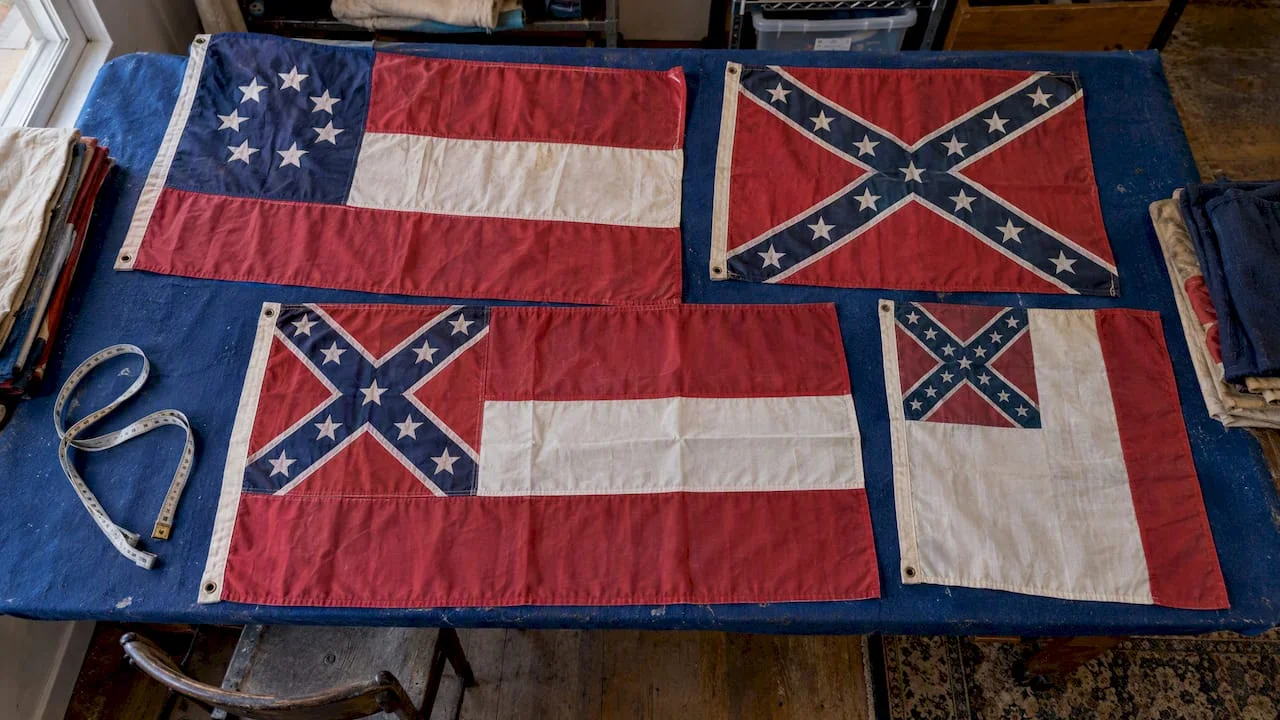
Southern heritage flags laid out for comparison

For outdoor display, choose durable polyester with a reinforced canvas header; for reenactment and collecting, favor sewn cotton or heavyweight parade cloth that honors the look and weight of the original banners. Each material carries its own trade-off between resilience and authenticity. We carry Southern heritage flags built for both purposes. The sections below walk through exactly how to match fabric, size, and mounting to your intended use.


TL;DR:

  • Stitched designs cost more but last longer and add texture; printed flags cost less, yet can fade faster and show through on the reverse.
  • A 3×5 foot flag suits most residential poles; use 4×6 or 5×8 for larger poles, and match grommets or sleeves to its mounting.
  • Collectors should block direct sunlight, rotate display time, and store flags flat or loosely rolled on acid free tubes away from changing humidity.
  • At events lasting several days, carry a spare flag of the same size and rotate them; use breakaway hardware on vehicles or in crowds.
  • Rules differ across private property, schools, government buildings, workplaces, vehicles, and shared venues, so check local policies before displaying a flag publicly.

Ultimate Flags
Find a Southern Heritage Flag
Explore Southern heritage flags for display, collecting, or historical reenactment, with related accessories available from Ultimate Flags.

Browse Southern heritage flags

Table of Contents

Fabric, construction and size guide: how to match flag type to use

The fabric you choose determines how your flag ages, moves in the wind, and reads from a distance. Polyester stands up to sun, rain, and repeated outdoor cycling far better than cotton, which is why most flags flown on residential poles or at outdoor events use it. Cotton, by contrast, carries a softer drape and a muted, woven texture that reenactors and collectors prize because it echoes the look of nineteenth-century textiles, even though it demands more careful handling. Specialty parade cloth splits the difference: lighter than canvas cotton but heavier than standard polyester, built for flags carried by hand in processions.

Construction matters as much as material. Stitched or appliqué flags, where stars, bars, or crosses are sewn piece by piece, cost more and last longer, and they carry a depth and shadow line that printed designs cannot match. Printed flags, dyed directly into the fabric, are lighter on the wallet and fine for everyday outdoor display, but the image can show through the back and fade faster under sustained sun. For a full breakdown of how these two approaches compare on durability and authenticity, see our cotton versus polyester comparison.

Standard sizing follows the use case closely:

  • 3×5 feet: the most common residential and indoor size, suited to porch poles and wall display.
  • 4×6 feet: a step up for larger poles, commercial fronts, or more commanding indoor presence.
  • 5×8 feet: built for tall flagpoles and open outdoor settings where visibility from a distance matters.
  • Parade and carry sizes: typically smaller and lighter, designed for hand-carried use in processions and reenactments where maneuverability outweighs scale.

Attachment style decides how a flag performs once it is mounted. A canvas header with brass grommets suits pole display and withstands repeated raising and lowering. A pole sleeve works well for handheld staffs used in reenactment, since it avoids hardware that can snag or clatter. Before you order, confirm the finished size, the header or sleeve style, the fabric weight, and whether the flag is stitched or printed; a quick checklist like that prevents mismatched hardware and disappointing color fidelity once the flag arrives.

Preservation and display: museum-backed care for flags and reproductions

A flag’s worst enemies are rarely dramatic. Cumulative light exposure, swinging humidity, pests, and the physical stress of wind or folding do more damage over years than any single mishap. Conservation guidance from the National Museum of American History stresses that environmental control, not cleaning, is the primary defense against deterioration, and that cleaning a historic or valued textile is a non-reversible step best left to professionals.

Light damage is cumulative, and it adds up as illuminance multiplied by hours of exposure, according to the Canadian Conservation Institute, which cites roughly a traditional benchmark for sensitive textiles that is relatively low light exposure. Cutting either the light level or the display time in half cuts the damage proportionally, a simple rule any collector can apply at home.

For flags you plan to keep rather than fly, a few steps make the difference between heirloom and faded relic:

  1. Keep direct, unfiltered sunlight off any displayed flag; the Library of Congress warns that UV exposure causes irreversible fading and fiber weakening, even on modern reproductions.
  2. Use UV-filtered bulbs or glass where a flag hangs near a window or under direct lighting.
  3. Rotate flags off display periodically rather than leaving the same piece exposed year-round.
  4. Store flags flat or loosely rolled on acid-free tubes, away from fluctuating humidity and temperature.
  5. Inspect stitching, color, and fabric integrity seasonally, and note any change in a simple written or photographic log.

Large public collections follow this same logic at scale, often displaying reproductions while originals rest in low-light, climate-stable storage, a model described in conservation literature on historic flag collections. If a flag shows tears, embrittlement, or unstable dye, that is the point to call a textile conservator rather than attempt a home fix.

Selecting flags for active use: reenactments, parades, and ceremonies

Reenactors and event organizers face a different calculus than collectors. A flag flown or carried repeatedly needs to survive wind, handling, and weather, so durability should usually win out over museum-grade authenticity unless your event specifically calls for a historically accurate reproduction.

  • Choose heavier stitched construction with reinforced seams at the fly end, where wind stress concentrates.
  • Space grommets or fit a sturdy pole sleeve to prevent tearing during repeated raising and lowering.
  • Fit quick-release or breakaway hardware for flags mounted on vehicles or carried through crowds, since safety matters as much as spectacle.
  • Pack flags flat between layers of tissue or acid-free paper for transport, and avoid leaving them folded tightly for long stretches between events.

Pro Tip: Carry a spare flag of the same size to any multi-day event; rotating two flags cuts wear on each by half and keeps your display looking sharp through the whole weekend.

Ordering logistics, customization choices and accessories to consider

Lead times stretch when you add custom stitching, embroidery, or double-sided printing, since each step requires separate production passes rather than a single print run. Build in extra time for any order beyond a standard stock size.

A complete setup usually calls for more than the flag itself:

  • A flagpole sized to the flag, plus a halyard rated for outdoor use.
  • A wall or porch mounting bracket, or a freestanding stand for indoor display.
  • Reinforced grommets, spaced correctly for the flag’s header, as detailed in our guide to grommet spacing.
  • A display frame or case for flags kept indoors as collector pieces rather than flown outdoors.

When commissioning custom artwork, supply exact finished dimensions, your preferred header style, and high-resolution artwork with safe bleed around the edges so nothing critical is lost in the hem. On arrival, unpack flags flat rather than yanking them from tight folds, which helps avoid the creasing that sets permanently into fabric over time.

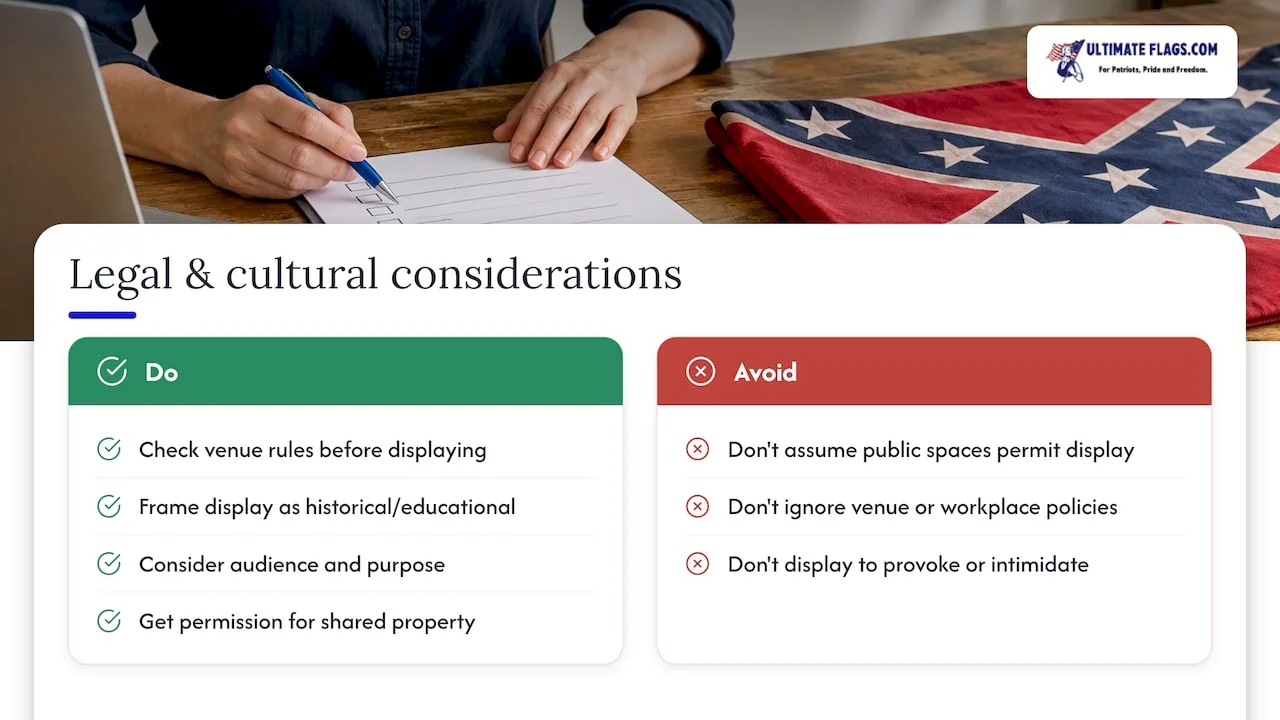
Flying or displaying a Southern heritage flag sits at the intersection of personal expression and public reception, and the rules differ by setting. Private property generally allows wide latitude for flag display under free expression protections, while government buildings, schools, and some workplaces may restrict or prohibit certain historical flags under their own policies. Anyone planning to display a flag at a public event, on a vehicle, or on shared or rented property should check the specific venue’s rules first, since policies vary widely and change without much notice.

Cultural sensitivity matters alongside the legal question. These flags carry different meanings for different Americans, and many buyers choose them specifically to honor ancestry, military memory, or regional identity rather than to provoke. Reenactors and collectors who display these flags in a historical or educational context, such as at a staged battle reenactment or a museum-style exhibit, generally find that framing and setting shape public reception as much as the flag itself. We encourage every buyer to think through the setting, the audience, and the purpose before raising a flag in a shared or public space, and to treat the symbol with the same care its history demands.

Legal considerations and cultural sensitivity surrounding Southern heritage flags — overview diagram

Historical context and symbolism of different Southern heritage flags

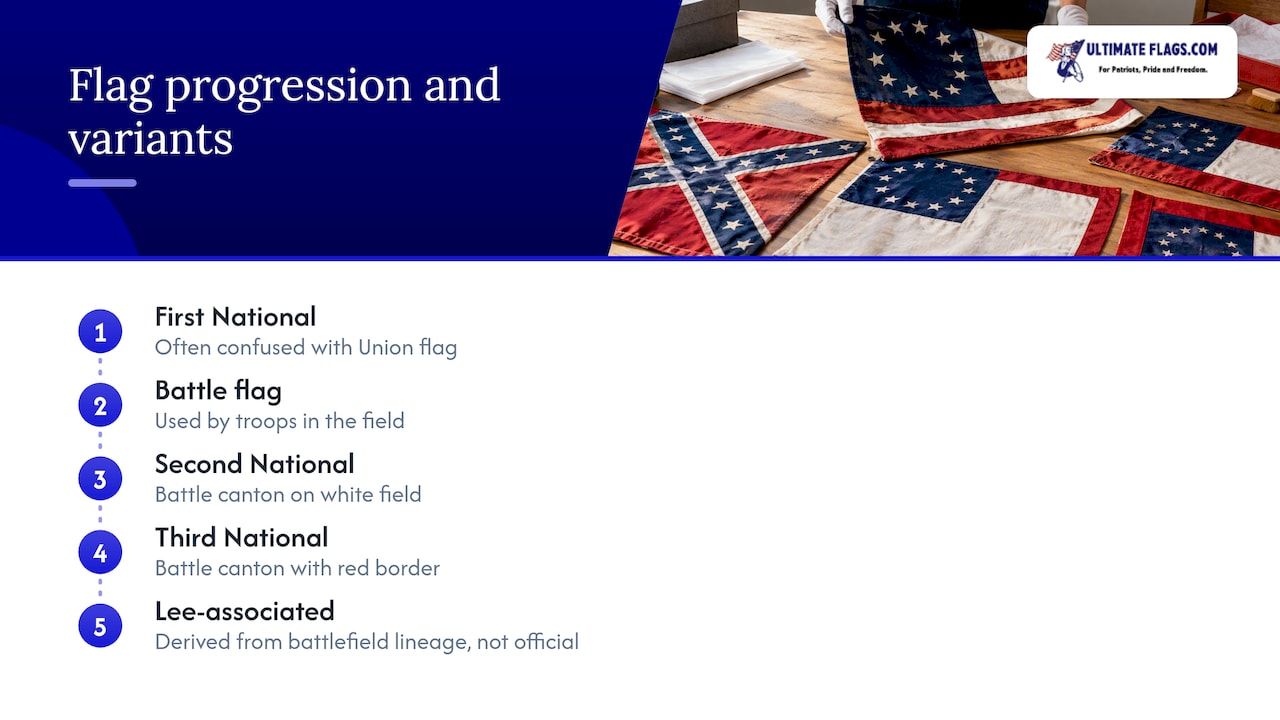
The flags gathered under the Southern heritage banner were never a single design. The First National flag, often called the Stars and Bars, served as the Confederacy’s official national flag early in the Civil War but was frequently confused with the Union flag at a distance on the battlefield, a practical failure that pushed commanders toward a distinct alternative. The battle flag that followed, the square or rectangular cross-and-stars design most people picture today, grew out of that confusion and became the banner carried by troops in the field rather than the flag of state.

Variants multiplied as the war dragged on: the Second and Third National flags incorporated the battle flag into a corner of a white or red-bordered field, each revision an attempt to balance recognition with national symbolism. The flag associated with figures like General Lee, often sold today as a standalone design, reflects this battlefield lineage rather than any single government’s official banner. Understanding which variant you are looking at, and which conflict or unit it traces back to, helps collectors and reenactors choose a historically accurate flag rather than a generic stand-in. Our history of the Confederate flag and our profile of the color guard who carried the battle flag trace these distinctions in more depth for buyers who want the full provenance behind a given design.

Historical Southern flag variants and sequence

Why we treat this heritage as something worth getting right

We built our catalog and our historical content around a simple conviction: a flag only honors what it represents when the people who fly it understand what they are flying. Southern heritage flags carry weight, both as objects of craft and as symbols tied to real history, and we think buyers deserve accurate information alongside a well-made product. As America’s oldest online flag store, we have spent years building out historical resources precisely because the story behind a flag matters as much as its stitching. Good preservation advice is not an afterthought here. It is how a flag someone cares about today still has color and strength to pass on tomorrow.

— John Hough

Where to find the right flag and what to order next

We stock the materials, sizes, and hardware this guide walks through, and our flag collections page is the fastest way to browse Southern heritage designs alongside the accessories that go with them.

Ultimate Flags

Before you check out, work through a short list:

  • Settle on fabric first: polyester for outdoor flying, cotton or parade cloth for reenactment and display.
  • Match the size to your pole height or display space rather than guessing.
  • Pick a header or sleeve style suited to how you will mount or carry it.
  • Add grommets, a pole, or a stand if you do not already have the hardware on hand.
  • Check our guide to USA-made options if domestic manufacturing matters to your purchase.

If you are furnishing a room around a flag display, our partners at One Day Doors & Closets put together some Americana styling ideas worth a look for indoor display settings.

FAQ

What material lasts longest for a flag flown outdoors?

Polyester with a reinforced canvas header holds up best against sun, rain, and wind cycling, which is why most outdoor pole flags use it. Cotton looks and drapes more like historic originals but wears faster outdoors, so it suits indoor display or careful, occasional outdoor use better.

How do I keep a flag from fading over time?

Keep it out of direct, unfiltered sunlight, since the Library of Congress notes that UV exposure causes irreversible fading even on modern reproductions. Rotating a displayed flag off view periodically and using UV-filtered lighting both reduce cumulative light damage.

What size flag should I buy for a standard residential pole?

A 3×5-foot flag suits most residential poles and porch displays, while a 4×6 or 5×8-foot flag fits taller poles or settings where visibility from a distance matters more. Match the size to pole height rather than ordering the largest option available.

Are stitched flags worth the extra cost over printed ones?

Stitched or appliqué flags cost more but last longer and carry a depth and texture that printed flags cannot replicate, making them the better choice for collectors and reenactors seeking authenticity. Printed flags remain a practical, budget-friendly choice for everyday outdoor flying where appearance up close matters less.

Where can I buy authentic Southern heritage flags?

We offer a dedicated selection of Southern heritage flags covering historical variants, sizes, and construction options, backed by historical content that helps buyers choose an accurate design. Pricing varies by size, fabric, and construction, so check the product page for the specific flag you are considering.

Sources

Posted on

Avoid Diplomatic Error: International Flag Etiquette for Ceremonies

National flags arranged on ceremony stage

Treat national flags with respect: never let them touch the ground, never place one nation’s flag above another in peacetime, and follow local flag codes and maritime courtesy practices. These principles echo through the U.S. Flag Code (4 U.S.C. §7), the United Nations Flag Code, and the Royal Yachting Association’s maritime guidance. Whether a flag flies over a courthouse, a front porch, or a vessel’s stern, the same spirit of reverence applies: a flag is never a prop, always a presence.


TL;DR:

  • Flags should never touch the ground, be worn, or used as decoration, and must be flown in good condition without tears or fading.
  • When multiple flags are displayed, they must be arranged in alphabetical order by country name, with no nation outranking another in peacetime.
  • Courtesy flags should be flown from the starboard spreader and replaced if worn or faded to avoid diplomatic offense.
  • Half-staff display requires specific procedures including hoisting, pausing, and lowering the flag steadily, with authorities controlling timing.
  • Flags flown overnight must be illuminated properly, or they should be lowered at sunset to maintain proper respect.

Ultimate Flags
Choose Flags Worth Displaying
Find national, military, historical, and nautical flags, plus poles and hardware, for ceremonies, collections, and respectful displays.

Explore the flag collection

Table of Contents

Core rules for displaying and handling flags with dignity

A flag carries the weight of a nation’s story, and the way we hold it, raise it, and retire it tells that story honestly or carelessly. When multiple national flags share a space, international usage forbids placing one above another during peacetime: each flag flies from its own staff, every staff standing at the same height, every flag cut to roughly the same size. No nation outranks another in a gathering of equals, and that principle alone prevents more diplomatic friction than any other single rule.

Handling a flag well means following a few unbending commitments:

  • Never let a flag touch the ground, floor, or water, since contact with the earth is considered a mark of disrespect in nearly every national tradition.
  • Never wear a flag as clothing, drape it over furniture, or use it as a tablecloth or decorative wrap.
  • Never attach pins, inscriptions, or decorations to the fabric itself, and never use a flag to carry or deliver anything.
  • Never fly a flag that is torn, faded, or frayed beyond a dignified appearance.

Timing matters as much as placement. The long-standing custom is to fly a flag from sunrise to sunset, taking it down each evening unless it is properly illuminated for continuous overnight display. A storm rolling in is not the moment for sentiment: an all-weather flag can usually stay aloft, but a lightweight or ceremonial flag should come down before wind and rain shred it.

Podiums and stages have their own quiet grammar. The position of honor sits to the speaker’s right, which appears as the viewer’s left when facing the stage, a detail that trips up even seasoned event planners. Before any ceremony begins, walk the staging area and confirm that the host flag occupies that position, that every flagpole stands level, and that no fabric brushes the floor.

Pro Tip: Do a five-minute walkthrough an hour before any ceremony, checking flag order, height, lighting, and ground clearance before guests arrive.

Maritime etiquette: ensigns, courtesy flags, and common mistakes at sea

Flag etiquette grows more intricate the moment a vessel leaves its home harbor. A courtesy flag, flown when visiting a foreign port, acknowledges the sovereignty of the coastal nation, a gesture of respect rather than a legal mandate in most waters. Yet Royal Yachting Association guidance notes that flying a tatty, faded, or incorrectly sized courtesy flag can cause real offense, sometimes drawing fines or at minimum a withering look from a harbor official.

The placement distinction matters as much as the gesture itself:

  1. Fly the national ensign as near the stern as possible, since this is the flag that declares the vessel’s own registry and carries the most formal weight aboard.
  2. Fly the courtesy flag from the starboard spreader or rigging, never from the stern, where it would compete with or overshadow the ensign.
  3. Size both flags proportionately to the vessel. The RYA’s heuristics tie flag dimensions to vessel length so nothing looks undersized or apologetic against the hull.
  4. Before entering a foreign port, research that nation’s specific courtesy flag customs, since expectations shift from coastline to coastline.
  5. Inspect every flag aboard for fraying or discoloration before departure, replacing anything that would embarrass the vessel in a new harbor.

In UK waters, the Red Ensign stands as the correct merchant ensign for most pleasure and commercial vessels, a convention the RYA documents in detail for skippers unfamiliar with British maritime tradition. A faded or tatty courtesy flag can be considered worse than flying none at all, as it suggests indifference rather than simple unfamiliarity. Our own boat flag etiquette guide walks through the one-inch-per-foot sizing rule that keeps ensigns and courtesy flags looking proportionate rather than lost against the mast.

Arranging multiple flags for diplomatic and public events

When several national flags share a stage, order becomes the single most scrutinized detail in the room. The United Nations resolved this with a simple, neutral formula: arrange flags in English alphabetical order by country name, a practice the UN Flag Code update clarified in its 2020 revision to cover lines, clusters, and semicircular groupings. Alphabetical order sidesteps the appearance of favoritism entirely, which is precisely why it has become the default for international gatherings.

A few placement rules carry across most formats:

  • In a straight indoor lineup, the host nation’s flag anchors one end, with remaining flags following in alphabetical sequence.
  • In a semicircle, the position of honor sits at the center, with alphabetical order radiating outward from there.
  • When poles are crossed, the flag on the viewer’s left crosses in front, a detail that reverses what instinct suggests.
  • Every flag in a grouped display should match in height and size, since a shorter or smaller flag reads as a diplomatic slight even when unintended.

Before any multi-nation event, a short checklist saves considerable embarrassment: confirm the host flag’s position, alphabetize the remaining nations, verify that every pole matches in height, and arrange lighting in advance so no flag disappears into shadow after dusk.

Half-staff rules, vertical display, and respectful retirement

A handful of special cases trip up even careful hosts, and each deserves its own precise procedure.

  1. Half-staff display calls for hoisting the flag briskly to the peak first, pausing there, then lowering it slowly to the half-staff position. At the end of the day, raise it briefly to the peak again before lowering it fully, a sequence that prevents the gesture from reading as simple negligence. In the United States, the authority to order half-staff display typically rests with the president or a state governor, and the duration varies by the occasion being honored.
  2. Vertical display requires attention to the canton, the field in the flag’s upper corner. For most nations that use one, the canton belongs at the upper left as the observer faces the building or pole, which sometimes means rotating or flipping a flag designed for horizontal use. Some national flags, flown upside down or in the wrong orientation, read as an internationally recognized distress signal, so getting this right is not a cosmetic detail. Our vertical flag rules guide covers canton placement for the United States, Canada, and several other nations in more depth.
  3. Night display without proper illumination breaks with long-standing custom. A flag left up after sunset needs a dedicated light source trained on it, not ambient street glow, and the alternative is simply to lower it each evening.
  4. Retirement of a worn flag calls for a dignified method rather than a trash bin. Burning remains the most widely recommended approach in U.S. guidance, though local veterans’ organizations and civic groups often host retirement ceremonies worth joining.

Pro Tip: Keep a spare, properly sized flag on hand so a worn one can be retired immediately rather than left flying past its dignity.

Choosing the right size, fabric, and care routine

Picking the correct flag starts with proportion. A flagpole roughly 20 feet tall typically suits a 3-by-5-foot flag, while taller commercial poles call for correspondingly larger dimensions, and the same logic that governs ensigns at sea, sizing to the vessel, applies to poles on land. Oversized flags strain grommets and hardware; undersized ones look timid against a tall pole.

Flag flying from tall commercial pole

Fabric choice depends on exposure. All-weather polyester resists fraying in wind and rain far better than cotton, making it the practical choice for anywhere the flag flies daily. Decorative or ceremonial fabrics have their place indoors or for short-term events where durability matters less than appearance.

A few care habits keep a flag presentable for years:

  • Launder according to the fabric’s care label, and air-dry rather than machine-dry to protect stitching.
  • Store a folded flag in a dry, dark space to prevent fading and mildew between uses.
  • Take a flag down promptly ahead of severe weather rather than risking a tear mid-storm.
  • Retire any flag showing frayed edges or significant fading rather than letting it fly in diminished condition.

Our flag care guide walks through cleaning and minor repair steps in more detail, and cultural sensitivity extends beyond national flags: displaying a Pan-African flag or another flag of cultural significance calls for the same care in understanding its symbolism before flying it.

Where to turn for deeper, country-specific guidance

We emphasize our long-standing experience in the online flag retail space, along with a commitment to help readers get etiquette right, not just inventory.

For legal questions specific to a country outside U.S. jurisdiction, the United Nations Flag Code and that nation’s own civic authorities remain the most reliable word.

Why this etiquette still matters

We believe a flag earns its place in the sky through the care it receives, not merely through the cloth it is cut from. A frayed edge, an inverted canton, or a flag left dark after sunset can read as carelessness in a ceremony meant to honor something larger than the moment. Inspect your flag today, and replace it the instant it looks tired rather than waiting for a holiday to prompt you.

— John Hough

Shop durable flags built for proper display

Getting etiquette right starts with a flag worthy of the pole it flies from, and our flag collections carry national, state, military, and historic designs built from fabric meant to stand up to daily wind and sun.

Ultimate Flags

A few categories solve the most common display problems:

  • Durable all-weather polyester flags for poles that fly a flag every day of the year.
  • Flagpoles and mounting hardware sized to match the flag dimensions your display calls for.
  • Lighting fixtures that make continuous overnight display possible without breaking with custom.

If a ceremony calls for a custom size or a bulk order for a public event, a customer service team can help you sort out specifics before the big day arrives. Browse the flag collections page to find the right fit for your pole, boat, or ceremony.

FAQ

What is the correct order of flag display on stage?

The host nation’s flag takes the position of honor, typically the speaker’s right or the center of a semicircle, with other national flags arranged in English alphabetical order following UN Flag Code practice. All flags in the grouping should match in height and size to avoid any appearance of favoritism.

What does it mean when a ship flies a courtesy flag?

A courtesy flag acknowledges the sovereignty of the coastal nation a vessel is visiting, flown from the starboard spreader while the vessel’s own ensign stays near the stern. RYA guidance notes that a worn or incorrectly flown courtesy flag can cause offense even where no formal law requires one.

When was the U.S. Flag Code adopted?

The U.S. Flag Code, codified as 4 U.S.C. §7, has served as the nation’s guide to flag display and handling for decades, outlining rules on precedence, half-staff timing, and retirement. It remains largely advisory rather than criminally enforced at the federal level, though many states and organizations treat it as binding custom.

Is it disrespectful to fly a flag at night without a light?

Custom calls for flags to come down at sunset unless they are illuminated by a dedicated light source through the night. Leaving a flag up in darkness without illumination breaks with long-standing etiquette, so the simplest fix is either adding proper lighting or lowering the flag each evening.

Sources

Posted on

1882 Parade: Meaning Behind Labor Day and Honoring It with Flags

Historical labor parade with American flags

Labor Day honors the social and economic contributions American workers have made to the nation’s strength and prosperity, and its roots trace directly to a Central Labor Union parade held in New York City on September 5, 1882. What began as a local demonstration by working people became a federal holiday in 1894, a transformation that still shapes how we understand the meaning behind Labor Day today.


TL;DR:

  • The original 1882 New York parade drew between 10,000 and 20,000 workers demonstrating labor strength and raising awareness during harsh industrial conditions.
  • Congress officially made Labor Day a federal holiday in 1894, choosing early September for mild weather and family-friendly timing between Independence Day and Thanksgiving.
  • Over time, Labor Day shifted from a politically charged protest to a broad celebration emphasizing community and leisure, with many cities still host parades echoing the original significance.
  • The holiday’s origins are contested, with the Department of Labor crediting Peter J. McGuire but evidence also pointing to Matthew Maguire as a possible founder.
  • Internationally, most countries celebrate May Day on May 1 with a more political focus, while the US maintains its separate, less protest-oriented September observance.

Ultimate Flags
Honor Labor Day Through History
Explore flags and banners that help commemorate American history, military service, heritage, and the stories remembered through meaningful displays.

Explore flags and banners

Table of Contents

Origins: the 1882 New York parade and the conditions that forged it

Picture Lower Manhattan on a Tuesday morning, thick with the sound of marching feet and brass bands rather than the clatter of factory machines. On September 5, 1882, somewhere between 10,000 and 20,000 workers walked off their jobs and into the streets, organized by the Central Labor Union in what became the nation’s first Labor Day celebration. The marchers proceeded through the city before gathering for speeches and a picnic that drew thousands of attendees, a gathering built to put labor’s collective power on full display.

That display was not born from comfort. Industrial workers in the Gilded Age routinely faced ten-hour days and six-day weeks, often in conditions that offered little safety and less dignity. The eight-hour workday campaign had become the rallying cry of organized labor, a demand for time, safety, and bargaining power that workers believed they had earned through their contributions to the nation’s growth. The 1882 parade served several purposes at once.

  • It demonstrated labor’s organized strength to employers and lawmakers watching from rooftops and windows along the route.
  • It raised public visibility for the movement at a moment when strikes and labor disputes rarely made sympathetic headlines.
  • It helped fund union activities through the picnic and the gathering that followed the march.

Becoming a national holiday and why September was chosen

Oregon became the first state to put Labor Day into law in 1887, and within a few years, momentum built across state legislatures until Congress acted. President Grover Cleveland signed the federal act on June 28, 1894, cementing the first Monday in September as a national observance. The timing was not accidental. Labor unrest marked much of the 1890s, and granting workers a federally sanctioned day of recognition offered lawmakers a way to acknowledge labor’s grievances without yielding to its more radical demands.

The choice of September over other possible dates owed something to practicality as well as politics.

  • Early autumn offered mild weather suited to outdoor parades and picnics across much of the country.
  • The date fell comfortably between Independence Day and Thanksgiving, giving workers a distinct holiday of their own.
  • Organizers favored a date that felt family-friendly, one that could draw spouses and children into what had begun as a labor demonstration.

What Labor Day has meant historically and what it means today

The earliest Labor Day celebrations blended two instincts that might seem at odds: political protest and communal celebration. A parade and a round of fiery speeches gave way to a picnic, a format that let organizers make their case to the public while giving families a reason to attend. That combination proved durable, even as the holiday’s political edge softened over the decades that followed, highlighting the importance of prioritizing worker health through better benefits.

  1. The holiday gradually shifted from a platform for organized labor’s demands toward a broader, less overtly political celebration, a de-radicalization that the Gilder Lehrman Institute credits with helping Labor Day become mainstream.
  2. Some cities still hold parades that echo the 1882 original, though they draw far smaller crowds relative to the broader population than the early celebrations did.
  3. For most Americans today, Labor Day marks the unofficial end of summer, a long weekend of leisure rather than a day of organized demonstration, even as political leaders continue to issue statements recognizing workers’ contributions.

Contested authorship and common myths

The U.S. Department of Labor has long credited Peter J. McGuire, a carpenters’ union leader, with proposing the holiday. Archival evidence complicates that tidy story. Contemporary local accounts and union records point instead to Matthew Maguire, a machinist active in the Central Labor Union, as the figure who may have first floated the idea. The Department of Labor itself acknowledges this uncertainty on its own historical pages, which is reason enough for us to present both names rather than settle on one. The honest answer is that the record remains genuinely contested, and any confident single attribution overstates what the evidence supports.

Contested authorship and common myths — overview diagram

International context: May Day and other workers’ observances

Labor Day shares its deepest roots with a very different holiday celebrated across much of the world. The call for an international demonstration on May 1 emerged from an 1889 gathering tied to the same eight-hour workday movement that drove the American parade seven years earlier. May Day spread internationally and retained a sharper political character in many countries, often marked by demonstrations rather than picnics. The United States chose a different path, keeping its September date and a public meaning closer to celebration than protest. Canada follows a similar pattern, observing Labour Day on the same first Monday in September, though the specific date and tone of workers’ holidays still vary considerably from one country to the next.

International context: May Day and other workers' observances — overview diagram

Flags, banners, and historically informed displays for Labor Day

Flags and trade banners were not decoration at the margins of that first Labor Day parade. They were the visual language of the march itself, carried by union locals to announce who they were and what they stood for as they moved through the streets. Readers planning a historically grounded commemoration today can draw on that same instinct.

  • Choose colors and imagery that reflect the occasion itself rather than borrowing symbols tied to unrelated causes.
  • Favor durable, weather-resistant materials for any outdoor display meant to last through a long weekend.
  • Pair a flag display with a brief note on its history, the kind of context we cover in our own look at what American Labor Day honors.

Pro Tip: Keep Labor Day displays focused on craft, trade, and community themes, the same spirit that filled the streets of New York in 1882.

Why a historically grounded Labor Day still matters

We find something worth sitting with in the fact that a day now spent at the lake began as a demonstration by people demanding safer hours and fair treatment. Labor Day carries a dual inheritance: political heritage on one hand, personal rest on the other. Holding both in mind gives the day its weight.

— John Hough

Mark Labor Day with flags and banners that honor the history

A long weekend built around rest and reflection deserves a display that matches the occasion, and we built our flag collections with exactly that kind of commemoration in mind. Whether you want a parade-style flag reminiscent of those carried through New York in 1882 or a straightforward way to mark the holiday at home, flag catalogs cover both without requiring a long-term commitment or a complicated order process.

Ultimate Flags

If you already own a flag and want ideas for putting it to use this weekend, our guide on what to do once you have your flag walks through practical, respectful display options suited to a holiday rooted in community and labor history.

FAQ

What happened on Labor Day in 1882?

On September 5, 1882, between 10,000 and 20,000 workers marched through New York City in a parade organized by the Central Labor Union, followed by a picnic that drew close to 25,000 people. The event combined public demonstration with family-friendly celebration, a format that shaped how later Labor Day observances evolved.

Did Labor Day originate in Canada?

No, the first recorded Labor Day celebration took place in New York City in 1882. Canada developed its own Labour Day tradition around the same era and now observes it on the same first Monday in September, but the holiday’s origin is tied to American labor organizing.

Is the United States the only country that celebrates Labor Day?

No, many countries recognize workers through a holiday, though most mark International Workers’ Day on May 1 rather than the American September date. Canada observes its Labour Day alongside the United States in early September, while the specific date and political tone vary by country.

What are some good images for Labor Day?

Historically accurate imagery draws on the trade banners and union flags carried during the original 1882 parade rather than symbols unrelated to labor history. A respectful display favors craft and community themes, paired with durable materials suited to outdoor use over a long weekend.

Who is credited with founding Labor Day?

The Department of Labor has traditionally credited Peter J. McGuire, a carpenters’ union leader, though archival evidence has identified Matthew Maguire, a machinist, as a possible alternate originator. The historical record remains genuinely unsettled, so both names appear in most careful accounts of the holiday’s founding.

Sources

Posted on

Buy the Right U.S. Flag Using the Quarter Pole Rule and FMAA Proof

Buyer comparing American flag fabrics

Choose the right flag size for your pole first, then confirm material, construction, and authenticity. Look for the FMAA seal and a sewn country-of-origin label on any flag claiming to be American-made, since those two markers separate a flag built to last from one that fades by midsummer. Experience in the flag industry shapes every recommendation in this flag buying guide.


TL;DR:

  • Choosing a flag size around one quarter of your pole height ensures proper visibility and durability, especially for large or tall poles.
  • Polyester flags with reinforced headers and brass grommets are better suited for high-wind or coastal areas than nylon or cotton options.
  • Only flags certified by FMAA with a sewn country-of-origin label guarantee full domestic manufacturing and authentic “Made in USA” status.
  • For outdoor flags, expect around 90 days of flight in moderate wind for nylon, with longer longevity for heavier polyester and indoor-use cotton flags.
  • Fixing flag size and header quality before purchase yields the greatest increase in lifespan and overall durability.

Ultimate Flags
ultimateflags.com
Find a Flag for Your Pole
Browse flags, banners, and accessories for patriotic displays, historical interests, military recognition, and personal collections.

Browse Ultimate Flags

Table of Contents

How do I choose the right flag size for my pole?

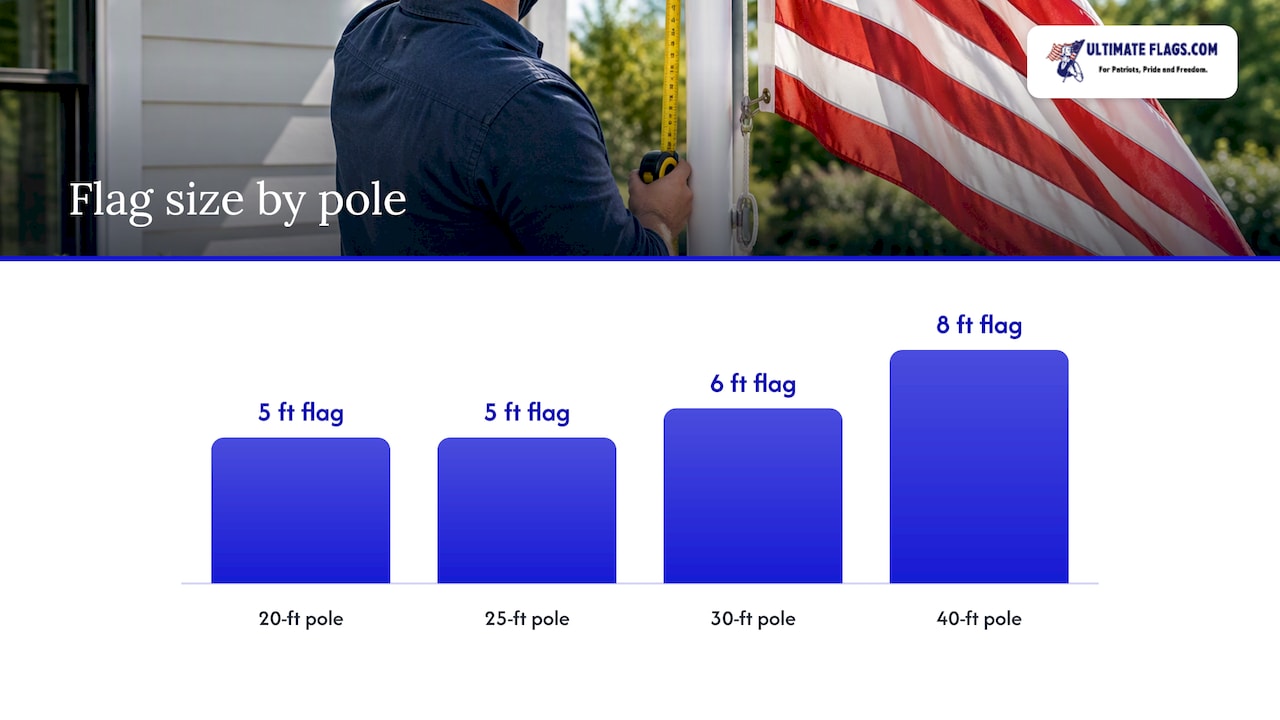
Size is where most buyers go wrong, and it costs them twice: once on a flag that looks undersized and flapping like an afterthought, and again when they replace it within a season because the fabric couldn’t handle the load it was never sized for. The standard rule is simple: your flag’s length should equal roughly one quarter of your pole’s height. A 20-foot pole calls for a flag with a 5-foot hoist; a 40-foot pole calls for one around 10 feet. This “quarter rule” works for the vast majority of residential and commercial installations, though ceremonial poles and very tall municipal flagpoles sometimes follow different conventions set by the agency or institution flying them.

Quarter-pole rule flag sizing examples

For official government use, U.S. Code Title 4 specifies the flag’s design proportions and lists authorized sizes used by executive agencies, which is why federal buildings often fly flags in exact statutory dimensions rather than the simplified ratio homeowners use.

A quick reference for common setups:

  • 20-foot pole: 4×6 foot flag, the most common residential size.
  • 25-foot pole: 5×8 foot flag for a fuller, more visible presence.
  • 30-foot pole: 6×10 foot flag, typical for commercial properties.
  • 40-foot pole: 8×12 foot flag, often seen outside businesses and public buildings.

Multi-flag setups, such as a state or military flag flown beneath the national colors, should use a proportionally smaller flag under the larger one. Indoor and parade staff flags run smaller still, typically 3×5 feet mounted on a decorative pole rather than sized to any building height.

Which flag material should you buy: nylon, polyester, or cotton?

Material determines whether your flag survives a windy spring or needs replacing by June. Each fabric earns its place depending on where and how the flag will fly.

  • Nylon: lightweight with an attractive sheen, dries quickly after rain, and performs well in light to moderate wind. It’s our top pick for most residential display.
  • Polyester: heavier and more wind-resistant, with better UV resistance in treated versions. Preferred for coastal properties, high-wind regions, and commercial poles that fly flags around the clock.
  • Cotton: a traditional, matte finish suited to indoor and ceremonial flags. It holds color beautifully but isn’t built for sustained outdoor exposure, where moisture and sun break it down fast.

When comparing listings, look past marketing language to the specs themselves: denier (fiber thickness), weight in ounces per square yard, and whether UV-resistant coatings are mentioned. A heavier denier and a UV treatment usually justify a higher price if your flag will fly daily.

Pro Tip: If you’re unsure which material fits your climate, think about your harshest month, not your average one. A flag sized and rated for your worst wind day will outlast one chosen for a calm afternoon.

What construction details separate a durable flag from a flimsy one?

The header, stitching, and star treatment tell you more about a flag’s lifespan than the material alone. A flag can be made of premium polyester and still fail early if the header rips loose from the pole.

  • Header and grommets: a double-layered canvas header with sewn-in webbing holds up far better than a thin single-ply strip, and brass or stainless grommets resist corrosion better than plated alternatives.
  • Stars and stripes: embroidered or appliqued stars and sewn stripes outlast printed designs outdoors, since printed ink and dye tend to crack and fade within a season or two of sun exposure.
  • What to check in photos: close-up images of the hem, the stitch lines along the stripes, and the label near the header. Vague stock photos with no close-up of these areas are a red flag worth taking seriously.

Reinforced headers and proper grommet spacing matter enough that we’ve written a full guide on flag header and grommet installation for readers setting up a new flag correctly from day one.

How do you verify a flag is genuinely “Made in USA”?

Two credentials do the heavy lifting here: FMAA certification and compliance with FTC labeling rules.

The FMAA Certification Program Requirements document requires domestic production from yarn weaving through final packaging, and certified flags must carry the official FMAA seal. That seal is the clearest shortcut available to a buyer who wants genuine confidence rather than a guess.

Domestic flag production certification chain

FMAA certification guarantees flags are made entirely in the USA, from yarn to packaging, and the certified product carries the official FMAA seal, according to the FMAA Certification Program Requirements. That standard matters because the phrase “Made in USA” alone isn’t always as airtight as it sounds.

FTC guidance on “Made in USA” claims requires that labeled products be “all or virtually all” made domestically, and the agency notes that phrases like “assembled in USA” carry a meaningfully different legal meaning, one that can still permit imported components.

Practical checks worth running before you buy:

  • Look for a sewn (not printed) country-of-origin label stitched into the header.
  • Ask the seller directly whether the flag is FMAA-certified, and request documentation if the answer is vague.
  • Treat phrases like “proudly American” or “patriot-made” with skepticism unless they’re backed by a seal or a specific domestic-sourcing claim.

How do you match a flag to where you’ll fly it?

The right flag depends entirely on its environment, and the same flag that thrives on a sheltered porch may fail within weeks on an exposed coastline.

  1. Residential front porch: a 3×5 or 4×6 nylon flag suits most 20 to 25-foot poles, offering good visibility with easy care.
  2. Coastal or high-wind properties: heavy polyester with a reinforced header and upgraded hardware holds up against sustained gusts and salt air far better than standard nylon.
  3. Indoor and ceremonial displays: cotton or a high-grade polyester with sewn stars and a refined finish suits presentation settings where appearance matters more than wind resistance.
  4. Nautical use: marine-grade construction built to handle halyard friction and constant moisture, a different specification entirely from a flag meant for a stationary residential pole.

How should you care for a flag, and when should you replace it?

A flag’s lifespan depends almost entirely on exposure and upkeep, not just the fabric it’s made from.

  • Clean periodically; we recommend a gentle 10 to 30 minute soak rather than harsh machine washing.
  • Inspect the rope or halyard regularly for fraying, since a failing line can drop or shred a flag in a single storm.
  • Rehem frayed edges or replace a worn header before the damage spreads; retire the flag respectfully once the fabric itself is torn or badly faded.
  • Expect roughly 90 days of daily outdoor flight from standard nylon in moderate wind, longer for heavier polyester, and considerably longer for indoor cotton flags kept out of direct sun.

Why trust this flag buying guide?

We have significant experience operating an online flag store, building a catalog that spans national, state, military, and historical flags alongside the hardware that supports them. That breadth means our product pages are built around the same sizing, material, and authenticity standards covered here, from pole-matched dimensions to flagpole types and footing rules for new installations.

What buyers get wrong, and what to fix first

In years of fielding buyer questions, two mistakes stand out above the rest: choosing a flag too small for the pole, and treating the header as an afterthought instead of the first point of failure. If you fix only one thing before buying, fix the size and the header quality together. That combination returns more lifespan than any fabric upgrade alone.

— John Hough

Ready to find the right flag for your pole?

Once you know your size, material, and authenticity checklist, the next step is simple: browse our flag collections for American, state, military, and historical options built to the standards covered above.

Ultimate Flags

Our catalog includes:

  • American and state flags sized for residential and commercial poles.
  • Military, police, and first-responder flags for service and tribute displays.
  • Flagpoles and hardware, including headers and grommets sized to match your flag.
  • Historical and political flags for collectors and history enthusiasts.

For readers furnishing a home alongside a new flag display, Americana-style interior doors make a fitting companion touch. If you’re still deciding between options, our guide on choosing a flag or banner walks through the same checklist in more detail.

FAQ

What size flag should I buy for a 25-foot flagpole?

A 25-foot pole typically calls for a 5×8 foot flag, following the standard quarter-pole sizing rule. Heavier winds or exposed locations may call for a slightly smaller flag in tougher polyester instead of a larger one in lighter fabric.

How can I tell if a flag is really made in the USA?

Check for the official FMAA seal and a sewn, not printed, country-of-origin label in the header, since the FMAA certification requires domestic production from yarn through packaging. The FTC’s “Made in USA” standard also requires that labeled products be “all or virtually all” made domestically, which rules out vague claims without documentation.

What’s the difference between “Made in USA” and “assembled in USA”?

“Made in USA” means the product meets the FTC’s “all or virtually all” domestic standard, while “assembled in USA” only confirms the final assembly step happened domestically and may still include imported components, according to FTC guidance. Buyers who want full domestic sourcing should look for FMAA certification specifically.

How long does an outdoor flag typically last?

Lifespan depends heavily on material and exposure, with standard nylon flags often needing replacement sooner under constant wind and sun than heavier treated polyester. Indoor cotton flags kept out of direct sunlight tend to last considerably longer since they avoid the UV and wind damage that wear down outdoor fabric.

Should I buy nylon or polyester for a coastal property?

Polyester is generally the better choice for coastal or high-wind properties because heavier, treated versions resist constant wind and salt exposure better than lighter nylon. Pairing it with a reinforced header and corrosion-resistant grommets extends its service life further.

Sources

Posted on

Buyers: Smithsonian 13 Star Southern Cross Flag ID and Display Rules

Buyer inspecting a 13-star Southern Cross flag

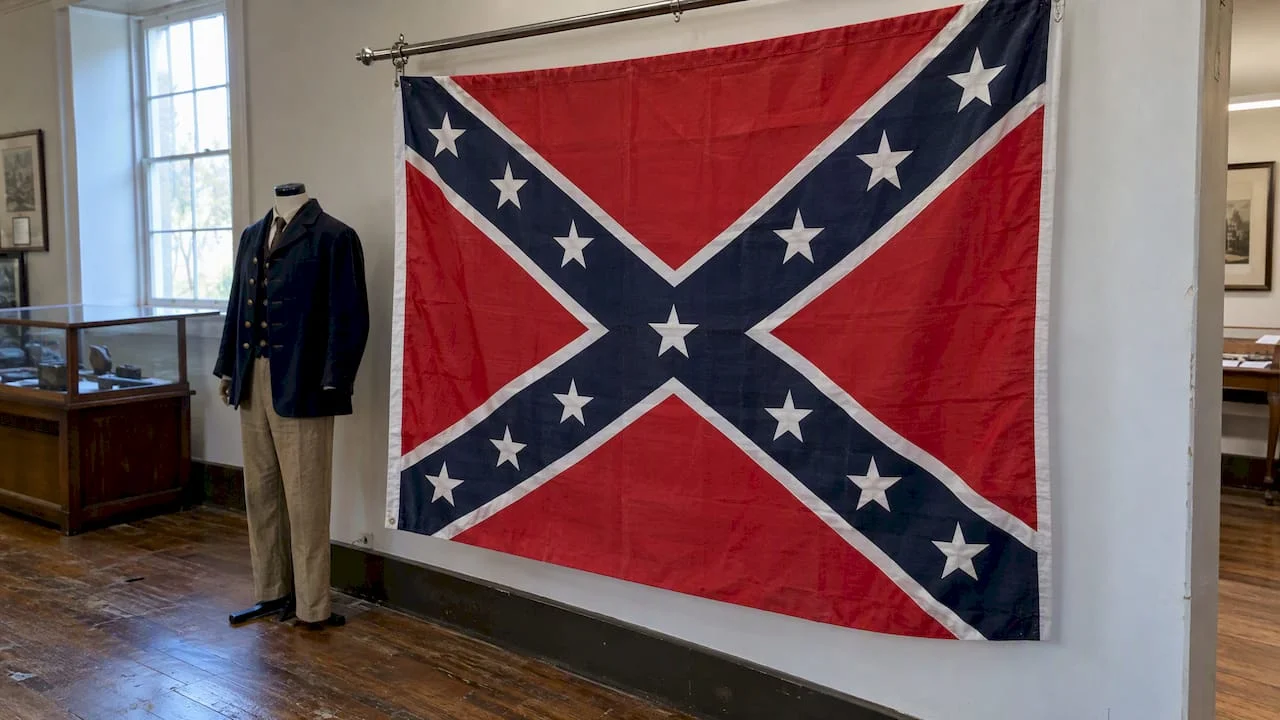
The Southern Cross, for shopping purposes, is the Confederate battle flag design: a blue diagonal saltire edged in white on a red field, usually set with thirteen stars. This guide walks you through identifying genuine patterns, choosing materials and sizes, and checking display rules before you buy. We draw on museum records and historical scholarship to help you shop with confidence and respect for what this banner represents.


TL;DR:

  • The Confederate battle flag’s stars typically number thirteen, but variations with fewer stars exist depending on the unit and historical period.
  • The flag’s size and proportions vary by use, with outdoor flags needing durable polyester or nylon for weather resistance, and cotton suited for indoor displays.
  • Federal and state rules restrict display on public land, with exceptions limited to museums, cemeteries, or historical contexts, requiring prior permission.
  • The term “Southern Cross” also refers to a star constellation unrelated to the Confederate flag, which can cause confusion in searches or discussions.
  • The flag was never the official national banner but served solely as a military insignia, with its design created to improve battlefield visibility.

Ultimate Flags
ultimateflags.com
Find Flags With Historical Significance
Explore Confederate, Civil War, and other historical flags for collecting, educational, commemorative, and display purposes.

Explore historical flags

Table of Contents

1. How to Identify the Southern Cross Pattern and Its Historic Variants

Before you add a flag to your cart, look closely at what the image actually shows. The National Museum of American History describes the Confederate battle flag, the Southern Cross, as a dark blue diagonal cross set against a red field, trimmed in white, with stars arranged in a count that identified specific units during the war. In the Smithsonian’s own catalog example, three stars sit on each arm of the cross and one rests at the center, a pattern that has become the version most reproductions follow today.

That said, wartime flags were never perfectly uniform. According to Encyclopedia Virginia, the battle flag was developed in 1861 specifically to solve a battlefield problem: the Confederacy’s first national flag, the Stars and Bars, looked enough like the Stars and Stripes to cause confusion through smoke and distance. The battle flag that emerged, and that we now call the Southern Cross, was never the Confederacy’s official national flag at all. It flew as a military banner, and its size, star count, and edging shifted depending on the unit, the branch of service, and the year it was made.

Before you buy, run through a short checklist so you order what you actually want:

  • Confirm the saltire is blue on a red field with white edging, not a variant with different colors or a different cross shape.
  • Count the stars in the product photo; thirteen is standard, but some historical reproductions use fewer to match a specific unit.
  • Check whether the listing specifies “battle flag,” “Second Confederate Navy Jack,” or another historical name, since sellers sometimes blur these terms.
  • Look for whether the flag is square (a common infantry proportion) or rectangular, since this changes how it displays.

Choosing the right flag starts with asking where it will live. A flag meant to fly outdoors in wind and rain has different requirements than one destined for a den wall or a reenactment camp.

  1. Pick your material based on exposure. Polyester and nylon resist fraying and fading in sun and wind, making them the practical choice for a flagpole that flies year round. Cotton gives a muted, textured look closer to period originals, but it wears out fast outdoors and suits indoor or display-only settings better.
  2. Match the size to the purpose. Small hand flags and miniature grave markers suit memorial and cemetery use. Mid-size three-by-five options fit standard residential poles, while larger banner-style flags work for wall displays or reenactment camp settings where a bigger visual statement makes sense.
  3. Check the finishing details. Grommets and sturdy headers hold up to repeated raising and lowering on a pole. Sewn edges and double-stitched hems resist fraying in wind far longer than a flag with simple cut edges.
  4. Think about who the flag is really for. Collectors and reenactors usually want a flag that mirrors a documented historical pattern, star count, and proportion. Shoppers looking for a decorative piece for a porch or a man cave have more flexibility to choose by color and size alone.

Care matters as much as the initial purchase. Polyester flags rinse clean with water and air dry quickly, while cotton reproductions need gentler handling, often a hand wash and a flat dry, to avoid shrinking or distorting the weave. For both materials, storing a flag folded and dry, away from direct sunlight, keeps colors from fading between uses. Our own comparison of cotton and polyester options breaks down the tradeoffs further if you want to go deeper before you decide.

Pro Tip: If you are unsure whether to size up or down, a flag slightly smaller than your pole’s maximum recommended size will hold up better in strong wind than one cut to the limit.

Buying the flag is the easy part. Where and how you display it carries real legal weight, and the rules are not the same everywhere.

At the federal level, the Congressional Research Service summarizes that most federal property generally restricts flying Confederate flags, though narrow, contextual exceptions exist. National Park Service sites and Veterans Affairs cemeteries sometimes permit limited historical displays, such as grave decorations tied to a specific observance or flags used within museum interpretation, but these exceptions are conditional and typically require a sponsoring organization or written permission in advance.

State and local rules add another layer, and they vary widely. Florida offers a useful illustration: its statute on Confederate flag use restricts copying or using the design for commercial advertising within the state, while still allowing decorative and patriotic exceptions, and it separately prohibits the mutilation or public disrespect of Confederate flag replicas.

One in a handful of federal policy carve-outs covers cemetery and museum contexts specifically, according to the Congressional Research Service, underscoring how narrow these exceptions really are compared to general public display.

Before you commit to flying a flag anywhere beyond private property, work through this short list:

  • Check the specific venue’s written policy, since federal, state, and private property rules all differ.
  • Ask property managers or HOA boards directly rather than assuming a flag is welcome.
  • Avoid flying one on public or federal land without documented permission.
  • Secure written approval in advance for any display tied to an interpretive or commemorative event.

4. Cultural Significance and Symbolism in Different Countries

It is worth pausing on a point of confusion shoppers sometimes raise: the name “Southern Cross” also belongs to a star pattern, the constellation Crux, which carries entirely separate meaning in countries like Australia and New Zealand. There, the Southern Cross constellation appears on national and state flags as a navigational and cultural symbol tied to the Southern Hemisphere sky, unrelated to the American Civil War.

Southern Cross constellation above Australian landscape

That is a different symbol with a different history, and this guide does not cover it. The flag we are discussing here, the one sold under names like “Southern Cross flag” or “Confederate battle flag,” belongs to a distinct American historical and cultural context rooted in the Civil War and its aftermath. If you encounter the term used in an astronomical or Pacific-nation context while researching your purchase, you have crossed into unrelated territory, and it is worth double-checking any listing that seems to blend the two to avoid confusion about what you are actually buying.

For our purposes as a flag retailer, the name “Southern Cross” refers consistently to the Confederate battle flag design, and every identification tip in this guide applies to that meaning alone.

5. Southern Cross Constellation Versus the Flag’s Design

Because the name overlaps with a star formation, it helps to separate the two clearly. The constellation Crux, often called the Southern Cross in casual speech, is a cluster of stars visible primarily from the Southern Hemisphere, used historically for navigation. It has no design relationship to the Confederate battle flag beyond sharing a name rooted in cross-shaped imagery.

The Confederate battle flag’s saltire, meanwhile, was a deliberate military design choice. As Encyclopedia Virginia notes, its diagonal blue cross on red was built for battlefield visibility, not for any symbolic reference to a star pattern. The stars placed on the saltire’s arms represented Confederate states, not literal constellations.

Shoppers occasionally see the two conflated in casual conversation or in search results, since both share the phrase “Southern Cross.” When you are browsing for a flag tied to American Civil War history, the saltire pattern described earlier in this guide, not any astronomical chart, is what you want to confirm in the product photos. Confusing the two risks landing on an entirely unrelated product, whether that is a novelty astronomy print or a flag from a different country altogether.

The Confederate battle flag has appeared across decades of American film, television, and music, often as shorthand for Southern identity, rebellion, or regional pride, depending on the storyteller’s intent. Its visual simplicity, that bold blue saltire on red, makes it instantly recognizable even to viewers unfamiliar with Civil War history.

That recognizability is part of why the flag remains controversial in media depictions. National Geographic traces how portrayals shifted over the twentieth century, with the flag increasingly read as a political statement rather than a neutral regional marker. Scholarship summarized by Harvard University Press on John Coski’s research points to the mid-twentieth century, particularly the Civil Rights era, as the period when the flag’s modern political associations intensified well beyond its original battlefield context.

For shoppers, this cultural weight means context matters. A flag purchased for a Civil War reenactment carries a different intended message than one flown from a truck or displayed at a public rally, even though the physical object is identical. We encourage every buyer to think through how a chosen display setting will read to the people who see it, since the same banner can carry very different meanings depending on where and how it appears.

7. Common Misconceptions and Controversies Surrounding the Flag

One persistent misconception is that the Southern Cross was the Confederacy’s official national flag. It was not. As Encyclopedia Virginia documents, it served as a military battle flag, distinct from the Stars and Bars and the later national flags the Confederate government adopted.

Another common assumption is that the flag has always carried a single, settled meaning. Scholarship summarized by Harvard University Press on Coski’s work makes clear this is not the case: the flag’s meaning has shifted across generations, and its association with white supremacist movements grew substantially during the twentieth century, layered on top of earlier Civil War and “Lost Cause” framing. National Geographic covers this same trajectory in detail, noting that some Americans view the flag primarily as a heritage symbol while others see it as inseparable from slavery and racial oppression.

A third misconception involves legality. Owning or displaying the flag on private property is broadly protected, but as the Florida statute and federal policy summaries above show, commercial use, public land display, and treatment of the physical object can all carry specific legal restrictions depending on where you are. We think the most responsible approach for shoppers is to recognize this complexity honestly rather than assume one interpretation applies universally, and to make display decisions with that complexity in mind.

7. Common Misconceptions and Controversies Surrounding the Flag — overview diagram

Publisher Perspective: Supporting Informed, Responsible Shoppers

We built this guide because so many shoppers arrive searching for a Southern Cross flag without a clear sense of what they are actually looking at or where they can display it. We have spent years cataloging historical flags, from Revolutionary War banners to Civil War battle flags, and writing about the people and events behind them.

A few resources we point readers toward when they want to go deeper:

Resource type What it covers
Historical article Stories of the color guard and battle flag origins
Material comparison Cotton versus polyester tradeoffs for display
Flagpole guide Pole types and footing rules for outdoor display

We encourage every shopper to verify venue rules before flying a flag publicly, and to treat the educational pages above as a starting point for matching the right product to the right context.

— John Hough

Find the Right Southern Cross Flag for Your Collection

We carry an extensive catalog of historical and regional flags, and our flag collections page is the fastest way to browse Confederate-themed options alongside military, state, and historic war flags.

Ultimate Flags

Once you have chosen a flag, you can explore options for sizing questions or custom requests that fall outside standard dimensions, since not every display setting fits a stock size. If you are decorating a space that calls for complementary vintage pieces, partners like ArtFuzz’s vintage Southern Railway sign offer decor that pairs well with historical flag displays.

A few starting points:

  • Browse Confederate and Southern heritage reproductions on the flag collections page.
  • Contact customer service for custom sizing or finishing requests.
  • Check the flagpole guide if you need hardware to match your new flag.

Ready to find the right piece for your collection? Visit our flag collections to get started.

FAQ

What does the Southern Cross flag actually look like?

The Southern Cross is a blue diagonal saltire edged in white on a red field, typically set with thirteen stars according to the Smithsonian’s catalog description. Star counts and proportions varied slightly by military unit during the Civil War.

Was the Southern Cross the official Confederate national flag?

No, it was not. According to Encyclopedia Virginia, it served as a battle flag for Confederate military units and was developed in 1861 to avoid battlefield confusion with the United States flag.

Can I legally fly a Southern Cross flag on public property?

It depends heavily on the location. The Congressional Research Service notes that federal property generally restricts display with narrow, conditional exceptions, and state laws like Florida’s statute add further restrictions on commercial use and treatment of the flag.

What material holds up best for an outdoor Southern Cross flag?

Polyester and nylon resist fading and fraying far better than cotton when flown outdoors regularly. Cotton suits indoor or collector display where period authenticity matters more than weather resistance.

Is the Southern Cross flag the same as the Southern Cross constellation on Australian flags?

No, these are unrelated symbols that happen to share a name. The Confederate battle flag’s saltire design has no connection to the Crux constellation that appears on flags in Australia and New Zealand.

Sources

Posted on

3’x5′ to 5’x8′: Pick the Right Patriotic USA Flag for Your Home

American flags in different sizes outside home

For most American homes, a standard nylon or woven polyester flag of a common residential size with sewn stars and a reinforced header strikes the best balance of durability and display quality. It is recommended to match flag material and size to where the flag will fly, then follow the care rules set out in the U.S. Flag Code and the standard established by Executive Order 10834. The checklist and care steps below will carry you the rest of the way.


TL;DR:

  • High-quality outdoor flags should be made of nylon or woven polyester with reinforced headers, dense stitching, and UV treatment to withstand harsh weather.
  • The ideal flag size depends on its mounting location, with 3×5 feet suitable for porches and larger flags like 4×6 or 5×8 feet reserved for tall poles and public displays.
  • When buying, verify stitch quality, grommet material, and fabric weight through close-up images or specifications because product photos can be misleading.
  • Regular gentle cleaning extends a flag’s lifespan, but damaged flags should be retired respectfully once frayed or torn beyond repair.
  • The modern US flag has fifty stars and thirteen stripes, adopted in 1960, but historical variants like the Betsy Ross flag remain meaningful for reenactments and collector displays.

Ultimate Flags
Find Your Patriotic Flag
Explore American flags, historical designs, military flags, and accessories for meaningful displays at home or beyond.

Explore Ultimate Flags

Table of Contents

Flag materials and finishes explained

Every flag tells its story through fabric, and choosing the right one means understanding what each material was built to withstand. Nylon is lightweight, dries fast, and holds vivid color even in brisk wind, making it a dependable choice for homes that see regular gusts. Woven polyester carries more weight in a light breeze and resists fraying with a determined toughness, which suits regions where the wind rarely lets up. Cotton, meanwhile, offers a softer, more traditional look and feel, prized for indoor display or ceremonial settings where a parade-ground drape matters more than weatherproofing.

Construction separates a flag built to last from one destined for the scrap pile within a season. Sewn or embroidered stars, stitched directly into the fabric, stand up to sun and wind far longer than printed stars, which can crack or fade under repeated exposure. Printed flags still have their place: they cost less and work well for short-term events, indoor décor, or temporary displays where longevity isn’t the point. Sewn stripes, by contrast, reinforce the flag’s structure at the seams, the very spots where cheaper flags tend to fail first.

Before buying, inspect these details:

  • Header type: a canvas header with brass grommets resists tearing far better than a thin sleeve.
  • Stitch density: tightly spaced, double-stitched hems hold up against wind far longer than loose or single stitching.
  • UV treatment: a UV-resistant coating slows fading and keeps colors honest through summer sun.
  • Fly-end reinforcement: the outer edge takes the most punishment from wind, so look for extra stitching there.

A flag rated for outdoor use should show all four of these signs at once. A flag missing most of them is better suited to a porch display away from harsh weather or a one-day event where looks matter more than endurance.

Sizes and display: which flag size and mounting options work where

Size should match both the setting and the distance from which the flag will be seen. A small flag suits a porch bracket or a small indoor stand, close enough that detail still reads clearly. A medium-sized flag remains the standard for most homes, visible and proportionate from the street without overwhelming a yard. Larger displays, 4’x6’ or 5’x8’, belong on taller residential poles or as a backdrop for community events, where distance and scale demand a bigger presence.

Pole length and flag size work together, not separately. A flagpole roughly one and a half to two times the flag’s length keeps the proportions balanced, so a 5’x8’ flag generally looks right on a pole between 20 and 25 feet tall. Mounting options vary by setting:

  • House bracket: ideal for a small or medium-sized flag on a porch or garage.
  • Residential pole: suited to 3’x5’ through 5’x8’ flags where ground clearance and wind exposure allow a taller setup.
  • Wall mount: a space-saving option for smaller flags near an entryway.
  • Indoor stand: best for cotton or decorative flags displayed in a den, office, or ceremonial space.

If you fly a flag after dark, the U.S. Flag Code calls for proper illumination rather than leaving it in darkness, a small detail that keeps the display respectful around the clock.

How to choose a high-quality patriotic USA flag: a shopping checklist

Comparing flags side by side gets easier once you know what actually predicts longevity. Work through these steps in order:

  1. Confirm the material matches your use: nylon or woven polyester for outdoor flags, cotton for indoor or ceremonial display.
  2. Check stitch quality on the hems and fly end, looking for tight, even rows rather than loose threads.
  3. Look for a reinforced header, ideally canvas, with brass grommets rather than plastic or a flimsy sleeve.
  4. Prioritize sewn or embroidered stars over printed ones if the flag will fly outdoors for extended periods.
  5. Ask about UV treatment, since untreated fabric fades faster than most buyers expect.
  6. Review the warranty and return policy, which often signal how confident a seller is in its own construction.

An economy printed flag is a reasonable choice for a one-time event, a classroom display, or a short holiday run. A premium sewn flag earns its higher price when it flies daily, faces real weather, or represents a permanent fixture of your home.

Product photos can hide more than they reveal. A flag shot from a distance rarely shows stitch density or grommet material, and a glowing description with no measurable specs, no stitch count, no fabric weight, is often compensating for a product that won’t hold up.

Pro Tip: Before buying, ask the seller for close-up stitch photos or request the fabric weight and grommet material in writing. A seller with nothing to hide will usually have the answer ready.

Care, cleaning, repair, and proper retirement of flags

A flag earns its keep through regular upkeep, and knowing when to clean versus when to let go preserves both the fabric and the respect it represents. Light soiling, dust, or faint discoloration can usually be washed away. A flag that has grown visibly tattered, frayed past its edges, or torn along the stripes has reached the point where retiring it respectfully serves the symbol better than patching it indefinitely.

For nylon and woven polyester flags, gentle cleaning with a short soak and mild soap, followed by air drying, protects the stitching far better than a washing machine’s mechanical agitation. Harsh detergents and tumbling can loosen embroidered stars and strain seams that hand washing would leave untouched.

When damage does appear, there’s a line between a quick fix and a lost cause:

  • Small tears or loose hems: a simple re-hem, done at home or by a tailor, often restores the flag fully.
  • Repeated repairs: after two or three re-hems, the fabric’s structural integrity is usually compromised, and continued patching does more harm than good.
  • Professional repair: worthwhile for a flag with sentimental or historical value, rarely cost-effective for an inexpensive printed flag.

When a flag has reached the end of its service, the U.S. Flag Code calls for a dignified retirement rather than disposal in the regular trash, a final gesture of respect for what the flag represents. You can read more on how to care for a flag through its full life cycle, from first wash to final retirement.

Official 50-star flag vs historical variants and decorative flags

The flag flying over nearly every American home today traces its design to a specific moment in history. Executive Order 10834 prescribed the modern configuration of thirteen stripes and a union of fifty stars, and that design was officially adopted on July 4, 1960, following the admission of Alaska and Hawaii. That fifty-star flag remains the standard for formal civic display, government buildings, and everyday patriotic use.

Historical variants tell a different, equally compelling part of the story. The Betsy Ross flag, with its circle of thirteen stars, and the old 48-star flag are not the official modern flag, but they carry genuine weight in reenactment, education, and collector display. Ultimate Flags’ own history of the Betsy Ross design traces how that early emblem came to symbolize the revolutionary spirit of the founding generation.

Collector displaying modern and historical American flags

Displaying a historical flag alongside or instead of the modern flag works well for themed decorations, classroom lessons, or a collector’s wall, as long as formal ceremonies and official government display stick to the current fifty-star design.

Author and Ultimate Flags: credentials, brand signals, and how we help buyers

This guide was written by John Hough for a retailer specializing in flags. Their catalog includes specialized collections spanning military honors, historic wars, and regional heritage, each backed by educational pages that trace a flag’s origin and proper use.

This retailer pairs that catalog with resources on the history of the American flag and practical care guidance, so a buyer isn’t just choosing fabric and stitching but understanding the symbol behind it. That combination, a wide catalog paired with grounded educational content, gives shoppers a clearer path to the right flag and the knowledge to keep it flying with dignity.

Publisher perspective on quality, respect, and why details matter

A flag is never just fabric and thread. It carries the weight of what it represents, and that weight deserves a product built to honor it: sewn stars instead of printed ones, a reinforced header instead of a flimsy sleeve, stitching that holds against wind rather than giving out after one hard season.

Choosing quality is the first act of respect. Caring for that flag, washing it gently, repairing it when it’s reasonable, retiring it when it isn’t, is the second. Both matter, and neither takes much more effort than getting it wrong.

— John Hough

Where to buy: Ultimate Flags product categories that match common needs

Ultimate Flags

Ultimate Flags organizes its catalog around exactly the needs this guide covers. Start with the flag collections page for USA flags, historic war flags, and state flags in the sizes and materials discussed above. For hardware, the site’s flagpole and footing guidance and grommet installation notes help you mount a flag correctly the first time. Readers outfitting a patriotic event or team display may also find custom patriotic apparel useful alongside a flag purchase.

  • Need a new flag: browse flag collections by material, size, and design.
  • Need hardware: check flagpole and mounting hardware options for your display type.
  • Just bought a flag: see what comes next for care and display tips.

FAQ

What is the flag of the United States?

The flag of the United States consists of thirteen horizontal stripes representing the original colonies and a union of fifty white stars on a blue field, one star for each state. This design was formalized by Executive Order 10834 and officially adopted on July 4, 1960.

Where is the best place to buy an American flag?

Look for a retailer with a specialized catalog, clear construction details, and educational resources on care and etiquette. There are retailers offering a wide range of USA flags in various materials and sizes, often backed by guidance on choosing and maintaining the right one.

Can you wash an American flag?

Yes, flags made of nylon or woven polyester can typically be hand washed with a short soak in mild soap and air dried, which protects stitching better than a washing machine. Harsh detergents and machine agitation can damage embroidered stars and seams, so gentler methods are recommended.

Which American flag has a circle of stars on it?

The Betsy Ross flag features a circle of thirteen stars representing the original colonies, a historical design tied to the American Revolution rather than the modern flag. It remains popular for reenactment and decorative display, but the official flag today uses the fifty-star configuration.

Sources

Posted on

5 Steps to Hoist Ensigns and Courtesy Flags for Cruisers

Cruiser raising ensign and courtesy flag

The ensign is your vessel’s national flag and the highest point of honor aboard, a proud declaration of registry flown at the stern or gaff. The courtesy flag is the host country’s civil ensign, raised as a token of respect when you sail into foreign waters, and etiquette demands it fly smaller and never above the ensign on the same halyard.


TL;DR:

  • The ensign is the vessel’s most senior flag and must be flown at the stern or gaff, representing the vessel’s nationality and registry.
  • The courtesy flag is only displayed in foreign waters, flown smaller than the ensign on the starboard spreader or bow, and must be lowered when leaving the country’s jurisdiction.
  • Flags should be hoisted correctly in the proper sequence, with the ensign first, followed by the courtesy flag, and never placed above the ensign on the same halyard.
  • Different nations have variations in ensign use, with some countries distinguishing civil, state, and naval versions, so mariners should verify local customs beforehand.
  • Wearing outdated or incorrect flags, such as tattered courtesy flags or improper proportions, can offend port officials and lead to fines or sanctions.

Ultimate Flags
Find Flags for Your Vessel
Explore nautical flags and accessories from Ultimate Flags for boating, display, and maritime traditions.

Table of Contents

The language of flags every mariner should know

Before you can hoist anything correctly, you need the vocabulary that governs it. The ensign) is the flag denoting a vessel’s nationality and registry, while the courtesy flag is a visiting country’s civil ensign, flown as a gesture of goodwill rather than a legal requirement.

A few terms unlock the rest of this guide:

  • Jack: a small flag flown at the bow, distinct from the ensign and governed by its own timing.
  • Civil, state, naval, and yacht ensigns: different versions of a nation’s flag reserved for private vessels, government craft, warships, and yachts respectively.
  • Hoist and fly: the vertical and horizontal dimensions of a flag, the ratio that defines its proportions.
  • Gaff and spreader: the gaff is a spar near the stern used to fly the ensign underway; the spreader is the horizontal support on a mast where the courtesy flag typically hangs.

How the national ensign marks your vessel’s identity

The ensign stands as the senior flag aboard any vessel, the unmistakable declaration of where she calls home. In port, it typically flies from the stern flagstaff; underway, it often shifts to a gaff or mast position, a tradition carried by sailors and merchant crews alike according to Wikipedia’s entry on ensigns.

Not every ensign serves the same purpose:

  • Civil ensigns mark privately owned vessels engaged in trade or pleasure.
  • State ensigns fly from government owned or operated craft.
  • Naval ensigns belong to warships and carry distinct markings.
  • Yacht ensigns apply in some nations to private pleasure craft registered with a recognized club, a distinction with its own gaff, stern, or upper leech traditions according to Cruising Club of America guidance.

Flying the wrong type, a state ensign on a private yacht, for instance, is a quiet but real breach of maritime custom.

When and where to fly the courtesy flag

The courtesy flag belongs in foreign waters only, a diplomatic gesture rather than a legal mandate, and it comes down the moment you leave that country’s jurisdiction. Get the placement and sizing right and you avoid the most common slight a visiting boat can commit.

  1. On masted vessels, hoist the courtesy flag from the outboard signal halyard of the starboard spreader, the position reserved specifically for this purpose according to the Flag and Etiquette Committee.
  2. On vessels without masts, fly it from the bow or a dedicated staff instead.
  3. If another flag normally occupies that starboard spreader position, move it to the port spreader or elsewhere, since the courtesy flag takes precedence there.
  4. Keep the courtesy flag visibly smaller than your ensign. The RYA suggests a 12 inch fly for boats 21 to 26 feet, 15 inches for 27 to 34 feet, 18 inches for 35 to 42 feet, 22 inches for 43 to 50 feet, and 30 inches for 51 to 60 feet.

A checklist for hoisting and lowering flags correctly

Getting the sequence right at colors, the ceremonial raising and lowering of flags, prevents the small mistakes that draw unwanted attention from port officials or fellow sailors.

  1. Raise the ensign first, at the stern or gaff, before any other flag goes up.
  2. Hoist the courtesy flag on the starboard spreader’s outboard halyard, or at the bow if your vessel has no mast.
  3. Relocate any burgee or club flag that would otherwise occupy that starboard position.
  4. If only one halyard exists, prioritize the ensign and courtesy flag together, with burgees coming down rather than crowding the hierarchy.
  5. Before entering a new country’s waters, confirm your courtesy flag’s proportions, check whether a quarantine or Q flag clearance is required first, and raise the VHF to confirm expectations with port control.

Pro Tip: Keep a small, clearly labeled pouch of correctly sized courtesy flags for each country on your cruising route, so you are never scrambling at the dock.

For readers who want a deeper dive into sizing ratios across boat lengths, our boat flag etiquette guide walks through the one inch per foot rule in detail.

Understanding which flag outranks which

Hierarchy aboard a vessel is not negotiable, and understanding it prevents accidental disrespect. The ensign holds the most senior position of all, the highest point of honor a boat can display. The courtesy flag ranks second, acknowledging the host nation without challenging the ensign’s precedence.

  • Club burgees and private signals rank below both and should never crowd the senior positions.
  • No flag should ever fly above the ensign on the same halyard, a rule with no exceptions.
  • Never fly one nation’s flag beneath another’s on a shared mast, since stacking nations implies a ranking that etiquette forbids.
  • A correctly dressed vessel entering, say, a Caribbean harbor flies its own ensign at the stern, the host nation’s courtesy flag at the starboard spreader, and any yacht club burgee at the bow or opposite spreader.

Watching for national differences in ensign practice

Flag practice is not uniform across the globe, and assuming your home country’s rules apply everywhere invites trouble. Some nations maintain separate civil, state, and naval ensigns, meaning the correct courtesy flag may not simply be the national flag you picture.

  • British Commonwealth nations often distinguish civil ensigns from state and naval versions, each reserved for different vessel types.
  • The United States relies on a single national flag for most ensign purposes, simplifying the choice for American vessels abroad.
  • Yacht ensigns carry their own traditions in certain jurisdictions, distinct from the ordinary civil ensign.

No single rulebook covers every port, and mariners should verify local custom before arrival, since the RYA itself cautions that relying on one generic instruction set can mislead even experienced crews.

Common mistakes that cause real offense

Small errors carry outsized weight in flag etiquette, and the most frequent ones are entirely avoidable. Flying a faded or tattered courtesy flag often reads worse than flying none at all, an embarrassment that quality fabric and timely replacement solve easily.

  • Hoisting a national flag instead of the specific civil ensign a country expects.
  • Displaying a courtesy flag with incorrect proportions, a surprisingly common pitfall among commercially sold flags.
  • Raising the courtesy flag before clearing quarantine, when some ports expect it only after pratique following the Q flag sequence according to the Flag and Etiquette Committee.

A worn or incorrectly proportioned courtesy flag can draw unwanted scrutiny and, in some ports, even fines from local authorities, making condition as important as choosing the right flag in the first place.

Choosing durable flags and keeping them shipshape

Marine conditions punish fabric fast, so prioritize correct proportions and weather resistant materials when buying an ensign or courtesy flag. Inspect regularly for fraying or fading, replace worn flags promptly, and store them dry between voyages. Our flag care guide covers cleaning and storage basics, while John Hough draws on maritime flag research in preparing guidance like this.

Owner inspecting frayed ensign fabric

Knowing when tradition bends and when it holds firm

Formal ports, official clearances, and yacht club harbors demand strict adherence to ensign and courtesy flag protocol, since officials and fellow sailors notice. In a quiet, remote anchorage far from any customs dock, a little pragmatism rarely draws criticism. Still, checking local sources before you arrive beats guessing once you’re there, and safety always outranks ceremony.

— John Hough

Where to find properly sized ensigns and courtesy flags

A courtesy flag that fits poorly or fades within a season causes more etiquette trouble than it solves. There are catalogs available offering national and historic flags made with lasting materials, which can help cruisers find flags with correct proportions the first time.

Ultimate Flags

Browse the full flag collections to find correctly sized options for your vessel, or see what else belongs aboard once your red, white, and blue is squared away.

Where to verify these rules yourself

These references cover the etiquette standards discussed above, useful if you want country-specific detail beyond this guide.

Sources

FAQ

Who can fly the ensign flag?

Any vessel registered under a nation’s flag can and should fly that country’s ensign, typically at the stern or gaff. It marks nationality and registry and is the senior flag aboard any boat, private or commercial.

Is it proper to salute the flag if you’re not a veteran?

Civilian boaters are not required to salute but commonly show respect by standing and facing the ensign during colors, the ceremonial raising or lowering. Military and veteran customs around hand salutes are separate from everyday boating etiquette.

What is the only flag allowed to fly above the ensign?

Nothing should fly above a vessel’s ensign on the same halyard; it holds the most senior position aboard according to longstanding ensign usage rules. Courtesy flags, burgees, and club signals all rank below it and belong on separate halyards or positions.

What is the difference between an ensign and a flag?

An ensign is a specific type of flag denoting a vessel’s nationality and registry, distinct from decorative or club flags aboard. A courtesy flag is one particular use of a flag, the host nation’s civil ensign flown temporarily as a gesture of respect while visiting foreign waters.

Posted on

Statute Specs, Not Folklore: The History of the Texas Flag

Cropped archival Texas flag textile in display

The Texas Lone Star flag stands today as it did on January 25, 1839: the national flag of the Republic of Texas, formally adopted that day and later carried into statehood as the official state banner. The single white star, set against blue, red, and white, represents Texas as one nation and one people, bravery, purity, and loyalty rendered in cloth and color. Its approval bears the hand of President Mirabeau B. Lamar, a signature that turned a piece of legislative business into an enduring symbol of Texan sovereignty.


TL;DR:

  • The Texas flag’s official proportions are 2:3, with the blue stripe one-third wide and the red and white stripes each two-thirds, with the star’s diameter fixed at three quarters of the blue strip’s width.
  • The official colors symbolize loyalty, purity, and bravery, and the flag’s design was legislated in 1839, with Peter Krag as the artist who created the official rendering.
  • The claim that Charles B. Stewart designed the flag was recognized in 1989 but overturned in 1992 due to lack of primary supporting evidence, making Krag the only confirmed artist.
  • Texas has no legal privilege to fly its flag higher than the U.S. flag; flags flown together should sit on poles of similar height, despite popular myths.
  • The Lone Star represents Texas’s unity and independence, with its history rooted in revolutionary banners and the state’s experience as an independent republic.

Ultimate Flags
Bring Lone Star History Home
Explore Texas flags and related accessories for collecting, displaying, commemorating, or telling the story of Texas through flags.

Explore Texas flags

Table of Contents

Revolution-Era Flags and the Immediate Precursors to the Lone Star

Before Texas ever had a national flag, it had a war, and the flags of that war tell their own story of a people improvising symbols of resistance under fire. Militia companies and naval crews raised whatever banners spoke to their cause, and several of those designs carried the seeds of what would become the Lone Star. According to the Texas Historical Commission, Texas had already adopted an official national standard on December 10, 1836, an azure field with a single golden star at its center, alongside a separate naval ensign flown by ships defending the young republic’s coast.

The years just before that standard produced a patchwork of local emblems, each one defiant in its own right:

  • The Dodson flag, raised by Harrisburg militia, carried early revolutionary iconography into the field.
  • A flag bearing “1824” honored the Mexican Constitution of that year, a rallying point for Texans who saw themselves as defenders of constitutional rule rather than outright separatists, at least at first.
  • The Come and Take It flag, born at Gonzales, turned a cannon dispute into a declaration that Texans would not surrender without a fight.
  • Burnet’s 1836 national standard formalized the lone star as an official emblem for the first time.

Across these banners, the single star kept reappearing, an emblem of unity that outlasted the individual militias who first raised it.

How the Lone Star Was Adopted: December 1838 to January 1839

The Lone Star flag Texans know today did not spring from a single burst of inspiration. It moved through a legislative process, deliberate and occasionally contentious, before Congress settled on the design. William H. Wharton introduced the bill that set the process in motion, and from there the flag took shape through committee work and formal approval:

  1. On December 28, 1838, Wharton introduced a bill in the Texas Congress proposing a new national flag.
  2. A committee substitute refined the design before it returned to the floor for a vote.
  3. Congress passed the flag bill on January 21, 1839.
  4. President Mirabeau B. Lamar signed the act into law on January 25, 1839, the date now recognized as the flag’s official adoption.

The approved artwork itself survives, rendered by Peter Krag, who produced the official drawing that Congress and the president signed off on. Lamar’s approval appears directly on that document alongside the signatures of Hansford and Burnet, a rare instance where the founding paperwork of a national symbol has survived intact rather than existing only in secondhand description.

Later historical review complicated the tidy version of this story. In 1989, the Texas Legislature passed a resolution crediting Charles B. Stewart as the flag’s designer, only to reverse that finding in 1992 after researchers determined the primary evidence did not support the claim. The corrected record leaves Krag’s rendering as the documented artifact and the designer’s identity as an open question rather than a settled fact.

Design, Proportions, and What the Colors Mean

The Lone Star flag’s dimensions are not a matter of custom or convention passed down loosely through the decades. They are written into statute, precise enough that a flag maker could reproduce the design from the text alone. The Texas State Library’s official description sets the width-to-length ratio at 2:3, with a blue vertical stripe occupying one third of the flag’s length and two horizontal stripes, red over white, each spanning the remaining two thirds.

Element Specification
Width to length ratio 2:3
Blue vertical stripe One third of flag length
Red and white horizontal stripes Each two thirds of flag length
Star diameter Three quarters of the blue stripe’s width
Star color White, five points
Standard color references Red and blue (Standard Color Reference of America, 10th ed.)

The star’s diameter is fixed by statute at three quarters of the blue stripe’s width, a detail the Texas State Library confirms and one that many mass-produced flags get wrong by eye rather than by measurement.

The statute assigns the colors their meaning directly: blue for loyalty, white for purity, red for bravery. Beyond the legal text, historians and flag enthusiasts have layered on additional readings over the years. Adina de Zavala, writing in 1948, offered her own interpretation of the star’s five points and their visual weight against the blue field, a reading that reflects personal historical reflection rather than statutory language, but one that has shaped how generations of Texans talk about their flag.

Attribution Controversies and the Myths That Won’t Die

Few symbols carry as much contested folklore as the question of who actually designed the Lone Star flag. The Stewart claim first surfaced in the 1920s and 1930s, decades after the flag’s adoption, and it took hold in popular memory long before anyone examined the paper trail closely. No primary document from 1839 names Stewart, or anyone else, as the sole designer, a gap that later research exposed plainly.

  • The Texas Legislature recognized Stewart as designer in 1989, then reversed that recognition in 1992 after reviewing the available evidence.
  • Adina de Zavala’s writings offered interpretation and symbolism, not documentary proof of authorship.
  • Peter Krag remains the one figure with a direct paper connection to the flag, as the artist who rendered the approved design.

Pro Tip: When you read a confident claim about who designed the Texas flag, ask whether it’s backed by an 1839 document or a story written decades after the fact.

The Texas Vexillological Commission and independent historians have since treated the designer’s identity as unresolved, a rare case where official uncertainty is the more honest position than the folk tradition. Persistent myths, that Zavala herself designed the flag, or that the pledge to it dates unaltered from statehood, don’t hold up against the archival record.

Statutory Codification and How the Flag Is Meant to Be Displayed

Statutory Codification and How the Flag Is Meant to Be Displayed — overview diagram

The 1839 law establishing the flag suffered an odd fate. The Handbook of Texas notes that the 1879 Revised Civil Statutes accidentally dropped the original flag law from the books, leaving Texas without a codified state flag for decades even as the Lone Star remained the flag everyone flew. Lawmakers restored it formally in 1933.

The pledge to the flag went through its own evolution:

  • The original pledge referenced “the flag of Texas, one and indivisible.”
  • Wording referring to 1836 was corrected in stages, with the modern version finalized by 1965.
  • Lawmakers added “one state under God” to the pledge in 2007.

One myth deserves direct correction: Texas has no special legal right to fly its flag higher than the American flag. Federal flag guidance is advisory, and flags flown together are expected to sit on poles of similar height, a point fact-checkers have confirmed despite the myth’s staying power.

Cultural Significance and the Six Flags Story

Few state flags can claim what the Lone Star can: it once flew as the national flag of an independent republic, not merely a state within a larger union. That history is why Texans treat their flag with a weight other states’ emblems rarely carry, an identity built on having stood alone before joining the rest of the country. The Texas Historical Commission’s Six Flags program documents the six national flags that have flown over Texas soil, approving historically accurate artwork for public display in 1996. Surviving artifacts, including the Liberty flag held in the Texas House collection, keep that revolutionary period tangible rather than abstract, a thread connecting the cannon fire at Gonzales to the flag flying over the capitol today.

Where This History Comes From and Why It Holds Up

This account draws on the Texas State Library’s archival flag records, the Texas Historical Commission’s research on Revolution-era banners, and the legislative text governing the flag’s design and pledge. Where popular memory and the documentary record disagree, the record wins. Many flag retailers emphasize supplying flags rooted in accurate American history, and encourage high sourcing standards for related articles.

— John Hough

Bringing an Accurate Lone Star Flag Into Your Own Collection

Knowing the statute, a 2:3 ratio, a star sized to three quarters of the blue stripe’s width, gives you a real standard to check against before you buy. Too many flags on the market round those numbers off, and the difference shows the moment you see one flying next to a properly proportioned Lone Star.

Ultimate Flags

  • Browse the flag collections for state and historic flags made to accurate specifications.
  • Pair a Lone Star flag with the right flagpole and hardware for a display that holds up outdoors.
  • Once your flag arrives, our guide on what comes next covers mounting and care.

Sources

FAQ

Why Is There Only One Star on the Texas Flag?

The single white star represents Texas as one unified nation and, later, one unified state, a deliberate choice tracing back to earlier Revolution-era banners that used the same lone-star motif. It stands for independence and sovereignty rather than a count of anything specific, and the Texas State Library’s official description confirms this symbolism as part of the statutory design.

Is Texas Allowed to Fly Its Flag at the Same Height as the U.S. Flag?

Texas has no special legal privilege allowing its flag to fly higher than the American flag. Flag guidance calls for flags displayed together to fly on poles of similar height, and this myth has been directly debunked by fact-checkers despite its wide circulation.

What Does a Black Texas Flag Mean?

A black version of the Texas flag is not an official or statutory design; the law defines the flag’s colors as blue, white, and red, each carrying specific meaning under statute. Black Texas flags circulate informally in modern culture and merchandising, but they carry no historical or legal standing tied to the 1839 adoption, as explained in articles about flag symbolism and cultural use in apparel.

Which Flag Never Flew Over Texas?

The Confederate national flags are sometimes wrongly listed among the “Six Flags” that flew over Texas, but the accepted six are Spain, France, Mexico, the Republic of Texas, the Confederate States, and the United States, with the Confederate battle flag itself distinct from the Confederacy’s national flags. The Texas Historical Commission’s Six Flags materials lay out the approved historical designs for each of the six nations.

Who Actually Designed the Texas Flag?

No single designer is documented with certainty; Peter Krag is the figure with direct paper evidence, having rendered the official approved artwork in 1839. The Texas Legislature briefly credited Charles B. Stewart in 1989 before reversing that recognition in 1992 after finding insufficient primary evidence to support the claim.

Posted on

1906 Legal Gap to New Magnolia: A Timeline of Mississippi’s Three Flags

Historic flag textiles in an archival setting

Mississippi has had three official state flags: the 1861 “Magnolia” flag, the 1894 flag (which carried the Confederate battle emblem), and the 2020 to 2021 “New Magnolia” flag approved by referendum and enacted into law in January 2021. The 1894 banner was retired that same year after a legislative commission was tasked with crafting a replacement, one that excludes Confederate imagery entirely. The flag flying over the state today bears a white magnolia, twenty stars, a lone gold star honoring the region’s original inhabitants, and the words “In God We Trust.”


TL;DR:

  • The 1894 Mississippi flag, which included the Confederate battle emblem, was legally recognized despite a 1906 omission that made it technically unofficial until court rulings around 2000.
  • The 1906 legal gap prompted a 2001 commission and a referendum that kept the old flag in place despite questions about its legality.
  • Growing national protests and economic concerns from 2015 to 2020 accelerated the removal of Confederate symbols, leading to the 2020 legislative decision to retire the 1894 flag.
  • The new “New Magnolia” flag was selected through a public process, approved by voters in November 2020, and features a magnolia, twenty white stars, a gold star, and the words “In God We Trust.”
  • The current flag’s symbolism emphasizes vigilance, justice, heritage, and respect for indigenous peoples, replacing divisive Confederate imagery with unifying symbols.

Ultimate Flags
Explore Flags That Preserve History
Discover historical, state, military, and regional flags for display, collecting, education, and commemorating the stories behind them.

Table of Contents

Flags That Flew Before Statehood

Long before Mississippi joined the Union, its soil answered to foreign crowns and rival claims, each leaving a symbolic mark that would echo, faintly, in the state’s later banners. The Gulf coast bent under Spanish rule for generations, its skies marked by the Bars of Aragon. British colonial power raised the Red Ensign over disputed territory, while French explorers staked their own claims inland.

  • Spain governed portions of the coast under the Bars of Aragon before ceding control.
  • Britain flew the Red Ensign during its colonial administration of the region.
  • France asserted early territorial claims across the Mississippi valley.
  • The short-lived Republic of West Florida flew the Bonnie Blue flag, a single white star on a blue field, a motif that would resurface with fierce symbolic weight during secession.

That lone-star imagery, along with the state’s beloved magnolia blossom, had already rooted itself in Mississippi’s visual imagination by the time secession forced the question of an official banner in 1861. The evolution of American flags across this era shows how borrowed motifs became distinctly regional symbols.

The Magnolia Flag of 1861 and Its Short Life

When Mississippi seceded in January 1861, a legislative committee moved swiftly to give the new republic a banner worthy of the moment. The result, adopted that same year, became known as the Magnolia Flag: a white field bearing a magnolia tree at its center, a blue canton holding a single white star in the corner, and a red bar along the fly end. It was a flag meant to declare sovereignty in unmistakable terms, drawing on the Bonnie Blue’s lone star while planting the state’s own botanical emblem at its heart.

In practice, the Magnolia Flag saw limited use. Confederate national flags and regimental battle standards dominated the battlefield and the public eye, leaving Mississippi’s own banner as more a ceremonial statement than a widely flown emblem. Its legal life proved just as brief. When Mississippi’s constitutional convention met in 1865 to reckon with defeat and reconstruction, the delegates repealed the 1861 flag law, and the Magnolia Flag slipped out of official existence almost as quickly as it had entered it, a footnote awaiting rediscovery generations later.

Why the 1894 Flag Carried the Confederate Emblem

Nearly three decades passed before Mississippi settled on a new official banner, and when it did, the choice carried unmistakable political weight. The legislature’s 1894 statute described a flag of three horizontal bars, blue, white, and red, with a canton in the upper left bearing the Confederate battle emblem’s square blue cross and thirteen stars. Governor John M. Stone presided over a state still negotiating its identity after Reconstruction, and the design reflected that negotiation directly.

Historical analysis ties the 1894 adoption to the currents of its era: veterans’ organizations pressing to enshrine their cause, and a broader political effort to consolidate a Confederate-centered regional memory into the state’s official symbols, as Mississippi History Now documents. The flag was never a neutral choice of colors and geometry. It was a deliberate act of memory politics, stitched into law at a moment when the state’s white political establishment sought to cement a particular narrative of the past.

The 1894 flag’s adoption reflected the post-Reconstruction politics of veterans’ memory and regional identity consolidation rather than a simple aesthetic decision.

That origin would haunt the flag for the rest of its 126-year run, fueling controversy that intensified with each passing decade even as the banner became, for many, simply “the Mississippi flag” through sheer familiarity.

The 1906 Omission That Left the Flag in Limbo

In 1906, the state undertook a wholesale revision of its legal code, and in the process of consolidating statutes, lawmakers omitted the 1894 flag law entirely. For nearly a century, Mississippi flew a banner that custom and habit sustained, but that no living statute actually authorized, a quiet legal vacancy hiding in plain sight atop every courthouse and schoolhouse in the state.

Historic flag fabric beside statute volumes

The gap went largely unnoticed until the 1990s, when legal challenges, including a suit brought with NAACP involvement, forced the courts to confront the question directly. Civic debate sharpened as Mississippians began asking not just whether the flag should change, but whether it legally existed at all. The Mississippi Supreme Court ultimately found, around 2000, that the state technically lacked an official flag due to the 1906 omission, a finding that landed with the force of revelation even though the underlying facts had sat dormant in the code for generations. That ruling did not erase the 1894 banner from public buildings, but it cracked open the door for the commissions and reform efforts that followed.

The 2001 Commission and a Referendum That Preserved the Old Flag

The Supreme Court’s finding prompted state leaders to convene an advisory commission in 2001, charged with proposing a formal successor. The commission held public hearings, drew input from schools and civic organizations, and ultimately proposed a new design replacing the Confederate canton with a circle of stars, paired with legislative language protecting the 1894 flag’s continued display as a historical artifact regardless of the outcome.

2001 commission and referendum sequence

Voters went to the polls that April, and the result surprised few who had watched the debate unfold along familiar lines: the electorate chose to retain the 1894 flag, with voting patterns splitting sharply along racial and political lines that mirrored the state’s broader divisions. The old banner, legally shaky or not, would fly for nearly two more decades.

Renewed Pressure From 2015 to 2020

The 2015 shooting at Emanuel African Methodist Episcopal Church in Charleston reshaped the national conversation around Confederate symbols almost overnight, and Mississippi felt the aftershocks directly. Universities across the state began lowering the 1894 flag from their campuses, and several municipal governments followed with their own removals, choosing not to wait for Jackson to act.

Staff lowering a flag on a university campus

Business and civic leaders added a pragmatic argument to the moral one, warning that the flag’s Confederate emblem carried real reputational and economic costs for a state courting investment and talent. That pressure built steadily through the following years until the summer of 2020, when a wave of national protest gave the legislature the momentum it needed. In June 2020, lawmakers passed House Bill 1796, retiring the 1894 flag outright and establishing a commission to design its replacement, a decisive break after decades of stalemate.

How Mississippi Chose Its New Flag

The Commission to Redesign the Mississippi State Flag moved with unusual speed once House Bill 1796 became law. Its mandate was clear from the outset: no Confederate emblem would appear on the new design, and the words “In God We Trust” were required by statute. Within that framework, the commission opened the process to the public, soliciting design submissions and gathering testimony at meetings held across the state, as MDAH’s commission records detail.

  1. The commission collected public submissions and narrowed the field across multiple review rounds.
  2. Design consultant Clay Moss briefed the commission on flag design principles, favoring simplicity and clear symbolism.
  3. Two finalists emerged for public consideration, including a design known as “Great River” alongside the eventual winner.
  4. The commission selected the “New Magnolia” design, branded with the phrase “In God We Trust,” and placed it on the November ballot.

Voters approved the New Magnolia design by a wide margin in the November 3, 2020 referendum, clearing the path for legislative action. Mississippi credits the design to Rocky Vaughan, with contributions acknowledged from Sue Anna Joe, Kara Giles, Dominique Pugh, and Micah Whitson, a genuinely collaborative act of civic artistry rather than the work of a single hand. The legislature ratified the choice through House Bill No. 1, and the governor signed the New Magnolia flag into law in January 2021, closing a chapter that had opened with the Supreme Court’s finding two decades earlier.

What the New Magnolia Flag Represents

The statute describing Mississippi’s current flag is precise about its imagery: a white magnolia blossom at the center, encircled by twenty white stars representing Mississippi’s status as the twentieth state, and a single gold star honoring the indigenous peoples who called the land home before statehood, as Britannica’s summary records.

  • The blue field is commonly associated with vigilance, justice, and perseverance.
  • Red stands for hardiness and valor, echoing the color’s traditional military meaning.
  • Gold represents the state’s cultural heritage, tying the emblem to the land’s deeper history.
  • The words “In God We Trust” appear beneath the magnolia, a statutory requirement rather than a decorative flourish.

Official artwork for the flag is published through the state’s own channels, and the design remains free of any proprietary restriction on civic or educational use.

A Publisher’s Note on Preserving This History

Flags carry the weight of the moments that shaped them, and Mississippi’s three banners tell a story no single image could hold alone: colonial ambition, secession’s defiance, a century of contested memory, and finally, a hard-won consensus forged in public. We appreciate the long history of online flag retailers and treat the history of flags with the seriousness it deserves, whether a collector is drawn to the new state banner or to the historical flags that came before it. Responsible collecting means understanding what a flag meant in its own time, not just what it looks like on a pole. Readers curious about historical flags and their designs will find that context matters as much as the fabric itself.

— John Hough

Where to Read the Original Records

Sources

FAQ

Why did Mississippi change its state flag?

Mississippi retired its 1894 flag in 2020 because its canton carried the Confederate battle emblem, a symbol tied to renewed national scrutiny following the 2015 Charleston church shooting and years of campus and municipal removals. The legislature passed House Bill 1796 that June, retiring the flag and creating a commission to design a replacement without Confederate imagery.

Why are there 21 stars on the Mississippi flag?

The current flag actually carries twenty white stars plus one gold star, not twenty-one as separate elements of the same kind. The twenty white stars represent Mississippi’s admission as the twentieth state, while the single gold star specifically honors the region’s indigenous peoples.

What U.S. state has the oldest continuously used flag?

Flag histories vary by state, and “oldest” often depends on whether the measure is continuous design or original adoption date. Mississippi’s own record shows three distinct official flags across its history, the Magnolia flag of 1861, the 1894 flag, and the New Magnolia flag adopted in 2021, making it a poor candidate for that title.

What state flag resembled a Confederate flag before being changed?

Mississippi’s flag from 1894 until 2020 incorporated the Confederate battle emblem directly into its canton, making it the most prominent example of a state flag built around that specific imagery. The state replaced it with the New Magnolia design after a November 2020 referendum and legislative enactment in January 2021.

Posted on

Casket Flag Etiquette for Families: DoD Script and Flag Care

Flag positioned at head of casket

A U.S. flag draped over a closed casket is placed lengthwise with the union, the blue field of stars, at the head and resting over the deceased’s left shoulder. At the close of the service, funeral honors personnel fold the flag into its traditional triangle, stars showing, and present it to next of kin using language the Department of Defense standardized in 2012. Eligible veterans receive one burial flag from the Department of Veterans Affairs at no cost.


TL;DR:

  • The flag is always draped lengthwise over the left shoulder with the union at the head, and it must never touch the ground or be lowered into the grave.
  • During open casket services, the flag is folded into a triangle and placed in the raised cap above the left shoulder; the full drape is reserved for closed caskets.
  • The standardized folding process produces a triangle with the union visible, and a specific script is recited when presenting the flag to the next of kin since 2012.
  • Eligibility for a burial flag includes veterans discharged under conditions other than dishonorable, active-duty service members, and certain reservists and National Guard members meeting service requirements.
  • Burial flags are made of lightweight cotton, requiring careful handling to prevent damage during transport, display, and retirement, with options for long-term display or respectful retirement.

Ultimate Flags
Honor Their Service With Care
Explore flags and accessories from Ultimate Flags for respectful displays honoring military service, remembrance, and American heritage.

Explore Ultimate Flags

Table of Contents

Draping the flag on a closed or open casket: exact placement and cardinal rules

The union, that constellation of stars against blue, always rests at the head of the casket and falls across what would be the deceased’s left shoulder. This is not a matter of preference. Service manuals and state National Guard guidance describe the placement as fixed, with the flag laid lengthwise over the full casket so its stripes trail toward the foot, and they reiterate that the flag must never touch the ground or be lowered into the grave.

Open casket and half-couch arrangements call for a different approach. Instead of draping the full casket, the flag is folded into its triangular form and placed in the casket’s raised cap, positioned above the left shoulder where mourners naturally look when paying final respects.

A few practical points matter as much as the ceremonial ones:

  • Never let the flag drag or lower into the grave, a prohibition repeated across service branch guidance and state directives.
  • Pin the flag lightly if wind or handling threatens to shift it, taking care not to pierce the fabric near the union.
  • Iron on low heat only if wrinkled, since burial flags are typically a lighter cotton blend that scorches easily.
  • Watch the weather. Rain or high wind before the service can warrant a brief indoor staging area to protect the flag until placement.

Folding and presentation: the military fold, its symbolism, and the required words

The fold that follows a graveside service produces the familiar triangle, a shape born of thirteen careful folds that leaves only the union visible, no red or white stripe showing. Arlington National Cemetery’s own materials walk through this sequence, describing how the flag is folded after Taps and presented to the next of kin in one continuous, deliberate motion.

The order runs roughly like this:

  1. The flag is lifted from the casket by the honor detail once Taps has finished playing.
  2. Two members fold it lengthwise, then in half again, before beginning the triangular folds from the striped end toward the union.
  3. The completed triangle is held at waist height, straight edge facing the recipient, and carried to the family.
  4. A member of the detail kneels or stands before the next of kin and recites the mandated presentation words, inserting the deceased’s branch of service.
  5. If no next of kin is present, the flag may be retained by the cemetery or handed to a designated representative rather than left unpresented.

Since 2012, the Department of Defense has required one standardized script for this moment, replacing the patchwork of unofficial wording once used at gravesides, a change confirmed in federal funeral honors guidance. Whether a uniformed honor guard or the funeral director performs the presentation, the same measured cadence and phrasing apply, honoring the fallen with words meant to steady grieving hands rather than complicate them.

Who is entitled to a burial flag and how to get one

Eligibility for a government-issued burial flag reaches further than many families expect. Veterans discharged under conditions other than dishonorable qualify, as do service members who die on active duty, along with certain reservists and National Guard members who meet minimum service requirements.

Requesting one rarely requires more than a phone call or a short trip:

  • Ask the funeral director first. They routinely file VA Form 27-2008 on the family’s behalf and know the fastest local channel.
  • Visit a VA regional office if the funeral home cannot assist directly.
  • Check a local post office. Many accept the completed form and issue a flag on the spot, part of a distribution network the VA maintains for rapid turnaround.
  • Do not delay the service waiting on paperwork. Funeral homes and VA staff generally recommend proceeding with ceremony planning while the flag request moves in parallel.

The government issues only one burial flag per veteran, a rule worth understanding before the service, since replacement after loss or damage is not automatic.

Handling, transport, and care for the burial flag before and after the service

Burial flags are typically made of a lighter cotton or cotton blend, chosen for the dignity of the fold rather than years of outdoor exposure. That material choice matters once the service ends: this is not the flag to run up a backyard pole through summer storms and winter ice.

During the ceremony, keep the flag shielded from rain, dirt, and rough handling. A protective sleeve or simple wrapping during transport to the gravesite prevents creasing that fights against a clean fold later.

Afterward, families have dignified options rather than a single mandate. A display case preserves the triangular fold indefinitely and suits a mantel or shelf. Indoor mounting on a wall works for those who want the flag visible daily. When a flag is too worn to display, veterans’ organizations such as The American Legion can guide a family through respectful retirement.

Ceremony protocol: mourner conduct, timing, and what families should expect

Military funeral honors follow a rhythm that repeats with quiet consistency across cemeteries nationwide, and knowing the sequence beforehand steadies a family through an otherwise disorienting hour. The casket moves to the gravesite, Taps sounds, the flag comes off the casket and into the fold, and only then does presentation happen.

Mourners are expected to stand at attention during the folding and stand or sit respectfully through Taps, removing hats unless weather makes that impractical. MilitaryOneSource notes that funeral honors require a minimum of two uniformed service members to perform the folding and playing of Taps, with individual branches sometimes adding a firing party, a color guard, or additional elements depending on rank and circumstance.

A few things to keep in mind as the moment approaches:

  • Taps signals the fold is about to begin, so this is the cue to prepare emotionally for the flag’s removal from the casket.
  • The presentation typically goes to the closest next of kin, though families can designate another relative in advance if needed.
  • Additional honors like a rifle volley depend on eligibility and branch, not every service includes them.

Pro Tip: Ask the funeral director in advance who in the family will receive the flag, so there’s no confusion or hesitation in the moment itself.

Common mistakes and misconceptions families should avoid

A few myths surface again and again at gravesides, and clearing them up ahead of time spares families needless worry.

  • Myth: a lost burial flag gets replaced automatically. The VA issues one flag per veteran, so loss or damage means turning to a retail replacement rather than a government reissue.
  • Myth: the flag can never be used again. Respectful display in a case or on a wall honors the service member; reuse becomes a concern only when the flag is treated carelessly.
  • Mistake: letting the flag brush the ground during transport. Assign one honor guard member or funeral staffer specifically to carry and steady it during movement.
  • Mistake: lowering the flag into the grave. It is removed and folded before the casket descends, never left to go down with it.

Practical advice from Ultimate Flags: choosing a respectful display flag and caring for it

A government burial flag and a durable outdoor display flag serve different purposes, and mixing them up leads to disappointment. The lightweight cotton burial flag is built for one solemn fold, not for years on a pole through wind and rain. Families wanting a lasting outdoor tribute typically choose a heavier nylon or polyester flag instead, paired with a display case or protective sleeve for the burial flag itself. Ultimate Flags’ care and retirement guidance walks through both paths step by step.

Differences in flag etiquette based on branch of military or veteran status

Core protocol, the drape, the fold, the presentation words, stays consistent regardless of which uniform the deceased wore. What changes are the additions layered on top by individual branches and by the nature of a veteran’s service.

An active-duty death typically brings a fuller honor detail, sometimes including a firing party and additional ceremonial elements beyond the federal minimum of two service members and Taps. A veteran who served but died long after discharge often receives the baseline honors: folding, presentation, and Taps, performed by a small detail or, when no honor guard is available, coordinated respectfully by the funeral director.

Rank can also shape the ceremony’s scale, with higher-ranking service members sometimes receiving expanded honors such as a larger color guard, though the flag itself, its placement, its fold, and its presentation wording, remains identical no matter the rank or branch insignia the deceased carried. Reserve and National Guard members who meet minimum service requirements qualify for the same burial flag and presentation as full-time veterans, a point families sometimes assume incorrectly does not apply to them.

The wording recited during presentation inserts the specific branch, Army, Navy, Air Force, Marine Corps, Space Force, or Coast Guard, but the surrounding language, the cadence, and the respect behind it never shift from one branch to the next.

Differences in flag etiquette based on branch of military or veteran status — overview diagram

Honoring service while offering practical help to families

Few moments carry more weight than watching that triangle of stars pass into a trembling hand. This guide exists to steady families through the protocol itself, not to replace the guidance of a funeral director or the VA, both of whom know the particulars of a given service far better than any article can. Whatever comes next, a display case, a quiet retirement, a wall in the family home, let it be handled with the same care shown at the graveside.

— John Hough

A respectful option for lasting flag display

Once the burial flag rests safely home, some families want a second flag built for years outdoors rather than a single fold. That’s a different flag entirely from the one just presented, and Ultimate Flags’ flag collections offer the heavier fabrics suited to a pole or porch bracket.

Ultimate Flags

This isn’t a substitute for the government burial flag, only an honest option for the display that follows it.

Need Best fit
One-time ceremonial fold Government-issued cotton burial flag
Long-term outdoor display Retail nylon or polyester flag
Preserving the folded triangle Display case or wall mount

Explore the flag collections page to find a display flag suited to daily weather, or read what comes next after receiving a burial flag.

Sources

FAQ

How should a flag be placed on a casket?

On a closed casket, the flag is draped lengthwise with the union at the head, over the deceased’s left shoulder. On an open casket, the flag is folded into the triangle and placed in the raised cap above the left shoulder.

Is it appropriate to fly a casket flag?

The burial flag itself is meant for the fold and presentation, not for flying outdoors, since its cotton material isn’t built for weather exposure. Families who want a flag to fly typically purchase a separate durable flag for that purpose.

Who is entitled to have an American flag on their casket?

Veterans discharged under conditions other than dishonorable, service members who die on active duty, and certain reservists or National Guard members who meet minimum service requirements all qualify for a VA burial flag. A funeral director can confirm eligibility and file the paperwork.

What does it mean to have a folded flag on a casket?

The triangular fold, with only the star field visible, represents the completed presentation of the flag after military funeral honors. It’s placed in the casket cap or presented to next of kin as the final ceremonial gesture, following the sequence Arlington National Cemetery outlines.

Posted on

Adopted 1900: The Florida Flag’s Law, Seal Fix, and Ongoing Debate

Detail of Florida's early white flag

The Florida state flag is a white field crossed by a red saltire with the Great Seal centered at its heart, a design adopted by voters on November 6, 1900. The seal itself was standardized in 1985, its imagery corrected to better honor the people it depicts. Both elements rest on statutory footing, yet the deeper story of why that red cross exists remains a subject historians still debate.


TL;DR:

  • The 1900 red saltire was added primarily to increase visibility and prevent the flag from being mistaken for a surrender banner during public displays.
  • The saltire’s design may have been influenced by Alabama’s 1895 flag or older Spanish Burgundian crosses, though definitive evidence remains inconclusive.
  • Florida’s flag dimensions are legally specified, with the seal’s diameter set at half the hoist and red bars each occupying one-fifth the hoist width.
  • The current seal, revised in 1985, now accurately depicts a Seminole woman, a palm tree, and geographic details true to Florida.
  • Historical flags include provisional banners from the Civil War era and a segment of overlapping colonial claims, complicating the state’s true flag heritage.

Ultimate Flags
Display Florida’s Flag Story
Explore Florida flags and historical designs for personal displays, educational projects, commemorations, or collections.

Explore the flag collection

Table of Contents

Colonial banners and the myth of five flags over Florida

Long before Florida raised its current banner, a procession of colonial powers claimed its soil, each planting a standard as proof of dominion. Spain’s early standards often carried the Burgundian saltire, a red diagonal cross that echoes, at least visually, in Florida’s modern flag. France and Great Britain each flew their own colors during their respective claims on the territory, and regional variation meant no single banner represented the whole peninsula at any one time.

Tourism boards and history markers often compress this tangle into a tidy phrase, the five flags over Florida narrative, listing Spain, France, Great Britain, the United States, and the Confederate States. It makes for a clean timeline, but historians caution that it flattens a far messier reality of overlapping claims, contested borders, and banners that never flew uniformly across the region.

  • Spanish colonial standards frequently bore the Burgundian saltire, a visual ancestor some trace to Florida’s own red cross.
  • French and British colors marked shorter, more contested periods of control.
  • The “five flags” phrase simplifies decades of overlapping and disputed sovereignty into a single, marketable sequence.

The 1845 inauguration flag and Florida’s unsettled early standards

When Florida entered the Union in 1845, the moment called for a flag, and one was raised at the inauguration ceremony marking statehood. Yet the record surrounding that banner is far from tidy. Archival documentation held by Florida Memory shows that the House and Senate approached the flag’s adoption through different resolution types, leaving historians to describe the 1845 flag as displayed publicly but never fully codified into law.

That irregularity set a pattern. For decades, Florida operated without a single, stable, legislatively secured flag design, relying instead on provisional banners that came and went with little formal permanence.

  • The 1845 flag was raised at the inauguration but lacked uniform legislative adoption across both chambers.
  • Florida Memory’s archival records document the inconsistency between House and Senate action on the design.
  • The absence of a settled standard meant multiple provisional flags circulated through the 19th century, none carrying lasting statutory weight.

Secession-era banners and the Civil War’s visual legacy

Florida’s departure from the Union in 1861 brought a burst of provisional emblems, among them the so called Chase Flag, raised amid the fervor of secession and quickly joined by other short-lived designs meant to signal the state’s new allegiance. As the war deepened, Florida units and citizens often flew the Confederate national flags of the period, and regional variants like the Bonnie Blue Flag or Lone Star banners occasionally appeared in local displays of defiance.

These wartime banners did more than mark a moment. They built a visual vocabulary, diagonal crosses, stars, and bold fields of color, that would echo decades later when Florida’s lawmakers reached for a design to modify the plain seal-on-white flag then in use. For readers curious about the era’s iconic imagery more broadly, the history of the Confederate flag traces how these Civil War symbols took shape and spread.

  • The Chase Flag and similar provisional emblems marked Florida’s 1861 secession before a settled state design existed.
  • Confederate national flags saw regular use, alongside occasional Bonnie Blue or Lone Star variants.
  • The saltire and diagonal-cross motifs from this era resurfaced in later debates over Florida’s own flag design.

Decades under a bare seal on white (1868 to 1900)

After the Civil War, Florida settled, at least by statute, on a flag consisting simply of the state seal centered on a plain white field, a design fixed into law by an 1868 statute. For over thirty years, that was Florida’s flag: no color, no border, just the seal floating on white cloth.

Timeline of Florida flag law changes

The trouble was practical as much as symbolic. A plain white flag, seal or no seal, bore an unfortunate resemblance to a flag of surrender, particularly at a distance or in low wind when the seal’s detail blurred into the fabric. That visual weakness lingered for decades before anyone in Tallahassee moved to address it, and when the change finally came, it arrived through a deliberate act of the legislature rather than gradual custom.

Adding the red saltire: the 1899 resolution and 1900 vote

The fix, when it came, moved through the legislature with striking speed. Senator Thomas Palmer introduced a resolution in 1899 proposing red bars diagonally across the white field, an addition the legislature published as Resolution No. 4 in that year’s Laws of Florida. The measure passed without meaningful opposition, then went before Florida’s voters as a constitutional amendment.

  1. Senator Thomas Palmer’s 1899 resolution proposed red diagonal bars across the existing white and seal design.
  2. The legislature approved the measure and published it as Resolution No. 4 in the 1899 Laws of Florida.
  3. Voters ratified the amendment on November 6, 1900, formally adding the red saltire that stretches from each corner toward the centered seal.

The visible result was immediate and unmistakable. Where the old flag had offered only a pale seal against an empty field, the new design gave Florida a flag with presence, a bold red cross reaching outward from the state’s emblem, visible at distance and unmistakable in a stiff breeze.

The Great Seal’s long road to historical accuracy

Florida’s seal predates its saltire by three decades, first adopted in 1868 under statutory mandate as the emblem meant to represent the state’s identity and authority. Over the following century, lawmakers revisited its details more than once. In 1970, the legislature corrected the depicted palm tree from a generic “cocoa” palm to the sabal palmetto, the species that actually grows across Florida and now serves as the state tree.

The most consequential revision came in 1985, when Secretary of State George Firestone led an effort to correct errors that had crept into the seal’s imagery over generations of reproduction.

  • The generic Indian figure in earlier seal versions was replaced with a depiction of a Seminole woman.
  • A bird not native to Florida was removed from the design entirely.
  • Mountainous background imagery, geographically inaccurate for a state with no such highlands, was eliminated.

The 1985 revision remains the seal’s most recent substantive correction, as of 2026, and it stands as the Department of State’s own record of the effort to align Florida’s official imagery with historical and geographic fact.

What the red saltire really means, and what historians still debate

Ask why Florida added a red cross in 1900, and you will get more than one answer. The most common account credits Governor Francis P. Fleming with pushing the change for practical reasons, giving the flag enough visual weight that it would never again be mistaken for a surrender banner. Other historians point to the timing itself, noting the amendment passed during the same political era that saw Jim Crow laws and disenfranchisement measures spread across the South, and argue the saltire’s resemblance to Confederate battle imagery was no accident of the Lost Cause period.

A third theory looks westward, noting the visual kinship between Florida’s 1900 design and Alabama’s flag, adopted five years earlier in 1895 with its own red saltire, or backward to the Burgundian cross carried by early Spanish standards. No single document definitively settles which explanation carried the day in the legislature’s actual deliberations.

  • The practical account ties the change to Governor Fleming and the surrender-flag resemblance problem.
  • The historiographical account links the timing to Lost Cause symbolism and the broader Jim Crow political climate.
  • The comparative account points to Alabama’s 1895 saltire or older Spanish Burgundian crosses as possible visual inspiration.

Pro Tip: Weigh each theory by its evidence, not its popularity. The practical explanation rests on secondary-source attribution, while the political and comparative theories remain informed conjecture rather than settled fact.

Official dimensions and specifications under Florida law

Anyone reproducing the flag with precision, whether for a classroom, a courthouse, or a private collection, should turn to the statute itself rather than guesswork. Florida Statute §15.012 fixes the proportions with exacting clarity.

Specification Measurement
Seal diameter One half the hoist
Red bar width One fifth the hoist
Seal placement Centered on a white field

These figures matter beyond bureaucratic tidiness. A flag with an undersized seal or thin red bars technically departs from the design Florida law actually describes, a detail worth checking before purchase or manufacture.

Why historical accuracy in flag reproduction matters

I have spent years tracing how symbols age, how a seal’s bird or a saltire’s width shifts across a century of reproduction. Florida’s flag carries real statutory precision behind it, and historical flags are best approached with respect for the record. Check the statute and the archival image before you hang one on your wall.

— John Hough

Finding an accurate Florida flag for your collection or display

Getting the details right honors the history behind them, and Ultimate Flags’ flag collections carry state flag reproductions built for exactly that kind of accuracy. Whether you are outfitting a classroom, a veterans’ hall, or your own front porch, matching your purchase to the proportions set out in Florida Statute §15.012 keeps your flag true to the design lawmakers actually enshrined.

Ultimate Flags

  • Browse state flag options through Ultimate Flags’ flag collections page.
  • Check seal diameter and red bar width against the statutory proportions before buying.
  • Once your flag arrives, see flagpole types and footing rules for proper outdoor display.

Where to verify the facts yourself

For readers who want to check every date and specification firsthand, a handful of sources anchor this entire history.

Sources

FAQ

Who is the woman on the Florida flag?

The seal at the center of Florida’s flag depicts a Seminole woman, an image added during the 1985 revision that replaced an earlier, more generic Indian figure. That change aimed to make the seal’s imagery more historically and culturally accurate.

What US state has the oldest flag?

Claims of the “oldest state flag” get complicated fast, since some states kept one continuous design for generations while others, including Florida, cycled through provisional and unofficial banners before settling on a permanent one. Florida’s current design dates to 1900, though earlier unofficial flags flew for decades before that.

What was the flag of Florida before 1900?

From 1868 until 1900, Florida’s flag consisted simply of the state seal centered on a plain white field, with no border or additional color. Before that, the state had no single stable design, relying on Civil War-era provisional banners and the irregularly adopted 1845 inauguration flag.

What are the five flags that flew over Florida?

The popular “five flags” narrative lists Spain, France, Great Britain, the United States, and the Confederate States as the powers whose banners flew over Florida territory. Historians note this framing, used often in tourism materials, simplifies a much more layered and contested colonial history.

Why does Florida’s flag have a red X on it?

The red saltire was added after voters ratified a 1900 amendment following a legislative resolution the previous year. The most cited explanation is practical, avoiding confusion with a surrender flag, though historians also debate political and comparative influences from the same era.