For most homes, a flag bracket angle of about 45° from vertical is the sensible starting point. It lifts the flag clear of the wall and porch rail, lets it catch the breeze, and keeps the stars where they belong, at the peak of the staff. Go steeper, nearer 60°, when a walkway, a railing or a low roofline sits in the flag’s path. Go for an adjustable bracket if you are not sure, because the right angle often reveals itself only once the flag is actually flying.
A flag on a house is more than décor. It is a small act of devotion, repeated every morning when the wind lifts the cloth and the colors answer. The bracket is the quiet partner in that ritual, and the angle it holds decides whether your flag flies proudly or sulks against the siding.
TL;DR
- 45° is the most common choice for a house-mounted flag. Use a steeper position where the flag could brush a walkway, railing or eave.
- Professional construction guidance lists outrigger projection angles of 30°, 45° and 60° from vertical, and calls for anchoring to structural backing, never to siding or trim alone.
- When a U.S. flag flies from a staff at an angle, federal law says the union goes at the peak of the staff.
- An adjustable bracket lets you set the angle after you see the flag fly, which saves you from drilling twice.
- Match the flag size to the pole length and leave clearance on every side for a full, unobstructed sweep.
Table of Contents
- What “bracket angle” actually means
- Choosing the angle for your house
- Fly the union at the peak
- Match flag size, pole length and bracket
- Mounting and anchoring it safely
- Perspective: why the angle is part of the tradition
- Our adjustable bracket and the rest of the hardware
- Common mistakes to avoid
- FAQ
- Sources
What “bracket angle” actually means
The angle of a flag bracket is the direction the pole leans away from the surface it is mounted on. Manufacturers describe it in two ways, which confuses buyers. Some measure from vertical, so a pole standing straight up is 0° and one sticking straight out sideways is 90°. Others describe it from the wall, so a horizontal pole is the “flat” position. Read the product page closely before you compare numbers.
The SYNC Flagpoles Construction Standard specifies outrigger projection angles from vertical of 30°, 45° or 60°. Those three numbers are a useful map of the territory:
| Angle from vertical | How the flag sits | Best for |
|---|---|---|
| 30° | Rises steeply, close to the wall | Narrow porches, tight spaces, flags that must stay near the building |
| 45° | Balanced diagonal, the classic look | Most front porches, garages and house fronts |
| 60° | Leans well out from the wall | Clearing railings, shrubs, sidewalks or low eaves |
| Horizontal (90°) | Straight out from the wall | Parades-style display, commercial frontage, generous clearance overhead |
A multi-position bracket offers several of these in one piece of hardware, and many include a vertical setting for mounting on a post or the top of a rail.
Choosing the angle for your house
Angle is a decision about three things: what is above the flag, what is beside it, and what is beneath it.
Above: the eave and the roofline
A flag mounted just under an overhang with too shallow an angle will tuck itself into the soffit on a calm day and snag on a gusty one. Give yourself room by mounting the bracket a foot or two below the eave and by choosing an angle that sends the pole outward as well as upward. If the roofline is low, a steeper-out position (toward 60° from vertical) keeps the cloth from catching.
Beside: railings, columns and trim
On a porch, the typical problem is a column or rail that sits within the flag’s swing. Hold the flag fully extended against your wall and picture the arc it sweeps as the wind shifts. Anything inside that arc will wear the fabric. Adjustable brackets earn their keep here, because you can move the pole a notch outward without re-drilling.
Beneath: walkways and doorways
A flag that hangs low over the path to your front door is a nuisance to every visitor and a hazard for the hem. Mount high enough that the lowest corner of the flag clears head height with room to spare, even when the pole is at its lowest-angled position. Taller family members and delivery drivers will thank you.
A simple way to decide
- Choose the mounting spot, ideally on a solid framing member.
- Hold the flag on its pole against that spot, or have a helper do so.
- Check the clearance from eave, rail and walkway at a few angles.
- Pick the lowest angle that clears everything. If two angles work, take the one that looks best from the street.
That last step matters. Stand at the curb. A flag that flatters the porch from inside may look cramped from the road.
Fly the union at the peak
Angle brings a point of etiquette with it. Under 4 U.S.C. § 7, when the flag is displayed from a staff projecting at an angle from a building, the union should be at the peak of the staff, unless the flag is at half-staff. Against a wall, horizontal or vertical, the union should be uppermost and to the observer’s left.
In practice that means a standard flag on a standard angled bracket is hung with its blue field at the top of the pole, nearest the sky. If you hang a vertical banner-style flag, our guide to the union at top left rule for vertical flags walks through it. For wider questions of respect and display, read our guide on how to properly display and respect the American flag. And if you worry that your homeowners association might object, what the 2005 flag law lets you do explains your footing as a homeowner.

Match flag size, pole length and bracket
A bracket holds a pole, and the pole holds a flag, so the three must suit one another.
- Pole length. Residential angled poles are commonly sold at around six feet, with some shorter and longer. A longer pole pushes the flag further from the wall, which is useful under a deep eave but heavier on the bracket.
- Flag size. A 3×5 foot flag is the familiar standard for a house-mounted pole. Smaller flags suit short poles and tight porches; oversized flags catch more wind and put more strain on the mount.
- Pole diameter. Check the bracket’s socket against the pole’s diameter. Many residential brackets are made for one-inch poles. A loose fit rattles, and a tight fit can crack the pole.
- Flag attachment. Flags with a pole hem sleeve slide onto the pole, while flags with grommets need clips or rope. Choose according to your hardware and how often you intend to lower the flag.
If you are flying more than one flag from a home, see displaying multiple flags: one pole or separate staffs before you buy a second bracket.
Mounting and anchoring it safely
A flag in a stiff breeze is a sail. It pulls on the pole, the pole pulls on the bracket, and the bracket pulls on whatever it is screwed into. The best angle in the world is worthless if the fasteners let go.
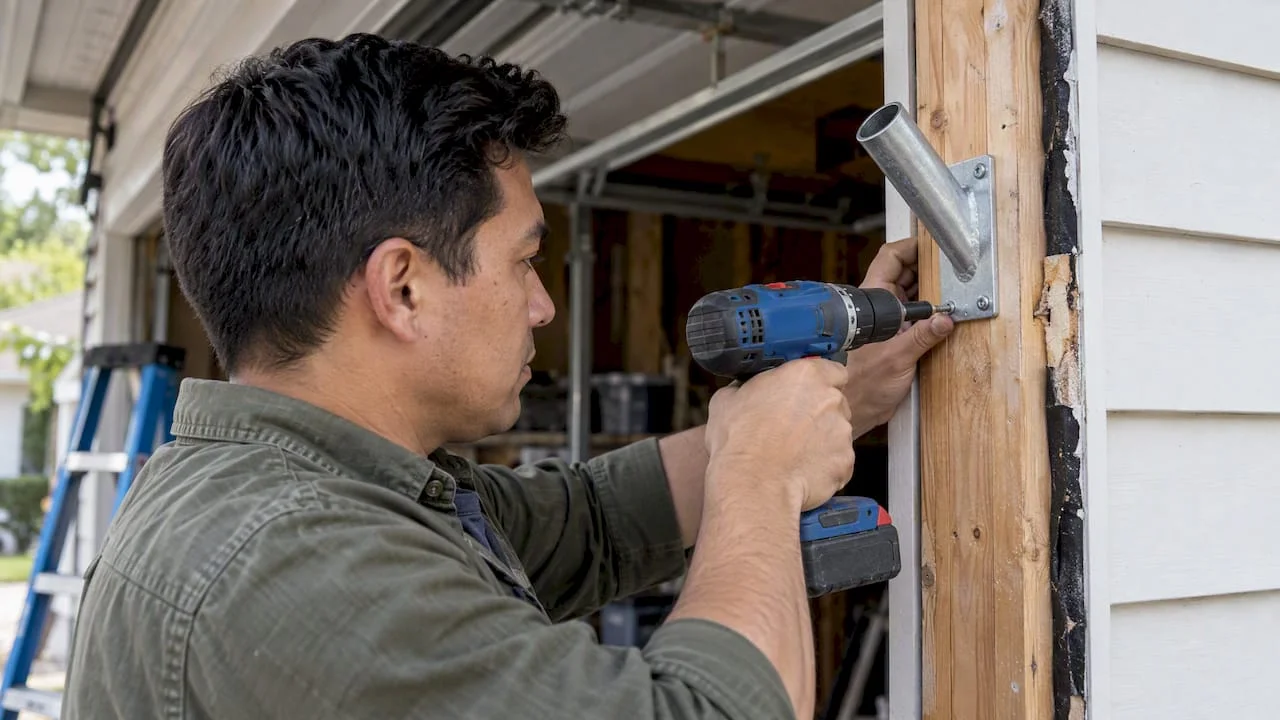
The construction standard cited above requires wall-mounted poles to be anchored to structural backing instead of veneer, cladding or other finish materials. Residential brackets are lighter duty than commercial outriggers, but the principle holds for a porch post or a wall: find the solid wood behind the surface and fasten into that.
For standards on the pole itself, the ANSI/NAAMM FP 1001-07 guide gives procedures for designing metal flagpoles and accounts for wind loads on both the pole and the flag. Industry commentary in Construction Specifier notes that the standard is unusual in explicitly counting the drag of the flag itself. Your porch bracket is not a commercial installation, but the lesson carries over: the flag adds real load.
Step by step
- Locate the studs or solid framing. Use a stud finder. Siding, trim, stucco and brick veneer are not structure.
- Mark the bracket position with a pencil, using a level so the mounting plate sits true.
- Pre-drill pilot holes sized for your fasteners. In masonry, use the correct masonry anchors and bit.
- Fasten the plate with the hardware supplied or stainless or coated hardware appropriate for outdoor use, and seal around the holes to keep water out.
- Set the angle and tighten the locking screw or pin firmly.
- Insert the pole and flag, step back, and check clearances in a light breeze.
- Recheck the hardware after the first storm and at the start of each season.
If you are unsure what lies behind your wall, if the surface is old brick, crumbling mortar, or a second story, a licensed contractor or a qualified handyman is the person to see. Do not hang a pole from a ladder in wind.
Perspective: why the angle is part of the tradition
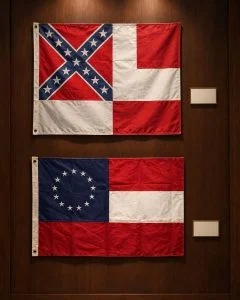
We have spent years in the company of flags, from Revolutionary War banners and Civil War standards to the plain cotton and nylon stripes that fly over American porches, and one thing never changes: a flag wants to move. It was made to rally, to signal, to be seen across a field. A flag pinned flat against a wall, or wrapped around a rail, has been robbed of its voice.
The angled bracket is a humble answer to that old problem. It lets the flag stand out from the building and speak. We recommend 45° to most homeowners for just that reason, and we recommend an adjustable bracket to anyone who is not sure, because every house, every porch and every prevailing wind is different. Fly the union at the peak, mount into solid framing, and give the cloth room to breathe.
— John Hough
Our adjustable bracket and the rest of the hardware
If you want one bracket that can adapt to your porch, look at our Ultimate Adjustable Bracket in white with flat mounting. It is an adjustable design, so you can set and reset the angle to suit your wall, your eave and your flag.

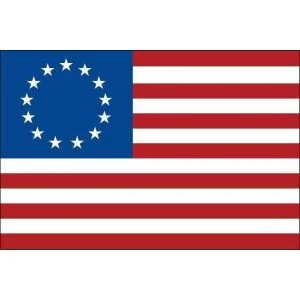
Browse our full range of flagpoles and hardware to pair a bracket with the right pole, and then choose the flag itself from our USA flag collection, our state flags, or our military flags. For a vintage look, our USA 48 star flag in 3×5 feet is a favorite of history lovers.
Common mistakes to avoid
- Mounting too low. The flag drags on bushes, heads or the porch rail. Measure clearance with the flag fully extended.
- Fastening into siding alone. Trim and cladding cannot carry the load. Find the framing.
- Choosing a flag too large for the pole. A big flag on a short, slim pole strains the bracket and wraps easily.
- Setting the angle once and forgetting it. Seasonal growth of shrubs, new railings and snow loads can change what clears. Look again each spring.
- Leaving the flag out in severe weather. All-weather flags are made for it, but storms can still damage the cloth, the pole and the mount. Bring it in when winds turn dangerous.
- Forgetting the union. Check that the blue field sits at the peak of the pole.
FAQ
What is the best angle for a flag bracket?
For most houses, 45° from vertical is the best all-round choice, because it shows the flag well and keeps it away from the wall. Use a steeper-out setting near 60° if a railing, shrub, sidewalk or low eave is in the way. An adjustable bracket lets you test both.
Which way does the union face on an angled flagpole?
The union goes at the peak of the staff. Under 4 U.S.C. § 7, that is the rule when a flag projects at an angle from a building, except at half-staff. Hang the flag so the blue field is nearest the top of the pole.
Can I mount a flag bracket on siding or brick?
Not on the siding alone. Construction guidance calls for anchoring to structural backing rather than veneer or cladding, so fasten into a stud, post or solid framing. On brick or masonry, use proper masonry anchors, and ask a contractor if you are unsure of the wall’s condition.
How high should I mount the bracket?
High enough that the lowest corner of the flag clears heads and walkways at your chosen angle, and a foot or two below any eave so the flag does not snag. Hold the flag in place before drilling and check the clearance on every side.
Do I need an adjustable bracket?
Not always, but it is the safest choice if you are unsure about angle, since it lets you adjust after the flag is flying. A fixed bracket works well when you know your clearances exactly.
Sources
- Flagpoles — Construction Standard | SYNC
- 4 U.S.C. § 7: Position and manner of display
- ANSI/NAAMM FP 1001-07
- Specifying Flagpoles: Exploring standards and common errors, Construction Specifier