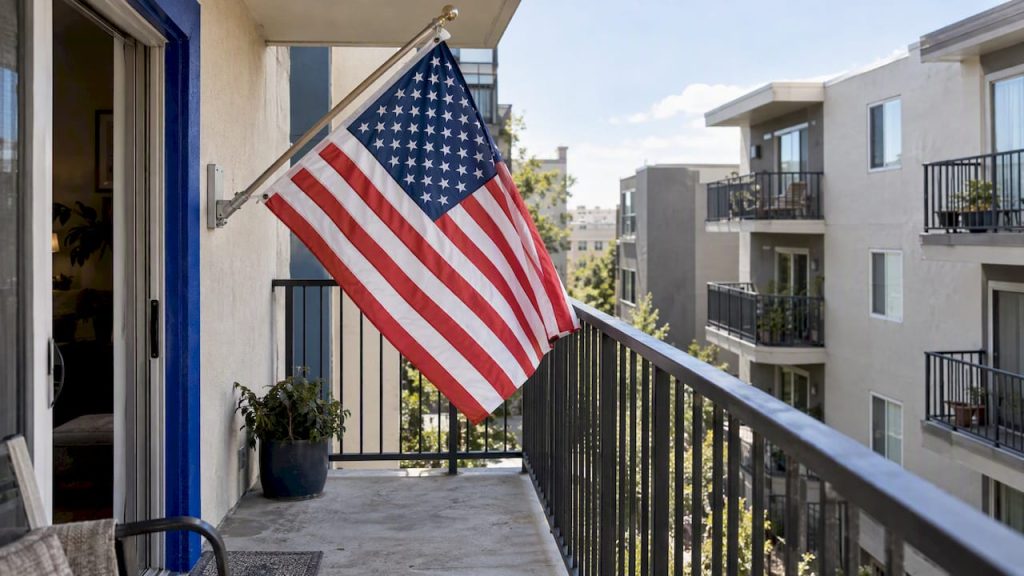
Under 4 U.S.C. § 7, a flag on a balcony belongs on a staff projecting out from the building, union at the peak, aloft and free. Skip draping it over the railing. Remember that your lease or association rules may add limits of their own, so read them before you mount anything. Owners and renters stand on different legal ground.
TL;DR:
- The Freedom to Display Act protects condominium and cooperative owners displaying flags on property they own or exclusively use, but associations may impose reasonable restrictions.
- Renters usually must follow their lease, while New York’s S3462 remains only a proposal and would require notice, compliance, and responsibility for damage.
- Choose a 3 by 5 foot flag for most standard balconies; a 4 by 6 foot flag needs more width and a longer pole.
- Display the flag from sunrise to sunset, or use weatherproof upward lighting after dark; bring it inside at dusk if lighting is impractical.
- Measure the railing before buying a clamp, since thick or unusual shapes may not fit; use corrosion resistant hardware and take the flag down during storms.
Table of Contents
- Quick balcony flag checklist before you hang anything
- Why a projecting staff beats draping over the railing
- What federal law, state law and your lease actually say
- Balcony flag mount options: poles, clamps and brackets
- How to size a balcony flag so it flies free
- Half-staff, night display and caring for a balcony flag
- Resolving a balcony flag dispute with a landlord or HOA
- A flag retailer’s view: etiquette first, then hardware
- Where to find the right flag and hardware at Ultimate Flags
- FAQ
- Sources
Quick balcony flag checklist before you hang anything
Here is the short version of what we tell every neighbor who asks. Run through it before you buy hardware or drill a single hole.
- Union at the peak. On a projecting staff, the blue field sits at the top of the staff, unless the flag is flying at half-staff.
- Nothing underneath. The flag should never touch the floor, the railing, a planter or anything else below it.
- Daylight or light. Follow flag etiquette for displaying the flag during daylight, or light it if it stays up after dark.
- Right-sized flag. Match the flag to your balcony width and pole length. A flag that is too large may snag on the railing.
- Rules first. Read your lease, your HOA or condo rules and any local ordinance before you drill or clamp.
The principle behind all of it is simple. Title 4 of the U.S. Code says the flag should never touch anything beneath it, whether that is the ground, the floor, water or merchandise, and should not be used as drapery.
Statute in plain terms: the same Title 4 passage says the flag should be displayed aloft and free, which is the exact reason a projecting staff beats a draped railing.
For a fuller walk through the customs, our flag etiquette guide covers positioning, half-staff and care in one place.
Why a projecting staff beats draping over the railing
The law speaks to your balcony by name. Section 7 of Title 4 says that when the flag is displayed from a staff projecting horizontally or at an angle from a window sill, balcony or front of a building, the union goes at the peak of the staff. Against a wall or in a window, the union is uppermost and to the observer’s left. Title 4’s display provisions confirm that rule for vertical and window displays, and our guide to vertical flag rules shows how it looks in practice.
A projecting pole does the real work of keeping the flag aloft and free. Held out past the railing, the cloth catches the breeze and falls clear of the balcony floor. A flag hung over the rail tends to sag, wrap the bars and brush whatever sits below.
Draping is the common point of friction. Legal commentary on the Flag Code notes that the Code does not explicitly ban hanging a flag from a balcony railing, but it discourages draping, and community associations often fold its customs into rules they can enforce. An association may well prohibit a draped flag and still allow a projecting one.
When a projecting staff is simply not possible, you still have honest choices:
- A window display: hang the flag flat against the glass with the union uppermost and to the observer’s left.
- A handheld flag: wave a handheld flag during a parade, a holiday or a game, then bring it inside.
- A short staff in a bracket: a compact angled pole can take up very little room.
- Another wall: a flag mounted flat on an interior wall honors the same union rule without touching your railing.
Pro Tip: Step outside and look up at your balcony from the street before you buy anything. Check that the pole clears your neighbor’s balcony and the railing below.
What federal law, state law and your lease actually say
Start with an honest distinction. The U.S. Flag Code is advisory for civilians, and practitioner commentary describes it as the authoritative etiquette standard rather than a criminal statute. Nobody is going to arrest you over a drooping hem. That said, associations and property managers cite it constantly, so following it keeps you on the strongest ground.
The protection that matters for owners is the Freedom to Display Act. Its congressional text protects condominium and cooperative owners who display the U.S. flag on property they own or have exclusive use of, while allowing reasonable restrictions to protect substantial association interests. Our overview of the 2005 flag law for homeowners breaks that down further.
Tenants should not assume the same rights. The Act reaches mainly owners in associations, and renters are usually bound by lease language that can bar decorations or drilling. Some states are working on it. New York bill S3462 is one example of a proposal that would extend the right to display the U.S. flag to tenants, with typical conditions: notice to the landlord, compliance with federal display customs and local law, and the renter’s liability for any damage. A bill is not a law until it passes, so check current status.
States that protect display often still allow rules about how. Arizona is a useful illustration: some rules protect certain flag displays while allowing associations to adopt reasonable rules about placement and size.
How to approach your landlord or board:
- Ask in writing and name the exact flag, size and mount you propose.
- Offer a no-drill clamp and say you will repair any mark on the railing.
- Cite the Flag Code for the projecting staff, so your request reads as etiquette and not a demand.
- Accept a size cap, since reasonable limits are the usual compromise.
- Keep a copy of the reply for your records.
Balcony flag mount options: poles, clamps and brackets
Several hardware types can suit a balcony. Pick the least invasive one that still lets the flag hang free.
- Projecting or angled poles. These are the etiquette favorite, because the staff leans out and keeps the cloth clear of the rail. Plan for a bracket that holds the pole firmly at an angle, and check that the angle does not push the flag into a neighbor’s space. Our flagpole types page walks through residential choices.
- Clamp-on railing mounts. No drilling is the draw. Some adjustable models, such as the Misopily no-drill mount, fit round or square railings and include anti-skid pads. Measure your railing first, because thick or oddly shaped rails may not seat well.
- Wall and soffit brackets. Kits like the Vrbgify bracket offer both clamp-on and wall-mount options for poles around 1 inch in diameter. Drilled installations need anchors rated for the wall, and brick, stucco or hollow material may call for a professional.
- Weather-ready hardware. Wind loads a balcony harder than you expect. Choose corrosion-resistant metal and a mount that does not wobble, and take the flag down in a storm.
Pro Tip: Test-fit the mount before you commit, then add rubber or anti-skid pads under every contact point. A clean railing is the best argument you can bring to a landlord.
How to size a balcony flag so it flies free
Sizing is where good intentions go wrong. A big flag on a short pole will slap the railing, and a ragged edge invites a complaint. Think about proportion, then clearance.
- 3 by 5 feet: the sensible choice for most narrow or standard balconies.
- 4 by 6 feet: works on a wider balcony with a longer pole.
- 5 by 8 feet: generally belongs on a tall residential pole, not a balcony.
- Pole length and angle: a longer, more angled pole lifts the flag clear of the rail, while a shorter pole shrinks your margin.
When you cannot decide, go smaller, or choose a shorter pole set at a steeper angle. Our flagpole height chart explains the 1/4 to 1/3 rule that pros use for ground poles, which gives a useful sense of scale.
What the rule says in practice: the flag must stay aloft and free of anything beneath it, so measure the drop of the cloth against the distance to your railing and floor, then leave a margin.

Half-staff, night display and caring for a balcony flag
A few customs apply every day, so build them into your routine.
- Half-staff. Follow the applicable flag etiquette for raising and lowering a flag at half-staff. When taking it down, follow the prescribed display customs. On a fixed balcony pole, check your angle first so the flag does not drop onto the railing when lowered. Our display and respect guide covers the full routine.
- Night display. The custom is sunrise to sunset unless the flag is properly lit. On a small balcony, a weatherproof spotlight aimed upward does the job, or you can simply bring the flag in at dusk.
- Repairs. Mend a small tear or frayed hem early, before wind turns it into a bigger problem.
- Retirement. When a flag is too worn to display, retire it respectfully rather than discarding it. Our etiquette page explains how.
- No drapery. Never use the flag as a tablecloth, a curtain or a decoration over a rail.
Resolving a balcony flag dispute with a landlord or HOA
Most disputes end quietly when you show you have done your homework. Work through it in order.
- Gather your references. Print the balcony passage of 4 U.S.C. § 7 and any state law that applies to you.
- Read the rule that is being cited. Ask for it in writing if no one will show it to you.
- Propose a gentle fix. Offer a clamp-on mount, a smaller flag or a display limited to holidays.
- Keep a paper trail. Save every email, letter and photo.
- Seek help if you must. A tenant-rights group or an attorney can tell you what your state and lease allow.
Pro Tip: Lead with the compromise and not the statute. Landlords and boards respond better to “here is how I will protect your railing” than to a legal citation.
A flag retailer’s view: etiquette first, then hardware
We believe people are more likely to stay out of trouble when they treat the flag with care and their neighbors with courtesy. A balcony is a small stage. Raise the flag on a proper projecting staff, keep it clear of the floor, light it at night, and your display speaks for itself. Choose landlord-friendly hardware first, because a clamp that leaves no mark can turn a grudging “no” into a “go ahead.” Display it proudly, but lawfully.
— John Hough
Where to find the right flag and hardware at Ultimate Flags
Once your plan is set, we can help you match the flag to the pole. Our pages cover what a balcony needs:
- Flag collections: browse sizes and materials, including USA flags, state flags and more.
- Flagpole types: compare residential poles and mounting styles.
- Flag qualities and uses guide: pick a fabric that will hold up on an exposed balcony.

Start with a collection that fits your balcony, then choose a pole and mount that suit your space and applicable rules.
FAQ
How do you place a flag on a house?
Mount it on a staff projecting from the building, with the union at the peak. Against a wall or in a window, hang it with the union uppermost and to the observer’s left, as 4 U.S.C. § 7 describes.
What are the rules of flag etiquette?
The core rules are that the flag stays aloft and free, never touches anything beneath it, and is never used as drapery or apparel. Title 4 sets these customs. They are advisory for civilians, but widely followed.
Is it illegal to hang a flag at night without a light?
Generally no, because the Flag Code is advisory for civilians. The custom is to display the flag from sunrise to sunset unless it is lit, so a light or bringing it in at dusk keeps you within etiquette.
Can a landlord or HOA ban my balcony flag?
It depends on whether you rent or own. The Freedom to Display Act protects association owners with reasonable limits, while renters usually follow their lease. Ask in writing and offer a no-drill mount.