The rule that governs every well-proportioned display is simple: your flag’s fly, the horizontal length, should measure roughly one-quarter to one-third of your pole’s height. A 20-foot pole calls for a 3×5-foot flag; a 25-foot pole can carry a 4×6. Before you climb toward the upper end of that range, confirm your pole’s “with flag” wind rating. Skipping that step is how a proud display becomes a liability in the first real storm.
TL;DR:
- The recommended flag size for a 20-foot pole is typically 3×5 feet, with a range up to 4×6 feet for sheltered locations and lighter wind conditions.
- Always verify your pole’s wind rating and foundation depth requirements before choosing a flag size, especially for poles near the upper end of the acceptable range.
- For open water or high-wind sites, favor smaller flags and ensure the pole’s engineering limits are not exceeded to prevent hazards during storms.
- When flying two flags on one pole, the national flag should always fly at the top, with the second flag smaller and maintained with separate halyards to avoid tangling.
- Proper measurement methods and adherence to standards like NAAMM FP-1001 and ASCE 7 are essential for safe, durable flagpole and flag combinations.
Table of Contents
- Flagpole Height Chart: Matching Pole Height to Flag Size
- How Do You Calculate the Right Flag Size for Your Pole?
- Can You Fly Two Flags on One Pole?
- What Factors Push You Away From the Standard Ratio?
- What Pole Height and Flag Size Fit Your Home?
- How Do You Measure Pole Height and Plan the Foundation?
- Why Trust Ultimate Flags on Flagpole Specs?
- A Word on Getting the Proportions Right
- Find the Right Flag Size at Ultimate Flags
- Standards and Guidance Worth Bookmarking
- Sources
- FAQ
Flagpole Height Chart: Matching Pole Height to Flag Size
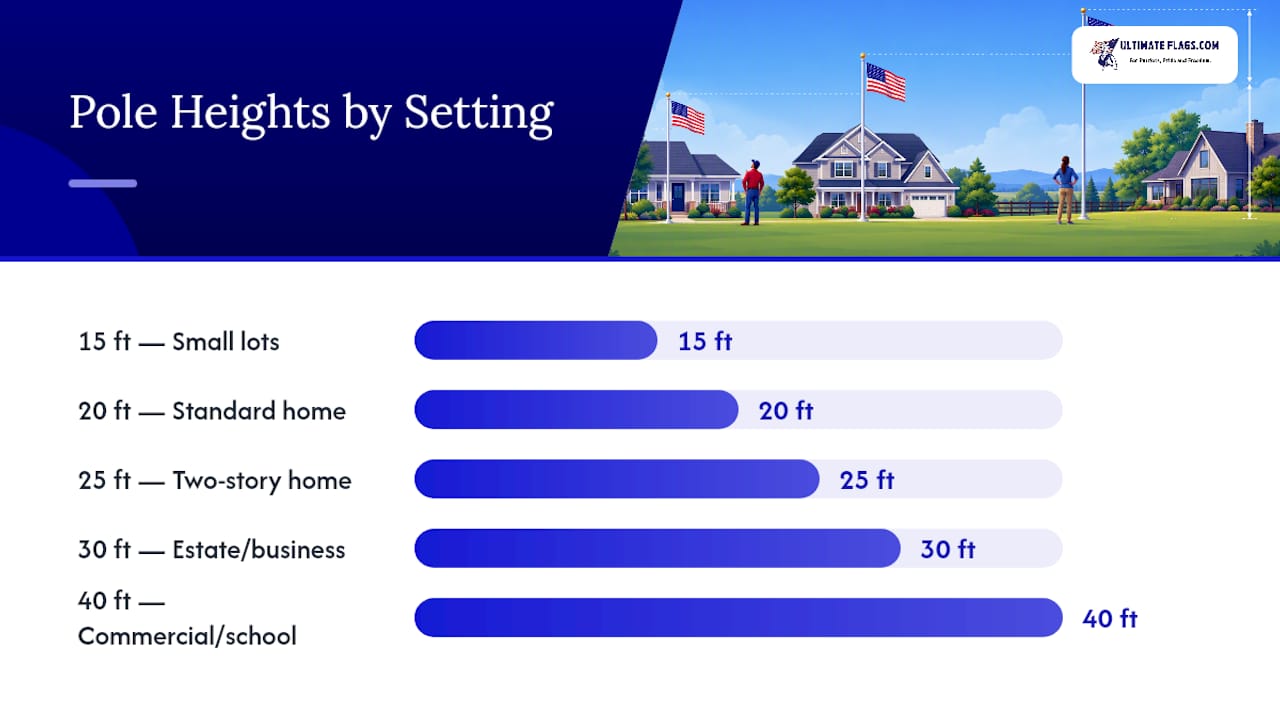
Every flagpole tells a story about the property it guards, and that story should be told in proportion. Too small a flag on a towering pole looks apologetic, like a whisper where a declaration belongs. Too large a flag on a short pole strains the hardware and looks like it’s fighting the wind rather than riding it. The chart below gives you the standard pairing used across the industry, rooted in the quarter-to-third proportion rule that flagpole manufacturers have relied on for generations.
| Pole Height | Recommended Flag Size | Acceptable Range | Typical Setting |
|---|---|---|---|
| 15 ft | 3×5 ft | 2×3 to 3×5 ft | Suitable for smaller residential lots, condos, townhomes |
| 20 ft | 3×5 ft | 3×5 to 4×6 ft | Typical standard single or two-story home |
| 25 ft | 4×6 ft | 4×6 to 5×8 ft | Two-story home, larger setback |
| 30 ft | 5×8 ft | 4×6 to 6×10 ft | Estate lots, businesses, churches |
| 40 ft | 6×10 ft | 5×8 to 6×10 ft | Commercial frontage, schools |
| — | 6×10 ft | 6×10 to 10×15 ft | Government buildings, memorials |
| — | 10×15 ft | 6×10 to — | Stadiums, large civic plazas |
Treat that “acceptable range” column as a decision, not a suggestion. A pole in an open field facing prevailing gusts belongs at the smaller end. A pole tucked against a house, shielded by trees or neighboring structures, can comfortably carry the larger flag in that same row.
Before you order anything at the top of a range, pull your pole’s published “with flag” wind rating and confirm the foundation depth matches what the manufacturer specifies for that height. This single check separates a display that endures decades from one that becomes a hazard in its first Nor’easter.
How Do You Calculate the Right Flag Size for Your Pole?
Flagpole dimensions come down to two measurements: hoist (the flag’s vertical height) and fly (the horizontal length that catches the wind and the eye). Every standard flag size is written as hoist x fly, so a 3×5 flag stands 3 feet tall and stretches 5 feet across.
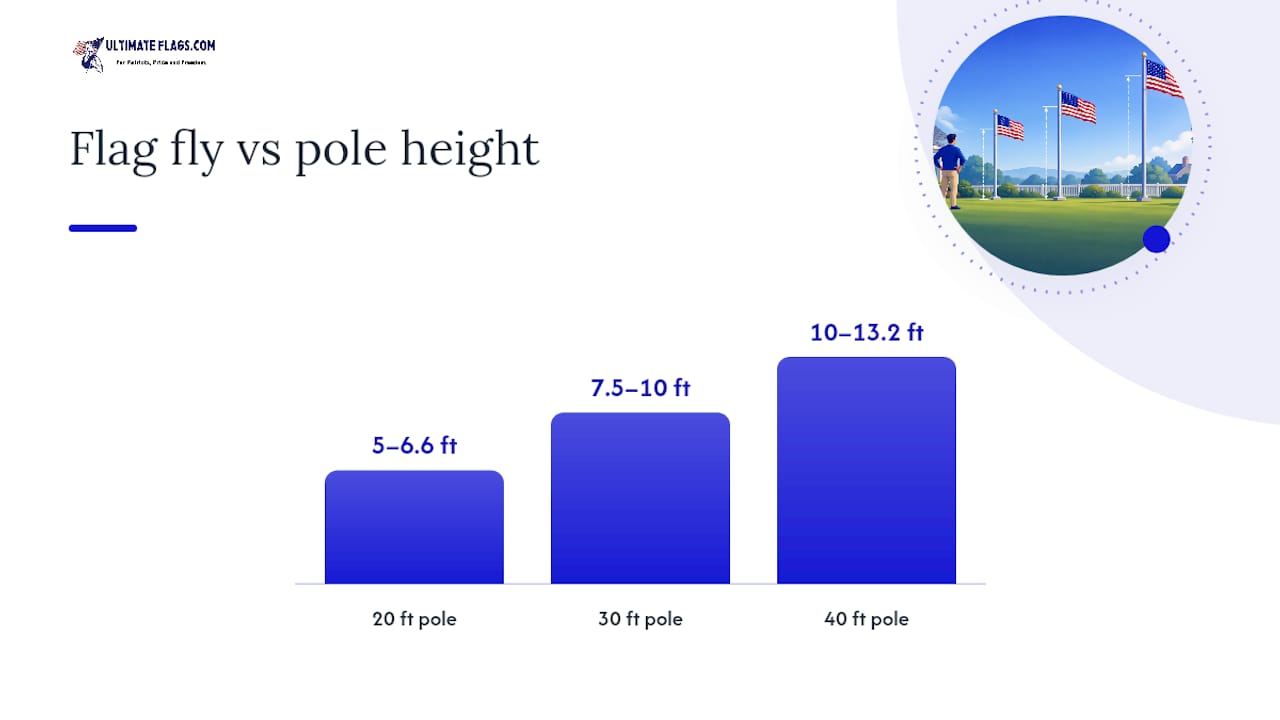
To calculate your ideal fly length, multiply your pole’s height by 0.25 for the conservative figure and by 0.33 for the fuller display, then round to the nearest standard size.
- 20-foot pole: 20 x 0.25 = 5 feet (fly) at the minimum, 20 x 0.33 = 6.6 feet at the maximum. Round down to the standard 5 feet, giving you the classic 3×5.
- 30-foot pole: 30 x 0.25 = 7.5 feet, 30 x 0.33 = 10 feet. That range lands you between a 5×8 and 6×10.
- 40-foot pole: 40 x 0.25 = 10 feet, 40 x 0.33 = 13.2 feet. A 6×10 sits comfortably in that window.
Pro Tip: Favor the quarter end of the rule on any pole facing open water, a ridge line, or unobstructed prairie wind. Favor the third end when the pole stands close to the house or when you want the flag readable from the street at a distance.
Can You Fly Two Flags on One Pole?
Yes, and Americans have done it for generations, from a state flag riding beneath Old Glory to a service flag honoring a branch of the military. The arrangement matters as much as the sizing.
- The national flag always occupies the top position on a shared pole, per longstanding flag etiquette.
- Choose a second flag with the same or slightly smaller fly, never larger than the flag above it.
- Use separate halyards or a multi-cleat setup to prevent the two flags from tangling in shifting wind.
- Space the flags so the lower flag’s hoist doesn’t overlap the upper flag’s fly, especially on poles under 25 feet where clearance runs tight.
Halyard placement deserves real attention here. A single rope carrying two flags close together invites wrapping, which frays fabric and grommets fast. A properly maintained pulley system keeps both banners moving independently and flying true.
What Factors Push You Away From the Standard Ratio?
The quarter-to-third rule is a starting point, not gospel. Real installations answer to wind, exposure, and the pole’s own engineering limits.
Manufacturers rate every pole two ways: unflagged and “with flag.” That second number, governed by ASCE 7 wind-load methodology, sets the true ceiling on how much fabric your pole can safely carry at your regional wind speed. Choosing a flag larger than that rating doesn’t just look wrong. It strips away the safety margin engineers built in.
- Coastal or open-plain exposure: drop to the smaller end of the range regardless of pole height.
- Sheltered suburban lots with windbreaks: the larger end of the range is usually safe.
- High-wind design categories: some sites require stepping down a full flag size from the chart’s default.
- Heavier or fuller-flying fabrics catch more wind than lightweight nylon, so a heavyweight flag effectively behaves like a size larger.
Guide specifications like NAAMM FP-1001 standardize the wind-load math and foundation tables that manufacturers build their ratings around. It’s a reference document, not a law, but it’s the backbone behind nearly every “with flag” number you’ll see on a spec sheet.
What Pole Height and Flag Size Fit Your Home?
Most homeowners are choosing between three heights, and the right one depends on how your house sits on its lot.
- Single-story home, standard lot: a 15 to 20-foot pole with a 3×5 flag reads as balanced from the street, not oversized.
- Two-story home: step up to a 20 to 25-foot pole, matching a 3×5 or 4×6 flag depending on setback.
- Large lot or long driveway approach: 25 to 30 feet lets a 4×6 or 5×8 flag stay legible from the road.
- Tight lot, HOA restrictions, or no ground clearance: a wall-mounted pole with a smaller flag, often 2.5×4 or 3×5, respects the space without crowding it.
Before you dig a single hole, check your homeowners’ association covenants and local zoning code. Many jurisdictions cap residential pole height, and some HOAs restrict poles entirely in favor of wall or porch mounts. It’s worth that phone call before the concrete truck shows up.
A corner lot with wide sight lines can often justify stepping up one size from the standard recommendation. A heavily wooded lot with a short, protected front yard usually justifies stepping down, no matter what the chart alone would suggest.
How Do You Measure Pole Height and Plan the Foundation?
Two low-tech methods get you a reliable height estimate without a survey crew. A smartphone clinometer app, aimed from a measured horizontal distance, calculates height from the tangent of the elevation angle and runs accurate to roughly 2 to 3%.
Foundation depth follows the pole, not the other way around. Residential poles in the 20 to 30-foot range typically need a tapered footing running 24 to 30 inches in diameter and 4 to 6 feet deep, though soil conditions and butt diameter shift that figure.
- Always compare your manufacturer’s specific foundation drawing against your site’s actual soil, not a generic estimate.
- In high-wind zones or unusual soil (sandy, waterlogged, or fill), loop in a local building official or structural engineer before pouring concrete.
- An undersized footing is the most common failure point in a storm. The pole itself can survive intact while the footing tilts beneath it.
Why Trust Ultimate Flags on Flagpole Specs?
Some flag retailers focus on outfitting patriotic Americans, veterans, and history enthusiasts with flags sized to fly right, not just to ship cheap. That means understanding the hardware as much as the fabric.
Before installing anything above 25 to 30 feet, request four numbers from your manufacturer: butt diameter, wall thickness, “with flag” wind rating, and the foundation drawing itself. Those four figures tell you everything a chart alone cannot.
Our flagpole types and footing guide walks through pole materials and foundation basics in more depth, and our rope replacement guide covers the halyard maintenance that keeps a display looking sharp for years. If you’re finishing the display, our breakdown on choosing the right finial covers the symbolism and sizing of that final touch.
A Word on Getting the Proportions Right
Get the ratio wrong in either direction and something feels off, even to viewers who couldn’t tell you why. Err toward the conservative end of the sizing range whenever your site faces real wind exposure, and trust the manufacturer’s rated numbers over your own instinct every time they disagree. A display that honors the flag honors it best by staying upright, intact, and legible for years, not by chasing the biggest fabric the pole can technically hold for one dramatic afternoon.
— John Hough
Find the Right Flag Size at Ultimate Flags
Once you know your number, whether it’s a 3×5, 4×6, or 6×10, the next step is finding a flag built to hold that size with dignity through wind, sun, and years of daily raising and lowering. Some flag catalogs are built specifically for readers who care about getting the proportions and the craftsmanship right, not just checking a box on a purchase.

Browse the full flag collections to find your exact size across national, military, historic, and regional designs, all cut to the standard dimensions this guide covers. If your pole calls for something outside the usual chart, our team can help match a nonstandard flag to a nonstandard height, whether that means a custom fly length or guidance on which category fits your display best. Start by browsing sizes on the flag collections page and reach out if your pole’s dimensions need a closer look before you order.
Standards and Guidance Worth Bookmarking
- NAAMM FP-1001: wind-load methodology and foundation tables
- ASCE 7 wind engineering: regional wind speeds and flag ratings
Sources
- How can I determine the height of a flagpole?- Jiangsu Shengqi Weiye Intelligent Technology Co., Ltd.
- What Size Flagpole For a House? | Residential Flag Pole Height – HD Flagpoles
FAQ
What is the best height for a flagpole?
For most homes, a 20-foot pole is the practical default, while two-story homes or larger lots often look better with 25 feet. The right height depends on your home’s scale, setback, and local HOA or zoning rules more than any single “best” number.
How deep should a 25-foot flagpole be in the ground?
A 25-foot residential pole typically needs a tapered footing around 24 to 30 inches in diameter and 4 to 6 feet deep, though exact figures depend on butt diameter and soil type. Always confirm against the manufacturer’s specific foundation drawing rather than a general estimate.
What is the standard height of a residential flagpole?
Most residential installations fall between 15 and 25 feet, with 20 feet being the most common single choice for standard single and two-story homes. Smaller lots or condos often use 15-foot poles or wall-mounted options instead.
What is the recommended flagpole height for a two-story house?
A two-story home generally suits a 20 to 25-foot pole paired with a 3×5 or 4×6 flag, keeping the proportion balanced against the taller facade. Homes with deeper front setbacks can lean toward the 25-foot end of that range for better street visibility.
What size flag fits a 20-foot flagpole?
A 20-foot pole is built for a 3×5-foot flag, following the standard quarter-to-third proportion rule. Sheltered sites can size up toward a 4×6 if the pole’s “with flag” wind rating supports it.