A Revolutionary War reenactment display works best with three to six period flags chosen for the units on the field: the Grand Union colors of the Continental forces from 1775-1776, the Gadsden and Culpeper rattlesnake flags of the early militia, and the 13-star Betsy Ross pattern adopted on June 14, 1777. Match each design to the unit it belongs with, size it to the pole or camp it flies over, and keep every flag documented so the display holds up to a knowing eye. The six flags below are the ones reenactment groups and living-history displays reach for first in 2026.
- Grand Union, Gadsden, Culpeper, Betsy Ross, Bennington and Serapis are the six core Revolutionary War display flags.
- Match each design to its unit and year: Continental colors from 1775-1776, militia flags from 1775, Congress’s standard from 1777.
- The 13-star, 13-stripe design became the national flag on June 14, 1777.
- Cotton reads period-correct in camp; nylon flies lighter and dries faster outdoors.
- July 4, 2026 marks America’s 250th anniversary, a natural year to add a display flag.

Why the flags matter in a reenactment display
Flags are the fastest thing a visitor reads at a reenactment. Before anyone studies a coat or a musket, they see what is flying over camp, and every design on the field carries a date. A 1775 militia impression flying a flag Congress adopted in 1777 quietly contradicts itself; the right flag makes the whole camp read true. That is also why serious living-history groups document their colors — every design below traces to dated, published records you can check before you buy.
Which Revolutionary War flags belong in a reenactment display?
| Flag | First flown | What it looks like | Best display use |
|---|---|---|---|
| Grand Union | December 1775 | 13 red and white stripes with a British Union Jack canton | Continental camps, 1775-1776 impressions |
| Gadsden | Late 1775 | Yellow field, coiled rattlesnake, DONT TREAD ON ME | Naval themes and gateway display |
| Culpeper | 1775 | White field, coiled rattlesnake, LIBERTY OR DEATH | Virginia militia and minutemen impressions |
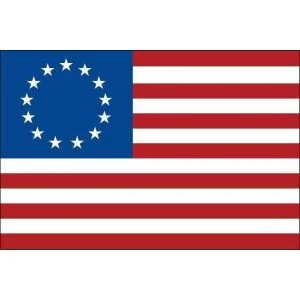
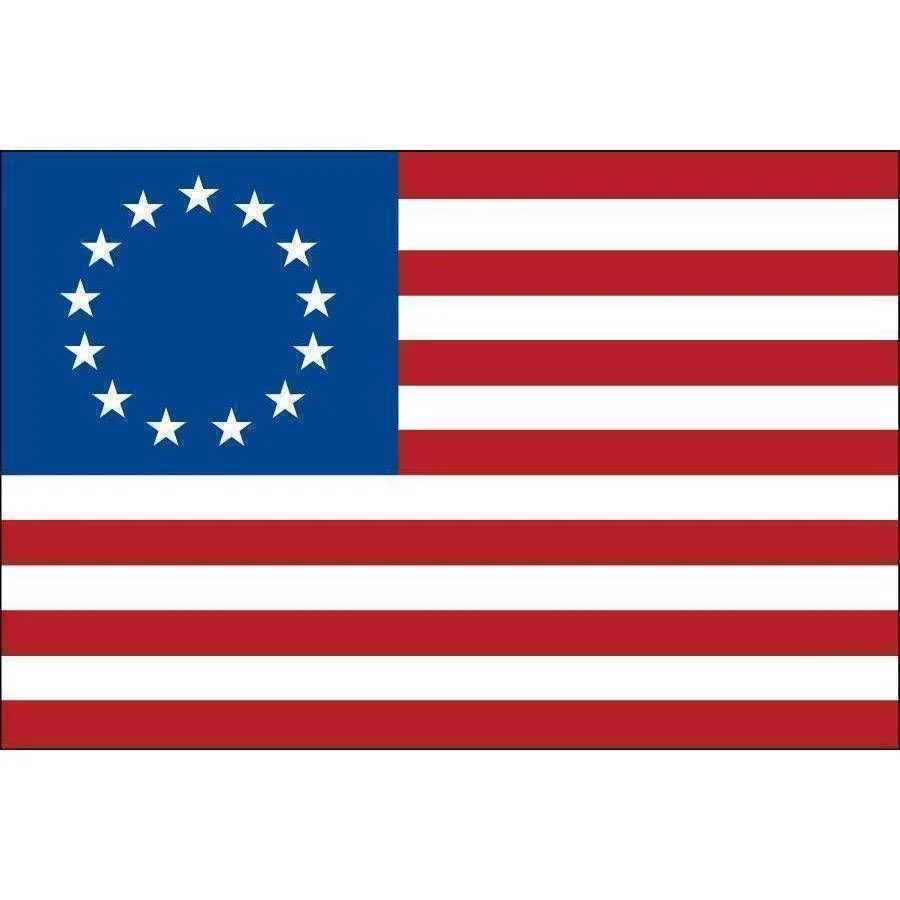
| Betsy Ross 13-star | June 14, 1777 | 13 stars in a circle on 13 stripes | Continental line camps and the patriotic centerpiece |
| Bennington | 1777 | Stars arched over a large 76 on 13 stripes | New England militia displays |
| Serapis | 1779 | Blue, white and red stripes with multi-pointed stars | Naval and John Paul Jones displays |
Read the table as a timeline and the answer builds itself: the rattlesnake flags and the Grand Union belong to the war's opening years, the 13-star flag to 1777 and after, and the Serapis flag to the navy's most famous fight of 1779.
The six display flags, one by one
Grand Union: the Continental forces' first colors
The Grand Union was the first flag raised over the Continental forces, hoisted in December 1775. Its 13 red and white stripes announced the united colonies, while the Union Jack in the canton still acknowledged the Crown — which is exactly what dates it to before independence. For a 1775-1776 Continental camp, the Grand Union is the period-correct choice, and it makes a striking contrast flying beside the later 13-star design.
Gadsden and Culpeper: the rattlesnake flags of 1775
The rattlesnake became the colonies' defiant emblem in 1775, and two militia designs carry it best. The Gadsden flag — a coiled timber rattlesnake on yellow with the words DONT TREAD ON ME — is the cleanest, most recognizable single flag of the war. The Culpeper flag of the Virginia minutemen adds LIBERTY OR DEATH, the phrase made famous by Patrick Henry in 1775, above its own coiled snake. Either one anchors a militia impression; together they bracket the war's first year.
Betsy Ross 13-star: the flag of 1777
On June 14, 1777, the Continental Congress resolved that the flag of the United States be 13 stripes and 13 stars. The circle-of-13-stars design associated with Betsy Ross is the most familiar version of that standard, and it is the centerpiece flag for any camp from 1777 to the war's end in 1783. If a display flies only one flag, this is the one.

Bennington: the 76 flag of New England
The Bennington design places arched stars over a large 76 for 1776, set on 13 stripes. Tradition ties it to the militia that fought at Bennington in August 1777, and the bold 76 makes it read at a distance no other period flag matches. It suits New England militia impressions and any display that wants a distinctly Independence-era banner.
Serapis: the naval flag of 1779
The Serapis flag takes its name from the British warship John Paul Jones captured in September 1779, when his own colors had gone overboard and a hastily made American ensign flew over the prize. Its blue, white and red stripes and multi-pointed stars make it one of the most striking early American designs. Naval impressions and maritime displays reach for it first.
Matching the flag to your impression
- Continental line, 1777 onward: Betsy Ross 13-star as the camp standard.
- Early-war militia, 1775-1776: Culpeper for Virginia units, Gadsden for a broad militia or naval theme, Grand Union for Continental camps.
- Naval or maritime display: Serapis flag, with a Gadsden alongside.
- Anniversary or heritage display: the Betsy Ross or Bennington design as the centerpiece, ringed by the earlier flags.
Sizing and construction for field use
A 3×5 ft flag is the practical standard for reenactment poles, porch displays and most camp setups; larger sizes suit taller poles and gateway positions. Construction matters as much as size. Cotton has the period look and handles camp display beautifully, while nylon flies lighter in a breeze and dries faster after rain — the better all-day outdoor choice. Check the attachment too: pole sleeves suit indoor and camp poles, and grommets suit rope halyards on taller poles.
When you are ready to Shop Ultimate Flags, compare the sewn and printed versions of the same design side by side — the stitching is the difference you can see at arm's length. Ultimate Flags carries hard-to-find historic designs, from the Grand Union to the Serapis pattern, alongside the familiar standards.
Common display mistakes to avoid
- Flying a 1777 flag at a 1775 impression. The rattlesnake flags and Grand Union predate the national standard; keep the timeline honest.
- One undersized flag on a tall pole. A 3×5 ft flag disappears on a 25-foot pole — step the size up with the pole height.
- No documentation on display. A small caption card naming the design and its year turns a decoration into an exhibit.
- Printed flags where the crowd stands close. Sewn and embroidered flags reward close inspection; print works better at distance.

The 250th anniversary makes 2026 the year to add one
July 4, 2026 marks 250 years since the Declaration of Independence, and commemorative displays are already built around that date. A Revolutionary War flag display gains a natural centerpiece this year: fly the 13-star design as the flag of 1777-1783, or add a commemorative anniversary banner beside the period colors. Either way, the designs above are the same ones museums and living-history groups are putting up for the anniversary.
Related questions about Revolutionary War display flags
How many flags should a reenactment camp display?
Three to six works best for most camps: one camp standard, one or two unit flags, and a national color. More than that and the timeline gets hard for visitors to follow.
What size flag works for a camp or tent display?
A 3×5 ft flag fits most reenactment poles and camp entrances. Save larger sizes for tall poles and gateway displays where the flag will not crowd the camp.
Were these flags the official flags of the Continental Army?
No. Congress set the national design on June 14, 1777, but armies and militia units carried many local and personal standards throughout the war. That variety is why matching each flag to its unit and year matters so much in a display.
FAQ
Which Revolutionary War flags belong in a reenactment display?
The core six are the Grand Union from December 1775, the Gadsden and Culpeper rattlesnake flags of 1775, the Betsy Ross 13-star design adopted June 14, 1777, the Bennington 76 flag of 1777, and the Serapis naval flag of 1779.
What is the Grand Union flag?
The Grand Union was the first flag of the Continental forces, raised in December 1775. It shows 13 red and white stripes with a British Union Jack in the canton, which dates it to before independence.
When did the 13-star flag become the national flag?
The Continental Congress resolved on June 14, 1777 that the United States flag would carry 13 stripes and 13 stars. The circle-of-stars design associated with Betsy Ross is the best-known version.
What flag should a 1775 militia impression fly?
The Culpeper flag with LIBERTY OR DEATH for Virginia minutemen, or the Gadsden rattlesnake flag for a broader militia or naval theme. Both designs date to 1775.
What size flag is right for a reenactment pole?
A 3×5 ft flag is the standard for most reenactment poles and camp displays, with larger sizes reserved for tall poles and gateway positions.
Is cotton or nylon better for a reenactment flag?
Cotton has the period-correct look for camp display, while nylon flies lighter, holds up outdoors and dries faster after rain. Choose cotton for authenticity in camp and nylon for all-day flying.
One last thing
The Grand Union still carries the Union Jack in its canton — which is exactly what makes it unmistakably a flag of 1775-1776, flown before independence settled the design. Fly it beside the Betsy Ross pattern and your camp tells the whole story of 1775 to 1783 without a single sign.
Related guides