Posted on

How do you care for outdoor American flags after rain?

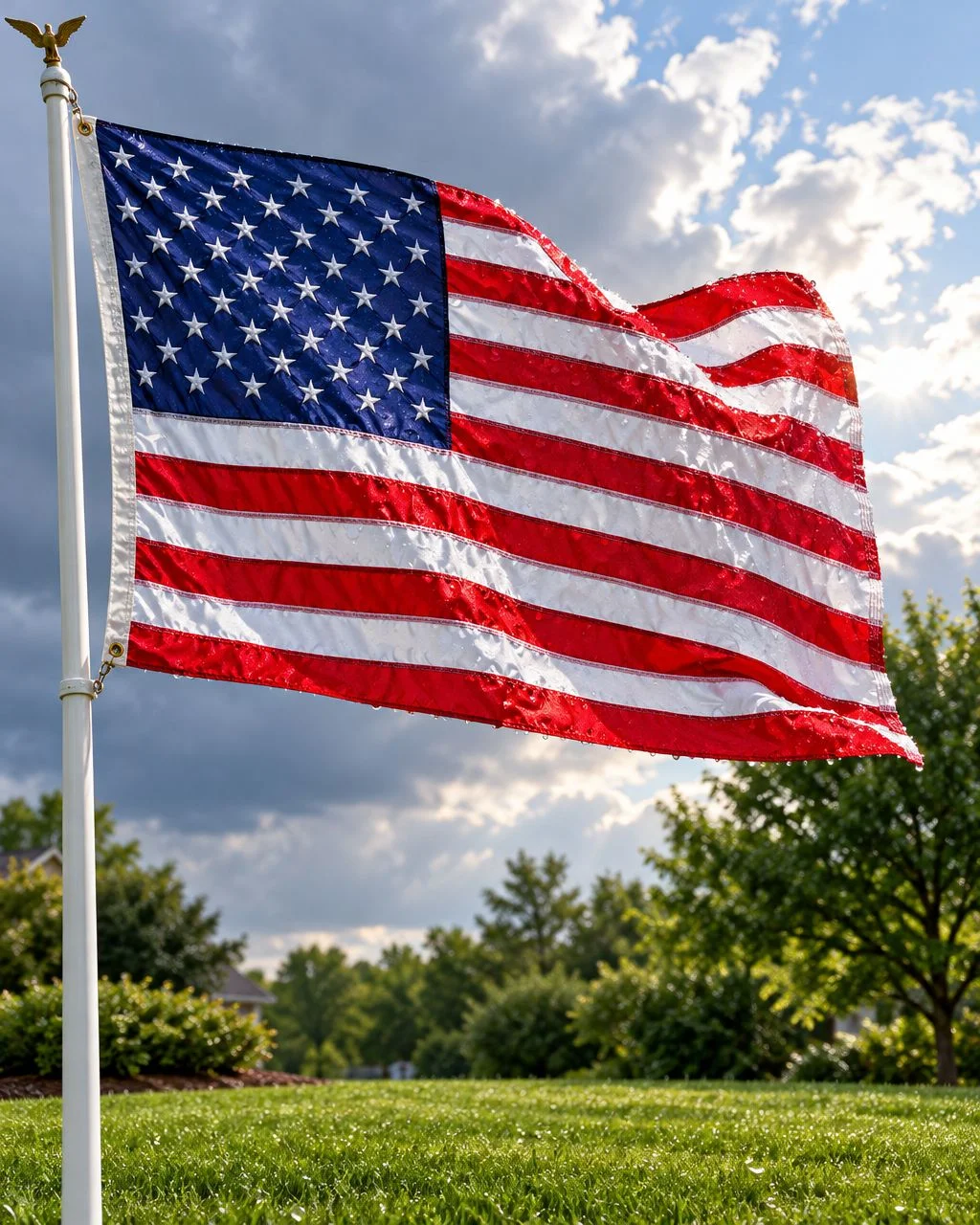
American flag with rain droplets drying on a white pole after a storm, sky clearing behind it

Bring a rain-soaked American flag down, let it dry completely, and wash off the grime the rain left behind — that three-part routine is the whole answer to caring for outdoor American flags after rain. The step you cannot skip is the drying: a flag folded or bunched up while damp grows mildew, and mildew eats fabric. The U.S. Flag Code, 4 U.S.C. § 6(c), allows a flag to stay out in bad weather only when it is an all-weather flag, and even a storm-rated flag deserves a fly-end check once the clouds clear.

Quick answer
  • Take the flag down, shake off the water and let it dry fully before storing.
  • Wash gently by hand in mild soap and lukewarm water; skip bleach.
  • Drape the flag wide to dry — never leave it bunched against the pole.
  • Check for a musty smell or specks after every multi-day wet stretch.
  • In rainy regions, embroidered nylon dries fastest; 2-ply polyester handles wind and sun best.

Ultimate Flags flag sale banner

How do you care for outdoor American flags after rain?

Work in this order — down, dry, clean, inspect, rehang. Most rain damage is really storage damage: the rain softened the cloth, and somebody folded it damp into a drawer or left it wadded on the pole. Five steps keep that from happening.

  1. Bring the flag down. Give it a gentle shake to throw off standing water and any twigs or leaves the storm delivered.
  2. Let it dry completely. Drape it over a clean railing or clothesline, or lay it flat, so air moves through the whole cloth. Spread out, not folded.
  3. Clean off what the rain left behind. Bird droppings, road dust and pollen stick to wet fabric and stain as they dry.
  4. Check for mildew. Sniff for a musty smell and look for gray or greenish specks, especially along the folds and the fly end.
  5. Inspect and rehang. Look over the stitching, grommets and fly end, then raise it again on a dry day.
2-ply poly embroidered American flag with sewn stripes flying on an outdoor poleShop Now
A 2-ply poly embroidered outdoor American flag from Ultimate Flags — a heavy sewn construction that rides out repeated storms better than thin cloth.

Why drying matters more than the rain itself

Rainwater itself rarely hurts a flag. What hurts is the hours afterward: damp cloth folded against damp cloth holds moisture for days, and that is exactly the conditions mildew needs. Once mildew takes hold, the musty smell never fully washes out and the fabric underneath is already weakened.

Fabric decides how long this takes. Nylon absorbs very little water, so an embroidered nylon flag dries in a few hours on a breezy day. A 2-ply polyester flag is heavier and holds more water, so it needs more time spread out. Cotton blends hold water the longest of all, which is one reason cotton is a fair-weather and indoor display fabric rather than a permanent outdoor one.

The practical rule for 2026: never store a flag you cannot honestly call bone-dry. If you would not fold it and put it away, do not fold it and put it away.

How to clean an American flag after rain

Hand washing is the safe default for every outdoor flag, and it takes about fifteen minutes of actual work.

  • Fill a basin or bathtub with lukewarm water and a small amount of mild soap — dish soap or a gentle laundry detergent both work.
  • Submerge the flag and swish it gently for a few minutes, then let stubborn spots soak briefly.
  • Rub soiled areas with your fingers or a soft cloth. Bird droppings and mud usually lift without scrubbing.
  • Rinse in clean water until no suds remain.
  • Air dry flat or draped, as above. Never twist or wring a flag — wringing stresses seams and distorts the fly end.

A washing machine is acceptable only when the flag's care instructions allow it, ideally in a mesh bag on the gentle cycle, and always air-dried afterward. Skip chlorine bleach entirely: it weakens fibers and can yellow the white stripes you are trying to brighten. Wash a permanently displayed flag a couple of times a year — grime holds moisture against the dye, and a clean flag keeps its color noticeably longer.

Mildew after rain: what to look for and what to do

The nose knows first. A flag that smells musty after a wet week is growing mildew whether or not you can see it. Visible mildew shows up as gray, green or black specks, most often along fold lines and the hem where moisture sat longest.

For early mildew, the same gentle wash above plus a day drying in open sunlight usually handles it — sunlight is a natural mildew killer. Work mild soap into the affected spots, rinse well, and dry spread out rather than folded. Cotton flags deserve extra gentleness here, because aggressive scrubbing can permanently damage the weave.

Mildew that survives a wash and a sunny dry-down has rooted into the fibers. At that point the flag is on borrowed time; plan a replacement and store the next one dry from the start.

The mistake that ruins more flags than the rain does

Leaving a soaked flag wadded on the pole. Wet nylon in the sun with no air moving through it can develop water stains and uneven fading within a day or two, and the creases where the wet fabric pressed against itself become the weak points that fray first. If a storm hits while you are away, the flag is not ruined — but the first thing you do when you get home is spread it out to dry, not leave it hanging in its own wad waiting for the next shower.

Nylon embroidered American flag with embroidered stars flying against a blue skyBuy This Flag- Click Here
An embroidered nylon American flag — the fabric that sheds rain and dries fastest, which makes it the easy choice in wet climates.

When rain should change what you buy

If a flag spends every wet season looking bedraggled, the fabric may simply be mismatched to your weather. Here is how the common constructions behave once the rain starts:

Fabric Best for After-rain behavior Watch out for
Embroidered nylon Humid and rainy regions, light wind Sheds water, dries in hours Wears faster in hard wind
2-ply polyester Open, windy, full-sun sites Heavier when wet, dries slower Needs a real breeze to fly
Printed polyester or nylon Seasonal and part-time display Fine when taken in between uses Thinnest cloth; fades first
Cotton blends Indoor and fair-weather display Holds water longest Not for permanent outdoor use

For a 2026 yard in the Gulf Coast states, the Pacific Northwest or anywhere afternoon storms are routine, the embroidered nylon above is the low-drama choice: it dries before mildew can get started. In a windy plains or coastal yard, accept the slower dry-down of 2-ply polyester in exchange for its longer life in the weather you actually have. For sizing — matching flag dimensions to a home pole — the checklist in How do you choose outdoor American flags for your home? covers pole heights and clearances in detail.

The decision to fly or lower during a storm is separate from fabric, and the rain-day rules in What do you do with an American flag on a rainy day? walk through the Flag Code side of that question.

How do you dry a wet American flag fast?

Air only. Drape the flag as wide as the cloth will go — over two points rather than one if you have them — in a spot with a breeze, and most nylon flags are dry within a few hours. Keep it out of a hot dryer: high heat can damage the cloth and the stitching, and a dryer drum tangles a flag into exactly the kind of wad you are trying to avoid.

Should I bring my flag inside every time it rains?

Not if it is a genuine all-weather flag — the Flag Code's bad-weather allowance exists for nylon and polyester outdoor flags, which are built to get wet. Do bring it in for severe storms, when the wind load or lightning risk is the bigger problem, and get in the habit of taking any flag down for the season's first hard freeze if you leave it up year-round. The habit that matters is the post-rain one: dry it before it is stored.

How do I keep my outdoor flag from getting musty?

Dry fully, then store in a breathable container. A cotton pillowcase or a ventilated storage bag beats an airtight plastic bin, which traps any residual moisture against the fabric. Wash the flag twice a year, and always after a visibly dirty or droppings-hit week, so the grime that feeds mildew never gets a running start.

When you are ready to Shop Ultimate Flags, the embroidered nylon and 2-ply polyester outdoor flags are the two constructions that handle repeat rain best, and both come in the standard home sizes.

FAQ

What should I do with my American flag after it rains?

Bring it down, shake off the water and let it dry completely before folding or storing. Wash off any bird droppings, dust or pollen the wet fabric picked up, then check the fly end and seams before rehanging.

Can an American flag stay up in the rain?

Under the U.S. Flag Code, 4 U.S.C. § 6(c), a flag should not be displayed in bad weather unless it is an all-weather flag. Outdoor nylon and polyester flags generally qualify, but no flag should ride out a severe storm.

How do I get water stains out of an American flag?

Hand wash the flag in lukewarm water with mild soap, working the stained areas gently with your fingers, then rinse and air dry flat. Water stains are usually mineral and grime deposits, which a gentle wash lifts.

How long does a wet flag take to dry?

An embroidered nylon flag dries in a few hours on a breezy day when draped wide. Heavier 2-ply polyester takes longer, and cotton takes longest of all — which is why cotton is a fair-weather fabric.

Can I put a wet American flag in the dryer?

No. Dryer heat can damage the cloth and stitching, and the tumbling tangles the flag. Air dry it draped wide over a railing or laid flat instead.

How do I get the musty smell out of a flag?

Wash it gently with mild soap, then dry it spread out in open sunlight, which kills mildew. A smell that survives a wash and a sunny dry-down means mildew has rooted in the fibers and the flag is ready for replacement.

What is the best flag fabric for a rainy climate?

Embroidered nylon is the best choice for rainy climates because it absorbs little water and dries fast, before mildew can start. 2-ply polyester lasts longer in wind and sun but dries more slowly after each storm.

One last thing

The most valuable thirty seconds after any storm is the fly-end check. The fly end takes every gust and every soaked-then-snapping cycle, and a fray you catch today is a five-minute trim; a fray you notice next month has already run a foot up the stripe. Ultimate Flags buyers who dry, wash and inspect on this schedule routinely get seasons of extra life from the same flag — and if your flag is already past that point, a fresh one costs less than the winter of mildew you are currently storing in the closet.

Related guides
Posted on

Best fade-resistant outdoor American flags in 2026

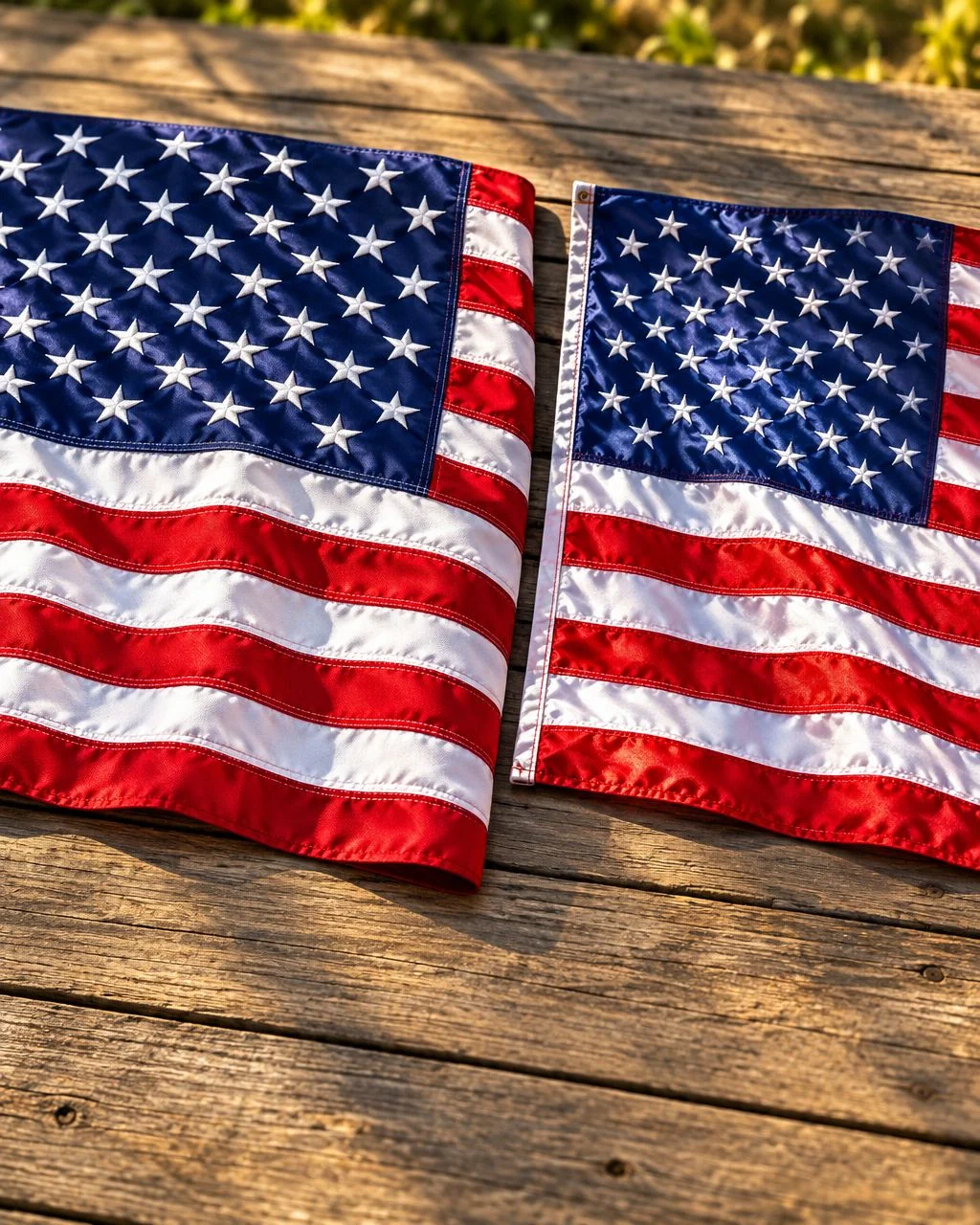
Two American flags with embroidered stars and sewn stripes laid on a wooden surface in sunlight, comparing heavy 2-ply polyester and lighter nylon fabrics

Best overall for fade resistance: a 2-ply spun polyester American flag, because its heavier weave is the fabric feature most consistently tied to slower color loss in all-day sun. Best for light-wind porches: an embroidered nylon flag, which flies in the faintest breeze and dries fast after rain. Best budget option: a printed polyester flag, the right pick when you would rather replace it sooner than spend more up front.

Quick answer
  • 2-ply spun polyester is the best outdoor American flag for all-day sun.
  • Embroidered nylon wins for light wind and fast drying after rain.
  • Printed flags fade first because the ink sits on the surface.
  • Red stripes show sun fade before the blue canton on most flags.
  • Match the flag to your wind and sun before comparing prices.

Ultimate Flags flag sale banner

Why fade resistance matters more than thread counts

A flag spends its life being slowly sandblasted by sunlight. Ultraviolet light breaks down dye molecules and fabric fibers at the same time, and the side of the flag facing the sun takes the worst of it. That is why the question buyers ask first — how long will the colors last — is really a question about fabric, not about stitching counts or branding.

The honest answer is that every outdoor flag fades eventually. The 2026 question worth asking is which fabric fades slowest in your particular yard: a flag on a shaded, breezy porch ages nothing like a flag on an open pole in a field with southern exposure. This guide ranks the common fabric-and-construction combinations by how well they hold their color, so you can match the flag to the sun it will actually live in.

What makes the best fade-resistant outdoor American flag

Before the ranking, here is what the comparison weighs. Any flag judged on these five points holds color longer than one chosen from a photo alone.

  • Fabric weight and plies. A 2-ply flag uses two yarns twisted together, which makes a heavier, more opaque cloth. More fabric between the dye and the sun means slower fade.
  • Dye penetration. Woven fabrics hold dyed yarn, so color sits throughout the thread. Printed designs put ink on the surface, where the sun reaches it directly.
  • Wind fit. A flag that flaps violently in too much wind wears thin at the fly end first, and thin fabric fades fast. A flag matched to its breeze keeps its coating of fiber longer.
  • Fly-end construction. The fly end takes the most abuse. Reinforced rows of stitching there keep the flag's shape, which matters because a sagging, threadbare fly end reads as faded even when the color is fine.
  • Realistic replacement plan. Fade resistance buys time, not immortality. The best setup is the fabric that gives you the longest acceptable-looking life per dollar in your exposure.

Fade-resistant outdoor American flags at a glance

Flag type Best for Standout feature Key limitation
2-ply spun polyester, embroidered Open yards with all-day sun Heaviest, most opaque weave Heavier; needs a decent breeze to fly well
Embroidered nylon Porches and light-wind spots Flies in the faintest breeze, dries quickly Lighter cloth; fades sooner in full sun than 2-ply
Printed polyester or nylon Budget and seasonal displays Lowest cost per flag Ink sits on the surface, so it fades first
Poly-cotton outdoor blend Traditional look, part-time display Cotton's rich, vintage appearance Absorbs water; not for constant all-weather use

1. 2-ply spun polyester: best fade resistance for all-day sun

This is the flag you put on the pole that never gets a break. Spun polyester is woven from finer, twisted yarns in a denser weave than standard polyester, and 2-ply construction doubles that up into a heavy cloth that feels closer to cotton than to a sail. The extra thickness is exactly what slows the sun down: color in a woven, dyed fabric runs through the yarn, so there is simply more dyed fiber for ultraviolet light to work through before the flag looks washed out.

The embroidered versions carry that advantage onto the design itself. Embroidered stars and sewn stripes are made from dyed thread stitched through the cloth, not ink laid on top of it, which is why an embroidered 50-star canton keeps its definition long after a printed one has gone pinkish at the edges.

2-ply spun polyester pros:

  • Heaviest common flag fabric, so it blocks the most sun per square inch
  • Dyed yarn carries color through the thread, not just across the surface
  • Embroidered stars and sewn stripes hold sharp detail for years
  • Handles rough, windy sites better than lighter cloth

2-ply spun polyester cons:

  • Needs a reasonable breeze to fly fully; it can look droopy on still mornings
  • Heavier weight puts more load on hardware, so check your pole's rating
  • Costs more up front than printed flags of the same size

Best for: open lawns, coastal and plains wind, and any 2026 display that faces unshaded sun for most of the day.

2-ply poly embroidered American flag with sewn stripes and embroidered stars flying on an outdoor poleShop Now
A 2-ply poly embroidered outdoor American flag with sewn stripes and embroidered stars, the construction ranked best for all-day sun.

2. Embroidered nylon: best for light wind and quick drying

Nylon is the lightweight champion. It unfurls in a breeze barely strong enough to move a trash bag, which makes it the right flag for porches, courtyards and anywhere the wind arrives politely rather than in gusts. It also sheds water: nylon absorbs little moisture, so after a rain it dries in short order instead of staying heavy and damp against your pole.

On fade resistance, nylon sits a clear second to 2-ply polyester. The cloth is thinner, so the sun works through it faster, and on most flags the red stripes show fading before the blue canton does. The embroidery helps — embroidered stars and lettering keep their color and relief long after flat printed areas have dulled — but if your display gets twelve hours of direct sun, the polyester option above is the more fade-resistant choice.

Embroidered nylon pros:

  • Flies in the lightest breeze of any common flag fabric
  • Dries quickly after rain, which discourages mildew and water staining
  • Embroidered details stay sharp and dimensional for years
  • Available in a full size run, from 3×5 ft up through 6×10 ft and beyond

Embroidered nylon cons:

  • Thinner cloth fades sooner than 2-ply polyester in identical full-sun sites
  • Too light for very windy exposures, where it will wear at the fly end

Best for: shaded or half-shaded porches, light-wind neighborhoods, and buyers who want a sharp-looking flag on display every day without heavy wind load.

Nylon embroidered American flag with embroidered stars flying against a blue skyBuy This Flag- Click Here
An embroidered nylon American flag flying in a light breeze, the fabric ranked best for porches and quick drying.

3. Printed polyester: best budget pick for seasonal and part-time display

A printed flag gets its design from ink laid on the surface of the cloth, and that is the whole story of its fade resistance. The sun works on that ink directly, with no thickness of dyed yarn in the way, so a printed flag shows fade before a dyed-and-sewn flag in the same spot — usually on the red stripes first.

That limitation is also why it earns a place in this ranking. For a lake house you visit on weekends, a holiday display, or a banner that comes down between occasions, a printed flag gives you a bright, complete design at the lowest cost, and the sun simply never accumulates enough hours to matter. Buy it for part-time duty, plan to replace it sooner under permanent display, and it is the most sensible flag on this list.

Printed polyester pros:

  • Lowest cost per flag, which makes replacements painless
  • Bright, complete design including fine details printing handles well
  • Light in weight, easy to fly on short poles and porch mounts

Printed polyester cons:

  • Surface ink fades first in steady sun; weakest fade resistance here
  • Thinner cloth wears faster in wind than sewn or 2-ply flags

Best for: seasonal displays, vacation homes and any flag that spends more time stored than flying.

Why flags fade and what actually slows it

  • Ultraviolet hours. The total sun the flag absorbs is the biggest factor. A south-facing pole with no shade accumulates UV hours several times faster than a porch flag.
  • Fabric thickness. Thicker, tighter weaves shade their own dye. This is the core advantage of the 2-ply polyester ranked first above.
  • Dye method. Woven, dyed yarn keeps color through the thread; printed ink sits on the surface where light hits it directly.
  • Wind abrasion. A flag flapping in too much wind thins its own fabric, and thin spots fade first. Right-sizing the flag to the pole and site slows this down.
  • Cleanliness. Dust, pollen and road film hold moisture and grime against the dye. A flag brought down and washed gently a couple of times a year keeps its color noticeably longer.

For the sizing half of that equation — matching flag dimensions to a home pole — the practical checklist in How do you choose outdoor American flags for your home? covers pole heights and clearances in detail.

When you are ready to Shop Ultimate Flags Store, the embroidered nylon and 2-ply polyester outdoor flags shown above are the two constructions this ranking would put on a permanently displayed pole in 2026.

How we ranked

The ranking weighs fade resistance first, everyday flyability second and cost last. 2-ply spun polyester leads because fabric thickness and dyed-through yarn are the two features most consistently tied to slow color loss in continuous sun. Embroidered nylon follows for its flyability and fast drying, accepting a shorter life in full sun. Printed polyester ranks third on fade resistance alone but wins the value slot for part-time displays. No ranking here depends on any single retailer's claims; it rests on how each construction is made.

Which fade-resistant outdoor American flag should you choose?

If your flag flies in open, unshaded sun all day, choose the 2-ply spun polyester embroidered flag — it is the most fade-resistant construction commonly sold. If your porch sees light wind and some shade, choose the embroidered nylon. If the flag comes down between weekends or seasons, the printed polyester is the honest budget pick. Match the fabric to the sun first, the wind second, and the purchase order writes itself.

FAQ

What is the best fade-resistant outdoor American flag?

A 2-ply spun polyester American flag with embroidered stars and sewn stripes is the best fade-resistant choice for all-day sun in 2026. Its heavy, tightly woven cloth shades its own dyed yarn, so color lasts longer than on lighter fabrics.

Is nylon or polyester better for a flag that fades?

Polyester resists fade better because it is woven thicker, while nylon is lighter and flies in less wind. For a full-sun, open-yard display choose 2-ply polyester; for a breezy shaded porch, embroidered nylon is the smarter match.

Do embroidered flags fade less than printed flags?

Yes. Embroidered designs are stitched from dyed thread through the cloth, while printed designs are ink on the surface where the sun hits them directly. On printed flags the red areas usually show fading first.

What color fades first on an American flag?

On most outdoor flags the red stripes fade before the blue canton, because red dyes break down faster under ultraviolet light. Checking the red stripes is the quickest way to judge how a flag is aging.

How long does an outdoor American flag stay colorful?

It depends on sun hours, wind and fabric more than on any fixed schedule. A 2-ply polyester flag in a harsh full-sun site and a printed flag on a shaded porch can age at similar rates, so match fabric to exposure instead of counting months.

What size American flag should I fly at home?

A common pairing is a 3×5 ft flag on a 20-foot pole, with larger flags for taller poles. Measure your pole and clearance first, then pick the size that flies without snagging, as covered in the pole-fitting guide linked above.

How do I make my American flag fade less?

Choose a heavier dyed fabric, wash the flag gently a couple of times a year to remove grime, and take it down in the worst afternoon sun if you can. Bringing a flag indoors during storms also protects both color and fabric.

One last thing

The most fade-resistant thing about a flag is not on the flag at all — it is the habit of taking it down. Washing a flag gently twice a year and storing it dry removes the grime that grinds dye away, and no fabric on this list survives a bad pole fit no matter how good its cloth is. Buy the 2-ply polyester for the sunny pole, inspect the fly end monthly, and the colors you buy in 2026 will still read true when the next buying season comes around.

Related guides

Posted on

How do you research symbols on Revolutionary War flags?

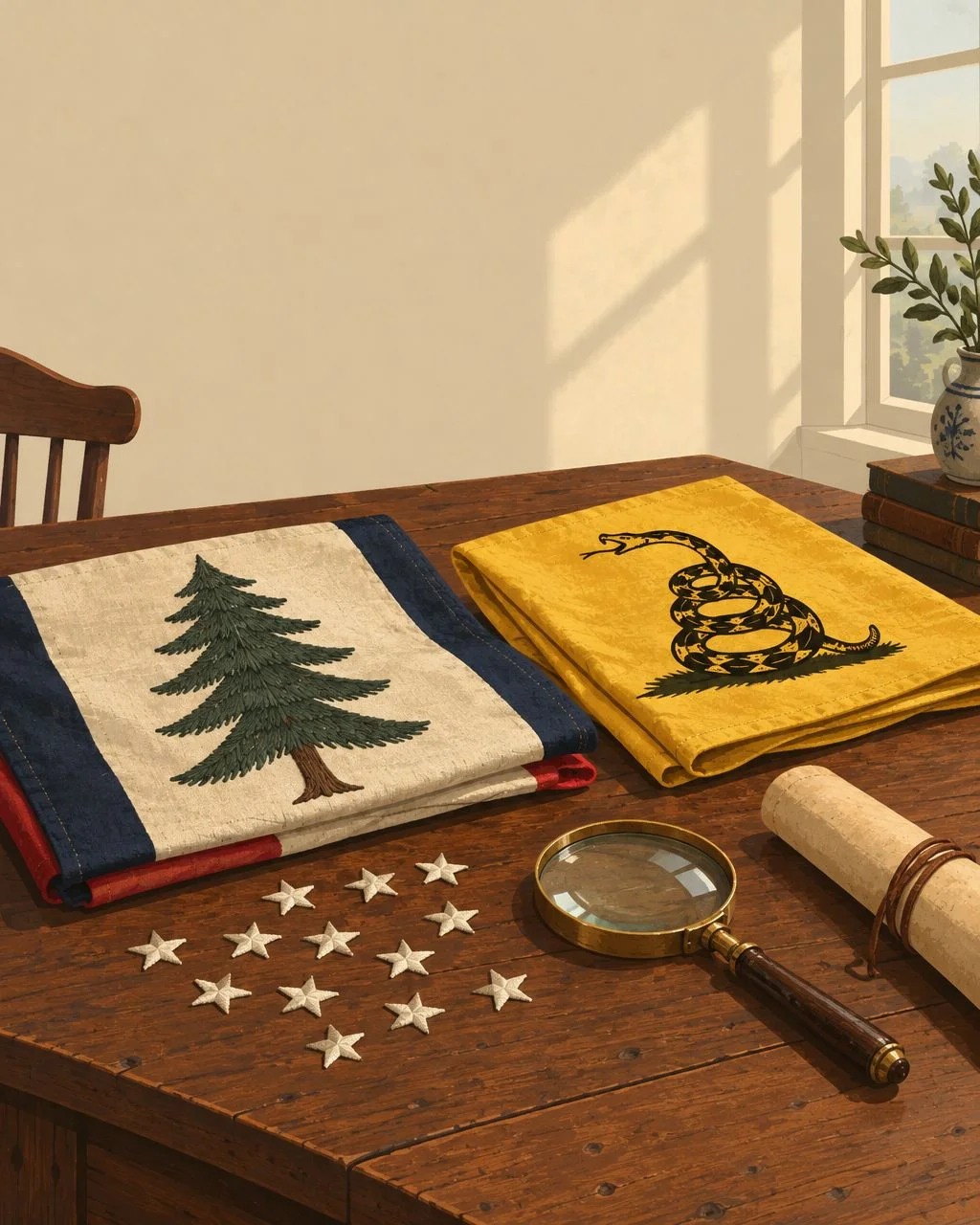
Embroidered pine tree flag and yellow Gadsden rattlesnake flag folded on a collector's wooden table with a magnifying glass and a rolled document

Researching the symbols on Revolutionary War flags comes down to three habits: find the dated source that names or shows the flag, match each symbol to the unit or cause that carried it, and only then hold a modern reproduction up against what the record supports. Work in that order and the pine tree, the rattlesnake and the stars and stripes stop being a pile of patriotic guesses and become dateable, checkable designs — which is exactly what you want before you buy one in 2026.

Quick answer
  • Start with dated sources: the 1775 cruisers flag and the 1777 Flag Resolution.
  • Match every symbol to the unit or cause that carried it.
  • The pine tree with An Appeal to Heaven served Washington’s cruisers from 1775.
  • The rattlesnake grew from Franklin’s 1754 Join, or Die cartoon.
  • No original Gadsden flag survives — every one sold today is a reproduction.

Ultimate Flags flag sale banner

Why Revolutionary War flag symbols are worth the homework

The Revolution produced its flags fast, locally and under pressure, and the symbols they carried were arguments made in cloth. A pine tree was not decoration — it stood for New England's timber and, in one famous reading, for an ancient liberty that English kings were said to have respected. A rattlesnake made the colonists' point about being left alone: it warns before it strikes. When you know what each image meant and when it was used, a flag becomes a dated document you can check.

That checking habit pays off twice. For a collector, it is the difference between a display that reads true and one that quietly mixes centuries. For a teacher, a parent or a history buff putting together a room, it is what lets you write a caption you can defend. And for a 2026 buyer, it protects you from listings that attach a famous story to a design that never carried one.

Ultimate Flags carries reproductions of these documented designs, from Washington's Cruisers flags to embroidered Gadsden banners, and this guide walks through the research method the store's own products are built on.

How do you research symbols on Revolutionary War flags?

Start with the date and the source, not the story you have heard. Five steps cover nearly every flag you will run across.

1. Start with the dated source, not the legend

The strongest sources are the ones written while the war was happening: letters describing a flag, resolutions adopting one, and museum records of flags that survived. The June 14, 1777 Flag Resolution of Congress is the classic example — it describes thirteen stripes alternating red and white with thirteen white stars on a blue field, and it says nothing about how the stars are arranged. A primary source like that settles more questions in one paragraph than a week of internet arguments.

Aim for at least one source per flag: a resolution, a letter, a period drawing or a museum catalog entry. Note the source and the date it supports, because that note is what your caption — or your collector's card — will stand on.

2. Match the symbol to who flew it

The same animal or tree can belong to different units, navies and militias, and the meaning shifts with each. The table below pulls together the most documented Revolutionary War flag symbols and where the record shows them.

Symbol Documented for Where the record shows it
Pine tree with "An Appeal to Heaven" Washington's cruisers, 1775-76 Colonel Joseph Reed's October 1775 flag description and the fleet's commissions
Coiled rattlesnake, "Don't Tread on Me" Continental Navy colors, 1775 Christopher Gadsden's recorded presentation of the design to Congress and Commodore Hopkins
Rattlesnake with "Liberty or Death" Culpeper Minute Men, 1775 Banners credited to the Culpeper County, Virginia battalion
Thirteen stripes and thirteen stars The Continental Congress, June 14, 1777 The Flag Resolution, which left the star arrangement open
Crescent over "LIBERTY" Colonel Moultrie's South Carolina troops, 1776 Moultrie's own account of designing the flag for Fort Sullivan

Read down that middle column and the research method answers itself: a symbol means what its carriers used it to mean, and the record names the carriers.

3. Compare surviving and documented examples

Some originals survive, and they are worth more than a thousand reproductions of reproductions. A flag tied by tradition to the Battle of Bennington on August 16, 1777 is preserved at the Bennington Museum in Vermont, stars and the year "76" across its canton. The Washington's Headquarters standard is documented in period drawings. Comparing a documented example with the reproduction you are considering tells you in seconds whether the maker followed the record or improvised.

When no original survives, the documentation stands in. No founding-era Gadsden flag is known to exist today, so the design rests on 1775-76 written accounts — which is plenty to research, as long as the seller and the buyer both treat the written record as the standard.

4. Separate what is documented from what is traditional

The most respected flag stories and the shakiest ones wear the same clothes. The Betsy Ross origin tale is the famous case: historians trace it to a story her grandson told in 1870, and the historical record neither proves nor disproves it. Tradition can still matter — the Bennington flag's battle story is exactly that — but a careful researcher writes "tradition holds" where the record goes quiet, and so should the caption on your wall.

5. Check a reproduction against the record before you buy

Once you know the documented design, the last step takes five minutes: read the listing, count the stars, check the motto's spelling, and compare the layout with your source. A reproduction that follows the record is a piece of history you can defend; one that does not is a decoration — and might still be nice, but you should know which one you are buying in 2026.

When you are ready to Shop Ultimate Flags, the rattlesnake designs covered below are the easiest place to put the method to work, because their documentation is unusually strong.

The pine tree and "An Appeal to Heaven"

In October 1775, as George Washington readied a small fleet of armed cruisers to hunt British supply ships, Colonel Joseph Reed described a flag for the vessels: a pine tree on a white field with the words "An Appeal to Heaven" alongside. The design served the cruisers through the fleet's 1776 service, and the pine tree itself reached back decades — Massachusetts had used a pine tree on its naval colors since at least the 1680s, and New England's great timber trade had made the tree a regional badge long before that.

The motto did heavy lifting. "An Appeal to Heaven," from a phrase John Locke used about the right of a people to resist tyranny when courts and kings offered no remedy, made the flag a statement of conscience as much as a naval ensign. That combination — a New England symbol carrying a philosophical argument — is why the design reads so strongly on a modern reproduction.

Washington's Cruiser flag reproduction with an embroidered pine tree and An Appeal to Heaven mottoShop Now
Washington’s Cruisers design as a modern double-nylon embroidered reproduction. The documented 1775 elements are the pine tree and the motto.

The rattlesnake and "Don't Tread on Me"

The snake's paperwork goes back further than the war itself. Benjamin Franklin's "Join, or Die" cartoon ran in the Pennsylvania Gazette on May 9, 1754, showing the colonies as the segments of a cut rattlesnake, and the image made the snake an American symbol twenty years before the first shot at Lexington. By late 1775 an essay published in the Pennsylvania Journal and attributed to Franklin was praising the rattlesnake's virtues at length: it never begins an attack, it gives fair warning, and it never surrenders.

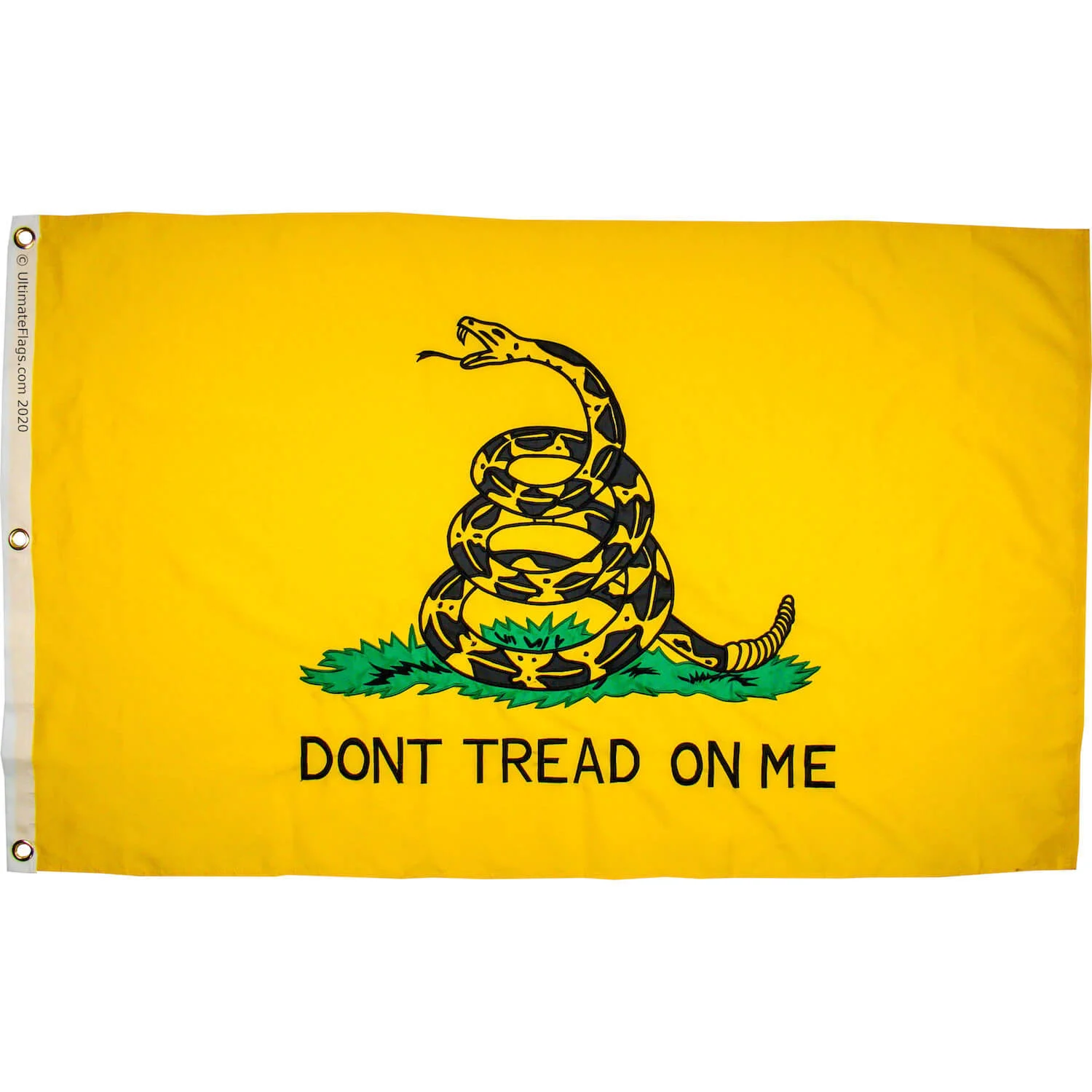
The famous yellow banner followed. Christopher Gadsden, a South Carolina patriot, is recorded presenting the design — a coiled rattlesnake on a yellow field with "Don't Tread on Me" — to the Continental Congress and to Commodore Esek Hopkins, the Navy's first commander, in 1775-76. The rattlesnake also flew in other outfits: the First Navy Jack paired it with thirteen red and white stripes, and a banner credited to the Culpeper Minute Men of 1775 combined the snake with Patrick Henry's "Liberty or Death."

One research note saves collectors real money: no original Gadsden flag is known to survive, so the design's authority rests entirely on those 1775-76 accounts. That is enough — but it means the wording and layout on any "authentic" claim should be checked against the accounts, not against the seller's confidence.

Yellow Gadsden flag reproduction with a sewn embroidered rattlesnake and Don't Tread on Me letteringBuy This Flag- Click Here
The 1775 Gadsden design as an embroidered nylon reproduction. The documented elements are the coiled rattlesnake, the yellow field and the motto.

What the 1777 Flag Resolution actually says

After a year of fighting under a patchwork of local banners, Congress settled the national colors. The resolution of June 14, 1777 reads that the flag be thirteen stripes, alternate red and white, with thirteen stars, white, on a blue field, representing a new constellation. Two details reward careful readers: it does not name a star arrangement, and it does not tie the design to any single battle.

That open arrangement explains why period and early flags show the thirteen stars in circles, in staggered rows and in other patterns. The 1777 document licenses them all equally — which means a reproduction with a circle of thirteen stars is not more correct than one with rows; both satisfy the record. What the resolution does pin down is the count: thirteen stripes, thirteen stars, as of June 1777.

Why the same symbol shows up on different flags

  • There was no central flag office. Congress adopted national colors in 1777, but armies, navies and militias sourced flags locally before and after, so designs multiplied.
  • Symbols were regional before they were national. The pine tree was New England's; the crescent was South Carolina's; the rattlesnake traveled with the Navy and the militias.
  • Mottos did the arguing. "An Appeal to Heaven" and "Don't Tread on Me" are positions, not decoration, and units chose the argument they wanted to make.
  • Postwar retellings reorganized the story. Nineteenth-century accounts attached stories to designs, which is why every modern buyer should weigh the dated record over the repeated legend.

Common mistakes when researching flag symbols

  • Mistaking a story for a source. "Everyone knows" is not documentation. The Betsy Ross tale and several battle stories rest on tradition, not on 1770s paper.
  • Dating a symbol to its most famous flag. The rattlesnake was twenty years old when the Gadsden design appeared; the pine tree was older still. Check the symbol's first documented use, not the flag that made it famous.
  • Reading one flag as the whole war. No single design represented the Revolutionary cause through the war. The Grand Union carried the British union in its canton well into 1776, and the national stars and stripes postdate the fighting's first year.
  • Trusting a listing over the record. A product title is not a historical source. Five minutes with a resolution or a museum catalog settles what a listing may not.

FAQ

What does the pine tree mean on Revolutionary War flags?

The pine tree stood for New England, whose timber and naval colors had used the tree for decades, and it carried the motto ‘An Appeal to Heaven’ on the flags of Washington’s cruisers in 1775-76. Colonel Joseph Reed’s October 1775 description is the key dated source.

Why is there a rattlesnake on Revolutionary War flags?

The rattlesnake warned before it struck and never surrendered, which made it a favorite American symbol from Franklin’s 1754 Join, or Die cartoon onward. By 1775 it flew on naval colors and militia banners, including the Gadsden design and the Culpeper Minute Men’s flag.

Did the 1777 Flag Resolution say how to arrange the stars?

No. The June 14, 1777 resolution specified thirteen stripes and thirteen white stars on a blue field but left the star arrangement open, which is why period flags show circles, rows and other patterns.

Is there an original Gadsden flag from 1775?

No founding-era original is known to survive. The design rests on written accounts of Christopher Gadsden’s 1775-76 presentations to Congress and Commodore Hopkins, so every Gadsden flag sold today is a reproduction of a documented design.

Is the Betsy Ross story documented?

The story comes from testimony her grandson presented in 1870, and historians find no conclusive evidence supporting or denying it. The circle-of-stars pattern itself is consistent with the open arrangement the 1777 resolution allows.

What is the best source to check a Revolutionary War flag against?

Use a dated primary source: a flag resolution, a period letter or description, or a museum catalog of a surviving flag. One dated source per flag is the standard a careful collector or teacher applies in 2026.

How do I know if a reproduction is historically accurate?

Compare its design element by element with the documented source — star count, motto wording, layout and colors. A reproduction that matches the record is accurate to the design, whatever its fabric or age.

One last thing

The rattlesnake's longest paper trail belongs to a cartoon, not a flag: Franklin drew "Join, or Die" in 1754 for a newspaper, twenty-one years before the war it is now remembered for. That is the quiet lesson of researching Revolutionary War flags — the symbols were already old arguments when the war borrowed them, and the dated sources are what let you tell the difference between a design the era used and a story the era never heard of.

Historical basis for this 2026 guide: the June 14, 1777 Flag Resolution (Continental Congress, via the National Archives); Colonel Joseph Reed's October 1775 flag description for Washington's cruisers; the Pennsylvania Gazette's May 9, 1754 "Join, or Die" cartoon and the 1775 Pennsylvania Journal rattlesnake essay attributed to Franklin; the Bennington Museum's record of the Bennington battle flag tradition.

Related guides

Posted on

Confederate flags for sale: documenting historical reproductions

Square Confederate battle flag reproduction with embroidered stars flying on a pole against a blue sky

Confederate flags for sale in 2026 range from casual printed banners to sewn reproductions built to match the exact flags that flew between 1861 and 1865. This guide shows you how to document a reproduction before you buy it: the design dates to check, the square sizes that identify each branch of the army, the unit honors that make a flag historically specific, and the construction details that separate a faithful copy from a lookalike.

TL;DR
  • Documenting a reproduction means checking design dates, size, unit honors and construction against historical records.
  • The first National flag, the Stars and Bars, carried 7 stars in March 1861 and 13 by 1863.
  • Army of Northern Virginia battle flags were square: roughly 48-52 inches for infantry, 36-38 for artillery, 30-32 for cavalry.
  • Cotton suits indoor and ceremonial display; sewn nylon handles outdoor weather.
  • Check embroidered stars, correct sizes and documented honors before buying.
Ultimate Flags flag sale banner

Why documentation matters

Reproduction quality varies more in this category than in almost any other. A printed rectangle with a saltire and thirteen stars will look right in a photo and wrong in your hands. A documented copy, by contrast, matches a real flag in the design that unit carried, the size that army's regulations or surviving examples support, and the construction method a period flagmaker would have used.

Documentation also protects you from the most common trap in this category: flags with borrowed or invented details. Battle honors sewn on a flag that a unit never carried, a rectangular "ANV" flag, or a Stars and Bars with the wrong star count are easy to produce and hard for a new collector to catch. The checks below take about ten minutes and catch nearly all of them.

What documented means for a Confederate flag reproduction

A documented reproduction is one you can trace back to a historical source: a surviving original, a photographic record of one, or an official-issue description in the war records. Museums and serious collectors apply a simple standard, and you can borrow it. For each detail on the flag, there should be an answer to the question, what evidence says the original looked like this?

That standard applies to four things in particular:

  • Design and date — which of the three national designs or battle flag patterns it is, and when that design was in use.
  • Size and shape — the dimensions a real unit's flag would have been.
  • Unit honors and markings — any battle names, regimental numbers or campaign ribbons sewn on the field.
  • Construction — materials, stitching and mounting that match how the flag was made to be used.

You do not need a museum archive to run these checks. The main facts are settled history, published in the official records and in standard flag references, and a good store prints its own documentation on each product page. What matters is that you check rather than assume.

Match the design to its date

The Confederacy used three national flags in sequence, and each has a date range you can verify:

  1. First National — the Stars and Bars, March 1861 to May 1863. Adopted in March 1861 with seven stars for the seven initial states. Additional stars were added as states joined, reaching thirteen by late 1861. Its red, white and blue layout with a circle of stars on three broad stripes is why it was repeatedly mistaken for the Union Stars and Stripes in the field.
  2. Second National — the Stainless Banner, May 1863 to March 1865. A white field with the battle flag in the canton. Adopted on May 1, 1863, to fix the confusion problem; the all-white field later earned it the nickname that stuck after flags were furled or soiled in the field.
  3. Third National — the Blood-Stained Banner, March 4, 1865. The same white field with a red vertical bar added at the fly so the flag would not read as a white surrender flag.

The battle flag itself — the Southern Cross with the saltire and stars — was adopted for the Army of Northern Virginia in late 1861, after the confusion at the First Battle of Manassas on July 21, 1861 made the problem unmistakable. General P.G.T. Beauregard pushed the change after his own headquarters flag was mistaken for a Union one. William Porcher Miles's rejected earlier design became the basis of the cross.

When you shop, date your flag first. A thirteen-star Stars and Bars is correct for late 1861 through 1863; a seven-star version is a March-to-summer-1861 flag. A white-field national flag with no red bar belongs to 1863-1865. A reproduction that mixes details from different years is not wrong to exist, but it is a display flag, not a documented one.

Check the size and shape against the unit type

Size is where reproductions most often drift, because many modern manufacturers simply make every flag 3×5 feet. The original Army of Northern Virginia battle flags were square, and the Richmond depot issued them in three size bands by branch: about 48 to 52 inches square for infantry regiments, 36 to 38 inches for artillery batteries, and roughly 30 to 32 inches for cavalry. A 52-inch by 52-inch flag with a pole sleeve and ties is the infantry format; a 38-inch square is the artillery format.

Rectangular battle flags existed too, but they belong to other commands — armies and departments west of Virginia issued rectangular patterns, and naval and later-period flags moved to rectangles as well. So the shape itself is a dating and attribution clue: a square battle flag points to the Army of Northern Virginia, while a rectangle points elsewhere or later.

Square Confederate artillery battle flag, 38 by 38 inches, sewn cotton with embroidered stars and a white border

A cotton artillery-format reproduction at the correct 38-inch square, with embroidered stars and the white border trim of the Southern Cross.

The same logic applies to national flags. The Stars and Bars was a rectangular flag at 3×5-scale proportions in period use; the Stainless and Blood-Stained Banners were larger-scale rectangles. If a store sells a "square Stars and Bars," that combination has no period basis.

Verify unit honors before you buy an honors flag

Battle honors are the most collectible feature on a reproduction and the easiest to fake. Real unit flags carried the names of engagements sewn or painted on them, usually in the saltire arms or above and below the cross. The names must match the unit's actual service record.

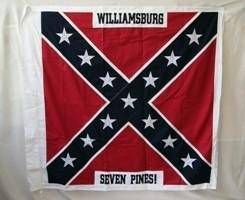
Take the 4th North Carolina Infantry as a worked example. Its flag carried Williamsburg and Seven Pines honors, and the unit's record supports exactly those: the regiment fought in the attack at Seven Pines, served through the Seven Days battles at Malvern Hill, held the Sunken Road at Antietam, fought all three days at Chancellorsville, was at Gettysburg on July 1, 1863, and went on through Spotsylvania, Petersburg and Appomattox. A flag bearing those two honors in that unit's name is documented. The same two names on a Tennessee regiment's flag would not be.

Two quick checks keep you safe with honors flags:

  • Does the honor list match the unit's documented battles? Regiments have published service records; a two-minute search settles it.
  • Is the flag attributed to a specific regiment at all? A generic honors flag with famous battle names and no unit attribution is decoration. Some collectors buy those knowingly for display; just do not document it as anything else.
52 by 52 inch cotton reproduction of the 4th North Carolina Infantry battle flag with Williamsburg and Seven Pines battle honors sewn on

A 52 by 52 inch cotton reproduction of the 4th North Carolina Infantry flag, with its Williamsburg and Seven Pines honors sewn on.

Read the construction, not the sales copy

Construction tells you what a flag is meant for, and it is the one thing you can judge from photos and product pages in 2026 without any special expertise:

  • Printed versus sewn. Printed flags have the design dyed or printed into the fabric. Sewn flags have appliquéd stripes and embroidered stars, which read visibly raised in close-up photos. Sewn construction is the documented-reproduction standard.
  • Cotton versus nylon. Cotton has the period-correct texture and drape and is the reenactor and ceremonial choice. It should not live outdoors in rain. Nylon and double-nylon flags are the outdoor-grade versions; double-nylon (two-ply) embroidered flags are the heaviest-duty sewn option.
  • Mounting. Period infantry flags carried a pole sleeve and ties rather than grommets, because they were carried on a staff, not flown from a halyard. Grommets are the practical choice for a porch pole. Either is fine — but if you want the documented field format, sleeve and ties is it.
  • Reverse side. On a properly made sewn flag, the design reads mirror-reversed from the back. That is standard construction, not a defect. A double-sided flag that reads correctly both ways is a modern convenience format, not a period copy.

None of this means one option is better overall. A cotton sleeve-and-ties flag documents a field flag; a double-nylon grommeted flag flies year-round. Match the construction to the purpose you have.

A comparison of reproduction types

Option Best for Key limitation
Printed nylon battle flag Casual display, campsite or truck use Not a documented construction; printed face
Sewn cotton, sleeve and ties Reenactment, museums, indoor memorials Damaged by outdoor rain and sun
Double-nylon embroidered Outdoor flying on a permanent pole Heavier and costlier than printed
Unit honors cotton reproduction Collectors documenting a specific regiment Honors must match the unit's record

Common mistakes buyers make

  • Buying 3×5 feet for everything. If you want a documented ANV format, the square sizes above are the point. A 3×5 rectangle is a display format that simply did not exist for ANV infantry flags.
  • Hanging cotton outside. Cotton is a wet-towel problem in the rain. Outdoor display calls for sewn nylon.
  • Expecting double-sided text. Mirror-reversed lettering on the reverse is correct construction on sewn flags.
  • Confusing national and battle flags. The Stars and Bars and the battle flag are different flags with different histories; most "first Confederate flag" searches actually want the Stars and Bars, while most collector reproductions are battle flags.
  • Trusting the word authentic without details. Authentic means nothing by itself. Sizes, dates, honors and construction are the details that either are documented or are not.

Where a documented flag fits in a collection

Collectors usually build around one of two axes: the national-flag sequence (Stars and Bars, Stainless Banner, Blood-Stained Banner) or unit flags of a particular army or state. Documented reproductions work for both, and they pair well with display practices that respect the historical context — a caption with the design's date range and unit attribution turns a wall of flags into an exhibit. Museums handle the same material this way, and the same caption discipline works at home.

If you are comparing documented designs side by side, Ultimate Flags keeps its rebel and Confederate flag collection organized by design and format, with each flag's construction and size listed on its own page. For the outdoor flag itself, the double-nylon embroidered flags are the workhorses; for shelf, office or museum-style display, the cotton sleeve-and-ties formats carry the documented details.

FAQ

What does documented mean for a Confederate flag reproduction?

It means every key detail — design, date, size, honors and construction — can be traced to a historical source such as a surviving original or the official records. A documented flag lists those details for you to check.

What size was the original Confederate battle flag?

The Army of Northern Virginia battle flag was square: about 48-52 inches for infantry, 36-38 inches for artillery, and roughly 30-32 inches for cavalry. Rectangular battle flags belonged to other commands and later periods.

Why did the Confederacy replace its national flag twice?

The Stars and Bars was repeatedly mistaken for the Union flag, so the white-field Stainless Banner was adopted on May 1, 1863. A red bar was added on March 4, 1865 to keep the all-white field from reading as a surrender flag.

Can a cotton reproduction fly outdoors?

Not reliably. Cotton absorbs rain and dries stiff, which shortens its life sharply. Cotton is the indoor, ceremonial and reenactment choice; outdoor display calls for sewn nylon or double-nylon.

What is the difference between the Stars and Bars and the battle flag?

The Stars and Bars was the first national flag, adopted in March 1861 with a circle of stars on three stripes. The battle flag is the square Southern Cross adopted in late 1861 after confusion at First Manassas.

Are unit battle honors on reproductions historically accurate?

They can be, when the honors match the unit’s documented service. For example, the 4th North Carolina Infantry’s flag carried Williamsburg and Seven Pines honors, which the regiment’s record supports. Always check the honors against the unit’s battles.

What should a 2026 buyer check before ordering?

Four things: the design’s date range, the size and shape against the unit type, whether any honors match the unit’s record, and whether the construction — cotton or nylon, sewn or printed, sleeve or grommets — matches how you plan to use it.

Related guides

Posted on

How did Confederacy flags change during the Civil War?

Stars and Bars first national Confederate flag with a circle of thirteen stars on three broad stripes, hanging on a wooden wall

Confederate national flags went through three designs in four years: the Stars and Bars flew from March 1861 to May 1863, the Stainless Banner from May 1863 until March 1865, and the Blood-Stained Banner for the Confederacy's final weeks in 1865. The changes were driven by one practical problem — each flag was too easy to mistake for something else, first the United States flag and then a flag of truce. For collectors and reenactors buying Confederate reproductions in 2026, those dates and reasons are what separate an accurate display from a generic one.

Quick answer
  • Three national flags served the Confederacy: Stars and Bars, Stainless Banner, Blood-Stained Banner.
  • Stars and Bars: March 1861 to May 1863, dropped because it resembled the Stars and Stripes.
  • Stainless Banner: adopted May 1, 1863, white field with the battle flag in the canton.
  • Blood-Stained Banner: March 1865, red bar added so a hanging flag could not read as truce.

Ultimate Flags flag sale banner

Why did the Confederacy keep changing its national flag?

The Confederate Congress did not redesign its national flags out of fashion. Each change answered a failure in the field or the harbor, and the record of why each flag fell is what makes the three designs easy to date.

The Stars and Bars confused soldiers on the battlefield. Adopted in March 1861, the first national flag carried a circle of white stars on a blue canton over three broad stripes — red, white, red. At First Manassas in July 1861, the resemblance to the United States flag caused deadly confusion between the lines. The battle flag grew out of that problem as a field flag, and the national design lost its job little by little afterward.

The Stainless Banner was too easy to mistake for a flag of truce. The second national flag, adopted by the Confederate Congress on May 1, 1863, placed the battle flag on a plain white field. When the wind dropped, a furled or hanging Stainless Banner showed mostly white — and a white flag is what armies read as surrender. The same whiteness was criticized in print at the time for exactly that reason.

The Blood-Stained Banner added a red bar to fix the truce problem. In March 1865 the Confederate Congress adopted the third national flag: the same white field and canton with a vertical red bar on the fly end. The record of the design notes the red was added so the flag could never be mistaken for a flag of truce, but the Confederacy had weeks left, and the third flag barely reached the field before the war ended in April 1865.

How did Confederacy flags change during the Civil War? A timeline

Flag Adopted Replaced Design Why it changed
Stars and Bars March 1861 — 7, later 13 stars on a blue canton over red-white-red stripes Dropped after First Manassas (July 1861) showed it was too easy to mistake for the US flag
Stainless Banner May 1, 1863 Stars and Bars Battle flag on a white field, official ratio 2:1 White field read as a flag of truce when hanging or furled
Blood-Stained Banner March 4, 1865 Stainless Banner White field, battle-flag canton, vertical red bar on the fly Red bar added so the flag could not be mistaken for a truce flag
Stars and Bars first national flag reproduction with thirteen stars in a circleShop Now

The Stars and Bars: March 1861 to May 1863

The first national flag was the product of hurry. Congress adopted it in March 1861, when seven states made up the Confederacy, so the original canton carried seven stars; the design later flew with thirteen stars as more states were added. Three broad stripes — red, white, red — ran down the field. It looked enough like the Stars and Stripes that at First Manassas in July 1861 officers could not always tell the lines apart, and the search for a field flag that would not be confused led directly to the battle flag.

If you are buying a reproduction for an early-war display, the star count is the dating feature. Seven stars belong to the first months of 1861; thirteen cover the eleven seceded states plus Kentucky and Missouri. A Stars and Bars flag in sewn cotton is the period-correct way to represent 1861 to early 1863 — cotton carries the matte drape the originals had, and it hangs right in a camp or office setting.

The Stainless Banner: May 1863 to March 1865

The second national flag put the battle flag — the Southern Cross with its thirteen stars — on a plain white field. The official ratio was 2:1, but flags produced by the Richmond Clothing Depot used the navy's 1.5:1 ratio, so surviving examples vary.

Its first official use was solemn: the flag draped the coffin of General Thomas J. "Stonewall" Jackson as it lay in state in the Virginia Capitol on May 12, 1863, which earned it the nickname the Jackson Flag. Its working life carried the same problem the first flag had — visibility, this time not of the wrong army but of the wrong message. A mostly white flag hanging still in no wind read as surrender, and the criticism came in the open during the war itself.

Stainless Banner second national flag reproduction with battle flag canton on a white fieldShop Now – Buy any 2, get 3rd Free

The Blood-Stained Banner: March 1865 to the war's end

The third national flag added a vertical red bar on the fly, half the flag's length, on a white field with the battle-flag canton. The design record states plainly that the red was added so the flag could never be mistaken for a flag of truce. The flag was adopted in March 1865, and the Confederacy dissolved in April 1865 — the third design flew for weeks, not years, which is why original examples and even faithful reproductions are far rarer than the other two.

Which flags belong in a complete Confederate display?

A collector who wants the full story needs more than one flag. The three national flags tell the political story; the battle flag tells the field story, and it was never a national flag at all. A well-built display runs the three national designs in order, dates them, and hangs a separate battle flag alongside to show the difference.

  • Stars and Bars reproduction for the 1861-1863 window — check the star count against your display date.
  • Stainless Banner reproduction for 1863-1865 — the white field is the point, and it photographs well beside the battle flag it borrowed.
  • Blood-Stained Banner reproduction for 1865 — the red bar is the dating feature.
  • Battle flag in the correct shape for the army you are representing: square with a white border for the Army of Northern Virginia, rectangular for the western armies.

You can Shop Ultimate Flags Store for all four designs in sewn cotton, and the same store carries the printed nylon versions if the display moves outdoors.

Common questions about the three Confederate national flags

Did the battle flag ever serve as the national flag?

No. The battle flag was a field flag issued to the armies, and the Confederacy's national flags were separate designs. The battle flag appears in the cantons of the second and third national flags, which is where the mix-up starts.

Why does the Stainless Banner have a nickname?

Its first official use was to drape Stonewall Jackson's coffin in the Virginia Capitol in May 1863, and the "Jackson Flag" name followed from that. The other nickname, the Stainless Banner, refers to the unstained white field.

What should a collector check before buying a reproduction?

Three things: the star count matches the period the display represents, the ratio matches the design's official or depot-correct proportions, and the seller states fabric and finishing on the listing. A sewn cotton reproduction with embroidered stars reads period-correct; a printed banner is a fine lightweight alternative for outdoor use.

FAQ

How many national flags did the Confederacy have?

Three: the Stars and Bars (1861-1863), the Stainless Banner (1863-1865) and the Blood-Stained Banner (March 1865 to the war's end in April 1865). Each design answered a practical failure of the one before it.

Why was the first Confederate national flag replaced?

Because it was too easy to mistake for the United States flag. At First Manassas in July 1861 the resemblance caused deadly confusion, and the battle flag was designed as the field flag that would not be confused.

What was the Stainless Banner?

The Confederacy's second national flag, adopted May 1, 1863 — the battle flag on a plain white field. Its first official use draped Stonewall Jackson's coffin on May 12, 1863, earning it the nickname Jackson Flag.

Why did the third Confederate flag have a red bar?

So it could not be mistaken for a flag of truce. A white flag with no red read as surrender when it hung or furled, so the March 1865 design added a vertical red bar on the fly end.

How long did the Blood-Stained Banner actually fly?

Weeks. Adopted in March 1865, it was still new when the Confederacy dissolved in April 1865, which makes surviving originals and faithful reproductions the rarest of the three.

What is the correct star count for a Stars and Bars reproduction?

Seven stars belong to the design's first months in 1861, and thirteen to its later period through May 1863, covering the eleven seceded states plus Kentucky and Missouri. Match the count to the date your display represents.

Where can I buy accurate Confederate national flag reproductions?

From sellers that document design, star count, fabric and finishing on every listing. Ultimate Flags carries the three national flag designs plus the battle flag in sewn cotton and printed nylon.

How many national flags did the Confederacy have?

Three: the Stars and Bars (1861-1863), the Stainless Banner (1863-1865) and the Blood-Stained Banner (March 1865 to April 1865). Each design answered a practical failure of the one before it.

Why was the first Confederate national flag replaced?

Because it was too easy to mistake for the United States flag. At First Manassas in July 1861 the resemblance caused deadly confusion, and the battle flag grew out of that problem.

What was the Stainless Banner?

The second national flag, adopted May 1, 1863 — the battle flag on a plain white field. Its first official use draped Stonewall Jackson’s coffin on May 12, 1863, which earned it the nickname Jackson Flag.

Why did the third Confederate flag have a red bar?

So it could not be mistaken for a flag of truce. The March 1865 design added a vertical red bar on the fly end of an otherwise white flag.

How long did the Blood-Stained Banner actually fly?

Weeks. Adopted in March 1865, it was still new when the Confederacy dissolved in April 1865, which makes surviving examples the rarest of the three designs.

What is the correct star count for a Stars and Bars reproduction?

Seven stars belong to early 1861 and thirteen to the design’s later period through May 1863, covering the eleven seceded states plus Kentucky and Missouri.

One last thing

The Stars and Bars was pulled from the field not because it failed as a symbol but because it failed as a signal — the same reason the Stainless Banner gave way to a red bar. Each Confederate national flag is a record of what went wrong with the last one, and a display that dates them correctly tells that story in order.

Related guides
Posted on

Why do Confederate battle flags have different shapes?

Why do Confederate battle flags have different shapes?

Confederate battle flags came in different shapes because there was never one official battle flag for the Confederate war effort. Each army issued its own: the Army of Northern Virginia carried a nearly square flag with a white border from late 1861, while the Army of Tennessee, the Trans-Mississippi departments and the navy flew rectangular versions of the same Southern Cross design. When you shop Confederate battle flags in 2026, the shape is the fastest way to tell which army a reproduction honors — so match the shape to the unit before you buy.

Quick answer
  • There was never one official Confederate battle flag: each army issued its own.
  • Square with a white border means the Army of Northern Virginia, issued from late 1861.
  • Rectangular versions served with the Army of Tennessee, the Trans-Mississippi and the navy.
  • Original infantry flags ran 48 inches square, artillery 36 and cavalry 30.
  • The modern 3×5 rectangle follows the post-war reunion flag, not the square original.

Ultimate Flags flag sale banner

Why the shape question matters to a buyer

Shape is not a style choice on these flags — it is a date and a unit rolled into one piece of cloth. Pick the wrong shape for a display or an impression and the flag contradicts the story next to it. Pick the right one and the whole setup reads true to people who know the material. That is why collectors and reenactors argue about shapes at all: the differences were real, they were deliberate, and they survived in the originals.

Why do Confederate battle flags have different shapes?

Because the Confederate army never adopted a single official battle flag. Each army and corps designated its own pattern, and the shapes grew apart from there. The National Park Service's study of Southern battle flags puts it plainly: the Confederate Army never had an official battle flag — instead, each army or corps had a designated one. Shape is therefore a unit marker, not a national standard.

Flag Carried by Shape Period
Battle flag with white border Army of Northern Virginia Nearly square, 48/36/30 inches by branch Late 1861 to 1865
1864-pattern battle flag Army of Tennessee Rectangular 1864 to 1865
Second naval jack Confederate navy Rectangular 1863 to 1865
Corps flags Hardee's corps and others Blue with white disc, no cross Varies by corps

Read the table left to right and the question answers itself: three armies, a navy and a set of corps flags, none of them centrally standardized. The square and the rectangle are the two survivors, but they were choices made by different quartermasters, not one design committee.

The square flag: the Army of Northern Virginia

William Porcher Miles of South Carolina drew the Southern Cross design in 1861 as a proposed national flag, and his drawing was rectangular. The Confederate Congress passed on it. The design found a second life after First Manassas in July 1861, where the Confederacy's first national flag resembled the United States flag so closely that gun smoke made the two nearly impossible to tell apart, and General Beauregard wanted a field flag that never could be confused with the enemy's colors.

Generals Johnston and Beauregard and Quartermaster-General Cabell approved the new battle flag at Fairfax Court House in September 1861. Johnston suggested making it square rather than rectangular, chiefly to save cloth, and he set a size for each branch of the army: 48 inches square for infantry, 36 for artillery and 30 for cavalry. A modern 3×5 display flag is smaller and longer by comparison, which is worth knowing when a listing describes a 52-inch square cotton reproduction as large — by the 1861 standard, it is.

The white border was not decoration either. Units painted their battle honors on it, regiment by regiment, which is why surviving Army of Northern Virginia originals read like service records. Thirteen stars on the blue saltire became the settled count, covering the eleven seceded states plus Kentucky and Missouri.


Square artillery battle flag reproduction with a white border, shown flat to illustrate its shapeShop Now
Square example: a 38 × 38-inch cotton artillery reproduction with a white border. Match a reproduction to the specific unit and period you are documenting.

The rectangular flags: the western armies and the navy

The Army of Tennessee went through at least eight different designs over the course of the war, according to the National Park Service's survey. Its 1864 pattern battle flag was rectangular and clearly based on the Army of Northern Virginia's square, and the departments west of the Mississippi used rectangular patterns as well. The Confederate navy flew its own rectangular cousin of the design, the second naval jack, from 1863 until 1865.

One detail worth settling for collectors: a popular claim holds that the naval jack used a lighter blue than the army's battle flag. Museum research on surviving exhibits points the other way — the jack's dark blue matches the battle flag's. If a seller's description leans on a lighter-blue navy story, that is a dating claim to check, not a fact to assume.

Not every cross-less flag is an error, either. Some units carried designs with no cross at all — Hardee's corps flew a blue flag with a plain white disc. When a shape or pattern looks off, the flag may be exactly right for a different unit.

After the war the rectangle won the popularity contest. Veterans' reunions standardized on the rectangular version because manufacturers could mass produce it more easily, and that rectangle — not the square original — is what most people picture when the design comes to mind in 2026.

Why there was never one official battle flag

Three practical reasons stacked up.

  • The flag belonged to the armies, not the government. It was adopted at army level in September 1861 and was never made a national flag, though the design was later folded into the cantons of the second and third national flags, adopted in May 1863 and March 1865.
  • Supply lines were separate. The Richmond quartermaster outfitted the Army of Northern Virginia while the western armies sourced flags closer to home, so patterns and shapes drifted apart.
  • The armies learned by experiment. The Army of Tennessee in particular kept redesigning as command and circumstances changed, which is why its flags passed through so many patterns.

What shape should a reproduction be?

Let the unit decide. A nearly square cotton flag with a white border, around 52 inches, is the period-correct choice for an Army of Northern Virginia camp display, a heritage exhibit or a collector's wall. A 3×5 rectangle is the familiar modern form, and it is the practical pick for marching, porch poles and everyday display. Both reproduce documented designs, and neither is more legitimate than the other — they answer different questions.

Reproduction Best for Key limitation
Square cotton flag with white border, about 52 inches Army of Northern Virginia camp displays and collections Heavier fabric; reads as a display piece, not a porch flag
Rectangular 3×5 flag, sewn or printed Everyday display, marching and the familiar look Smaller and longer than the original issue

When you are ready to Shop Ultimate Flags, compare the square and rectangular versions of the same design side by side and pick by unit, not by habit. Ultimate Flags carries battle flag patterns in both constructions, which is the easiest way to see what the shape change actually does to the look.


Rectangular North Carolina battle flag reproduction with NC lettering and dated scrolls, shown flatShop Now
Rectangular example: the store’s 3 × 5-foot North Carolina cotton reproduction. This photo illustrates the rectangular format, not an identification of a particular wartime army’s issued pattern.

Related questions about battle flag shapes

Was the rectangular rebel flag a naval jack?

It matches the second Confederate naval jack, which was rectangular and flew from 1863 to 1865, and it also resembles the Army of Tennessee's 1864 pattern. The common rectangular flag of today traces to both, and to the post-war reunion flags.

Which shape came first?

The square came first. The Army of Northern Virginia issued square battle flags from late 1861, while the well-known rectangular versions date to 1863 for the navy and 1864 for the Army of Tennessee.

Why do modern reproductions usually come rectangular?

Post-war veterans' reunions favored the rectangle because manufacturers could mass produce it, and the modern display business inherited that standard. Square reproductions are still made for buyers who want the Army of Northern Virginia look.

FAQ

Why do Confederate battle flags have different shapes?

Because each Confederate army issued its own battle flag. The Army of Northern Virginia flew a nearly square flag with a white border from late 1861, while the Army of Tennessee, the Trans-Mississippi and the navy used rectangular versions.

What shape was the original Confederate battle flag?

The original designer’s drawing was rectangular, but General Johnston had it made square to save cloth, and the Army of Northern Virginia issued it that way from September 1861. Infantry flags ran 48 inches square.

Was the Confederate battle flag ever a national flag?

No. It was adopted at army level and never made a national flag, although the design was placed in the canton of the second and third Confederate national flags in 1863 and 1865.

What sizes did the square battle flags come in?

48 inches square for infantry, 36 for artillery and 30 for cavalry, as set when the flag was approved in September 1861.

Is a rectangular battle flag wrong for an Army of Northern Virginia display?

Yes, if accuracy is the goal. The Army of Northern Virginia carried square flags with white borders, while rectangles served with the Army of Tennessee, the Trans-Mississippi and the navy.

Can you display a Confederate battle flag today?

Yes. The flag is legal to display in the United States and appears in museums, battlefield parks, reenactments and historical collections as historical material.

One last thing

The square was a quartermaster's economy measure, not a design statement — Johnston cut the corners to save cloth, and the army he was supplying happened to be the one whose flags drew the most attention after the war. Buy the shape the unit actually carried, and the reproduction tells the true story.

Related guides

Posted on

Civil War flags for sale: a reenactor’s reproduction checklist

Square cotton Confederate battle flag reproduction with pole sleeve and ties, made for Civil War reenactment display

A reenactor's Civil War flag checklist comes down to six checks: match the design to the right army and year, pick the shape and size the unit actually carried, choose fabric that survives the field, inspect the hoist and finishing, verify the stars and wording against the historical record, then buy from a seller that documents what it lists. Civil War flags for sale in 2026 range from accurate sewn cotton reproductions to lightweight printed banners, and the right pick depends on whether the flag is marching with you or hanging in camp.

Quick answer
  • Match the flag pattern to the army and the years you portray — never just to the movie version.
  • Square with a white border means the Army of Northern Virginia; rectangles served farther west.
  • Cotton sewn reproductions read period-correct in camp; nylon suits wet-weather marching.
  • Original battle flags ran near four feet square — a modern 3×5 display flag is smaller by design.

Ultimate Flags flag sale banner

Why the flag you carry matters on the field

A Civil War regiment's colors were not decoration. Regiments on both sides carried their flags into every engagement because gun smoke hid whole brigades, and the colors were the one thing a scattered company could rally on. Carrying them was an honored, dangerous post — color bearers fell in such numbers that capturing an enemy's flag earned a soldier the Medal of Honor, and dozens of Civil War medals were awarded for exactly that act.

That history is why the hobby judges flags closely. A veteran reenactor reading your camp is reading the flag first, and the details that matter — pattern, shape, star count, fabric — are the same details a historian uses to date the originals.

The originals themselves have a story worth knowing before you buy. Many battle flags were captured in the field and held by the federal government for decades. Congress authorized the return of captured Confederate flags in 1905, and the transfers carried on over the following years; Georgia's battle flags came home in 1916, and heritage groups such as the United Daughters of the Confederacy, formed in 1894, and the Sons of Confederate Veterans, organized in 1896, drove much of the preservation work that keeps those flags in state museums today.

The six checks before you buy a reproduction

Work the checks in order. Each one narrows what to look for before money changes hands.

Step 1: Match the design to the army and the year

The Confederacy carried three national flags plus the battle flag, and each belongs to a specific window. The Stars and Bars, adopted in March 1861 with seven stars and later thirteen, served until May 1863, when the Stainless Banner replaced it; the Blood-Stained Banner followed in March 1865. The square Southern Cross battle flag with a white border was issued by the Army of Northern Virginia from late 1861, while rectangular battle flags served in the Army of Tennessee and the Trans-Mississippi.

  • Portraying 1861 or 1862? The Stars and Bars or a first-issue battle flag fits.
  • Portraying the Army of Northern Virginia in 1862-1865? Square battle flag, white border.
  • Portraying the western armies? Rectangular battle flag patterns.
  • Union impressions need a 34, 35 or 36 star Stars and Stripes plus a blue regimental color.

Step 2: Check the shape and size against period issue

Original Army of Northern Virginia battle flags were issued close to four feet on the side — not the familiar 3×5 ratio. Union regimental colors ran larger still, around six feet, because they had to be seen across a battlefield. Modern reproductions are sold in standard display sizes, and that is fine: a 3×5 flag is what most events allow and what most flag belts and lances are cut for. Just know the difference, because a 52-inch square cotton battle flag reads noticeably more period-correct in camp photos than a 3×5 rectangle of the same design.

Square artillery battle flag reproduction with white borderShop Now

Step 3: Pick fabric for the field, not the shelf

Fabric decides how the flag behaves on the field more than anything else.

  • Cotton sewn: the period-correct look, with the drape and matte finish of the originals. Heavier, and it dries slowly after rain.
  • Nylon: light, quick to dry and bright in the wind. The look is more modern, which is why many reenactors pair a nylon marching flag with a cotton camp flag.
  • Printed polyester: the lightest thing to pack, fine as a backup or for travel.

In 2026 most reputable sellers state the fabric plainly on the product page. If a listing does not say, ask before you buy.

Step 4: Inspect the hoist and finishing

The hoist is the edge that attaches to your lance or pole. Carried flags usually take a pole sleeve with ties; displayed flags take grommets. Check that hems are double-stitched, that stars are sewn or embroidered rather than printed when the listing promises it, and that the flag's finishing matches how you will actually carry it. A sleeve-and-tie cotton battle flag is built for a lance; a grommeted printed banner is built for a pole kit.

Step 5: Verify the stars, wording and honors against the record

A reproduction earns its keep by matching the documented design. Count the canton — thirteen stars is the settled Confederate battle flag count — and check any unit wording or battle honors against the historical record, the same way you would identify an original. The five-step method for matching Civil War flags to a unit and battle covers that verification in detail, from pattern and wording through to the regimental records in the Official Records of the War of the Rebellion.

Step 6: Buy from a seller that documents the design

A good listing names the pattern, the army it belonged to, the size, the fabric and the finishing. Vague listings are where impression mistakes start. When you are ready to Shop Ultimate Flags, compare the cotton and nylon versions of the same design side by side and pick by use, not by habit.

Which reproduction to pick, at a glance

Option Best for Key limitation
Cotton sewn battle flag, about 52 inches square Main camp display and Army of Northern Virginia impressions Heaviest fabric; needs drying after damp weather
Nylon printed battle flag, 3×5 ft Marching, lances and wet-weather events Lighter, more modern look than period cotton
Cotton Stars and Bars national flag Early-war Confederate impressions, 1861-1863 Wrong flag for 1863-1865 events
Printed polyester national or regional flag, 3×5 ft Backup flag and travel kit Least period-correct hand feel
North Carolina cotton battle flag reproduction with lettering and dated scrollsFlag Sale – Shop Now!

Common mistakes reenactors make with Civil War flags

  • Flying the battle flag as a national flag. The battle flag never was the Confederacy's national flag, and the mix-up starts with the first national flag being pulled from field use after First Manassas in July 1861, when its resemblance to the Union's caused deadly confusion.
  • Wrong star count for the year. A seven-star Stars and Bars belongs to early 1861; thirteen stars cover the eleven seceded states plus Kentucky and Missouri.
  • A rectangle where a square belongs, or the reverse. Shape is the fastest tell of which army a battle flag served in.
  • Packing a damp cotton flag away. Cotton that goes into a kit wet comes out with mildew and permanent stains.
  • Treating a 3×5 as the regulation size. It is the modern display standard, not the period issue size.

Related questions about Civil War flags for reenacting

What flag did most Confederate soldiers actually fight under?

The battle flag, not a national flag. After July 1861 the first national flag was withdrawn from field use because it was too easy to mistake for the Union's, and the battle flags of the three main armies became the flags soldiers rallied on.

Is a printed flag acceptable for reenacting?

Yes, for field use. A printed nylon or polyester flag is what many reenactors march with because it is light and dries fast, while sewn cotton reproductions are saved for camp display, photographs and headquarters scenes where period look matters most.

What happened to the original flags after the war?

Many were captured and held by the War Department for decades. Congress authorized their return in 1905, the transfers carried on over the following years, and Georgia's battle flags came home in 1916 — which is why surviving originals cluster in state museums rather than private hands.

FAQ

What size Civil War flag is best for reenacting?

A 3×5 feet reproduction is the practical standard for marching, and a larger square cotton flag near 52 inches is the period-correct choice for an Army of Northern Virginia camp display. Original regimental colors were larger still, near six feet.

Cotton or nylon Civil War flag for reenacting?

Cotton for camp and photos, nylon for the march. Cotton sewn reproductions carry the period look, while nylon handles rain, dries fast and weighs less on a lance all day.

What is the difference between the Stars and Bars and the battle flag?

The Stars and Bars was the Confederacy's first national flag, adopted in March 1861 with a circle of stars on three broad stripes. The battle flag is the Southern Cross field flag with a star-studded diagonal cross, and it was never a national flag.

How big were original Civil War battle flags?

Army of Northern Virginia battle flags were issued close to four feet square with a white border, and Union regimental colors ran near six feet so they could be seen across a battlefield. Modern 3×5 reproductions are a display convention, not a period size.

What star count should a Confederate reproduction have?

Thirteen stars on a battle flag canton is the settled, correct count. On the Stars and Bars national flag, seven stars belong to early 1861 and thirteen to the design's later period through 1863.

Can I fly a Civil War flag today?

Yes. Civil War flags are legal to display in the United States and are flown at museums, battlefields, reenactments and historic commemorations. The flag is historical material, and the reenacting community treats it that way.

Where is the best place to buy Civil War flag reproductions?

From a seller that documents pattern, size, fabric and finishing on every listing, and that offers both sewn cotton and printed nylon so you can match the flag to the use. Ultimate Flags Store carries all four Civil War flag generations plus the battle flag patterns in both constructions.

What size Civil War flag is best for reenacting?

A 3×5 feet reproduction is the practical standard for marching, and a square cotton flag near 52 inches is the period-correct choice for an Army of Northern Virginia camp display. Original regimental colors ran near six feet.

Cotton or nylon Civil War flag for reenacting?

Cotton for camp and photos, nylon for the march. Sewn cotton carries the period look, while nylon handles rain, dries fast and weighs less on a lance all day.

What is the difference between the Stars and Bars and the battle flag?

The Stars and Bars was the Confederacy’s first national flag, adopted in March 1861. The battle flag is the Southern Cross field flag, and it was never a national flag.

How big were original Civil War battle flags?

Army of Northern Virginia battle flags were issued close to four feet square with a white border, and Union regimental colors ran near six feet. A modern 3×5 flag is a display convention, not a period size.

What star count should a Confederate reproduction have?

Thirteen stars is the settled battle flag count. On the Stars and Bars, seven stars belong to early 1861 and thirteen to the design’s later period through 1863.

Can I fly a Civil War flag today?

Yes. Civil War flags are legal to display in the United States and are flown at museums, battlefields, reenactments and commemorations as historical material.

One last thing

The square battle flag with a white border was a quartermaster's decision, not a national one — it was issued by a single army to solve a battlefield recognition problem, and it worked so well that the rectangular versions out west are the exception people argue about. Buy the flag the unit would have recognized, and the impression argues for itself.

Related guides

Posted on

How do you match Civil War flags to a unit and battle?

Square cotton Confederate battle flag of the 4th North Carolina Infantry with Williamsburg and Seven Pines battle honors sewn on

Matching a Civil War flag to a specific unit and battle is a five-step read: identify the flag's pattern and generation, read the wording on the field, count the stars, decode any battle honors sewn or painted on it, then cross-check all of that against the surviving regimental records. Civil War regiments carried their colors into every fight because smoke and chaos made them the only reliable rallying point, so most flags carry at least one clue that ties them to one unit. In 2026 the same method works whether you are identifying a museum piece or shopping a reproduction for a display.

TL;DR
  • Read the flag in five steps: pattern, wording, star count, battle honors, records.
  • Confederate national flags split into three generations: 1861, 1863 and 1865.
  • A square battle flag with a white border points to the Army of Northern Virginia.
  • Embroidered place names are battle honors: Sharpsburg, Fredericksburg, Gettysburg.
  • Confirm any match in regimental histories before trusting the flag alone.

Ultimate Flags flag sale banner

How do you match a Civil War flag to its unit and battle?

Work the five clues in order, and let each one narrow the field before you move to the next. A flag that matches on pattern but fails on the wording is a reproduction of a style, not of a unit's colors.

Step 1: Identify the flag's pattern and generation

Start with the overall design, because it narrows the date and the army before you read a single word. The Union flew the Stars and Stripes in its 34, 35 and 36 star layouts from 1861 through 1865, alongside blue regimental colors. The Confederacy cycled through three national designs: the Stars and Bars from March 1861, the Stainless Banner from May 1863 with the battle flag in the canton, and the Blood-Stained Banner from March 1865, which added a vertical red bar so the white field would not read as a flag of surrender when the wind dropped. The square Southern Cross battle flag with a white border belongs to the Army of Northern Virginia; rectangular battle flags served in the Army of Tennessee and the Trans-Mississippi.

Step 2: Read the wording on the flag

Wording is the strongest single clue. A regimental color usually carries the regiment's number and state — "4th N.C. Inf." — and sometimes the unit's nickname. Battle flags in the Eastern theater were often marked the same way, and headquarters flags name the general. If the flag spells out a unit, write down exactly what it says, including abbreviations, because records use the same forms.

Modern North Carolina battle flag reproduction showing letters and dated scrollsClick Here-Shop Now

Step 3: Count the stars

Star counts date a Confederate national flag quickly. Seven stars mark the original seven seceded states of early 1861; thirteen stars, the count the Stars and Bars settled on, covered the eleven seceded states plus Kentucky and Missouri. A Union flag's star count is coarser — 34 stars from 1861, 35 after West Virginia joined in 1863, 36 in 1864-65 — but it still brackets the flag's earliest possible date.

Step 4: Decode the battle honors

Battle honors are the place names, embroidered, painted or stenciled on the field, that record the fights where the unit carried that flag. Names like Williamsburg, Seven Pines, Sharpsburg, Fredericksburg, Chancellorsville and Gettysburg map directly to known battles, and the set of honors on one flag belongs to exactly one regiment or battery. A square cotton battle flag marked "Williamsburg" and "Seven Pines," for example, points to a North Carolina or Virginia regiment that fought in the 1862 Peninsula Campaign under the Army of Northern Virginia.

Step 5: Cross-check the regimental records

Finish in the records, never on the flag alone. The Official Records of the War of the Rebellion, state adjutant-general reports and the American Battlefield Trust's regiment pages list which flags a unit carried and which battles it fought. Surviving originals in the Smithsonian's collection and state battle-flag museums give you the patterns to compare against. When the flag's wording, star count and honors all agree with the record, you have your match.

What each part of the flag tells you

Flag feature What it tells you Watch out for
Overall pattern Which army and which generation of design The battle flag pattern was never the Confederacy's national flag
Unit wording The exact regiment or command Abbreviations differ from modern forms
Star count Date bracket and claimed states Stars were added unevenly on period flags
Battle honors The battles the unit fought under it Honors were added at different times, not all at once
Shape Square = Army of Northern Virginia; rectangular = other armies Some Western units copied the square shape later in the war

Matching Union flags to their units

Union identification usually runs easier because the wording tends to be complete. A Federal regiment's national color was a standard Stars and Stripes, often marked with the regiment's designation, while the regimental color was a blue field with an eagle, the regiment's name and its battles painted on. State-issued colors add the state seal. When you match a Union flag, the regimental color's painted list of battles is often the fastest confirmation, because regiments recorded engagements in the order they were earned.

Matching Confederate flags to their units

Confederate identification leans harder on pattern and honors because national designs changed while unit markings varied by army. The first national flag, the Stars and Bars, was dropped for field use after First Manassas in July 1861, when its resemblance to the Stars and Stripes caused deadly confusion. The battle flag took its place, and armies standardized their own versions: the Army of Northern Virginia's square flag with a white border from late 1861, and the rectangular patterns farther west. For a national flag, match the star count to the generation first, then look for the unit marking; for a battle flag, the honors and the shape carry the identification.

Square artillery battle flag reproduction showing its white borderShop Now

Why flags vary between units

  • Issue source. Flags came from state governments, private presentations and army depots, so two regiments raised the same month could carry different patterns.
  • Theater. Eastern and Western armies standardized separately, which is why battle flag shapes differ by army.
  • Date. A flag issued in 1861 cannot show a battle honor from 1864; the honors sequence records when it was retired or replaced.
  • Maker. Depot sew shops and contracting seamstresses varied star layouts and letter styles, and examiners use those quirks to separate period flags from later copies.
  • Survival and repair. Flags were replaced when worn, and honors from an old flag were sometimes reapplied to its successor.

Choosing an accurate reproduction

Once you know which flag you want, the reproduction criteria mirror the identification criteria: the right pattern for the army and date, the correct star count, and unit markings only when a documented original carries them. Collectors usually want cotton sewn reproductions with embroidered stars for display, because cotton has the drape and look of the period, while reenactors who march with a flag often pick lighter nylon or printed fabric for field use. The Civil War flag lineup at the Ultimate Flags store runs from Stars and Bars national flags in cotton and embroidered nylon to Bonnie Blue, Lee's headquarters flag and square battle flags with reenactor-quality sleeve-and-tie finish, so you can match the construction to the display. When you are ready to buy, Shop Ultimate Flags and compare the cotton and nylon versions of the same design side by side.

The same scrutiny you applied to identification applies to buying. The six Civil War flag patterns and what each meant are laid out on the site's provenance guide, and the practical checks — fabric, stitching density, hoist reinforcement — are the same ones used to judge any sewn reproduction. A guide to distinguishing a 48 star flag replica from an antique covers those construction checks in detail.

Related questions about matching Civil War flags

How big were Civil War regimental flags?

Regimental colors were made large so they could be seen across a battlefield: typical issue sizes ran near 6 by 6 feet for square battle flags and around 6 by 6½ feet for Union regimental colors, flown from roughly 10-foot lances. Modern reproductions sold for display usually come in the standard 3 by 5 feet and 4 by 6 feet sizes instead.

What is the difference between a national flag and a battle flag?

A national flag represented the government — the Union's Stars and Stripes or the Confederacy's three national designs — while a battle flag was the field marking a unit rallied on. The Confederate battle flag was never a national flag; it was adopted for field use because the first national flag was too easy to confuse with the Union's.

Can you match a flag to a battle if it has no wording?

Sometimes, but the match stays provisional. A plain flag can still be bracketed by pattern, star count, fabric and size, and assigned to the armies that used that combination; only a written record — a muster roll note, a capture report, a presentation inscription — turns the bracket into a unit match.

FAQ

How do you match a Civil War flag to a specific unit?

Read the flag’s pattern and generation, then the unit wording, then the star count, then any battle honors, and confirm everything in regimental records such as the Official Records. Wording naming the regiment is the strongest clue; pattern and star count bracket the date and army.

What do battle honors on a Civil War flag mean?

Battle honors are place names such as Sharpsburg or Gettysburg sewn or painted on the flag to record the battles the unit fought while carrying it. The full set of honors belongs to one unit, so the list often identifies the regiment on its own.

How many stars are on a Confederate Civil War flag?

The Stars and Bars carried seven stars for the first seven seceded states and settled at thirteen, covering the eleven seceded states plus Kentucky and Missouri. The later Stainless Banner and Blood-Stained Banner keep the thirteen-star battle flag canton.

Why was the Confederate battle flag square in Virginia?

The Army of Northern Virginia standardized a square battle flag with a white border from late 1861, while the Army of Tennessee and the Trans-Mississippi used rectangular versions. The shape difference is one of the fastest ways to tell which army a battle flag pattern was issued in.

What size Civil War flag should I buy for display?

For a home or classroom display, a 3 by 5 feet reproduction is the practical standard, and 4 by 6 feet reads better outdoors. Period regimental colors were larger — near 6 feet on the side — so serious collectors looking for scale accuracy choose cotton sewn flags in those bigger sizes.

Are Civil War flag reproductions historically accurate?

Quality reproductions follow the documented patterns, star counts and construction of surviving originals, and the best ones use sewn cotton with embroidered stars as period flags did. Accuracy varies by maker, so check the pattern, star count and stitching against a documented original before buying.

One last thing

More battle flags were captured than retired: regiments lost their colors to enemy capture in nearly every major engagement, and recovered flags were formally returned by the War Department decades after the war ended. That is why surviving originals cluster in state museums, and why a reproduction's job is to carry a unit's story a photograph alone cannot. Pick the unit first, then the flag, and the display explains itself.

Related guides

Posted on

Gadsden flag for sale: choosing material and construction

Double-sided embroidered yellow Gadsden Don't Tread On Me flag 3x5 ft, front and back shown

Buying a Gadsden flag for sale starts with one honest question: how will you fly it? A Gadsden flag is the yellow banner with a coiled timber rattlesnake and the words "Don't Tread on Me," first made in 1775, and it comes today in printed polyester, sewn nylon, double-sided embroidered nylon and cotton. The right pick depends on where it hangs — a porch pole, a porch railing, a boat, a cabin wall or a collector's shelf — and this guide walks you through that choice step by step.

TL;DR
  • Embroidered nylon is the everyday pick for outdoor poles; 3×5 ft fits most homes.
  • Printed polyester 3×5 ft suits light use, porches and tighter budgets.
  • Double-sided embroidered nylon reads correctly from both sides of a pole.
  • Cotton flags belong indoors — ceremonies, framed displays, collector shelves.
  • Measure the pole height before you buy; a 3×5 ft flag is the default for a 20 ft pole.

Ultimate Flags flag sale banner

Why the material matters more than the snake

The rattlesnake design stays the same from flag to flag. What changes is the fabric, the stitching and the weight, and those three things decide how long the flag lasts and how good it looks flying. A flag built for a coastal porch and a flag built for a parade line are two different purchases.

Material also decides the price of ownership over time. A heavier sewn nylon flag costs more up front but holds its shape through seasons of wind; a lighter printed flag is honest about being a lighter-duty product. Neither is wrong — the mistake is buying one when your display needs the other.

How to choose a Gadsden flag that fits your display

Match the design to your display

Start with the design, not the fabric. The classic Gadsden is the yellow field with the coiled snake facing left, which is the version a flag shopper usually wants. Beyond the classic, the lineup includes distressed and weathered vintage looks, a Betsy Ross variant that swaps the snake into a circle of 13 stars beneath it, the red First Navy Jack with the snake and stripes, Texas Gadsden designs, and black tactical versions.

  • Classic yellow — the 1775 design as most people picture it, and the safest pick for a flagpole or a history display.
  • Vintage weathered — a deliberate aged print; good for cabins, garages and living rooms, less traditional for formal events.
  • First Navy Jack — red and white stripes with the rattlesnake, tied to the Navy's 1775 origins; pairs well with military displays.
  • Double-sided — two flag layers sewn back to back so the snake reads left-facing from both sides of the pole.

Historically, the design traces to 1775, when South Carolina patriot Christopher Gadsden is recorded presenting one of the flags to the Continental Congress and another to Commodore Esek Hopkins, the first commander of the new Continental Navy. The coiled rattlesnake itself grew out of Benjamin Franklin's 1754 "Join, or Die" cartoon, which had already made the snake an American symbol. Knowing that makes the classic yellow design the one to buy when history accuracy matters.

Yellow Gadsden flag with coiled rattlesnake and Don't Tread on Me letteringShop Now

Choose the material for how you'll fly it

This is the decision that sets your flag's lifespan. Three fabrics cover nearly every Gadsden flag for sale today.

  • Printed polyester (standard) — the lightweight workhorse. Designs are dyed or printed into the fabric, it flies in the faintest breeze, and it dries fast after rain. Best for covered porches, seasonal displays and casual buyers.
  • Sewn and embroidered nylon — the snake and lettering are stitched on with thread, not printed. Heavier, far more durable on an outdoor pole, and the embroidery gives the snake a textured, raised look that reads well up close. This is the everyday pick for a home flagpole.
  • Cotton — the traditionalist's fabric, with rich color and a period-correct feel. Cotton soaks up water and sun-fades faster than synthetics, so it belongs indoors: ceremonies, framing, museum-style displays and collections.

A fourth option, double-sided embroidered nylon, is a construction choice rather than a fabric — two nylon flags sewn back to back with a blocker layer between. More on that below.

Pick the size that fits your pole

Size rules are simple arithmetic: the flag's length should run about one-quarter to one-third of the pole's visible height. Common Gadsden sizes run 2×3, 3×5, 4×6, 5×8 and 6×10 feet.

  • 2×3 ft — apartments, boat rails, porch brackets and smaller wall mounts.
  • 3×5 ft — the standard American answer for a residential pole, typically a 20 ft pole, and by far the most common size sold.
  • 4×6 ft and 5×8 ft — taller residential poles, 25-30 ft, and business or lodge displays that need to read from a road.
  • 6×10 ft — large poles, acreage entrances and commercial buildings.

Oversizing is the most common sizing mistake. A 5×8 ft flag on a 20 ft pole strains the hoist, wraps its own pole in light wind and wears out months early.

Decide single-sided or double-sided

A single-layer flag shows a mirror image — reversed text — on its back side. Many buyers never care. If your pole faces a road, a lake or a neighbor's porch, though, "DON'T TREAD ON ME" reading backward gets noticed, and not in a good way.

A double-sided flag solves that with two layers and a sewn-in light blocker so each side shows a correct, left-facing snake. The trade is weight and wind: double-sided flags are heavier and take a stronger breeze to fly fully. On a breezy rural lot that is a non-issue; on a still, wooded lot it can leave the flag hanging limp.

Choose grommets or a pole sleeve

Grommets — the brass rings on the flag's hoist edge — clip to a standard pulley or clevis system and are what most home poles use. A pole sleeve (also called a pole hem) is a sewn tube the pole slides through, which gives a cleaner look on indoor poles, wall brackets and parade flagsticks but adds stress in open wind.

  • Grommets: best for outdoor residential poles, boats and trucks. Check for brass over plated steel — brass will not rust streak the fabric.
  • Pole sleeve: best for indoor, parade and porch-bracket displays, and for any flag you plan to take down often.

Inspect the craftsmanship before you buy

Whatever the fabric, four checkpoints tell you the flag is built to last. Run your thumb over the stitching on the snake and the lettering — embroidery should be dense and even, with no loose thread loops. Check the fly end (the far edge) for multiple rows of stitching, since that edge takes all the wind wear. Look at the hoist edge reinforcement, and on a double-sided flag, confirm the layers are sewn, not glued, along every seam. Finally, read the product listing for the fabric and the stitching type rather than trusting the photos alone.

Hang it where the snake reads well

The Gadsden design is a portrait, not wallpaper. The snake reads best with clear space around it, so pick the spot before you pick the size: a flag centered on a blank wall, hung above a fireplace or flown alone on a pole needs less space to read than one crowded between other banners. On multi-flag poles, flag etiquette keeps the American flag highest, with the Gadsden flown beneath it.

Comparison: which Gadsden flag is right for you?

Flag Best for Key limitation
Printed polyester 3×5 ft (standard) Porches, boats, casual and seasonal display Lightest duty; prints show wear sooner than stitching
Sewn nylon embroidered 2×3-5×8 ft Everyday home flagpoles and long-term outdoor display Heavier and pricier than printed; needs a decent breeze
Double-sided embroidered nylon 3×5 ft Poles seen from both sides — roads, lakes, front yards Heaviest option; hangs limp in very light wind
Cotton Gadsden flag Indoor ceremonies, framing and collector displays Fades and soaks outdoors; indoor use only

No price column here on purpose: fabric grades and sizes vary, and the honest move is to compare a standard printed 3×5 against the embroidered nylon of the same size before you decide.

Vintage-style Gadsden flag reproduction with a weathered yellow finishClick Here-Shop Now

Common mistakes Gadsden buyers make

  • Buying oversized. The flag outruns the pole, wraps constantly and frays at the fly end within a season. Match the size to the pole first.
  • Putting cotton outdoors. Cotton looks right and is the wrong fabric for rain and sun. Save it for indoor and covered displays.
  • Choosing double-sided for a windless yard. The extra layer is a real weight; in still air the flag never unfurls and nobody sees the snake at all.
  • Skipping the hoist check. A flag is only as strong as its attachment edge. Brass grommets and reinforced corners are worth two minutes of reading before checkout.
  • Hanging it against a busy background. A yellow flag against a yellow wall or a cluttered garage disappears. Give the snake its contrast.

When you have matched design, fabric and size, Shop Ultimate Flags to see the current Gadsden lineup in every fabric and size covered above.

FAQ

What is the best material for an outdoor Gadsden flag?

Sewn, embroidered nylon is the best everyday material for an outdoor Gadsden flag. It is heavier than printed polyester, the stitched snake holds up to wind, and it dries quickly after rain. Printed polyester suits covered porches and lighter use.

What size Gadsden flag should I buy for a home pole?

A 3×5 ft Gadsden flag is the standard choice for a typical 20 ft residential pole. The flag’s length should be roughly one-quarter to one-third of the pole’s visible height, so taller 25-30 ft poles take a 4×6 ft or 5×8 ft flag.

Is a printed or embroidered Gadsden flag better?

An embroidered Gadsden flag is better for regular outdoor flying because the stitched design and denser fabric resist wind wear far longer. A printed flag is lighter, flies in the faintest breeze and costs less, which makes it a good casual-use pick.

Why is the Gadsden flag yellow?

The yellow field comes from the flag’s 1775 origins, when the rattlesnake banners of the Revolution were commonly made on yellow ground. The design is attributed to South Carolina patriot Christopher Gadsden, and an early example was presented to Commodore Esek Hopkins of the Continental Navy.

What is the difference between the Gadsden flag and the First Navy Jack?

The Gadsden flag is a yellow field with a coiled rattlesnake and ‘Don’t Tread on Me.’ The First Navy Jack swaps the field for 13 red and white stripes with the snake, and both trace to the Continental Navy of 1775.

Can a Gadsden flag fly in the rain?

Nylon and polyester Gadsden flags can fly in light rain without harm, though all-weather flags last longer when brought down in storms. Cotton should never fly wet — water weight and sun do the fastest damage to cotton fibers.

One last thing

The 1775 original's exact maker is a small historical mystery — the flag is named for Christopher Gadsden, who is recorded presenting examples of it in 1775, and no founding-era original is known to survive today. Every Gadsden flag you can buy, from a printed 3×5 to a heavy double-embroidered nylon, is a reproduction of a design about 250 years old. That is a fair thing to know before paying for hand-stitching: what you are really buying is how faithfully and how durably the reproduction is made.

Related guides

Posted on

Revolutionary War flags for classroom history displays

Illustration of folded reproduction flag fabric, books, pencils, and blank caption cards on a classroom table

Classroom Revolutionary War flags are teaching reproductions used to compare the symbols, loyalties, and changing ideas of the American Revolution. Choose each flag to answer a historical question, then label its identity, evidence, and status as a modern reproduction rather than presenting decoration as an original artifact.

TL;DR
  • Use Revolutionary War flags to teach historical change, not just decorate a wall.
  • Compare the Grand Union design with a 13-star Stars and Stripes reproduction.
  • Explain that the Betsy Ross origin story is not established by conclusive evidence.
  • Match every flag to a reliable reference and a clear classroom question.
Ultimate Flags flag sale banner

Why Revolutionary War flags matter for classroom history

A flag gives students a visible object to compare with a document, a date, or a claim. The most useful classroom display does more than identify colors. It helps students ask what a symbol represented, who used it, and how firmly that association is documented.

Ultimate Flags carries historical reproductions, including Revolutionary War designs. For a display that includes the familiar circle-of-stars pattern, the Betsy Ross reproduction guide explains why a design name and an origin story should be treated separately.

In a 2026 classroom, the strongest display can be a small, well-explained comparison. You do not need a crowded wall or an expensive collection to teach students the difference between a historical source and a modern representation.

Start with the question, not the shopping list

Decide whether students are studying the movement toward independence, the development of national symbols, or the way historical stories become familiar. Each goal suggests a different arrangement.

For example, comparing a flag that retains the British union in its canton with a later stars-on-blue design can prompt a discussion about political change. Comparing a familiar Betsy Ross image with the wording of the 1777 flag resolution supports a different lesson: a document can establish some design features while leaving other details unspecified.

Keep the task narrow enough that students can answer it from the sources provided. A reproduction is useful because its design is visible and accessible, not because it proves where a historical original was carried.

Build a classroom display in 6 practical steps

1. Define the learning objective

Write a question students will answer after studying the display. Make that question more specific than name these flags. Ask them to compare evidence, sequence a change, or explain the limits of a popular claim.

A good starting exercise separates observation from interpretation. Students first describe the image, then explain what the caption or source adds. That prevents a confident story from replacing a careful look.

  • Choose one central historical question.
  • State which source students must use.
  • Separate visible details from inferred meaning.
  • Include a claim students can evaluate.
  • Plan a short written answer rather than a recognition test alone.

For a younger class, use straightforward color and shape comparisons. For older students, add competing descriptions and ask which statements the evidence supports.

2. Select a small comparison with a clear purpose

Choose flags because the contrast teaches something. A Grand Union reproduction and a 13-star Stars and Stripes reproduction provide a visual difference that can be discussed without pretending they represent every flag used during the war.

The Grand Union design combines stripes with the British union in the canton. The 1777 resolution described 13 stripes and 13 white stars on a blue field, but did not prescribe a single arrangement of those stars. That leaves room for a useful discussion about specification and variation.

  • Limit the initial comparison to designs you can explain.
  • Keep each design’s name beside its image.
  • Identify the period being discussed.
  • Avoid implying one pattern appeared everywhere.
  • Add another flag only if it answers a new question.

Ultimate Flags historical reproductions can supply physical examples after the lesson is planned. The purchasing decision should follow the teaching objective rather than dictate it.

Grand Union Continental Colors flag reproductionFlag Sale – Shop Now!

3. Verify the design against a reliable source

Use archives, museums, and established historical organizations to check the claims on your captions. Record the source title and the particular fact it supports. Do not treat a sales title as the only authority for a battle association or a famous maker.

The National Archives Foundation’s discussion of the Stars and Stripes reproduces the wording of the June 14, 1777, flag resolution. The American Battlefield Trust’s history of the flag explains that the familiar Betsy Ross claim lacks conclusive evidence supporting or denying it.

  • Check star arrangement and stripe count.
  • Verify dates in the caption.
  • Distinguish documented use from later tradition.
  • Avoid repeating an unverified battle connection.
  • Keep the source available for students to inspect.
  • Use uncertainty as a teaching point when the evidence is incomplete.

For a 2026 lesson plan, write the date you checked the source into your teacher notes. That makes future revisions easier without adding unnecessary dates to every student caption.

4. Write captions that separate design from object

A classroom reproduction has two histories: the earlier design it represents and the modern object hanging on your wall. Make that distinction visible. A caption should not imply that a newly bought flag is an eighteenth-century textile.

A useful caption names the design, gives the supported historical context, and identifies the object as a reproduction. If a familiar name includes an uncertain attribution, explain that instead of leaving students to infer certainty.

  • Put the design name first.
  • State the relevant date when supported.
  • Identify the physical item as a modern reproduction.
  • Add one observation students can verify visually.
  • Explain any important uncertainty in plain language.

Avoid labels that make the object do more historical work than it can. A reproduction can show a pattern clearly, but it cannot authenticate its own association with a particular event.

5. Match size and mounting to the room

Measure the available space before ordering a full-size flag. Think about the distance from which students will study it and whether a large textile will cover a map, obstruct a board, or hide details when folded.

Check your school’s display and safety requirements before installing hardware. Use the mounting method appropriate to the specific reproduction, and keep walkways and exits clear. Never improvise around a safety rule simply to make the display fit.

  • Measure the wall or display area.
  • Confirm the flag’s listed dimensions.
  • Check whether the attachment uses a sleeve or grommets.
  • Keep important details and captions at readable positions.
  • Follow school rules for fixtures and materials.
  • Avoid loose fabric where it can catch on equipment.

A smaller well-supported display can teach more effectively than a larger one whose canton is folded out of view. Visibility and a clear question matter more than scale.

6. Give students an evidence-based activity

Ask students to use the flags alongside a document rather than treating them as a finished answer. The 1777 resolution is particularly useful because students can compare what it specifies with what it leaves open.

Have students create two short lists: what the source establishes and what remains uncertain. Then ask them to revise an overconfident caption. That exercise turns a wall display into practice in historical reasoning.

  • Describe the flag before reading the caption.
  • Underline claims supported by the supplied document.
  • Mark claims that need another source.
  • Compare the two designs using the same criteria.
  • Write a corrected caption in the student’s own words.
  • Explain one limitation of learning from a reproduction.

Ultimate Flags reproductions belong in the activity as teaching objects. The sources and the student’s reasoning supply the historical explanation.

Which flag options suit which lesson?

Choose the option that supports your question, not the one with the longest story in its listing. A comparison becomes easier to follow when every item has a distinct purpose.

Option Best for Visible teaching point Main limitation
Grand Union design reproduction Discussing changing political identity Stripes combined with the British union in the canton Does not represent every Revolutionary War flag
13-star circle design reproduction Comparing familiar imagery with the 1777 resolution Stars arranged in a circle rather than prescribed by the resolution Familiarity does not prove the Betsy Ross origin story
Another documented 13-star arrangement Teaching variation within a written description Different arrangements can satisfy the same broad wording Needs a reliable reference for its particular historical context
Source document reproduction Evaluating claims against written evidence Students can identify exactly what the document says Cannot show the texture or scale of a physical flag

A Grand Union and 13-star comparison is a useful starting display because the visible difference supports a focused historical question. It is a teaching selection, not a claim that those were the only designs in use.

Betsy Ross-pattern reproduction with thirteen stars in a circleClick Here-Shop Now

Teach the Betsy Ross story without presenting legend as settled fact

The circle-of-stars flag is familiar, and familiarity can make a story feel proven. Explain that the name commonly used for a pattern is not the same thing as conclusive evidence about its first maker.

The American Battlefield Trust describes the story as originating with Betsy Ross’s grandson, William J. Canby, who presented it to the Historical Society of Pennsylvania in 1870. Its account states that there is no conclusive evidence supporting or denying the claim.

That distinction does not make the flag unusable in a classroom. It makes it an opportunity to compare family tradition, later retelling, and contemporary documentation. Students can respect the historical subject while being precise about what is known.

For a 2026 display, a responsible caption identifies the familiar pattern and explains the evidentiary limit. Do not ask a reproduction to settle a question historians cannot settle from the surviving record.

Common mistakes in Revolutionary War classroom displays

Treating all patriotic designs as interchangeable

A flag associated with one period does not automatically belong in another. Verify the design before using it to illustrate a particular event, and remove unsupported associations from the caption.

Confusing a reproduction with a primary-source object

A new flag is a modern teaching object. The design it reproduces can be historical, but that does not make the physical textile an original from the period. Label both clearly.

Presenting a familiar origin story as established fact

A repeated story needs evidence just as an unfamiliar story does. Distinguish a commonly used design name from a claim about who first made it.

Buying before measuring

A flag that overwhelms the wall can crowd out the map, source, or question that makes the lesson useful. Plan the layout before choosing the item’s size.

Displaying symbols without a question

Students need a reason to compare what they see. A caption, source excerpt, and focused prompt turn decoration into a history activity.

Prepare a reusable teaching file for 2026 and beyond

Keep the flag identification, source notes, mounting details, and student activity together. Record the exact claims on your caption so another teacher can review them without reconstructing your research.

Add a photograph of the finished display to document what students actually saw. If you later change the arrangement, check that the caption still describes the visible flag and that no folded section hides a detail the lesson depends on.

Ultimate Flags historical flags serve the display; the teacher’s source choices and questions serve the learning objective. Keeping those roles distinct makes the lesson easier to reuse and easier to correct.

Find a flag for your classroom display

Ready to choose a reproduction for your history lesson? Shop Ultimate Flags Store and compare the designs with your lesson plan, display space, and mounting needs.

FAQ

Which Revolutionary War flags work well for a classroom comparison?

A Grand Union reproduction and a 13-star Stars and Stripes reproduction provide a useful comparison of visible design features. Choose them for a defined lesson rather than implying they represent every flag used during the war.

Did the 1777 flag resolution require stars in a circle?

No. The June 14, 1777, resolution specified 13 stripes and 13 white stars on a blue field, but did not prescribe a single star arrangement.

Should a classroom caption say Betsy Ross definitely made the first flag?

No. The American Battlefield Trust notes that there is no conclusive evidence supporting or denying that claim, so the caption should explain the uncertainty.

Are modern flag reproductions primary-source artifacts?

No. A modern reproduction is a teaching object representing an earlier design, not an original textile from that period.

Do I need a large flag for a history lesson?

No. Choose a size that leaves the design and caption visible and fits the classroom safely; a clear comparison matters more than scale.

How can students evaluate the display instead of just memorizing names?

Ask students to separate visible observations, claims supported by a source, and questions that need more evidence. Then have them write a corrected caption.

One last thing

Ask students to find one statement the flag cannot prove. The answer might be its first maker, its use in a particular battle, or the age of the textile on the wall. Recognizing that limit is historical thinking, not a failure of the display.

Historical basis for this 2026 guide: National Archives Foundation, The Stars and Stripes Forever, for the 1777 resolution and Grand Union context; American Battlefield Trust, Short History of the United States Flag, for star-arrangement variation and the evidence surrounding the Betsy Ross story.

Related guides

Posted on

Texas flags for sale: choosing between modern and historic designs

Illustration of the Texas Lone Star flag displayed flat on a light-colored interior wall

Texas flag buyers can choose the current Lone Star design for everyday state pride or a documented historical design for a specific period display. The important distinction is the design you are reproducing, not whether the fabric has a fresh or weathered appearance.

TL;DR
  • The current Texas state flag uses the Lone Star design adopted by the Republic of Texas in 1839.
  • Choose a historical design by its documented identity and intended context.
  • An antiqued Lone Star flag is a finish choice, not proof of an older design or artifact.
  • Match dimensions and attachments to your actual display before ordering.
Ultimate Flags flag sale banner

Why Texas flag selection matters for your display

A porch flag, a classroom timeline, and a historical collection do different jobs. A familiar modern state display needs an easily recognized design. A history display needs a flag that matches the event or period named on its label.

Ultimate Flags carries Texas flags and historical reproductions. Start by deciding which job your purchase needs to do, then compare the actual item description. Our state flag buying guide covers the practical questions that apply before any flag goes on a pole.

For a 2026 display, keep three decisions separate: design, physical construction, and presentation. A historically appropriate image can still be mounted badly, and a well-made display flag can still be the wrong design for the story you are telling.

Choose the design before choosing the finish

The Texas State Library and Archives Commission identifies today’s state flag as the 1839 national flag of the Republic of Texas. That means the familiar Lone Star design is both historical in origin and current in state use.

Its specified proportions are 2 units high to 3 units long. The blue vertical stripe occupies one-third of the flag’s length. The remaining area has white above red, with a white five-pointed star centered in the blue panel and one point facing upward.

Those details are more helpful than a vague modern-versus-old label. A weathered print of that same layout is still a version of the Lone Star design. A genuinely different historical design should be identified by name and supported with a historical source.

For a general Texas home display, the current Lone Star design is the clear default. Choose another design when you can explain what it represents and why it belongs in that particular setting.

Texas Lone Star state flag with blue panel and white-over-red stripesShop Now

How to select a Texas flag for your setting

1. Define what the display should say

Write a plain sentence before shopping. Perhaps you want a recognizable Texas state flag for the front porch. Perhaps you are building a teaching display about the Republic, or matching a reproduction to a documented historical reference.

That sentence prevents an attractive photograph from deciding the purchase for you. It also makes it easier to reject a design that looks interesting but does not match the display’s purpose.

  • Name the audience who will see the flag.
  • Decide whether the setting is everyday or educational.
  • Identify any particular historical period.
  • Separate decoration from claims of historical accuracy.
  • Keep your goal beside the product details while comparing options.

For an ordinary state display in 2026, recognition will often matter more than novelty. In a collection, the opposite can be true, but the unusual design still needs a clear identity.

2. Verify the exact design and its name

Compare the listing photograph with a reliable reference, not just another store’s title. Check the arrangement of colors, position of the star, and wording if the design includes lettering.

The Texas State Library’s description supplies a reliable baseline for the current Lone Star flag. For another historical design, look for an archive or museum explanation that distinguishes documentary evidence from later popular associations.

  • Record the design’s full name.
  • Check its date or period against a named source.
  • Compare color placement rather than color alone.
  • Read any lettering in the actual photograph.
  • Ask about details that are hidden by folds.
  • Avoid treating an unsourced caption as a historical record.

A reproduction sold today does not become an original artifact because it recreates an older pattern. Use reproduction in your display label when that is what you have purchased.

3. Match the physical flag to the location

Measure the display space before selecting a flag. Check the existing pole and hardware, then compare them with the attachment method stated for the actual item. Grommets and a sleeve serve different mounting arrangements; compatibility should be confirmed rather than assumed.

For an indoor wall display, consider how the flag will be supported and whether the full design remains visible. For outdoor use, consider exposure and the manufacturer’s care instructions without assuming every historical reproduction is intended for the same conditions.

  • Measure available height and width.
  • Check the pole or bracket you already own.
  • Confirm the listed attachment method.
  • Leave clearance from walls, plants, and rough edges.
  • Review the care instructions for the exact material.
  • Ask before purchasing if the mounting details are unclear.

Ultimate Flags Texas flag listings should be evaluated individually. Do not transfer a material or construction detail from one item to another merely because both show the same design.

4. Compare construction without confusing it with authenticity

Printed designs, attached fabric sections, and embroidered details describe how a flag is made. None of those terms, on its own, proves that a reproduction is historically appropriate for every use.

A printed flag can suit a particular display goal. A sewn or embroidered option can offer a different visual texture. The right choice depends on the actual specification and the look you need, not a blanket claim that one method is always better.

  • Read the complete material description.
  • Check whether the image shows one side or both.
  • Confirm construction details that matter to you.
  • Look for close photographs of edges and attachments.
  • Distinguish decorative texture from documented historical construction.

For a history-focused purchase in 2026, assess the represented design and the physical reproduction separately. That keeps a construction preference from becoming an unsupported claim of period accuracy.

5. Decide whether an antiqued finish helps your goal

An antiqued or vintage-style finish is an appearance choice. It can make a new reproduction look weathered, but it does not establish age, provenance, or use in any historical event.

Compare that finish with the purpose you defined earlier. A teaching display may benefit from clear colors that students can compare easily. A decorative room may favor a weathered appearance. Neither preference changes the identity of the design.

  • Read whether the listing describes a styled finish.
  • Ask whether weathering is printed or otherwise applied if it matters.
  • Keep reproduction language in any collection label.
  • Avoid calling a new flag an authenticated antique.
  • Choose visibility over atmosphere when the details must be studied.

For the current Lone Star design, Shop Ultimate Flags Store. For a vintage-style finish, Shop Ultimate Flags. Compare the actual descriptions to understand the difference; the names alone do not establish the age of an individual textile.

6. Add context before putting the flag on display

A historical flag without a caption can be misunderstood. Tell viewers what design they are seeing, what source supports the identification, and whether the object is a modern reproduction.

For a home porch, that level of explanation may not be necessary. For a classroom, collection, exhibit, or public event, it makes the display more useful and reduces the chance that decoration will be mistaken for evidence.

  • State the design name in plain language.
  • Give the relevant historical date when verified.
  • Identify the object as a reproduction when appropriate.
  • Note any deliberate styling or adaptation.
  • Keep a copy of the supporting reference.
  • Avoid attaching a specific battle story without evidence.

A 2026 exhibit label can be short and still be accurate. The important part is distinguishing what the design represents from when the physical flag was manufactured.

Modern and historical Texas flag options at a glance

The word historical covers different purchasing goals. It can mean a current design with historical roots, a reproduction of another earlier design, or an actual older textile. Those are not the same category.

Option Best for What to verify Main limitation
Current Lone Star reproduction General Texas state displays Layout, material, dimensions, and attachment Does not by itself explain other Texas historical periods
Antiqued Lone Star reproduction Decorative settings seeking a weathered look Finish description and full design Appearance does not establish age
Named historical-design reproduction A display tied to a documented period Identity, source, and intended context Requires explanation to avoid misleading viewers
Older original textile Collecting focused on physical artifacts Provenance, repairs, and condition Fragility can restrict ordinary display

For an undecided buyer, Ultimate Flags is a source for comparing reproduction designs, not a substitute for independent authentication of an older object. Buy for the display you intend to build, and demand evidence for any separate claim about age.

Burnet Republic of Texas reproduction with a gold star on blueClick Here-Shop Now

Common mistakes Texas flag buyers make

Treating modern and historical as opposites

The Lone Star design was adopted in 1839 and remains the state flag. A current-use design can therefore have a long history. Ask which design you mean rather than assuming current means recently invented.

Choosing a weathered look as historical evidence

An antiqued appearance does not prove age. If you want a new decorative reproduction, that is perfectly straightforward. If you want an original textile, a finish description is not the evidence you need.

Buying a design without checking the story

A memorable name does not establish when, where, or by whom a flag was used. Keep the historical reference beside the product photograph and avoid claims that the source does not support.

Forgetting attachment details

A flag that does not fit your pole or intended mount creates an avoidable problem. Check dimensions and hardware before ordering, not after choosing the image.

Letting a large display hide the important detail

A folded canton, an obscured star, or a caption too far from the flag can defeat the purpose of a historical presentation. Arrange the display so the feature you want people to notice can actually be seen.

A practical buying check for 2026

Before completing the purchase, review the chosen item as if you were explaining it to somebody else. Can you name the design, describe the mounting, and say why that particular reproduction suits your setting?

If the answer depends on an assumption, clarify it first. Do not assume a sewn description, a historical title, or a vintage-style photograph answers every question about material, accuracy, and intended use.

Ultimate Flags Texas flags serve different display preferences. The best match is the item whose verified details answer your requirements, not the one with the most dramatic story attached.

FAQ

Is the current Texas flag also a historical design?

Yes. The current Texas state flag is the Lone Star design adopted as the Republic of Texas national flag in 1839, according to the Texas State Library and Archives Commission.

What are the proportions of the Texas state flag?

The Texas state flag has a height-to-length ratio of 2 to 3. Its blue vertical stripe occupies one-third of the flag’s length.

Which color belongs above the red stripe?

White belongs above red in the Lone Star design, with the blue vertical panel at the hoist side and a white star centered within it.

Is an antiqued Texas flag an actual antique?

Not necessarily. Antiqued or vintage-style can describe the finish of a new reproduction rather than the age of the textile.

Which Texas flag should I choose for a home porch?

The current Lone Star design is the straightforward choice for a recognizable state display. Confirm the actual flag’s dimensions, material, and mounting details before ordering.

How should I choose a historical Texas flag for a classroom?

Choose a named design that matches the period being taught, verify it with a reliable source, and label the physical flag as a reproduction when that is what it is.

One last thing

You do not have to choose between Texas history and a recognizable state flag. The Lone Star design already connects the two. Start there unless your display has a specific, documented reason to use something else.

Historical basis: Texas State Library and Archives Commission, State Flag Description, consulted for this 2026 guide. The source identifies the current design, its proportions, and its adoption in 1839; it does not authenticate any individual flag for sale.

Related guides

Posted on

How do you distinguish a 48 star flag replica from an antique?

Illustration of folded striped flag fabric beside a magnifying glass on a textile inspection table

A 48 star flag’s design identifies an era, not its manufacturing date. To distinguish a replica from an older original, compare documented ownership, maker information, fabric, stitching, and alterations; no single stain or seam proves authenticity.

TL;DR
  • The 48 star flag was official from July 4, 1912, through July 3, 1959.
  • An old-looking reproduction is not an authenticated period flag.
  • Provenance and construction must support the same conclusion.
  • Choose a reproduction for regular display; protect a potentially historic textile from unnecessary handling.
Ultimate Flags flag sale banner

Why this matters

A flag can carry family meaning without being a rare artifact. It can also reproduce a historical design accurately while being newly made. Keeping those ideas separate helps you buy honestly, describe your collection clearly, and avoid damaging something that deserves a closer look.

Ultimate Flags offers historical flag reproductions for people who want to display earlier designs. That is a different purchase from an authenticated collectible. For the broader distinction between a design, its history, and the object you are buying, start with our historical flag selection guide.

If you are assessing a flag in 2026, begin with the question you actually need answered: do you want a display reproduction, an older flag with a traceable history, or an object connected to a particular person or event? Those goals require different evidence.

How do you distinguish a 48 star flag replica from an antique?

Start with the evidence that can be checked independently. Ask who owned the flag, when it was acquired, whether old photographs show that same object, and whether a maker’s label survives. Then compare the physical details with that history.

The Smithsonian’s published U.S. flag chronology dates the official 48-star design from July 4, 1912, to July 3, 1959. Those dates establish the design’s period of official use. They do not establish when an individual flag was sewn, printed, purchased, or carried.

Evidence What it can help establish What it cannot establish alone
Dated photograph showing identifiable details The object existed by that date Its entire ownership history
Maker’s label with a traceable company history A plausible manufacturing period An exact production date without supporting records
Documented family or institutional ownership A chain of custody Every story later attached to the object
Fabric, seams, and attachments Compatibility with a proposed date Authentication from appearance alone
Fading, stains, and fraying The object has experienced wear That the wear occurred during the design’s official era
A seller’s reproduction disclosure The object is offered as a reproduction The identity or age of an unrelated flag

A strong identification comes from agreement between records and construction, not from a dramatic-looking surface. If one part of the evidence contradicts the story, investigate the contradiction rather than explaining it away.

Read the description before reading the wear

Words such as antique, vintage, original, period, replica, reproduction, and antiqued are not interchangeable. Ask the seller to explain what each word means in that particular listing. A statement about appearance is not automatically a statement about age.

A reproduction recreates an earlier design. An antiqued finish recreates an older-looking surface. A seller describing an item as original should be able to explain original to what period, maker, or documented use.

  • Save the full listing and photographs before purchasing.
  • Separate factual descriptions from promotional language.
  • Ask for a written clarification of any age claim.
  • Record whether the flag is sold as a reproduction.
  • Keep supporting documents with the object rather than relying on memory.

Check the star field without treating it as a date stamp

Count the stars rather than relying on the listing title. The familiar 48-star arrangement has 6 rows of 8 stars. That arithmetic is a useful identification check, but it does not authenticate a textile.

A newly made flag can reproduce the same layout. An older flag can have repairs or replacement sections. A picture can also hide a folded row, making a quick visual count unreliable.

Compare the entire canton, the blue field containing the stars, in a photograph taken square to the fabric. Look at both sides if possible. Note whether the stars are printed, embroidered, or separately attached, and describe what you can actually see without assigning a date from that feature alone.

In a 2026 collection record, a careful description might say that a flag has the 48-star layout and that its manufacturing date is unverified. That is more useful than repeating an unsupported military association.

Modern 48-star American flag reproduction shown flatShop Now

Examine fabric and stitching as supporting evidence

Fabric can narrow the questions you ask, but it rarely answers all of them. Cotton does not automatically mean old, and machine stitching does not automatically mean modern. Reproduction makers can use traditional-looking materials and construction.

Study the seams, edges, and area where the flag attaches to a pole or halyard. Are the different components consistent with one another? Does a replacement heading appear newer than the striped field? Are repairs documented, or is the seller presenting every part as original?

A mixed-age object is not necessarily fraudulent. Flags are repaired because people use and value them. The problem is a description that conceals changes or treats a replacement component as proof of an unrelated story.

  • Photograph seams in clear, indirect light.
  • Record loose threads without pulling them.
  • Compare the front and back of attached stars.
  • Note repairs separately from original construction.
  • Avoid destructive fiber tests or removing stitches.
  • Ask a textile specialist when the evidence matters to the purchase.

Do not burn a thread, cut a sample, or wash a section to test your theory. Those actions can permanently change the object before a qualified person has examined it.

Look for labels and a verifiable ownership trail

A label is a starting point for research. Photograph its wording, typeface, placement, and how it is attached. Record anything legible before handling causes further loss, but do not scrape, wet, or chemically treat a faded label to make it easier to read.

Then ask whether the proposed maker’s dates and product history fit the seller’s claim. A company’s existence during a particular period does not prove every flag bearing its name was produced in that period. A familiar brand can span several decades.

Ownership records deserve the same care. A dated receipt can document a purchase, while a photograph can establish that a recognizable flag existed at a particular time. A family recollection is valuable context, but it should be labeled as a recollection when independent evidence is missing.

For a 2026 inventory, keep 3 categories separate: documented facts, attributed stories, and unanswered questions. That simple division makes later research much easier and prevents a tentative statement from becoming an apparent certainty as the flag changes hands.

Why identification varies from one flag to another

Two flags with identical star counts can require very different assessments. One might have an intact label and dated photographs; the other might be a loose textile with no known history.

The main variables are:

  • Documentation: records can establish an earlier point in the object’s history.
  • Repairs: replacement components complicate a single manufacturing-date claim.
  • Construction: seams and materials need to be considered together.
  • Condition: wear can obscure evidence rather than prove age.
  • Claim specificity: a general period attribution needs less evidence than a named battle connection.
  • Purpose: routine display and serious collecting demand different levels of verification.

Ultimate Flags historical reproductions suit buyers who want an earlier design without treating a new display flag as an authenticated artifact. When you want provenance rather than appearance, make provenance part of the purchase requirements before choosing an item.

Choose between a display reproduction and a collectible

For a porch, classroom, commemorative setting, or historical arrangement, a clearly described reproduction is the straightforward option. You can choose the design for its meaning while evaluating the actual product’s material, dimensions, and attachment method.

For a collection centered on original objects, the questions change. You need a documented description, clear photographs, an account of repairs, and an explanation of what is known versus assumed. A compelling story should not substitute for those basics.

Option Best for Main advantage Main limitation
Clearly labeled reproduction Regular historical display No ambiguity about being a modern copy Does not carry period provenance
Older flag with documented history Object-focused collecting Traceable connection to earlier ownership Condition can restrict handling and display
Undocumented older-looking flag Research projects with understood uncertainty Offers an object to investigate Age and associations remain unverified

When comparing Ultimate Flags options, use Shop Ultimate Flags to inspect the actual reproduction description. Buy it for the design and intended display, not for a claim of antique origin that the listing does not make.

Betsy Ross-pattern reproduction, another historical American design rather than an antique textileFlag Sale – Shop Now!

Protect a potentially historic flag while you investigate

The Smithsonian’s Guidelines for the Preservation of Flags and Banners advises that cleaning should be performed by trained professionals. A flag can contain different materials that react differently to water, detergents, and solvents.

Do not wash a potentially historic flag simply to make its details easier to inspect. Cleaning changes the object and can remove evidence along with surface dirt. Handling and display should also respect fragile fabric rather than treating an old textile like a new outdoor flag.

Support the flag when moving it. Avoid tugging at tears or testing weak areas by stretching them. If it is already folded, brittle, or stuck to another surface, seek advice before forcing it open.

For an everyday reproduction, follow the care instructions for that specific item. The preservation guidance for a possible artifact and the routine care of a new display flag are different subjects.

What should you record before buying in 2026?

Create a short object sheet while the evidence is still available. Include the seller’s exact age claim, photographs of both sides, dimensions as measured, label details, repair descriptions, and the documents supplied with the purchase.

Keep your own conclusions separate from the seller’s description. If you later obtain a specialist opinion, attach it with its date and scope. An opinion based on photographs is not the same examination as an in-person assessment.

Ultimate Flags can be part of a historical display plan without being the source of an authentication claim. For buyers in 2026, that distinction keeps a reproduction purchase simple and a collecting decision honest.

FAQ

Does a 48 star flag have to be an antique?

No. The 48-star design can be reproduced today, so the star count alone does not establish the age of the textile.

What years was the 48 star flag official?

The 48 star flag was official from July 4, 1912, through July 3, 1959, according to the Smithsonian’s U.S. flag chronology.

Does faded cotton prove that a flag is old?

No. Fading and cotton construction do not prove a manufacturing date. They must be considered with documentation, maker information, and the flag’s other features.

Can stitching alone identify an original flag?

No. Stitching is supporting evidence rather than a complete authentication method, and repairs can introduce newer components into an older object.

Should I wash an old flag before having it assessed?

No. Avoid cleaning a potentially historic textile before specialist advice; different materials can react differently to water and cleaning products.

Is a reproduction better for regular display?

A clearly labeled reproduction is the practical choice when you want the historical design for regular display rather than an authenticated period object.

One last thing

The date a design entered use and the date an object was made are two different facts. Write both down when you know them; write unknown when you do not. That habit protects your collection better than any shortcut based on stains or stitching.

Historical basis: Smithsonian Institution, Facts about the United States Flag, chronology prepared by the Armed Forces History Collections and revised September 2001; National Museum of American History, Guidelines for the Preservation of Flags and Banners. Buying and documentation guidance is framed for 2026, not presented as a professional appraisal.

Related guides