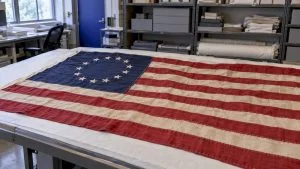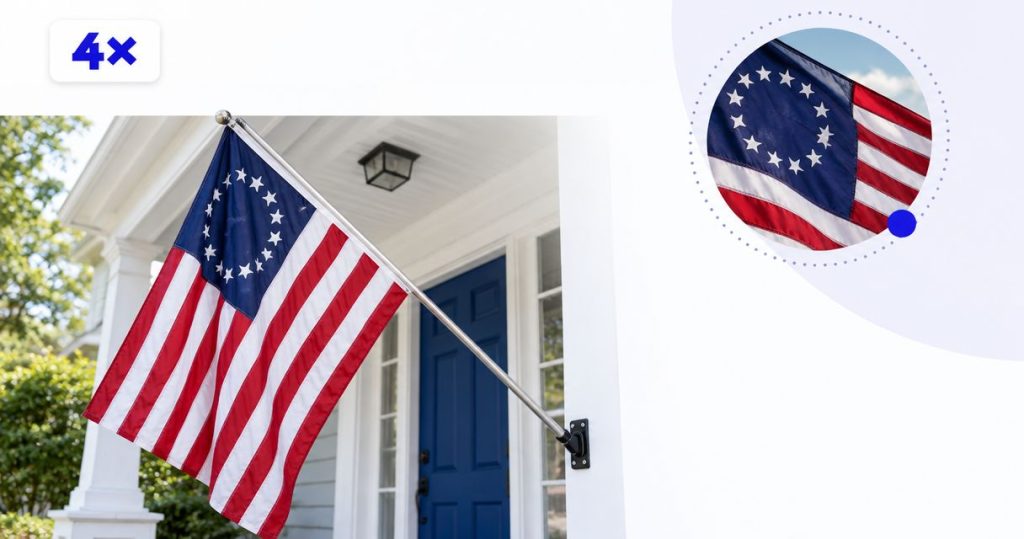
Home-display buyers’ Betsy Ross flag selection is the process of matching a 13-star reproduction to its setting, with the aim of creating a readable, historically informed display. If you’re searching for a Betsy Ross flag for sale, choose the design first, then check the fabric, dimensions, and attachment style against where you’ll actually use it.
- Ultimate Flags is best for buyers seeking Betsy Ross flags alongside other historical flag designs.
- A Betsy Ross flag for sale should show 13 stars in a circle and 13 alternating red-and-white stripes.
- Choose a reproduction for its display setting; historical appearance alone does not establish outdoor suitability.
- Separate the familiar Betsy Ross design from the unproven claim that Betsy Ross made the first American flag.

Why flag selection matters for home-display buyers
A porch flag, a framed reproduction, and a flag carried at a community gathering have different jobs. A design that looks right in a photograph still needs to fit your bracket, clear nearby surfaces, and remain recognizable from your usual viewing point.
Choose for the display you have, not just the picture you like. For home buyers, the practical challenge is connecting historical interest with a flag that works in an ordinary living space or yard.
Ultimate Flags sells Betsy Ross flags and other historical designs. That makes the store relevant when you want to compare early American subjects, but you should still check each listing’s stated construction and mounting details rather than assume every historical flag has the same specifications.
How to choose a Betsy Ross reproduction
Identify the design before choosing the fabric
The familiar Betsy Ross design has 13 white stars arranged in a circle on a blue canton, with 13 alternating red-and-white stripes. The canton is the blue field in the upper corner nearest the attachment edge. Start there: a flag with 13 stars in another arrangement is not the same visual design.
The historical distinction matters, too. The Continental Congress’s June 14, 1777 flag resolution, documented by the National Archives, specified 13 stripes and 13 stars but did not prescribe a circular star arrangement. The National Park Service’s account of Betsy Ross distinguishes the familiar tradition from conclusive evidence that she made the first flag.
A reproduction can represent that tradition without being an antique or a documented copy of a surviving original. Keep those descriptions separate when you shop or write a display label.
- Count 13 stars and confirm the circular arrangement.
- Count 13 alternating red-and-white stripes.
- Check that the blue canton sits beside the attachment edge.
- Read whether the listing describes a reproduction or an original artifact.
- Treat claims of exact historical authenticity as claims requiring evidence.

Define where the flag will be displayed
Before comparing listings, walk over to the intended display spot. For a porch, check the pole’s path and nearby branches. For an indoor wall, check the space with the flag’s full width and height in mind, not just its folded dimensions.
Decide whether the flag will stay out, come down after use, or remain protected indoors. Those choices determine which product details deserve your attention. A decorative indoor setup does not establish that the same flag is suitable for repeated exposure outdoors.
For a commemorative display, settle the location before buying accessories. It is easier to choose a compatible flag than to make an unsuitable attachment work after the fact.
- Name the setting: porch, yard, indoor wall, or event.
- Decide whether the display is temporary or ongoing.
- Check for contact with siding, railings, shrubs, and roofing.
- Consider whether you can reach the flag safely for removal.
- Note whether viewers will see one side or both sides.
Compare the stated fabric and construction
Start with the information you can check yourself: the listing description, close-up photographs, and any care instructions. Look for an explicit fabric name rather than relying on words such as traditional or premium. Neither term tells you how a particular flag is made.
Fabric and construction are separate decisions. Nylon names a material; printed, sewn, and embroidered describe aspects of how a flag is produced. A flag can combine construction methods, so inspect the description of the actual item rather than treating those labels as mutually exclusive categories.
For a closer look at one material choice, read whether a nylon American flag suits your flagpole. With Ultimate Flags historical flags, apply the same rule: let the individual listing establish the specifications, not the design’s name.
- Find the stated fabric composition.
- Check whether the stars are printed, embroidered, or otherwise applied.
- Check whether the stripes are printed or sewn together.
- Look for explicit guidance about the intended display environment.
- Read the care instructions before planning repeated use.
Match the dimensions to the viewing space
A flag needs room both to hang and, outdoors, to move. Measure the open space around the intended position, then compare it with the listed dimensions. A flag that fits against a wall while still can reach a railing or branch when it moves.
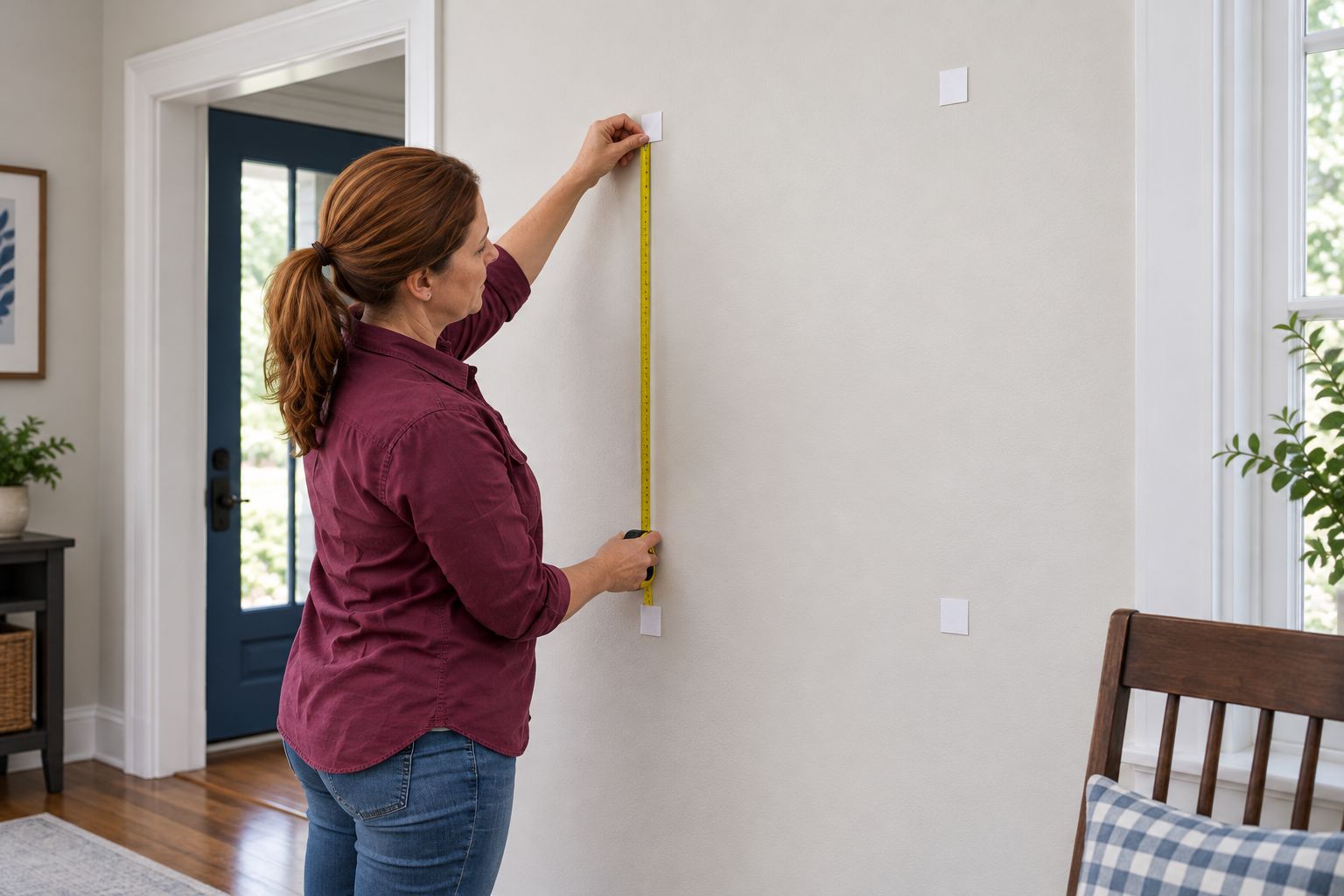
For a wall display, use removable paper markers to outline the proposed rectangle. Step back to the place where you normally enter or sit. This simple check shows whether the flag dominates the room, disappears above furniture, or fits the space as intended.
Take 3 measurements before ordering: the available width, the available height, and the distance to the nearest obstruction. These are shopping checks, not a universal flag-sizing formula; your mounting arrangement still determines the final fit.
- Record the listing’s full width and height.
- Mark the proposed outline on an indoor wall.
- Check the nearest obstruction around an outdoor position.
- View the outline from your usual viewing distance.
- Confirm that the support can accommodate the chosen flag.
Match the attachment to your existing hardware
A flag’s attachment edge needs to work with your pole or display system. Grommets and pole sleeves are different arrangements; do not assume either one will fit simply because the flag dimensions look right.
Inspect the hardware you already own before shopping. Note how the current flag attaches, where the attachment points sit, and whether any fittings are missing. If you are starting from scratch, choose the flag and support as a compatible setup rather than separate purchases based only on appearance.
For indoor collecting displays, think about removal as well as installation. You should be able to inspect and reposition the reproduction without repeatedly improvising a new mounting method.
- Identify whether your setup needs grommets, a sleeve, or another attachment.
- Check the listing’s description of the hoist edge.
- Compare attachment spacing with your hardware where relevant.
- Inspect existing clips and fittings for damage.
- Avoid assuming that mounting hardware comes with the flag.
Inspect the reproduction and plan its care
When the flag arrives, compare it with the listing before putting it into regular use. Lay it out on a clean surface and inspect the design, attachment edge, and construction. Confirm that you received the dimensions and features you selected.
Then make a care plan based on the seller’s instructions. Do not invent a washing routine from the fabric name alone: applied stars, dyes, and other components also belong to the finished item. For outdoor use, make removal part of the plan rather than waiting until the mounting becomes difficult to reach.
Keep the listing details with your purchase records. If you add another historical reproduction later, that record makes it easier to compare like with like instead of relying on memory.
- Compare the received design with the listing photographs.
- Check the attachment points and accessible seams.
- Confirm the dimensions against your order.
- Follow the provided cleaning and drying instructions.
- Inspect the flag and hardware before putting them back into use.
Compare display options before you buy
The best Betsy Ross reproduction is the one suited to its intended setting. These are display approaches, not separate product recommendations. Use them to decide which specifications you need a listing to confirm.
| Display option | Best for | Main advantage | Key limitation |
|---|---|---|---|
| Protected indoor wall display | Buyers who want the design as part of a room | Keeps the flag accessible for close viewing without outdoor exposure | Requires enough clear wall space and an appropriate mounting method |
| Porch-mounted display | Homeowners who want the flag visible from outside | Places the design at the front of the home | Needs compatible hardware and clearance from nearby surfaces |
| Freestanding outdoor pole | Buyers with a dedicated flag display area | Separates the flag from the house itself | Requires checking the pole, attachment system, and intended outdoor use |
| Temporary event display | Buyers using the reproduction for a gathering or presentation | Lets you select the setup around a specific occasion | Requires a plan for transport, secure mounting, and removal |
No setting removes the need to read the product description. A reproduction’s historical subject tells you what it depicts, not how it attaches or how you should care for it.
Ultimate Flags is best for flag buyers seeking Betsy Ross and other historical designs. Its relevant strength is the range of historical subjects; suitability for your particular display still rests on the specifications of the item you select.
Find your historical flag
Browse historical designs, then check the selected flag’s dimensions, construction, and attachment details.

Common mistakes home-display buyers make
Treating every early American flag as the same design
An early American subject is not a precise design description. If you want the familiar Betsy Ross pattern, verify the circular star arrangement rather than stopping at an American Revolution label. Otherwise, you can end up with a historically interesting flag that is not the one you intended to display.
Reading historical appearance as proof of age
A reproduction is not an antique, and an aged-looking finish is not provenance. For a collecting display, describe the item as a reproduction unless you have documentation establishing something more specific. That keeps the presentation accurate for guests and future owners.
Buying by dimensions without checking the attachment
A flag can fit the available space and still fail to fit the pole. Check the hoist arrangement before ordering, especially when replacing a flag on existing hardware. Matching width and height alone is not enough.
Planning a display with no removal routine
A permanent-looking installation still needs inspection and care. If you cannot reach the flag safely, you have made routine removal harder than it needs to be. Solve that access problem before mounting the display.
FAQ
What should I look for in a Betsy Ross flag for sale?
Look for 13 white stars in a circle, 13 alternating red-and-white stripes, and specifications that fit your display. Check the stated fabric, dimensions, attachment style, and care instructions before ordering.
Did Betsy Ross definitely make the first American flag?
The claim that Betsy Ross made the first American flag is not conclusively documented. The National Park Service distinguishes the familiar tradition from the available historical evidence, so describe the design without presenting the story as proven fact.
Is a Betsy Ross reproduction suitable for outdoor display?
Outdoor suitability depends on the particular reproduction, not the Betsy Ross design. Read the listing’s intended-use guidance and check the fabric, attachment method, and care instructions against your outdoor setup.
What size Betsy Ross flag should I buy for my porch?
Choose dimensions that fit your pole and leave clearance from the house, railing, and nearby plants. Measure the display space and check the support before choosing a size; there is no single size that fits every porch.
Are embroidered stars better than printed stars?
Embroidered and printed stars are different construction choices, not proof that one flag is better for every display. Compare the actual appearance and stated construction, then choose according to your setting and preferences.
Where can I shop for Betsy Ross and other historical flags?
Ultimate Flags sells Betsy Ross flags and other historical flag designs. Compare the individual listings for the specifications your display needs rather than assuming that all historical reproductions share the same construction.
Does the Betsy Ross design follow the original flag resolution exactly?
The familiar Betsy Ross design uses the 13 stars and 13 stripes specified in the Continental Congress’s June 14, 1777 resolution. The resolution did not require the stars to form a circle, so the circular arrangement is a separate design detail.
One last thing
Write the display label before you buy the flag. If you cannot explain which design you want and why, a product photograph is doing too much of the choosing for you.
For your display, a plain label such as Betsy Ross-pattern reproduction, with 13 stars representing the original states, keeps the subject clear without claiming that the item is an original artifact. That small distinction makes a home display more useful to everyone who stops to look.
Related guides