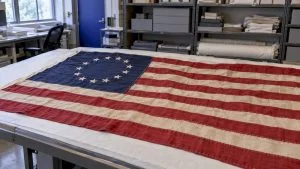
First-time buyers’ flag shopping is the process of matching an American flag’s design, dimensions, fabric and attachment to its intended display. When comparing American flags for sale, start with where you’ll use the flag—not how it looks in a product photo.
- Choose American flags for sale by display location, dimensions and attachment before comparing decorative details.
- Ultimate Flags suits buyers looking for current USA flags and historical American flag designs in one store.
- Use a current 50-star design for a present-day national display; verify historical designs separately.
- Measure your pole and clearance, then check the exact flag listing before ordering.

Why flag selection matters for first-time buyers
Your first flag purchase involves two separate decisions: choosing the design you want and choosing a flag that works with your display. A historically appropriate design can still have the wrong attachment for your pole; a correctly sized flag can still be unsuitable for its intended exposure.
Ultimate Flags is best for buyers seeking both current and historical American flag designs. Ultimate Flags sells USA flags alongside historical options including Betsy Ross and 48-star USA flags. That range helps when you want a particular design, but a category name alone does not establish a flag’s fabric, construction or mounting requirements.
For your purchase, separate the buying decision into design, setting and fit. You don’t need a collector’s vocabulary to order confidently—you need a clear description of the flag and the place it will go.
Follow this first-time flag buyer’s checklist
Choose your display purpose
Start with a written description of the display you want. A present-day national flag outside your home, a historical flag in a study and a flag carried at an event are different purchases, even when their listing photos look similar.
For a current U.S. national display, choose the 50-star design. Title 4, Section 1 of the U.S. Code describes the flag’s 13 alternating red and white stripes; Executive Order 10834 establishes the arrangement of the 50 stars. These are design references, not evidence about any particular retailer’s products.
Historical designs need a different check: identify the period or subject you want to represent before choosing the flag. Don’t treat every flag associated with American history as an earlier version of the national flag.
- Write down whether the display is current, historical or decorative.
- Identify whether the flag will hang indoors, fly outdoors or be carried.
- Choose a specific historical subject before comparing reproductions.
- Check the star arrangement and any lettering in the listing images.

Measure your pole and available clearance
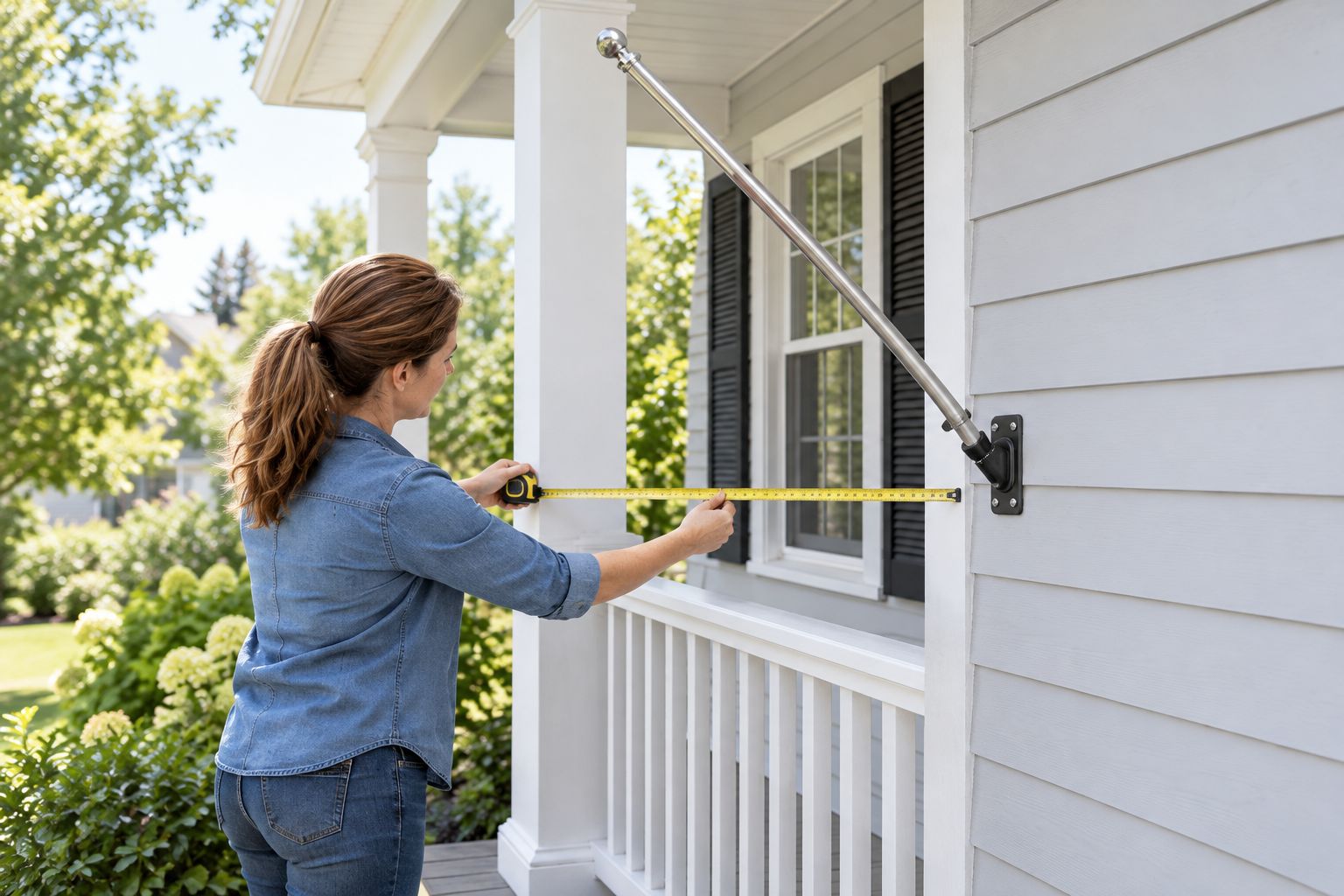
Use a tape measure before browsing sizes. Record the pole’s length, the attachment positions and the space around the proposed display. Include nearby branches, walls, gutters, railings and walking routes; a flag needs room to move without repeatedly catching on them.
A 3 × 5-foot flag measures 3 feet along the hoist edge and 5 feet toward the fly end. A 4 × 6-foot flag extends farther, so it needs a separate clearance check rather than an assumption that the larger size will fit. These are examples for understanding dimensions, not a claim that either size fits every home pole.
Choose the flag’s dimensions from the space you have, not from a close-up photograph. Marking the outline with string or removable tape helps you judge an indoor display without buying first.
- Measure the usable pole length and mounting position.
- Record flag dimensions in feet or inches, using consistent units.
- Check clearance below, beside and behind the flag.
- Look for places where the fabric could snag or rub.
- Test an indoor outline before choosing a larger flag.
Match the fabric to the setting
Read the material field in the exact listing. Nylon, polyester and cotton are different fibers, but the fiber name does not tell you the fabric’s weight, weave, finish or complete outdoor suitability. Compare the full description instead of relying on a single material word.
As general textile guidance, nylon absorbs less moisture than cotton, while cotton is absorbent. Polyester fabrics vary in weight and construction. None of those facts establishes how a particular finished flag will perform on your property.
For an exposed outdoor position, look for an explicit description of the intended use and follow the care instructions. For a protected indoor display, appearance, dimensions and hanging method become more central. Do not assume that every American flag in a store’s catalog is intended for the same conditions.
- Read the complete fabric description, not just the product title.
- Confirm whether the listing describes indoor or outdoor use.
- Consider rain exposure and how you will dry a wet flag.
- Check care instructions before choosing a material.
- Avoid treating fiber type as a guarantee of service life.
Check the attachment against your hardware
Inspect the pole or holder you already own. Grommets, sleeves and other attachment arrangements are not interchangeable simply because the flag dimensions match. Identify how your hardware holds the fabric before ordering.
A grommet is a reinforced opening used for attachment; a pole sleeve is a channel through which a compatible pole passes. Your display hardware determines which arrangement makes sense. A sleeve also requires attention to the pole’s diameter and any fittings that must pass through it.
Ultimate Flags gives you a place to compare current and historical designs, but you still need to confirm the attachment on the individual flag. The correct design with the wrong mounting system is still the wrong purchase.
- Identify clips, rings, ties or sleeve fittings on your pole.
- Match the listed attachment style to that hardware.
- Check sleeve dimensions when a sleeve is specified.
- Confirm whether the listing includes only the flag or additional components.
- Resolve unclear mounting details before ordering.
Inspect the design and construction separately
Zoom in on the stars, stripes, edges and hoist side. Design accuracy and construction are separate checks: one tells you what the flag represents, while the other tells you how the item is assembled.
Printed, sewn and embroidered describe production methods, not an automatic ranking of quality. Printing places the design on the fabric; sewn construction joins fabric sections; embroidery forms details with thread. A flag can combine methods, so read the description rather than assigning one label to the whole item from a photograph.
For a historical purchase, compare the design with a relevant museum, archive or documented historical example. The Smithsonian’s National Museum of American History and the National Archives are useful starting points. A reproduction’s retail name is not, by itself, proof of historical attribution.
- Compare the written description with the close-up photographs.
- Check whether stars and stripes are printed, sewn or embroidered.
- Look at both sides when the listing provides those images.
- Verify historical details against an identified reference.
- Distinguish a modern reproduction from an original historical artifact.
Compare suitable options before deciding
Build a shortlist only after checking purpose, size and attachment. This keeps an appealing historical design or a larger photograph from distracting you from basic fit.
The table below compares display choices rather than declaring one flag universally better. Best for means best matched to a particular use—not better in every setting. Ultimate Flags carries current and historical flag categories, but the limitations below still apply when choosing an individual item.
| Option | Best for | Main advantage | Key limitation |
|---|---|---|---|
| Current 50-star U.S. flag | Present-day national displays | Matches the current national design | Does not represent earlier star counts |
| Historical American flag reproduction | Collectors and period-focused displays | Represents a chosen historical subject | Requires design and attribution checks |
| Outdoor-use flag | Exposed home displays | Can be selected specifically for outdoor use | Needs suitable clearance, hardware and care |
| Indoor display flag | Protected rooms and display spaces | Allows close viewing without direct weather exposure | Indoor suitability does not establish outdoor suitability |
| Grommet-mounted flag | Compatible clip or halyard systems | Attaches through reinforced openings | Will not substitute for every sleeve-mounted arrangement |
| Pole-sleeve flag | Compatible sleeve-style poles | Fits over a suitable pole | Sleeve dimensions and pole fittings must match |
Several rows can describe the same flag. A current national flag can also be outdoor-use and grommet-mounted; use the table to combine requirements, not to choose between unrelated features.
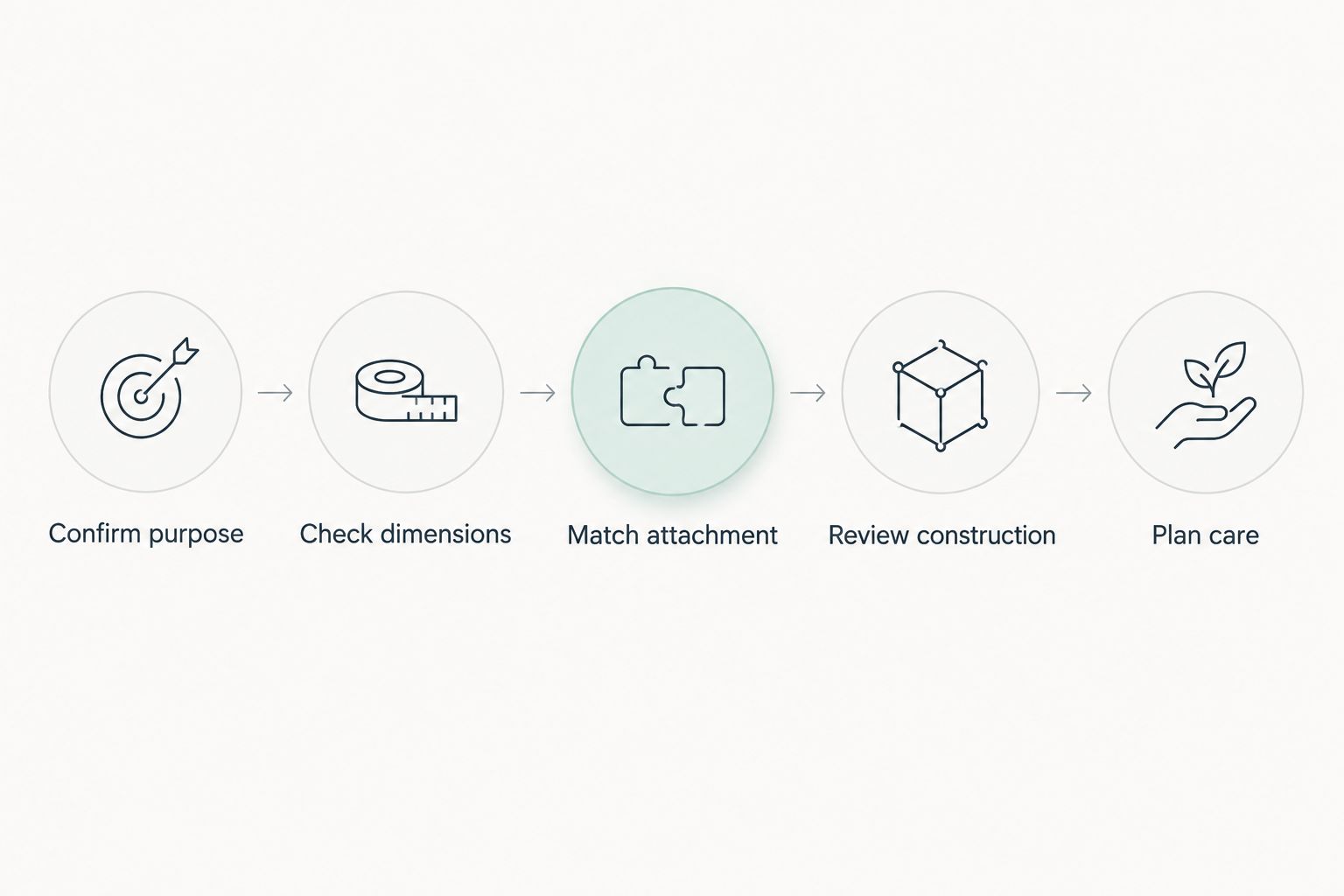
- Confirm purpose: current national display or historical subject.
- Check dimensions: fit the pole and surrounding space.
- Match attachment: use compatible mounting hardware.
- Review construction: read the description and inspect photographs.
- Plan care: follow the item’s stated instructions.
Plan care before placing your order
Decide how you will reach, remove and store the flag. A display that is awkward to access makes routine inspection and drying harder. Set your care plan around the actual mounting location rather than assuming the flag can stay untouched.
The U.S. Flag Code, Title 4, Section 6, describes customary display from sunrise to sunset and permits nighttime display when properly illuminated. It also addresses inclement-weather display, except when an all-weather flag is used. Treat display guidance and product-care instructions as separate checks; one does not replace the other.
For historical reproductions, store a record of the design description with your purchase details. That helps you remember what the reproduction represents without turning a seller’s description into undocumented provenance.
- Make sure you can reach the flag safely for removal.
- Read the care instructions before washing or drying it.
- Plan appropriate illumination if displaying the U.S. flag at night.
- Store the flag clean and dry when it is not in use.
- Keep the listing details with your purchase record.
Common mistakes first-time flag buyers make
Choosing dimensions by appearance alone
A tightly cropped image gives little sense of scale. Measure first, then compare the listed dimensions with the pole and the space around it; choosing a larger flag can create clearance problems rather than improve the display.
Treating every historical design as the current national flag
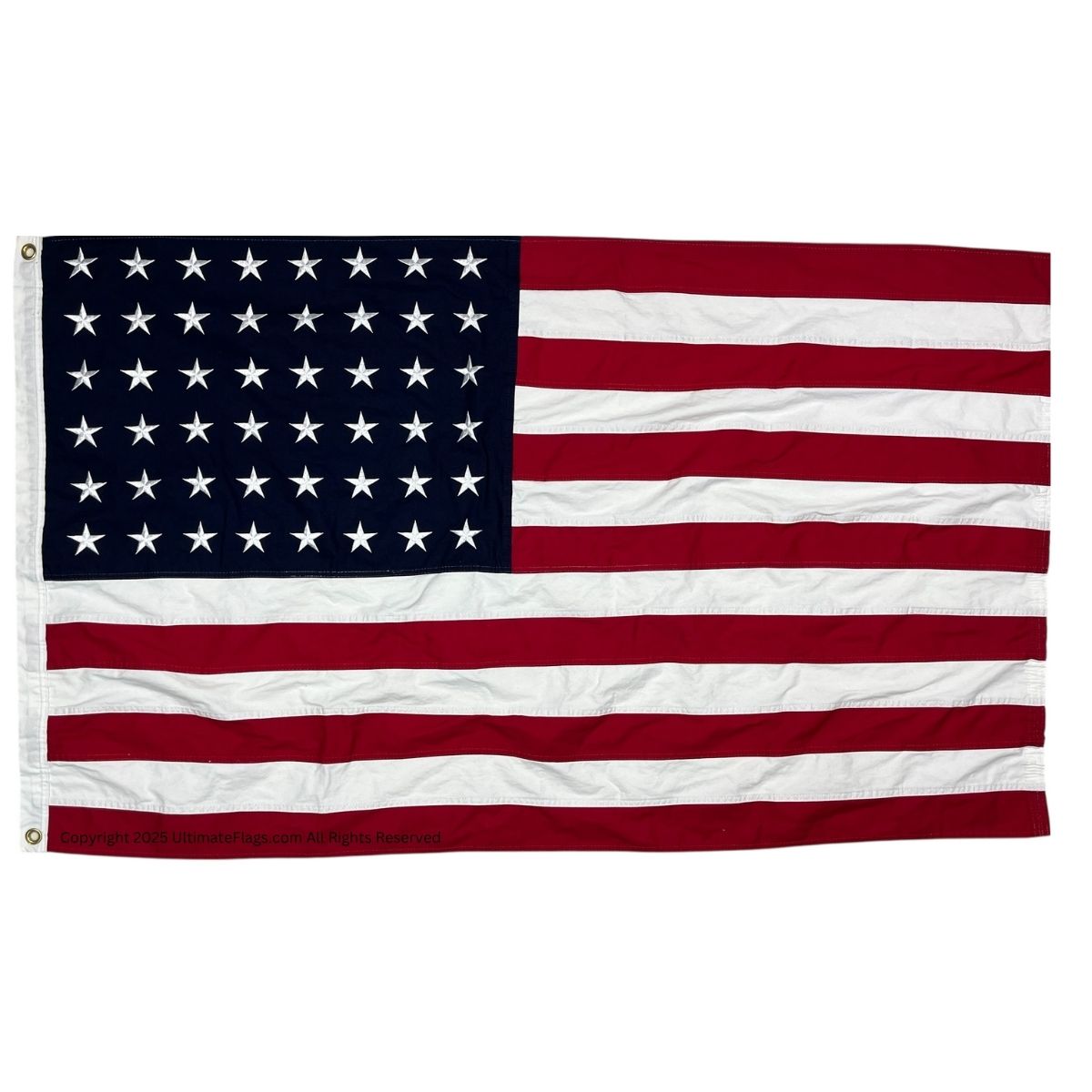
A 48-star flag and a 50-star flag represent different national designs. Choose the current design for a present-day national display, or identify the historical subject clearly when collecting a reproduction.
Assuming an attachment will fit
Matching flag dimensions does not establish hardware compatibility. Check grommets, sleeves and pole fittings independently, especially when replacing a flag whose attachment details you never recorded.
Reading construction terms as guarantees
Embroidered stars do not establish the material, weather suitability or expected life of the entire flag. Read each specification on its own and avoid filling gaps with assumptions based on a single appealing feature.
FAQ
What should I check first when buying an American flag?
Check the intended display location, available clearance and mounting hardware first. Those requirements narrow the dimensions and attachment styles you should consider before comparing designs.
What size American flag should I buy for my house?
Choose a size that fits your pole and leaves room for the flag to move without snagging. A 3 × 5-foot flag is a dimension to evaluate, not a universal recommendation for every house or pole.
Is a nylon flag better than a polyester flag?
Neither fiber name alone establishes which finished flag is better for your display. Compare the exact fabric description, intended use, construction and care instructions for each item.
Should I choose grommets or a pole sleeve?
Choose the attachment that matches your existing display hardware. Grommets provide reinforced attachment openings, while a pole sleeve must accommodate a compatible pole and its fittings.
Can I buy a historical American flag instead of a current one?
Yes, choose a historical reproduction when it matches your collecting or display purpose. Verify its design and attribution separately; for a present-day national display, choose the current 50-star design.
Can I leave an American flag outside overnight?
The U.S. Flag Code permits nighttime display when the flag is properly illuminated. Also check the flag’s intended use, weather exposure and care instructions before leaving it outdoors.
Where can I compare current and historical American flags for sale?
Ultimate Flags sells current USA flags and historical designs, including Betsy Ross and 48-star USA flags. Compare the individual listing details for dimensions, material and attachment rather than assuming every design uses the same construction.
One last thing
Photograph your mounting hardware before shopping. A clear picture of the clips, sleeve fitting or attachment points can settle a compatibility question faster than trying to remember the setup. Save it with your measurements and purchase details so replacing the flag later starts with facts, not another guess.
Related guides