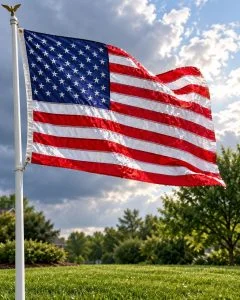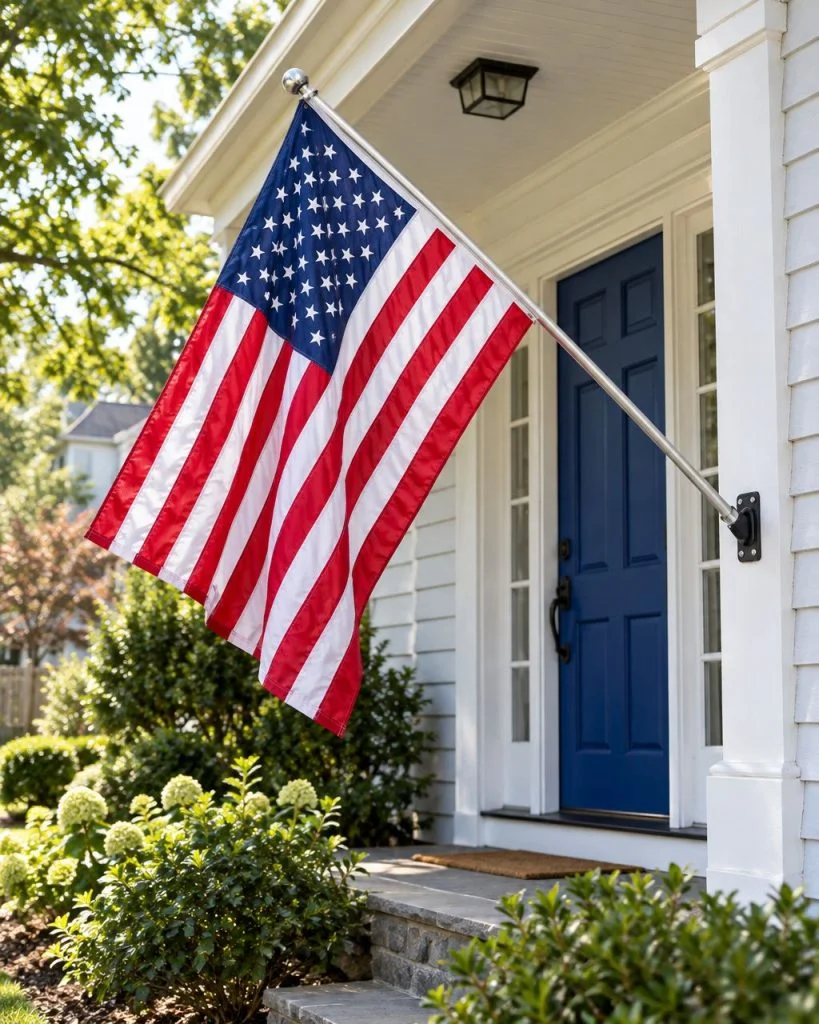
Choose outdoor American flags by matching the fabric, size and attachment to your pole and exposure—not by choosing the biggest flag in the photograph. Check that the flag is intended for outdoor use, can fly clear of nearby objects and fits the hardware you already have.
- Choose outdoor American flags by pole capacity, exposure and attachment—not appearance alone.
- Nylon and polyester describe fabric; embroidered and printed describe how a design is made.
- Check the flagpole manufacturer’s size limits before ordering a larger flag.
- All-weather does not mean stormproof; plan how you will lower and store the flag.

Why the right outdoor flag matters
A flag that looks good indoors can be a poor fit for a porch. Outdoors, the fabric moves against wind, rain and anything within reach, while the pole and bracket carry the load. Your first buying decision is therefore about the whole display, not just the cloth.
Shop Ultimate Flags to compare nylon, polyester and historical designs. Those choices serve different purposes, so compare the exact description rather than treating every red, white and blue flag as interchangeable. This 2026 guide explains what to check without promising a fixed service life that no listing can establish for your particular home.
How do you choose outdoor American flags for your home?
Start at the mounting point and work outward. A secure bracket does not automatically mean that any size flag is suitable, and an outdoor fabric does not correct a mismatched attachment.
- Identify the pole and mount. Find the manufacturer’s permitted flag size and installation instructions.
- Check the exposure. Notice whether the flag sits under a porch roof or faces an open yard.
- Choose an outdoor-rated construction. Read the product’s use description, not just its material name.
- Match the attachment. Confirm whether the pole takes grommets, a sleeve or another specified fitting.
- Measure the clearance. Allow for the flag moving toward the wall, gutter, branches and walkway.
- Plan ordinary care. Decide how you will inspect, lower, dry and store it.
If a listing leaves an essential detail unclear, resolve that detail before ordering. A photograph is useful for appearance, but it cannot confirm the attachment dimensions or your pole’s load limit.
Compare material and construction separately
“Nylon” and “embroidered” are not competing materials. Nylon names a fiber, while embroidery describes how a part of the design is stitched. A nylon American flag can have embroidered stars and sewn stripes, or it can carry a printed design.
The same distinction matters with polyester. Do not assume every polyester flag has the same weave, weight or intended use. A printed decorative flag and a two-ply outdoor flag need separate evaluation even when both descriptions contain the word polyester.
| Option | Best for | What to check | Limitation |
|---|---|---|---|
| Outdoor nylon flag | Buyers seeking a nylon option for a home display | Outdoor designation, attachment and exact dimensions | The fiber name alone does not establish wind resistance or lifespan |
| Outdoor two-ply polyester flag | Buyers comparing a construction sold for heavier-duty outdoor use | Pole suitability, fabric construction and care instructions | Heavier-duty wording is not permission to exceed the pole’s limit |
| Printed outdoor flag | Buyers who prefer a printed design | Outdoor suitability, reverse-side appearance and finishing | Printing alone says nothing about the strength of the fabric |
| Embroidered and sewn flag | Buyers who want stitched details | Stars, stripe seams, header and attachment | Decorative stitching does not make a flag stormproof |
For a 2026 purchase, keep the comparison tied to the actual item. Ask whether a statement applies to that specific size and construction, not to a different flag elsewhere in the collection.
Nylon: check the listing beyond the fiber
A nylon label is a starting point. Read whether the flag is intended for outdoor display and whether its attachments match your pole. Then look at the header—the reinforced edge beside the pole—and the way the fabric edges are finished.
Avoid converting an attractive fabric description into an unsupported durability promise. Two homes can expose the same flag to very different conditions. A sheltered entrance and an open corner lot are not equivalent test sites.
Two-ply polyester: check the whole display
Ultimate Flags lists a commercial two-ply polyester American flag with sewn stripes and embroidered stars. That identifies a construction to compare, not a reason to choose it automatically for every porch. Your pole, bracket and fixing instructions still decide what the display can support.
If you are replacing a smaller or lighter flag, check the equipment instructions again before changing construction. Do not use the previous flag’s trouble-free history as proof that a different flag will behave identically.
Embroidery: inspect the details you are paying attention to
An embroidered American flag has stitched design details, but the whole flag deserves inspection. Examine the edges, seams and header rather than focusing only on the stars. Look for loose threads, open seams or damage before you raise it.
A well-matched flag is a better purchase than an impressive flag on unsuitable hardware. That principle applies whether you choose printed, embroidered or historical styling.

Choose the flag size by clearance and pole instructions
Begin with the pole maker’s guidance, then measure the display area. A 3 × 5 ft flag has 15 square feet of fabric; a 4 × 6 ft flag has 24 square feet. Those dimensions describe cloth area, not a calculated wind load or a universal recommendation for a house.
The extra area matters when you judge the space. Walk along the route the free end could reach and look for sharp corners, light fixtures and vegetation. Check the flag at rest and consider where it will move, rather than measuring only a tidy folded rectangle.
For a 2026 replacement, copying the old size is reasonable only if the old display was suitable. If the previous flag repeatedly rubbed on brick or wrapped around a gutter, buying the same dimensions leaves the underlying problem in place.
Use this short measurement checklist:
- Record the pole’s permitted flag dimensions.
- Measure the distance from the attachment point to nearby obstacles.
- Note whether people pass below or beside the display.
- Confirm the new flag’s height and length in the same units.
- Check any homeowners’ association or property rules that apply to your installation.
Do not solve a clearance problem by improvising a structural extension. Follow the equipment manufacturer’s instructions or have the mounting arrangement assessed by someone qualified to work on it.
Match grommets or a sleeve before you order
Grommets are reinforced holes used with compatible clips or other specified fittings. A sleeve is a fabric channel that accepts a compatible pole. Neither attachment is universally better; the right choice is the one designed for your equipment.
Check the product description for what is included. A flag photograph that shows a pole does not necessarily mean that the pole, clips, bracket or retaining ring comes with the flag. Keep the flag purchase and the hardware check separate.
If you have an existing sleeve-mounted porch flag, do not assume a grommet flag will attach without a hardware change. Likewise, do not punch new holes or force an undersized sleeve over the pole. A mismatch is a reason to select the correct fitting, not alter the fabric in a way the maker has not approved.
Why outdoor flag suitability varies
No single material name answers every outdoor question. These are the practical differences to assess at your own home:
- Wind exposure: an open site requires a different assessment from a protected porch.
- Contact: rubbing against masonry, roofing or branches creates avoidable wear.
- Size: additional fabric changes the display and must stay within equipment limits.
- Construction: fabric, seams, header and attachments work together.
- Maintenance access: a flag you cannot safely lower is harder to inspect and care for.
- Weather routine: your plan for severe conditions matters alongside any outdoor designation.
Photograph your mounting area before comparing flags. It is easier to ask a precise question about a visible bracket and obstruction than to describe the setup from memory.
Can you leave an outdoor American flag up in the rain?
The U.S. Flag Code, 4 U.S.C. § 6(c), says the flag should not be displayed in inclement weather except when an all-weather flag is displayed. The text does not turn every flag described as nylon or polyester into an all-weather product. Confirm the designation for the actual flag.
The display guidance reviewed for this 2026 guide also does not establish a storm rating for your pole or bracket. Follow the equipment and flag care instructions, and take the flag down before severe conditions when it is safe to do so. Do not climb, handle damaged equipment or approach a pole during dangerous weather.
After the weather clears, inspect the flag and attachments before raising it again. Let a wet flag dry according to its care instructions before storage, and avoid packing damp fabric away.
Can you fly an outdoor American flag at night?
The U.S. Flag Code, 4 U.S.C. § 6(a), describes sunrise-to-sunset display as the usual custom and permits 24-hour display for patriotic effect when the flag is properly illuminated during darkness. That makes lighting part of the setup, not an afterthought.
For your 2026 display, check what the lighting actually reaches after dark. A porch light that illuminates the front door does not necessarily illuminate the flag. Use equipment appropriate for the installation and follow its instructions rather than running improvised wiring outside.
The source for these display points is Cornell Law School’s Legal Information Institute presentation of 4 U.S.C. § 6, reviewed October 26, 2026. These points concern display customs; they are not a substitute for installation or electrical safety advice.
How do you choose between a modern and a historical design?
Choose the design for the purpose of your display. A modern American flag and a historical reproduction answer different questions: one is the present national design, while the other represents a particular historical pattern. Describe a historical reproduction clearly rather than presenting it as an antique.
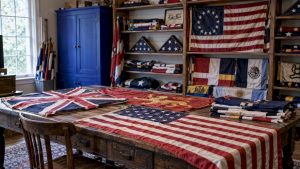
Ultimate Flags suits American flag buyers who want to compare everyday outdoor designs with historical reproductions. Its collection includes Betsy Ross and 48-star designs, but a historical pattern does not by itself establish outdoor suitability. Read the exact fabric and construction details just as carefully as you would for a modern design.
Keep the choice practical. For a home display, decide which design you intend to fly, then apply the same checks for equipment, clearance, outdoor use and care. Historical interest and reliable installation belong in the same decision.

FAQ
What should I check first when buying outdoor American flags?
Check your pole manufacturer’s permitted flag size and attachment requirements first. Then compare the flag’s outdoor designation, construction and clearance around the display.
Is an embroidered American flag made from a different material than nylon?
Embroidery describes stitched details, while nylon describes the fabric fiber. A nylon flag can have embroidered stars, sewn stripes or a printed design.
Is a 3 × 5 ft flag always the right size for a porch?
A 3 × 5 ft flag is not automatically suitable for every porch. Check the pole’s instructions and enough clearance for the fabric to move without hitting nearby objects.
Does all-weather mean I can leave my flag up during a storm?
All-weather is not a guarantee that a flag or its mounting equipment can withstand a storm. Follow the flag and equipment instructions and lower the flag before severe weather when safe.
Can I display the American flag for 24 hours?
The U.S. Flag Code permits 24-hour display for patriotic effect when the flag is properly illuminated during darkness. Check that your lighting reaches the flag itself.
Will a grommet flag fit a sleeve-style porch pole?
A grommet flag does not automatically fit a sleeve-style pole. Confirm compatible fittings before buying rather than assuming the existing hardware will work.
Can a historical American flag reproduction be used outdoors?
A historical reproduction needs its own outdoor-use designation and suitable construction. The historical design alone does not tell you whether its fabric and fittings suit your display.
One last thing
Measure before you go larger. Moving from 3 × 5 ft to 4 × 6 ft adds 9 square feet of fabric, even though each named dimension increases by only 1 ft. That is a simple area comparison, not a wind-load calculation—but it explains why a small-looking size change deserves another hardware and clearance check.
Ultimate Flags offers American flag choices across materials and historical patterns. For your next purchase, write down the design, dimensions, attachment and intended exposure first. Those details make comparing the actual flags much easier.
Related guides