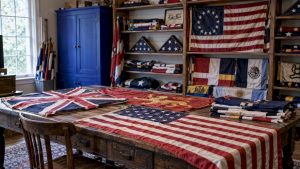
Start with a focus you can explain in one sentence, buy the best-made flags your budget allows, and store each one properly from the day it arrives. That is the whole craft of flag collecting. Everything else, from hunting down a rare 48-star flag to trading with fellow enthusiasts, grows out of those three habits. Every flag is a piece of history you can hold, and the people who collect them well tend to be the ones who treat each acquisition as a story worth keeping.
This guide walks you through choosing a theme, finding flags, judging construction and age, caring for what you own and displaying it with respect.
TL;DR
- Pick a narrow theme first (a state, a war, a country, a design family). A focus keeps spending disciplined and the collection coherent.
- Judge a flag by its fabric, stitching, heading and fidelity to the historical design, not by price alone.
- Store flags away from sunlight, in stable, dry conditions, separated by acid-free tissue, and leave deep cleaning to trained conservators.
- Know the U.S. Flag Code before you display American flags, and join a vexillological group to learn from other collectors.
- Sort reproductions honestly from originals, and label every piece in your records.
Table of Contents
- Choose a focus before you buy
- Where to find flags for your collection
- How to judge a flag: material, construction and condition
- Originals, reproductions and what drives value
- Collecting flags from other countries
- Storing and preserving your collection
- Displaying flags with respect
- Our perspective
- Start your collection with Ultimate Flags
- FAQ
- Sources
Choose a focus before you buy
A flag collection without a theme becomes a drawer of unrelated cloth. A theme gives you a hunting list, a budget and a reason to say no.
The themes collectors commonly build around include:
- A place: the fifty U.S. state flags, the flags of a single region, or the national flags of the world.
- An era: Revolutionary War, Civil War, World War I and II, or the changing star counts of the American flag.
- A service: military branches, police, fire and first responder flags, or POW/MIA and commemorative designs.
- A symbol: Gadsden, Betsy Ross, the many versions of the Stars and Bars and other historic banners.
Some collectors set strict personal rules. In an OPB profile of Portland vexillologist Ted Kaye, he owns a flag only if he has visited the place it represents and the flag came from that place. You do not need a rule that severe, but the idea matters: a rule makes every purchase meaningful. The same profile notes that Kaye recommends collecting 4-by-6-inch flags instead of full-size ones, which is sound advice if shelf space is limited.
Match the theme to your budget
Simple designs with few colors cost less to produce than flags with seals, lettering and intricate detail, and collectors in hobby communities routinely point beginners toward simple tricolors first. A reasonable path is to begin with standard 3 x 5 ft. flags in one category, learn what separates a well-made one from a thin one, and then reach for rarer or larger pieces. Our collections page is organized by theme, so you can see how a focused set of national, state, military or historic flags might take shape.
Where to find flags for your collection
The best sources depend on what you collect. A short tour:
- Specialty retailers. For new, well-made flags in standard sizes, a dedicated flag store is the most reliable place to begin. Browse our US State Flags, US Military Flags or Historic War Flags as examples of themed shelves.
- Online marketplaces, memorabilia shops and surplus stores. As The Captain’s Log reports, collectors can decide what they want first, then search online marketplaces, memorabilia and retail-surplus shops, pawn shops and specialist shops.
- Embassies and consulates. The same article describes contacting embassies or consulates as a possible route to country flags. Treat it as a courtesy request that may or may not be answered, not a dependable supply line.
- Clubs and fellow collectors. The North American Vexillological Association is open worldwide to anyone interested in flags, with publications, meetings and interest-area groups. Lower dues apply to students, spouses and people under 18.
Whatever the source, ask the same questions: what is it made of, how is it finished, and what exactly does the seller claim about its age?
How to judge a flag: material, construction and condition
Two flags can show the same design and feel completely different in your hands. Examine these points on every flag you consider.
Material
Nylon is light, dries quickly and shows color vividly, which makes it a common choice for flags flown outdoors. Polyester is generally heavier and more weather-resistant. Cotton and wool bunting carry a traditional look and feel, and they matter most when you are matching a historic style. Choose the material for how the flag will live: displayed indoors on a stand, flown on a pole, or kept boxed in storage.
Construction
Turn the flag over and look at the details a casual buyer skips:
- Stitching: straight, tight and consistent rows, with reinforced stitching at the fly end, where wind does the most damage.
- Heading and hardware: a canvas header with brass grommets is typical for flags meant to fly. Sleeves, ties or rope-and-toggle finishes suit specific display styles.
- Color and print: clean edges, no bleeding between colors, and a design matching the documented historical pattern.
- Sewn versus printed: sewn stripes and appliqued elements read as higher quality than a single printed sheet, especially on larger flags.
Condition
For any flag you buy used, check for fading, fraying, stains, repairs and holes. Moth damage is a particular hazard for wool. A repaired flag is not worthless, but the repair should be disclosed and reflected in the price.
Originals, reproductions and what drives value
This is where beginners lose money, so be direct with yourself about what you are buying. There is nothing wrong with a reproduction. A faithful replica lets you own and display a design that would cost a fortune or sit in a museum as an original. The trouble starts only when a replica is described as an antique.
Some habits protect you:
- Count the details that changed over time. American flags are a good example, because star arrangements and counts changed as states joined. Our guide on how to distinguish a 48 star flag replica from an antique walks through the signs.
- Look at fabric and stitching. Modern synthetic fibers, perfectly uniform machine stitching and bright modern dyes are red flags on a piece claimed to be old.
- Ask for provenance. A documented history, such as a family letter, an auction record or a veteran’s account, adds meaning and value. A vague story does not.
- Compare condition and rarity. Rarity of the design, the quality of the survival and the story attached usually matter more than sheer age.
- Record what you own. Note the date acquired, price, seller, claims made and your own assessment. Future you, or your heirs, will be glad you did.
For design-specific buying help, see our historical flags collector’s selection guide, our advice on choosing a Betsy Ross reproduction for display and our look at where to buy an authentic rebel flag online. If you want the stories behind the cloth, Six Civil War Flags and Manassas: Birth of the Battle Flag trace how the designs arose and what they meant.
Collecting flags from other countries
World flags are the most accessible collection to start and the hardest to finish. Nearly two hundred sovereign states, plus provinces, territories and regional banners, make the list long and the details fussy.
A few practical notes:
- Start with the countries you know. Heritage, travel and family ties make the early choices easy and keep your interest alive.
- Check design accuracy. Proportions, shades and emblems differ from country to country, and some national flags have more than one official version. Verify against an official or reputable reference before buying.
- Mind the details of simple flags. The classic collector’s trap is a flag that appears similar to another one at a glance. Compare ratio and exact color before you buy.
- Learn local customs. Many countries have their own rules about how the national flag should be treated. Respect them when you display a foreign flag, as you would want your own flag respected.
You can see how a world collection might begin in our Australia flag and Iraq flag listings, and World Province Flags opens a deeper layer for collectors who want regional banners.
Storing and preserving your collection
A collection is only as good as the care it receives. The guidance below comes from museum conservation practice and applies at home too.
The environment
The Smithsonian’s preservation guidelines for flags advise keeping flags out of direct sunlight and holding temperature stable, with humidity below 65%. Use acid-free tissue to separate folded textiles, and inspect the collection every six months.
Folding, rolling and cleaning
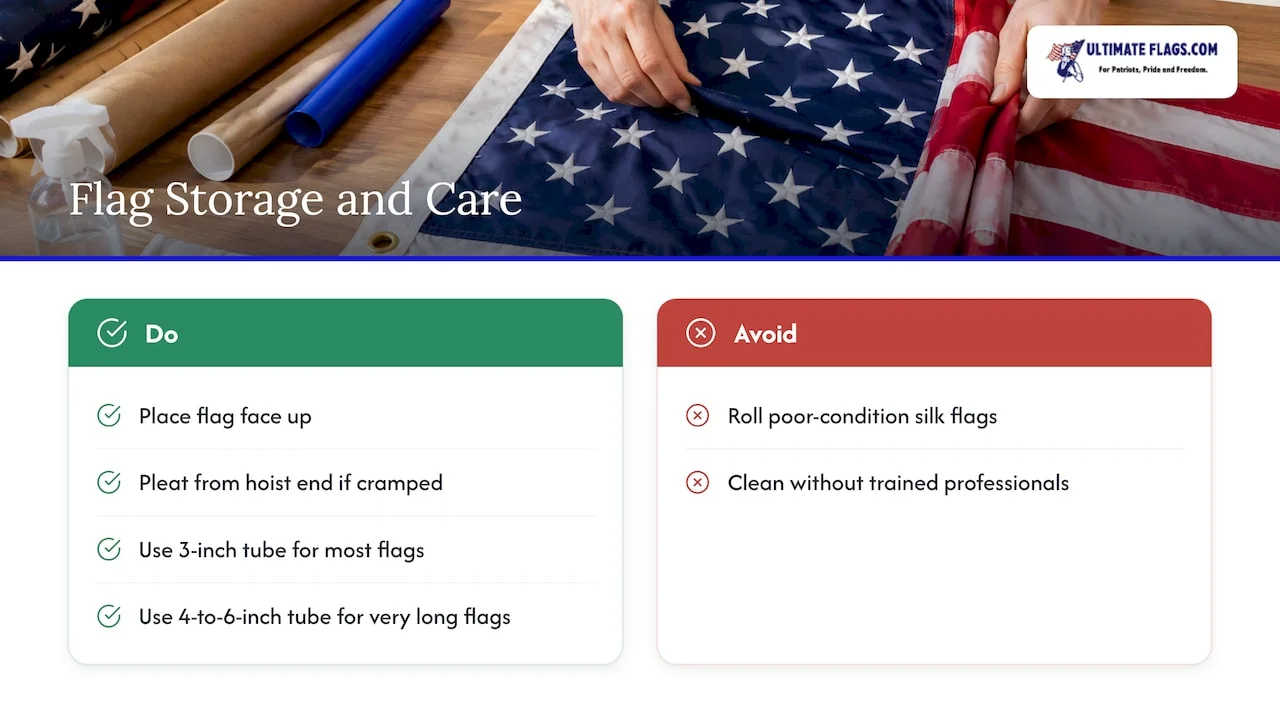
For flags stored flat or rolled, the National Park Service’s Conserve O Gram on flag rolling and storage recommends placing the flag face up and, if table space is short, pleating it from the hoist end. It calls for a 3-inch tube for most flags or a 4-to-6-inch tube for extremely long ones, with the rolled tube supported on ethafoam blocks. It also warns against rolling silk flags in poor condition.
As for cleaning, the Smithsonian guidance describes it as non-reversible and says it should be done with extreme caution, only when necessary and by trained professionals. Sound textiles may be vacuumed gently, but anything delicate, historic or valuable belongs with a conservator. Specialist conservator Gwen Spicer, writing for the International Federation of Vexillological Associations, notes that managing large flag collections takes systematic, project-based work such as documentation and rehousing, often shaped by limited space and budgets. Even a modest home collection benefits from that mindset.
Our own pages cover the practical side: fold, roll and protect your flags, and a care plan for storing Union Jack flags that applies to many other designs. For Southern heritage pieces, see our notes on sizes, materials and museum-grade care.
Displaying flags with respect
A flag in a drawer tells no story. Display what you can, and display it correctly.
For American flags, the U.S. Flag Code is the guide. 4 U.S. Code § 8 says the flag should never be displayed with the union down except as a signal of dire distress, and should never be used as wearing apparel, bedding or drapery, or for advertising. It also says the flag should be carried aloft and free, with limited exceptions for military or patriotic observances done respectfully. The Code is a set of customs and guidance for civilians, so read it as a standard of respect rather than a legal trap, and check the full text for the rest.
Practical display tips:
- Indoors: frame or case flags, away from windows, and rotate pieces so none sits in light for long stretches.
- Outdoors: fly only flags made for weather, and bring a flag in when conditions are severe. Our guides on flagpole types and footing rules and flagpole cleat height help you set up properly, and RV flagpole setup covers life on the road.
- Keep your best pieces out of the weather. Reserve the rarest and oldest flags for indoor display or storage, and fly durable modern ones outside.
If you are starting with American flags, our first-time buyer’s checklist covers sizes, materials and what to look for.
Our perspective
We have spent our time among flags long enough to know that a good collection is not built by accumulation. It is built by intention. Each banner you bring home should answer a question: what story does this tell, and why does it belong beside the others?
As America’s oldest online flag store, we see collectors come to us for many reasons: a grandfather’s service, a love of the Revolution, a Southern family’s heritage, a pride in a home state. Those reasons are the real foundation of a collection, and we believe a catalog should honor all of them, from the national colors to the defiant banners of history.
Our advice is simple. Begin with sewn, well-finished flags in the themes that stir you. Let the cloth teach you what quality feels like. Buy reproductions as reproductions, proudly and honestly, and save your hunt for originals until your eye is trained. Then protect everything you gather, because a flag is a trust passed from one keeper to the next.
John Hough
Start your collection with Ultimate Flags
Whether you are drawn to the fifty states, the Revolution, the armed forces or the banners of other nations, our flag collections cover USA flags, state flags, military and service flags, historic war flags, country flags, political flags and the poles and hardware to display them. Browse by theme and build your first shelf one flag at a time.

Ready to display what you gather? Our flagpoles and hardware category has the mounting gear to match.
FAQ
What is the best way to start a flag collection?
Pick one theme, such as your state, a war or a group of countries, and buy a few well-made standard-size flags in it. Learn what good stitching and fabric feel like before spending on rarer pieces. Joining a vexillological group such as NAVA also puts you in touch with experienced collectors.
How do I know if an old flag is real?
Look at the star count or design details against the period, the fabric, the stitching and any documented history. Modern fibers and perfectly uniform machine sewing on a supposed antique are warning signs. When the stakes are high, have a textile conservator or an experienced dealer of historic flags look at it.
How should I store flags I am not displaying?
Keep them out of direct sunlight in a stable, dry space, with humidity below 65%, and separate folded flags with acid-free tissue. Check them about every six months. Leave cleaning of anything delicate or valuable to trained professionals.
Can I collect flags from other countries?
Yes, and it is one of the most popular ways to collect. Verify each design against a reliable reference, and treat foreign flags with the same respect you would give your own. Some collectors also write to embassies or consulates to request flags, though replies are never guaranteed.
Sources
- About NAVA – North American Vexillological Association
- For this Portland vexillologist, every day is Flag Day – OPB
- The Joys of Flag Collecting – The Captain’s Log
- Guidelines for the Preservation of Flags – Smithsonian
- Conserve O Gram 16/5: Flag Rolling and Storage – National Park Service
- Display and Storage of Historic Flag Collections – FIAV
- 4 U.S. Code § 8 – Respect for flag