Store a flag clean, completely dry, out of the light, and in a cool, ventilated room. Fold it in the traditional triangle if you will fly it again soon. Roll it on an acid-free tube if you want it to last for decades. Never seal it in a plastic bag. That is the whole craft in four sentences, and the rest of this guide explains the reasons and the details, so you can protect a daily flyer, a veteran’s memorial flag or a shelf of collector pieces.
A flag is more than cloth. It carries a nation’s story, a family’s grief and pride, or a moment in history you chose to keep. Where it sleeps between flights is part of how you honor it.
TL;DR
- Clean the flag if needed, then dry it fully before it goes anywhere near a box, case or tube. Moisture trapped in folds is the fastest route to mildew.
- Use the triangular fold for a flag you will fly again soon or for one in a display case. Use rolling on an acid-free tube for long-term preservation, because folds become permanent creases.
- Choose a cool, dry, ventilated, dark place. Avoid damp basements, hot garages and attics, and skip plastic bags in favor of breathable wraps such as muslin or Tyvek.
- Check stored flags at least once a year for moths, moisture and fiber damage. Storage is active monitoring, not forgetting.
- A flag too worn to display with dignity should be retired, not stashed forever in a closet.
Table of Contents
- Why storage decides how long a flag lives
- Start with a clean, completely dry flag
- The triangular fold: short- to medium-term storage
- Rolling: the better answer for long-term preservation
- What to wrap it in, and what never to use
- Where to keep it: the room matters more than the box
- Shelving rolled flags without crushing them
- Storing a flag collection
- Check on them: storage is active monitoring
- When the right place for a flag is retirement
- Our perspective: a flag you store well is a story you keep telling
- Gear that makes storage easier
- A seasonal storage routine you can follow
- FAQ
- Sources
Why storage decides how long a flag lives
Most flags are not ruined on the pole. They are ruined in the closet. Sun, wind and rain wear a flag you can see, and you replace it when the edges fray. Storage damage is quiet: a musty smell, a yellow stain along a fold, a small hole where a moth larva fed. By the time you notice, the harm is done.
Guidance on caring for the flag points to the same environmental culprits again and again. Flags should be kept cool, dry and well ventilated, away from direct sunlight, heat and dampness, because those conditions cause fading, weakened fabric and mold. Federal law adds a principle that frames everything else: under 4 U.S.C. § 8, the flag should never be stored in a manner that will permit it to be easily torn, soiled or damaged.
It helps to think of storage as two different jobs, because the right method depends on which one you are doing.
| Situation | Goal | Best method |
|---|---|---|
| Flag you fly every season | Keep it clean and ready | Triangular fold or loose, flat fold in a breathable cover |
| Memorial or burial flag | Honor and display | Triangular fold in a display case |
| Valuable, historic or collector flag | Preservation over decades | Roll on an acid-free tube, interleaved with tissue |
| Large collection | Access plus protection | Rolled tubes on shelves, labeled, with a regular inspection schedule |
The National Park Service’s conservation guidance draws the same line. A flag in daily use calls for respectful handling, while an aging artifact calls for preservation that avoids harm: limiting light, managing humidity and avoiding cleaning that cannot be undone. Decide which kind of flag you hold before you choose a method.
Start with a clean, completely dry flag
Every good storage plan begins before the flag moves. Dirt attracts pests and sets into fibers, and damp cloth grows mildew. Preparation is an extension of respect: a flag put away soiled or damaged is, in the eyes of flag-care guidance, treated with the same disregard as a poor display.
- Inspect it. Look at the hoist edge, the fly end and the stitching. Small tears can be mended. If you are unsure whether it is worth fixing, read our guide to flag repair before you decide.
- Clean it if it needs it. A gentle soak works for most everyday nylon and polyester flags. Our walkthrough on how to wash an American flag covers the soak, the rinse and what to avoid. For a truly historic piece, skip home washing entirely, since conservators warn against cleaning procedures that cannot be reversed.
- Dry it fully. Lay it flat or hang it indoors, out of harsh direct sun. The VA’s folding instructions are blunt on the subject: the flag should be clean and dry before it is folded so that mildew cannot take hold.
- Wait. If there is any doubt, give it another day. Nobody ever regretted an extra day of drying.
The triangular fold: short- to medium-term storage
The familiar triangle is more than tradition. It produces a compact, tidy bundle with the blue union showing, it suits a display case, and it is the right choice for a flag that will go back on the pole within the year.
The VA’s published method works best with two people holding the flag waist-high:
- Fold the flag in half lengthwise, then in half lengthwise again, so the blue field sits against one edge with stripes alongside.
- Starting at the striped end, make a triangular fold by bringing the corner up to meet the open edge.
- Continue folding the triangle over itself, keeping the edges tight, until the whole length is used.
- Tuck the final bit of cloth into the pocket made by the folds, so only the blue field with stars shows.
A few habits make the fold kinder to the fabric:
- Keep the flag off the floor and the ground. The law says it should not touch anything beneath it, such as the ground, the floor or water, and that applies while you fold as well.
- Do not pile other items on top of the folded flag. A weight resting on a fold for months leaves a hard crease.
- Refold now and then, along slightly different lines if you can. A fold that sits unchanged for years becomes a stress line.
If the flag came from a funeral or a ceremony and you want a case, measure first. Our guide to flag case size explains the depth a folded burial flag needs, so the triangle is not crushed to fit.
Rolling: the better answer for long-term preservation
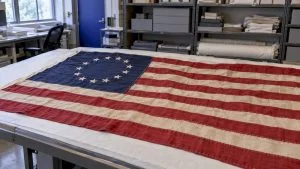
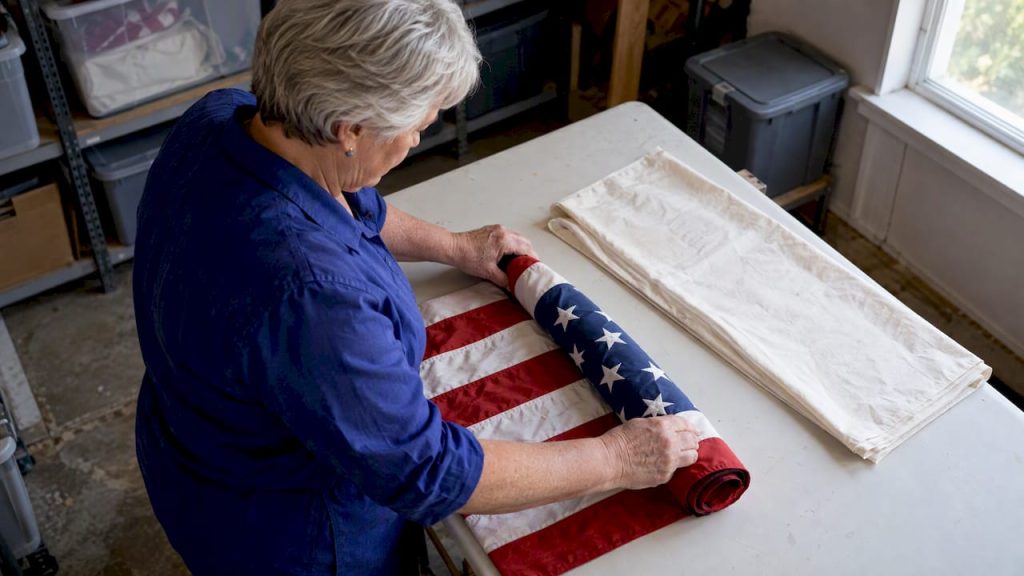
Folding has one real weakness. Every fold is a line of stress, and over years that line is where fibers break and tears begin. The National Park Service’s conservation note on flag rolling states that rolling on an archival tube stores a flag compactly and avoids damaging creases. For a heritage piece, a battlefield reproduction you treasure, a family heirloom or any flag you want to hand down, rolling is the method to choose.
What you need
- An archival-quality, acid-free tube wider than the flag’s hoist is tall, so the flag can roll flat without overhang.
- Unbuffered, acid-free tissue paper to interleave the layers. The park service guidance recommends this tissue to prevent dye transfer and cushion the fibers.
- A breathable outer cover, which we cover below.
- Clean hands, a clean table and a helper for anything large.
How to roll
- Lay the flag flat on a clean surface, smoothing wrinkles gently without pulling.
- Place a sheet of tissue over the flag, so that no fabric will touch fabric once rolled.
- Start at one end and roll evenly around the tube, keeping tension loose. You are laying cloth around a core, not winding a spool.
- Add tissue wherever the flag overlaps, especially if the colors are strong. Red and blue dyes are the usual suspects for transfer onto white.
- Tie the roll with soft cotton tape or cloth strips, never string or rubber bands that could cut or stain.
- Label the tube with the flag’s name, size, date stored and any repairs.
A lesson from museum practice is worth adopting at home. One museum storage manual describes a system for suites of robust flags in which a flag can be examined and re-rolled without disturbing the others. The same manual cautions that this particular system is not suitable for fragile flags, and that is the right instinct: very old or brittle cloth deserves a conservator’s advice, not a weekend project.
What to wrap it in, and what never to use
The instinct to seal a flag away from dust is a good one. The material you choose matters enormously.
Avoid plastic bags and containers that seal. Conservation guidance says plastic bags trap moisture and promote mildew. The zip-top bag that feels so protective can turn into a small greenhouse for mold. Cheap clear organizers sold for flags are fine for brief periods in a stable, dry room, but they are not what you want around a flag you plan to keep for years.
Choose breathable covers. The same guidance points to Tyvek or pre-washed cotton muslin as covers that block dust and splashes while letting the fabric breathe. Pre-washing the muslin removes sizing and residue that could transfer to your flag.
Be wary of ordinary cardboard and wood. Standard cardboard and many woods give off acids over time. If you use a box, make it an acid-free archival one, and line it with tissue.
Skip mothballs and scented sachets. They can leave odors and residues. A clean flag, a sealed-off room from pests, and regular inspection do more.

Where to keep it: the room matters more than the box
A perfect tube in a bad room is still a bad bet. The Sykesville guidance recommends cool, dry and ventilated spaces away from sunlight and heat. Translated to a typical American home:
- Good: an interior closet on the main living level, a bedroom dresser or a shelf in a climate-controlled room, away from outside walls and windows.
- Risky: a basement (dampness), a garage (heat swings, fumes, pests), an attic (summer heat), or any closet that shares a wall with a bathroom or laundry.
- Bad: anywhere near the ground. Floors flood, and the flag should never rest where it can be soiled.
Light deserves its own mention. Ultraviolet light fades dyes and weakens fibers even through a window, which is why conservation guidance puts limiting light at the top of the list for older flags. A closed, opaque cover costs nothing and helps a lot.
Humidity swings are the quiet enemy. If your climate is muggy, a small hygrometer on the storage shelf tells you more than your nose will. Steady, moderate conditions beat any gadget.
Shelving rolled flags without crushing them
A roll resting directly on a hard shelf takes its own weight at two contact points, and over time the cloth flattens or marks there. Museum practice solves this with support blocks. Archivists use custom-cut ethafoam cradles that lift the ends of the tube so the flag itself never bears the load against the shelf.
At home, the idea translates into a few simple rules:
- Let the tube, not the cloth, carry the weight. The tube should be longer than the flag is wide so its ends can rest on supports.
- Pad any contact point with acid-free foam or clean muslin.
- Store tubes horizontally, never stacked in a pile. One layer per shelf is ideal.
- Keep tubes off the floor and away from pipes or exterior walls.
Storing a flag collection
Collectors face a different puzzle: dozens of flags, limited space and a wish to rotate displays. The National Park Service’s textile care appendix offers a tidy rule of thumb. If you have many textiles, consider creating a dedicated storage room, and if you have only a few, dedicate a space of their own. Either way, the principle is the same: a place that is only for the collection.
Some habits that work for serious collectors:
- Catalog everything. A simple spreadsheet with the flag’s name, size, maker, condition and storage location saves hours. Add photos.
- Group by condition and fragility. Put your sturdiest everyday flags together and your delicate or antique pieces apart, with the most protection for the oldest.
- Rotate on a schedule. Flags that never leave their tube cannot be enjoyed. Flying two at a time and swapping with the season or the holiday keeps wear shared and the collection alive.
- Keep reproductions and originals apart. A modern sewn Revolutionary War or Civil War reproduction is sturdy and made to fly. An original relic is a museum object. Treat each accordingly.
- Keep hardware separate. Brass grommets, snap hooks and poles are metal, and metal corrodes and stains. Store them in their own bin.
Small flags have their own answers. Garden flags and 12 by 18 inch banners fit well in a hanging organizer with pockets or flat in a shallow drawer with tissue between them, provided the room is dry and the flags are too. String flags and bunting are best loosely coiled in a breathable bag, since tight bundles tangle and crease.
Check on them: storage is active monitoring
The most overlooked tip is the simplest. Look at what you have stored. The guidance from the National Museum of American History on caring for the flag stresses that artifacts have unique preservation needs based on their past history and materials, and that as organic materials age they become more sensitive. A closet cannot tell you when something has changed. You have to.
At least once a year, the Sykesville guidance suggests, inspect every stored flag for pests, moisture and fiber damage. Pick a date you will remember, such as the week after the Fourth of July or just before Memorial Day, and make a ritual of it:
- Open the cover and smell it. Musty means moisture.
- Look for tiny holes, webbing or cast-off casings, signs of clothes moths.
- Check folds and rolled layers for new discoloration.
- Touch the cloth lightly. It should be supple, not stiff or brittle.
- Re-roll or refold with fresh tissue, and, if you used a triangular fold, change where the creases fall.
- Note the date on the label.
If you find mildew, do not seal the flag away again. Dry it, brush off loose growth outdoors, and consider a professional for anything valuable. For ordinary flags, a careful wash may be the answer, and our flag care guide walks through it.
When the right place for a flag is retirement
Storage is for flags that can still be displayed with dignity. A flag that is tattered, torn beyond repair or faded to ghost colors is not meant for a closet shelf indefinitely. Under the federal code, a flag no longer fit for display should be destroyed in a dignified way, preferably by burning. Our guide to U.S. flag retirement rules explains the options, from ceremony to community collection points.
It is worth remembering that this applies to the national flag in particular. A historic or sentimental piece, such as a flag that draped a coffin or that flew at a family milestone, is a different matter. It belongs in preservation storage or a case, not in the fire.
Our perspective: a flag you store well is a story you keep telling
We have spent our working lives around flags, and the stories we hear most often are about storage gone wrong. A grandfather’s flag found in a damp trunk. A Revolutionary War reproduction left in a garage through three summers. A collector who learned about acid in cardboard only after a stain crept across a hoist.
What we believe is simple. A flag is a witness. The Betsy Ross stars, the Gadsden rattlesnake, the Stars and Stripes carried by a soldier and the battle flags that rallied troops all carry a piece of the past into the present, and they only whisper those tales if the cloth survives. Folding a flag well is a small act of reverence, and rolling one on an acid-free tube is an act of stewardship for whoever comes next.
So we tell customers the same thing we tell ourselves. Keep your daily flyers clean, dry and folded with care. Give your treasures a tube, tissue and a quiet, cool room. Open the cover once a year and look. And when a flag has given everything it had, retire it with the ceremony it earned.
— John Hough
Gear that makes storage easier
Good storage starts with good flags and good hardware. Our flag collections include USA flags, state flags, military and service flags, historic war flags and country flags, and our hardware and flagpoles keep your display running so the rotation system above becomes effortless. If you are building a display rotation, our guidance on flagpole types and footing rules and displaying multiple flags will help you plan what flies and what rests.
A seasonal storage routine you can follow
Habits beat good intentions. Here is a routine that fits most households and collectors.
- After each flying season or holiday: take the flag down in dry weather, inspect it, clean if necessary, dry completely and fold or roll.
- At storage time: wrap in muslin or Tyvek, label, and place in a cool, dry, dark, ventilated space off the floor.
- Once a year: open every cover, inspect, re-roll or refold, and record the date.
- When something changes: a new smell, a stain or a hole means you act that day, not next season.
- When a flag is spent: repair if sensible, display with dignity if it is still fit, and retire it properly if not.
The routine takes minutes per flag. Compared with losing a family heirloom to mildew, it is the cheapest insurance you will ever buy.
FAQ
Should I fold or roll a flag for storage?
Fold it in the traditional triangle if you will fly it again soon or want it in a display case. Roll it around an acid-free tube if you want long-term protection, since folds create creases that can eventually break fibers. Valuable and historic flags are better rolled.
Can I store a flag in a plastic bag?
It is best not to. Conservation guidance says plastic traps moisture and encourages mildew. Use a breathable cover such as pre-washed cotton muslin or Tyvek, and only ever store a flag that is completely dry.
Where is the best place to store a flag at home?
Choose a cool, dry, dark and ventilated spot, such as an interior closet or shelf in a climate-controlled room. Avoid basements, garages, attics and closets that share a wall with a bathroom, where humidity and temperature swings do their damage.
How often should I check stored flags?
At least once a year. Look for moisture, pests such as clothes moths and any change in the fabric, because problems in a closed closet or box go unseen until they are serious.
What do I do with a flag that is too damaged to store?
If small tears are the only problem, repair is acceptable. If the fabric is beyond saving, the U.S. Flag Code calls for dignified retirement, preferably by burning. Our pages on flag repair and retirement rules explain how to decide.
Sources
- Correct Method of Folding the United States Flag, U.S. Department of Veterans Affairs
- Honoring Old Glory: Flag Care and Etiquette, Town of Sykesville, MD
- 4 U.S.C. § 8: Respect for flag
- Conserve O Gram 16/5: Flag Rolling and Storage, National Park Service
- Storage Systems, Conservation and Care of Collections, Western Australian Museum
- Guidelines for the Preservation of the Flag, National Museum of American History
- Appendix K: Curatorial Care of Textile Objects, National Park Service