Six flags carried the Civil War through its four bloodiest years: the Union’s Stars and Stripes, the Confederacy’s three national banners (Stars and Bars, Stainless Banner, Blood-Stained Banner), the battle flag known popularly as the Southern Cross, and the regimental colors that units carried into every fight. Each began as a functional tool for identifying troops on a smoke-choked field. Over the following century and a half, veterans’ groups, segregationist politicians, and modern protest movements reshaped what that cloth was understood to mean, turning battlefield hardware into some of the most contested symbols in American life.
TL;DR:
- The Confederate battle flag was created to be highly distinguishable on the battlefield, designed specifically after the First Manassas confusion to avoid friendly fire incidents.
- Flags carried by soldiers served as vital command tools and symbols of unit identity, leading to intense emotional attachments and high risks for flag bearers.
- The image and meaning of Confederate flags shifted significantly after the war, with organized efforts turning them into symbols of regional pride and, later, racial segregation and racism.
- Public displays of the flags in the 20th century increasingly aligned with opposition to civil rights, especially during the 1948 Dixiecrats’ movement and subsequent resistance to desegregation.
- Context, setting, and provenance are crucial for interpreting a Civil War flag today, as their meaning varies greatly depending on ownership, display, and historical circumstances.
Table of Contents
- Understanding Civil War Flag Meanings: A Catalog of the Designs
- Why the Battle Flag Looks the Way It Does
- What Flags Meant to the Men Who Carried Them
- How the Lost Cause Rewrote What the Battle Flag Meant
- The 20th Century Turn: Segregation, Politics, and Mass Merchandising
- Reading Civil War Flags in 2026: Context Is Everything
- How Civil War Flags Were Made and Preserved
- Two Flags That Show How Provenance Shapes Meaning
- Regional and State Variations Worth Knowing
- What the Colors Actually Symbolized
- Naval Flags and Signals of the Civil War
- Union and Confederate Flag Protocols Compared
- How People at the Time Actually Reacted to These Flags
- Ultimate Flags on Getting the History Right
- A Note on Reading These Flags Responsibly
- Sources
- FAQ
Understanding Civil War Flag Meanings: A Catalog of the Designs
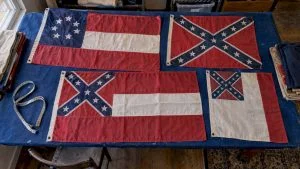
Sorting out civil war flag meanings starts with naming the flags correctly, because popular culture has blurred several distinct designs into one another for generations. Here’s the roster, straightened out.
- Stars and Bars — the Confederacy’s first official national flag, adopted in March 1861. It featured a circle of white stars on a blue field in the corner, with three horizontal bars of red and white. Its resemblance to the Union’s Stars and Stripes caused real confusion at First Manassas, which is the whole reason the next design exists.
- Confederate battle flag (Southern Cross / Beauregard battle flag) — the blue diagonal saltire studded with white stars on a red field. This is the flag most people picture when they hear “Confederate flag,” yet it was never the Confederacy’s national flag. It served as a battlefield and regimental banner, most famously for the Army of Northern Virginia.
- Stainless Banner — the Confederacy’s second national flag, adopted in 1863. It placed the battle flag’s canton in the corner of an all white field, a design choice that drew criticism for looking too much like a flag of surrender when the wind went still.
- Blood-Stained Banner — the third and final Confederate national flag, adopted in March 1865, weeks before the war ended. It added a vertical red bar to the Stainless Banner’s design to fix the surrender-flag problem, though it saw almost no real-world use given the timing.
- United States flag (Stars and Stripes) — the Union’s national flag throughout the war, carried by every Federal regiment and used as the rallying symbol for the cause of preserving the union.
- Regimental colors — unit-specific flags, often state-issued or locally sewn, that identified individual regiments on the field and carried battle honors, mottos, and unit numbers unique to each command.
The Flags of the Confederate States of America entry is worth bookmarking if you want the full chronology, because the succession from Stars and Bars to Stainless Banner to Blood-Stained Banner tracks almost exactly with Confederate military fortunes: confident in 1861, defensive by 1863, desperate by 1865. The battle flag, meanwhile, ran on its own separate track entirely, outliving the government it served and outlasting every national flag the Confederacy ever adopted.
Why the Battle Flag Looks the Way It Does
The saltire design wasn’t an aesthetic choice. It was a battlefield fix for a problem that had already gotten men killed.
- First Manassas exposed a fatal flaw. In July 1861, Confederate and Union commanders on the field struggled to distinguish the Stars and Bars from the Stars and Stripes at a distance, especially in windless conditions or through drifting smoke. Officers misjudged troop positions because the two national flags looked similar enough to cause hesitation at exactly the moment hesitation got soldiers shot.
- General P.G.T. Beauregard pushed for a distinct battle flag. Beauregard, who commanded Confederate forces at Manassas, argued for a design that could never be mistaken for the enemy’s colors, regardless of light or wind.
- William Porcher Miles supplied the pattern. Miles, a South Carolina politician and chairman of the Confederate Congress’s flag committee, had already proposed a blue saltire design for the national flag itself. Congress rejected it as too aggressive and too reminiscent of Scotland’s St. Andrew’s Cross for a fledgling government trying to look established. Beauregard and Johnston revived Miles’s rejected pattern for the new battle flag instead, and it worked precisely because it was visually loud.
- The saltire became the Army of Northern Virginia’s signature banner by late 1861, and other Confederate armies adopted variations, though not all of them adopted the same design or proportions.
The Confederate battle flag entry from Encyclopedia Virginia traces this design lineage carefully, and it’s a useful corrective to the assumption that the battle flag and the Confederate nation’s actual flag were ever the same thing. They weren’t. Congress never adopted Miles’s saltire as a national symbol. It rose to prominence entirely through military use, which is a detail that matters enormously once you get to the post-war chapters of this story.
The political backdrop mattered too. The Stars and Bars itself was a compromise design, built to signal continuity with the United States flag rather than a sharp break from it. Secession commissioners wanted a flag that looked familiar to a population still adjusting to disunion, not a radical new banner. That instinct for visual continuity is exactly what caused the battlefield confusion the saltire was invented to solve. The irony writes itself: a flag designed to reassure people it belonged to the same visual family as the Union’s flag nearly got Confederate units shot by their own side.
What Flags Meant to the Men Who Carried Them
Battle flags weren’t decorative. They were command-and-control equipment in an era before radios, and losing one carried a weight that modern readers sometimes underestimate.
A regiment’s colors marked its position for commanders trying to read a battlefield through smoke and chaos, told scattered soldiers where to regroup, and served as a visible measure of a unit’s discipline under fire. The color bearer’s job ranked among the most dangerous assignments in any regiment. He couldn’t carry a weapon effectively while holding the flag upright, which made him a stationary, unmistakable target for enemy sharpshooters who understood exactly what dropping a regiment’s colors would do to morale on both sides.
- Color guards typically included several soldiers assigned specifically to protect the flag bearer, because losing the colors to capture was considered a lasting disgrace for the entire regiment.
- Regiments stitched battle honors, unit numbers, and mottos directly onto their colors, turning each flag into a running record of where that unit had fought and survived.
- Capturing an enemy’s flag was treated as a significant individual feat, sometimes cited in official reports and later recognized with commendations.
- A flag that survived a battle riddled with bullet holes became a point of regimental pride rather than something to replace, worn damage functioning almost as a badge of honor.
Pro Tip: If you’re researching a specific regiment’s flag history, look for the unit’s own after-action reports before consulting general histories. Color-bearer casualties and flag-capture incidents were often documented in granular detail at the regimental level, and that’s where the real texture of the story lives.
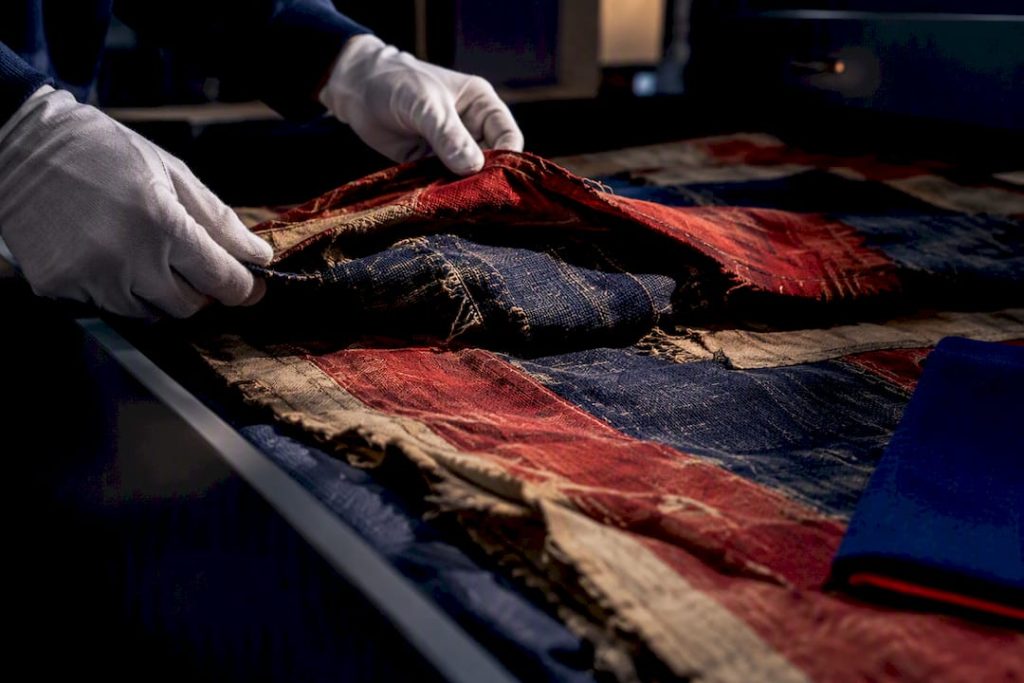
The human cost attached to these banners was severe enough that some units cycled through multiple color bearers in a single engagement, one man falling and another immediately stepping forward to keep the colors upright. That’s not folklore. It’s a pattern that shows up repeatedly in regimental histories from both armies, and it explains why surviving Civil War flags in museum collections today so often carry battle damage, bloodstains, and repair stitching that curators preserve rather than restore. The physical condition of the artifact is itself part of the historical record.
How the Lost Cause Rewrote What the Battle Flag Meant
The war ended in 1865. The battle flag’s transformation into something else entirely was only beginning.
Veterans’ organizations built the machinery that turned a battlefield tool into a monument to a cause. The United Confederate Veterans, founded in 1889, and the United Daughters of the Confederacy, founded in 1894, led a decades-long campaign to memorialize Confederate service in terms of valor, sacrifice, and states’ rights, systematically minimizing slavery’s role as the war’s central cause. This reframing is what historians call the Lost Cause narrative, and the battle flag became its central visual emblem.
- The UDC funded and erected the overwhelming majority of Confederate monuments built between the 1890s and the 1920s, many featuring the battle flag prominently in stone and bronze.
- Confederate veterans’ reunions incorporated the battle flag into ceremonial display, funerals, and memorial rituals, cementing its association with mourning and regional honor rather than military tactics.
- Textbooks influenced by Lost Cause advocacy groups shaped how generations of Southern schoolchildren understood the war’s causes, often downplaying slavery in favor of states’ rights framing.
- The flag’s integration into Memorial Day observances and Confederate heritage groups gave it a ceremonial life entirely separate from its original battlefield function.
This period is where the split between wartime meaning and inherited meaning really opens up. On the battlefield, the saltire meant “this is where the Army of Northern Virginia stands.” By the early 1900s, thanks to organized memorial culture, it had come to mean something closer to “this is what the South endured and how nobly it endured it.” That shift didn’t happen by accident. It was the product of deliberate, well-funded, decades-long institutional effort, and it laid the groundwork for everything that came next.
The 20th Century Turn: Segregation, Politics, and Mass Merchandising
The battle flag’s next transformation had almost nothing to do with the Civil War itself and everything to do with mid-20th-century racial politics.
In 1948, the States’ Rights Democratic Party, known informally as the Dixiecrats, broke from the national Democratic Party specifically to oppose federal civil-rights legislation and racial integration. The battle flag became the movement’s unofficial banner, waved at rallies and printed on campaign materials. That single year marks the clearest pivot point in the flag’s public meaning, according to National Geographic’s history of the symbol: the flag went from a regional heritage marker to an active political weapon deployed against desegregation.
- Segregationist governors and state legislatures across the South added the battle flag to state flags and capitol displays throughout the 1950s and 1960s, timed closely to resistance against federal integration orders.
- Mass merchandising accelerated the flag’s visibility, printing it on everything from bumper stickers to novelty items, which normalized its presence far beyond any connection to Confederate ancestry or Civil War history.
- The flag appeared at Ku Klux Klan rallies and other extremist gatherings throughout the civil-rights era, a documented association that hardened its meaning for many Americans regardless of the intent of any individual displaying it.
- Public schools, courthouses, and other government buildings in several states flew or displayed the battle flag during exactly the years when those same institutions were resisting integration orders.
That timing is not incidental, and it is the single hardest fact for heritage-focused defenders of the flag to work around: the flag’s biggest surge in public visibility across the 20th century lines up almost exactly with the decades of the most organized resistance to civil rights.
Reading Civil War Flags in 2026: Context Is Everything
Ask Americans today what the battle flag means and you’ll get genuinely divided answers, which is exactly what current survey data shows.
A YouGov poll cited by National Geographic found a plurality of respondents view the Confederate battle flag as a symbol of racism, while a substantial minority regard it primarily as a heritage symbol. Neither camp is a fringe position. That divide is precisely why context matters so much when you’re trying to interpret any specific display of the flag, whether you’re researching it academically or just encountering it in the world.
- A battle flag flown outside a Civil War museum exhibit, clearly labeled with historical context, communicates something entirely different from the same flag flown at a political rally.
- A flag displayed alongside explicitly extremist symbols or slogans signals intent that a lone flag on private property does not automatically carry.
- Government buildings and public institutions carry a different weight than private residences, because state endorsement of a symbol reads differently than personal expression.
- Historian John M. Coski, who wrote the standard scholarly reference on the flag’s history, argues that the “heritage versus hate” framing oversimplifies a symbol whose meaning has never been fixed. It shifts with who is using it, when, and why.
Pro Tip: If you’re documenting a modern flag display for research purposes, note the setting, any accompanying symbols or text, and the stated intent of whoever placed it, rather than assuming meaning from the fabric alone. Provenance and context do more interpretive work than the design itself.
How Civil War Flags Were Made and Preserved
The physical construction of these flags tells its own quiet story about wartime scarcity and shifting priorities.
Early-war Confederate flags, including many battle flags issued in 1861, were often silk, hand-sewn by local women’s sewing circles who donated fabric and labor to outfit departing regiments. That supply chain didn’t survive contact with a prolonged war. By 1862, and accelerating through mid-1863, production shifted decisively to wool bunting, manufactured through standardized kits assembled by the Richmond Clothing Bureau, the Confederacy’s central production operation for military textiles.
That silk-to-bunting transition isn’t a footnote for textile enthusiasts. It’s a diagnostic tool. Museums and collectors use material composition, stitching technique, and dye characteristics to date a flag and verify its wartime origin, since documented manufacturing shifts at the Richmond Clothing Bureau produced at least seven identifiable variants of the Army of Northern Virginia’s battle flag over the course of the war.
- Museums typically catalog captured flags with accession numbers, provenance notes, and any War Department inventory marks found on the fabric itself.
- Conservators generally stabilize rather than restore battle damage, preserving bullet holes, tears, and bloodstains as part of the historical record rather than repairing them away.
- Climate-controlled storage and display cases protect fragile wool bunting and silk from light damage and fabric degradation, since original Civil War textiles are now well over 160 years old.
Two Flags That Show How Provenance Shapes Meaning
Individual surviving flags carry stories that no general history can fully capture, and two examples illustrate how capture, inventory, and exhibition all shape what a flag ultimately comes to represent.
The 13th Alabama Infantry’s battle flag has moved in and out of public display at Gettysburg, with a temporary exhibit period running through 2027 that lets visitors see a flag that actually marched with Confederate troops onto that field. Its documented manufacturing history, including its bunting composition and Richmond Clothing Bureau origin, gives curators a concrete basis for dating and authenticating it rather than relying on secondhand attribution.
- The 28th Virginia’s battle flag was captured during the war and subsequently inventoried and marked by the U.S. War Department, a bureaucratic process that left a documentary trail researchers still use today.
- Congress authorized the return of many captured Confederate flags to Southern states starting in 1905, but provenance complications meant plenty of flags stayed in federal or institutional custody well beyond that legislation.
- Capture narratives, meaning the specific battlefield story of how a flag changed hands, remain central to how museums frame these artifacts for visitors, since the capture itself is often as historically significant as the flag’s original manufacture.
Provenance isn’t a bureaucratic footnote in these cases. It’s the difference between a flag being a generic Confederate artifact and being a documented piece of a specific regiment’s specific battle.
Regional and State Variations Worth Knowing
Not every Confederate unit carried a version of the Beauregard saltire, and that variation matters more than popular memory suggests.
The Army of Tennessee used its own distinct battle flag design, a rectangular pattern rather than the square Army of Northern Virginia flag, reflecting regional command differences rather than any single unified Confederate battle standard. Individual states also issued their own regimental colors before standardization efforts took hold, meaning early-war units frequently carried state-specific designs that had nothing to do with either national Confederate flag or the saltire battle flag most people picture today. Louisiana, Texas, and several other states maintained flag traditions tied to their own pre-war state banners well into the conflict’s early phases.
On the Union side, state-issued regimental colors varied widely too, since individual Northern states outfitted their own volunteer regiments with locally designed flags that supplemented, rather than replaced, the national Stars and Stripes each unit also carried. A New York regiment’s colors looked nothing like an Ohio regiment’s, even though both served under the same national flag and the same overall command structure.
That regional patchwork is a useful reminder that “the Confederate flag” and “the Union flag” oversimplify a much messier visual reality on the actual battlefield, where dozens of distinct unit-level designs operated alongside the handful of national and battle standards that history remembers best.
What the Colors Actually Symbolized
Flag colors in this era carried inherited European heraldic associations more than any invented Confederate or Union ideology, though both sides leaned on established meanings for effect.
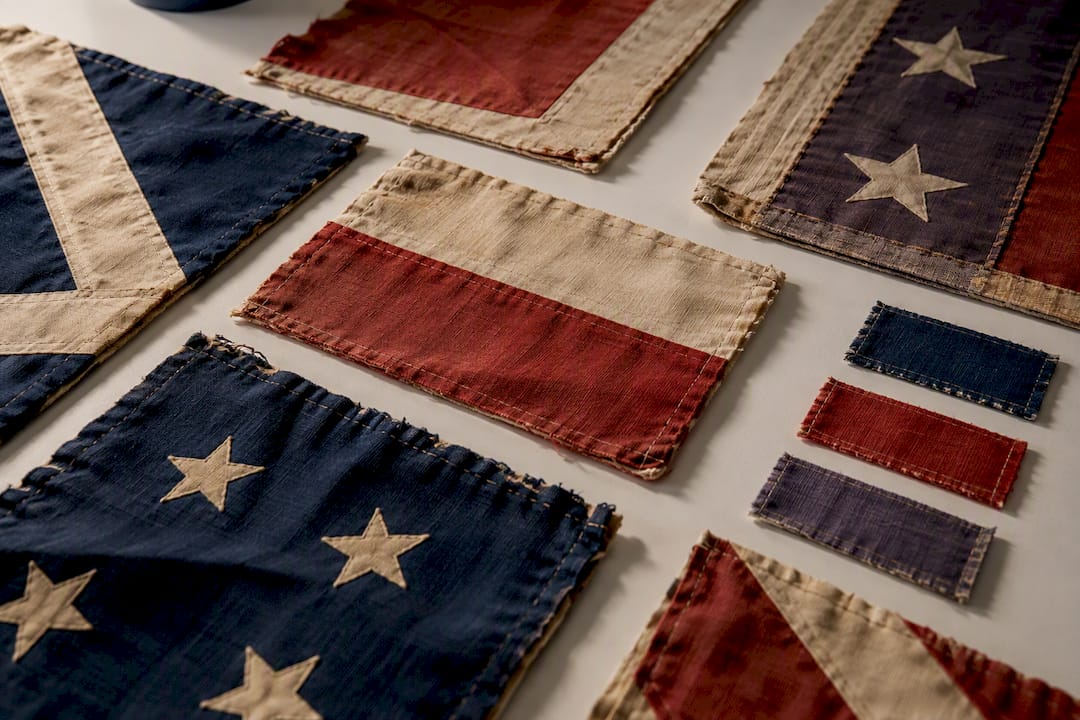
Red traditionally signaled valor and bloodshed in military heraldry, which is exactly why it dominates both the Confederate battle flag’s field and the red stripes of the Union’s Stars and Stripes. Blue conventionally represented vigilance, perseverance, and justice, a meaning both the Confederate battle flag’s saltire and the Union flag’s canton drew on. White, used in the Confederacy’s Stainless Banner and Blood-Stained Banner, traditionally signified purity, though the practical problem with an all-white field, looking like a surrender flag in still air, ended up mattering more than any symbolic intent once real deployment exposed the flaw.
The stars on both the Union and Confederate flags represented constituent states, a shared visual convention rather than a point of design originality on either side. The Union’s stars tracked the actual number of states in the federal union throughout the war. The Confederacy’s stars similarly expanded as more states seceded, eventually reaching 13, even though only 11 states formally seceded, because the Confederate government counted Kentucky and Missouri despite their contested status.
None of these colors carried a fixed, universally agreed meaning even during the war itself. Heraldic convention gave designers a starting vocabulary, but the meanings people actually attached to the colors in 1861 were shaped far more by which side made them than by any inherent symbolism in red, white, or blue themselves.
Naval Flags and Signals of the Civil War
Naval warfare ran on an entirely separate flag system from land combat, built around identification and communication rather than regimental pride.
Union and Confederate warships flew their respective national ensigns to identify allegiance at a distance, a critical function during a war that included extensive blockade operations along thousands of miles of coastline. Signal flags served a distinct communication purpose entirely apart from national identification, allowing ships to relay tactical orders, warnings, and status updates using standardized flag codes that both navies adapted from established maritime signaling systems already in use before the war began.
The Confederacy’s naval ensign changed alongside its national flags, though naval commanders sometimes continued flying earlier designs longer than land forces did, since a ship at sea for months might not receive updated flag specifications as quickly as army units closer to Richmond. Blockade runners, meanwhile, often avoided flying identifiable colors altogether, or flew false flags of neutral nations, since concealment mattered more than allegiance display when the entire mission depended on slipping past Union naval patrols undetected.
Union naval forces also used flags to mark captured vessels and prize ships, a practical administrative function that had nothing to do with the ideological weight later attached to land-based Confederate banners. At sea, a flag’s job stayed remarkably close to its most basic function: telling other ships, quickly and unambiguously, who you were.
Union and Confederate Flag Protocols Compared
Union flag etiquette drew directly on established prewar U.S. military tradition, since the Union army was simply the continuation of the existing federal military structure. Regimental colors received formal presentation ceremonies, were guarded by dedicated color guards, and were treated with the same reverence protocols that predated the war and continued after it. Damaged or retired Union flags were preserved rather than destroyed, a practice that fed directly into the extensive state and federal flag collections that exist in archives today.
Confederate flag protocol had to be built from scratch, since the Confederacy was an entirely new government without inherited military flag tradition. Early regiments improvised color-guard practices based on prewar state militia customs, and formal protocols standardized only gradually as the war progressed and the Richmond Clothing Bureau’s kit production created more uniformity across units. One meaningful difference: Confederate units showed far more attachment to their battle flags specifically than to either of the first two national flags, since soldiers rarely saw the Stars and Bars or Stainless Banner in daily use compared to the battle flag they carried into every engagement.
Both armies treated flag capture and loss with comparable severity, and both sides considered flag capture significant enough to note in official reports and, in some cases, formal recognition. The core etiquette difference wasn’t really about respect level. It was about which flag received that respect, since Confederate soldiers’ loyalty attached overwhelmingly to unit-level battle flags rather than the several national designs that came and went over four years.
How People at the Time Actually Reacted to These Flags
Wartime reactions to these flags were far more visceral and immediate than the abstract symbolism debates of later generations.
Soldiers on both sides described intense emotional attachment to their regimental colors in letters and diaries, often ranking flag loss alongside the death of comrades as a defining trauma of a battle. Civilians reacted just as strongly. Southern communities held elaborate ceremonies when local regiments departed with newly sewn colors, often crafted by the very women’s sewing circles who’d assembled them, turning the flag’s departure into a communal event tied to specific families and towns rather than abstract national politics.
Union civilians treated captured Confederate flags as trophies worth public display, and Northern newspapers regularly reported on flag captures as significant battlefield achievements, sometimes naming the specific soldier who’d seized the enemy’s colors. That same instinct worked in reverse. Confederate soldiers who captured Union flags received recognition specific enough that regimental histories still record individual names generations later.
Neither side, notably, treated these flags as abstract political symbols during the war itself the way later generations would. The meaning was immediate, tactical, and personal: this is my unit, this is who I stand with, and losing this cloth means something has gone badly wrong today.
Ultimate Flags on Getting the History Right
As America’s oldest online flag store, Ultimate Flags has spent years pairing accurate historical detail with the reproductions collectors and enthusiasts actually want to own. That means treating civil war flag meanings as a subject worth getting right, not simplifying into a bumper-sticker version of a genuinely complicated story.
If this article sparked your curiosity, the site’s own archive digs deeper into specific threads. The history of the Confederate flag walks through design evolution in more depth, while the Manassas origin story covers the battlefield confusion that forced the saltire’s creation in far more granular detail than a single section here could manage. For readers researching a specific banner rather than the broader category, the piece on General Lee’s flag versus the Army’s battle flag untangles a distinction that trips up even experienced researchers.
For anyone wanting a physical piece of this history rather than just the story behind it, Ultimate Flags stocks a full range of Historic War Flags built for collectors, reenactors, and anyone assembling an accurate display. The goal across all of it stays the same: pair the history with the object, and let readers make informed decisions about what they’re actually displaying and why.
A Note on Reading These Flags Responsibly
Every flag in this article started as a piece of battlefield equipment. None of them stayed that way. The saltire that helped Confederate officers avoid friendly-fire confusion at Manassas is not the same object, symbolically, that a Dixiecrat rally waved in 1948 or that a museum case displays with interpretive placards today.
The responsible move, whether you’re a researcher, a collector, or just someone who encountered one of these flags and wanted to understand it, is to ask what specific era, use, and context you’re actually looking at before assigning it a single fixed meaning. Provenance matters. So does the company a flag keeps.
— John Hough
Sources
For readers who want to verify claims or dig further into primary documentation, these sources anchor most of the historical record covered above.
- Confederate battle flag
- Flags of the Confederate States of America
- How the Confederate battle flag became a symbol of racism
- History of memory, tourism, and the Lost Cause at Fort Pulaski
Consulting museum exhibits and primary War Department documentation directly remains the gold standard for anyone researching a specific flag’s provenance rather than its general history.
FAQ
What does it mean if someone flies a Confederate flag today?
There’s no single fixed meaning. Context, including where it’s displayed, what accompanies it, and the stated intent of whoever raised it, shapes how the flag reads, and survey data shows Americans themselves are split between reading it as a racist symbol or a heritage marker.
Is owning a Confederate flag racist?
Ownership alone doesn’t determine meaning; use and context do far more of that work. Historian John M. Coski’s scholarship argues the flag’s significance depends heavily on who is displaying it, when, and for what purpose, rather than functioning as a fixed symbol with one universal interpretation.
Why is the Confederate battle flag associated with racism?
The association traces to its adoption by segregationist Dixiecrats in 1948 and its later use by white supremacist and extremist groups throughout the civil-rights era. That documented history is what shifted the flag’s public meaning from a Civil War artifact toward a modern political symbol.
Do amusement parks or public venues still display the Confederate flag?
Public and commercial venues have largely phased out Confederate flag displays over the past decade, reflecting the broader institutional shift away from the symbol following widespread civil-rights-era controversy and more recent public debate. Specific current policies vary by venue and are best confirmed directly with the institution in question.
What’s the difference between the Confederate battle flag and the actual Confederate national flag?
The battle flag, the familiar blue saltire on red, was never the Confederacy’s official national flag. The Confederacy’s three actual national flags were the Stars and Bars, the Stainless Banner, and the Blood-Stained Banner, none of which resemble the battle flag most people recognize today.