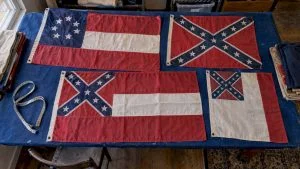
For outdoor display, choose durable polyester with a reinforced canvas header; for reenactment and collecting, favor sewn cotton or heavyweight parade cloth that honors the look and weight of the original banners. Each material carries its own trade-off between resilience and authenticity. We carry Southern heritage flags built for both purposes. The sections below walk through exactly how to match fabric, size, and mounting to your intended use.
TL;DR:
- Stitched designs cost more but last longer and add texture; printed flags cost less, yet can fade faster and show through on the reverse.
- A 3×5 foot flag suits most residential poles; use 4×6 or 5×8 for larger poles, and match grommets or sleeves to its mounting.
- Collectors should block direct sunlight, rotate display time, and store flags flat or loosely rolled on acid free tubes away from changing humidity.
- At events lasting several days, carry a spare flag of the same size and rotate them; use breakaway hardware on vehicles or in crowds.
- Rules differ across private property, schools, government buildings, workplaces, vehicles, and shared venues, so check local policies before displaying a flag publicly.
Table of Contents
- Fabric, construction and size guide: how to match flag type to use
- Preservation and display: museum-backed care for flags and reproductions
- Selecting flags for active use: reenactments, parades, and ceremonies
- Ordering logistics, customization choices and accessories to consider
- Legal considerations and cultural sensitivity surrounding Southern heritage flags
- Historical context and symbolism of different Southern heritage flags
- Why we treat this heritage as something worth getting right
- Where to find the right flag and what to order next
- FAQ
- Sources
Fabric, construction and size guide: how to match flag type to use
The fabric you choose determines how your flag ages, moves in the wind, and reads from a distance. Polyester stands up to sun, rain, and repeated outdoor cycling far better than cotton, which is why most flags flown on residential poles or at outdoor events use it. Cotton, by contrast, carries a softer drape and a muted, woven texture that reenactors and collectors prize because it echoes the look of nineteenth-century textiles, even though it demands more careful handling. Specialty parade cloth splits the difference: lighter than canvas cotton but heavier than standard polyester, built for flags carried by hand in processions.
Construction matters as much as material. Stitched or appliqué flags, where stars, bars, or crosses are sewn piece by piece, cost more and last longer, and they carry a depth and shadow line that printed designs cannot match. Printed flags, dyed directly into the fabric, are lighter on the wallet and fine for everyday outdoor display, but the image can show through the back and fade faster under sustained sun. For a full breakdown of how these two approaches compare on durability and authenticity, see our cotton versus polyester comparison.
Standard sizing follows the use case closely:
- 3×5 feet: the most common residential and indoor size, suited to porch poles and wall display.
- 4×6 feet: a step up for larger poles, commercial fronts, or more commanding indoor presence.
- 5×8 feet: built for tall flagpoles and open outdoor settings where visibility from a distance matters.
- Parade and carry sizes: typically smaller and lighter, designed for hand-carried use in processions and reenactments where maneuverability outweighs scale.
Attachment style decides how a flag performs once it is mounted. A canvas header with brass grommets suits pole display and withstands repeated raising and lowering. A pole sleeve works well for handheld staffs used in reenactment, since it avoids hardware that can snag or clatter. Before you order, confirm the finished size, the header or sleeve style, the fabric weight, and whether the flag is stitched or printed; a quick checklist like that prevents mismatched hardware and disappointing color fidelity once the flag arrives.
Preservation and display: museum-backed care for flags and reproductions
A flag’s worst enemies are rarely dramatic. Cumulative light exposure, swinging humidity, pests, and the physical stress of wind or folding do more damage over years than any single mishap. Conservation guidance from the National Museum of American History stresses that environmental control, not cleaning, is the primary defense against deterioration, and that cleaning a historic or valued textile is a non-reversible step best left to professionals.
Light damage is cumulative, and it adds up as illuminance multiplied by hours of exposure, according to the Canadian Conservation Institute, which cites roughly a traditional benchmark for sensitive textiles that is relatively low light exposure. Cutting either the light level or the display time in half cuts the damage proportionally, a simple rule any collector can apply at home.
For flags you plan to keep rather than fly, a few steps make the difference between heirloom and faded relic:
- Keep direct, unfiltered sunlight off any displayed flag; the Library of Congress warns that UV exposure causes irreversible fading and fiber weakening, even on modern reproductions.
- Use UV-filtered bulbs or glass where a flag hangs near a window or under direct lighting.
- Rotate flags off display periodically rather than leaving the same piece exposed year-round.
- Store flags flat or loosely rolled on acid-free tubes, away from fluctuating humidity and temperature.
- Inspect stitching, color, and fabric integrity seasonally, and note any change in a simple written or photographic log.
Large public collections follow this same logic at scale, often displaying reproductions while originals rest in low-light, climate-stable storage, a model described in conservation literature on historic flag collections. If a flag shows tears, embrittlement, or unstable dye, that is the point to call a textile conservator rather than attempt a home fix.
Selecting flags for active use: reenactments, parades, and ceremonies
Reenactors and event organizers face a different calculus than collectors. A flag flown or carried repeatedly needs to survive wind, handling, and weather, so durability should usually win out over museum-grade authenticity unless your event specifically calls for a historically accurate reproduction.
- Choose heavier stitched construction with reinforced seams at the fly end, where wind stress concentrates.
- Space grommets or fit a sturdy pole sleeve to prevent tearing during repeated raising and lowering.
- Fit quick-release or breakaway hardware for flags mounted on vehicles or carried through crowds, since safety matters as much as spectacle.
- Pack flags flat between layers of tissue or acid-free paper for transport, and avoid leaving them folded tightly for long stretches between events.
Pro Tip: Carry a spare flag of the same size to any multi-day event; rotating two flags cuts wear on each by half and keeps your display looking sharp through the whole weekend.
Ordering logistics, customization choices and accessories to consider
Lead times stretch when you add custom stitching, embroidery, or double-sided printing, since each step requires separate production passes rather than a single print run. Build in extra time for any order beyond a standard stock size.
A complete setup usually calls for more than the flag itself:
- A flagpole sized to the flag, plus a halyard rated for outdoor use.
- A wall or porch mounting bracket, or a freestanding stand for indoor display.
- Reinforced grommets, spaced correctly for the flag’s header, as detailed in our guide to grommet spacing.
- A display frame or case for flags kept indoors as collector pieces rather than flown outdoors.
When commissioning custom artwork, supply exact finished dimensions, your preferred header style, and high-resolution artwork with safe bleed around the edges so nothing critical is lost in the hem. On arrival, unpack flags flat rather than yanking them from tight folds, which helps avoid the creasing that sets permanently into fabric over time.
Legal considerations and cultural sensitivity surrounding Southern heritage flags
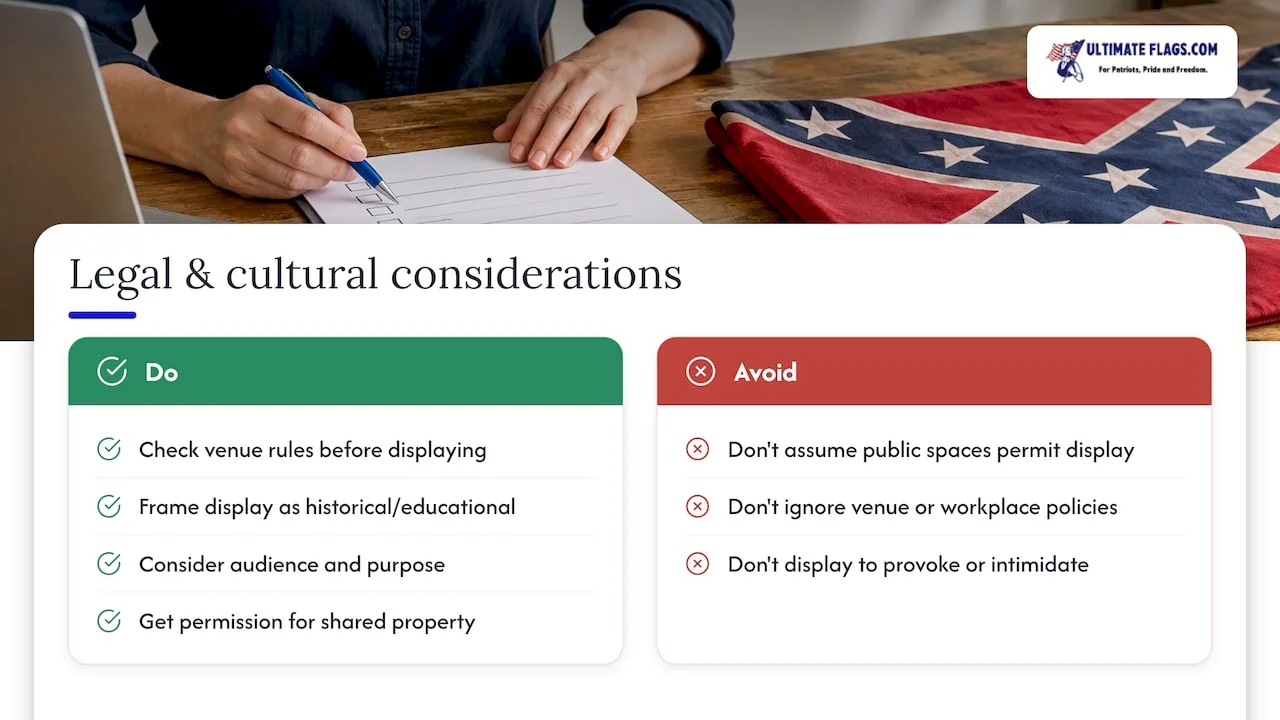
Flying or displaying a Southern heritage flag sits at the intersection of personal expression and public reception, and the rules differ by setting. Private property generally allows wide latitude for flag display under free expression protections, while government buildings, schools, and some workplaces may restrict or prohibit certain historical flags under their own policies. Anyone planning to display a flag at a public event, on a vehicle, or on shared or rented property should check the specific venue’s rules first, since policies vary widely and change without much notice.
Cultural sensitivity matters alongside the legal question. These flags carry different meanings for different Americans, and many buyers choose them specifically to honor ancestry, military memory, or regional identity rather than to provoke. Reenactors and collectors who display these flags in a historical or educational context, such as at a staged battle reenactment or a museum-style exhibit, generally find that framing and setting shape public reception as much as the flag itself. We encourage every buyer to think through the setting, the audience, and the purpose before raising a flag in a shared or public space, and to treat the symbol with the same care its history demands.
Historical context and symbolism of different Southern heritage flags
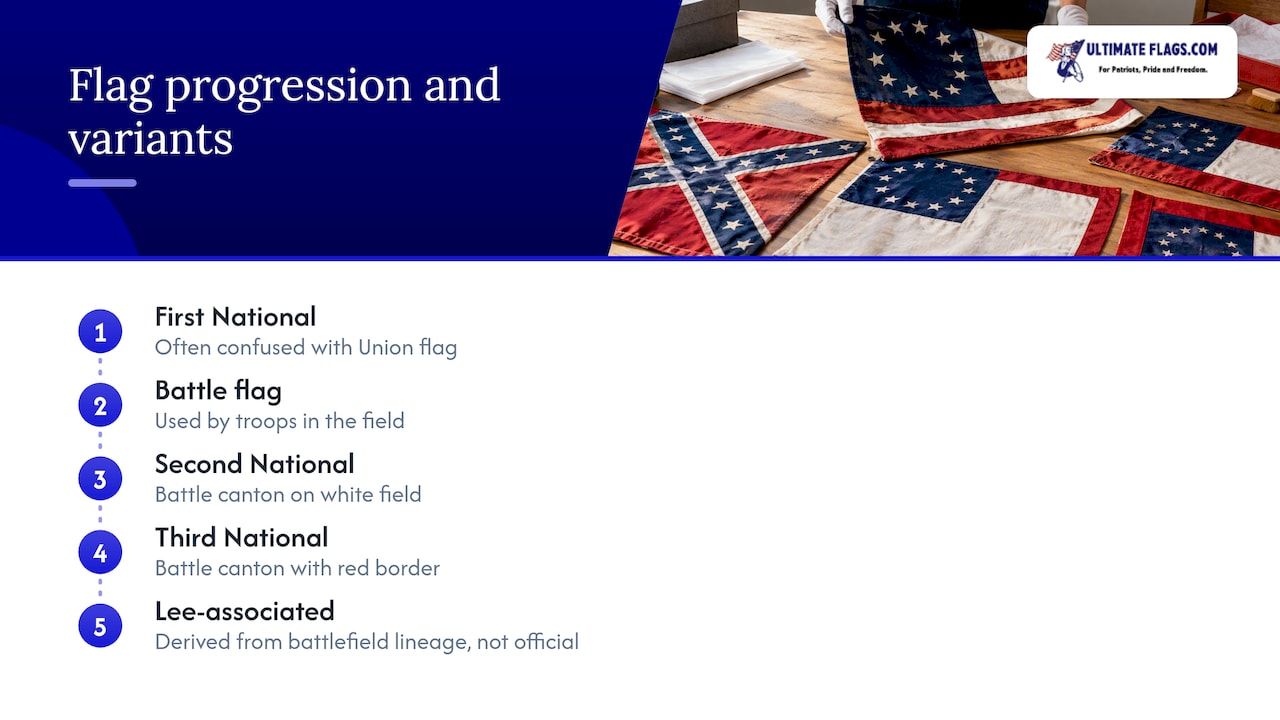
The flags gathered under the Southern heritage banner were never a single design. The First National flag, often called the Stars and Bars, served as the Confederacy’s official national flag early in the Civil War but was frequently confused with the Union flag at a distance on the battlefield, a practical failure that pushed commanders toward a distinct alternative. The battle flag that followed, the square or rectangular cross-and-stars design most people picture today, grew out of that confusion and became the banner carried by troops in the field rather than the flag of state.
Variants multiplied as the war dragged on: the Second and Third National flags incorporated the battle flag into a corner of a white or red-bordered field, each revision an attempt to balance recognition with national symbolism. The flag associated with figures like General Lee, often sold today as a standalone design, reflects this battlefield lineage rather than any single government’s official banner. Understanding which variant you are looking at, and which conflict or unit it traces back to, helps collectors and reenactors choose a historically accurate flag rather than a generic stand-in. Our history of the Confederate flag and our profile of the color guard who carried the battle flag trace these distinctions in more depth for buyers who want the full provenance behind a given design.
Why we treat this heritage as something worth getting right
We built our catalog and our historical content around a simple conviction: a flag only honors what it represents when the people who fly it understand what they are flying. Southern heritage flags carry weight, both as objects of craft and as symbols tied to real history, and we think buyers deserve accurate information alongside a well-made product. As America’s oldest online flag store, we have spent years building out historical resources precisely because the story behind a flag matters as much as its stitching. Good preservation advice is not an afterthought here. It is how a flag someone cares about today still has color and strength to pass on tomorrow.
— John Hough
Where to find the right flag and what to order next
We stock the materials, sizes, and hardware this guide walks through, and our flag collections page is the fastest way to browse Southern heritage designs alongside the accessories that go with them.

Before you check out, work through a short list:
- Settle on fabric first: polyester for outdoor flying, cotton or parade cloth for reenactment and display.
- Match the size to your pole height or display space rather than guessing.
- Pick a header or sleeve style suited to how you will mount or carry it.
- Add grommets, a pole, or a stand if you do not already have the hardware on hand.
- Check our guide to USA-made options if domestic manufacturing matters to your purchase.
If you are furnishing a room around a flag display, our partners at One Day Doors & Closets put together some Americana styling ideas worth a look for indoor display settings.
FAQ
What material lasts longest for a flag flown outdoors?
Polyester with a reinforced canvas header holds up best against sun, rain, and wind cycling, which is why most outdoor pole flags use it. Cotton looks and drapes more like historic originals but wears faster outdoors, so it suits indoor display or careful, occasional outdoor use better.
How do I keep a flag from fading over time?
Keep it out of direct, unfiltered sunlight, since the Library of Congress notes that UV exposure causes irreversible fading even on modern reproductions. Rotating a displayed flag off view periodically and using UV-filtered lighting both reduce cumulative light damage.
What size flag should I buy for a standard residential pole?
A 3×5-foot flag suits most residential poles and porch displays, while a 4×6 or 5×8-foot flag fits taller poles or settings where visibility from a distance matters more. Match the size to pole height rather than ordering the largest option available.
Are stitched flags worth the extra cost over printed ones?
Stitched or appliqué flags cost more but last longer and carry a depth and texture that printed flags cannot replicate, making them the better choice for collectors and reenactors seeking authenticity. Printed flags remain a practical, budget-friendly choice for everyday outdoor flying where appearance up close matters less.
Where can I buy authentic Southern heritage flags?
We offer a dedicated selection of Southern heritage flags covering historical variants, sizes, and construction options, backed by historical content that helps buyers choose an accurate design. Pricing varies by size, fabric, and construction, so check the product page for the specific flag you are considering.
Sources
- Guidelines for the Preservation of Flags and Banners (National Museum of American History)
- Textiles and the environment — Canadian Conservation Institute (CCI)
- Light and the Library of Congress (preservation guidance)
- Display and storage of historic flag collections: a holistic approach (Gwen Spicer/Fiav)