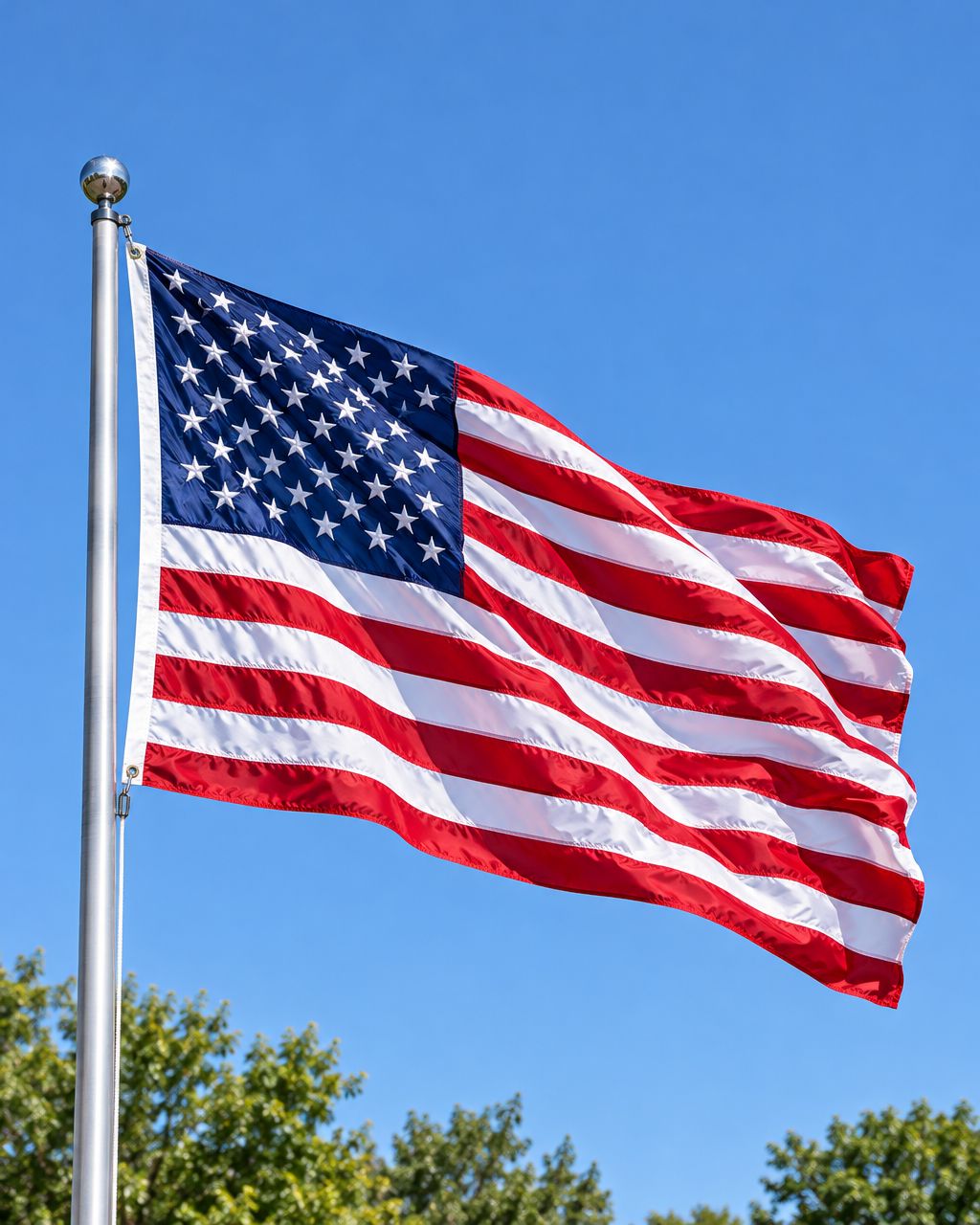
A 20-foot flagpole flies a 3×5 ft American flag in most home settings, and that is the size you will see on the majority of residential 20-foot poles across the country. If your yard sits wide open to steady wind, a 4×6 ft flag also works and fills the pole out more, but 3×5 ft is the safe default that won't strain the pole or shred in gusts. The quick rule behind it: the flag's fly length should run about one-quarter to one-third of the pole's visible height, and for a 20-foot pole that lands you squarely at 3×5 ft.
- A 3×5 ft American flag is the standard size for a 20-foot pole.
- A 4×6 ft flag works on 20-foot poles in open yards with steady wind.
- Flag fly length should be one-quarter to one-third of pole height.
- Sewn or embroidered flags handle wind far better than printed ones.
- Never let the flag touch the ground — size down if it drags.
What size American flag should you fly on a 20-foot pole?
The straight answer for 2026: 3×5 ft, the same proportions as the official United States flag (1:1.9), flown from a pole that stands 20 feet above grade. That size clears the roofline of a single-story house, moves well in a normal breeze, and puts less stress on the halyard rope, pulley and clips than anything bigger.
A 4×6 ft flag is the step-up option when the pole stands in an open yard, a field edge or a commercial lot with nothing blocking the wind. It looks fuller from the road, but it also catches roughly twice the fabric area of a 3×5 ft flag, which means more load on the pole hardware every time the wind picks up.
| Pole height | Standard flag size | Open-wind option | Typical setting |
|---|---|---|---|
| 15-16 ft | 3×5 ft | — | Small front yards |
| 20 ft | 3×5 ft | 4×6 ft | Most residential yards |
| 25-30 ft | 4×6 ft | 5×8 ft | Larger lots, rural drives |
| 30-35 ft | 5×8 ft | 6×10 ft | Farms, businesses, schools |
| 40-50 ft | 6×10 ft | 8×12 ft | Commercial and civic poles |
Those pairings come from the sizing charts flag manufacturers have published for decades, and they all trace back to the same ratio: the flag's fly length should measure about one-quarter to one-third of the pole's height above the ground.

Why the flag-to-pole ratio matters
Sizing is not about looks alone — it is about physics. A flag that is too big for its pole does three bad things:
- Overloads the hardware. Every square foot of fabric is a sail. A 6×10 ft flag on a 20-foot residential pole can stress the pulley, the rope and the truck at the top until something fails in a storm.
- Whips the pole. Oversized flags flog harder in gusts, and that constant snapping wears the finish off the pole and fatigues the base over the years.
- Shreds the flag itself. A flag flying past its pole's capacity takes the punishment first. The fly end frays, the header tears at the grommets, and you replace it seasons earlier than you should.
The one-quarter to one-third ratio keeps all three problems in check. On a 20-foot pole, one-quarter is 5 feet of fly length and one-third is about 6.7 feet, which is why 3×5 ft and 4×6 ft are the only two sizes that genuinely fit.
The U.S. Flag Code (4 U.S.C. §7) adds one rule that applies at any size: the flag should never touch the ground, the floor or the water beneath it. On a 20-foot pole, a 3×5 ft flag raised to the truck leaves more than 15 feet of clearance, so you never have to fly it partway up the pole just to keep the fly end off the lawn.

When to size up to a 4×6 ft flag on a 20-foot pole
The 3×5 ft standard assumes an average yard. Three situations justify the 4×6 ft step up:
- Open exposure. If the pole stands in a clearing, at the end of a long driveway or across from an open field, steady wind fills a 4×6 ft flag and it displays beautifully.
- Viewing distance. If you want the flag readable from the road, the extra 25% of fabric area on a 4×6 ft flag makes a visible difference from 100 feet or more away.
- Heavy fabric. A 2-ply spun polyester flag with embroidered stars and sewn stripes is built for that extra load — the double-layer fabric and additional cross stitching are exactly what a bigger flag needs on a residential pole.
The reverse matters just as much: on a 20-foot pole tucked between houses or shaded by mature trees, a 4×6 ft flag will spend most days hanging limp while a lighter 3×5 ft nylon flag snaps in the same faint breeze. Match the size to the wind you actually get, not the wind you wish you got.
What material holds up best on a 20-foot residential pole
Size is half the decision; fabric is the other half. For a 20-foot pole you are choosing among three constructions, and each suits a different yard:
- Sewn nylon. Lightweight, quick to fly in a light breeze, and it dries fast after rain. The right pick for a shaded or partially sheltered yard where the 3×5 ft size gets most days of honest flying.
- 2-ply spun polyester. Heavier, textured like cotton, and the most durable outdoor fabric in the trade. For an open, windy site — or a 4×6 ft flag — this is the fabric that outlasts the others.
- Printed polyester. The budget option, and the one that frays first on a pole that flies year-round. Fine for occasional display; not the choice for a flag you raise every morning.
Whichever you choose, check the heading and grommets, because on a 20-foot pole the fly end and the header take the brunt of the weather. Reinforced fly ends and brass grommets are the difference between a flag that lasts a couple of seasons and one that frays in a few months.
Does the flag size change for a commercial 20-foot pole?
The pole's height sets the size, not its location, so a 20-foot pole at a business flies the same 3×5 ft standard as one in a yard. The difference is duty cycle: a storefront flag flies 8 to 12 hours a day, every day, so commercial buyers usually step up to heavier fabric — a 2-ply commercial-grade flag in 3×5 ft rather than a lighter residential weave — rather than a bigger size.
Related questions
Can a 20-foot pole fly a 5×8 ft flag?
Not safely. A 5×8 ft flag measures 8 feet along the fly, which is 40% of a 20-foot pole's height — well past the one-third ceiling. That combination overloads the hardware and flogs the pole in gusts; 5×8 ft belongs on 30-to-35-foot poles.
What size flag for a 15-foot or 25-foot pole?
A 15-foot pole takes a 3×5 ft flag, the same as 20 feet, because 3 to 5 feet of fly length falls inside the ratio for both. A 25-foot pole steps up to a 4×6 ft standard with 5×8 ft as the open-wind option.
How high should the flag fly on the pole?
To the truck — the pulley housing at the top of the pole. Flying the flag at the full height keeps the fly end well clear of the ground and looks right from any distance; the Flag Code's never-touch-the-ground rule takes care of itself.
FAQ
What size American flag should you fly on a 20-foot pole?
A 3×5 ft flag is the standard for a 20-foot pole, following the one-quarter to one-third fly-length-to-pole-height ratio. A 4×6 ft flag works in open yards with steady wind.
Can I fly a 4×6 flag on a 20-foot pole?
Yes. 4×6 ft is within the sizing ratio for a 20-foot pole and looks fuller from a distance. Choose a heavier 2-ply fabric so the extra wind load doesn’t wear the flag early.
Is 3×5 too small for a 20-foot pole?
No — 3×5 ft is the size most residential 20-foot poles fly. It clears the ground by more than 15 feet, moves in light wind and puts the least stress on the pole hardware.
What size flag for a 20-foot pole in high wind?
3×5 ft in a heavy 2-ply spun polyester rather than a larger size. In sustained wind, fabric weight matters more than flag size — the bigger flag just catches more of it.
What is the flag-to-pole size ratio?
The flag’s fly length should be one-quarter to one-third of the pole’s height above the ground. For a 20-foot pole, that means a flag between 3×5 ft and 4×6 ft.
What size flag goes on a 25-foot pole?
A 4×6 ft flag is standard for a 25-foot pole, with 5×8 ft as the option for open, windy sites. The same quarter-to-third ratio governs every pole height.
Should the flag touch the ground?
Never. The U.S. Flag Code (4 U.S.C. §7) says the flag should not touch anything beneath it. On a 20-foot pole, a 3×5 ft flag raised fully leaves more than 15 feet of clearance.
One last thing
Measure the pole before you buy, not after. Settle for "about 20 feet" and you can end up with a 4×6 ft flag flogging on what turns out to be an 18-foot pole, or a 3×5 ft flag looking lost on a 25-footer. Drop a tape measure from the truck at the top, or count the pole's sections and check the manufacturer's stated height above grade — five minutes of measuring decides whether you order 3×5 or 4×6.
Related guides