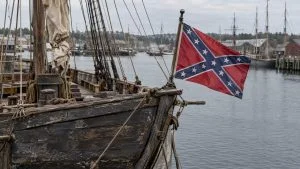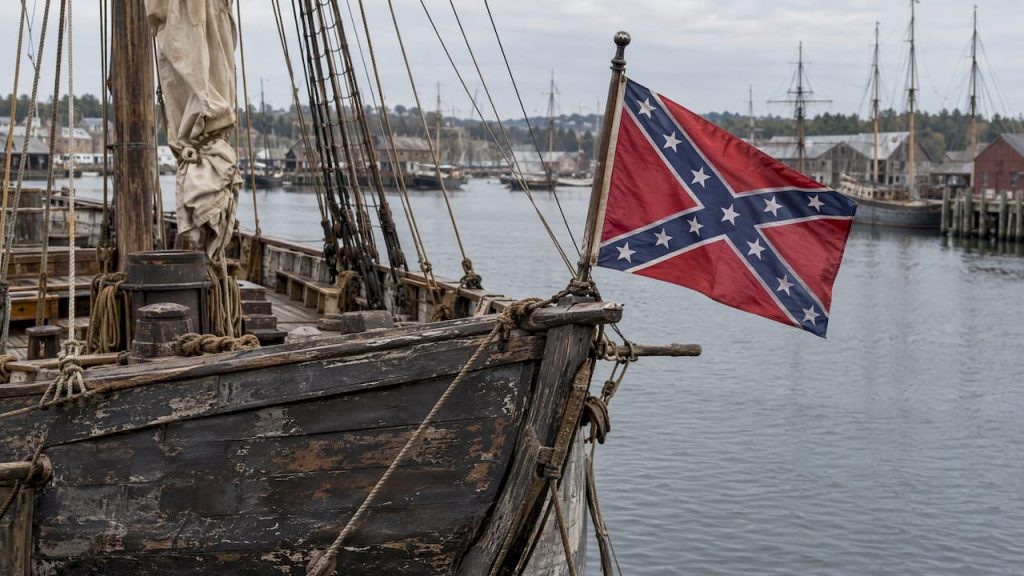
The Confederate naval jack was a small flag flown at the bow of a Confederate warship in port. Its best-known pattern, adopted in 1863, is a red rectangle crossed by a blue saltire (a diagonal cross) set with thirteen white stars. That is the design most Americans picture when they hear “Confederate flag”, though it was never the national flag. If you want to own a historical reproduction of it, we carry the Confederate naval jack among our historic war flags.
This guide walks through where the jack came from, how the two wartime patterns differ, how it relates to the Stars and Bars, the Stainless Banner and the battle flag, and what to look for in a reproduction.
TL;DR
- A naval jack is a small bow flag. The Confederate Navy flew one at the bow and a larger ensign, the ship’s national flag, at the stern.
- The first pattern (1861 to 1863) was a blue field with a circle of white stars. The second (1863 to 1865) was the red rectangle with the blue saltire.
- The rectangular 1863 jack is a cousin of the Army of Northern Virginia battle flag and of the Army of Tennessee flag, not the Confederacy’s national flag.
- The design gathered many meanings after the war, which is why historians urge precise names for each flag.
- For display or collecting, choose by pattern, size and material, then match it to a pole and hardware that suit it.
Table of Contents
- What a naval jack is, and why ships flew one
- The first jack, 1861 to 1863: a field of stars
- The second jack, 1863 to 1865: the saltire on red
- Jack, ensign, battle flag: sorting out the family
- What the jack means
- Choosing a reproduction naval jack
- Perspective
- Bring a piece of the story home
- FAQ
- Sources
What a naval jack is, and why ships flew one
A ship carries more than one flag. The ensign is the national flag, flown from the stern. The jack is a smaller, secondary flag flown from a staff at the bow, traditionally while a vessel is in port or entering and leaving it. The Confederate Navy borrowed this British-derived practice wholesale: an ensign aft, a jack forward, and a pennant at the masthead.
That distinction matters for everything that follows. When people call the red rectangle “the Confederate flag”, they flatten three or four separate flags into one. The jack was a working naval flag with a specific job and a specific place on the ship.
The first jack, 1861 to 1863: a field of stars
The earliest Confederate jacks mirrored the national flag of the day, the Stars and Bars. The Stars and Bars had a blue canton (the upper corner rectangle) holding a ring of white stars, and the navy’s jack took that element and made it the whole flag: a plain blue field with white five-pointed stars in a circle. Reference accounts of the period describe seven to fifteen stars, depending on how many states the Confederacy counted.
This follows an old naval rule, inherited from the Royal Navy and the U.S. Navy: the jack is the “union” of the ensign, the part of the national flag that carries the stars. Because the Confederacy changed its national flag in 1863, the jack changed with it.
The second jack, 1863 to 1865: the saltire on red
In 1863 the Confederacy adopted a new national flag, the Stainless Banner, a white flag with the battle-flag saltire in its canton. The navy’s jack followed the same logic and took the canton design as a flag of its own. The Florida Department of State notes that a rectangular version of the Southern Cross, without a white border, became the official Confederate naval jack in 1863. The National Park Service’s Fort Sumter brochure likewise says the rectangular saltire flag served as a naval jack after May 26, 1863.
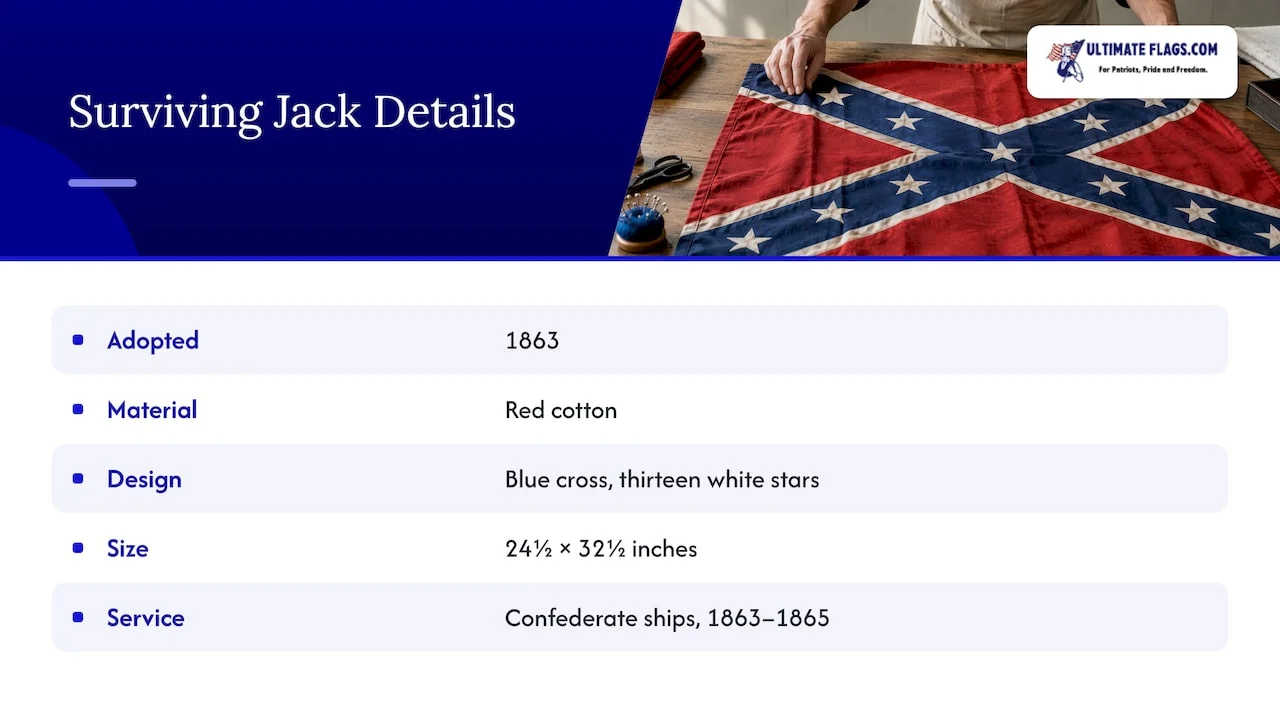
The New-York Historical Society holds a surviving example in its collection. Its catalog describes a red cotton jack with a blue diagonal cross and thirteen white stars, measuring 24½ by 32½ inches, and says this rectangular jack flew on Confederate ships from 1863 to 1865.
That object is a useful reference point. A real shipboard jack was modest in size. Many modern reproductions are far larger, because modern buyers fly them from house poles, not from a ship’s bow.
Why thirteen stars
The thirteen stars on the saltire are generally tied to the Confederacy’s claim of thirteen states: the eleven that seceded, plus Kentucky and Missouri, which were represented in the Confederate government. The star count on surviving originals and period souvenirs can vary. A miniature jack in a framed souvenir set at the Smithsonian’s National Museum of African American History and Culture, for example, shows twelve regular stars plus a somewhat larger thirteenth, and the museum dates that frame to the late nineteenth or early twentieth century, not to the war years. It is a reminder that the design lived on long after 1865 in many forms.
Jack, ensign, battle flag: sorting out the family
The confusion over Confederate flags is old, and sorting it out is half the pleasure of collecting them. Here is the working map.
| Flag | Years | Where it flew | Design |
|---|---|---|---|
| Stars and Bars (first national flag) | 1861 to 1863 | Ensign at the stern; also flown on land | Red, white, red bars with a blue canton of stars |
| First naval jack | 1861 to 1863 | Bow of a ship | Blue field with a circle of white stars |
| Stainless Banner (second national flag) | 1863 to 1865 | Ensign at the stern | White field with the saltire in the canton |
| Second naval jack | 1863 to 1865 | Bow of a ship | Red rectangle, blue saltire, thirteen white stars |
| Army of Northern Virginia battle flag | From late 1861 | Army units in the field | Generally square, same saltire on red |
The National Park Service explains that Army of Northern Virginia battle flags were generally square, while other units, including the Army of Tennessee, used rectangular forms. Its Pea Ridge National Military Park page adds that the familiar red rectangle with thirteen stars on a blue X is described as either the Confederate Naval Jack or the 1864 Army of Tennessee battle flag, both of them based on the Army of Northern Virginia design.
So when you hold a red rectangular saltire flag, you are holding a design that served the navy as a jack, served the Army of Tennessee as a battle flag, and later became the form most commonly manufactured. Pea Ridge’s page notes that rectangular versions were easy to produce, which helped their popularity at postwar veterans’ reunions.
Historian Jack Davis, writing in the Essential Civil War Curriculum, makes a point every collector should keep in mind: the blue cross on red was not itself the Confederacy’s official national flag, though it became a central element of the 1863 national flag. Naming each flag exactly is how you honor what it was.
If you want the national-flag side of the story, our Stainless Banner collection carries the 1863 national flag, and our Army of Northern Virginia battle flags cover the field flag the jack descends from.
What the jack means
What does the navy jack flag mean? Strictly, it was a ship’s bow flag of a naval service that existed from 1861 to 1865. The New-York Historical Society’s catalog says the design is now the South’s most universally recognized symbol, commonly called the Southern Cross, the Rebel flag or the Dixie flag.
Those later names point to a longer story. Davis traces how the saltire acquired layered, conflicting meanings over time: the memory of Confederate soldiers, Southern regional identity, rebelliousness, and for others associations with segregation and racism. People who display it today usually say they do so for ancestry, regional pride, or an interest in history. Because those meanings differ from person to person, it helps to know the flag’s documented origins. A reader who can say exactly what a naval jack was, and when it flew, speaks with authority about it.
The flag’s history after the war is a subject on its own, and we cover it in our history of the Confederate flag.

Choosing a reproduction naval jack
Surviving wartime flags belong in museums and archives. What most readers want is a faithful reproduction to fly, hang or exhibit. A few practical decisions shape the result.
- Pick the pattern first. Decide whether you want the 1861 to 1863 blue star jack or the 1863 to 1865 red saltire jack. They are different flags with different stories, and a collector’s wall often includes both beside the Stars and Bars and Stainless Banner.
- Choose the shape. The 1863 jack was rectangular. A square flag with a saltire is the style associated with the Army of Northern Virginia, so match the shape to the history you want to show.
- Choose the star layout. Thirteen white stars on the blue cross is the documented standard for the second jack, as in the New-York Historical Society example.
- Choose size and material for the setting. A framed or indoor display suits a smaller flag. A flag flown daily outdoors calls for a size in proportion to the pole. Our catalog lists custom size and quality options, so you can match the flag to its job.
- Plan the hardware. A flag flies well only on the right pole. Our flagpole and hardware selection and our guide to flagpole types and footing rules cover the choices.
For a closer look at how we approach historically documented reproductions, read our article on Confederate flags for sale and historical reproductions.
Displaying it as a collection
A tidy way to tell the story is a chronological wall: the Stars and Bars, the first blue jack, the Stainless Banner, then the second jack and the battle flag. Each flag on that wall answers a different question, and a short label card with the years of use turns decoration into a lesson. Historical reenactors and educators often build their displays this way, because the progression explains why the Confederacy changed its flags and why the saltire kept returning.
Perspective
We have spent years sorting through the flags of American history, and the naval jack is one of the most instructive. It began life as a plain nautical custom, a small flag at a ship’s bow, and it ended up carrying more meaning than almost any piece of cloth in the country.
What we have learned is that people who care about history want the real thing named correctly. They want to know that the 1863 jack, the Army of Tennessee flag and the Army of Northern Virginia battle flag are related but not identical. That is why we organize our historical flags by pattern and period, and why we treat a reproduction as a way of telling a story, not just filling a wall.
As America’s oldest online flag store, we believe the right way to approach any historical banner is with knowledge and respect for the people and the period behind it. Find the pattern that matches the story you want to tell, and fly or display it with confidence.
John Hough
Bring a piece of the story home
If the naval jack belongs in your collection, display or reenactment kit, start with our Confederate naval jack flags, then explore the wider range of historic war flags, military flags, state flags and flagpoles in our full flag collections. We stock historical, patriotic, political and Southern heritage flags, with custom size and quality options, plus poles and hardware to fly them.

For related displays, our Civil War regiment flags and Civil War infantry flags pair naturally with a naval jack.
FAQ
What was the Confederate naval jack?
It was a small flag flown at the bow of Confederate Navy ships, mainly in port. The first pattern was a blue field with white stars, and the second, from 1863, was a red rectangle with a blue saltire and thirteen white stars.
Is the Confederate naval jack the same as the battle flag?
They share a design but not a purpose. The National Park Service describes the red rectangular flag with thirteen stars as either the naval jack or the 1864 Army of Tennessee battle flag, both derived from the Army of Northern Virginia battle flag. The Army of Northern Virginia flags were generally square.
When did the second naval jack become official?
The Florida Department of State dates the official adoption of the rectangular version without a white border to 1863, and the New-York Historical Society says it flew on Confederate ships from 1863 to 1865.
What is the difference between a jack and an ensign?
The ensign is a ship’s national flag, flown at the stern. The jack is a smaller flag at the bow. In 1863 the Confederate ensign became the Stainless Banner, while the jack took the saltire from that flag’s canton.
Sources
- Battle Flag, Florida Department of State
- Confederate Navy Jack, or “Southern Cross”, New-York Historical Society eMuseum
- Fort Sumter flags brochure, National Park Service
- Southern Battle Flags, Pea Ridge National Military Park
- The Confederate Flag, Essential Civil War Curriculum
- Frame with four Confederate States of America miniature flags, National Museum of African American History and Culture