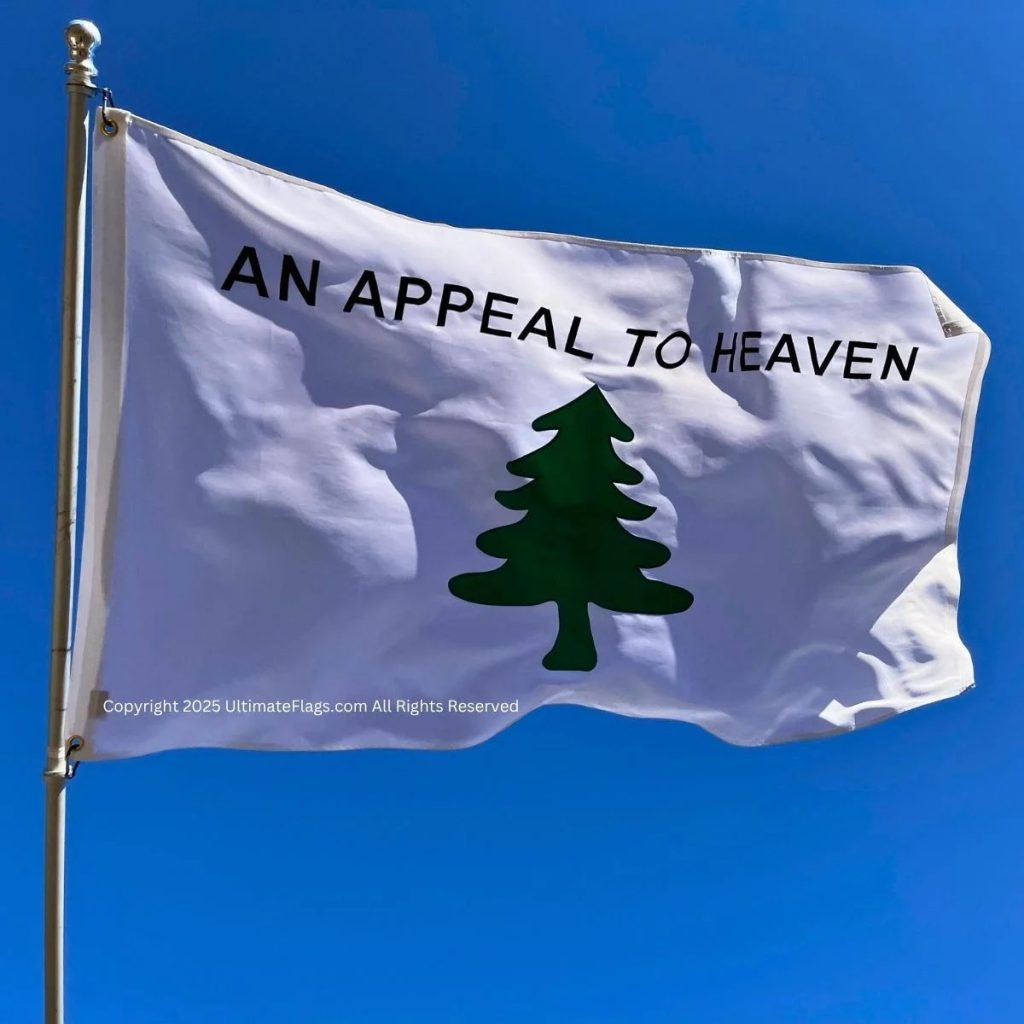
Yes — the Appeal to Heaven flag and the Pine Tree flag are the same banner. A white field, a green pine tree, and the words "An Appeal to Heaven" across the top: collectors and historians use both names for the flag that flew over George Washington's armed schooners beginning in the fall of 1775. The one wrinkle worth knowing before you buy is that a separate pine tree flag without the motto also exists, and that one is a different historical banner.

- Yes — the Appeal to Heaven flag and the Pine Tree flag are two names for the same 1775 design.
- Colonel Joseph Reed proposed the design on October 20, 1775 for Washington’s armed schooners.
- Massachusetts adopted the pine tree flag as its state navy ensign in April 1776.
- A separate Pine Tree flag with no motto is a different banner — don’t confuse the two.
- Reproductions come in sewn cotton and double nylon embroidered builds.
Is the Appeal to Heaven flag the same as the Pine Tree flag?
The short answer sits in one table. Three common names describe one design, and a fourth flag with a pine tree on it is genuinely different:
| Name | Design | Where it comes from |
|---|---|---|
| Appeal to Heaven flag | White field, green pine tree, motto "An Appeal to Heaven" | Washington's Cruisers, 1775 |
| Pine Tree flag | The same design under another name | The same 1775 fleet; the Massachusetts navy, 1776 |
| Washington's Cruisers flag | The same design under a third name | The armed schooners Washington commissioned near Boston |
| Plain Pine Tree flag | Pine tree only, no motto | New England and Massachusetts colony banners, 1686–1778 |
So when someone says "Pine Tree flag" and means the Revolutionary War banner with the motto, they mean the Appeal to Heaven flag. The confusion is understandable because the motto line sits above the tree and some modern reproductions crop it out or leave it off entirely. In 2026, most flag sellers use the three names interchangeably for the motto design and reserve "Pine Tree flag" on its own for the no-motto version.
Where each name comes from
All three names for the motto design trace back to the same paper trail: a letter written by Colonel Joseph Reed and a resolution passed by the Massachusetts council in April 1776.
Washington's Cruisers, fall 1775
In September 1775, during the Siege of Boston, the Continental Army set up two floating batteries on the Charles River. The next month they opened fire on the British in Boston, and Washington commissioned two schooners, the Lynch and the Franklin, to cruise Massachusetts Bay and intercept British supply ships. By February 1776, six armed vessels authorized by Washington were at sea.
The fleet needed a way to recognize its own ships, and that job fell to Washington's military secretary, Colonel Joseph Reed. His letter of October 20, 1775 proposed the design that stuck:
"Please fix upon some particular color for a flag, and a signal by which our vessels may know one another. What do you think of a flag with a white ground and a tree in the middle, the motto 'AN APPEAL TO HEAVEN' — this is the flag of our floating batteries."
The schooners became known as Washington's cruisers, and the white pine tree banner became their colors — which is why collectors still call it the Washington's Cruisers flag.
 Shop Ultimate Flags
The Massachusetts state navy, April 1776
In April 1776 the Massachusetts council passed regulations for its sea service, and the pine tree design moved from Washington's private fleet to an official state navy ensign. The resolution reads:
"Resolved, that the uniform of the officers be green and white, and that the colors be a white flag, with a green pine tree, and the inscription, 'An Appeal to Heaven'."
That April 1776 resolution is the clearest period description of the flag, and it is why museums and history pages list the banner under both the Washington's Cruisers and Massachusetts navy headings. Any 2026 buyer checking a seller's historical notes should see both dates — 1775 and 1776 — in the design's story.
What does "An Appeal to Heaven" mean?
The motto comes from the English philosopher John Locke. In his Second Treatise of Government (1690), Locke wrote that when a people have no judge on earth to turn to against tyranny, their only remaining recourse is an "appeal to Heaven" — they place their cause directly in God's hands.
The colonists adopted the phrase for exactly that reason. They had petitioned King George III without result, so flying "An Appeal to Heaven" over an armed ship declared that the crew saw its fight as just and its fate as settled by a higher court than Parliament. On a warship in 1775, the motto was a statement of purpose, not decoration.
Why a pine tree?
The pine tree was New England's home-grown symbol of independence, and it carried two centuries of history by the time it reached Washington's fleet. Massachusetts struck pine tree shilling coins in the 1600s, and colonists had long resented the British Crown's claim to the tallest white pines for Royal Navy ship masts — the best trees in the colony were marked for the King, and the broad-arrow marks on those trunks were a standing grievance.
By 1775 the tree already flew on New England banners, including the red flag carried at the Battle of Bunker Hill. Putting a pine tree on white cloth read, to any New Englander, as a claim of local independence — which is why Reed needed no explanation in his letter when he wrote "a tree in the middle."
 Shop Ultimate Flags Store
Which Appeal to Heaven flag should you buy in 2026?
Both main builds reproduce the same 1775 design, and the right one depends on where it will fly:
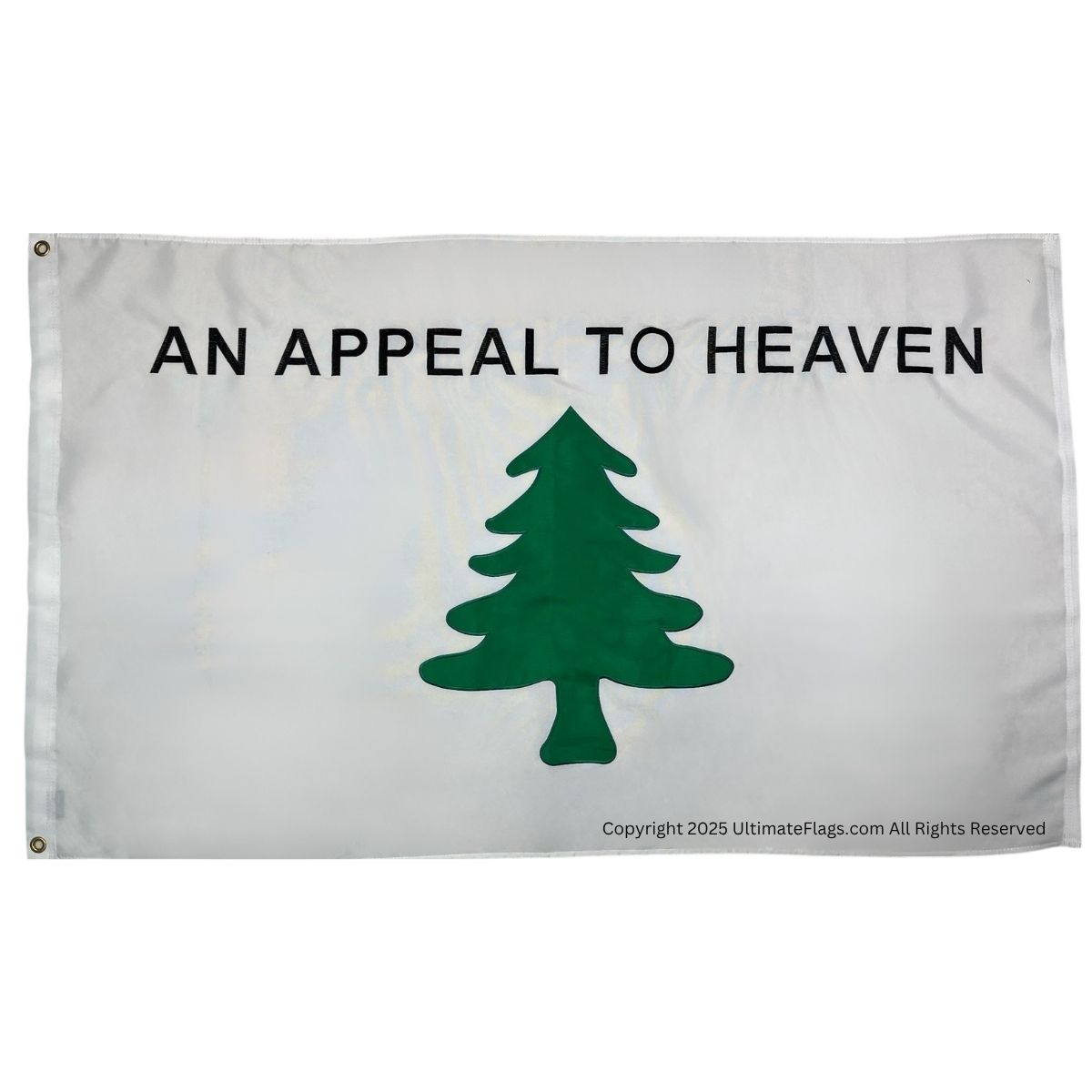
- Sewn cotton, 3 x 5 ft — the traditional choice. The cotton weave looks, feels and moves the way a period flag did, and the pine tree and lettering are embroidered. Cotton suits indoor displays, reenactment camps, museums and color-guard use; it is heavier than nylon and is not the pick for long-term outdoor weather.
- Double nylon sewn and embroidered, 3 x 5 ft — the two-ply outdoor build. Designs are embroidered on both sides, edges are double and quad stitched, and the grommet holes are reinforced. This is the version to hang on a pole through a full season of weather.
- Double-sided builds — the motto and tree read correctly from both sides, which matters if the flag faces a road or walkway.
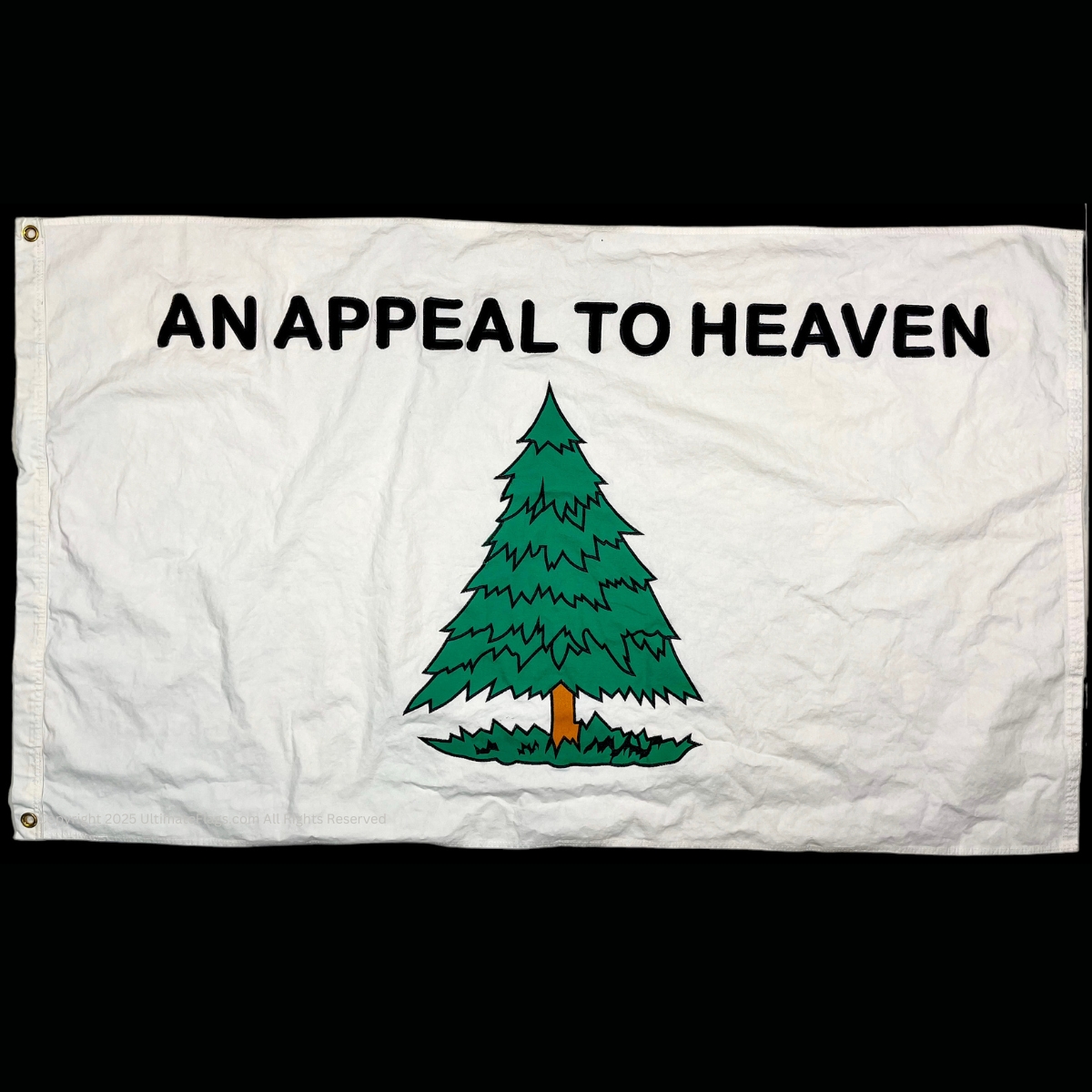
One honest note for 2026 shoppers: some period reproductions show the tree with grass tufts underneath and some show the bare trunk, mirroring the variation in the historical record. Check the listing photos before ordering so the design on your pole matches the one in your collection notes.
Flags that get mixed up with it
Two other pine tree banners from the same era cause most of the confusion, and the differences are easy to hold onto once you see them:
- The plain Pine Tree flag (no motto) — a white field with a pine tree and nothing else. New England and Massachusetts flew pine tree banners in some form from 1686 to 1778, so this design predates the Appeal to Heaven version and is its own legitimate historical flag, not a shortened copy.
- The Bunker Hill flag — a red field with a pine tree in the canton, carried at the Battle of Bunker Hill in June 1775. Same tree, completely different field color.
If a seller's "Pine Tree flag" listing shows a motto, it is the Appeal to Heaven design. If it shows a tree alone on white, it is the older no-motto banner. Red field means Bunker Hill.
FAQ
Is the Appeal to Heaven flag the same as the Pine Tree flag?
Yes. The Appeal to Heaven flag, the Pine Tree flag and the Washington’s Cruisers flag are three names for the same white banner with a green pine tree and the motto. A separate pine tree flag with no motto is a different historical banner.
Who created the Appeal to Heaven flag?
Colonel Joseph Reed, George Washington’s military secretary, proposed the design in an October 20, 1775 letter for the armed schooners fitted out near Boston. The ships that flew it became known as Washington’s cruisers.
What does the motto ‘An Appeal to Heaven’ mean?
The phrase comes from John Locke’s Second Treatise of Government (1690): when a people have no earthly judge left against tyranny, they appeal their cause to Heaven. The colonists used it to declare their fight was just after petitioning King George III failed.
When was the Appeal to Heaven flag used?
It flew over Washington’s cruisers beginning in the fall of 1775, and Massachusetts adopted it as the ensign of its state navy in April 1776.
What does the pine tree on the flag represent?
The pine tree was New England’s symbol of independence. It appeared on Massachusetts shilling coins in the 1600s, on the Bunker Hill flag, and on colony banners that resented the Crown’s claim to the tallest white pines for Royal Navy masts.
Is the Bunker Hill flag the same as the Appeal to Heaven flag?
No. The Bunker Hill flag is a red field with a pine tree in the canton and no motto. The Appeal to Heaven flag is white with the tree centered and the motto across the top.
Which Appeal to Heaven flag is best for outdoor use?
A double nylon sewn and embroidered 3 x 5 ft version is the outdoor pick — embroidered on both sides with reinforced grommets. Sewn cotton is the traditional choice for indoor displays, museums and reenactment use.
One last thing
The six armed vessels Washington commissioned by February 1776 were captured by the Royal Navy, wrecked or lost by the end of 1777 — the fleet lasted barely two years, but its flag outlived it by centuries. No original Appeal to Heaven flag from the fleet survives, which is why every version you see today, including the 2026 reproductions on this page, is a careful re-creation of Reed's written description rather than a copy of an existing cloth.
Related guides