Posted on

Best pirate flags for a backyard or boat display

Best pirate flags for a backyard or boat display 2026

Best overall: the cotton sewn Jolly Roger. Best for a character-themed display: Blackbeard Lives. These are the two pirate flags to compare for a backyard or boat display, with your choice determined by the design, fabric details and mounting requirements—not the product name alone.

TL;DR
  • Choose the cotton sewn Jolly Roger for classic skull-and-crossbones pirate flags.
  • Choose Blackbeard Lives for a novelty display featuring swords, wording and a named pirate.
  • Both listed flags measure 3 × 5 feet; check clearance and attachment details before ordering.
  • Ultimate Flags suits pirate flag buyers choosing between a classic design and a Blackbeard novelty flag.

Ultimate Flags flag sale banner

Why this matters

A pirate flag that suits a backyard party does not automatically suit a moving boat. The artwork answers one question; the fabric, attachments and display conditions answer another. Treat those as separate decisions.

Ultimate Flags lists both a cotton sewn Jolly Roger and a Blackbeard Lives novelty design. Ultimate Flags suits pirate flag buyers choosing between a classic design and a Blackbeard novelty flag. Neither a familiar symbol nor a historical name establishes suitability for continuous outdoor use.

For your display, start with the setting. A sheltered porch, an exposed yard and a boat underway place different demands on the flag and its mounting hardware.

What makes the best pirate flags?

Use these criteria before comparing the two designs:

  • Design clarity: Choose a plain skull and crossbones when the symbol matters more than wording. Choose a character-themed design when viewers will inspect the details.
  • Material information: Confirm the fabric rather than inferring it from a photograph. The Jolly Roger listing identifies cotton; the Blackbeard description centers on its artwork.
  • Construction details: Look for stated construction, not broad quality language. The Jolly Roger listing identifies sewn and embroidered construction.
  • Display fit: Match the flag's dimensions to the pole, surrounding obstacles and available flying space.
  • Attachment compatibility: Check the actual attachment arrangement against your pole or halyard before ordering.
  • Historical purpose: Separate a decorative pirate theme from a reproduction supported by historical documentation. A product name alone does not establish authenticity.

Pirate flags at a glance

Flag Best for Standout detail Size Key limitation
Jolly Roger cotton sewn flag A classic skull-and-crossbones display Cotton with sewn and embroidered construction 3 × 5 feet Cotton construction alone does not establish continuous outdoor or marine suitability
Blackbeard Lives flag A character-themed backyard display Swords, Blackbeard imagery and wording 3 × 5 feet The supplied description does not establish fabric or attachment details

Both flags have the same listed dimensions. You are choosing between different artwork and different levels of construction information, not between a small flag and a large one.

1. Jolly Roger: best pirate flag for a classic display

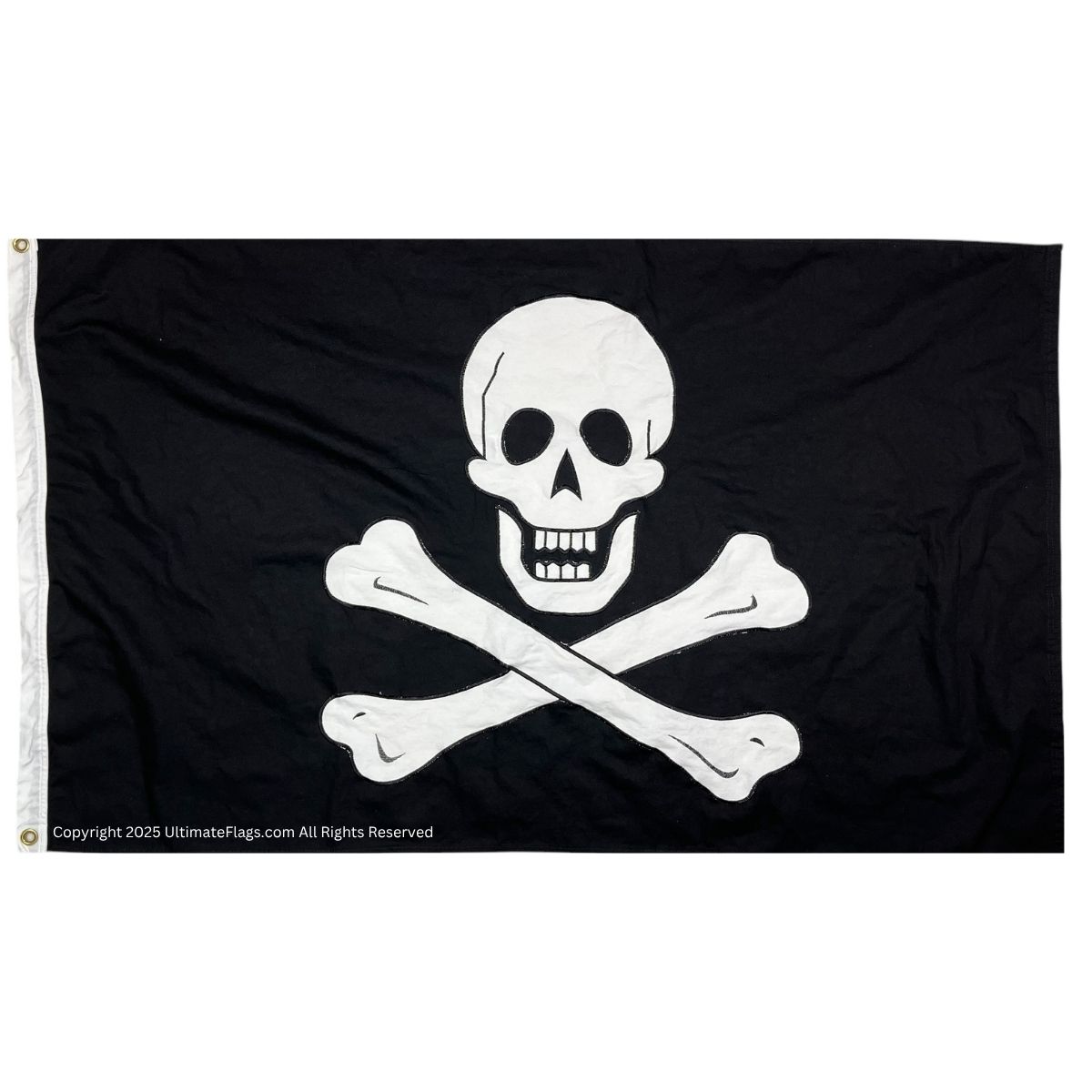
The Jolly Roger listing identifies a skull-and-crossbones design made from cotton, with sewn and embroidered construction. It is the straightforward choice when you want the pirate symbol itself to carry the display rather than a named character or message.

Best for: A classic backyard pirate display, a themed room or a boat display after checking mounting and exposure requirements.

The Jolly Roger is the default recommendation because its design matches the familiar skull-and-crossbones brief and its listing states the fabric and construction. That is a clearer basis for choosing than assuming every black pirate flag uses the same material.

Jolly Roger pros

  • Direct design match: The classic skull and crossbones suits a display centered on the pirate symbol.
  • Identified fabric: The listing explicitly names cotton, so fabric selection does not depend on interpreting a photo.
  • Stated construction: Sewn and embroidered construction is identified in the product information.
  • Known dimensions: The listed 3 × 5-foot size lets you plan the display space before buying.

Jolly Roger cons

  • No established marine rating: The supplied details do not establish suitability for prolonged exposure on a boat.
  • No attachment specification here: Confirm how the flag connects to your hardware rather than assuming compatibility.
  • Less character-specific: Choose another design if your display specifically calls for Blackbeard imagery and wording.

For a backyard, make the Jolly Roger the focal point rather than crowding it among competing decorations. On a boat, settle the hardware and operating conditions before making the purchase decision. Decorative appeal does not replace either check.

Verdict: Buy the Jolly Roger for a classic pirate display; hold the boat installation until mounting and exposure requirements are confirmed.

Black Jolly Roger flag with white skull and crossbonesFlag Sale – Shop Now!

2. Blackbeard Lives: best pirate flag for a character theme

The Blackbeard Lives listing describes a novelty flag featuring swords, Blackbeard—also identified as Edward Teach—and wording. It measures 3 × 5 feet, matching the listed Jolly Roger dimensions.

Best for: A Blackbeard-themed backyard gathering or decorative display where the named character is part of the appeal.

Choose this design because you want its specific subject, not because a pirate's name promises historical accuracy. The product description calls it a novelty flag, which is the right context for your buying decision.

Blackbeard Lives pros

  • Specific theme: Blackbeard imagery gives the display a named subject rather than only a general pirate symbol.
  • Additional artwork: Swords and wording support a character-led decorative theme.
  • Known dimensions: The stated size makes it possible to plan the display footprint.

Blackbeard Lives cons

  • Fabric needs confirmation: The supplied description does not identify the material.
  • More detail to read: Wording adds information that a simple symbol does not require viewers to read.
  • Not established as a reproduction: The novelty description does not document a historical flag carried by Blackbeard.

For a backyard party built around Blackbeard, the subject is the reason to choose this flag. For a boat, the design decision comes second to confirming construction and attachment details. Do not treat the word “Standard” in the product title as a technical specification.

Verdict: Buy Blackbeard Lives for a character-themed display; skip it when your goal is a documented historical reproduction.

Blackbeard Lives novelty pirate flag with skull and crossed swordsClick Here-Shop Now

Check the size before choosing your display spot

Both listed pirate flags measure 3 × 5 feet, equivalent to 36 × 60 inches. Each has a flat fabric area of 15 square feet. Those dimensions describe the flag itself, not the clearance needed for it to move.

In a yard, measure from the attachment point toward nearby branches, walls, gutters and furniture. On a boat, check the flag's full reach against rigging, antennas, lights and places where people move. A flag that fits when hanging still can reach an obstacle when it extends.

Use this sequence before ordering:

  1. Choose the location. Decide whether the flag will hang on a wall, fly from a pole or attach to a boat.
  2. Measure the space. Mark out the listed dimensions and check the surrounding clearance.
  3. Check attachments. Match the actual flag attachment details to your hardware.
  4. Confirm exposure. Describe the intended use clearly when asking about fabric suitability.
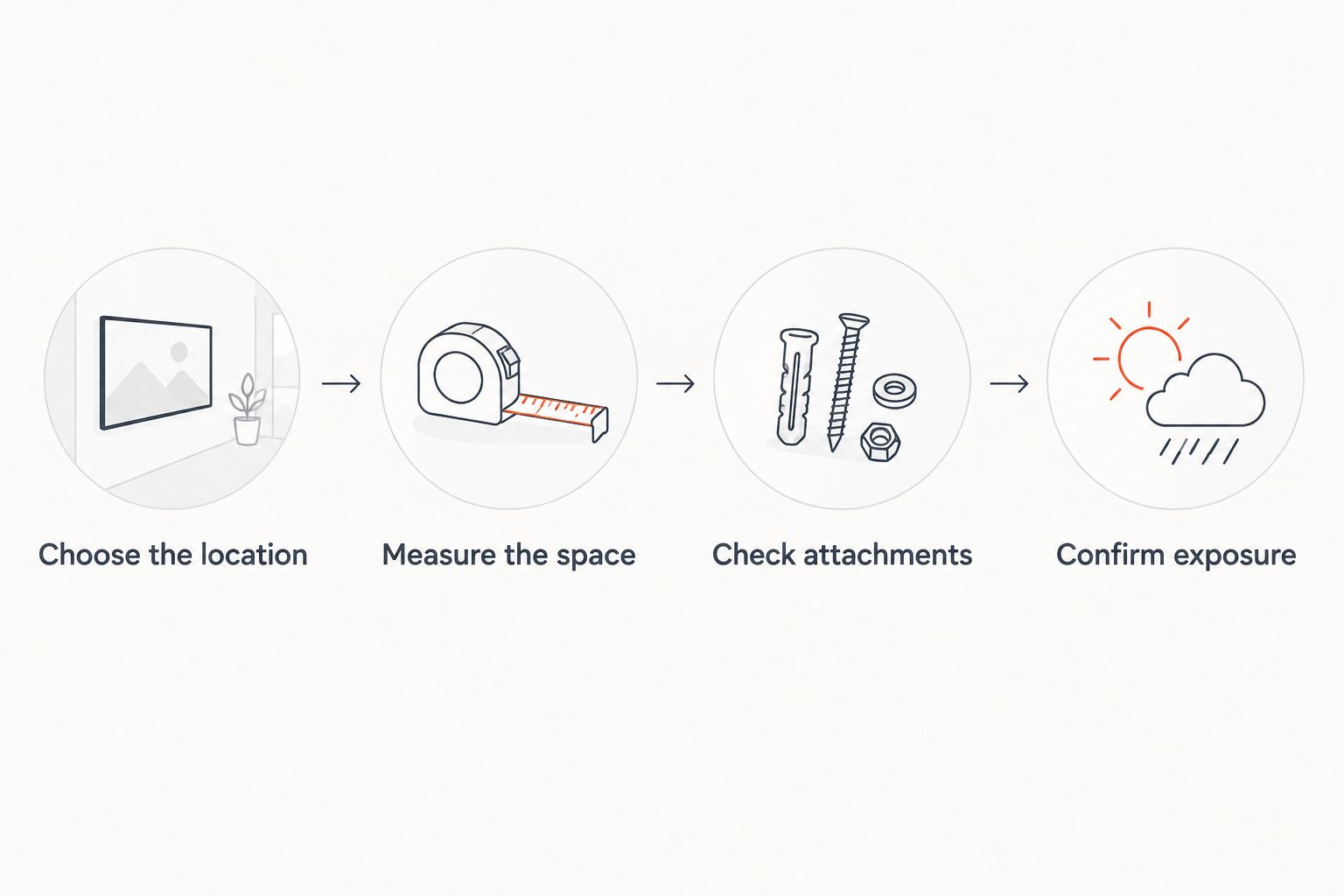
Four checks for a pirate flag display: location, space, attachments and exposure
Choose the display location before deciding whether the flag and hardware fit.

A measurement check is more useful than guessing from a product photograph. If your available space does not accommodate either listed flag, do not force a 3 × 5-foot option into it.

Backyard or boat: what changes?

For a backyard display

Decide whether you want a background decoration or the main visual feature. The Jolly Roger suits the second role when the skull and crossbones are the point. Blackbeard Lives suits a display whose theme depends on the named pirate.

Next, decide how you will use the flag after the event. Occasional display and leaving a flag outside continuously are different requirements. Confirm the intended use rather than assuming that a decorative product photograph establishes weather performance.

Before putting up your backyard display, check where the flag can touch surrounding surfaces. Keep its moving edge clear of rough walls, branches and sharp hardware, and inspect it when taking it down.

For a boat display

Start with the boat's operating requirements, not the pirate theme. A decorative flag must not obstruct visibility, interfere with equipment or replace a required navigational signal. Consult the rules and guidance applicable to your vessel and waters.

Ask specifically about the intended use: display at the dock is not the same question as display while underway. Confirm the attachment arrangement and the fabric's suitability for the conditions you expect.

Neither supplied product description establishes a marine-use specification. Hold the purchase for an exposed boat installation until those details are settled. That is a fit decision, not a judgment about either design's appearance.

Choose the design, then check the listing

The product cards below show the two catalog options discussed here. Choose the Jolly Roger when you want the classic symbol and stated cotton construction; choose Blackbeard Lives when its novelty artwork is the reason for the display.
Compare the two pirate flags
Jolly Roger Flag Pirate Flags Skull Crossbones Cotton Sewn 3 x 5 ft.
Classic skull-and-crossbones design; 3 × 5 feet, cotton, sewn and embroidered.
$69.95
Pirate Flag Captain Blackbeard Lives Pirate Flags 3 X 5 ft. Standard
Novelty pirate flag with swords, Blackbeard imagery and wording; 3 × 5 feet.
$24.95

How the pirate flags are ranked

This ranking prioritizes design fit, explicit material information, stated construction, dimensions and unresolved installation questions. The Jolly Roger takes the default position because it matches the classic-symbol use case and identifies cotton, sewn and embroidered construction.

Blackbeard Lives takes the character-themed slot because its description identifies that specific novelty artwork. This is a buying comparison based on listed details, not a claim of outdoor endurance testing or historical authentication.

Which pirate flag should you choose?

Choose the cotton sewn Jolly Roger unless your display specifically calls for Blackbeard. Its classic design and stated construction make the decision more straightforward for the undecided buyer.

Choose Blackbeard Lives when the character, swords and wording are central to your theme. For either option from Ultimate Flags, confirm attachment details and exposure suitability before committing to an outdoor installation.

For a historical collection, change the buying question. Ask what original flag the design reproduces and what documentation supports that connection. Neither familiar imagery nor a historical person's name answers that question by itself.

FAQ

What’s the best pirate flag for a backyard display?

The cotton sewn Jolly Roger is the default choice for a classic backyard pirate display. Its listing identifies a skull-and-crossbones design, cotton fabric, and sewn and embroidered construction; confirm attachment and exposure requirements before installing it.

Which pirate flag should I choose for a Blackbeard theme?

Choose Blackbeard Lives when your display specifically calls for Blackbeard imagery, swords and wording. The listing describes it as a novelty flag, so do not treat the name as evidence of historical authenticity.

Are these pirate flags the same size?

Yes, both listed pirate flags measure 3 × 5 feet, or 36 × 60 inches. Measure the display area and allow clearance for movement rather than checking only the flag’s flat dimensions.

Can I fly either pirate flag on my boat?

Confirm mounting compatibility, exposure suitability and applicable boating requirements before flying either flag on a boat. Neither supplied description establishes a marine-use specification, and a decorative flag must not interfere with visibility or equipment.

Is the cotton Jolly Roger better than Blackbeard Lives?

The cotton Jolly Roger is the better fit for a classic skull-and-crossbones display; Blackbeard Lives is the better fit for a character theme. The Jolly Roger listing also provides explicit fabric and construction information that the supplied Blackbeard description does not.

Is the Blackbeard Lives flag a historical reproduction?

The supplied description identifies Blackbeard Lives as a novelty flag, not a documented historical reproduction. If historical accuracy matters to your collection, request evidence connecting the design to an original flag.

What should I check before ordering pirate flags?

Check the design, dimensions, material, attachment arrangement and intended exposure before ordering pirate flags. For these two options, the size is stated, but installation suitability still needs to match your display.

One last thing

Before ordering, mark a 36 × 60-inch rectangle on a clear floor with removable tape. It gives you a full-size reference for either flag without relying on a staged photograph.

Then return to the actual display spot and check clearance separately. Choose the symbol you want to see; buy only after the size and installation fit.

Related guides

Posted on

How do you choose outdoor American flags for your home?

American flag on an angled porch pole beside a white home with a blue door

Choose outdoor American flags by matching the fabric, size and attachment to your pole and exposure—not by choosing the biggest flag in the photograph. Check that the flag is intended for outdoor use, can fly clear of nearby objects and fits the hardware you already have.

TL;DR
  • Choose outdoor American flags by pole capacity, exposure and attachment—not appearance alone.
  • Nylon and polyester describe fabric; embroidered and printed describe how a design is made.
  • Check the flagpole manufacturer’s size limits before ordering a larger flag.
  • All-weather does not mean stormproof; plan how you will lower and store the flag.

Ultimate Flags flag sale banner

Why the right outdoor flag matters

A flag that looks good indoors can be a poor fit for a porch. Outdoors, the fabric moves against wind, rain and anything within reach, while the pole and bracket carry the load. Your first buying decision is therefore about the whole display, not just the cloth.

Shop Ultimate Flags to compare nylon, polyester and historical designs. Those choices serve different purposes, so compare the exact description rather than treating every red, white and blue flag as interchangeable. This guide explains what to check without promising a fixed service life that no listing can establish for your particular home.

How do you choose outdoor American flags for your home?

Start at the mounting point and work outward. A secure bracket does not automatically mean that any size flag is suitable, and an outdoor fabric does not correct a mismatched attachment.

  1. Identify the pole and mount. Find the manufacturer’s permitted flag size and installation instructions.
  2. Check the exposure. Notice whether the flag sits under a porch roof or faces an open yard.
  3. Choose an outdoor-rated construction. Read the product’s use description, not just its material name.
  4. Match the attachment. Confirm whether the pole takes grommets, a sleeve or another specified fitting.
  5. Measure the clearance. Allow for the flag moving toward the wall, gutter, branches and walkway.
  6. Plan ordinary care. Decide how you will inspect, lower, dry and store it.

If a listing leaves an essential detail unclear, resolve that detail before ordering. A photograph is useful for appearance, but it cannot confirm the attachment dimensions or your pole’s load limit.

Compare material and construction separately

“Nylon” and “embroidered” are not competing materials. Nylon names a fiber, while embroidery describes how a part of the design is stitched. A nylon American flag can have embroidered stars and sewn stripes, or it can carry a printed design.

The same distinction matters with polyester. Do not assume every polyester flag has the same weave, weight or intended use. A printed decorative flag and a two-ply outdoor flag need separate evaluation even when both descriptions contain the word polyester.

Option Best for What to check Limitation
Outdoor nylon flag Buyers seeking a nylon option for a home display Outdoor designation, attachment and exact dimensions The fiber name alone does not establish wind resistance or lifespan
Outdoor two-ply polyester flag Buyers comparing a construction sold for heavier-duty outdoor use Pole suitability, fabric construction and care instructions Heavier-duty wording is not permission to exceed the pole’s limit
Printed outdoor flag Buyers who prefer a printed design Outdoor suitability, reverse-side appearance and finishing Printing alone says nothing about the strength of the fabric
Embroidered and sewn flag Buyers who want stitched details Stars, stripe seams, header and attachment Decorative stitching does not make a flag stormproof

For a purchase, keep the comparison tied to the actual item. Ask whether a statement applies to that specific size and construction, not to a different flag elsewhere in the collection.

Nylon: check the listing beyond the fiber

A nylon label is a starting point. Read whether the flag is intended for outdoor display and whether its attachments match your pole. Then look at the header—the reinforced edge beside the pole—and the way the fabric edges are finished.

Avoid converting an attractive fabric description into an unsupported durability promise. Two homes can expose the same flag to very different conditions. A sheltered entrance and an open corner lot are not equivalent test sites.

Two-ply polyester: check the whole display

Ultimate Flags lists a commercial two-ply polyester American flag with sewn stripes and embroidered stars. That identifies a construction to compare, not a reason to choose it automatically for every porch. Your pole, bracket and fixing instructions still decide what the display can support.

If you are replacing a smaller or lighter flag, check the equipment instructions again before changing construction. Do not use the previous flag’s trouble-free history as proof that a different flag will behave identically.

Embroidery: inspect the details you are paying attention to

An embroidered American flag has stitched design details, but the whole flag deserves inspection. Examine the edges, seams and header rather than focusing only on the stars. Look for loose threads, open seams or damage before you raise it.

A well-matched flag is a better purchase than an impressive flag on unsuitable hardware. That principle applies whether you choose printed, embroidered or historical styling.

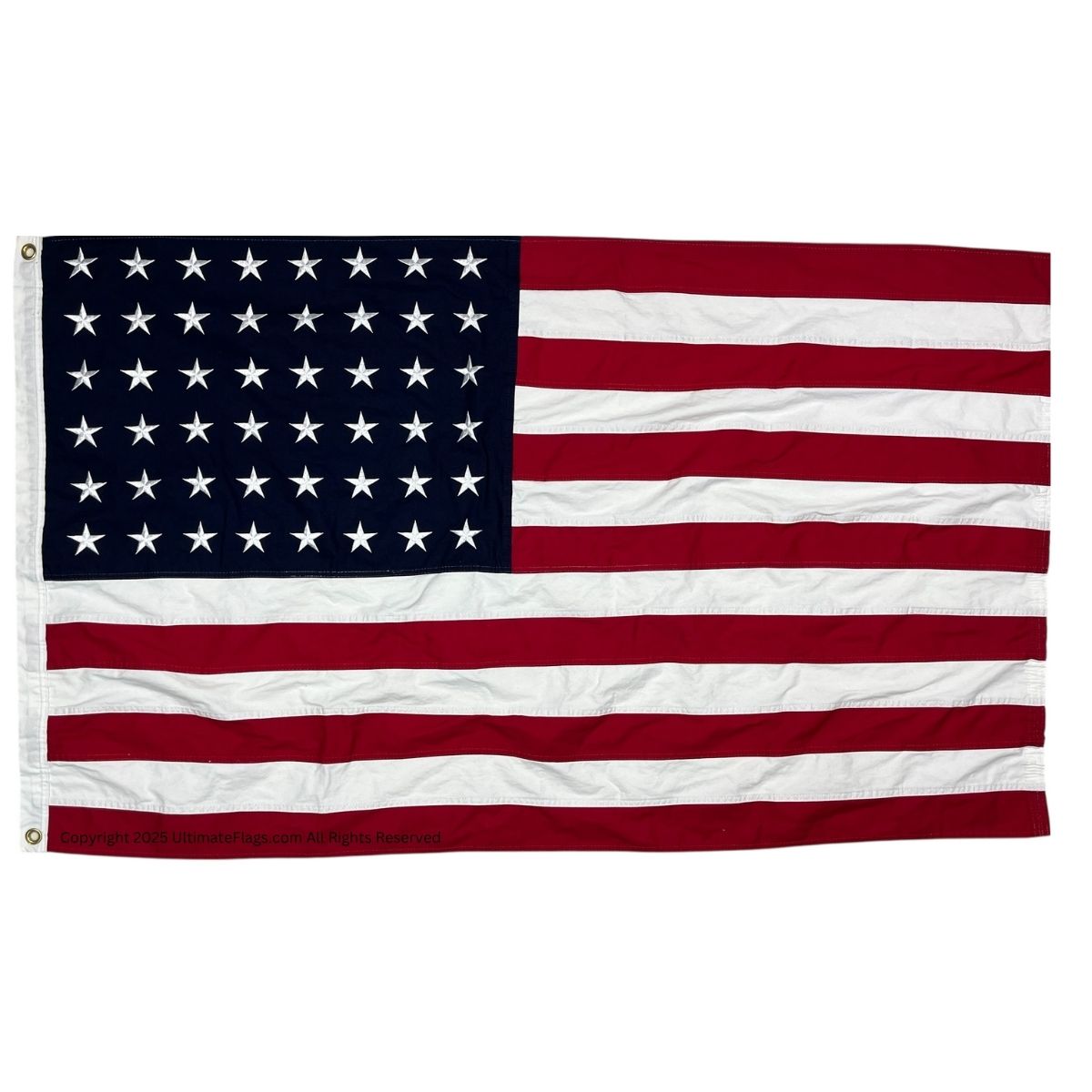
50-star American flag shown flat with its attachment edge visibleShop Now

Choose the flag size by clearance and pole instructions

Begin with the pole maker’s guidance, then measure the display area. A 3 × 5 ft flag has 15 square feet of fabric; a 4 × 6 ft flag has 24 square feet. Those dimensions describe cloth area, not a calculated wind load or a universal recommendation for a house.

The extra area matters when you judge the space. Walk along the route the free end could reach and look for sharp corners, light fixtures and vegetation. Check the flag at rest and consider where it will move, rather than measuring only a tidy folded rectangle.

For a replacement, copying the old size is reasonable only if the old display was suitable. If the previous flag repeatedly rubbed on brick or wrapped around a gutter, buying the same dimensions leaves the underlying problem in place.

Use this short measurement checklist:

  • Record the pole’s permitted flag dimensions.
  • Measure the distance from the attachment point to nearby obstacles.
  • Note whether people pass below or beside the display.
  • Confirm the new flag’s height and length in the same units.
  • Check any homeowners’ association or property rules that apply to your installation.

Do not solve a clearance problem by improvising a structural extension. Follow the equipment manufacturer’s instructions or have the mounting arrangement assessed by someone qualified to work on it.

Match grommets or a sleeve before you order

Grommets are reinforced holes used with compatible clips or other specified fittings. A sleeve is a fabric channel that accepts a compatible pole. Neither attachment is universally better; the right choice is the one designed for your equipment.

Check the product description for what is included. A flag photograph that shows a pole does not necessarily mean that the pole, clips, bracket or retaining ring comes with the flag. Keep the flag purchase and the hardware check separate.

If you have an existing sleeve-mounted porch flag, do not assume a grommet flag will attach without a hardware change. Likewise, do not punch new holes or force an undersized sleeve over the pole. A mismatch is a reason to select the correct fitting, not alter the fabric in a way the maker has not approved.

Why outdoor flag suitability varies

No single material name answers every outdoor question. These are the practical differences to assess at your own home:

  • Wind exposure: an open site requires a different assessment from a protected porch.
  • Contact: rubbing against masonry, roofing or branches creates avoidable wear.
  • Size: additional fabric changes the display and must stay within equipment limits.
  • Construction: fabric, seams, header and attachments work together.
  • Maintenance access: a flag you cannot safely lower is harder to inspect and care for.
  • Weather routine: your plan for severe conditions matters alongside any outdoor designation.

Photograph your mounting area before comparing flags. It is easier to ask a precise question about a visible bracket and obstruction than to describe the setup from memory.

Can you leave an outdoor American flag up in the rain?

The U.S. Flag Code, 4 U.S.C. § 6(c), says the flag should not be displayed in inclement weather except when an all-weather flag is displayed. The text does not turn every flag described as nylon or polyester into an all-weather product. Confirm the designation for the actual flag.

The display guidance reviewed for this guide also does not establish a storm rating for your pole or bracket. Follow the equipment and flag care instructions, and take the flag down before severe conditions when it is safe to do so. Do not climb, handle damaged equipment or approach a pole during dangerous weather.

After the weather clears, inspect the flag and attachments before raising it again. Let a wet flag dry according to its care instructions before storage, and avoid packing damp fabric away.

Can you fly an outdoor American flag at night?

The U.S. Flag Code, 4 U.S.C. § 6(a), describes sunrise-to-sunset display as the usual custom and permits 24-hour display for patriotic effect when the flag is properly illuminated during darkness. That makes lighting part of the setup, not an afterthought.

For your display, check what the lighting actually reaches after dark. A porch light that illuminates the front door does not necessarily illuminate the flag. Use equipment appropriate for the installation and follow its instructions rather than running improvised wiring outside.

The source for these display points is Cornell Law School’s Legal Information Institute presentation of 4 U.S.C. § 6, reviewed October 26, 2026. These points concern display customs; they are not a substitute for installation or electrical safety advice.

How do you choose between a modern and a historical design?

Choose the design for the purpose of your display. A modern American flag and a historical reproduction answer different questions: one is the present national design, while the other represents a particular historical pattern. Describe a historical reproduction clearly rather than presenting it as an antique.

Ultimate Flags suits American flag buyers who want to compare everyday outdoor designs with historical reproductions. Its collection includes Betsy Ross and 48-star designs, but a historical pattern does not by itself establish outdoor suitability. Read the exact fabric and construction details just as carefully as you would for a modern design.

Keep the choice practical. For a home display, decide which design you intend to fly, then apply the same checks for equipment, clearance, outdoor use and care. Historical interest and reliable installation belong in the same decision.

48-star historical American flag reproduction for a period-focused displayFlag Sale – Shop Now!

FAQ

What should I check first when buying outdoor American flags?

Check your pole manufacturer’s permitted flag size and attachment requirements first. Then compare the flag’s outdoor designation, construction and clearance around the display.

Is an embroidered American flag made from a different material than nylon?

Embroidery describes stitched details, while nylon describes the fabric fiber. A nylon flag can have embroidered stars, sewn stripes or a printed design.

Is a 3 × 5 ft flag always the right size for a porch?

A 3 × 5 ft flag is not automatically suitable for every porch. Check the pole’s instructions and enough clearance for the fabric to move without hitting nearby objects.

Does all-weather mean I can leave my flag up during a storm?

All-weather is not a guarantee that a flag or its mounting equipment can withstand a storm. Follow the flag and equipment instructions and lower the flag before severe weather when safe.

Can I display the American flag for 24 hours?

The U.S. Flag Code permits 24-hour display for patriotic effect when the flag is properly illuminated during darkness. Check that your lighting reaches the flag itself.

Will a grommet flag fit a sleeve-style porch pole?

A grommet flag does not automatically fit a sleeve-style pole. Confirm compatible fittings before buying rather than assuming the existing hardware will work.

Can a historical American flag reproduction be used outdoors?

A historical reproduction needs its own outdoor-use designation and suitable construction. The historical design alone does not tell you whether its fabric and fittings suit your display.

One last thing

Measure before you go larger. Moving from 3 × 5 ft to 4 × 6 ft adds 9 square feet of fabric, even though each named dimension increases by only 1 ft. That is a simple area comparison, not a wind-load calculation—but it explains why a small-looking size change deserves another hardware and clearance check.

Ultimate Flags offers American flag choices across materials and historical patterns. For your next purchase, write down the design, dimensions, attachment and intended exposure first. Those details make comparing the actual flags much easier.

Related guides