Posted on

How do you match Civil War flags to a unit and battle?

Confederate Battle Flag Infantry 52 x 52 inch cotton embroidered with pole sleeve / ties and gold fringe

Matching a Civil War flag to a specific unit and battle is a five-step read: identify the flag's pattern and generation, read the wording on the field, count the stars, decode any battle honors sewn or painted on it, then cross-check all of that against the surviving regimental records. Civil War regiments carried their colors into every fight because smoke and chaos made them the only reliable rallying point, so most flags carry at least one clue that ties them to one unit. Today the same method works whether you are identifying a museum piece or shopping a reproduction for a display.

TL;DR
  • Read the flag in five steps: pattern, wording, star count, battle honors, records.
  • Confederate national flags split into three generations: 1861, 1863 and 1865.
  • A square battle flag with a white border points to the Army of Northern Virginia.
  • Embroidered place names are battle honors: Sharpsburg, Fredericksburg, Gettysburg.
  • Confirm any match in regimental histories before trusting the flag alone.

Ultimate Flags flag sale banner

How do you match a Civil War flag to its unit and battle?

Work the five clues in order, and let each one narrow the field before you move to the next. A flag that matches on pattern but fails on the wording is a reproduction of a style, not of a unit's colors.

Step 1: Identify the flag's pattern and generation

Start with the overall design, because it narrows the date and the army before you read a single word. The Union flew the Stars and Stripes in its 34, 35 and 36 star layouts from 1861 through 1865, alongside blue regimental colors. The Confederacy cycled through three national designs: the Stars and Bars from March 1861, the Stainless Banner from May 1863 with the battle flag in the canton, and the Blood-Stained Banner from March 1865, which added a vertical red bar so the white field would not read as a flag of surrender when the wind dropped. The square Southern Cross battle flag with a white border belongs to the Army of Northern Virginia; rectangular battle flags served in the Army of Tennessee and the Trans-Mississippi.

Step 2: Read the wording on the flag

Wording is the strongest single clue. A regimental color usually carries the regiment's number and state — "4th N.C. Inf." — and sometimes the unit's nickname. Battle flags in the Eastern theater were often marked the same way, and headquarters flags name the general. If the flag spells out a unit, write down exactly what it says, including abbreviations, because records use the same forms.
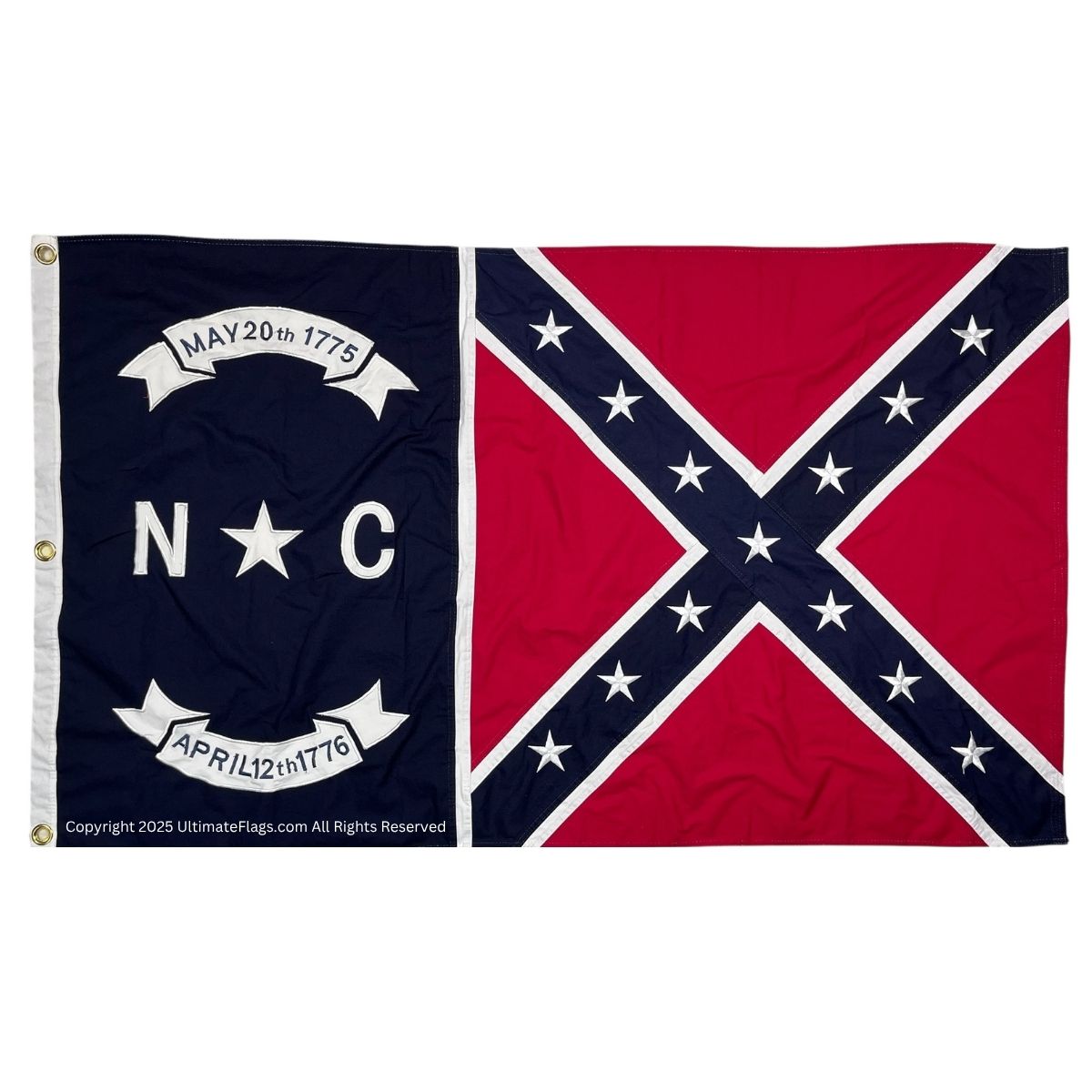
Modern North Carolina battle flag reproduction showing letters and dated scrollsClick Here-Shop Now

Step 3: Count the stars

Star counts date a Confederate national flag quickly. Seven stars mark the original seven seceded states of early 1861; thirteen stars, the count the Stars and Bars settled on, covered the eleven seceded states plus Kentucky and Missouri. A Union flag's star count is coarser — 34 stars from 1861, 35 after West Virginia joined in 1863, 36 in 1864-65 — but it still brackets the flag's earliest possible date.

Step 4: Decode the battle honors

Battle honors are the place names, embroidered, painted or stenciled on the field, that record the fights where the unit carried that flag. Names like Williamsburg, Seven Pines, Sharpsburg, Fredericksburg, Chancellorsville and Gettysburg map directly to known battles, and the set of honors on one flag belongs to exactly one regiment or battery. A square cotton battle flag marked "Williamsburg" and "Seven Pines," for example, points to a North Carolina or Virginia regiment that fought in the 1862 Peninsula Campaign under the Army of Northern Virginia.

Collectors searching those regiment names online usually land on small dealers, many of whom run Meta ads on a small Shopify budget to reach reenactors and history buffs.

Step 5: Cross-check the regimental records

Finish in the records, never on the flag alone. The Official Records of the War of the Rebellion, state adjutant-general reports and the American Battlefield Trust's regiment pages list which flags a unit carried and which battles it fought. Surviving originals in the Smithsonian's collection and state battle-flag museums give you the patterns to compare against. When the flag's wording, star count and honors all agree with the record, you have your match.

What each part of the flag tells you

Flag feature What it tells you Watch out for
Overall pattern Which army and which generation of design The battle flag pattern was never the Confederacy's national flag
Unit wording The exact regiment or command Abbreviations differ from modern forms
Star count Date bracket and claimed states Stars were added unevenly on period flags
Battle honors The battles the unit fought under it Honors were added at different times, not all at once
Shape Square = Army of Northern Virginia; rectangular = other armies Some Western units copied the square shape later in the war

Matching Union flags to their units

Union identification usually runs easier because the wording tends to be complete. A Federal regiment's national color was a standard Stars and Stripes, often marked with the regiment's designation, while the regimental color was a blue field with an eagle, the regiment's name and its battles painted on. State-issued colors add the state seal. When you match a Union flag, the regimental color's painted list of battles is often the fastest confirmation, because regiments recorded engagements in the order they were earned.

Matching Confederate flags to their units

Confederate identification leans harder on pattern and honors because national designs changed while unit markings varied by army. The first national flag, the Stars and Bars, was dropped for field use after First Manassas in July 1861, when its resemblance to the Stars and Stripes caused deadly confusion. The battle flag took its place, and armies standardized their own versions: the Army of Northern Virginia's square flag with a white border from late 1861, and the rectangular patterns farther west. For a national flag, match the star count to the generation first, then look for the unit marking; for a battle flag, the honors and the shape carry the identification.
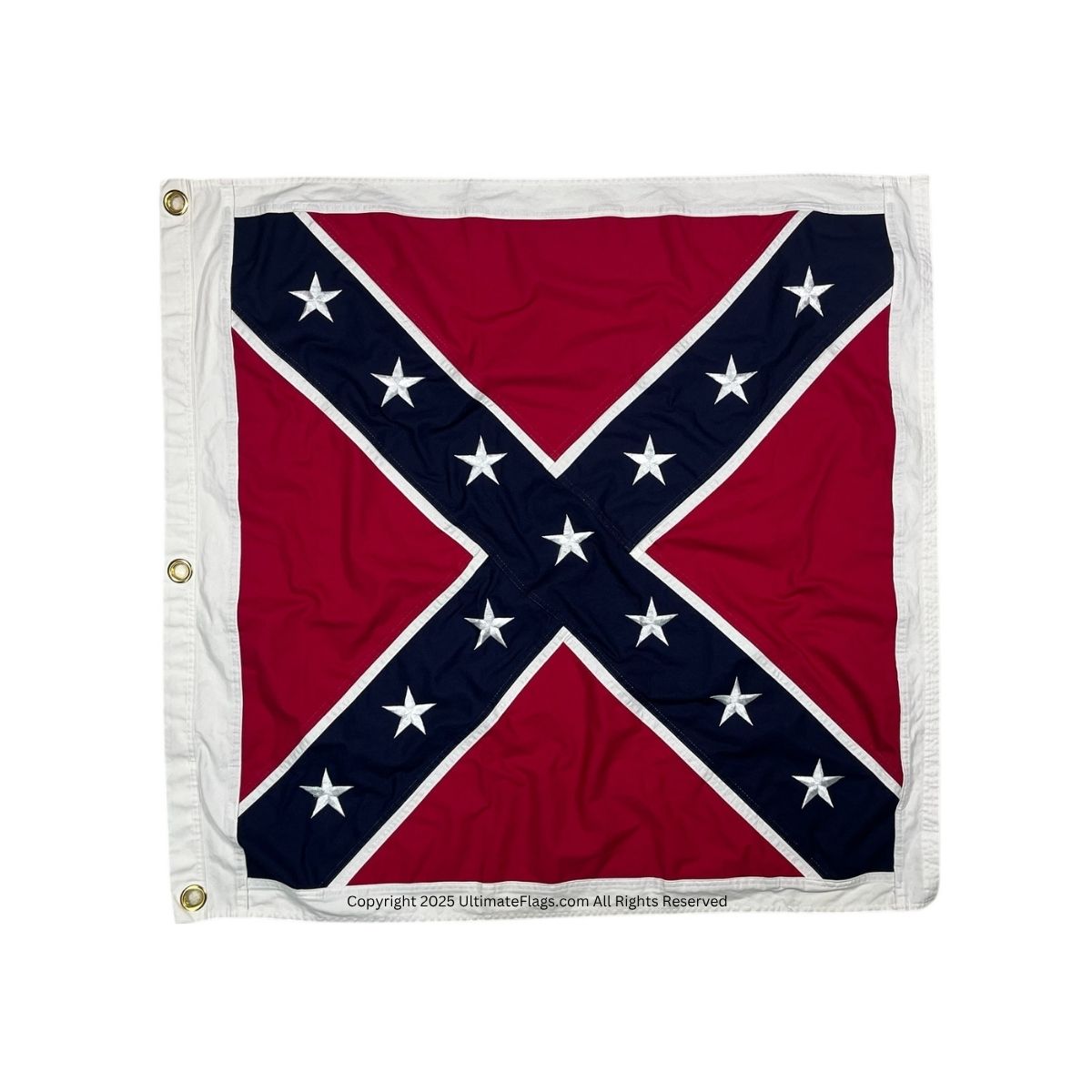
Square artillery battle flag reproduction showing its white borderShop Now

Why flags vary between units

  • Issue source. Flags came from state governments, private presentations and army depots, so two regiments raised the same month could carry different patterns.
  • Theater. Eastern and Western armies standardized separately, which is why battle flag shapes differ by army.
  • Date. A flag issued in 1861 cannot show a battle honor from 1864; the honors sequence records when it was retired or replaced.
  • Maker. Depot sew shops and contracting seamstresses varied star layouts and letter styles, and examiners use those quirks to separate period flags from later copies.
  • Survival and repair. Flags were replaced when worn, and honors from an old flag were sometimes reapplied to its successor.

Choosing an accurate reproduction

Once you know which flag you want, the reproduction criteria mirror the identification criteria: the right pattern for the army and date, the correct star count, and unit markings only when a documented original carries them. Collectors usually want cotton sewn reproductions with embroidered stars for display, because cotton has the drape and look of the period, while reenactors who march with a flag often pick lighter nylon or printed fabric for field use. The Civil War flag lineup at the Ultimate Flags store runs from Stars and Bars national flags in cotton and embroidered nylon to Bonnie Blue, Lee's headquarters flag and square battle flags with reenactor-quality sleeve-and-tie finish, so you can match the construction to the display. When you are ready to buy, Shop Ultimate Flags and compare the cotton and nylon versions of the same design side by side.

The same scrutiny you applied to identification applies to buying. The six Civil War flag patterns and what each meant are laid out on the site's provenance guide, and the practical checks — fabric, stitching density, hoist reinforcement — are the same ones used to judge any sewn reproduction. A guide to distinguishing a 48 star flag replica from an antique covers those construction checks in detail.

Related questions about matching Civil War flags

How big were Civil War regimental flags?

Regimental colors were made large so they could be seen across a battlefield: typical issue sizes ran near 6 by 6 feet for square battle flags and around 6 by 6½ feet for Union regimental colors, flown from roughly 10-foot lances. Modern reproductions sold for display usually come in the standard 3 by 5 feet and 4 by 6 feet sizes instead.

What is the difference between a national flag and a battle flag?

A national flag represented the government — the Union's Stars and Stripes or the Confederacy's three national designs — while a battle flag was the field marking a unit rallied on. The Confederate battle flag was never a national flag; it was adopted for field use because the first national flag was too easy to confuse with the Union's.

Can you match a flag to a battle if it has no wording?

Sometimes, but the match stays provisional. A plain flag can still be bracketed by pattern, star count, fabric and size, and assigned to the armies that used that combination; only a written record — a muster roll note, a capture report, a presentation inscription — turns the bracket into a unit match.

FAQ

How do you match a Civil War flag to a specific unit?

Read the flag’s pattern and generation, then the unit wording, then the star count, then any battle honors, and confirm everything in regimental records such as the Official Records. Wording naming the regiment is the strongest clue; pattern and star count bracket the date and army.

What do battle honors on a Civil War flag mean?

Battle honors are place names such as Sharpsburg or Gettysburg sewn or painted on the flag to record the battles the unit fought while carrying it. The full set of honors belongs to one unit, so the list often identifies the regiment on its own.

How many stars are on a Confederate Civil War flag?

The Stars and Bars carried seven stars for the first seven seceded states and settled at thirteen, covering the eleven seceded states plus Kentucky and Missouri. The later Stainless Banner and Blood-Stained Banner keep the thirteen-star battle flag canton.

Why was the Confederate battle flag square in Virginia?

The Army of Northern Virginia standardized a square battle flag with a white border from late 1861, while the Army of Tennessee and the Trans-Mississippi used rectangular versions. The shape difference is one of the fastest ways to tell which army a battle flag pattern was issued in.

What size Civil War flag should I buy for display?

For a home or classroom display, a 3 by 5 feet reproduction is the practical standard, and 4 by 6 feet reads better outdoors. Period regimental colors were larger — near 6 feet on the side — so serious collectors looking for scale accuracy choose cotton sewn flags in those bigger sizes.

Are Civil War flag reproductions historically accurate?

Quality reproductions follow the documented patterns, star counts and construction of surviving originals, and the best ones use sewn cotton with embroidered stars as period flags did. Accuracy varies by maker, so check the pattern, star count and stitching against a documented original before buying.

One last thing

More battle flags were captured than retired: regiments lost their colors to enemy capture in nearly every major engagement, and recovered flags were formally returned by the War Department decades after the war ended. That is why surviving originals cluster in state museums, and why a reproduction's job is to carry a unit's story a photograph alone cannot. Pick the unit first, then the flag, and the display explains itself.

Related guides
Posted on

Gadsden flag for sale: choosing material and construction

gadsden flag, hopkins flag double nylon embroidered flag 3x5 4x6 5x8

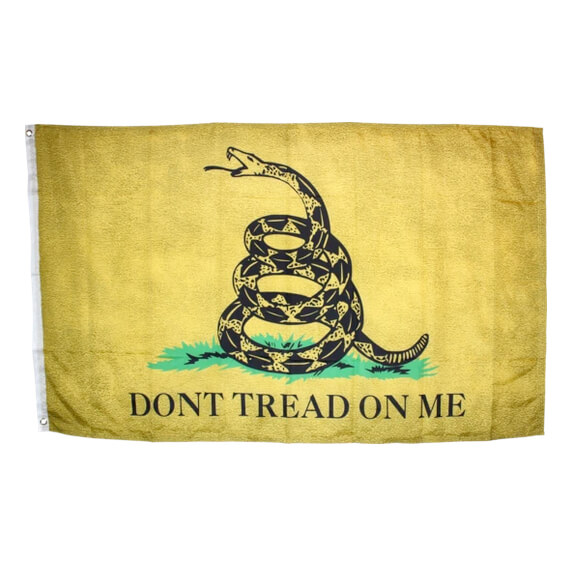
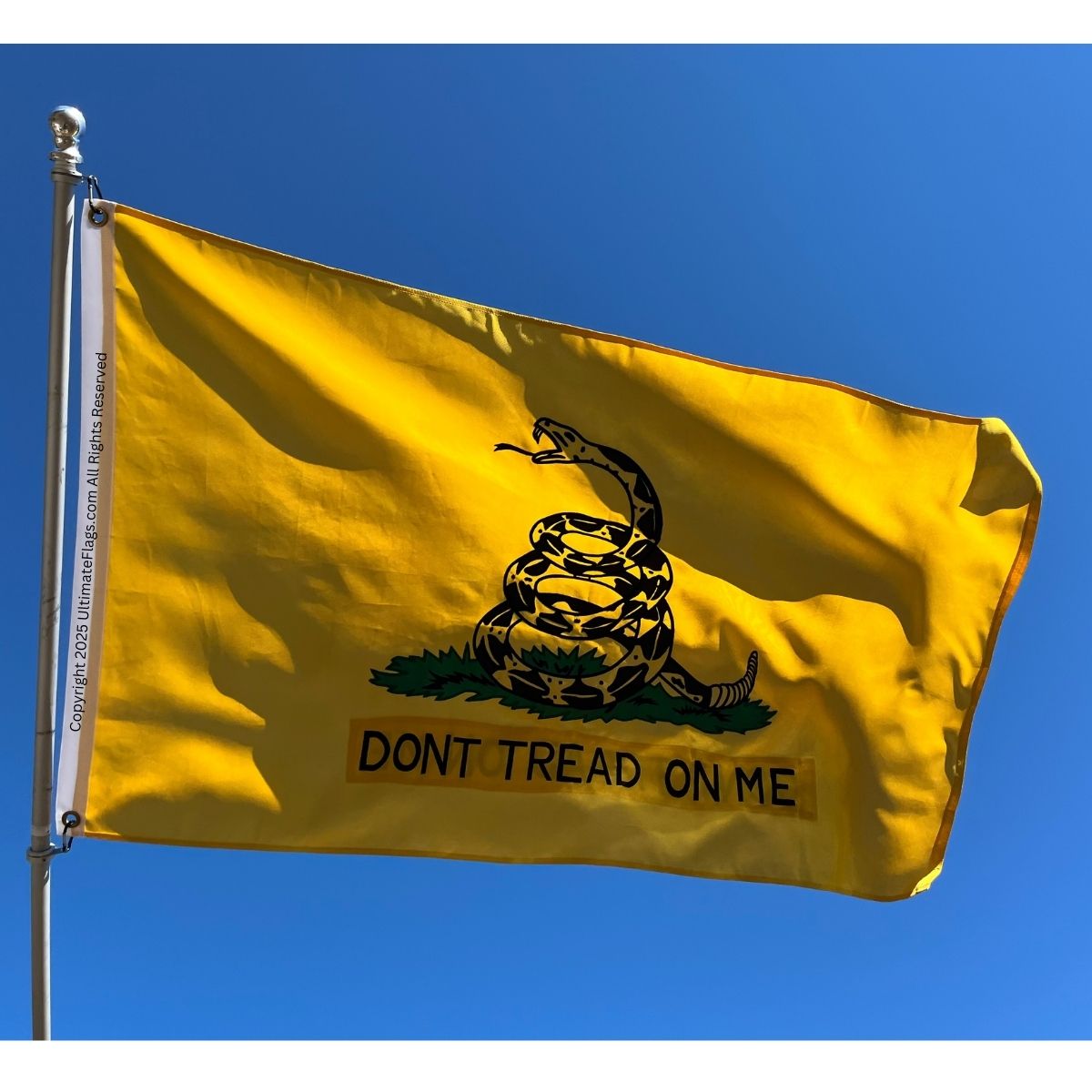
Buying a Gadsden flag for sale starts with one honest question: how will you fly it? A Gadsden flag is the yellow banner with a coiled timber rattlesnake and the words "Don't Tread on Me," first made in 1775, and it comes today in printed polyester, sewn nylon, double-sided embroidered nylon and cotton. The right pick depends on where it hangs — a porch pole, a porch railing, a boat, a cabin wall or a collector's shelf — and this guide walks you through that choice step by step.

TL;DR
  • Embroidered nylon is the everyday pick for outdoor poles; 3×5 ft fits most homes.
  • Printed polyester 3×5 ft suits light use, porches and tighter budgets.
  • Double-sided embroidered nylon reads correctly from both sides of a pole.
  • Cotton flags belong indoors — ceremonies, framed displays, collector shelves.
  • Measure the pole height before you buy; a 3×5 ft flag is the default for a 20 ft pole.

Ultimate Flags flag sale banner

Why the material matters more than the snake

The rattlesnake design stays the same from flag to flag. What changes is the fabric, the stitching and the weight, and those three things decide how long the flag lasts and how good it looks flying. A flag built for a coastal porch and a flag built for a parade line are two different purchases.

Material also decides the price of ownership over time. A heavier sewn nylon flag costs more up front but holds its shape through seasons of wind; a lighter printed flag is honest about being a lighter-duty product. Neither is wrong — the mistake is buying one when your display needs the other.

How to choose a Gadsden flag that fits your display

Match the design to your display

Start with the design, not the fabric. The classic Gadsden is the yellow field with the coiled snake facing left, which is the version a flag shopper usually wants. Beyond the classic, the lineup includes distressed and weathered vintage looks, a Betsy Ross variant that swaps the snake into a circle of 13 stars beneath it, the red First Navy Jack with the snake and stripes, Texas Gadsden designs, and black tactical versions.

  • Classic yellow — the 1775 design as most people picture it, and the safest pick for a flagpole or a history display.
  • Vintage weathered — a deliberate aged print; good for cabins, garages and living rooms, less traditional for formal events.
  • First Navy Jack — red and white stripes with the rattlesnake, tied to the Navy's 1775 origins; pairs well with military displays.
  • Double-sided — two flag layers sewn back to back so the snake reads left-facing from both sides of the pole.

Historically, the design traces to 1775, when South Carolina patriot Christopher Gadsden is recorded presenting one of the flags to the Continental Congress and another to Commodore Esek Hopkins, the first commander of the new Continental Navy. The coiled rattlesnake itself grew out of Benjamin Franklin's 1754 "Join, or Die" cartoon, which had already made the snake an American symbol. Knowing that makes the classic yellow design the one to buy when history accuracy matters.

Yellow Gadsden flag with coiled rattlesnake and Don't Tread on Me letteringShop Now

Choose the material for how you'll fly it

This is the decision that sets your flag's lifespan. Three fabrics cover nearly every Gadsden flag for sale today.

  • Printed polyester (standard) — the lightweight workhorse. Designs are dyed or printed into the fabric, it flies in the faintest breeze, and it dries fast after rain. Best for covered porches, seasonal displays and casual buyers.
  • Sewn and embroidered nylon — the snake and lettering are stitched on with thread, not printed. Heavier, far more durable on an outdoor pole, and the embroidery gives the snake a textured, raised look that reads well up close. This is the everyday pick for a home flagpole.
  • Cotton — the traditionalist's fabric, with rich color and a period-correct feel. Cotton soaks up water and sun-fades faster than synthetics, so it belongs indoors: ceremonies, framing, museum-style displays and collections.

A fourth option, double-sided embroidered nylon, is a construction choice rather than a fabric — two nylon flags sewn back to back with a blocker layer between. More on that below.

Pick the size that fits your pole

Size rules are simple arithmetic: the flag's length should run about one-quarter to one-third of the pole's visible height. Common Gadsden sizes run 2×3, 3×5, 4×6, 5×8 and 6×10 feet.

  • 2×3 ft — apartments, boat rails, porch brackets and smaller wall mounts.
  • 3×5 ft — the standard American answer for a residential pole, typically a 20 ft pole, and by far the most common size sold.
  • 4×6 ft and 5×8 ft — taller residential poles, 25-30 ft, and business or lodge displays that need to read from a road.
  • 6×10 ft — large poles, acreage entrances and commercial buildings.

Oversizing is the most common sizing mistake. A 5×8 ft flag on a 20 ft pole strains the hoist, wraps its own pole in light wind and wears out months early.

Decide single-sided or double-sided

A single-layer flag shows a mirror image — reversed text — on its back side. Many buyers never care. If your pole faces a road, a lake or a neighbor's porch, though, "DON'T TREAD ON ME" reading backward gets noticed, and not in a good way.

A double-sided flag solves that with two layers and a sewn-in light blocker so each side shows a correct, left-facing snake. The trade is weight and wind: double-sided flags are heavier and take a stronger breeze to fly fully. On a breezy rural lot that is a non-issue; on a still, wooded lot it can leave the flag hanging limp.

Choose grommets or a pole sleeve

Grommets — the brass rings on the flag's hoist edge — clip to a standard pulley or clevis system and are what most home poles use. A pole sleeve (also called a pole hem) is a sewn tube the pole slides through, which gives a cleaner look on indoor poles, wall brackets and parade flagsticks but adds stress in open wind.

  • Grommets: best for outdoor residential poles, boats and trucks. Check for brass over plated steel — brass will not rust streak the fabric.
  • Pole sleeve: best for indoor, parade and porch-bracket displays, and for any flag you plan to take down often.

Inspect the craftsmanship before you buy

Whatever the fabric, four checkpoints tell you the flag is built to last. Run your thumb over the stitching on the snake and the lettering — embroidery should be dense and even, with no loose thread loops. Check the fly end (the far edge) for multiple rows of stitching, since that edge takes all the wind wear. Look at the hoist edge reinforcement, and on a double-sided flag, confirm the layers are sewn, not glued, along every seam. Finally, read the product listing for the fabric and the stitching type rather than trusting the photos alone.

Hang it where the snake reads well

The Gadsden design is a portrait, not wallpaper. The snake reads best with clear space around it, so pick the spot before you pick the size: a flag centered on a blank wall, hung above a fireplace or flown alone on a pole needs less space to read than one crowded between other banners. On multi-flag poles, flag etiquette keeps the American flag highest, with the Gadsden flown beneath it.

Comparison: which Gadsden flag is right for you?

Flag Best for Key limitation
Printed polyester 3×5 ft (standard) Porches, boats, casual and seasonal display Lightest duty; prints show wear sooner than stitching
Sewn nylon embroidered 2×3-5×8 ft Everyday home flagpoles and long-term outdoor display Heavier and pricier than printed; needs a decent breeze
Double-sided embroidered nylon 3×5 ft Poles seen from both sides — roads, lakes, front yards Heaviest option; hangs limp in very light wind
Cotton Gadsden flag Indoor ceremonies, framing and collector displays Fades and soaks outdoors; indoor use only

No price column here on purpose: fabric grades and sizes vary, and the honest move is to compare a standard printed 3×5 against the embroidered nylon of the same size before you decide.

Vintage-style Gadsden flag reproduction with a weathered yellow finishClick Here-Shop Now

Common mistakes Gadsden buyers make

  • Buying oversized. The flag outruns the pole, wraps constantly and frays at the fly end within a season. Match the size to the pole first.
  • Putting cotton outdoors. Cotton looks right and is the wrong fabric for rain and sun. Save it for indoor and covered displays.
  • Choosing double-sided for a windless yard. The extra layer is a real weight; in still air the flag never unfurls and nobody sees the snake at all.
  • Skipping the hoist check. A flag is only as strong as its attachment edge. Brass grommets and reinforced corners are worth two minutes of reading before checkout.
  • Hanging it against a busy background. A yellow flag against a yellow wall or a cluttered garage disappears. Give the snake its contrast.

When you have matched design, fabric and size, Shop Ultimate Flags to see the current Gadsden lineup in every fabric and size covered above.

FAQ

What is the best material for an outdoor Gadsden flag?

Sewn, embroidered nylon is the best everyday material for an outdoor Gadsden flag. It is heavier than printed polyester, the stitched snake holds up to wind, and it dries quickly after rain. Printed polyester suits covered porches and lighter use.

What size Gadsden flag should I buy for a home pole?

A 3×5 ft Gadsden flag is the standard choice for a typical 20 ft residential pole. The flag’s length should be roughly one-quarter to one-third of the pole’s visible height, so taller 25-30 ft poles take a 4×6 ft or 5×8 ft flag.

Is a printed or embroidered Gadsden flag better?

An embroidered Gadsden flag is better for regular outdoor flying because the stitched design and denser fabric resist wind wear far longer. A printed flag is lighter, flies in the faintest breeze and costs less, which makes it a good casual-use pick.

Why is the Gadsden flag yellow?

The yellow field comes from the flag’s 1775 origins, when the rattlesnake banners of the Revolution were commonly made on yellow ground. The design is attributed to South Carolina patriot Christopher Gadsden, and an early example was presented to Commodore Esek Hopkins of the Continental Navy.

What is the difference between the Gadsden flag and the First Navy Jack?

The Gadsden flag is a yellow field with a coiled rattlesnake and ‘Don’t Tread on Me.’ The First Navy Jack swaps the field for 13 red and white stripes with the snake, and both trace to the Continental Navy of 1775.

Can a Gadsden flag fly in the rain?

Nylon and polyester Gadsden flags can fly in light rain without harm, though all-weather flags last longer when brought down in storms. Cotton should never fly wet — water weight and sun do the fastest damage to cotton fibers.

One last thing

The 1775 original's exact maker is a small historical mystery — the flag is named for Christopher Gadsden, who is recorded presenting examples of it in 1775, and no founding-era original is known to survive today. Every Gadsden flag you can buy, from a printed 3×5 to a heavy double-embroidered nylon, is a reproduction of a design about 250 years old. That is a fair thing to know before paying for hand-stitching: what you are really buying is how faithfully and how durably the reproduction is made.

Related guides

Posted on

Revolutionary War flags for classroom history displays

Illustration of folded reproduction flag fabric, books, pencils, and blank caption cards on a classroom table

Classroom Revolutionary War flags are teaching reproductions used to compare the symbols, loyalties, and changing ideas of the American Revolution. Choose each flag to answer a historical question, then label its identity, evidence, and status as a modern reproduction rather than presenting decoration as an original artifact.

TL;DR
  • Use Revolutionary War flags to teach historical change, not just decorate a wall.
  • Compare the Grand Union design with a 13-star Stars and Stripes reproduction.
  • Explain that the Betsy Ross origin story is not established by conclusive evidence.
  • Match every flag to a reliable reference and a clear classroom question.
Ultimate Flags flag sale banner

Why Revolutionary War flags matter for classroom history

A flag gives students a visible object to compare with a document, a date, or a claim. The most useful classroom display does more than identify colors. It helps students ask what a symbol represented, who used it, and how firmly that association is documented.

Ultimate Flags carries historical reproductions, including Revolutionary War designs. For a display that includes the familiar circle-of-stars pattern, the Betsy Ross reproduction guide explains why a design name and an origin story should be treated separately.

In a classroom, the strongest display can be a small, well-explained comparison. You do not need a crowded wall or an expensive collection to teach students the difference between a historical source and a modern representation.

Start with the question, not the shopping list

Decide whether students are studying the movement toward independence, the development of national symbols, or the way historical stories become familiar. Each goal suggests a different arrangement.

For example, comparing a flag that retains the British union in its canton with a later stars-on-blue design can prompt a discussion about political change. Comparing a familiar Betsy Ross image with the wording of the 1777 flag resolution supports a different lesson: a document can establish some design features while leaving other details unspecified.

Keep the task narrow enough that students can answer it from the sources provided. A reproduction is useful because its design is visible and accessible, not because it proves where a historical original was carried.

Build a classroom display in 6 practical steps

1. Define the learning objective

Write a question students will answer after studying the display. Make that question more specific than name these flags. Ask them to compare evidence, sequence a change, or explain the limits of a popular claim.

A good starting exercise separates observation from interpretation. Students first describe the image, then explain what the caption or source adds. That prevents a confident story from replacing a careful look.

  • Choose one central historical question.
  • State which source students must use.
  • Separate visible details from inferred meaning.
  • Include a claim students can evaluate.
  • Plan a short written answer rather than a recognition test alone.

For a younger class, use straightforward color and shape comparisons. For older students, add competing descriptions and ask which statements the evidence supports.

2. Select a small comparison with a clear purpose

Choose flags because the contrast teaches something. A Grand Union reproduction and a 13-star Stars and Stripes reproduction provide a visual difference that can be discussed without pretending they represent every flag used during the war.

The Grand Union design combines stripes with the British union in the canton. The 1777 resolution described 13 stripes and 13 white stars on a blue field, but did not prescribe a single arrangement of those stars. That leaves room for a useful discussion about specification and variation.

  • Limit the initial comparison to designs you can explain.
  • Keep each design’s name beside its image.
  • Identify the period being discussed.
  • Avoid implying one pattern appeared everywhere.
  • Add another flag only if it answers a new question.

Ultimate Flags historical reproductions can supply physical examples after the lesson is planned. The purchasing decision should follow the teaching objective rather than dictate it.

Grand Union Continental Colors flag reproductionFlag Sale – Shop Now!

3. Verify the design against a reliable source

Use archives, museums, and established historical organizations to check the claims on your captions. Record the source title and the particular fact it supports. Do not treat a sales title as the only authority for a battle association or a famous maker.

The National Archives Foundation’s discussion of the Stars and Stripes reproduces the wording of the June 14, 1777, flag resolution. The American Battlefield Trust’s history of the flag explains that the familiar Betsy Ross claim lacks conclusive evidence supporting or denying it.

  • Check star arrangement and stripe count.
  • Verify dates in the caption.
  • Distinguish documented use from later tradition.
  • Avoid repeating an unverified battle connection.
  • Keep the source available for students to inspect.
  • Use uncertainty as a teaching point when the evidence is incomplete.

For a lesson plan, write the date you checked the source into your teacher notes. That makes future revisions easier without adding unnecessary dates to every student caption.

4. Write captions that separate design from object

A classroom reproduction has two histories: the earlier design it represents and the modern object hanging on your wall. Make that distinction visible. A caption should not imply that a newly bought flag is an eighteenth-century textile.

A useful caption names the design, gives the supported historical context, and identifies the object as a reproduction. If a familiar name includes an uncertain attribution, explain that instead of leaving students to infer certainty.

  • Put the design name first.
  • State the relevant date when supported.
  • Identify the physical item as a modern reproduction.
  • Add one observation students can verify visually.
  • Explain any important uncertainty in plain language.

Avoid labels that make the object do more historical work than it can. A reproduction can show a pattern clearly, but it cannot authenticate its own association with a particular event.

5. Match size and mounting to the room

Measure the available space before ordering a full-size flag. Think about the distance from which students will study it and whether a large textile will cover a map, obstruct a board, or hide details when folded.

Check your school’s display and safety requirements before installing hardware. Use the mounting method appropriate to the specific reproduction, and keep walkways and exits clear. Never improvise around a safety rule simply to make the display fit.

  • Measure the wall or display area.
  • Confirm the flag’s listed dimensions.
  • Check whether the attachment uses a sleeve or grommets.
  • Keep important details and captions at readable positions.
  • Follow school rules for fixtures and materials.
  • Avoid loose fabric where it can catch on equipment.

A smaller well-supported display can teach more effectively than a larger one whose canton is folded out of view. Visibility and a clear question matter more than scale.

6. Give students an evidence-based activity

Ask students to use the flags alongside a document rather than treating them as a finished answer. The 1777 resolution is particularly useful because students can compare what it specifies with what it leaves open.

Have students create two short lists: what the source establishes and what remains uncertain. Then ask them to revise an overconfident caption. That exercise turns a wall display into practice in historical reasoning.

  • Describe the flag before reading the caption.
  • Underline claims supported by the supplied document.
  • Mark claims that need another source.
  • Compare the two designs using the same criteria.
  • Write a corrected caption in the student’s own words.
  • Explain one limitation of learning from a reproduction.

Ultimate Flags reproductions belong in the activity as teaching objects. The sources and the student’s reasoning supply the historical explanation.

Which flag options suit which lesson?

Choose the option that supports your question, not the one with the longest story in its listing. A comparison becomes easier to follow when every item has a distinct purpose.

Option Best for Visible teaching point Main limitation
Grand Union design reproduction Discussing changing political identity Stripes combined with the British union in the canton Does not represent every Revolutionary War flag
13-star circle design reproduction Comparing familiar imagery with the 1777 resolution Stars arranged in a circle rather than prescribed by the resolution Familiarity does not prove the Betsy Ross origin story
Another documented 13-star arrangement Teaching variation within a written description Different arrangements can satisfy the same broad wording Needs a reliable reference for its particular historical context
Source document reproduction Evaluating claims against written evidence Students can identify exactly what the document says Cannot show the texture or scale of a physical flag

A Grand Union and 13-star comparison is a useful starting display because the visible difference supports a focused historical question. It is a teaching selection, not a claim that those were the only designs in use.

Betsy Ross-pattern reproduction with thirteen stars in a circleClick Here-Shop Now

Teach the Betsy Ross story without presenting legend as settled fact

The circle-of-stars flag is familiar, and familiarity can make a story feel proven. Explain that the name commonly used for a pattern is not the same thing as conclusive evidence about its first maker.

The American Battlefield Trust describes the story as originating with Betsy Ross’s grandson, William J. Canby, who presented it to the Historical Society of Pennsylvania in 1870. Its account states that there is no conclusive evidence supporting or denying the claim.

That distinction does not make the flag unusable in a classroom. It makes it an opportunity to compare family tradition, later retelling, and contemporary documentation. Students can respect the historical subject while being precise about what is known.

For a display, a responsible caption identifies the familiar pattern and explains the evidentiary limit. Do not ask a reproduction to settle a question historians cannot settle from the surviving record.

Common mistakes in Revolutionary War classroom displays

Treating all patriotic designs as interchangeable

A flag associated with one period does not automatically belong in another. Verify the design before using it to illustrate a particular event, and remove unsupported associations from the caption.

Confusing a reproduction with a primary-source object

A new flag is a modern teaching object. The design it reproduces can be historical, but that does not make the physical textile an original from the period. Label both clearly.

Presenting a familiar origin story as established fact

A repeated story needs evidence just as an unfamiliar story does. Distinguish a commonly used design name from a claim about who first made it.

Buying before measuring

A flag that overwhelms the wall can crowd out the map, source, or question that makes the lesson useful. Plan the layout before choosing the item’s size.

Displaying symbols without a question

Students need a reason to compare what they see. A caption, source excerpt, and focused prompt turn decoration into a history activity.

Prepare a reusable teaching file for years to come

Keep the flag identification, source notes, mounting details, and student activity together. Record the exact claims on your caption so another teacher can review them without reconstructing your research.

Add a photograph of the finished display to document what students actually saw. If you later change the arrangement, check that the caption still describes the visible flag and that no folded section hides a detail the lesson depends on.

Ultimate Flags historical flags serve the display; the teacher’s source choices and questions serve the learning objective. Keeping those roles distinct makes the lesson easier to reuse and easier to correct.

Find a flag for your classroom display

Ready to choose a reproduction for your history lesson? Shop Ultimate Flags Store and compare the designs with your lesson plan, display space, and mounting needs.

FAQ

Which Revolutionary War flags work well for a classroom comparison?

A Grand Union reproduction and a 13-star Stars and Stripes reproduction provide a useful comparison of visible design features. Choose them for a defined lesson rather than implying they represent every flag used during the war.

Did the 1777 flag resolution require stars in a circle?

No. The June 14, 1777, resolution specified 13 stripes and 13 white stars on a blue field, but did not prescribe a single star arrangement.

Should a classroom caption say Betsy Ross definitely made the first flag?

No. The American Battlefield Trust notes that there is no conclusive evidence supporting or denying that claim, so the caption should explain the uncertainty.

Are modern flag reproductions primary-source artifacts?

No. A modern reproduction is a teaching object representing an earlier design, not an original textile from that period.

Do I need a large flag for a history lesson?

No. Choose a size that leaves the design and caption visible and fits the classroom safely; a clear comparison matters more than scale.

How can students evaluate the display instead of just memorizing names?

Ask students to separate visible observations, claims supported by a source, and questions that need more evidence. Then have them write a corrected caption.

One last thing

Ask students to find one statement the flag cannot prove. The answer might be its first maker, its use in a particular battle, or the age of the textile on the wall. Recognizing that limit is historical thinking, not a failure of the display.

Historical basis for this guide: National Archives Foundation, The Stars and Stripes Forever, for the 1777 resolution and Grand Union context; American Battlefield Trust, Short History of the United States Flag, for star-arrangement variation and the evidence surrounding the Betsy Ross story.

Related guides
Posted on

Texas flags for sale: choosing between modern and historic designs

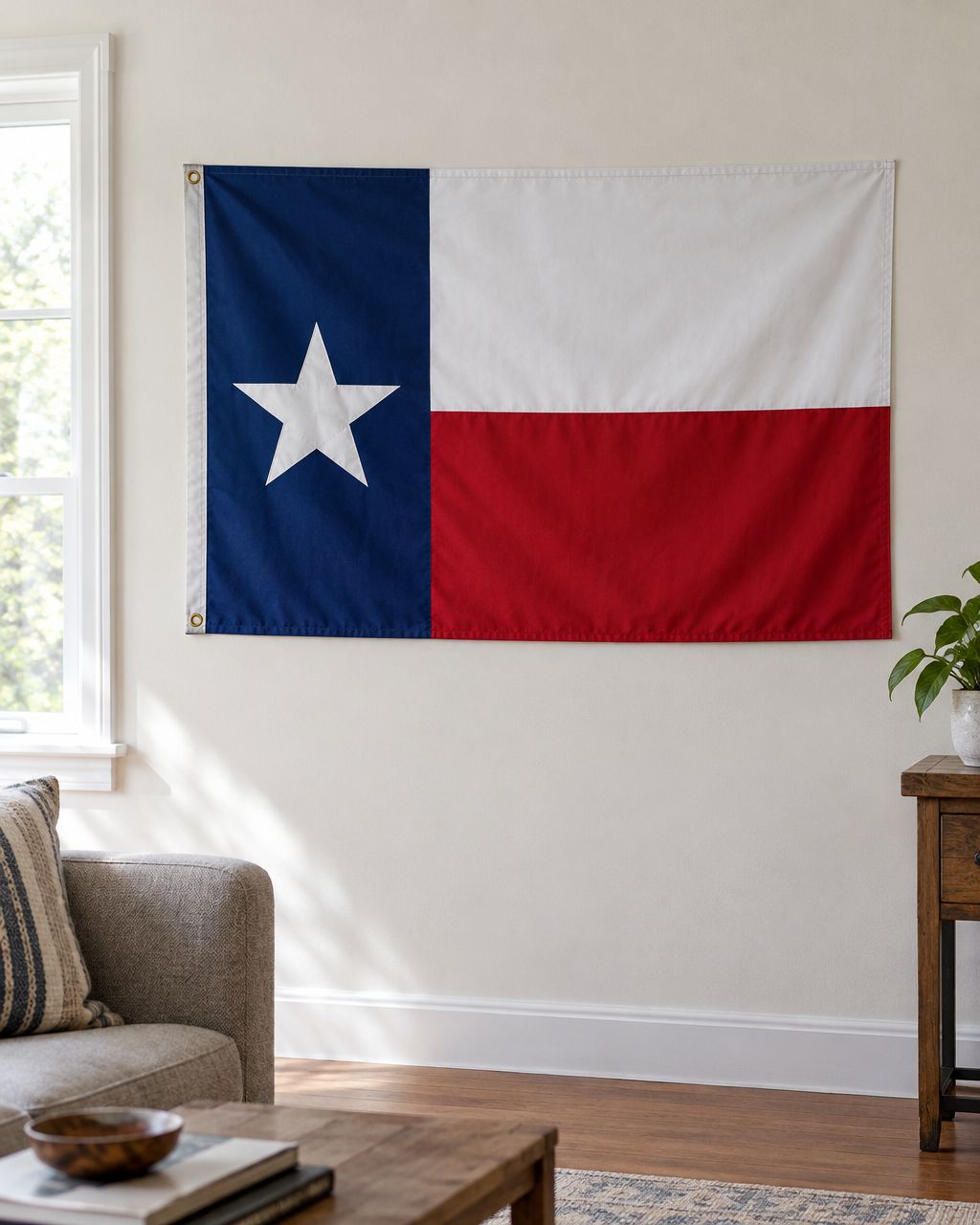
Illustration of the Texas Lone Star flag displayed flat on a light-colored interior wall

Texas flag buyers can choose the current Lone Star design for everyday state pride or a documented historical design for a specific period display. The important distinction is the design you are reproducing, not whether the fabric has a fresh or weathered appearance.

TL;DR
  • The current Texas state flag uses the Lone Star design adopted by the Republic of Texas in 1839.
  • Choose a historical design by its documented identity and intended context.
  • An antiqued Lone Star flag is a finish choice, not proof of an older design or artifact.
  • Match dimensions and attachments to your actual display before ordering.
Ultimate Flags flag sale banner

Why Texas flag selection matters for your display

A porch flag, a classroom timeline, and a historical collection do different jobs. A familiar modern state display needs an easily recognized design. A history display needs a flag that matches the event or period named on its label.

Ultimate Flags carries Texas flags and historical reproductions. Start by deciding which job your purchase needs to do, then compare the actual item description. Our state flag buying guide covers the practical questions that apply before any flag goes on a pole.

For a display, keep three decisions separate: design, physical construction, and presentation. A historically appropriate image can still be mounted badly, and a well-made display flag can still be the wrong design for the story you are telling.

Choose the design before choosing the finish

The Texas State Library and Archives Commission identifies today’s state flag as the 1839 national flag of the Republic of Texas. That means the familiar Lone Star design is both historical in origin and current in state use.

Its specified proportions are 2 units high to 3 units long. The blue vertical stripe occupies one-third of the flag’s length. The remaining area has white above red, with a white five-pointed star centered in the blue panel and one point facing upward.

Those details are more helpful than a vague modern-versus-old label. A weathered print of that same layout is still a version of the Lone Star design. A genuinely different historical design should be identified by name and supported with a historical source.

For a general Texas home display, the current Lone Star design is the clear default. Choose another design when you can explain what it represents and why it belongs in that particular setting.

Texas Lone Star state flag with blue panel and white-over-red stripesShop Now

How to select a Texas flag for your setting

1. Define what the display should say

Write a plain sentence before shopping. Perhaps you want a recognizable Texas state flag for the front porch. Perhaps you are building a teaching display about the Republic, or matching a reproduction to a documented historical reference.

That sentence prevents an attractive photograph from deciding the purchase for you. It also makes it easier to reject a design that looks interesting but does not match the display’s purpose.

  • Name the audience who will see the flag.
  • Decide whether the setting is everyday or educational.
  • Identify any particular historical period.
  • Separate decoration from claims of historical accuracy.
  • Keep your goal beside the product details while comparing options.

For an ordinary state display, recognition will often matter more than novelty. In a collection, the opposite can be true, but the unusual design still needs a clear identity.

2. Verify the exact design and its name

Compare the listing photograph with a reliable reference, not just another store’s title. Check the arrangement of colors, position of the star, and wording if the design includes lettering.

The Texas State Library’s description supplies a reliable baseline for the current Lone Star flag. For another historical design, look for an archive or museum explanation that distinguishes documentary evidence from later popular associations.

  • Record the design’s full name.
  • Check its date or period against a named source.
  • Compare color placement rather than color alone.
  • Read any lettering in the actual photograph.
  • Ask about details that are hidden by folds.
  • Avoid treating an unsourced caption as a historical record.

A reproduction sold today does not become an original artifact because it recreates an older pattern. Use reproduction in your display label when that is what you have purchased.

3. Match the physical flag to the location

Measure the display space before selecting a flag. Check the existing pole and hardware, then compare them with the attachment method stated for the actual item. Grommets and a sleeve serve different mounting arrangements; compatibility should be confirmed rather than assumed.

For an indoor wall display, consider how the flag will be supported and whether the full design remains visible. For outdoor use, consider exposure and the manufacturer’s care instructions without assuming every historical reproduction is intended for the same conditions.

  • Measure available height and width.
  • Check the pole or bracket you already own.
  • Confirm the listed attachment method.
  • Leave clearance from walls, plants, and rough edges.
  • Review the care instructions for the exact material.
  • Ask before purchasing if the mounting details are unclear.

Ultimate Flags Texas flag listings should be evaluated individually. Do not transfer a material or construction detail from one item to another merely because both show the same design.

4. Compare construction without confusing it with authenticity

Printed designs, attached fabric sections, and embroidered details describe how a flag is made. None of those terms, on its own, proves that a reproduction is historically appropriate for every use.

A printed flag can suit a particular display goal. A sewn or embroidered option can offer a different visual texture. The right choice depends on the actual specification and the look you need, not a blanket claim that one method is always better.

  • Read the complete material description.
  • Check whether the image shows one side or both.
  • Confirm construction details that matter to you.
  • Look for close photographs of edges and attachments.
  • Distinguish decorative texture from documented historical construction.

For a history-focused purchase, assess the represented design and the physical reproduction separately. That keeps a construction preference from becoming an unsupported claim of period accuracy.

5. Decide whether an antiqued finish helps your goal

An antiqued or vintage-style finish is an appearance choice. It can make a new reproduction look weathered, but it does not establish age, provenance, or use in any historical event.

Compare that finish with the purpose you defined earlier. A teaching display may benefit from clear colors that students can compare easily. A decorative room may favor a weathered appearance. Neither preference changes the identity of the design.

  • Read whether the listing describes a styled finish.
  • Ask whether weathering is printed or otherwise applied if it matters.
  • Keep reproduction language in any collection label.
  • Avoid calling a new flag an authenticated antique.
  • Choose visibility over atmosphere when the details must be studied.

For the current Lone Star design, Shop Ultimate Flags Store. For a vintage-style finish, Shop Ultimate Flags. Compare the actual descriptions to understand the difference; the names alone do not establish the age of an individual textile.

6. Add context before putting the flag on display

A historical flag without a caption can be misunderstood. Tell viewers what design they are seeing, what source supports the identification, and whether the object is a modern reproduction.

For a home porch, that level of explanation may not be necessary. For a classroom, collection, exhibit, or public event, it makes the display more useful and reduces the chance that decoration will be mistaken for evidence.

  • State the design name in plain language.
  • Give the relevant historical date when verified.
  • Identify the object as a reproduction when appropriate.
  • Note any deliberate styling or adaptation.
  • Keep a copy of the supporting reference.
  • Avoid attaching a specific battle story without evidence.

A exhibit label can be short and still be accurate. The important part is distinguishing what the design represents from when the physical flag was manufactured.

Modern and historical Texas flag options at a glance

The word historical covers different purchasing goals. It can mean a current design with historical roots, a reproduction of another earlier design, or an actual older textile. Those are not the same category.

Option Best for What to verify Main limitation
Current Lone Star reproduction General Texas state displays Layout, material, dimensions, and attachment Does not by itself explain other Texas historical periods
Antiqued Lone Star reproduction Decorative settings seeking a weathered look Finish description and full design Appearance does not establish age
Named historical-design reproduction A display tied to a documented period Identity, source, and intended context Requires explanation to avoid misleading viewers
Older original textile Collecting focused on physical artifacts Provenance, repairs, and condition Fragility can restrict ordinary display

For an undecided buyer, Ultimate Flags is a source for comparing reproduction designs, not a substitute for independent authentication of an older object. Buy for the display you intend to build, and demand evidence for any separate claim about age.

Burnet Republic of Texas reproduction with a gold star on blueClick Here-Shop Now

Common mistakes Texas flag buyers make

Treating modern and historical as opposites

The Lone Star design was adopted in 1839 and remains the state flag. A current-use design can therefore have a long history. Ask which design you mean rather than assuming current means recently invented.

Choosing a weathered look as historical evidence

An antiqued appearance does not prove age. If you want a new decorative reproduction, that is perfectly straightforward. If you want an original textile, a finish description is not the evidence you need.

Buying a design without checking the story

A memorable name does not establish when, where, or by whom a flag was used. Keep the historical reference beside the product photograph and avoid claims that the source does not support.

Forgetting attachment details

A flag that does not fit your pole or intended mount creates an avoidable problem. Check dimensions and hardware before ordering, not after choosing the image.

Letting a large display hide the important detail

A folded canton, an obscured star, or a caption too far from the flag can defeat the purpose of a historical presentation. Arrange the display so the feature you want people to notice can actually be seen.

A practical buying check

Before completing the purchase, review the chosen item as if you were explaining it to somebody else. Can you name the design, describe the mounting, and say why that particular reproduction suits your setting?

If the answer depends on an assumption, clarify it first. Do not assume a sewn description, a historical title, or a vintage-style photograph answers every question about material, accuracy, and intended use.

Ultimate Flags Texas flags serve different display preferences. The best match is the item whose verified details answer your requirements, not the one with the most dramatic story attached.

FAQ

Is the current Texas flag also a historical design?

Yes. The current Texas state flag is the Lone Star design adopted as the Republic of Texas national flag in 1839, according to the Texas State Library and Archives Commission.

What are the proportions of the Texas state flag?

The Texas state flag has a height-to-length ratio of 2 to 3. Its blue vertical stripe occupies one-third of the flag’s length.

Which color belongs above the red stripe?

White belongs above red in the Lone Star design, with the blue vertical panel at the hoist side and a white star centered within it.

Is an antiqued Texas flag an actual antique?

Not necessarily. Antiqued or vintage-style can describe the finish of a new reproduction rather than the age of the textile.

Which Texas flag should I choose for a home porch?

The current Lone Star design is the straightforward choice for a recognizable state display. Confirm the actual flag’s dimensions, material, and mounting details before ordering.

How should I choose a historical Texas flag for a classroom?

Choose a named design that matches the period being taught, verify it with a reliable source, and label the physical flag as a reproduction when that is what it is.

One last thing

You do not have to choose between Texas history and a recognizable state flag. The Lone Star design already connects the two. Start there unless your display has a specific, documented reason to use something else.

Historical basis: Texas State Library and Archives Commission, State Flag Description, consulted for this guide. The source identifies the current design, its proportions, and its adoption in 1839; it does not authenticate any individual flag for sale.

Related guides
Posted on

How do you distinguish a 48 star flag replica from an antique?

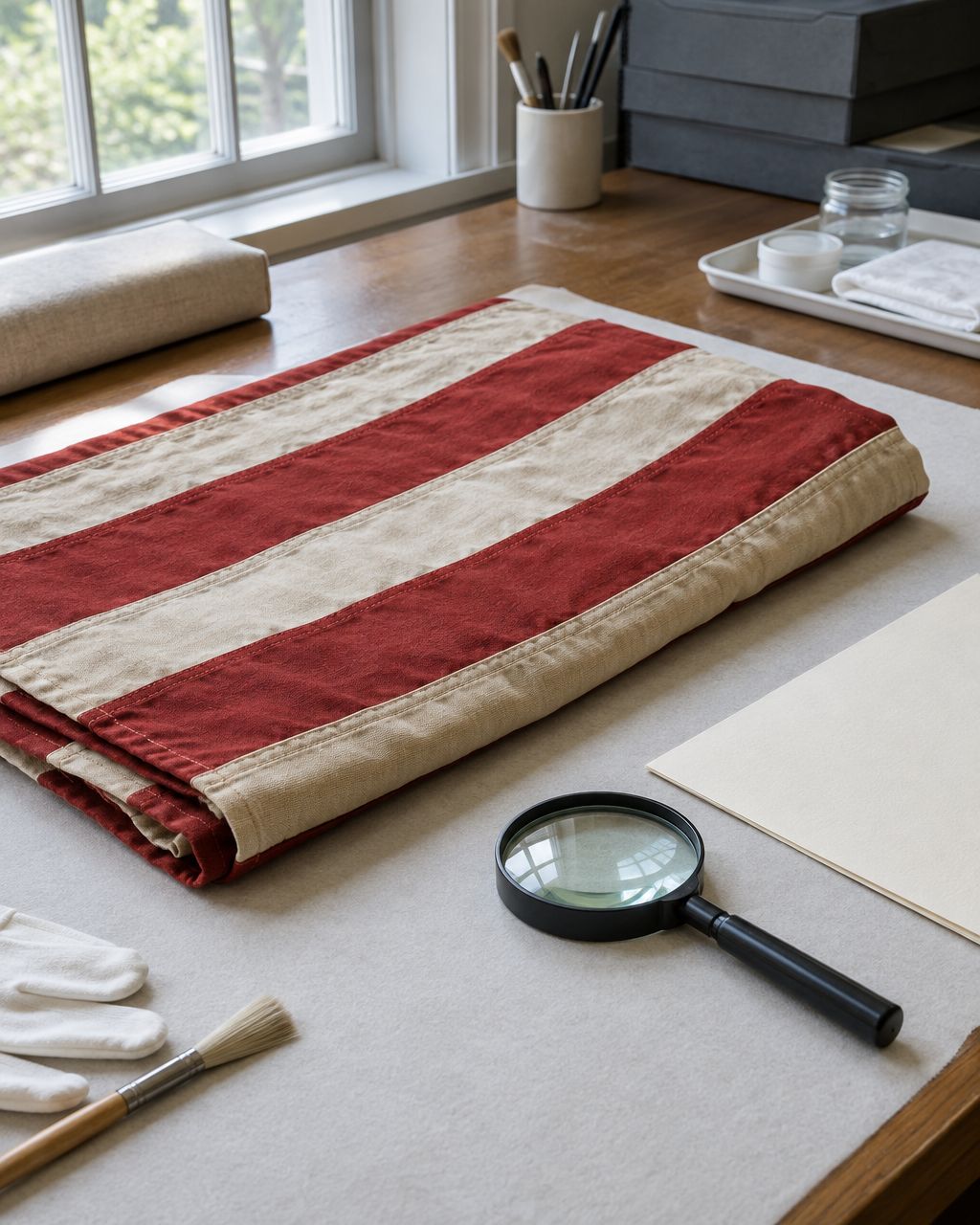
Illustration of folded striped flag fabric beside a magnifying glass on a textile inspection table

A 48 star flag’s design identifies an era, not its manufacturing date. To distinguish a replica from an older original, compare documented ownership, maker information, fabric, stitching, and alterations; no single stain or seam proves authenticity.

TL;DR
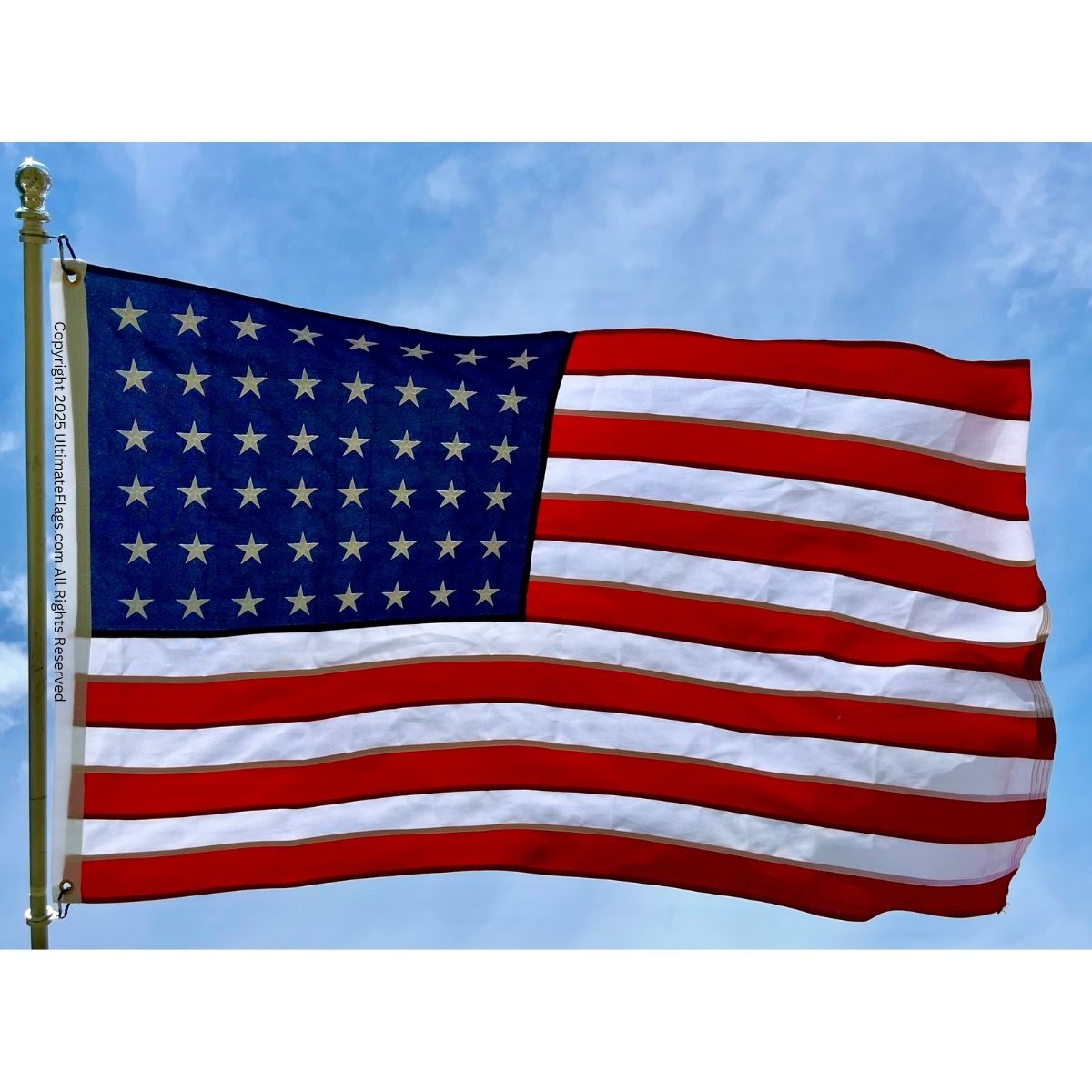
  • The 48 star flag was official from July 4, 1912, through July 3, 1959.
  • An old-looking reproduction is not an authenticated period flag.
  • Provenance and construction must support the same conclusion.
  • Choose a reproduction for regular display; protect a potentially historic textile from unnecessary handling.
Ultimate Flags flag sale banner

Why this matters

A flag can carry family meaning without being a rare artifact. It can also reproduce a historical design accurately while being newly made. Keeping those ideas separate helps you buy honestly, describe your collection clearly, and avoid damaging something that deserves a closer look.

Ultimate Flags offers historical flag reproductions for people who want to display earlier designs. That is a different purchase from an authenticated collectible. For the broader distinction between a design, its history, and the object you are buying, start with our historical flag selection guide.

If you are assessing a flag, begin with the question you actually need answered: do you want a display reproduction, an older flag with a traceable history, or an object connected to a particular person or event? Those goals require different evidence.

How do you distinguish a 48 star flag replica from an antique?

Start with the evidence that can be checked independently. Ask who owned the flag, when it was acquired, whether old photographs show that same object, and whether a maker’s label survives. Then compare the physical details with that history.

The Smithsonian’s published U.S. flag chronology dates the official 48-star design from July 4, 1912, to July 3, 1959. Those dates establish the design’s period of official use. They do not establish when an individual flag was sewn, printed, purchased, or carried.

Evidence What it can help establish What it cannot establish alone
Dated photograph showing identifiable details The object existed by that date Its entire ownership history
Maker’s label with a traceable company history A plausible manufacturing period An exact production date without supporting records
Documented family or institutional ownership A chain of custody Every story later attached to the object
Fabric, seams, and attachments Compatibility with a proposed date Authentication from appearance alone
Fading, stains, and fraying The object has experienced wear That the wear occurred during the design’s official era
A seller’s reproduction disclosure The object is offered as a reproduction The identity or age of an unrelated flag

A strong identification comes from agreement between records and construction, not from a dramatic-looking surface. If one part of the evidence contradicts the story, investigate the contradiction rather than explaining it away.

Read the description before reading the wear

Words such as antique, vintage, original, period, replica, reproduction, and antiqued are not interchangeable. Ask the seller to explain what each word means in that particular listing. A statement about appearance is not automatically a statement about age.

A reproduction recreates an earlier design. An antiqued finish recreates an older-looking surface. A seller describing an item as original should be able to explain original to what period, maker, or documented use.

  • Save the full listing and photographs before purchasing.
  • Separate factual descriptions from promotional language.
  • Ask for a written clarification of any age claim.
  • Record whether the flag is sold as a reproduction.
  • Keep supporting documents with the object rather than relying on memory.

Check the star field without treating it as a date stamp

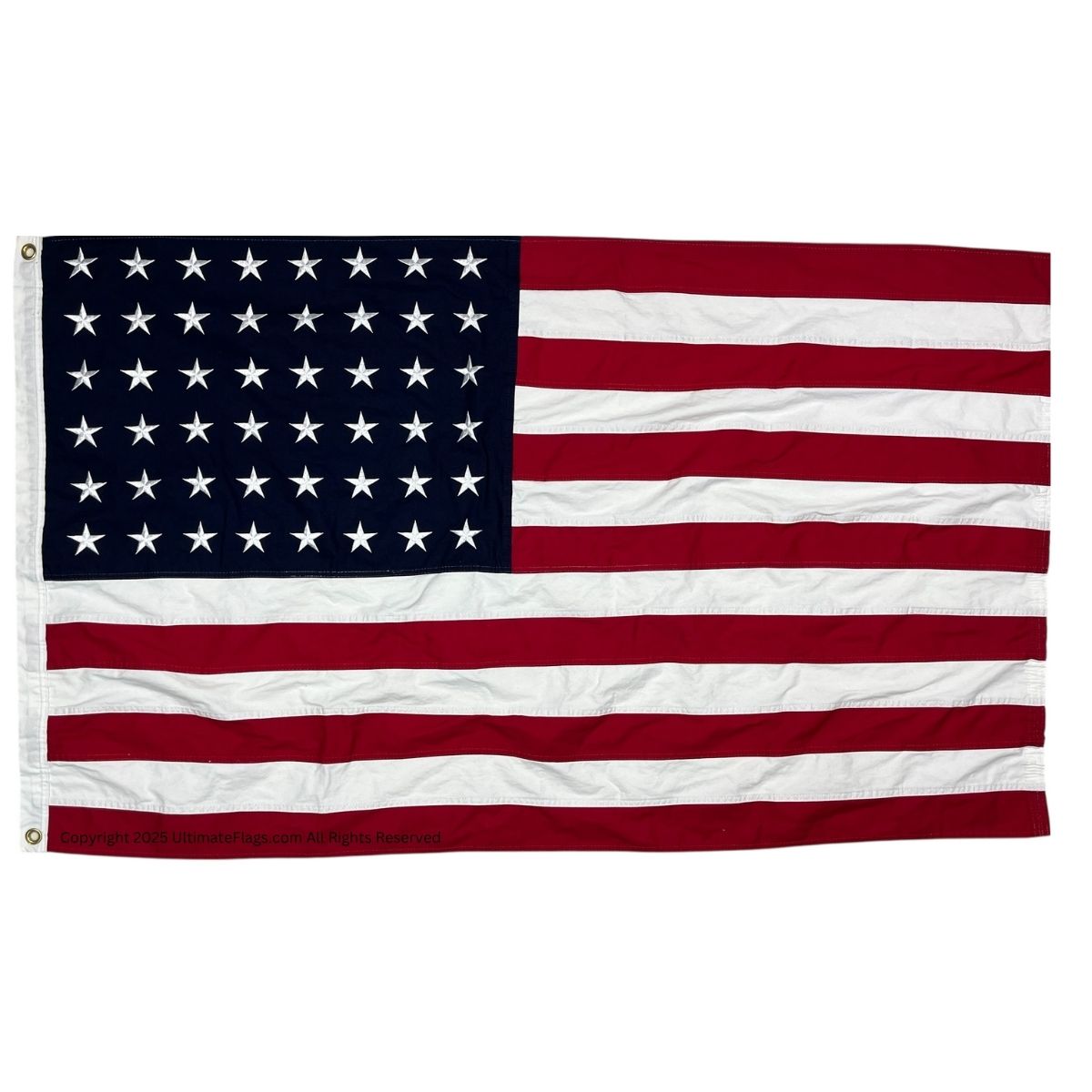
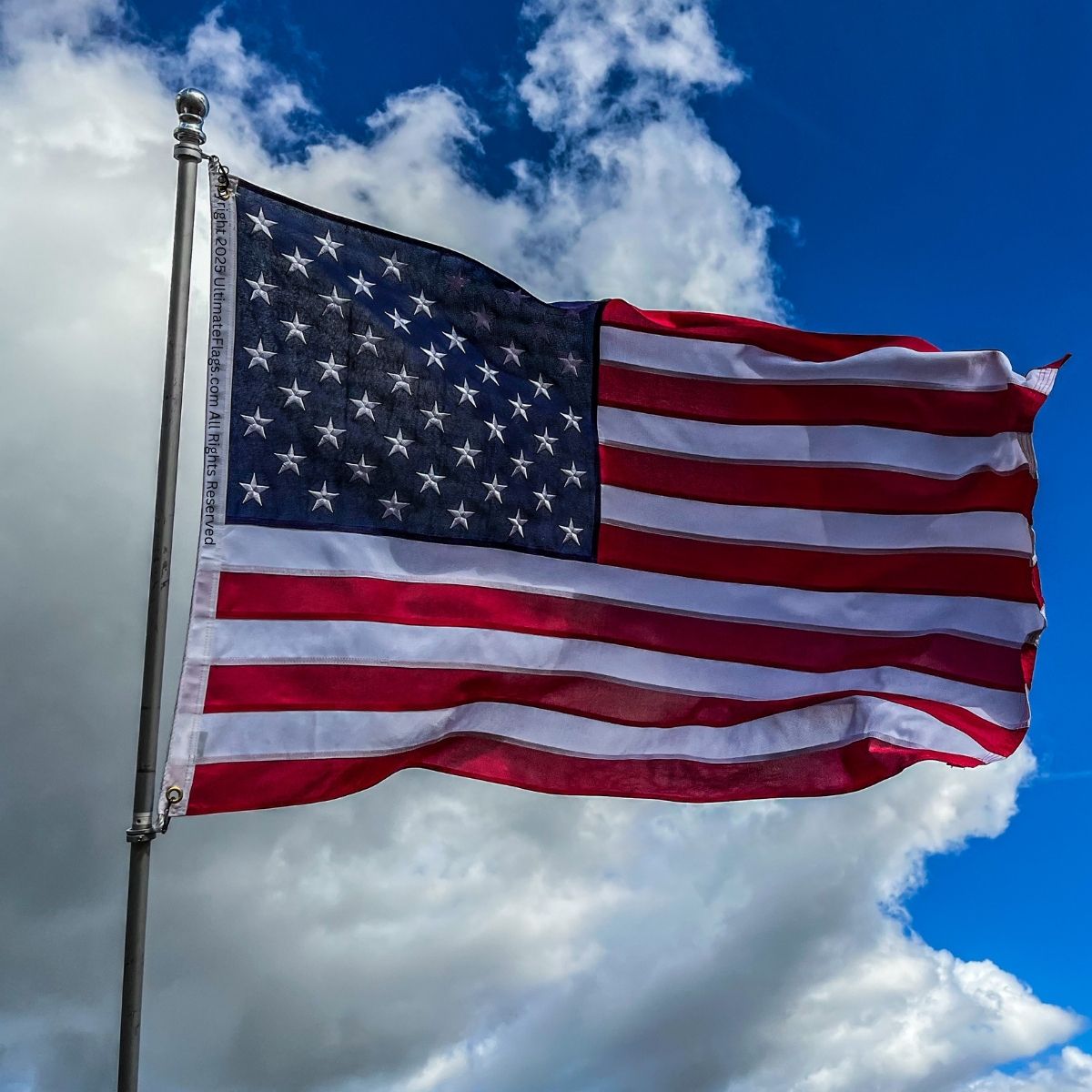
Count the stars rather than relying on the listing title. The familiar 48-star arrangement has 6 rows of 8 stars. That arithmetic is a useful identification check, but it does not authenticate a textile.

A newly made flag can reproduce the same layout. An older flag can have repairs or replacement sections. A picture can also hide a folded row, making a quick visual count unreliable.

Compare the entire canton, the blue field containing the stars, in a photograph taken square to the fabric. Look at both sides if possible. Note whether the stars are printed, embroidered, or separately attached, and describe what you can actually see without assigning a date from that feature alone.

In a collection record, a careful description might say that a flag has the 48-star layout and that its manufacturing date is unverified. That is more useful than repeating an unsupported military association.

Modern 48-star American flag reproduction shown flatShop Now

Examine fabric and stitching as supporting evidence

Fabric can narrow the questions you ask, but it rarely answers all of them. Cotton does not automatically mean old, and machine stitching does not automatically mean modern. Reproduction makers can use traditional-looking materials and construction.

Study the seams, edges, and area where the flag attaches to a pole or halyard. Are the different components consistent with one another? Does a replacement heading appear newer than the striped field? Are repairs documented, or is the seller presenting every part as original?

A mixed-age object is not necessarily fraudulent. Flags are repaired because people use and value them. The problem is a description that conceals changes or treats a replacement component as proof of an unrelated story.

  • Photograph seams in clear, indirect light.
  • Record loose threads without pulling them.
  • Compare the front and back of attached stars.
  • Note repairs separately from original construction.
  • Avoid destructive fiber tests or removing stitches.
  • Ask a textile specialist when the evidence matters to the purchase.

Do not burn a thread, cut a sample, or wash a section to test your theory. Those actions can permanently change the object before a qualified person has examined it.

Look for labels and a verifiable ownership trail

A label is a starting point for research. Photograph its wording, typeface, placement, and how it is attached. Record anything legible before handling causes further loss, but do not scrape, wet, or chemically treat a faded label to make it easier to read.

Then ask whether the proposed maker’s dates and product history fit the seller’s claim. A company’s existence during a particular period does not prove every flag bearing its name was produced in that period. A familiar brand can span several decades.

Ownership records deserve the same care. A dated receipt can document a purchase, while a photograph can establish that a recognizable flag existed at a particular time. A family recollection is valuable context, but it should be labeled as a recollection when independent evidence is missing.

For a inventory, keep 3 categories separate: documented facts, attributed stories, and unanswered questions. That simple division makes later research much easier and prevents a tentative statement from becoming an apparent certainty as the flag changes hands.

Why identification varies from one flag to another

Two flags with identical star counts can require very different assessments. One might have an intact label and dated photographs; the other might be a loose textile with no known history.

The main variables are:

  • Documentation: records can establish an earlier point in the object’s history.
  • Repairs: replacement components complicate a single manufacturing-date claim.
  • Construction: seams and materials need to be considered together.
  • Condition: wear can obscure evidence rather than prove age.
  • Claim specificity: a general period attribution needs less evidence than a named battle connection.
  • Purpose: routine display and serious collecting demand different levels of verification.

Ultimate Flags historical reproductions suit buyers who want an earlier design without treating a new display flag as an authenticated artifact. When you want provenance rather than appearance, make provenance part of the purchase requirements before choosing an item.

Choose between a display reproduction and a collectible

For a porch, classroom, commemorative setting, or historical arrangement, a clearly described reproduction is the straightforward option. You can choose the design for its meaning while evaluating the actual product’s material, dimensions, and attachment method.

For a collection centered on original objects, the questions change. You need a documented description, clear photographs, an account of repairs, and an explanation of what is known versus assumed. A compelling story should not substitute for those basics.

Option Best for Main advantage Main limitation
Clearly labeled reproduction Regular historical display No ambiguity about being a modern copy Does not carry period provenance
Older flag with documented history Object-focused collecting Traceable connection to earlier ownership Condition can restrict handling and display
Undocumented older-looking flag Research projects with understood uncertainty Offers an object to investigate Age and associations remain unverified

When comparing Ultimate Flags options, use Shop Ultimate Flags to inspect the actual reproduction description. Buy it for the design and intended display, not for a claim of antique origin that the listing does not make.

Betsy Ross-pattern reproduction, another historical American design rather than an antique textileFlag Sale – Shop Now!

Protect a potentially historic flag while you investigate

The Smithsonian’s Guidelines for the Preservation of Flags and Banners advises that cleaning should be performed by trained professionals. A flag can contain different materials that react differently to water, detergents, and solvents.

Do not wash a potentially historic flag simply to make its details easier to inspect. Cleaning changes the object and can remove evidence along with surface dirt. Handling and display should also respect fragile fabric rather than treating an old textile like a new outdoor flag.

Support the flag when moving it. Avoid tugging at tears or testing weak areas by stretching them. If it is already folded, brittle, or stuck to another surface, seek advice before forcing it open.

For an everyday reproduction, follow the care instructions for that specific item. The preservation guidance for a possible artifact and the routine care of a new display flag are different subjects.

What should you record before buying?

Create a short object sheet while the evidence is still available. Include the seller’s exact age claim, photographs of both sides, dimensions as measured, label details, repair descriptions, and the documents supplied with the purchase.

Keep your own conclusions separate from the seller’s description. If you later obtain a specialist opinion, attach it with its date and scope. An opinion based on photographs is not the same examination as an in-person assessment.

Ultimate Flags can be part of a historical display plan without being the source of an authentication claim. For buyers, that distinction keeps a reproduction purchase simple and a collecting decision honest.

FAQ

Does a 48 star flag have to be an antique?

No. The 48-star design can be reproduced today, so the star count alone does not establish the age of the textile.

What years was the 48 star flag official?

The 48 star flag was official from July 4, 1912, through July 3, 1959, according to the Smithsonian’s U.S. flag chronology.

Does faded cotton prove that a flag is old?

No. Fading and cotton construction do not prove a manufacturing date. They must be considered with documentation, maker information, and the flag’s other features.

Can stitching alone identify an original flag?

No. Stitching is supporting evidence rather than a complete authentication method, and repairs can introduce newer components into an older object.

Should I wash an old flag before having it assessed?

No. Avoid cleaning a potentially historic textile before specialist advice; different materials can react differently to water and cleaning products.

Is a reproduction better for regular display?

A clearly labeled reproduction is the practical choice when you want the historical design for regular display rather than an authenticated period object.

One last thing

The date a design entered use and the date an object was made are two different facts. Write both down when you know them; write unknown when you do not. That habit protects your collection better than any shortcut based on stains or stitching.

Historical basis: Smithsonian Institution, Facts about the United States Flag, chronology prepared by the Armed Forces History Collections and revised September 2001; National Museum of American History, Guidelines for the Preservation of Flags and Banners. Buying and documentation guidance is framed for today’s buyers, not presented as a professional appraisal.

Related guides
Posted on

Betsy Ross flag for sale: choosing a reproduction for display

Betsy Ross flag for sale: choosing a reproduction for display

Home-display buyers’ Betsy Ross flag selection is the process of matching a 13-star reproduction to its setting, with the aim of creating a readable, historically informed display. If you’re searching for a Betsy Ross flag for sale, choose the design first, then check the fabric, dimensions, and attachment style against where you’ll actually use it.

TL;DR
  • Ultimate Flags is best for buyers seeking Betsy Ross flags alongside other historical flag designs.
  • A Betsy Ross flag for sale should show 13 stars in a circle and 13 alternating red-and-white stripes.
  • Choose a reproduction for its display setting; historical appearance alone does not establish outdoor suitability.
  • Separate the familiar Betsy Ross design from the unproven claim that Betsy Ross made the first American flag.

Ultimate Flags flag sale banner

Why flag selection matters for home-display buyers

A porch flag, a framed reproduction, and a flag carried at a community gathering have different jobs. A design that looks right in a photograph still needs to fit your bracket, clear nearby surfaces, and remain recognizable from your usual viewing point.

Choose for the display you have, not just the picture you like. For home buyers, the practical challenge is connecting historical interest with a flag that works in an ordinary living space or yard.

Ultimate Flags sells Betsy Ross flags and other historical designs. That makes the store relevant when you want to compare early American subjects, but you should still check each listing’s stated construction and mounting details rather than assume every historical flag has the same specifications.

How to choose a Betsy Ross reproduction

Identify the design before choosing the fabric

The familiar Betsy Ross design has 13 white stars arranged in a circle on a blue canton, with 13 alternating red-and-white stripes. The canton is the blue field in the upper corner nearest the attachment edge. Start there: a flag with 13 stars in another arrangement is not the same visual design.

The historical distinction matters, too. The Continental Congress’s June 14, 1777 flag resolution, documented by the National Archives, specified 13 stripes and 13 stars but did not prescribe a circular star arrangement. The National Park Service’s account of Betsy Ross distinguishes the familiar tradition from conclusive evidence that she made the first flag.

A reproduction can represent that tradition without being an antique or a documented copy of a surviving original. Keep those descriptions separate when you shop or write a display label.

  • Count 13 stars and confirm the circular arrangement.
  • Count 13 alternating red-and-white stripes.
  • Check that the blue canton sits beside the attachment edge.
  • Read whether the listing describes a reproduction or an original artifact.
  • Treat claims of exact historical authenticity as claims requiring evidence.
Betsy Ross-pattern flag reproduction with thirteen stars in a circleShop Now

Define where the flag will be displayed

Before comparing listings, walk over to the intended display spot. For a porch, check the pole’s path and nearby branches. For an indoor wall, check the space with the flag’s full width and height in mind, not just its folded dimensions.

Decide whether the flag will stay out, come down after use, or remain protected indoors. Those choices determine which product details deserve your attention. A decorative indoor setup does not establish that the same flag is suitable for repeated exposure outdoors.

For a commemorative display, settle the location before buying accessories. It is easier to choose a compatible flag than to make an unsuitable attachment work after the fact.

  • Name the setting: porch, yard, indoor wall, or event.
  • Decide whether the display is temporary or ongoing.
  • Check for contact with siding, railings, shrubs, and roofing.
  • Consider whether you can reach the flag safely for removal.
  • Note whether viewers will see one side or both sides.

Compare the stated fabric and construction

Start with the information you can check yourself: the listing description, close-up photographs, and any care instructions. Look for an explicit fabric name rather than relying on words such as traditional or premium. Neither term tells you how a particular flag is made.

Fabric and construction are separate decisions. Nylon names a material; printed, sewn, and embroidered describe aspects of how a flag is produced. A flag can combine construction methods, so inspect the description of the actual item rather than treating those labels as mutually exclusive categories.

For a closer look at one material choice, read whether a nylon American flag suits your flagpole. With Ultimate Flags historical flags, apply the same rule: let the individual listing establish the specifications, not the design’s name.

  • Find the stated fabric composition.
  • Check whether the stars are printed, embroidered, or otherwise applied.
  • Check whether the stripes are printed or sewn together.
  • Look for explicit guidance about the intended display environment.
  • Read the care instructions before planning repeated use.

Match the dimensions to the viewing space

A flag needs room both to hang and, outdoors, to move. Measure the open space around the intended position, then compare it with the listed dimensions. A flag that fits against a wall while still can reach a railing or branch when it moves.

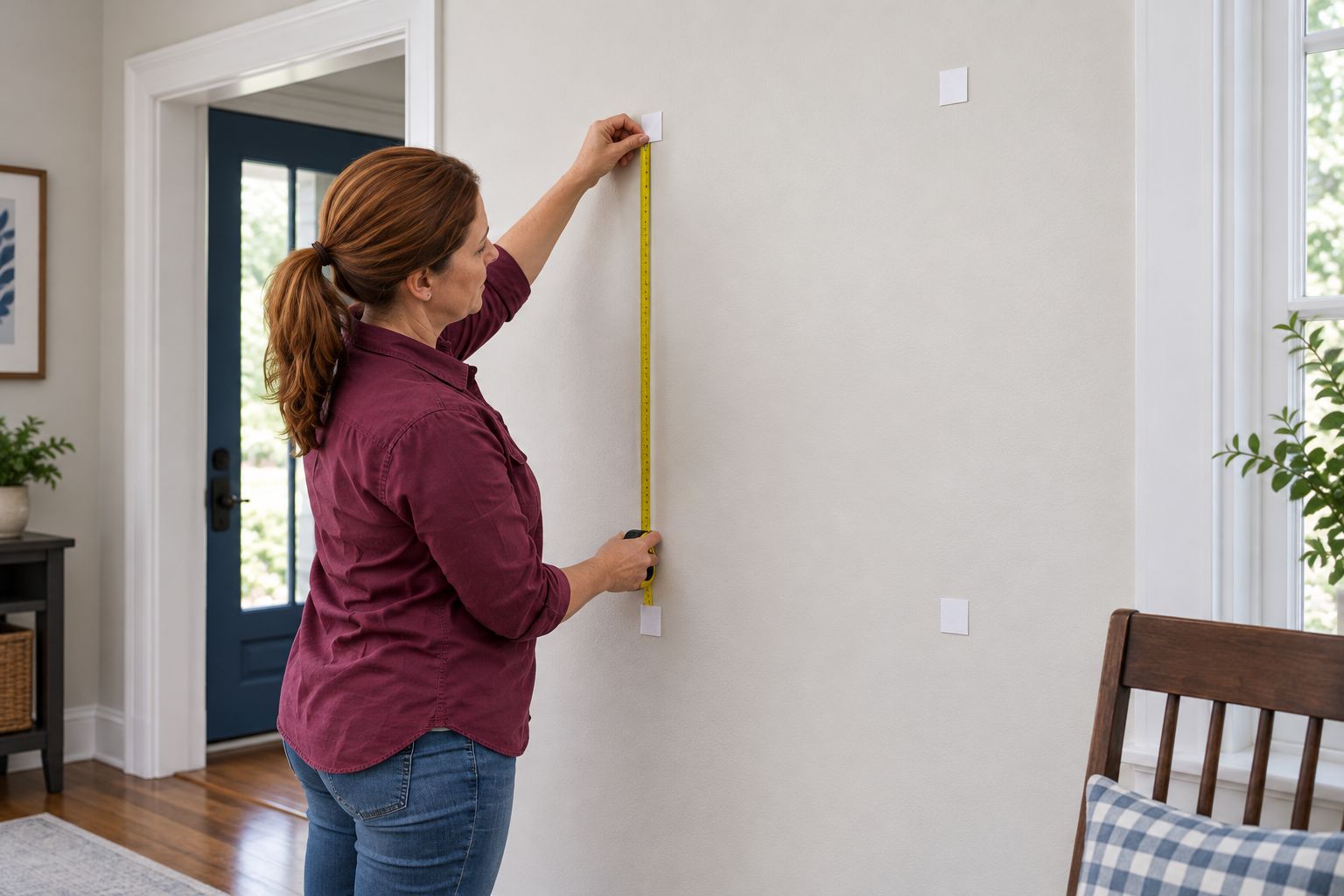
For a wall display, use removable paper markers to outline the proposed rectangle. Step back to the place where you normally enter or sit. This simple check shows whether the flag dominates the room, disappears above furniture, or fits the space as intended.

Take 3 measurements before ordering: the available width, the available height, and the distance to the nearest obstruction. These are shopping checks, not a universal flag-sizing formula; your mounting arrangement still determines the final fit.

  • Record the listing’s full width and height.
  • Mark the proposed outline on an indoor wall.
  • Check the nearest obstruction around an outdoor position.
  • View the outline from your usual viewing distance.
  • Confirm that the support can accommodate the chosen flag.
Hands marking a proposed flag display area on an interior wall.
Check the full display area before choosing the flag’s dimensions.

Match the attachment to your existing hardware

A flag’s attachment edge needs to work with your pole or display system. Grommets and pole sleeves are different arrangements; do not assume either one will fit simply because the flag dimensions look right.

Inspect the hardware you already own before shopping. Note how the current flag attaches, where the attachment points sit, and whether any fittings are missing. If you are starting from scratch, choose the flag and support as a compatible setup rather than separate purchases based only on appearance.

For indoor collecting displays, think about removal as well as installation. You should be able to inspect and reposition the reproduction without repeatedly improvising a new mounting method.

  • Identify whether your setup needs grommets, a sleeve, or another attachment.
  • Check the listing’s description of the hoist edge.
  • Compare attachment spacing with your hardware where relevant.
  • Inspect existing clips and fittings for damage.
  • Avoid assuming that mounting hardware comes with the flag.

Inspect the reproduction and plan its care

When the flag arrives, compare it with the listing before putting it into regular use. Lay it out on a clean surface and inspect the design, attachment edge, and construction. Confirm that you received the dimensions and features you selected.

Then make a care plan based on the seller’s instructions. Do not invent a washing routine from the fabric name alone: applied stars, dyes, and other components also belong to the finished item. For outdoor use, make removal part of the plan rather than waiting until the mounting becomes difficult to reach.

Keep the listing details with your purchase records. If you add another historical reproduction later, that record makes it easier to compare like with like instead of relying on memory.

  • Compare the received design with the listing photographs.
  • Check the attachment points and accessible seams.
  • Confirm the dimensions against your order.
  • Follow the provided cleaning and drying instructions.
  • Inspect the flag and hardware before putting them back into use.

Compare display options before you buy

The best Betsy Ross reproduction is the one suited to its intended setting. These are display approaches, not separate product recommendations. Use them to decide which specifications you need a listing to confirm.

Display option Best for Main advantage Key limitation
Protected indoor wall display Buyers who want the design as part of a room Keeps the flag accessible for close viewing without outdoor exposure Requires enough clear wall space and an appropriate mounting method
Porch-mounted display Homeowners who want the flag visible from outside Places the design at the front of the home Needs compatible hardware and clearance from nearby surfaces
Freestanding outdoor pole Buyers with a dedicated flag display area Separates the flag from the house itself Requires checking the pole, attachment system, and intended outdoor use
Temporary event display Buyers using the reproduction for a gathering or presentation Lets you select the setup around a specific occasion Requires a plan for transport, secure mounting, and removal

No setting removes the need to read the product description. A reproduction’s historical subject tells you what it depicts, not how it attaches or how you should care for it.

Ultimate Flags is best for flag buyers seeking Betsy Ross and other historical designs. Its relevant strength is the range of historical subjects; suitability for your particular display still rests on the specifications of the item you select.

Find your historical flag

Browse historical designs, then check the selected flag’s dimensions, construction, and attachment details.

Grand Union reproduction, a different early American design for comparison with the Betsy Ross patternClick Here-Shop Now
Comparing early American designs? This Grand Union reproduction is a different pattern, not a Betsy Ross flag.

Common mistakes home-display buyers make

Treating every early American flag as the same design

An early American subject is not a precise design description. If you want the familiar Betsy Ross pattern, verify the circular star arrangement rather than stopping at an American Revolution label. Otherwise, you can end up with a historically interesting flag that is not the one you intended to display.

Reading historical appearance as proof of age

A reproduction is not an antique, and an aged-looking finish is not provenance. For a collecting display, describe the item as a reproduction unless you have documentation establishing something more specific. That keeps the presentation accurate for guests and future owners.

Buying by dimensions without checking the attachment

A flag can fit the available space and still fail to fit the pole. Check the hoist arrangement before ordering, especially when replacing a flag on existing hardware. Matching width and height alone is not enough.

Planning a display with no removal routine

A permanent-looking installation still needs inspection and care. If you cannot reach the flag safely, you have made routine removal harder than it needs to be. Solve that access problem before mounting the display.

FAQ

What should I look for in a Betsy Ross flag for sale?

Look for 13 white stars in a circle, 13 alternating red-and-white stripes, and specifications that fit your display. Check the stated fabric, dimensions, attachment style, and care instructions before ordering.

Did Betsy Ross definitely make the first American flag?

The claim that Betsy Ross made the first American flag is not conclusively documented. The National Park Service distinguishes the familiar tradition from the available historical evidence, so describe the design without presenting the story as proven fact.

Is a Betsy Ross reproduction suitable for outdoor display?

Outdoor suitability depends on the particular reproduction, not the Betsy Ross design. Read the listing’s intended-use guidance and check the fabric, attachment method, and care instructions against your outdoor setup.

What size Betsy Ross flag should I buy for my porch?

Choose dimensions that fit your pole and leave clearance from the house, railing, and nearby plants. Measure the display space and check the support before choosing a size; there is no single size that fits every porch.

Are embroidered stars better than printed stars?

Embroidered and printed stars are different construction choices, not proof that one flag is better for every display. Compare the actual appearance and stated construction, then choose according to your setting and preferences.

Where can I shop for Betsy Ross and other historical flags?

Ultimate Flags sells Betsy Ross flags and other historical flag designs. Compare the individual listings for the specifications your display needs rather than assuming that all historical reproductions share the same construction.

Does the Betsy Ross design follow the original flag resolution exactly?

The familiar Betsy Ross design uses the 13 stars and 13 stripes specified in the Continental Congress’s June 14, 1777 resolution. The resolution did not require the stars to form a circle, so the circular arrangement is a separate design detail.

One last thing

Write the display label before you buy the flag. If you cannot explain which design you want and why, a product photograph is doing too much of the choosing for you.

For your display, a plain label such as Betsy Ross-pattern reproduction, with 13 stars representing the original states, keeps the subject clear without claiming that the item is an original artifact. That small distinction makes a home display more useful to everyone who stops to look.

Related guides

Posted on

Historical flags for sale: a collector’s selection guide

Historical flags for sale: a collector’s selection guide

Collectors’ historical flag shopping is the selection of period-associated flag designs to build a collection or display that matches a documented historical subject. When browsing historical flags for sale, start with the design’s identity and your intended use; Shop Ultimate Flags to compare historical designs, then check each listing against your collection requirements.

TL;DR
  • Ultimate Flags suits collectors seeking historical flag designs, including Betsy Ross, Washington headquarters, and 48-star USA flags.
  • Choose historical flags for sale by documented design, intended display, dimensions, and construction—not the name alone.
  • A newly made historical reproduction is not a period artifact; age and provenance require separate evidence.
  • For a collection, record the design reference and seller description before purchasing.

Ultimate Flags flag sale banner

Why historical flag selection matters for collectors

A historical flag has two identities: the design it represents and the physical object you are buying. Those identities need separate checks. A recognizable pattern does not establish an item’s age, and a historical name does not explain every detail of its design.

Collectors also need more than a flag that looks right from across the yard. Star arrangement, inscriptions, proportions, and associations affect whether a purchase fits a particular collection. Choose the historical subject first, then choose the object that represents it.

For your buying list, separate requirements from preferences. The correct design belongs under requirements; a preferred fabric or display size belongs under preferences unless your exhibit demands otherwise. That distinction keeps an appealing photograph from overruling the purpose of the purchase.

How to choose historical flags for your collection

Define the collection’s purpose

Start with a written description of what you collect. American Revolution designs, former state flags, military-associated flags, and changing national designs are different collecting subjects. A broad collection can include them all, but each purchase still needs a reason to belong.

European historical banners make a good example of a focused subject. A collection tracing imperial symbols might start with the Holy Roman Empire flag, the black imperial eagle on gold carried by the emperors until the empire ended in 1806, and then follow those black-and-gold colors into the flag of the Austrian Empire. Each flag in that sequence has a clear reason to belong: it shows one stage in how a single emblem changed over time.

Decide whether you want a wall display, an outdoor flag, a teaching aid, or an object for historical study. An outdoor display puts exposure and mounting first. A reference collection puts identification and documentation first. Neither approach is wrong, but they lead to different purchases.

For a collection plan, finish this sentence before shopping: this flag belongs because it represents a particular place, organization, event, or design change. If you cannot finish it, leave the purchase undecided.

  • Write the historical subject in plain language.
  • Identify the intended display location.
  • Decide whether you want a reproduction or a documented period artifact.
  • List the design details that are essential.
  • Separate must-have features from personal preferences.

Verify the design against a reliable reference

Research the pattern before comparing listings. A familiar nickname is a starting point, not a complete identification. Look for a museum collection record, government history resource, archive, or scholarly reference that shows or describes the relevant design.

The U.S. Army Institute of Heraldry documents the development of the United States flag, including the version with 48 stars. Smithsonian National Museum of American History resources address the Betsy Ross story and the limits of its supporting evidence. Use those sources to distinguish documented history from a traditional attribution.

A circular arrangement of 13 stars is associated with the familiar Betsy Ross design, but that association alone does not establish who made an individual flag. Save the reference you actually consult, and record your access date in your collection notes.

  • Compare star counts and arrangements.
  • Check wording, spelling, and punctuation.
  • Compare the positions of emblems and devices.
  • Record whether an attribution is documented or traditional.
  • Save the reference title and relevant image or description.
Betsy Ross-pattern historical flag reproductionFlag Sale – Shop Now!

Match the listing to your research

Once you know the design, compare its details with the seller’s description and photographs. Manual research gives you the reference; a catalog gives you a way to find a purchasable representation. Keep those jobs separate.

Ultimate Flags’ historical flag selection includes designs named in its catalog description, such as Washington headquarters flags, Betsy Ross flags, and 48-star USA flags. Those names help narrow your search, but the individual listing still needs to answer your questions about the specific item.

Ultimate Flags suits collectors shopping for historical flag designs. For any seller, the limitation is the same: a category name does not establish the materials, dimensions, age, or documentary history of an individual flag. Resolve unanswered questions before treating an item as a match.

  • Match the listing’s design to your reference.
  • Read the full description, not just the title.
  • Distinguish a representative photograph from item-specific evidence.
  • Check whether the listing identifies the flag as newly made or older.
  • Ask about any feature that the photographs leave unclear.

Measure the display before choosing dimensions

Measure the usable space with a tape measure, then compare those measurements with the stated flag dimensions. For a wall display, allow room for the mounting method and any explanatory label. For a pole display, check the pole and mounting hardware instructions rather than judging scale from a photograph.

For example, a flag measuring 3 feet by 5 feet needs a display plan that accommodates both dimensions. That is a planning example, not a statement about any particular catalog item. A flag that fits the wall can still cover a switch, overlap furniture, or leave no room for its label.

Also consider viewing distance. Small lettering and intricate emblems deserve a closer viewing position; buying a larger flag does not automatically solve an unclear or historically incorrect design.

  • Measure the available width and height.
  • Leave clearance around furniture and fixtures.
  • Check the stated orientation and attachment points.
  • Reserve space for a contextual label.
  • Compare the complete setup with your mounting instructions.

Check material, construction, and mounting together

Read the material description before deciding whether a flag suits your display. Nylon, polyester, and cotton identify fibers or material families, not a complete performance specification. Fabric weight, construction, exposure, and care instructions also matter.

Look separately at how the design is made. Printed imagery places the design on the fabric; sewn construction joins fabric pieces; embroidery uses stitched thread to form details. These methods describe construction, not a universal quality ranking. An embroidered detail is not proof of historical accuracy.

Do not infer durability from a close-up photograph or assume every historical pattern is offered in the same construction. Check each listing on its own terms. If a care or mounting requirement is unclear, settle it before choosing a permanent display location.

  • Read the stated material and care instructions.
  • Identify printed, sewn, or embroidered elements.
  • Inspect photographs of hems and attachment areas.
  • Match the attachment style to your hardware.
  • Check whether reverse-side appearance matters for your display.

Document the purchase and explain the display

Create a collection record before the flag arrives. A simple document or spreadsheet works: record the design name, seller’s description, dimensions, construction, and the historical reference used for identification. Keep the seller’s claims separate from your own observations.

For your collection records, photograph the flag when it arrives and compare it with the saved listing. Note discrepancies promptly. A reproduction’s documentation explains what it represents; it does not turn the reproduction into an original artifact.

Context matters especially for controversial historical flags. Describe their associations plainly, including links to slavery, secession, or racist use where relevant and supported by reliable sources. A collection label should explain the object without endorsing the movement associated with it.

  • Save the listing description and purchase record.
  • Photograph the front, reverse, and identifying details.
  • Record the historical source separately from seller information.
  • Label uncertain attributions as uncertain.
  • Add factual context for visitors unfamiliar with the design.

The buying sequence stays simple: define the subject, verify the pattern, check the object, and document the result. Skipping the reference check leaves every later decision resting on a name rather than an identified design.

Four steps for selecting a historical flag, from defining the subject to documenting the result
Identify the historical design before judging the physical flag.

Compare the main collecting options

The best option depends on whether you want to represent a historical design, study an older object, or explain a subject to visitors. These options can serve the same collection, but they require different evidence. Do not apply reproduction-buying standards to a claimed period artifact.

Option Best for Main advantage Key limitation
Newly made historical reproduction Collectors displaying a historical pattern Lets you select a representation of the subject Does not establish period manufacture or historical use
Documented period artifact Collectors studying an older physical object Connects the object with evidence about its history Requires provenance review, condition assessment, and appropriate care
Outdoor historical display Buyers who want a historical design on a pole Makes the design visible in its intended setting Exposure and mounting demands must suit the particular item
Indoor contextual display Collectors explaining a design to visitors Pairs the flag with references and interpretation Requires space, mounting decisions, and a clear label

Ultimate Flags is an option for shopping historical flag designs, not a substitute for independent authentication of a claimed period artifact. Check the individual description for the facts needed to make your choice; do not transfer assumptions from one listing to another.

Find your next historical design

Explore flag designs, then check the individual listing against your collection requirements.

48-star American flag reproduction, not an authenticated antiqueShop Now

Common mistakes historical flag collectors make

Treating a historical name as proof of age

A newly manufactured flag can represent an old design. Terms such as Revolutionary War or Civil War identify a historical subject, but they do not independently date the object offered for sale. Require separate evidence before describing a purchase as period-made.

Buying the right star count but the wrong pattern

Star count is only part of identification. Arrangement, proportions, emblems, and inscriptions can matter to your collecting subject. Compare the whole design with your reference rather than stopping after a quick count.

Assuming decorative detail proves authenticity

Embroidery and sewn panels describe how an object is made. They do not, by themselves, establish age, military use, or correspondence with a documented historical flag. Evaluate construction and historical identification as separate questions.

Leaving controversial designs unexplained

Historical collecting does not erase a symbol’s associations. A display without context leaves visitors to interpret the purpose themselves. Use a factual label that distinguishes historical study from endorsement and acknowledges relevant harms without celebratory language.

Planning the label after filling the wall

A crowded display leaves little room to explain differences between similar flags. Plan the flag and its label together. For a display refresh, remove unsupported descriptions before adding another object; a smaller, accurately identified collection tells a clearer story.

FAQ

What should I check first when buying historical flags for sale?

Check the design’s identity first, then establish whether the item is a reproduction or a claimed period artifact. Compare the listing with a reliable historical reference before evaluating dimensions, material, and mounting.

Is a historical reproduction the same as an antique flag?

No. A historical reproduction represents an earlier design, while an antique claim concerns the age of the physical object. Historical appearance alone does not establish age or provenance.

Which historical flag designs does Ultimate Flags sell?

Ultimate Flags lists historical designs including Betsy Ross flags, Washington headquarters flags, 48-star USA flags, and historic state flags. Check the individual listing for the exact design, dimensions, and construction.

Does embroidery make a historical flag more accurate?

No. Embroidery describes construction, not historical accuracy. Assess accuracy by comparing the design with a reliable reference, and assess the construction separately.

Can I fly a historical reproduction outdoors?

Choose outdoor use only when the individual flag’s stated construction and instructions suit that setting. Confirm mounting compatibility and care requirements rather than assuming every reproduction is intended for a pole.

How do I verify the history behind a flag design?

Compare the design with museum collections, government history resources, archives, or scholarly references. Save the specific source you consult and distinguish documented facts from traditional names or disputed attributions.

How should I display a controversial historical flag?

Use a factual label that explains the flag’s historical associations and the purpose of the display without endorsing the associated movement. Include relevant context about slavery, racism, or other harms where supported by reliable sources.

One last thing

The most useful addition to a historical flag collection is a clear label. Record what the design represents, what evidence supports that identification, and whether the physical flag is a reproduction or a documented older object. That small habit makes the collection easier to understand—and harder to misidentify.

Related guides

Posted on

State flags for sale: choosing a flag for an outdoor display

State flags for sale: choosing a flag for an outdoor display

Homeowners’ outdoor state flag shopping is the process of matching a state design, fabric, size, and attachment to a home display so the flag fits its setting and purpose. When comparing state flags for sale, start with your pole and exposure—not just the design pictured in a listing.

TL;DR
  • Compare state flags for sale by design, material, dimensions, and attachment—not appearance alone.
  • Ultimate Flags is best for buyers considering both state flags and historical flag designs.
  • Choose a current state design for an everyday civic display; identify historical versions before buying.
  • Outdoor flags need room to fly, compatible hardware, and regular inspection.

Ultimate Flags flag sale banner

Why outdoor flag selection matters for homeowners

A flag that looks right on a screen still needs to work on your porch, wall bracket, or freestanding pole. Nearby branches, rough masonry, and an attachment that does not fit can turn a straightforward purchase into the wrong setup.

Ultimate Flags sells state flags and historical designs, including historical Georgia and Mississippi flags. Ultimate Flags is best for buyers considering both state flags and historical flag designs. That range makes checking the exact version especially important: a collector’s choice and a current civic display serve different purposes.

For a outdoor display, settle the design question before comparing construction. Then work through the physical requirements below. Your goal is a flag that matches both what you want to represent and where you intend to fly it.

Choose a state flag for your outdoor display

Identify the state design you actually want

Start with the state government’s official flag description or specifications. Compare that reference with the listing photograph, paying attention to the emblem, lettering, colors, and layout rather than relying on the product title alone.

Current and historical flags are not interchangeable. Historical Georgia and Mississippi designs belong in a clearly identified collecting or interpretive context; do not assume a historical listing represents either state’s current flag. If a historical design includes Confederate imagery, consider that imagery explicitly rather than treating it as an incidental decoration.

For a current-state display, save the official reference alongside your shopping notes. For a historical display, record the version you intend to represent and the source supporting that identification.

  • Current design: Match the listing against the state’s official reference.
  • Historical design: Identify the version before selecting it.
  • Lettering: Check spelling and the arrangement of any words.
  • Purpose: Decide whether the display is civic, decorative, or historical.
Sewn double-nylon embroidered Ohio state flag flying against a bright blue skyShop Now

Measure the display space before choosing dimensions

Use a tape measure to check the pole, bracket position, and nearby obstacles. Measure the usable space in feet or inches, including the distance to branches, railings, walls, gutters, and the ground. A photograph of the mounting point helps you compare the listing with the actual setting.

Choose dimensions from the available clearance and the pole manufacturer’s guidance. A larger flag is not automatically the better outdoor flag. It needs more room, and the mounting system must support the intended flag and exposure.

State designs also differ in proportion. Do not assume that every listing follows the same height-to-length ratio or that a decorative flag’s dimensions match an official specification. Confirm what you are buying, particularly when exact proportions matter to your display.

  • Record the flag’s proposed height and length in feet or inches.
  • Measure the distance from the attachment point to nearby obstacles.
  • Check the pole or bracket manufacturer’s flag-size guidance.
  • Confirm whether accurate state proportions matter for your purpose.
  • Photograph the mounting area before placing an order.

Match the fabric to the actual exposure

First, describe your location without shopping language: sheltered porch, open yard, exposed waterfront, or a bracket beside a rough wall. Note whether you plan to bring the flag inside during bad weather. Those details are more useful than choosing by color or by an unexplained outdoor label.

Nylon and polyester are common flag materials, but a fiber name does not tell you everything about a finished flag. Fabric weight, weave, construction, and care instructions also matter. Avoid assuming that every nylon flag behaves alike or that every polyester flag has the same outdoor characteristics.

When comparing an Ultimate Flags state flag, read the individual listing for its stated material and intended use. If a detail determines whether the flag suits your site, confirm it before buying rather than filling in the gap yourself.

  • Exposure: Note wind, rain, direct sun, and nearby surfaces.
  • Material: Read the actual fabric description.
  • Construction: Check the stated finishing and reinforcement details.
  • Care: Find the cleaning, drying, and storage instructions.
Outdoor flag selection diagram connecting exposure, material, construction, and care
Match the flag’s stated construction to your location and care routine.

Check how the flag attaches to your pole

Inspect your existing hardware before choosing a finish. A flag with grommets needs compatible attachment points; a flag with a pole sleeve needs a pole and mounting arrangement that suit the sleeve. These are different systems, not interchangeable descriptions of the same thing.

Check the listing photographs as well as the written specifications. Look for how the flag attaches, whether any sleeve dimensions are stated, and whether you need separate hardware. Do not assume that a pictured pole, bracket, or clip comes with the flag.

For a replacement flag, compare the new attachment method with the flag you are taking down. That simple check often answers the practical question faster than browsing more designs.

  • Identify whether your setup uses clips, rings, or a sleeve.
  • Confirm that grommets match your intended attachment method.
  • Check sleeve clearance against the pole’s diameter.
  • Read what the listing includes rather than relying on photographs.
  • Inspect existing clips and brackets for damage before reuse.
Current Georgia state flag in sewn double nylon with embroidered emblem, flying outdoors against blue skyClick Here-Shop Now

Compare the front, reverse, and finishing details

Look closely at how the state emblem and lettering appear. Some flags show a reversed image on the back; other constructions are designed to present readable artwork on both sides. The listing should establish what applies to the flag you are considering.

Single-reverse and double-sided construction describe different choices. Neither term, by itself, establishes suitability for every outdoor location. Consider where people will stand, whether the reverse faces a road or walkway, and how much the lettering matters to your display.

Likewise, printed, sewn, and embroidered elements describe construction methods—not a complete durability ranking. Judge the finished flag by its stated specifications and your display requirements, not by one impressive-sounding word. A close-up photograph is useful only when it shows the detail you need to assess.

  • Check whether the reverse image matters from your viewing positions.
  • Read any explanation of single-reverse or double-sided construction.
  • Inspect photographs of the hoist edge and outer edge.
  • Separate decorative detail from evidence of outdoor suitability.

Plan the display alongside your American flag

Sketch the arrangement before adding a state flag to an existing display. Establish whether the flags will share a staff or use separate staffs, then check both the physical clearance and the applicable display guidance.

The U.S. Flag Code, Title 4 of the United States Code, Section 7, provides the federal reference for displaying the U.S. flag with state flags. On the same halyard, the U.S. flag belongs at the peak. For adjacent staffs in the arrangement described by Section 7(f), the U.S. flag is raised first and lowered last; another flag should not be placed above it or to its right.

For a home setup, consult the statutory wording rather than relying on a photograph copied from another property. Distinguish flag etiquette from the installation instructions that keep your particular mounting system secure.

  • Decide whether the display uses a shared or separate staff.
  • Consult Section 7 for the arrangement you intend to use.
  • Check that the flags can move without striking each other.
  • Follow the mounting hardware’s installation instructions.
  • Confirm any applicable property or community display rules.

Establish a care routine before the first raising

Read the care instructions before putting the flag outdoors. Decide how you will reach the attachments, lower the flag, and inspect it safely. A display that is difficult to access is also difficult to maintain.

Check the flag after severe weather and whenever you notice tangling, fraying, or a change in how it hangs. Inspect the attachment points and mounting hardware as well as the fabric. Damage at the outer edge needs attention, but so does a loose bracket or worn clip.

Keep your purchase information with your measurements and care notes. When you replace the flag, those notes let you compare the new choice against the same requirements rather than starting over. For your display, make maintenance part of the purchase decision—not an afterthought.

  • Follow the flag’s stated cleaning and drying instructions.
  • Lower the flag when conditions exceed its stated intended use.
  • Check edges, attachment points, clips, and mounting hardware.
  • Store the flag clean and dry according to its care guidance.
  • Replace or repair damaged components before raising it again.

Compare outdoor state flag options

These options answer different buying questions: which design to display, how the flag attaches, and how the artwork reads. They are not mutually exclusive. A current-design flag, for example, can also have grommets and a single-reverse construction.

Option Best for Practical advantage Key limitation
Current state design Everyday civic displays Represents the state’s current official design when correctly identified Requires checking the listing against an official state reference
Historical state design Collectors and historical interpretation Represents a particular earlier design Can be mistaken for the current flag without context
Grommet attachment Compatible clip or ring systems Connects to matching attachment hardware Does not substitute for a pole sleeve
Pole-sleeve attachment Compatible porch or decorative poles Fits over a suitably sized pole Sleeve clearance and retention method must match the setup
Single-reverse construction Displays where reversed artwork is acceptable Suits buyers who do not need front-facing artwork on both sides Lettering or emblems can appear reversed from behind
Double-sided construction Displays where both viewing directions matter Can present readable artwork on both sides when specified The term alone does not establish weight, material, or outdoor suitability

Choose the design first, then the physical specification. Ultimate Flags’ mix of state and historical flags is relevant to the design decision; the individual listing must answer the material, dimensions, and attachment questions.

Common mistakes homeowners make when buying state flags

Mistaking a historical design for the current flag

A familiar image is not proof that a flag is current. Compare the exact design with the state government’s reference, especially when shopping across historical and present-day categories. If you want a historical flag, choose it deliberately and keep its context clear.

Buying a larger flag without checking clearance

A larger design can look appealing in a listing and still be wrong for a narrow porch. Measure the space the flag needs while moving, not just the empty space visible when it hangs still. Follow the pole manufacturer’s size guidance.

Treating outdoor use as a complete specification

An outdoor description does not answer every question about fabric, finishing, exposure, or care. Read the supporting details. If your location is demanding, confirm the relevant specifications before deciding that the flag suits it.

Assuming all pictured accessories are included

A display photograph can show a flag, pole, bracket, and clips together without establishing what the purchase includes. Read the listing contents and compare them with your existing equipment. Make a separate list of anything your installation still needs.

Ignoring the reverse until the flag is raised

A state seal or motto can look different from behind. Decide whether that matters from the street, porch, or main approach to your home, then select the stated construction accordingly. Do not assume the front photograph describes both sides.

FAQ

What should I check when comparing state flags for sale?

Check the exact state design, dimensions, material, attachment method, and intended use. Then compare those details with your pole, available clearance, weather exposure, and care routine.

What is the best size state flag for my porch?

The best size fits your pole manufacturer’s guidance and leaves sufficient clearance from the ground, walls, branches, and railings. Measure your installation in feet or inches before choosing the flag’s dimensions.

Is nylon or polyester better for an outdoor state flag?

The fiber name alone does not establish which flag suits your outdoor display. Compare the finished flag’s weight, weave, construction, intended use, and care instructions against your site conditions.

Can I fly a state flag below the American flag?

Yes, a state flag can fly below the U.S. flag on the same halyard. Title 4 of the United States Code, Section 7(f), places the U.S. flag at the peak in that arrangement.

How do I know whether a state flag design is current?

Compare the listing with the state government’s official flag description or specifications. Check the artwork and lettering rather than relying only on the listing title, particularly when a store also sells historical designs.

Does a double-sided state flag automatically last longer?

Double-sided construction does not automatically establish a longer service life. It describes how the artwork is presented; material, finishing, exposure, and care remain separate considerations.

Does Ultimate Flags sell historical state flags?

Ultimate Flags sells historical state flags, including historical Georgia and Mississippi designs. Check each listing to identify the particular version and distinguish it from the state’s current flag.

One last thing

Before you order, take a photograph from the place people will actually view your flag—not just from beside the pole. That angle helps you judge whether a detailed state seal, lettering, or reverse image matters to the display.

For a purchase, keep that photograph with your measurements and official design reference. A useful buying checklist describes your installation, not just the flag you like.

Related guides
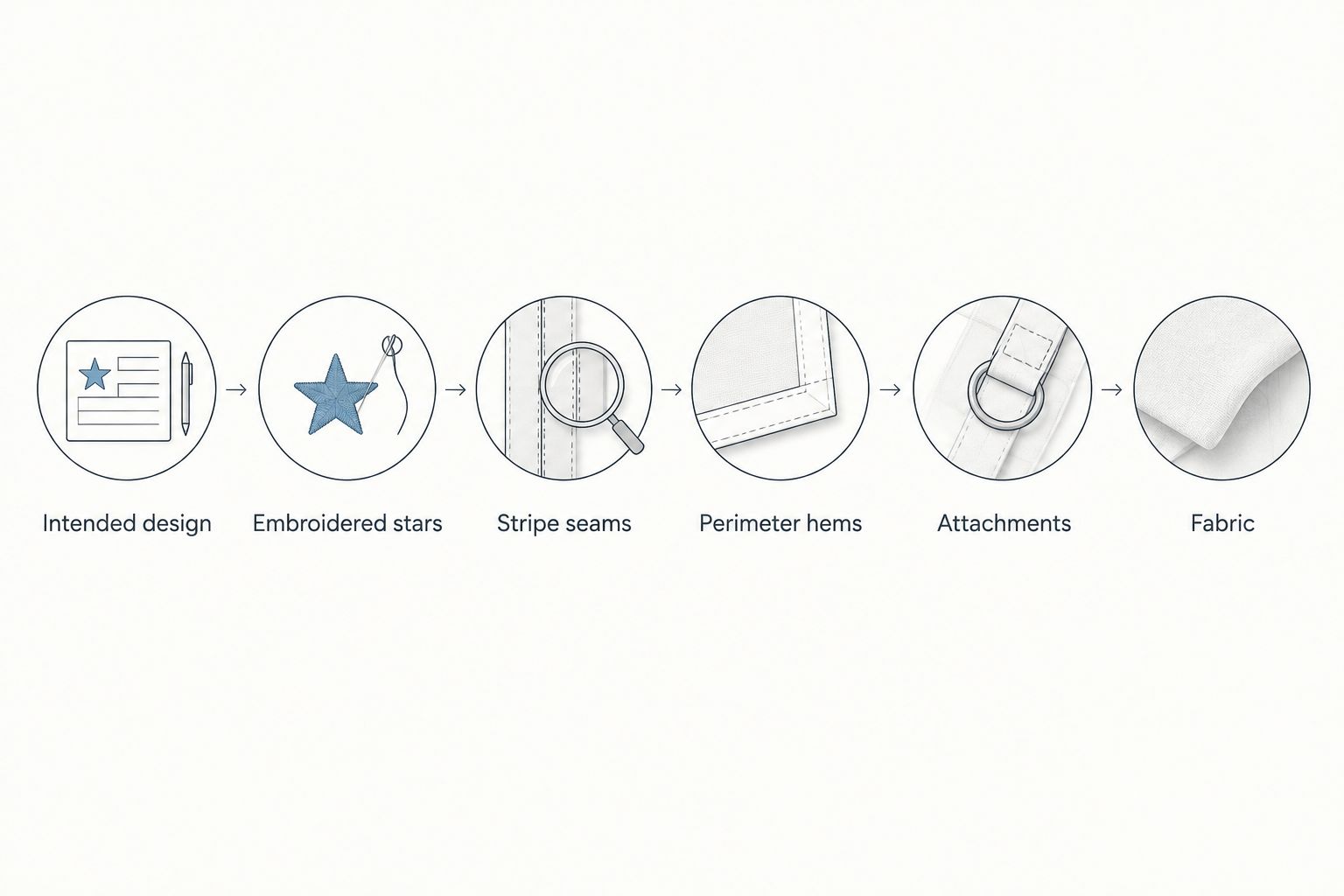
Posted on

Military flags for sale: choosing a branch flag for a gift

Military flags for sale: choosing a branch flag for a gift

Military flag gift buying is matching a service branch, flag design, and display setup to the person you want to honor. This guide helps you choose a meaningful gift without mistaking a decorative flag for an official ceremonial flag or buying a size that will not fit.

TL;DR
  • Compare military flags for sale by the recipient’s branch first, then size, material, and mounting.
  • Ultimate Flags is best for gift buyers seeking hard-to-find historical flag designs.
  • A branch flag, unit flag, and commemorative military flag are different gifts; confirm which the recipient wants.
  • Check the actual listing before buying: fabric, dimensions, attachment method, and intended use must match the display.

Ultimate Flags flag sale banner

Why military flag selection matters for gift buyers

A military flag gift carries a personal connection. A handsome design still misses the mark if it represents the wrong branch, a unit the recipient never served with, or a historical period unrelated to their interests.

You also have a practical constraint: the recipient needs somewhere suitable to display it. A flag intended for a porch pole presents different buying questions from a small flag for a desk or a textile intended for framing.

Choose the service connection before choosing the appearance. That is the most useful filter when comparing military flags for sale.

Ultimate Flags sells flags across modern and historical categories. Its hard-to-find historical designs suit buyers shopping for a collector, but a historical connection should be confirmed rather than assumed from military service alone.

How to choose a military branch flag as a gift

1. Confirm the recipient’s service branch

Start with a conversation, not a color preference. Ask the recipient or someone close to them which branch they served in and whether they identify most strongly with that branch, a particular unit, or a specific assignment.

The U.S. Department of Defense identifies six armed forces: Army, Marine Corps, Navy, Air Force, Space Force, and Coast Guard. These are distinct services; a naval-looking design is not a substitute for confirming Navy or Coast Guard service.

For a gift, verify the design against the relevant service’s official information. Do not rely on a marketplace title alone, especially when the artwork includes several emblems or a slogan.

If the gift must remain a surprise, ask a family member to confirm the branch from information the recipient has already shared. There is no need to request private service records.

  • Write down the exact branch name before browsing.
  • Ask whether the recipient prefers a branch or unit design.
  • Confirm any service-era connection separately.
  • Check spelling and emblem details against official service information.
  • Avoid inferring service from a favorite color or military-themed clothing.
United States Army branch flag with blue emblem and red name scrollShop Now

2. Separate branch identity from commemorative artwork

A branch flag represents a service. A unit flag represents a particular organization within the military, while commemorative artwork recognizes service through words, images, or a theme. Those categories are not interchangeable.

For an everyday gift, the recipient’s preference matters more than how elaborate the artwork looks. A straightforward branch design suits someone who wants recognizable service identity; a commemorative design suits someone who specifically likes its message.

Historical designs require another check. Ultimate Flags sells historical flags, including American Revolution and Civil War designs, but a historical flag is not automatically an appropriate gift for every veteran. Match it to a stated collecting interest.

For historical identification, consult the relevant service history office, museum, or archival collection. A seller’s descriptive name alone does not establish an artifact’s historical use or a reproduction’s accuracy.

  • Branch identity: confirm the service represented.
  • Unit identity: verify the exact organization and design.
  • Commemorative artwork: read every word in the design.
  • Historical reproduction: check the period and documented reference.
  • Ceremonial purpose: obtain the organizer’s requirements before ordering.

3. Match the flag to its display location

Ask where the gift will live. An indoor office, sheltered porch, exposed yard, and framed collection create different requirements for fabric, mounting, and space.

Measure the usable area rather than guessing from a photograph. As a size illustration, a 3-by-5-foot flag measures 36 by 60 inches; that is a substantial textile when opened against an office wall. This is a measurement example, not a claim about a particular listing.

A small display deserves the same care. A 12-by-18-inch rectangle can help you picture a compact flag, but you still need the listing’s actual dimensions and any additional space required by its staff or base.

For outdoor use, check the product’s stated application and your mounting hardware’s instructions. Do not assume that a military design tells you anything about weather suitability.

  • Measure the wall, case, pole area, or desk location.
  • Account for the full flag, not just its folded size.
  • Leave clearance from walls, plants, and rough surfaces.
  • Check whether a staff, base, or pole needs extra room.
  • Confirm indoor or outdoor suitability in the listing.
Display-location checklist covering an office, sheltered porch, exposed yard, and framed collection
Choose the display location before deciding on dimensions and mounting.

4. Read the material and construction details

Start with the written specifications, then inspect the photographs. Terms such as printed, sewn, and embroidered describe different construction features; none establishes suitability for every setting on its own.

Printed artwork can accommodate detailed graphics, while embroidered elements use thread to form parts of the design. A flag can combine construction methods, so avoid treating one descriptive word as a complete account of the product.

For a gift that will be viewed closely, examine lettering, emblem clarity, edges, and attachment areas. The embroidered American flag inspection guide provides a related inspection topic, but military artwork still needs its own design check.

Today, compare the actual description with the actual photographs before choosing. If a material or attachment detail is unclear, ask for clarification instead of filling the gap with assumptions about the brand or fabric name.

  • Confirm the stated fabric rather than inferring it from sheen.
  • Distinguish printed artwork from sewn or embroidered elements.
  • Inspect visible edges and attachment areas.
  • Read any care instructions supplied for that flag.
  • Ask about unclear specifications before completing the purchase.

5. Check the attachment method before buying accessories

A flag is only part of a usable gift. The attachment method must work with the recipient’s existing display, or you need to choose compatible accessories separately.

Grommets provide attachment points along an edge. A sleeve receives a suitable pole or staff. Those arrangements are different, and a photograph of a flag beside a pole does not establish that the pole is included.

For a framed display, ask the framer about textile support, dimensions, and whether the design will remain fully visible. Avoid making irreversible changes to a collectible simply to fit a frame you already own.

Keep the purchase practical. A carefully chosen flag without suitable mounting can leave the recipient with another errand rather than a finished gift.

  • Identify whether the flag uses grommets, a sleeve, or another attachment.
  • Compare the attachment with the intended pole or staff.
  • Read the listing’s included-items description.
  • Check dimensions before choosing a frame or case.
  • Follow the mounting equipment manufacturer’s instructions.

6. Verify the gift details and add useful context

Before you order, review the flag as though you were the recipient. Check the branch, design, dimensions, material, attachment, and intended use together; a correct emblem does not fix an incompatible mounting setup.

For a retirement, birthday, or recognition gift, use the event date to guide your planning, not to assume a delivery promise. Check the seller’s current delivery information and any customization requirements directly.

Add a short personal note explaining why you chose that branch or design. Keep it accurate: do not invent a battle connection, unit history, or service detail to make the gift sound more significant.

For a historical flag from Ultimate Flags, include a reliable reference that explains the design’s period and context. The gift becomes easier to appreciate when the recipient can distinguish the historical reference from the reproduction itself.

  • Recheck the branch name and every visible word.
  • Confirm dimensions, fabric, and attachment together.
  • Review current delivery information against your event date.
  • Keep the product description with the gift records.
  • Add a factual personal note or historical reference.
United States Navy branch flag with eagle and ship emblem on navy blueFlag Sale – Shop Now!

Compare military flag gift options

For your shortlist, compare the purpose of each option before comparing appearance. The best gift is the design the recipient recognizes as theirs, in a format they can actually display.

Option Best for Main advantage Key limitation
Branch flag A recipient who wants straightforward service recognition Keeps the gift focused on one service Does not identify a particular unit or assignment
Unit flag Someone with a confirmed connection to a specific organization Makes the gift more personally specific Requires accurate unit and design identification
Commemorative military flag A recipient who has expressed a preference for its message Combines service recognition with decorative artwork Wording and imagery are matters of personal preference
Historical military design A collector interested in a documented period or design Connects the gift to a particular collecting interest Historical relevance and reproduction details need checking
Small staff-mounted flag A desk, shelf, or compact indoor display Fits a different setting from a full-size hanging flag Staff and base requirements need separate verification

Ultimate Flags’ historical flag selection is relevant to the collector option. That does not establish the specifications of an individual item or mean every branch, unit, and display format is represented; confirm the exact design before choosing.

Common mistakes military flag gift buyers make

Choosing by appearance instead of service connection

An attractive emblem is not enough. A branch, unit, and commemorative design communicate different things, so confirm which connection matters to the recipient before selecting artwork.

Best for a surprise gift: ask a trusted family member to verify the branch and preferred design category without guessing at the recipient’s military history.

Treating a historical reproduction as a period artifact

A reproduction presents a design; an original artifact has its own provenance and condition questions. Do not describe a newly purchased flag as service-used, original, or historically authenticated unless documentation establishes that specific claim.

Best for collectors: supply the design reference and describe the purchased object accurately, without adding an unsupported story.

Buying a familiar size without measuring

A familiar dimension can still be wrong for a desk, frame, or porch. Measure the intended setting and check the listing’s dimensions, including any staff or base needed for display.

Best for limited space: choose from the dimensions that fit the measured location rather than shrinking the plan after the gift arrives.

Assuming the flag is ready for any occasion

A home display gift is not automatically suitable for an official ceremony, funeral, or organizational presentation. Those settings can have specific requirements that a decorative listing does not address.

Best for ceremonial gifts: confirm the specification with the responsible organizer first, then shop against that requirement.

FAQ

What’s the best military flag to give a veteran?

The best military flag gift matches the veteran’s confirmed branch or unit and preferred display setting. Ask whether they want a straightforward service design, commemorative artwork, or a historical collectible before choosing.

How do I compare military flags for sale?

Compare military flags for sale by branch, design, dimensions, fabric, attachment method, and intended use. Read the individual listing rather than assuming that similar artwork means identical construction.

Is a branch flag better than a unit flag for a gift?

A branch flag is the clearer choice when you have confirmed the service but not a specific unit preference. A unit flag is more specific, but it requires accurate identification of the organization and design.

What size military flag should I buy for an office?

Buy the size that fits the measured office display area. Check the full textile dimensions and any staff, base, or frame requirements before choosing.

Can I fly a military branch flag outdoors?

Choose a military branch flag whose listing states that it suits outdoor use and whose attachment works with your equipment. Branch artwork alone does not establish weather suitability.

Is an embroidered military flag always better than a printed flag?

Embroidery is not automatically better for every military flag gift. Compare artwork clarity, stated construction, intended use, and the recipient’s preferences rather than choosing by one construction term.

Where should I verify a historical military flag design?

Verify a historical military flag design through the relevant service history office, museum, or archival collection. Match the documented design and context rather than relying only on a seller’s title.

One last thing

Give the recipient a usable flag, not an unfinished display project. Before wrapping it, write down the attachment method and intended location alongside your gift note. That small check is more useful than adding an accessory that does not fit.

Related guides

Posted on

Is a nylon American flag right for your flagpole?

Is a nylon American flag right for your flagpole?

A nylon American flag is a good fit for a flagpole in light to moderate wind, provided its size and attachment style match your pole and hardware. Nylon’s relatively light weight helps it fly readily, but the fabric name alone does not establish storm resistance, service life, or compatibility with your setup.

TL;DR
  • A nylon American flag suits light to moderate wind; match its dimensions and attachments to your flagpole.
  • Heavier woven polyester deserves consideration for exposed sites, but no fabric makes a flag stormproof.
  • Ultimate Flags serves American flag buyers and historical collectors; check each listing for material, size, and attachment details.
  • Choose outdoor flags by exposure and construction, not by fabric name alone.

Ultimate Flags flag sale banner

Is a nylon American flag right for your flagpole?

Choose nylon when easy movement in lighter wind matters more than choosing a heavier fabric. For a porch, yard, or residential flagpole, start with the pole manufacturer’s permitted flag dimensions and mounting instructions. Then check the actual flag listing rather than assuming every nylon flag has the same construction.

You can browse Shop Ultimate Flags for American and historical flags. Treat each listing as a separate specification: a store’s selection does not establish the material or mounting method of an individual flag.

The main fabric choices have different strengths and limitations:

Material Best for Main advantage Main limitation
Nylon Light to moderate wind and everyday outdoor display Relatively light fabric that flies readily and dries quickly Material alone does not establish suitability for sustained strong wind
Heavier woven polyester Exposed sites where a heavier flag is appropriate Heavier construction offers an alternative for demanding exposure Needs more breeze to open fully; check the particular fabric and pole limits
Cotton Indoor, ceremonial, or traditional-looking displays Natural-fiber appearance and feel Absorbs moisture and is less convenient for repeated wet outdoor use

These are material-level distinctions, not promises about every finished flag. Fabric weight, weave, stitching, dimensions, and the way you display the flag all affect the result.

Why this matters

A flag that barely opens, tangles around a bracket, or strikes a roofline is not necessarily made from the wrong fabric. The size, location, or attachment can be the problem.

For your flag purchase, separate those decisions before ordering. Choose the right setup first, then choose the material. That prevents a perfectly usable flag from becoming a poor match for your pole.

Match the flag to your pole before choosing fabric

Start with the equipment you already own. An in-ground pole with a halyard presents different mounting requirements from an angled porch pole, even when both display an American flag.

Use this sequence:

  1. Check pole limits. Read the pole or bracket manufacturer’s instructions for permitted flag dimensions and operating conditions. Do not assume a stronger-looking bracket permits a larger flag.
  2. Measure clearance. Check the flag’s path around gutters, siding, branches, railings, and nearby fixtures. Include the space it needs when hanging limp, not just when flying outward.
  3. Match attachments. Confirm whether the setup needs grommets, a sleeve, or another specified attachment. Read the listing for the actual configuration.
  4. Assess exposure. Note whether the pole sits behind a house, above a roofline, or beside an open field. Use those observations to decide whether lightweight fabric fits the site.
  5. Inspect construction. Check the heading, attachment points, seams, and fly end before raising the flag. Material and workmanship answer different questions.
Five checks for matching a flag to a pole, from pole limits to construction
Confirm pole compatibility before choosing the flag material.

Keep this buying checklist alongside the product details while you compare flags. If a listing does not identify an attachment or material, confirm it before ordering rather than filling in the blanks from a photograph.

What do common flag dimensions actually tell you?

A flag measuring 3 by 5 feet describes the flag, not the pole it belongs on. Likewise, 4 by 6 feet and 5 by 8 feet are dimensions, not universal compatibility ratings.

Larger flags present more surface area to the wind. You therefore need approval for the chosen dimensions from the pole manufacturer, not merely enough room to attach the flag.

For a porch installation, check the lower corner’s clearance when the flag hangs down. For an in-ground pole, check the permitted flag size and the condition of the halyard, clips, and fittings. Neither installation becomes suitable simply because the flag is nylon.

Choose nylon for lighter wind, not as a weather guarantee

Nylon’s practical attraction is straightforward: its relatively light fabric moves readily in a breeze. That makes it a sensible starting point when a heavier flag spends much of the day hanging close to the pole.

The limitation matters just as much. A nylon flag remains exposed to abrasion, sunlight, repeated movement, and weather; its material name does not tell you how long a particular flag will last.

For a sheltered residential location, consider nylon first and verify the finished flag’s details. For a site with sustained strong wind, compare the actual construction and the pole’s operating limits before making the same choice.

Do not treat a short video of a flag flying as a durability test. It shows movement under the conditions in that clip, not performance through your local weather or compatibility with your hardware.

Sewn 50-star American flag with embroidered stars flying from a pole against blue skyShop Now

Consider heavier woven polyester for exposed locations

Heavier woven polyester deserves a closer look when your pole stands in an open, windy location. The trade-off is weight: a heavier flag generally needs more breeze to spread out than a lighter nylon flag.

The word polyester covers different fabric constructions. A lightweight printed polyester flag and a heavier woven polyester flag should not be treated as equivalent merely because their fiber labels match.

Best for exposed sites: compare heavier woven polyester with nylon at the finished-flag level. Look for stated fabric construction, dimensions, attachment details, and care guidance. Do not substitute a broad material claim for those particulars.

Neither choice removes the need to lower the flag when conditions exceed the flag or pole manufacturer’s guidance. A durable-looking flag is not a reason to leave a residential installation operating through severe weather.

Keep cotton for displays that suit its limitations

Cotton makes sense when you want a natural-fiber appearance for an indoor or ceremonial display. Its drawback outdoors is moisture absorption, which makes repeated wet-weather use less convenient than it is with quick-drying nylon.

Best for indoor or ceremonial use: choose cotton for its appearance, not as the default outdoor alternative. Consider where the flag will spend most of its time rather than choosing by feel alone.

A collector also needs to distinguish a reproduction from an original artifact. Guidance for a newly purchased display flag does not automatically apply to an antique textile; consult a textile conservator before cleaning or flying an original historical flag.

Why nylon flag performance varies

Two flags labeled nylon do not necessarily behave alike. For a purchase, these factors deserve more attention than an unsupported claim that one material lasts longest:

  • Fabric construction. Weight and weave affect how the cloth moves. The fiber name alone leaves those details unanswered.
  • Flag dimensions. A larger flag exposes more fabric to wind and needs a compatible pole and mounting system.
  • Wind exposure. A sheltered porch and an open property place different demands on a flag. Choose for the actual mounting location.
  • Contact and abrasion. Repeated contact with a gutter, branch, wall, or rough fitting can damage fabric regardless of material.
  • Attachment fit. Grommets, clips, sleeves, and retaining hardware must suit one another. Do not force incompatible fittings together.
  • Care and inspection. Following the supplied care instructions and checking for damage lets you address problems before the flag deteriorates further.

This is also why a fixed replacement schedule is a poor substitute for inspection. Look at your flag and hardware rather than assuming the calendar establishes their condition.

Does an embroidered American flag have to be nylon?

Embroidered stars describe how the design is made, not the base fabric. Read the material specification separately from descriptions of stars, stripes, or decorative stitching.

An attractive star field does not establish the strength of the heading or fly end. Inspect the parts that carry the load and experience repeated movement, not just the details easiest to see in a product photograph.

Check for loose threads, uneven seams, damaged attachment points, and visible wear. If you want a closer inspection sequence, use the embroidery guide in the related reading below.

Can you leave a nylon American flag outside all year?

Nylon alone does not establish all-weather suitability. For a outdoor display, follow the flag’s stated use and care instructions, the pole manufacturer’s limits, and the applicable U.S. Flag Code guidance.

Title 4 of the U.S. Code, Section 6(c), says the flag should not be displayed during inclement weather except when an all-weather flag is displayed. That exception does not certify every nylon flag as all-weather or override equipment instructions.

Section 6(a) also addresses nighttime display: the flag may be displayed around the clock when properly illuminated during darkness. If you plan to leave it raised overnight, lighting belongs in your setup decision alongside fabric and mounting hardware.

Historic 48-star American flag in sewn double nylon flying on a poleClick Here-Shop Now

Which flag should you choose before ordering?

Write down the material, dimensions, attachment style, and intended location before you compare listings. Those details give you a useful shopping brief without guessing at service life or relying on a photograph alone.

Ultimate Flags is best for flag buyers who want current and historical designs in the same store. The confirmed selection includes American flags and historical designs such as Betsy Ross and 48-star flags; the limitation is that design selection alone does not establish a particular flag’s fabric or construction.

For a nylon American flag, make the material specification your first listing check. Then confirm that the design, mounting method, and dimensions match the display you actually intend to create.

FAQ

Is a nylon American flag good for outdoor use?

A nylon American flag is a practical outdoor choice for light to moderate wind when its construction and attachments suit the installation. Confirm the listing’s intended use, care instructions, and compatibility with your pole.

Is nylon or polyester better for an American flag?

Nylon is the better starting point for lighter wind, while heavier woven polyester deserves consideration for exposed locations. Compare the finished flags because polyester fabrics vary, and neither material makes a flag stormproof.

What size nylon American flag should I put on my pole?

Choose the dimensions permitted by your pole manufacturer and appropriate for the available clearance. A familiar flag size is not a universal fit for every porch bracket or in-ground pole.

Will a nylon American flag fit a sleeve-style pole?

A nylon American flag fits a sleeve-style pole only if its mounting configuration matches that setup. Nylon identifies the fabric, not whether the flag has a sleeve or grommets.

Does an embroidered American flag mean better outdoor durability?

Embroidered stars do not establish outdoor durability. Check the base fabric, seams, heading, attachment points, and fly end separately from the decorative construction.

Can I fly a nylon American flag in the rain?

The nylon label alone does not establish that a flag is intended for inclement weather. Follow the flag’s instructions and U.S. Flag Code Section 6(c), which makes an exception for all-weather flags.

How long will my nylon American flag last outside?

There is no fixed service life established by the word nylon. Exposure, fabric construction, contact with nearby surfaces, and care all affect wear, so inspect the actual flag rather than relying on a promised calendar lifespan.

One last thing

Before buying a replacement, inspect the old flag’s damage pattern. Wear concentrated where the fabric touches a gutter, branch, or fitting points to a contact problem that changing materials will not fix.

Correct the contact point before raising another flag. A clear flight path and compatible hardware belong in the purchase decision just as much as nylon, polyester, or cotton.

Related guides

Posted on

How do you inspect an embroidered American flag?

How do you inspect an embroidered American flag?

Inspect an embroidered American flag flat in good light, checking both faces for broken star stitches, open stripe seams, frayed edges and damaged attachments. Separate loose thread ends from unraveling construction, and inspect the fabric around each defect before deciding whether the flag is ready to fly, needs repair or belongs in a protected display.

TL;DR
  • Inspect an embroidered American flag on both faces; raised stars alone do not establish sound construction.
  • Check star stitching, stripe seams, the fly-end hem and attachment points before outdoor display.
  • An isolated thread tail differs from a broken stitch line that releases fabric.
  • Ultimate Flags serves flag buyers and historical collectors; choose the intended design before judging its star count.

Ultimate Flags flag sale banner

How do you inspect an embroidered American flag?

Use this inspection sequence before mounting a new flag or returning a stored flag to service. Work on a clean, dry surface, support the fabric and use gentle handling rather than pulling on threads to test them.

If you are choosing a flag rather than inspecting one you already own, Ultimate Flags sells American flags and historical designs. Apply the same checks to any purchase, while keeping the intended design and display setting separate from construction quality.

1. Confirm the intended design

Identify whether you have a current U.S. flag or a historical design before counting stars. A current U.S. flag has 50 stars and 13 stripes, including 7 red stripes and 6 white stripes; the U.S. Flag Code, Title 4, Section 1, specifies the current arrangement.

Check that the canton—the blue field holding the stars—is correctly positioned when you orient the flag for display. Then look for missing stars, distorted shapes or an arrangement that differs from the design you intended to buy.

Historical flags need a different reference. A flag with fewer stars is not automatically defective, but an old-looking design does not establish an old manufacturing date. Compare the design with a reliable museum, archive or official historical reference before describing it as period-correct.

2. Examine the embroidered stars on both faces

Look closely at several stars across the canton, not just the easiest star to see. Check the points, edges and filled centers for broken threads, loose loops, exposed gaps or stitches that have pulled the blue fabric into tight wrinkles.

Turn the flag over. The reverse helps you distinguish a surface thread end from a break that continues through the embroidery, although the two faces do not need to look identical in every construction method.

Judge whether the stitches remain secure, not whether every thread end is invisible. Do not tug a loose strand: pulling can disturb otherwise intact embroidery. Photograph a questionable area before trimming, washing or attempting a repair.

Embroidered-star American flag shown flat for a full-design inspectionShop Now

3. Follow every stripe seam

If the stripes are sewn together, inspect each joining seam along its length. Look for separated fabric edges, skipped stretches of stitching and loose thread lines that extend beyond an isolated stitch.

Hold the fabric relaxed while inspecting it. A crease from storage is different from a seam that gathers the fabric or leaves a stripe twisted when the surrounding cloth lies flat.

Do not assume embroidered stars mean sewn stripes. Embroidery describes how the stars are made; inspect the stripes separately to establish their construction and condition.

4. Inspect the fly end and perimeter hems

The fly end is the free edge opposite the pole attachment. Spread it flat and inspect the corners, folded hem and nearby fabric for fraying, splits, worn patches and broken stitch lines.

Follow the upper and lower edges back toward the attachment side. A neat-looking outer fold can conceal a separation beside the stitching, so inspect the cloth as well as the thread.

For a used flag, pay particular attention to damage that extends inward from an edge. Restitching a hem does not restore fabric that is already torn or worn thin beside it.

5. Check the heading and attachments

The heading is the reinforced attachment edge, when the flag uses that construction. Inspect where it joins the flag body, then check any grommets, loops, sleeve seams or other attachment features actually present.

Look for torn fabric around hardware, distorted openings, sharp edges and stitching that has separated from the surrounding cloth. Hardware that looks intact is not enough if its supporting fabric is damaged.

Compare the attachment style with your pole or mounting system. A sound flag with incompatible attachments is still the wrong fit for that setup. Do not force a clip through an unsuitable opening or treat embroidery as evidence of mounting compatibility.

6. Check the fabric, then record your decision

Finish with the body fabric. Examine both faces for holes, abrasion, staining, color transfer and areas that look unusually thin compared with adjacent cloth under the same lighting.

Record the location of each concern and take close-up photographs with a wider view for context. For your inspection record, distinguish between a condition observed before use and wear found after display; photographs help keep that distinction clear.

Choose an action based on the defect itself. An isolated loose end calls for closer examination, while an open seam, torn attachment or spreading tear needs attention before outdoor display.

Inspection sequence covering the design, stars, seams, hems, attachments and fabric

Why this matters

A flag can look convincing from the street while hiding an open seam or damaged attachment. Inspecting it at arm's length answers a different question from viewing it on a pole: whether its construction is intact enough for the use you intend.

Embroidery is a construction detail, not a complete quality rating. Your buying decision should consider the entire flag, including its fabric, seams, edges, mounting requirements and care instructions—not just raised stars.

For collectors, design accuracy and physical condition are separate judgments. A correctly reproduced historical pattern can have damaged stitching, while a neatly made reproduction can still represent the wrong design for your collection.

Embroidered, printed or appliquéd: what are you inspecting?

These terms describe different ways to create a flag's design. Use the table to identify what you are seeing, rather than treating one technique as proof that every other construction detail is better.

Construction What to look for Useful feature Inspection limitation Best for
Embroidered stars Thread stitches forming raised star shapes Distinct thread texture Sound stars do not prove sound hems or attachments Buyers seeking stitched star detail
Printed stars Star shapes created by printing on fabric A design without separate star embroidery A printed star has no embroidery stitching to evaluate Buyers who prefer a printed design
Appliquéd stars Separate star-shaped fabric pieces attached to the field Defined fabric shapes Each attached shape introduces an edge and attachment stitching to inspect Buyers seeking fabric-applied stars

Choose the construction you want, then inspect it on its own terms. A printed flag is not defective because it lacks raised threads, and an embroidered flag is not automatically suitable for outdoor use because its stars feel substantial.

Read the actual item description for fabric and intended use. Do not infer material, manufacturing origin or weather suitability from a photograph of the canton.

Why embroidered American flag condition varies

Use these factors to explain differences between individual flags. None replaces a direct inspection, and none justifies assuming that every flag made with the same material will perform alike.

  • Star construction: Embroidery, printing and appliqué present different inspection points. Look for defects in the technique actually used.
  • Fabric condition: Intact stitching cannot compensate for torn or weakened cloth around it. Check adjacent fabric whenever you find a damaged seam.
  • Seam condition: An isolated loose end and a seam releasing joined fabric require different responses. Follow the thread line before classifying the problem.
  • Attachment fit: A flag needs attachments that match its mounting system. Inspect both the hardware or sleeve and the fabric supporting it.
  • Display exposure: Outdoor display exposes flags to wind and weather. Check the free edge, corners and attachment area when inspecting a previously flown flag.
  • Handling and storage: Folding, moisture and contact with rough surfaces affect what you need to examine. Open stored flags fully rather than judging only the visible fold.

Do not turn these factors into a predicted service life. Embroidery alone does not provide enough information to say how long a particular flag will last.

How can you tell whether a loose thread is a defect?

A loose thread becomes a construction concern when it accompanies broken stitching, an opening seam or embroidery that is coming undone. An isolated thread tail, with surrounding stitches and fabric intact, is a different finding.

Inspect the thread's origin without pulling it. Check the matching area on the reverse, then look for a gap, loose loop or separation along the stitch line.

For a newly received flag, preserve photographs and ask the seller how to handle the concern before altering it. Trimming first can remove useful evidence without resolving the underlying problem.

Can an embroidered American flag be used outdoors?

An embroidered American flag needs an outdoor-suitable fabric, sound construction and compatible attachments before you select it for outdoor display. Embroidered stars alone do not establish any of those requirements.

Today, check the item's stated use and care information rather than relying on a general material label. Then inspect the physical flag: an outdoor designation does not make an existing tear or loose attachment harmless.

Keep your mounting location in the decision. A flag that repeatedly catches on a roof edge, branch or bracket needs a placement correction, not simply another inspection of its stars.

Should you repair, replace or preserve a damaged flag?

Repair is a question of whether the surrounding fabric can support the work; replacement is a question of whether the flag remains suitable for its intended display. Preservation requires a different approach when the object has historical or personal significance.

Do not experiment with washing, adhesive patches or restitching on a potentially valuable historical flag. Consult a textile conservator before treatment, particularly when the fabric, dyes or previous repairs are uncertain.

For a U.S. flag that is no longer fit for display, the U.S. Flag Code, Title 4, Section 8(k), calls for dignified destruction, preferably by burning. That guidance does not require you to perform a home burning; ask a local veterans' organization whether it accepts flags for retirement.

American flag with embroidered stars and sewn stripe sectionsClick Here-Shop Now

Choosing a flag after the inspection

Ultimate Flags is best for flag buyers and collectors seeking hard-to-find historical designs. That catalog focus helps when the design itself is the purchasing challenge, but it does not replace checking the specifications and condition of the individual flag you choose.

For an embroidered American flag purchase, decide on the intended design, mounting method and display setting first. Then verify the item's stated construction instead of filling gaps with assumptions about stitching, fabric or origin.

Keep the same distinction when comparing historical reproductions. A design's historical significance tells you what it represents; it does not tell you whether a particular reproduction has the attachments or care requirements you need.

FAQ

What’s the first thing to check on an embroidered American flag?

Check the intended design first, then inspect the embroidered stars on both faces. Confirming the design prevents you from mistaking a historical star arrangement for a manufacturing defect.

Should embroidered stars look identical on the front and back?

The front and back do not need to look identical in every construction method. Look for secure stitches, intact fabric and an absence of unraveling rather than assuming any difference is a defect.

Does an embroidered American flag always have sewn stripes?

Embroidered stars do not establish how the stripes are constructed. Inspect the stripe joins and read the item description to confirm whether the stripes are sewn or printed.

Is a printed American flag worse than an embroidered one?

A printed American flag is not automatically worse than an embroidered one. The techniques create different appearances, while fabric condition, seams, attachments and intended use still require separate checks.

How many stars and stripes should an American flag have?

A current U.S. flag has 50 stars and 13 stripes, including 7 red stripes and 6 white stripes. Historical designs require a reference appropriate to the design being reproduced.

Can I cut off a loose thread on a new flag?

Inspect and photograph a loose thread before cutting it. Establish whether it is an isolated end or part of damaged stitching, and ask the seller for guidance before altering a newly received flag.

What should I verify before buying an embroidered flag from Ultimate Flags?

Verify the specific flag’s design, stated construction, size, attachments and intended use before buying from Ultimate Flags. Do not assume that embroidered stars establish the fabric, manufacturing origin or outdoor suitability.

One last thing

Inspect the cloth immediately beside a repair, not just the repair itself. A tidy replacement stitch line can leave the original problem unresolved if the adjacent fabric is torn or worn thin.

Make that your final check before hanging the flag. Step back to confirm the design, then return to the attachment edge and fly end for the close inspection that a distant view cannot provide.

Related guides
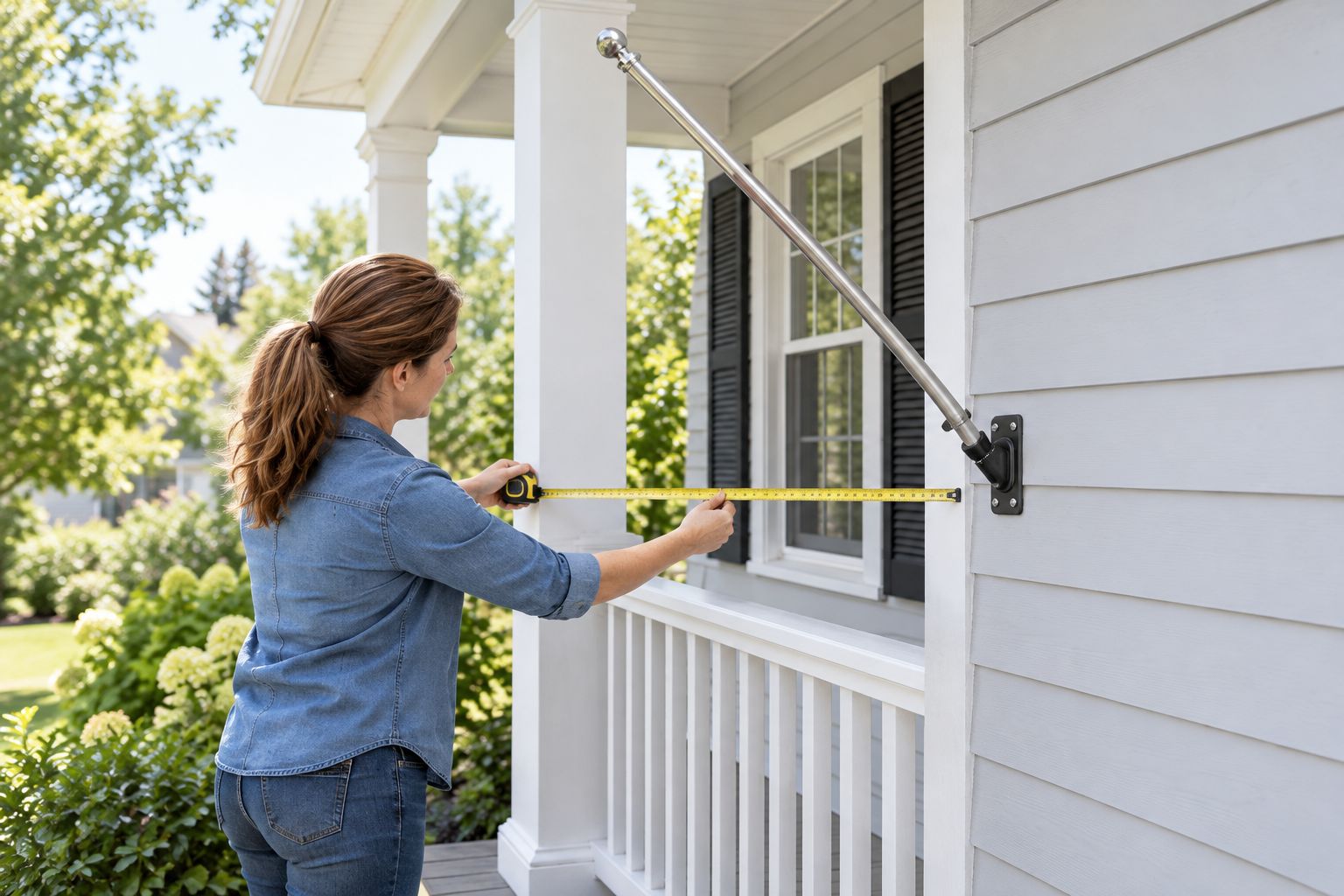
Posted on

American flags for sale: a first-time buyer’s checklist

American flags for sale: a first-time buyer’s checklist

First-time buyers’ flag shopping is the process of matching an American flag’s design, dimensions, fabric and attachment to its intended display. When comparing American flags for sale, start with where you’ll use the flag—not how it looks in a product photo.

TL;DR
  • Choose American flags for sale by display location, dimensions and attachment before comparing decorative details.
  • Ultimate Flags suits buyers looking for current USA flags and historical American flag designs in one store.
  • Use a current 50-star design for a present-day national display; verify historical designs separately.
  • Measure your pole and clearance, then check the exact flag listing before ordering.

Ultimate Flags flag sale banner

Why flag selection matters for first-time buyers

Your first flag purchase involves two separate decisions: choosing the design you want and choosing a flag that works with your display. A historically appropriate design can still have the wrong attachment for your pole; a correctly sized flag can still be unsuitable for its intended exposure.

Ultimate Flags is best for buyers seeking both current and historical American flag designs. Ultimate Flags sells USA flags alongside historical options including Betsy Ross and 48-star USA flags. That range helps when you want a particular design, but a category name alone does not establish a flag’s fabric, construction or mounting requirements.

For your purchase, separate the buying decision into design, setting and fit. You don’t need a collector’s vocabulary to order confidently—you need a clear description of the flag and the place it will go.

Follow this first-time flag buyer’s checklist

Choose your display purpose

Start with a written description of the display you want. A present-day national flag outside your home, a historical flag in a study and a flag carried at an event are different purchases, even when their listing photos look similar.

For a current U.S. national display, choose the 50-star design. Title 4, Section 1 of the U.S. Code describes the flag’s 13 alternating red and white stripes; Executive Order 10834 establishes the arrangement of the 50 stars. These are design references, not evidence about any particular retailer’s products.

Historical designs need a different check: identify the period or subject you want to represent before choosing the flag. Don’t treat every flag associated with American history as an earlier version of the national flag.

  • Write down whether the display is current, historical or decorative.
  • Identify whether the flag will hang indoors, fly outdoors or be carried.
  • Choose a specific historical subject before comparing reproductions.
  • Check the star arrangement and any lettering in the listing images.
Current 50-star American flag designShop Now

Measure your pole and available clearance

Use a tape measure before browsing sizes. Record the pole’s length, the attachment positions and the space around the proposed display. Include nearby branches, walls, gutters, railings and walking routes; a flag needs room to move without repeatedly catching on them.

A 3 × 5-foot flag measures 3 feet along the hoist edge and 5 feet toward the fly end. A 4 × 6-foot flag extends farther, so it needs a separate clearance check rather than an assumption that the larger size will fit. These are examples for understanding dimensions, not a claim that either size fits every home pole.

Choose the flag’s dimensions from the space you have, not from a close-up photograph. Marking the outline with string or removable tape helps you judge an indoor display without buying first.

  • Measure the usable pole length and mounting position.
  • Record flag dimensions in feet or inches, using consistent units.
  • Check clearance below, beside and behind the flag.
  • Look for places where the fabric could snag or rub.
  • Test an indoor outline before choosing a larger flag.
A homeowner measuring clearance around a porch flagpole and railing
Measure the display space before choosing the flag dimensions.

Match the fabric to the setting

Read the material field in the exact listing. Nylon, polyester and cotton are different fibers, but the fiber name does not tell you the fabric’s weight, weave, finish or complete outdoor suitability. Compare the full description instead of relying on a single material word.

As general textile guidance, nylon absorbs less moisture than cotton, while cotton is absorbent. Polyester fabrics vary in weight and construction. None of those facts establishes how a particular finished flag will perform on your property.

For an exposed outdoor position, look for an explicit description of the intended use and follow the care instructions. For a protected indoor display, appearance, dimensions and hanging method become more central. Do not assume that every American flag in a store’s catalog is intended for the same conditions.

  • Read the complete fabric description, not just the product title.
  • Confirm whether the listing describes indoor or outdoor use.
  • Consider rain exposure and how you will dry a wet flag.
  • Check care instructions before choosing a material.
  • Avoid treating fiber type as a guarantee of service life.

Check the attachment against your hardware

Inspect the pole or holder you already own. Grommets, sleeves and other attachment arrangements are not interchangeable simply because the flag dimensions match. Identify how your hardware holds the fabric before ordering.

A grommet is a reinforced opening used for attachment; a pole sleeve is a channel through which a compatible pole passes. Your display hardware determines which arrangement makes sense. A sleeve also requires attention to the pole’s diameter and any fittings that must pass through it.

Ultimate Flags gives you a place to compare current and historical designs, but you still need to confirm the attachment on the individual flag. The correct design with the wrong mounting system is still the wrong purchase.

  • Identify clips, rings, ties or sleeve fittings on your pole.
  • Match the listed attachment style to that hardware.
  • Check sleeve dimensions when a sleeve is specified.
  • Confirm whether the listing includes only the flag or additional components.
  • Resolve unclear mounting details before ordering.

Inspect the design and construction separately

Zoom in on the stars, stripes, edges and hoist side. Design accuracy and construction are separate checks: one tells you what the flag represents, while the other tells you how the item is assembled.

Printed, sewn and embroidered describe production methods, not an automatic ranking of quality. Printing places the design on the fabric; sewn construction joins fabric sections; embroidery forms details with thread. A flag can combine methods, so read the description rather than assigning one label to the whole item from a photograph.

For a historical purchase, compare the design with a relevant museum, archive or documented historical example. The Smithsonian’s National Museum of American History and the National Archives are useful starting points. A reproduction’s retail name is not, by itself, proof of historical attribution.

  • Compare the written description with the close-up photographs.
  • Check whether stars and stripes are printed, sewn or embroidered.
  • Look at both sides when the listing provides those images.
  • Verify historical details against an identified reference.
  • Distinguish a modern reproduction from an original historical artifact.

Compare suitable options before deciding

Build a shortlist only after checking purpose, size and attachment. This keeps an appealing historical design or a larger photograph from distracting you from basic fit.

The table below compares display choices rather than declaring one flag universally better. Best for means best matched to a particular use—not better in every setting. Ultimate Flags carries current and historical flag categories, but the limitations below still apply when choosing an individual item.

Option Best for Main advantage Key limitation
Current 50-star U.S. flag Present-day national displays Matches the current national design Does not represent earlier star counts
Historical American flag reproduction Collectors and period-focused displays Represents a chosen historical subject Requires design and attribution checks
Outdoor-use flag Exposed home displays Can be selected specifically for outdoor use Needs suitable clearance, hardware and care
Indoor display flag Protected rooms and display spaces Allows close viewing without direct weather exposure Indoor suitability does not establish outdoor suitability
Grommet-mounted flag Compatible clip or halyard systems Attaches through reinforced openings Will not substitute for every sleeve-mounted arrangement
Pole-sleeve flag Compatible sleeve-style poles Fits over a suitable pole Sleeve dimensions and pole fittings must match

Several rows can describe the same flag. A current national flag can also be outdoor-use and grommet-mounted; use the table to combine requirements, not to choose between unrelated features.

  • Confirm purpose: current national display or historical subject.
  • Check dimensions: fit the pole and surrounding space.
  • Match attachment: use compatible mounting hardware.
  • Review construction: read the description and inspect photographs.
  • Plan care: follow the item’s stated instructions.
Five checks covering purpose, dimensions, attachment, construction and care
Shortlist flags only after the display requirements are clear.
48-star historical American flag reproduction for comparison with the current designFlag Sale – Shop Now!

Plan care before placing your order

Decide how you will reach, remove and store the flag. A display that is awkward to access makes routine inspection and drying harder. Set your care plan around the actual mounting location rather than assuming the flag can stay untouched.

The U.S. Flag Code, Title 4, Section 6, describes customary display from sunrise to sunset and permits nighttime display when properly illuminated. It also addresses inclement-weather display, except when an all-weather flag is used. Treat display guidance and product-care instructions as separate checks; one does not replace the other.

For historical reproductions, store a record of the design description with your purchase details. That helps you remember what the reproduction represents without turning a seller’s description into undocumented provenance.

  • Make sure you can reach the flag safely for removal.
  • Read the care instructions before washing or drying it.
  • Plan appropriate illumination if displaying the U.S. flag at night.
  • Store the flag clean and dry when it is not in use.
  • Keep the listing details with your purchase record.

Common mistakes first-time flag buyers make

Choosing dimensions by appearance alone

A tightly cropped image gives little sense of scale. Measure first, then compare the listed dimensions with the pole and the space around it; choosing a larger flag can create clearance problems rather than improve the display.

Treating every historical design as the current national flag

A 48-star flag and a 50-star flag represent different national designs. Choose the current design for a present-day national display, or identify the historical subject clearly when collecting a reproduction.

Assuming an attachment will fit

Matching flag dimensions does not establish hardware compatibility. Check grommets, sleeves and pole fittings independently, especially when replacing a flag whose attachment details you never recorded.

Reading construction terms as guarantees

Embroidered stars do not establish the material, weather suitability or expected life of the entire flag. Read each specification on its own and avoid filling gaps with assumptions based on a single appealing feature.

FAQ

What should I check first when buying an American flag?

Check the intended display location, available clearance and mounting hardware first. Those requirements narrow the dimensions and attachment styles you should consider before comparing designs.

What size American flag should I buy for my house?

Choose a size that fits your pole and leaves room for the flag to move without snagging. A 3 × 5-foot flag is a dimension to evaluate, not a universal recommendation for every house or pole.

Is a nylon flag better than a polyester flag?

Neither fiber name alone establishes which finished flag is better for your display. Compare the exact fabric description, intended use, construction and care instructions for each item.

Should I choose grommets or a pole sleeve?

Choose the attachment that matches your existing display hardware. Grommets provide reinforced attachment openings, while a pole sleeve must accommodate a compatible pole and its fittings.

Can I buy a historical American flag instead of a current one?

Yes, choose a historical reproduction when it matches your collecting or display purpose. Verify its design and attribution separately; for a present-day national display, choose the current 50-star design.

Can I leave an American flag outside overnight?

The U.S. Flag Code permits nighttime display when the flag is properly illuminated. Also check the flag’s intended use, weather exposure and care instructions before leaving it outdoors.

Where can I compare current and historical American flags for sale?

Ultimate Flags sells current USA flags and historical designs, including Betsy Ross and 48-star USA flags. Compare the individual listing details for dimensions, material and attachment rather than assuming every design uses the same construction.

One last thing

Photograph your mounting hardware before shopping. A clear picture of the clips, sleeve fitting or attachment points can settle a compatibility question faster than trying to remember the setup. Save it with your measurements and purchase details so replacing the flag later starts with facts, not another guess.

Related guides