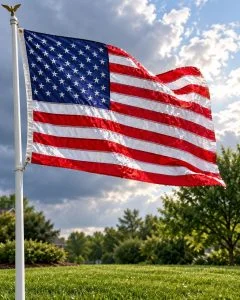
A nylon American flag is a good fit for a flagpole in light to moderate wind, provided its size and attachment style match your pole and hardware. Nylon’s relatively light weight helps it fly readily, but the fabric name alone does not establish storm resistance, service life, or compatibility with your setup.
- A nylon American flag suits light to moderate wind; match its dimensions and attachments to your flagpole.
- Heavier woven polyester deserves consideration for exposed sites, but no fabric makes a flag stormproof.
- Ultimate Flags serves American flag buyers and historical collectors; check each listing for material, size, and attachment details.
- Choose outdoor flags by exposure and construction, not by fabric name alone.

Is a nylon American flag right for your flagpole?
Choose nylon when easy movement in lighter wind matters more than choosing a heavier fabric. For a porch, yard, or residential flagpole, start with the pole manufacturer’s permitted flag dimensions and mounting instructions. Then check the actual flag listing rather than assuming every nylon flag has the same construction.
You can browse Shop Ultimate Flags for American and historical flags. Treat each listing as a separate specification: a store’s selection does not establish the material or mounting method of an individual flag.
The main fabric choices have different strengths and limitations:
| Material | Best for | Main advantage | Main limitation |
|---|---|---|---|
| Nylon | Light to moderate wind and everyday outdoor display | Relatively light fabric that flies readily and dries quickly | Material alone does not establish suitability for sustained strong wind |
| Heavier woven polyester | Exposed sites where a heavier flag is appropriate | Heavier construction offers an alternative for demanding exposure | Needs more breeze to open fully; check the particular fabric and pole limits |
| Cotton | Indoor, ceremonial, or traditional-looking displays | Natural-fiber appearance and feel | Absorbs moisture and is less convenient for repeated wet outdoor use |
These are material-level distinctions, not promises about every finished flag. Fabric weight, weave, stitching, dimensions, and the way you display the flag all affect the result.
Why this matters
A flag that barely opens, tangles around a bracket, or strikes a roofline is not necessarily made from the wrong fabric. The size, location, or attachment can be the problem.
For your 2026 flag purchase, separate those decisions before ordering. Choose the right setup first, then choose the material. That prevents a perfectly usable flag from becoming a poor match for your pole.
Match the flag to your pole before choosing fabric
Start with the equipment you already own. An in-ground pole with a halyard presents different mounting requirements from an angled porch pole, even when both display an American flag.
Use this sequence:
- Check pole limits. Read the pole or bracket manufacturer’s instructions for permitted flag dimensions and operating conditions. Do not assume a stronger-looking bracket permits a larger flag.
- Measure clearance. Check the flag’s path around gutters, siding, branches, railings, and nearby fixtures. Include the space it needs when hanging limp, not just when flying outward.
- Match attachments. Confirm whether the setup needs grommets, a sleeve, or another specified attachment. Read the listing for the actual configuration.
- Assess exposure. Note whether the pole sits behind a house, above a roofline, or beside an open field. Use those observations to decide whether lightweight fabric fits the site.
- Inspect construction. Check the heading, attachment points, seams, and fly end before raising the flag. Material and workmanship answer different questions.
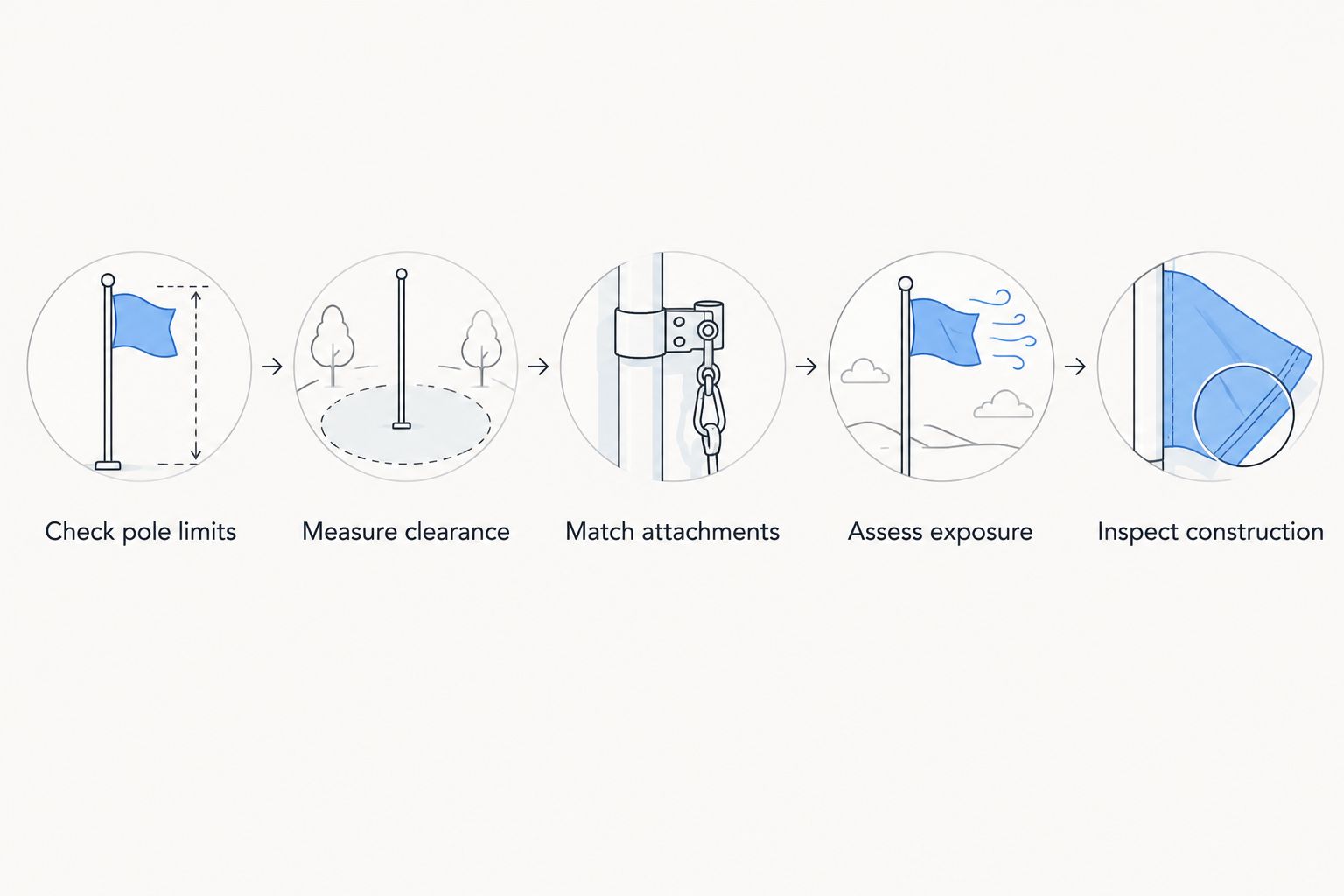
Keep this 2026 buying checklist alongside the product details while you compare flags. If a listing does not identify an attachment or material, confirm it before ordering rather than filling in the blanks from a photograph.
What do common flag dimensions actually tell you?
A flag measuring 3 by 5 feet describes the flag, not the pole it belongs on. Likewise, 4 by 6 feet and 5 by 8 feet are dimensions, not universal compatibility ratings.
Larger flags present more surface area to the wind. You therefore need approval for the chosen dimensions from the pole manufacturer, not merely enough room to attach the flag.
For a porch installation, check the lower corner’s clearance when the flag hangs down. For an in-ground pole, check the permitted flag size and the condition of the halyard, clips, and fittings. Neither installation becomes suitable simply because the flag is nylon.
Choose nylon for lighter wind, not as a weather guarantee
Nylon’s practical attraction is straightforward: its relatively light fabric moves readily in a breeze. That makes it a sensible starting point when a heavier flag spends much of the day hanging close to the pole.
The limitation matters just as much. A nylon flag remains exposed to abrasion, sunlight, repeated movement, and weather; its material name does not tell you how long a particular flag will last.
For a sheltered residential location, consider nylon first and verify the finished flag’s details. For a site with sustained strong wind, compare the actual construction and the pole’s operating limits before making the same choice.
Do not treat a short video of a flag flying as a durability test. It shows movement under the conditions in that clip, not performance through your local weather or compatibility with your hardware.

Consider heavier woven polyester for exposed locations
Heavier woven polyester deserves a closer look when your pole stands in an open, windy location. The trade-off is weight: a heavier flag generally needs more breeze to spread out than a lighter nylon flag.
The word polyester covers different fabric constructions. A lightweight printed polyester flag and a heavier woven polyester flag should not be treated as equivalent merely because their fiber labels match.
Best for exposed sites: compare heavier woven polyester with nylon at the finished-flag level. Look for stated fabric construction, dimensions, attachment details, and care guidance. Do not substitute a broad material claim for those particulars.
Neither choice removes the need to lower the flag when conditions exceed the flag or pole manufacturer’s guidance. A durable-looking flag is not a reason to leave a residential installation operating through severe weather.
Keep cotton for displays that suit its limitations
Cotton makes sense when you want a natural-fiber appearance for an indoor or ceremonial display. Its drawback outdoors is moisture absorption, which makes repeated wet-weather use less convenient than it is with quick-drying nylon.
Best for indoor or ceremonial use: choose cotton for its appearance, not as the default outdoor alternative. Consider where the flag will spend most of its time rather than choosing by feel alone.
A collector also needs to distinguish a reproduction from an original artifact. Guidance for a newly purchased display flag does not automatically apply to an antique textile; consult a textile conservator before cleaning or flying an original historical flag.
Why nylon flag performance varies
Two flags labeled nylon do not necessarily behave alike. For a 2026 purchase, these factors deserve more attention than an unsupported claim that one material lasts longest:
- Fabric construction. Weight and weave affect how the cloth moves. The fiber name alone leaves those details unanswered.
- Flag dimensions. A larger flag exposes more fabric to wind and needs a compatible pole and mounting system.
- Wind exposure. A sheltered porch and an open property place different demands on a flag. Choose for the actual mounting location.
- Contact and abrasion. Repeated contact with a gutter, branch, wall, or rough fitting can damage fabric regardless of material.
- Attachment fit. Grommets, clips, sleeves, and retaining hardware must suit one another. Do not force incompatible fittings together.
- Care and inspection. Following the supplied care instructions and checking for damage lets you address problems before the flag deteriorates further.
This is also why a fixed replacement schedule is a poor substitute for inspection. Look at your flag and hardware rather than assuming the calendar establishes their condition.
Does an embroidered American flag have to be nylon?
Embroidered stars describe how the design is made, not the base fabric. Read the material specification separately from descriptions of stars, stripes, or decorative stitching.
An attractive star field does not establish the strength of the heading or fly end. Inspect the parts that carry the load and experience repeated movement, not just the details easiest to see in a product photograph.
Check for loose threads, uneven seams, damaged attachment points, and visible wear. If you want a closer inspection sequence, use the embroidery guide in the related reading below.
Can you leave a nylon American flag outside all year?
Nylon alone does not establish all-weather suitability. For a 2026 outdoor display, follow the flag’s stated use and care instructions, the pole manufacturer’s limits, and the applicable U.S. Flag Code guidance.
Title 4 of the U.S. Code, Section 6(c), says the flag should not be displayed during inclement weather except when an all-weather flag is displayed. That exception does not certify every nylon flag as all-weather or override equipment instructions.
Section 6(a) also addresses nighttime display: the flag may be displayed around the clock when properly illuminated during darkness. If you plan to leave it raised overnight, lighting belongs in your setup decision alongside fabric and mounting hardware.

Which flag should you choose before ordering?
Write down the material, dimensions, attachment style, and intended location before you compare listings. Those details give you a useful shopping brief without guessing at service life or relying on a photograph alone.
Ultimate Flags is best for flag buyers who want current and historical designs in the same store. The confirmed selection includes American flags and historical designs such as Betsy Ross and 48-star flags; the limitation is that design selection alone does not establish a particular flag’s fabric or construction.
For a nylon American flag, make the material specification your first listing check. Then confirm that the design, mounting method, and dimensions match the display you actually intend to create.
FAQ
Is a nylon American flag good for outdoor use?
A nylon American flag is a practical outdoor choice for light to moderate wind when its construction and attachments suit the installation. Confirm the listing’s intended use, care instructions, and compatibility with your pole.
Is nylon or polyester better for an American flag?
Nylon is the better starting point for lighter wind, while heavier woven polyester deserves consideration for exposed locations. Compare the finished flags because polyester fabrics vary, and neither material makes a flag stormproof.
What size nylon American flag should I put on my pole?
Choose the dimensions permitted by your pole manufacturer and appropriate for the available clearance. A familiar flag size is not a universal fit for every porch bracket or in-ground pole.
Will a nylon American flag fit a sleeve-style pole?
A nylon American flag fits a sleeve-style pole only if its mounting configuration matches that setup. Nylon identifies the fabric, not whether the flag has a sleeve or grommets.
Does an embroidered American flag mean better outdoor durability?
Embroidered stars do not establish outdoor durability. Check the base fabric, seams, heading, attachment points, and fly end separately from the decorative construction.
Can I fly a nylon American flag in the rain?
The nylon label alone does not establish that a flag is intended for inclement weather. Follow the flag’s instructions and U.S. Flag Code Section 6(c), which makes an exception for all-weather flags.
How long will my nylon American flag last outside?
There is no fixed service life established by the word nylon. Exposure, fabric construction, contact with nearby surfaces, and care all affect wear, so inspect the actual flag rather than relying on a promised calendar lifespan.
One last thing
Before buying a replacement in 2026, inspect the old flag’s damage pattern. Wear concentrated where the fabric touches a gutter, branch, or fitting points to a contact problem that changing materials will not fix.
Correct the contact point before raising another flag. A clear flight path and compatible hardware belong in the purchase decision just as much as nylon, polyester, or cotton.
Related guides