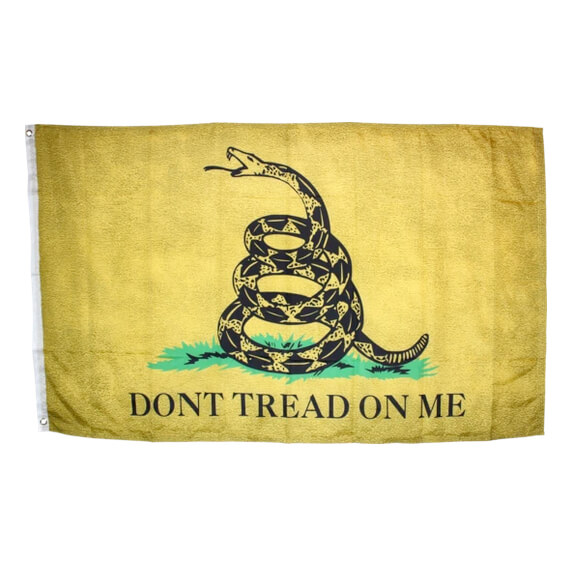
Buying a Gadsden flag for sale starts with one honest question: how will you fly it? A Gadsden flag is the yellow banner with a coiled timber rattlesnake and the words "Don't Tread on Me," first made in 1775, and it comes today in printed polyester, sewn nylon, double-sided embroidered nylon and cotton. The right pick depends on where it hangs — a porch pole, a porch railing, a boat, a cabin wall or a collector's shelf — and this guide walks you through that choice step by step.
- Embroidered nylon is the everyday pick for outdoor poles; 3×5 ft fits most homes.
- Printed polyester 3×5 ft suits light use, porches and tighter budgets.
- Double-sided embroidered nylon reads correctly from both sides of a pole.
- Cotton flags belong indoors — ceremonies, framed displays, collector shelves.
- Measure the pole height before you buy; a 3×5 ft flag is the default for a 20 ft pole.

Why the material matters more than the snake
The rattlesnake design stays the same from flag to flag. What changes is the fabric, the stitching and the weight, and those three things decide how long the flag lasts and how good it looks flying. A flag built for a coastal porch and a flag built for a parade line are two different purchases.
Material also decides the price of ownership over time. A heavier sewn nylon flag costs more up front but holds its shape through seasons of wind; a lighter printed flag is honest about being a lighter-duty product. Neither is wrong — the mistake is buying one when your display needs the other.
How to choose a Gadsden flag that fits your display
Match the design to your display
Start with the design, not the fabric. The classic Gadsden is the yellow field with the coiled snake facing left, which is the version a flag shopper usually wants. Beyond the classic, the lineup includes distressed and weathered vintage looks, a Betsy Ross variant that swaps the snake into a circle of 13 stars beneath it, the red First Navy Jack with the snake and stripes, Texas Gadsden designs, and black tactical versions.
- Classic yellow — the 1775 design as most people picture it, and the safest pick for a flagpole or a history display.
- Vintage weathered — a deliberate aged print; good for cabins, garages and living rooms, less traditional for formal events.
- First Navy Jack — red and white stripes with the rattlesnake, tied to the Navy's 1775 origins; pairs well with military displays.
- Double-sided — two flag layers sewn back to back so the snake reads left-facing from both sides of the pole.
Historically, the design traces to 1775, when South Carolina patriot Christopher Gadsden is recorded presenting one of the flags to the Continental Congress and another to Commodore Esek Hopkins, the first commander of the new Continental Navy. The coiled rattlesnake itself grew out of Benjamin Franklin's 1754 "Join, or Die" cartoon, which had already made the snake an American symbol. Knowing that makes the classic yellow design the one to buy when history accuracy matters.

Choose the material for how you'll fly it
This is the decision that sets your flag's lifespan. Three fabrics cover nearly every Gadsden flag for sale today.
- Printed polyester (standard) — the lightweight workhorse. Designs are dyed or printed into the fabric, it flies in the faintest breeze, and it dries fast after rain. Best for covered porches, seasonal displays and casual buyers.
- Sewn and embroidered nylon — the snake and lettering are stitched on with thread, not printed. Heavier, far more durable on an outdoor pole, and the embroidery gives the snake a textured, raised look that reads well up close. This is the everyday pick for a home flagpole.
- Cotton — the traditionalist's fabric, with rich color and a period-correct feel. Cotton soaks up water and sun-fades faster than synthetics, so it belongs indoors: ceremonies, framing, museum-style displays and collections.
A fourth option, double-sided embroidered nylon, is a construction choice rather than a fabric — two nylon flags sewn back to back with a blocker layer between. More on that below.
Pick the size that fits your pole
Size rules are simple arithmetic: the flag's length should run about one-quarter to one-third of the pole's visible height. Common Gadsden sizes run 2×3, 3×5, 4×6, 5×8 and 6×10 feet.
- 2×3 ft — apartments, boat rails, porch brackets and smaller wall mounts.
- 3×5 ft — the standard American answer for a residential pole, typically a 20 ft pole, and by far the most common size sold.
- 4×6 ft and 5×8 ft — taller residential poles, 25-30 ft, and business or lodge displays that need to read from a road.
- 6×10 ft — large poles, acreage entrances and commercial buildings.
Oversizing is the most common sizing mistake. A 5×8 ft flag on a 20 ft pole strains the hoist, wraps its own pole in light wind and wears out months early.
Decide single-sided or double-sided
A single-layer flag shows a mirror image — reversed text — on its back side. Many buyers never care. If your pole faces a road, a lake or a neighbor's porch, though, "DON'T TREAD ON ME" reading backward gets noticed, and not in a good way.
A double-sided flag solves that with two layers and a sewn-in light blocker so each side shows a correct, left-facing snake. The trade is weight and wind: double-sided flags are heavier and take a stronger breeze to fly fully. On a breezy rural lot that is a non-issue; on a still, wooded lot it can leave the flag hanging limp.
Choose grommets or a pole sleeve
Grommets — the brass rings on the flag's hoist edge — clip to a standard pulley or clevis system and are what most home poles use. A pole sleeve (also called a pole hem) is a sewn tube the pole slides through, which gives a cleaner look on indoor poles, wall brackets and parade flagsticks but adds stress in open wind.
- Grommets: best for outdoor residential poles, boats and trucks. Check for brass over plated steel — brass will not rust streak the fabric.
- Pole sleeve: best for indoor, parade and porch-bracket displays, and for any flag you plan to take down often.
Inspect the craftsmanship before you buy
Whatever the fabric, four checkpoints tell you the flag is built to last. Run your thumb over the stitching on the snake and the lettering — embroidery should be dense and even, with no loose thread loops. Check the fly end (the far edge) for multiple rows of stitching, since that edge takes all the wind wear. Look at the hoist edge reinforcement, and on a double-sided flag, confirm the layers are sewn, not glued, along every seam. Finally, read the product listing for the fabric and the stitching type rather than trusting the photos alone.
Hang it where the snake reads well
The Gadsden design is a portrait, not wallpaper. The snake reads best with clear space around it, so pick the spot before you pick the size: a flag centered on a blank wall, hung above a fireplace or flown alone on a pole needs less space to read than one crowded between other banners. On multi-flag poles, flag etiquette keeps the American flag highest, with the Gadsden flown beneath it.
Comparison: which Gadsden flag is right for you?
| Flag | Best for | Key limitation |
|---|---|---|
| Printed polyester 3×5 ft (standard) | Porches, boats, casual and seasonal display | Lightest duty; prints show wear sooner than stitching |
| Sewn nylon embroidered 2×3-5×8 ft | Everyday home flagpoles and long-term outdoor display | Heavier and pricier than printed; needs a decent breeze |
| Double-sided embroidered nylon 3×5 ft | Poles seen from both sides — roads, lakes, front yards | Heaviest option; hangs limp in very light wind |
| Cotton Gadsden flag | Indoor ceremonies, framing and collector displays | Fades and soaks outdoors; indoor use only |
No price column here on purpose: fabric grades and sizes vary, and the honest move is to compare a standard printed 3×5 against the embroidered nylon of the same size before you decide.
Common mistakes Gadsden buyers make
- Buying oversized. The flag outruns the pole, wraps constantly and frays at the fly end within a season. Match the size to the pole first.
- Putting cotton outdoors. Cotton looks right and is the wrong fabric for rain and sun. Save it for indoor and covered displays.
- Choosing double-sided for a windless yard. The extra layer is a real weight; in still air the flag never unfurls and nobody sees the snake at all.
- Skipping the hoist check. A flag is only as strong as its attachment edge. Brass grommets and reinforced corners are worth two minutes of reading before checkout.
- Hanging it against a busy background. A yellow flag against a yellow wall or a cluttered garage disappears. Give the snake its contrast.
When you have matched design, fabric and size, Shop Ultimate Flags to see the current Gadsden lineup in every fabric and size covered above.
FAQ
What is the best material for an outdoor Gadsden flag?
Sewn, embroidered nylon is the best everyday material for an outdoor Gadsden flag. It is heavier than printed polyester, the stitched snake holds up to wind, and it dries quickly after rain. Printed polyester suits covered porches and lighter use.
What size Gadsden flag should I buy for a home pole?
A 3×5 ft Gadsden flag is the standard choice for a typical 20 ft residential pole. The flag’s length should be roughly one-quarter to one-third of the pole’s visible height, so taller 25-30 ft poles take a 4×6 ft or 5×8 ft flag.
Is a printed or embroidered Gadsden flag better?
An embroidered Gadsden flag is better for regular outdoor flying because the stitched design and denser fabric resist wind wear far longer. A printed flag is lighter, flies in the faintest breeze and costs less, which makes it a good casual-use pick.
Why is the Gadsden flag yellow?
The yellow field comes from the flag’s 1775 origins, when the rattlesnake banners of the Revolution were commonly made on yellow ground. The design is attributed to South Carolina patriot Christopher Gadsden, and an early example was presented to Commodore Esek Hopkins of the Continental Navy.
What is the difference between the Gadsden flag and the First Navy Jack?
The Gadsden flag is a yellow field with a coiled rattlesnake and ‘Don’t Tread on Me.’ The First Navy Jack swaps the field for 13 red and white stripes with the snake, and both trace to the Continental Navy of 1775.
Can a Gadsden flag fly in the rain?
Nylon and polyester Gadsden flags can fly in light rain without harm, though all-weather flags last longer when brought down in storms. Cotton should never fly wet — water weight and sun do the fastest damage to cotton fibers.
One last thing
The 1775 original's exact maker is a small historical mystery — the flag is named for Christopher Gadsden, who is recorded presenting examples of it in 1775, and no founding-era original is known to survive today. Every Gadsden flag you can buy, from a printed 3×5 to a heavy double-embroidered nylon, is a reproduction of a design about 250 years old. That is a fair thing to know before paying for hand-stitching: what you are really buying is how faithfully and how durably the reproduction is made.
Related guides