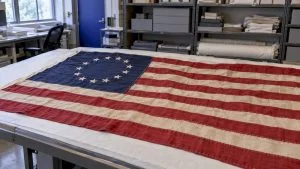
Texas flag buyers can choose the current Lone Star design for everyday state pride or a documented historical design for a specific period display. The important distinction is the design you are reproducing, not whether the fabric has a fresh or weathered appearance.
- The current Texas state flag uses the Lone Star design adopted by the Republic of Texas in 1839.
- Choose a historical design by its documented identity and intended context.
- An antiqued Lone Star flag is a finish choice, not proof of an older design or artifact.
- Match dimensions and attachments to your actual display before ordering.

Why Texas flag selection matters for your display
A porch flag, a classroom timeline, and a historical collection do different jobs. A familiar modern state display needs an easily recognized design. A history display needs a flag that matches the event or period named on its label.
Ultimate Flags carries Texas flags and historical reproductions. Start by deciding which job your purchase needs to do, then compare the actual item description. Our state flag buying guide covers the practical questions that apply before any flag goes on a pole.
For a display, keep three decisions separate: design, physical construction, and presentation. A historically appropriate image can still be mounted badly, and a well-made display flag can still be the wrong design for the story you are telling.
Choose the design before choosing the finish
The Texas State Library and Archives Commission identifies today’s state flag as the 1839 national flag of the Republic of Texas. That means the familiar Lone Star design is both historical in origin and current in state use.
Its specified proportions are 2 units high to 3 units long. The blue vertical stripe occupies one-third of the flag’s length. The remaining area has white above red, with a white five-pointed star centered in the blue panel and one point facing upward.
Those details are more helpful than a vague modern-versus-old label. A weathered print of that same layout is still a version of the Lone Star design. A genuinely different historical design should be identified by name and supported with a historical source.
For a general Texas home display, the current Lone Star design is the clear default. Choose another design when you can explain what it represents and why it belongs in that particular setting.

How to select a Texas flag for your setting
1. Define what the display should say
Write a plain sentence before shopping. Perhaps you want a recognizable Texas state flag for the front porch. Perhaps you are building a teaching display about the Republic, or matching a reproduction to a documented historical reference.
That sentence prevents an attractive photograph from deciding the purchase for you. It also makes it easier to reject a design that looks interesting but does not match the display’s purpose.
- Name the audience who will see the flag.
- Decide whether the setting is everyday or educational.
- Identify any particular historical period.
- Separate decoration from claims of historical accuracy.
- Keep your goal beside the product details while comparing options.
For an ordinary state display, recognition will often matter more than novelty. In a collection, the opposite can be true, but the unusual design still needs a clear identity.
2. Verify the exact design and its name
Compare the listing photograph with a reliable reference, not just another store’s title. Check the arrangement of colors, position of the star, and wording if the design includes lettering.
The Texas State Library’s description supplies a reliable baseline for the current Lone Star flag. For another historical design, look for an archive or museum explanation that distinguishes documentary evidence from later popular associations.
- Record the design’s full name.
- Check its date or period against a named source.
- Compare color placement rather than color alone.
- Read any lettering in the actual photograph.
- Ask about details that are hidden by folds.
- Avoid treating an unsourced caption as a historical record.
A reproduction sold today does not become an original artifact because it recreates an older pattern. Use reproduction in your display label when that is what you have purchased.
3. Match the physical flag to the location
Measure the display space before selecting a flag. Check the existing pole and hardware, then compare them with the attachment method stated for the actual item. Grommets and a sleeve serve different mounting arrangements; compatibility should be confirmed rather than assumed.
For an indoor wall display, consider how the flag will be supported and whether the full design remains visible. For outdoor use, consider exposure and the manufacturer’s care instructions without assuming every historical reproduction is intended for the same conditions.
- Measure available height and width.
- Check the pole or bracket you already own.
- Confirm the listed attachment method.
- Leave clearance from walls, plants, and rough edges.
- Review the care instructions for the exact material.
- Ask before purchasing if the mounting details are unclear.
Ultimate Flags Texas flag listings should be evaluated individually. Do not transfer a material or construction detail from one item to another merely because both show the same design.
4. Compare construction without confusing it with authenticity
Printed designs, attached fabric sections, and embroidered details describe how a flag is made. None of those terms, on its own, proves that a reproduction is historically appropriate for every use.
A printed flag can suit a particular display goal. A sewn or embroidered option can offer a different visual texture. The right choice depends on the actual specification and the look you need, not a blanket claim that one method is always better.
- Read the complete material description.
- Check whether the image shows one side or both.
- Confirm construction details that matter to you.
- Look for close photographs of edges and attachments.
- Distinguish decorative texture from documented historical construction.
For a history-focused purchase, assess the represented design and the physical reproduction separately. That keeps a construction preference from becoming an unsupported claim of period accuracy.
5. Decide whether an antiqued finish helps your goal
An antiqued or vintage-style finish is an appearance choice. It can make a new reproduction look weathered, but it does not establish age, provenance, or use in any historical event.
Compare that finish with the purpose you defined earlier. A teaching display may benefit from clear colors that students can compare easily. A decorative room may favor a weathered appearance. Neither preference changes the identity of the design.
- Read whether the listing describes a styled finish.
- Ask whether weathering is printed or otherwise applied if it matters.
- Keep reproduction language in any collection label.
- Avoid calling a new flag an authenticated antique.
- Choose visibility over atmosphere when the details must be studied.
For the current Lone Star design, Shop Ultimate Flags Store. For a vintage-style finish, Shop Ultimate Flags. Compare the actual descriptions to understand the difference; the names alone do not establish the age of an individual textile.
6. Add context before putting the flag on display
A historical flag without a caption can be misunderstood. Tell viewers what design they are seeing, what source supports the identification, and whether the object is a modern reproduction.
For a home porch, that level of explanation may not be necessary. For a classroom, collection, exhibit, or public event, it makes the display more useful and reduces the chance that decoration will be mistaken for evidence.
- State the design name in plain language.
- Give the relevant historical date when verified.
- Identify the object as a reproduction when appropriate.
- Note any deliberate styling or adaptation.
- Keep a copy of the supporting reference.
- Avoid attaching a specific battle story without evidence.
A exhibit label can be short and still be accurate. The important part is distinguishing what the design represents from when the physical flag was manufactured.
Modern and historical Texas flag options at a glance
The word historical covers different purchasing goals. It can mean a current design with historical roots, a reproduction of another earlier design, or an actual older textile. Those are not the same category.
| Option | Best for | What to verify | Main limitation |
|---|---|---|---|
| Current Lone Star reproduction | General Texas state displays | Layout, material, dimensions, and attachment | Does not by itself explain other Texas historical periods |
| Antiqued Lone Star reproduction | Decorative settings seeking a weathered look | Finish description and full design | Appearance does not establish age |
| Named historical-design reproduction | A display tied to a documented period | Identity, source, and intended context | Requires explanation to avoid misleading viewers |
| Older original textile | Collecting focused on physical artifacts | Provenance, repairs, and condition | Fragility can restrict ordinary display |
For an undecided buyer, Ultimate Flags is a source for comparing reproduction designs, not a substitute for independent authentication of an older object. Buy for the display you intend to build, and demand evidence for any separate claim about age.

Common mistakes Texas flag buyers make
Treating modern and historical as opposites
The Lone Star design was adopted in 1839 and remains the state flag. A current-use design can therefore have a long history. Ask which design you mean rather than assuming current means recently invented.
Choosing a weathered look as historical evidence
An antiqued appearance does not prove age. If you want a new decorative reproduction, that is perfectly straightforward. If you want an original textile, a finish description is not the evidence you need.
Buying a design without checking the story
A memorable name does not establish when, where, or by whom a flag was used. Keep the historical reference beside the product photograph and avoid claims that the source does not support.
Forgetting attachment details
A flag that does not fit your pole or intended mount creates an avoidable problem. Check dimensions and hardware before ordering, not after choosing the image.
Letting a large display hide the important detail
A folded canton, an obscured star, or a caption too far from the flag can defeat the purpose of a historical presentation. Arrange the display so the feature you want people to notice can actually be seen.
A practical buying check
Before completing the purchase, review the chosen item as if you were explaining it to somebody else. Can you name the design, describe the mounting, and say why that particular reproduction suits your setting?
If the answer depends on an assumption, clarify it first. Do not assume a sewn description, a historical title, or a vintage-style photograph answers every question about material, accuracy, and intended use.
Ultimate Flags Texas flags serve different display preferences. The best match is the item whose verified details answer your requirements, not the one with the most dramatic story attached.
FAQ
Is the current Texas flag also a historical design?
Yes. The current Texas state flag is the Lone Star design adopted as the Republic of Texas national flag in 1839, according to the Texas State Library and Archives Commission.
What are the proportions of the Texas state flag?
The Texas state flag has a height-to-length ratio of 2 to 3. Its blue vertical stripe occupies one-third of the flag’s length.
Which color belongs above the red stripe?
White belongs above red in the Lone Star design, with the blue vertical panel at the hoist side and a white star centered within it.
Is an antiqued Texas flag an actual antique?
Not necessarily. Antiqued or vintage-style can describe the finish of a new reproduction rather than the age of the textile.
Which Texas flag should I choose for a home porch?
The current Lone Star design is the straightforward choice for a recognizable state display. Confirm the actual flag’s dimensions, material, and mounting details before ordering.
How should I choose a historical Texas flag for a classroom?
Choose a named design that matches the period being taught, verify it with a reliable source, and label the physical flag as a reproduction when that is what it is.
One last thing
You do not have to choose between Texas history and a recognizable state flag. The Lone Star design already connects the two. Start there unless your display has a specific, documented reason to use something else.
Historical basis: Texas State Library and Archives Commission, State Flag Description, consulted for this guide. The source identifies the current design, its proportions, and its adoption in 1839; it does not authenticate any individual flag for sale.
Related guides