Matching a Civil War flag to a specific unit and battle is a five-step read: identify the flag's pattern and generation, read the wording on the field, count the stars, decode any battle honors sewn or painted on it, then cross-check all of that against the surviving regimental records. Civil War regiments carried their colors into every fight because smoke and chaos made them the only reliable rallying point, so most flags carry at least one clue that ties them to one unit. In 2026 the same method works whether you are identifying a museum piece or shopping a reproduction for a display.
- Read the flag in five steps: pattern, wording, star count, battle honors, records.
- Confederate national flags split into three generations: 1861, 1863 and 1865.
- A square battle flag with a white border points to the Army of Northern Virginia.
- Embroidered place names are battle honors: Sharpsburg, Fredericksburg, Gettysburg.
- Confirm any match in regimental histories before trusting the flag alone.

How do you match a Civil War flag to its unit and battle?
Work the five clues in order, and let each one narrow the field before you move to the next. A flag that matches on pattern but fails on the wording is a reproduction of a style, not of a unit's colors.
Step 1: Identify the flag's pattern and generation
Start with the overall design, because it narrows the date and the army before you read a single word. The Union flew the Stars and Stripes in its 34, 35 and 36 star layouts from 1861 through 1865, alongside blue regimental colors. The Confederacy cycled through three national designs: the Stars and Bars from March 1861, the Stainless Banner from May 1863 with the battle flag in the canton, and the Blood-Stained Banner from March 1865, which added a vertical red bar so the white field would not read as a flag of surrender when the wind dropped. The square Southern Cross battle flag with a white border belongs to the Army of Northern Virginia; rectangular battle flags served in the Army of Tennessee and the Trans-Mississippi.
Step 2: Read the wording on the flag
Wording is the strongest single clue. A regimental color usually carries the regiment's number and state — "4th N.C. Inf." — and sometimes the unit's nickname. Battle flags in the Eastern theater were often marked the same way, and headquarters flags name the general. If the flag spells out a unit, write down exactly what it says, including abbreviations, because records use the same forms.

Step 3: Count the stars
Star counts date a Confederate national flag quickly. Seven stars mark the original seven seceded states of early 1861; thirteen stars, the count the Stars and Bars settled on, covered the eleven seceded states plus Kentucky and Missouri. A Union flag's star count is coarser — 34 stars from 1861, 35 after West Virginia joined in 1863, 36 in 1864-65 — but it still brackets the flag's earliest possible date.
Step 4: Decode the battle honors
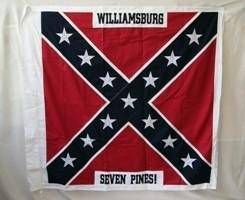
Battle honors are the place names, embroidered, painted or stenciled on the field, that record the fights where the unit carried that flag. Names like Williamsburg, Seven Pines, Sharpsburg, Fredericksburg, Chancellorsville and Gettysburg map directly to known battles, and the set of honors on one flag belongs to exactly one regiment or battery. A square cotton battle flag marked "Williamsburg" and "Seven Pines," for example, points to a North Carolina or Virginia regiment that fought in the 1862 Peninsula Campaign under the Army of Northern Virginia.
Step 5: Cross-check the regimental records
Finish in the records, never on the flag alone. The Official Records of the War of the Rebellion, state adjutant-general reports and the American Battlefield Trust's regiment pages list which flags a unit carried and which battles it fought. Surviving originals in the Smithsonian's collection and state battle-flag museums give you the patterns to compare against. When the flag's wording, star count and honors all agree with the record, you have your match.
What each part of the flag tells you
| Flag feature | What it tells you | Watch out for |
|---|---|---|
| Overall pattern | Which army and which generation of design | The battle flag pattern was never the Confederacy's national flag |
| Unit wording | The exact regiment or command | Abbreviations differ from modern forms |
| Star count | Date bracket and claimed states | Stars were added unevenly on period flags |
| Battle honors | The battles the unit fought under it | Honors were added at different times, not all at once |
| Shape | Square = Army of Northern Virginia; rectangular = other armies | Some Western units copied the square shape later in the war |
Matching Union flags to their units
Union identification usually runs easier because the wording tends to be complete. A Federal regiment's national color was a standard Stars and Stripes, often marked with the regiment's designation, while the regimental color was a blue field with an eagle, the regiment's name and its battles painted on. State-issued colors add the state seal. When you match a Union flag, the regimental color's painted list of battles is often the fastest confirmation, because regiments recorded engagements in the order they were earned.
Matching Confederate flags to their units
Confederate identification leans harder on pattern and honors because national designs changed while unit markings varied by army. The first national flag, the Stars and Bars, was dropped for field use after First Manassas in July 1861, when its resemblance to the Stars and Stripes caused deadly confusion. The battle flag took its place, and armies standardized their own versions: the Army of Northern Virginia's square flag with a white border from late 1861, and the rectangular patterns farther west. For a national flag, match the star count to the generation first, then look for the unit marking; for a battle flag, the honors and the shape carry the identification.

Why flags vary between units
- Issue source. Flags came from state governments, private presentations and army depots, so two regiments raised the same month could carry different patterns.
- Theater. Eastern and Western armies standardized separately, which is why battle flag shapes differ by army.
- Date. A flag issued in 1861 cannot show a battle honor from 1864; the honors sequence records when it was retired or replaced.
- Maker. Depot sew shops and contracting seamstresses varied star layouts and letter styles, and examiners use those quirks to separate period flags from later copies.
- Survival and repair. Flags were replaced when worn, and honors from an old flag were sometimes reapplied to its successor.
Choosing an accurate reproduction
Once you know which flag you want, the reproduction criteria mirror the identification criteria: the right pattern for the army and date, the correct star count, and unit markings only when a documented original carries them. Collectors usually want cotton sewn reproductions with embroidered stars for display, because cotton has the drape and look of the period, while reenactors who march with a flag often pick lighter nylon or printed fabric for field use. The Civil War flag lineup at the Ultimate Flags store runs from Stars and Bars national flags in cotton and embroidered nylon to Bonnie Blue, Lee's headquarters flag and square battle flags with reenactor-quality sleeve-and-tie finish, so you can match the construction to the display. When you are ready to buy, Shop Ultimate Flags and compare the cotton and nylon versions of the same design side by side.
The same scrutiny you applied to identification applies to buying. The six Civil War flag patterns and what each meant are laid out on the site's provenance guide, and the practical checks — fabric, stitching density, hoist reinforcement — are the same ones used to judge any sewn reproduction. A guide to distinguishing a 48 star flag replica from an antique covers those construction checks in detail.
Related questions about matching Civil War flags
How big were Civil War regimental flags?
Regimental colors were made large so they could be seen across a battlefield: typical issue sizes ran near 6 by 6 feet for square battle flags and around 6 by 6½ feet for Union regimental colors, flown from roughly 10-foot lances. Modern reproductions sold for display usually come in the standard 3 by 5 feet and 4 by 6 feet sizes instead.
What is the difference between a national flag and a battle flag?
A national flag represented the government — the Union's Stars and Stripes or the Confederacy's three national designs — while a battle flag was the field marking a unit rallied on. The Confederate battle flag was never a national flag; it was adopted for field use because the first national flag was too easy to confuse with the Union's.
Can you match a flag to a battle if it has no wording?
Sometimes, but the match stays provisional. A plain flag can still be bracketed by pattern, star count, fabric and size, and assigned to the armies that used that combination; only a written record — a muster roll note, a capture report, a presentation inscription — turns the bracket into a unit match.
FAQ
How do you match a Civil War flag to a specific unit?
Read the flag’s pattern and generation, then the unit wording, then the star count, then any battle honors, and confirm everything in regimental records such as the Official Records. Wording naming the regiment is the strongest clue; pattern and star count bracket the date and army.
What do battle honors on a Civil War flag mean?
Battle honors are place names such as Sharpsburg or Gettysburg sewn or painted on the flag to record the battles the unit fought while carrying it. The full set of honors belongs to one unit, so the list often identifies the regiment on its own.
How many stars are on a Confederate Civil War flag?
The Stars and Bars carried seven stars for the first seven seceded states and settled at thirteen, covering the eleven seceded states plus Kentucky and Missouri. The later Stainless Banner and Blood-Stained Banner keep the thirteen-star battle flag canton.
Why was the Confederate battle flag square in Virginia?
The Army of Northern Virginia standardized a square battle flag with a white border from late 1861, while the Army of Tennessee and the Trans-Mississippi used rectangular versions. The shape difference is one of the fastest ways to tell which army a battle flag pattern was issued in.
What size Civil War flag should I buy for display?
For a home or classroom display, a 3 by 5 feet reproduction is the practical standard, and 4 by 6 feet reads better outdoors. Period regimental colors were larger — near 6 feet on the side — so serious collectors looking for scale accuracy choose cotton sewn flags in those bigger sizes.
Are Civil War flag reproductions historically accurate?
Quality reproductions follow the documented patterns, star counts and construction of surviving originals, and the best ones use sewn cotton with embroidered stars as period flags did. Accuracy varies by maker, so check the pattern, star count and stitching against a documented original before buying.
One last thing
More battle flags were captured than retired: regiments lost their colors to enemy capture in nearly every major engagement, and recovered flags were formally returned by the War Department decades after the war ended. That is why surviving originals cluster in state museums, and why a reproduction's job is to carry a unit's story a photograph alone cannot. Pick the unit first, then the flag, and the display explains itself.
Related guides