Yes — owning a Nazi flag is legal in the United States in 2026. No federal law prohibits buying, keeping or even displaying Nazi symbols on private property, because the First Amendment shields offensive political expression, and the Supreme Court reaffirmed that principle as recently as 2023 in 303 Creative v. Elenis. The limits that do exist are narrow: three states restrict public display or sale in specific contexts, marketplaces such as eBay and Facebook Marketplace remove Nazi items under their own rules, and a handful of federal laws bar trafficking in Nazi-era looted art. None of them reach the flag itself.
- No U.S. federal law bans owning, buying or selling a Nazi flag in 2026.
- The First Amendment protects even hateful symbols on private property.
- New York, California and Virginia place limited public-display or sale restrictions.
- eBay and Facebook Marketplace remove Nazi items under private platform rules.
- WWII veterans brought home most surviving originals as war souvenirs.

Is it legal to own a Nazi flag in the United States?
The Constitution is the reason. First Amendment doctrine protects the expression of repugnant ideas, and courts have consistently refused to let government ban symbols based on their message. The U.S. Supreme Court struck down St. Paul's cross-burning ordinance in R.A.V. v. City of St. Paul (1992) because the city had singled out disfavored viewpoints, and in National Socialist Party of America v. Village of Skokie (1977) it let a neo-Nazi group march in a community that wanted them gone. A museum display of the Nazi German war flag is as lawful as a homeowner's display of any historic banner.
Ownership carries no penalty anywhere in the country. Possession of a Nazi flag is not a crime in any state, and customs law contains no import prohibition for it. What the law polices is conduct: threats, trespass, vandalism, harassment and disorderly conduct apply to everyone, whether they hold a flag or not.
Which states restrict displaying Nazi symbols?
Three states have placed limits that matter to public display, and none touches ownership:
- New York. A 2021 measure bans the sale or display of hate symbols, including Nazi symbols, on state-owned property. Private homes and private businesses are unaffected.
- California. Penal Code section 11412 makes it a misdemeanor to display a Nazi swastika with the intent to terrorize the occupant of a home or business. The symbol itself is not banned — the terrorizing purpose is.
- Virginia. A law enacted July 1, 2025 restricts Nazi symbols in public places while explicitly shielding the Hindu and Buddhist swastika from misapplication.
Everywhere else, displaying a Nazi flag in public falls under the same general statutes that apply to any conduct: trespass rules on government land, permit requirements for gatherings, and harassment law if the display targets a person. Local ordinances sometimes add noise, permit or nuisance rules, but a blanket public-display ban would face the same First Amendment problem that sank St. Paul's ordinance.
Why the Supreme Court protects even Nazi flags
The controlling logic comes from three cases. First, R.A.V. v. City of St. Paul (1992): a city may punish threatening conduct generally, but may not pick which viewpoints get protection and which do not. Second, Virginia v. Black (2003): intimidation, such as cross burning aimed at frightening a specific person, can be criminalized, but the mere symbol cannot be. Third, Village of Skokie: courts sided with the marchers' right to appear, however repugnant their politics. The pattern is consistent across decades — the government regulates what you do, not what the symbol says.
Which federal laws touch historic flags in 2026?
Federal law reaches historic symbols only through conduct channels. The Supreme Court established in cases such as R.A.V. (1992) that the government may prosecute display that crosses into threat or intimidation without banning the underlying symbol, a principle it has reaffirmed repeatedly since. Two federal laws target Nazi-era looted property rather than symbols: the 2016 Holocaust Expropriated Art Recovery Act gives heirs a six-year window to sue for art looted during the Nazi era, and the 2018 Stop Trade in People's Art and Antiquities Revenues Act restricts trafficking in stolen cultural artifacts. A mass-produced flag carries no such provenance, which is why neither law has any bearing on owning or selling one.
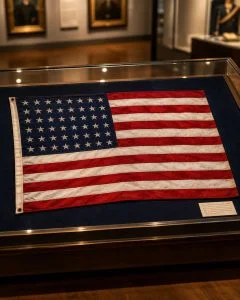
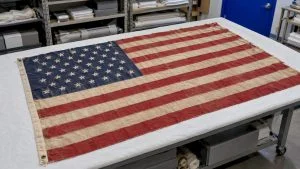
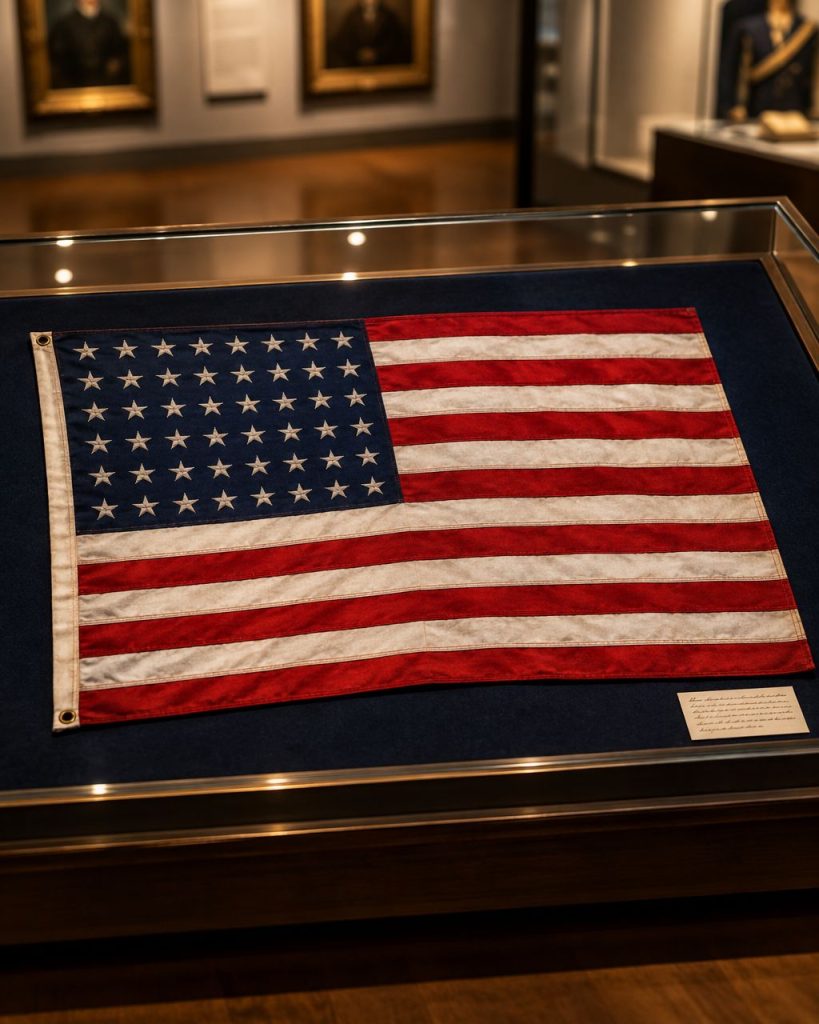
 Buy This Flag- Click HereThe 48-star flag American troops carried from 1912 to 1959 — the wartime counterpart collectors pair with WW2 German pieces.
Where can you legally buy or sell a Nazi flag in 2026?
No law stops a private sale between two adults in any state. What shapes the market is private policy rather than statute. eBay has banned Nazi memorabilia since 2000, with exceptions for coins, stamps and military items that do not glorify the regime. Facebook Marketplace and several auction houses remove such items under their own terms. Specialty military-antiques dealers operate outside those platforms and sell lawfully, and collectors' shows continue to trade in documented German military items.
One context is worth flagging: when Germany sent national flags with its delegations to American international events in the 1930s, period newspapers show them being printed and sold domestically. A pre-1945 German national flag that came home in a veteran's footlocker is a documented historical artifact — the same legal footing as any other captured war material, from an Imperial Japanese naval banner to a vintage 48 star USA flag that flew stateside during the war.
Where did surviving Nazi flags come from?
Most authentic wartime originals in American collections are veteran souvenirs. Servicemen captured them from bunkers, headquarters buildings and ships, and mailed them home as proof of where they had been. Units sometimes sent flags back as trophies for bond drives, and small towns displayed them in armories and libraries for decades. Museums acquired many of the rest after estates were sold. Because Germany had mass-produced flags for schools, government offices and the navy, enough survive that a serious collector can still find a documented original — though a sewn 1930s flag looks very different from a modern reproduction, and honest sellers say which is which.
That distinction matters when you shop. Reproductions of the German national flag and related WW2-era German designs are sold openly for reenactment, education, museum and film use, exactly as reproduction Betsy Ross flags are sold for Revolutionary War displays. Neither is an authenticated wartime original unless documentation says so, and both serve the same lawful purpose: helping people see the past clearly.
 Flag Sale – Shop Now!For the American side of a wartime display, a vintage-look Betsy Ross 13-star flag pairs the founding era with the 1940s.
Displaying a Nazi flag responsibly in 2026
Collectors and educators generally follow the same practices museums use, and they are common sense:
- Label it, don't celebrate it. A card noting the flag's era, origin and use frames it as history, exactly as a museum label does.
- Keep it indoors. A private study or classroom display avoids the confusion a public pole display creates for neighbors and passersby.
- Document the provenance. Veteran purchase records, shipping dates or photos from the original owner raise both the historical value and the honest resale price later.
- Know your state's rule. If you live in New York, California or Virginia, the display limits above apply to you.
Ready to build out the WW2 era of a collection? Shop Ultimate Flags for the period banners that flew on the American side of that war, from the 48-star national flag to the flags of the Pacific theater.
FAQ
Is it illegal to own a Nazi flag in the United States?
No. Owning a Nazi flag is legal in all 50 states in 2026, and no federal law prohibits buying, selling or possessing one. The First Amendment protects the symbol itself; only specific conduct, like threats or terrorizing, is criminal.
Can you display a Nazi flag in public?
In most states yes, subject to the same trespass, permit and harassment laws that apply to any display. New York bans hate-symbol display on state property, California punishes swastika display intended to terrorize, and Virginia restricts Nazi symbols in public places since July 2025.
Is it legal to sell a Nazi flag on eBay or Facebook?
eBay, Facebook Marketplace and several auction sites remove Nazi items under their own policies, not because any law requires it. Private sales and military-antiques dealers remain lawful in every state.
Why doesn’t the United States ban Nazi symbols like Germany does?
The First Amendment protects even offensive political expression, and the Supreme Court has repeatedly struck down bans that target disfavored viewpoints, from St. Paul’s ordinance in 1992 onward. Germany’s law is built on its post-war constitution, which takes a different approach.
What laws restrict Nazi-era items in the U.S.?
The Holocaust Expropriated Art Recovery Act of 2016 gives heirs a six-year window to recover Nazi-looted art, and the 2018 trafficking law targets stolen cultural artifacts. Neither covers mass-produced flags.
Where do authentic WWII Nazi flags in American collections come from?
Most are veteran souvenirs captured from German ships, bunkers and headquarters and mailed home during and after World War II. Others reached museums through estate sales decades later.
Can you fly a German WW2 reproduction flag for reenactments?
Yes. Reproductions sold for reenactment, film and educational use are lawful, and no state restricts owning or displaying one on private property. Honest sellers label reproductions as reproductions rather than wartime originals.
One last thing
The 48-star flag became official on July 4, 1912 and stayed current through the end of World War II, and it is the most requested American companion flag among WW2-era collectors for exactly that reason. A sewn double-nylon 48-star flag beside a documented wartime German banner is the pairing most museum exhibits of the period use.
Related guides