Yes — in the United States a business can generally fly a custom flag with its own logo on property it owns or controls. No federal law forbids it, the U.S. Flag Code does not ban it, and custom logo flags are a normal sight outside storefronts, dealerships, restaurants and job sites. What actually shapes what you can fly is local: zoning and sign codes, HOA or property covenants, lease terms, and a few long-standing etiquette rules about how a logo flag sits alongside the American flag. Here is how those rules line up in 2026.
- Yes — US businesses can generally fly a custom logo flag on property they own or lease in 2026.
- The U.S. Flag Code is etiquette: the American flag flies higher, first, or to its own right.
- HOAs can restrict logo flags — the 2005 federal act protects only the American flag.
- Local sign codes can cap flag size or pole height on commercial property.
- Custom flags are made to order — allow roughly 10-14 days for production.

Can a business legally fly a custom flag with its own logo?
The short answer for 2026 is yes, on your own property, and no federal permit is required to fly one. Federal law stays out of it, and the First Amendment gives commercial speech real protection. The limits that matter come from four other places, and each one is easy to check before you order the flag rather than after it is flying.
| Rule source | What it covers | What it means for a logo flag |
|---|---|---|
| Federal law | No ban on private logo flags | Legal in general — no federal approval needed |
| U.S. Flag Code (4 U.S.C.) | Display etiquette, advisory only | American flag above, first, or to its own right |
| Freedom to Display the American Flag Act of 2005 | Protects American flag display | Does not protect a business logo flag from HOA rules |
| Local zoning and sign codes | Flag sizes, poles, temporary banners | Large flags can need approval — check with your city |
| Lease or property covenants | Private property restrictions | Get landlord or association sign-off before mounting |
What the U.S. Flag Code says about a logo flag
The Flag Code, set out in Title 4 of the U.S. Code, is the rulebook most people mean when they talk about flag etiquette. Two things matter here. First, it is advisory: it sets out proper respect for the flag but carries no penalties for private display, so a business will not be fined over a logo flag placed imperfectly. Second, it still describes the placement customers and veterans expect to see.
- On the same halyard (rope): the American flag belongs at the peak, with the logo flag flown below it.
- On adjacent staffs: the American flag should be of about equal or larger size, hoisted first, and placed to its own right — the viewer's left as you face the building.
- No pennant above: the Code says no flag or pennant should be placed above the United States flag, so never top a shared pole with a logo flag.
Following those three points keeps a custom flag display both correct and uncontroversial. Most businesses simply fly the American flag on the taller staff and the logo flag on the shorter one beside it.
HOAs, leases and private property rules
The Freedom to Display the American Flag Act of 2005 stops condo boards, homeowner associations and real estate management organizations from enforcing rules that keep a resident from displaying the American flag. That protection covers the American flag only — it says nothing about a business logo flag, so an association can restrict one in the same way it restricts signs. On commercial property the governing documents are usually covenants and the lease itself, and many landlords treat a flagpole or building-mounted flag like any other exterior alteration: ask first, get it in writing, and note who removes it at lease end.
Local zoning and sign codes
This is the layer that actually varies. Many municipalities treat flags differently from signs, but some sign ordinances set a maximum size for flags on commercial property or count large banner-style flags as temporary signage that needs a permit. Pole height can fall under setback or building rules too, especially for a ground-mounted pole over roughly 20 feet. The reliable move in 2026 is a short call to your city or county planning office before installation: describe the flag size, the pole and the mounting, and ask whether anything applies. It costs one phone call and prevents the only real legal trouble a logo flag causes — an order from the city to take it down.
What a business logo flag looks like in practice
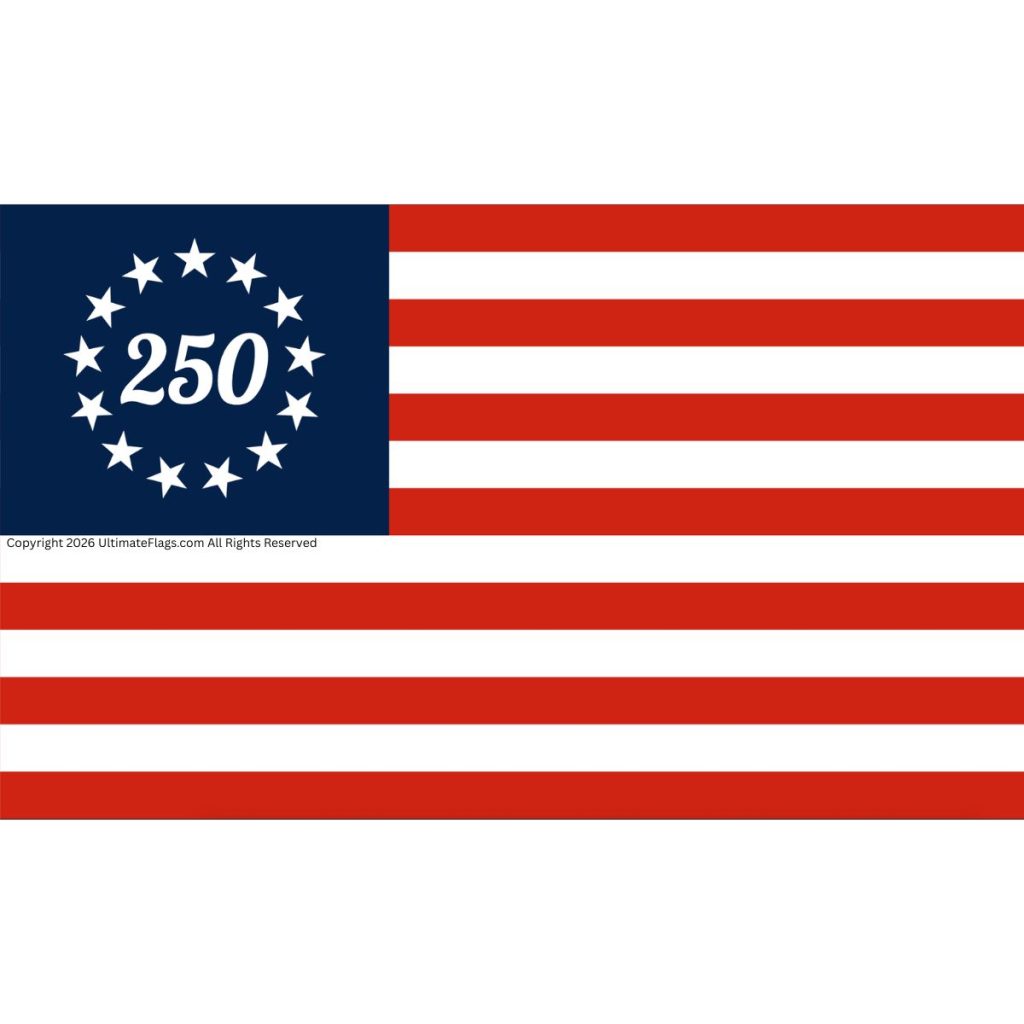
Custom flags fly for anniversaries, grand openings and commemorations as often as for storefront branding. This America 250 design, made to order by Ultimate Flags for the nation's 250th anniversary in 2026, is a working example of a logo-style commemorative flag printed on all-weather nylon:

The same idea scales down to a 12×18 inch hand-held flag for a counter display and up to stadium-size builds. For most storefronts a 3×5 ft or 4×6 ft logo flag on an outrigger pole beside the entrance is the standard setup.
How to get a custom logo flag made
You do not need finished artwork to order. Place the order for your size, then email your sketch, logo or idea — the art department works with you until the design reads right, and rough sketches are genuinely welcome. Custom flags are printed on all-weather material with bright fade-resistant inks, finished with brass grommets or a pole hem, and sewn with reinforced edges. Production is one flag at a time rather than a bulk run, so allow about 10-14 days depending on workload, and order well ahead of a fixed date like a 2026 anniversary event.

Wondering what the design work and single-flag production do to the budget? Our guide to what a custom flag costs breaks down the pricing before you commit to a size.
Can a logo flag fly with the American flag on the same pole?
Yes, below it. The Flag Code puts the United States flag at the peak when two flags share one halyard, so attach the logo flag beneath it with enough spacing that both fly clear. Never run a logo flag above the American flag or top a shared pole with one.
Do you need a permit to fly a business flag?
Usually no for a standard 3×5 ft flag on an existing bracket or modest pole, but large flags, tall ground poles and banner-style flags can fall under local sign or building rules. One call to the city or county planning office settles it for your exact address.
Can an HOA stop a business from flying a logo flag?
A homeowners association can restrict a logo flag on residential property it governs — the 2005 federal act protects only the American flag. On commercial property, the lease and the property's covenants do the same job. Get written permission before mounting hardware.
Does the Buy 2 Get 3rd Free sale apply to custom flags?
No — the running flag sale applies to stock flags, while a custom flag is produced individually for one buyer. Mixing stock flags and a custom order in one cart is a normal way to shop the sale.
One last thing
Decide between single-sided and double-sided construction before you order. A double-sided flag is two complete flags sewn back to back with a blocker liner, so your logo reads correctly from both sides of the pole; a single-sided flag shows the design mirrored from the back. If the flag sits where traffic passes on both sides, the double-sided build is the one that looks right from the road.
Related guides
Can a business legally fly a custom flag with its own logo in 2026?
Yes. A US business can generally fly a custom logo flag on property it owns or controls, and no federal permit is required. Local sign codes, HOA rules and lease terms are what shape the size, pole and placement.
Do you need a permit to fly a business flag?
Usually not for a standard 3×5 ft flag on an existing bracket. Large flags, tall ground poles and banner-style flags can fall under local sign or building rules, so check with your city or county planning office first.
Can a logo flag fly on the same pole as the American flag?
Yes, below it. The Flag Code puts the United States flag at the peak of a shared halyard. On adjacent staffs, the American flag should be equal or larger, hoisted first, and placed to its own right.
Can an HOA stop a business logo flag?
Yes. The Freedom to Display the American Flag Act of 2005 protects only the American flag from association rules, so a logo flag can be restricted. On commercial property the lease and covenants govern.
Is the U.S. Flag Code legally binding for businesses?
No. The Flag Code in Title 4 of the U.S. Code is advisory etiquette with no penalties for private display. Following it is still the standard customers, veterans and the community expect.
How long does a custom logo flag take to make?
About 10-14 days depending on workload, since each custom flag is printed, sewn and finished one at a time. The production clock starts when you approve the artwork.
Does the Buy 2 Get 3rd Free sale apply to custom flags?
No. The sale applies to stock flags, while custom flags are made to order individually. Stock flags and a custom flag can still be mixed in the same order.
What size logo flag should a storefront fly?
A 3×5 ft or 4×6 ft flag on an outrigger pole beside the entrance is the standard setup. Custom builds run from 12×18 inch hand-helds up to stadium sizes by request.