For most residential poles, a 1/4" to 5/16" UV-stabilized polyester halyard is the right rope, and the fastest, safest way to install it is the old method: tape the new rope to the old one and pull it straight through the truck. Standing at the base of a pole with a frayed, sun-bleached rope in your hand can feel like staring down a small mutiny against your own flag, but this repair rarely takes more than an hour. The one exception that demands a professional: poles standing roughly eight to ten meters or taller, internal halyard systems, or a truck that’s visibly damaged.
TL;DR:
- Polyester is the best material for residential flagpole halyards due to its UV resistance and low stretch, ensuring the flag stays taut in windy conditions.
- Use 1/4 inch diameter rope up to 20 feet poles and switch to 5/16 inch for taller or heavier wind load poles for improved durability and safety.
- Measure the pole height times two plus a few extra feet to determine the appropriate rope length; ordering slightly more prevents costly trips back up the ladder.
- Replacing a rope is straightforward when using the old line as a guide and taping a tapered splice with a hot knife to prevent snagging during installation.
- Pre-inspect pulleys and hardware for smooth operation and replace rusted or damaged parts before installing new rope to prolong halyard life and prevent premature wear.
Table of Contents
- Flagpole Rope Replacement: Choosing the Right Material and Diameter
- How Much Rope Do You Need for a Flagpole?
- How to Replace a Flagpole Rope Step by Step
- Should You Replace the Pulley While You’re Up There?
- Why Do Flagpole Ropes Wear Out So Fast?
- When Should You Hire a Professional for Flagpole Rope Replacement?
- Where Ultimate Flags’ Flagpole Guidance Comes From
- How to Keep Your New Halyard From Wearing Out Early
- Tying Off the New Rope So It Doesn’t Slip
- Are Flagpole Rope Kits Worth Buying?
- Staying Safe While You Do This Yourself
- Rope Wear Versus Pole Problems: What the Fix Actually Tells You
- Get the Right Halyard, Snaps, and Hardware in One Order
- Sources
- FAQ
Flagpole Rope Replacement: Choosing the Right Material and Diameter
Not all rope earns the right to fly your colors. The material you choose determines whether this repair lasts three years or thirty months, and getting it wrong means you’re back up the ladder sooner than you’d like.
Braided polyester is the workhorse for a reason. It resists ultraviolet degradation, holds its shape under load, and stretches far less than its rivals, which matters when a stiff wind is testing every inch of that line. That low stretch is the difference between a flag that flies taut and one that sags and slaps against the pole all afternoon. QualityNylonRope’s comparison of halyard materials confirms polyester’s balance of UV resistance and durability makes it the standard choice for most installations.
Nylon is stronger pound for pound, but it stretches considerably more under tension. That elasticity can be useful for absorbing shock loads on a pole exposed to heavy gusts, but it also means more frequent tension adjustments and a rope that behaves less predictably over time.
Polypropylene costs less and works fine for light residential use, but sunlight breaks it down faster than either alternative, and it degrades noticeably quicker in coastal environments where salt air accelerates wear.
Wire-core or cable systems show up on commercial poles and anywhere theft or vandalism is a real concern, since a cable-and-lock configuration inside a pole is far harder to cut than an exposed rope. Homeowners rarely need this level of security.
On diameter:
- 1/4 inch (about 5mm) covers standard residential poles up to roughly 20 feet with typical 3×5 flags.
- 5/16 inch (about 6mm) suits taller poles, larger flags, or anywhere wind load is heavier than average.
- Corbeo’s guide to halyard sizing notes these two diameters cover the overwhelming majority of home and small commercial installations.
If your pole sits within a few hundred feet of saltwater, or takes a beating from sustained coastal winds, step up to the thicker diameter and inspect it more often than you would inland. The material handles UV fine either way, but abrasion and wind-driven wear both accelerate near the coast.
How Much Rope Do You Need for a Flagpole?
Guessing at rope length is how people end up three feet short with the hardware store closed. The formula is simple enough to do in your head: about twice the pole height plus extra length for knots, snap attachments, and cleat clearance.
Corbeo’s sizing guidance backs this same doubling rule, since the rope has to travel up one side of the pole, around the truck pulley, and back down the other, with extra length left over for tying off.
Here’s how that plays out on common pole heights:
- 15-foot pole: 15 × 2 = 30 feet, plus 4 feet allowance = 34 feet of rope.
- 20-foot pole: 20 × 2 = 40 feet, plus 4 feet allowance = 44 feet of rope.
- 25-foot pole: 25 × 2 = 50 feet, plus 5 feet allowance = 55 feet, and at this height you should already be weighing whether this is a DIY job at all.
If the old rope is missing entirely or too degraded to measure, measure the pole itself from base to truck and run the same formula. When in doubt, order a little extra. Trimming a few feet of excess polyester with a hot knife after installation costs you thirty seconds. Coming up short costs you a second trip up the ladder.
How to Replace a Flagpole Rope Step by Step
This is where the actual work happens, and it’s simpler than it looks once you understand the logic: you’re using the old rope as a guide to thread the new one through a pulley you can’t easily reach.
Before you start, lower the flag completely and remove it from the rope. Clear the area around the pole’s base, put on a pair of work gloves, and if the pole is tall enough that you’ll be pulling from a stretched position, have a second person on hand to steady the base or hold tension.
Gather your materials first:
- Your new UV-stabilized halyard, cut to the length you calculated
- Strong cloth or electrical tape
- Replacement snap hooks if the old ones are rusted or bent
- A lighter or hot knife to seal cut rope ends and prevent fraying
- Work gloves
Now the replacement itself:
- Locate the connection point. Before disconnecting anything, find where the old rope currently loops through the truck pulley at the top of the pole.
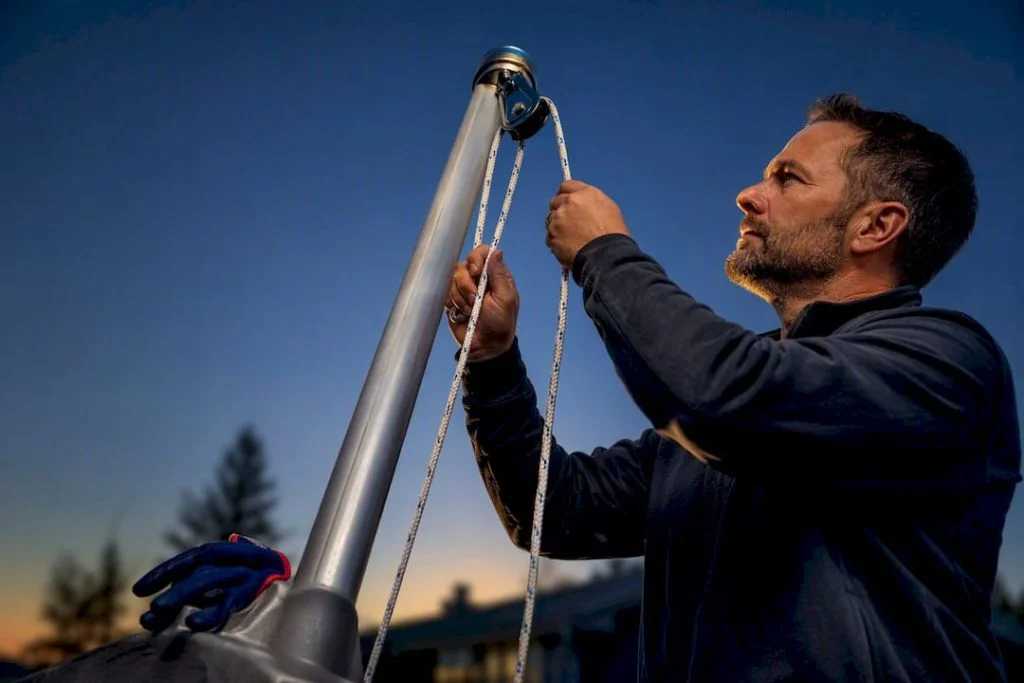
- Tape the new rope to the old one. Fold back about 3 to 4 inches of each rope’s end, overlap them, and wrap tightly with cloth tape to create a slim, tapered connection with no bulky lump. A short splice works too if you’re comfortable with rope work. Harrison Flagpoles’ safety guidance recommends exactly this approach, since a smooth taper is what lets the connection pass through the truck opening without catching.
- Pull the old rope through slowly. As you draw the old rope down and out from one side, it drags the new rope up and through the pulley from the other. Steady, even tension is the goal here.
- If it jams, stop immediately. Do not yank harder. Back the rope up a few inches, untape the connection, rework it flatter, and try again. Forcing a snagged connection is how people damage a pulley they were trying to avoid replacing.
- Remove the tape and separate the ropes once the new halyard has fully passed through and hangs on both sides of the pole.
- Tie your knots. A bowline makes a reliable, non-slipping loop for attaching snap hooks, and a figure-eight stopper knot at the working end prevents the rope from pulling back through the pulley by accident.
- Attach the snaps, spacing them about 12 to 18 inches apart for a standard 3×5 flag, so the flag hangs straight without excess bunching.
- Test it. Run the flag up and down a few full cycles. Listen for squeaking, feel for binding, and watch for any spot where the rope catches instead of gliding freely.
Pro Tip: Wrap the taped splice in one final, smooth outer layer of tape running the same direction as your pull. A rough or lumpy taper is the single most common reason a splice snags halfway through the truck.
Should You Replace the Pulley While You’re Up There?
A brand-new rope run through a worn-out pulley is a repair with an expiration date already stamped on it. Before you install anything new, spend two minutes checking the hardware you’re about to trust with it.
If your pole design allows ground-level access to the truck, or if you can safely reach it, spin the sheave (the small wheel the rope runs over) by hand. It should turn smoothly and quietly. Bob’s Flagpole Company’s installation guide recommends this exact test, since a seized or gritty sheave will shred a fresh rope in a fraction of the time a healthy one would.
Watch for these warning signs:
- A sheave that doesn’t spin freely, or grinds when it turns
- Sharp edges or grooves worn into the pulley track where rope has cut in over the years
- Snap hooks that are rusted, bent, or won’t close securely
- A cleat with a rounded or damaged cam that no longer grips rope tightly
Rusted or worn snaps are cheap to replace and rarely worth saving. The same goes for a cleat that’s lost its bite, since a rope that slips at the cleat undoes every bit of careful work you just did at the top of the pole.
Consider adding a retainer ring or a small counterweight near the snap connections. Both reduce rope slap against the pole in wind, which is one of the fastest ways a brand-new halyard develops fraying and abrasion.
Why Do Flagpole Ropes Wear Out So Fast?
Every halyard is fighting a losing battle against sun, wind, and friction from the day it’s installed. Knowing the signs of failure, and roughly how long you should expect a rope to last, keeps you from either waiting too long or replacing rope that didn’t need it.
Watch for fraying strands, a rope that’s gone stiff and brittle instead of flexible, noticeable discoloration or bleaching, or a flag that slips down the pole on its own because the rope has lost its grip at the cleat. Rope slap, that rhythmic thwacking against the pole in wind, accelerates every one of these symptoms.
On lifespan, Atlantic Flagpole’s replacement guide puts most halyards at a 2 to 5 year replacement window depending on exposure and rope quality, with well-made polyester consistently outlasting cheaper general-purpose rope within that range. Polypropylene tends toward the shorter end of that window, especially in coastal or high-UV climates.
A temporary fix, like knotting a broken rope back together, will get your flag up for a weekend. It will not survive a season. And if you’re replacing rope every year despite buying quality polyester, the rope isn’t your problem. A worn pulley, an undersized diameter for your flag’s wind load, or an oversized flag on an underbuilt pole are the more likely culprits.
When Should You Hire a Professional for Flagpole Rope Replacement?
Some poles are not a weekend project, and pretending otherwise is how people end up in an emergency room instead of finishing a flag repair. Set your own threshold before you climb anything.
- Height over roughly 25 to 33 feet (8 to 10 meters) typically requires equipment you don’t own and a professional’s judgment about wind and access.
- Internal halyard systems, where the rope and cable run inside the pole itself, need specialized tools to service and are not a DIY-friendly design.
- Damaged trucks or pulleys at height should be assessed and replaced by someone equipped to work safely that far off the ground.
- Proximity to power lines, busy streets, or attempting the job alone are all reasons to call a professional rather than improvise.
A professional brings a bucket truck for real height access, replaces a damaged pulley on the spot instead of working around it, and can service an internal cable system without disassembling the pole. That’s a fair trade for a repair that would otherwise put you on a ladder you don’t quite trust.
Where Ultimate Flags’ Flagpole Guidance Comes From
Flagpole hardware sits at the intersection of practical repair and long American tradition, and getting the how-to right matters as much as getting the flag itself right. This guide draws on established halyard replacement practices and on Ultimate Flags’ own history serving customers who fly everything from a small porch pole to a full commercial installation.
If you’re working through a replacement and want to go deeper on the hardware side, these resources cover related ground:
- Flagpole types and footing rules for matching your pole design to the right halyard and hardware.
- Real-world installation considerations drawn from an actual pole placement dispute.
- Ultimate Flags’ full post archive for more how-to and product content.
- Sizing large flags to your pole if you’re upgrading to a bigger display alongside your rope replacement.
Some online retailers sell halyards, snap kits, and pole accessories, and can provide guidance on the correct diameter and length for specific pole and flag combinations.
How to Keep Your New Halyard From Wearing Out Early
A new rope is only as good as the care it gets afterward. Most halyard failures aren’t really about the rope’s original quality. They’re about months of neglect that any five-minute maintenance routine would have caught.
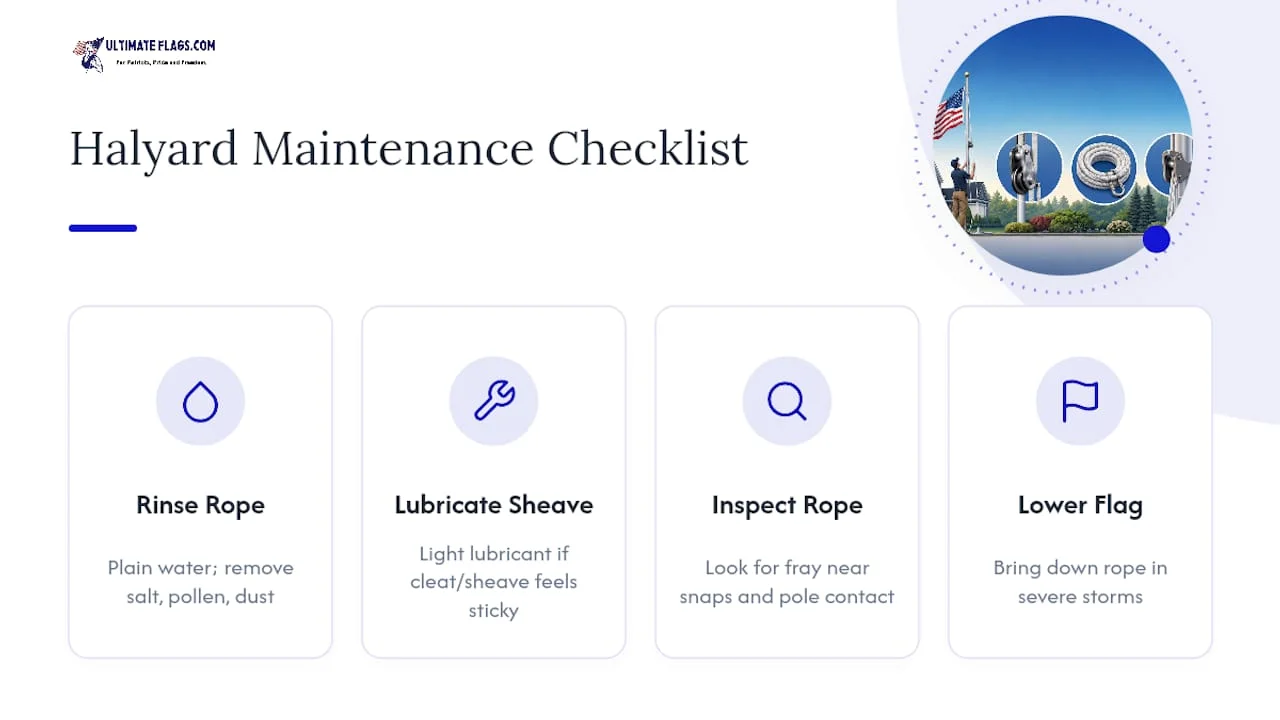
Rinse the rope periodically with plain water, especially if you’re within reach of salt air or heavy pollen and dust. Grit that works its way into the braid acts like sandpaper every time the rope moves across the pulley, and salt residue accelerates UV breakdown that’s already happening from sun exposure.
Check the cleat and snap hardware every few months for rust or stiffness, and work a small amount of light lubricant into a cleat cam or pulley sheave if it starts to feel sticky. A sheave that spins freely puts far less friction wear on the rope passing over it than one that’s binding.
Look over the full length of exposed rope for early fraying, particularly near the snap attachments and anywhere it contacts the pole in wind. Catching a fray early, and moving your snap point a few inches, can buy real time before a full replacement is needed.
If your area sees severe storms, consider lowering the flag and rope entirely rather than leaving it to thrash against the pole for hours. That single habit, more than any product you could buy, is what separates a halyard that lasts five years from one that lasts two.
Tying Off the New Rope So It Doesn’t Slip
A halyard that slips loose after installation isn’t a rope problem. It’s usually a knot problem, and it’s the single most avoidable mistake in this entire repair.
Use a bowline knot to create the loop where your snap hooks attach. It holds firmly under load, doesn’t tighten into an unremovable knot the way a simple overhand loop can, and is easy enough to untie later if you ever need to adjust snap spacing.
At the working end of the rope, tie a figure-eight stopper knot. Its job is simple: it’s just large enough that it can’t slip back through the truck pulley opening, which prevents the entire rope from disappearing up into the pole if a snap ever fails or the wind catches it hard.
After tying off, cleat the rope using a proper figure-eight wrap around the cleat’s horns rather than a single loose loop. A rope wrapped correctly around a cleat holds under sustained tension; a rope draped over the top slips the first time a strong gust hits the flag.
Finally, seal any cut rope ends with a lighter or a hot knife. An unsealed synthetic rope end unravels from the tip inward, and once that unraveling starts working its way up the strand, it spreads faster than most people expect.
Are Flagpole Rope Kits Worth Buying?
Kits take the guesswork out of a repair, and for most homeowners they’re the simplest way to get everything needed in one order instead of assembling parts piecemeal.
A typical kit bundles a length of halyard, matched snap hooks, and sometimes a cleat hook or retainer ring, sold in common lengths that generally run from 50 to 100 feet to cover a range of pole heights. That range matters because it means you’re rarely stuck buying more rope than your pole actually needs, or short-changed on length for a taller installation.
When you’re looking at a kit, check three things on the product listing: the material (polyester should be your default unless you have a specific reason otherwise), the diameter (1/4 inch or 5/16 inch for the overwhelming majority of residential setups), and whether snaps are included or need to be purchased separately. A kit that skips the snap hooks isn’t really a complete kit, it’s just rope with better marketing.
Buying a kit also sidesteps a common measurement mistake: ordering rope that’s technically long enough for the pole but too short once you account for knots, cleat wrap, and snap attachment length. A well-designed kit accounts for that allowance already.
For anyone replacing hardware alongside the rope itself, a kit is generally the more efficient purchase over buying rope, snaps, and a cleat hook as three separate items.
Staying Safe While You Do This Yourself
None of this repair is complicated, but every year people get hurt doing exactly this kind of job because they treated a ladder and a rope like they couldn’t possibly go wrong. They can.
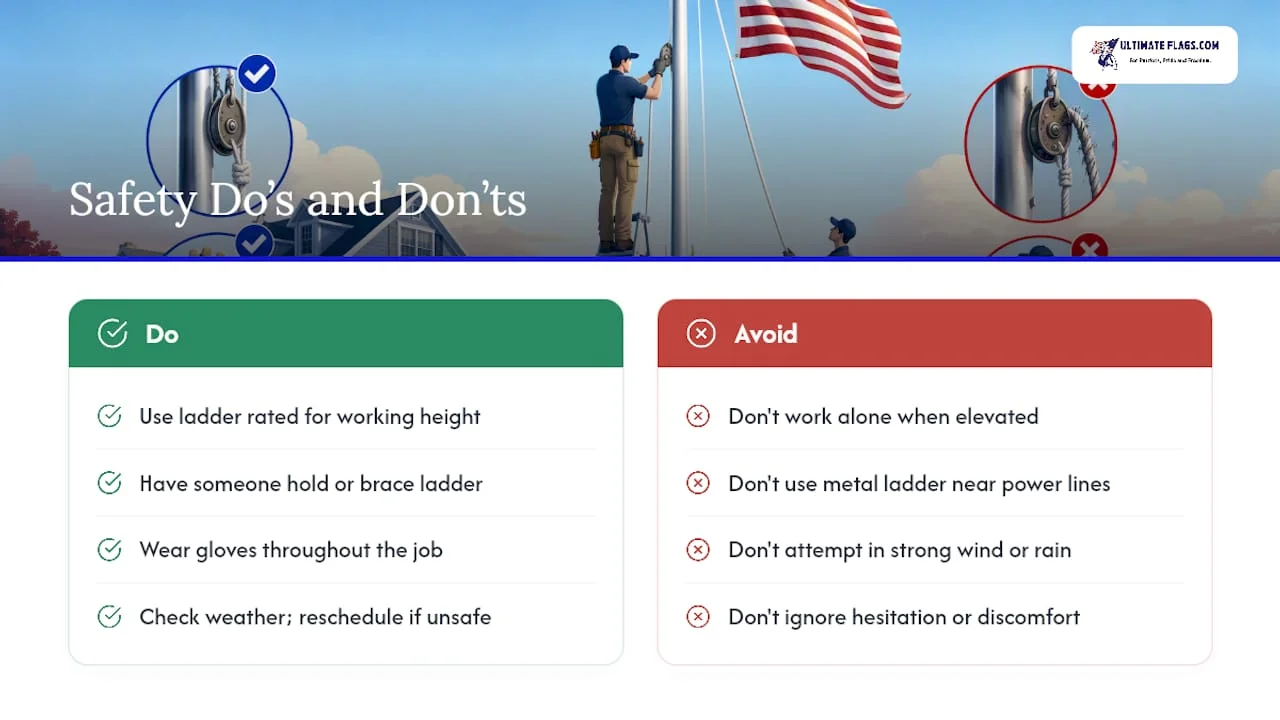
Use a ladder rated for the height you’re working at, and have someone hold or brace it rather than working alone whenever the pole height puts you more than a few feet off the ground. Wear gloves throughout, both to protect your hands from rope friction burn during the pull and to improve your grip on a rope under tension.
Before you start, look up. Flagpoles are sometimes installed closer to overhead power lines than they should be, and any metal ladder or pole hardware near a line is a serious hazard that has nothing to do with the rope repair itself. If your pole sits anywhere near power lines, treat that alone as a reason to call a professional rather than proceed.
Check the weather. Wind that’s strong enough to make the rope hard to control, or rain that makes a ladder or pole surface slick, is reason enough to reschedule. This repair isn’t going anywhere, and neither should you attempt it under conditions that turn a simple task into a fall risk.
If the pole height, hardware condition, or your own comfort level gives you any hesitation, that hesitation is worth listening to. A flagpole rope replacement should never turn into an emergency room visit over a repair that could have waited for better conditions or a professional’s help.
Rope Wear Versus Pole Problems: What the Fix Actually Tells You
Replacing a frayed halyard is the right call when the wear is isolated to the rope itself and the hardware underneath, the truck, the pulley, the cleat, checks out sound. That’s the majority of cases, and it’s a repair most homeowners can knock out in under an hour with the right rope in hand.
But if you’re replacing rope every single season no matter what you buy, the pattern is telling you something the rope alone can’t fix. At that point, a telescoping or rope-free pole removes the maintenance cycle entirely rather than asking you to keep fighting it. For everyone else sticking with a traditional halyard system, sourcing a quality UV-stabilized rope and the right hardware is the whole job.
— John Hough
Get the Right Halyard, Snaps, and Hardware in One Order
Some online stores carry halyards, snap kits, and pole accessories needed for flagpole rope replacement, offering rope sorted by important specifications such as material, diameter, length, and snap inclusion.

When you’re browsing, match your pole height to the length formula covered above, confirm the diameter fits your flag size, and check whether the listing includes snap hooks or expects you to source them separately. Certain retailers have served flag owners for decades, focusing on practical flag accessories as well as flags themselves. If you’re also considering an upgrade to a larger display once your hardware is sorted, take a look at how Ultimate Flags helps size flags to your pole for guidance that pairs naturally with a fresh halyard. Start browsing halyards and kits, or explore a piece of American history while you’re there, with The Patriot Marksman as a starting point into the stories Ultimate Flags tells alongside its products.
Sources
- Flagpole halyard: 4 ideal ropes for your flagpole | QualityNylonRope
- How to replace the halyard on a flagpole safely | Harrison Flagpoles
- Which flagpole rope guide — best halyard | Corbeo
- Best Flagpole Rope Replacement Guide: Halyard Rope & Knots – Atlantic Flagpole
- How to Replace a Halyard the Right Way – Bob’s Flagpole Company LLC
FAQ
What’s the best kind of rope to use for a flagpole?
UV-stabilized braided polyester is the top choice for most residential and small commercial poles, since it resists sun damage and holds tension far better than nylon or polypropylene.
How do I replace a missing rope on a flagpole?
If the old rope is gone entirely, measure the pole from base to truck and apply the same doubling formula (height times two, plus 3 to 5 feet), then feed the new rope through manually or use a weighted line to guide it through the pulley if you can’t reach the truck directly.
What size rope should I use for my flagpole?
A 1/4 inch (about 5mm) diameter covers most residential poles up to 20 feet, while 5/16 inch (about 6mm) suits taller poles or larger flags that see heavier wind load.
How much rope do I need for a 20-foot flagpole?
Using the standard formula of pole height times two plus a 3 to 5 foot allowance, a 20-foot pole needs approximately 44 feet of rope.
How long does a flagpole halyard typically last?
Most halyards need replacement every 2 to 5 years depending on sun exposure, flag size, and rope quality, with well-made polyester consistently outlasting inexpensive general-purpose rope.