Always fly your vessel’s national ensign correctly in the senior stern position, hoist a courtesy flag on the starboard spreader when visiting another country’s waters, and keep every flag clean and properly sized. Your burgee belongs at the masthead or on the port spreader, never competing with the ensign for authority. Get the ensign wrong, and in some jurisdictions you’re not just breaking tradition. You may be breaking the law.
TL;DR:
- The national ensign must be flown correctly at the stern and in the senior position on the boat, or legal penalties may apply.
- A courtesy flag should always be hoisted on the starboard spreader in foreign waters, replacing the usual position of the boat’s burgee.
- Flags should be proportional to boat length, roughly one inch of fly per foot, and kept in good condition to avoid signaling neglect.
- Signal flags have fixed meanings for communication; using them decoratively can lead to misunderstandings or misinterpretations by other vessels.
- Always prepare and verify proper flags and fittings before departure to meet legal requirements and prevent common flag-related mistakes.
Table of Contents
- What Is Boat Flag Etiquette, and Which Flags Actually Matter
- Where Every Flag Belongs on Your Boat
- Getting the Size and Condition Right
- Ensign Hours, Dipping, and Clearance Flags
- The Signal Flags Worth Knowing (and Why Misuse Is Risky)
- The Mistakes That Give You Away as a Novice
- Choosing Flags and Fittings That Actually Hold Up
- Why Ultimate Flags Backs This Guide
- A Skipper’s Take: Match the Formality to the Trip
- Get the Right Flags Before Your Next Trip Out
- Where to Verify the Rules Yourself
- Sources
- FAQ
What Is Boat Flag Etiquette, and Which Flags Actually Matter
Boat flag etiquette is the unwritten (and sometimes written) code that governs which flags a vessel flies, where, and when. It blends maritime tradition with actual statute, and the two carry very different weight. Understanding the difference between “expected” and “required” is where most confusion starts.
The national ensign sits atop this hierarchy. It identifies your vessel’s country of registration, and it is the most senior flag aboard, meaning it always occupies the most important position on the boat. Under laws like the UK’s Merchant Shipping Act, flying an unauthorized ensign or improper colors can constitute an offense, not merely a breach of custom. The Royal Yachting Association puts it plainly: flag etiquette is a mix of law and tradition, and wearing the wrong ensign crosses into the legal side of that line.
A courtesy flag is a smaller version of a host nation’s ensign, flown as a gesture of respect when you enter that country’s territorial waters. It has no legal standing. It’s diplomacy in miniature, a way of saying “I recognize where I am” without a word spoken. You hoist it on arrival and lower it when you depart, and forgetting it does not usually invite prosecution, but it does invite raised eyebrows at the marina.
The burgee is different again. It’s your yacht club’s flag, or a personal owner’s flag if you belong to no club, and it signals affiliation rather than nationality. A jack, when carried, is a smaller national or historic flag flown from a bow staff, more common on larger vessels or naval-style rigging than on the average weekend cruiser.
Then there are signal flags, drawn from the International Code of Signals, which standardizes flag meanings so vessels of different nationalities can communicate without a shared language. These are not decoration. Each letter carries a fixed meaning, and stringing them along a rail for a party can accidentally spell out something you never intended.
- National ensign: legal identity, senior position, non-negotiable.
- Courtesy flag: respect gesture in foreign waters, no legal weight.
- Burgee: club or personal affiliation, subordinate to the ensign.
- Jack: bow-mounted national or historic flag, mostly larger vessels.
- Signal flags: fixed operational meanings, not for casual display.
Where Every Flag Belongs on Your Boat
Placement follows a strict order of precedence, and “senior position” has a specific technical meaning: it’s the spot that would be the flagstaff if your boat only flew one flag. On most recreational vessels, that’s the stern staff. On a sailboat with a boom, it can be the leech of the aftermost sail, near the top, when underway.
- National ensign goes on the stern staff when at anchor or moored, or near the top of the leech on the aftermost sail (or at the gaff, if your rig has one) when sailing.
- Courtesy flag goes on the starboard spreader, always. This position is reserved for the host nation’s flag and nothing else once you’ve crossed into foreign waters.
- Burgee goes at the masthead if you have a single mast and no antennas or instruments in the way. When the masthead is occupied by rigging or electronics, move it to the port spreader instead.
- Signal flags, when actually in use for communication, run on a separate halyard, never mixed in with your ensign or burgee.
Powerboats without spreaders adapt this logic to bow rails, radio antennas, or dedicated flag staffs mounted aft. The principle carries over even without traditional sailboat rigging: senior flag at the stern, courtesy flag to starboard, everything else subordinate.
Pro Tip: Rig a separate, easily reachable halyard just for the courtesy flag before you leave home waters. Fumbling with a shared halyard while customs officials watch you swap flags at the dock is not the impression you want to make.
One nuance worth knowing: if you normally fly your burgee from the starboard spreader out of habit or convenience, that has to change the moment you enter another country’s waters. The starboard spreader belongs to the courtesy flag at that point, full stop, and the burgee shifts to port.
Getting the Size and Condition Right
Flag size is not a matter of taste. The widely used rule of thumb is roughly one inch of fly for every foot of boat length, and several boating guides translate that into practical yard-based sizing:
- Typical boats in the 21 to 26 foot range use flags around three quarters of a yard of fly.
- Slightly larger boats, about 27 to 34 feet, use flags about a yard of fly.
- Larger cruisers and small yachts: scale up proportionally from there.
When in doubt, size up rather than down. A flag that’s slightly larger than the guideline reads clearly in a crowded harbor or during a parade of sail, while an undersized ensign just looks like an afterthought. The only real constraint is clearance: a flag too big for its position will foul rigging, drag in the water, or wrap itself around a stanchion in a stiff breeze.
Condition matters as much as size. A faded, fraying, or torn ensign signals neglect even when the boat itself is immaculate, and in many cruising communities, a tatty flag reads as disrespect whether or not any law is being broken. Build a simple habit around it:
- Inspect flags before every extended trip for fraying edges or faded color.
- Rinse saltwater residue off after passages; it accelerates fabric breakdown.
- Repair a small tear immediately or replace the flag outright once fraying reaches the fly edge.
- Stow flags out of direct sun between trips. UV exposure is the single fastest way to bleach a good flag into a bad one.
If your exact size isn’t available when you need it, a slightly smaller flag flown correctly beats a correctly sized flag flown in the wrong spot, or worse, no flag at all.
Ensign Hours, Dipping, and Clearance Flags
Traditional ensign hours run from 0800 until sunset, and many clubs and marinas still treat this as the default hoisting window, lowering the ensign formally at day’s end rather than leaving it up overnight. This custom carries no penalty for skipping it on a casual afternoon sail, but it matters at formal clubs and during organized events where a colors ceremony is observed.
Dipping the ensign is a salute performed when passing a warship: you lower your ensign partway as you approach, the warship typically responds in kind, and you re-hoist fully once past. It’s a courtesy gesture rooted in naval tradition, not a legal obligation, but it’s instantly recognized by any naval vessel you encounter.
The Q flag, plain yellow, means “my vessel is healthy, I request clearance to enter port.” You fly it on approach to a foreign country before you’ve cleared customs, and it comes down only after officials clear you in. Once cleared, you replace the Q flag with your courtesy flag, not before.
A short arrival sequence for foreign ports:
- Hoist the Q flag as you approach the port or anchorage, before customs contact.
- Anchor or dock and report to the relevant authorities without flying any other national flag.
- Once cleared, lower the Q flag and hoist the courtesy flag on the starboard spreader.
- Leave the courtesy flag flying for the duration of your stay in that country’s waters.
Skippers who have logged the routine describe morning colors around 0800 and sunset lowering as the most consistent custom across cruising fleets, even where formal enforcement is nonexistent.
The Signal Flags Worth Knowing (and Why Misuse Is Risky)
The International Code of Signals assigns each letter flag a specific meaning, and a handful come up often enough in recreational boating that every skipper should recognize them on sight:
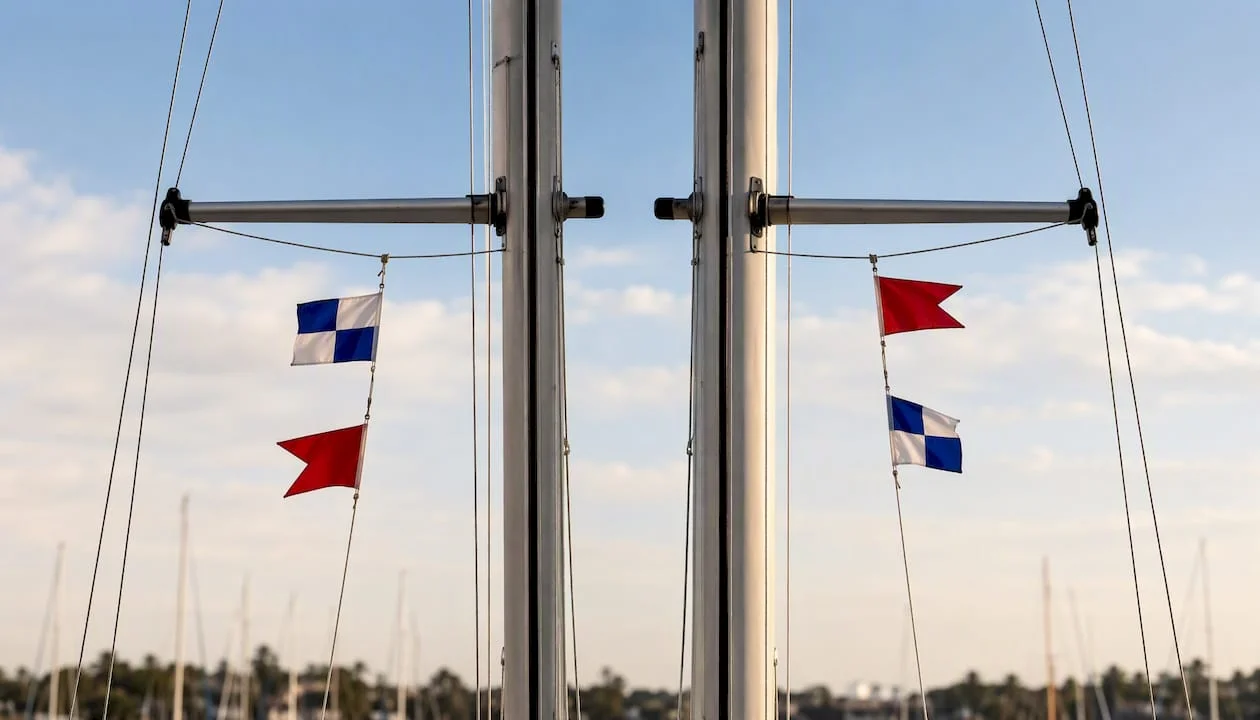
- A (blue and white swallowtail): diver down, keep clear and proceed at slow speed.
- B (red swallowtail): dangerous cargo aboard.
- G: I require a pilot.
- H: pilot aboard.
- I: I am altering my course to port.
- O: man overboard.
- P (Blue Peter): all persons should report aboard, vessel about to sail (also doubles with Q-flag context at anchorages).
- V: I require assistance.
- W: I require medical assistance.
- X: stop carrying out your intentions and watch for my signals.
These meanings are standardized internationally precisely so a vessel from any nation can read them without translation. Multi-flag combinations exist because a single letter can’t cover every possible message. Stringing several flags together lets vessels communicate detailed situations, from navigational hazards to distress specifics, using a shared visual vocabulary.
That standardization is also why decorative use is a genuine hazard. The meanings behind flags like O (man overboard) and W (medical assistance) don’t disappear because you meant them as party bunting. Another vessel, especially a commercial ship or a Coast Guard patrol, may read your signal flags literally. If you want festive color on deck, use pennant strings or novelty flags that are visibly not part of the ICS set, not actual signal letters strung out of context.
The Mistakes That Give You Away as a Novice
Most flag etiquette failures aren’t ignorance of the rules. They’re small shortcuts that accumulate. A few show up constantly:
- Flying a land-only or decorative flag as if it were a legitimate national ensign, which can breach national ensign law depending on jurisdiction.
- Leaving a faded, fraying ensign up for a full season because replacing it “can wait.”
- Cluttering the rigging with multiple burgees, club pennants, and novelty flags until the senior ensign gets visually lost in the mix.
- Forgetting to swap the burgee to port when a courtesy flag takes the starboard spreader in foreign waters.
Pro Tip: Do a thirty-second flag check before every departure, the same way you’d check your bilge or your lights. It takes less time than starting the engine.
A quick pre-departure checklist covers the essentials: ensign present, correctly sized, and in good condition; courtesy flag aboard and ready if you’re crossing into foreign waters; Q flag accessible if clearance is pending; signal flags stowed unless actively in use; halyards and clips secure so nothing jams at the worst possible moment.
Choosing Flags and Fittings That Actually Hold Up
Material choice determines how long your flags survive real conditions, not just how they look in the store. Nylon dries quickly and holds color well in light wind, making it a strong pick for everyday cruising ensigns. Polyester stands up better to sustained UV exposure and heavier wind loads, which matters if your boat lives on a mooring rather than a trailer. Cotton looks handsome for ceremonial or historic reproductions, but it’s a poor everyday choice on the water since it holds moisture and degrades faster in salt air.
Fittings matter as much as fabric. A few essentials:
- Snap shackles or clips rated for marine use, so flags don’t chafe through in a season.
- A halyard long enough that the ensign never drags in the water at the stern.
- A dedicated spare courtesy flag aboard, since forgetting one at a foreign port is a common and easily avoided lapse.
- Fly and hoist dimensions matched to your boat’s actual length, not a generic “one size fits most” flag.
Ultimate Flags carries marine-grade ensigns and courtesy flags sized for common boat lengths, along with the flagpole and fitting hardware that keeps them rigged securely rather than flapping loose at the first stiff breeze.
Why Ultimate Flags Backs This Guide
Ultimate Flags has spent years as one of America’s longest-standing online flag retailers, and nautical flags sit alongside the historical and patriotic categories the company is best known for. That range matters here: the same attention to correct proportions, durable stitching, and authentic colors that goes into a flag display done right applies just as much on the water as it does on a front porch flagpole.
Readers who want the deeper legal context behind proper display, or who are curious about the most common flag-handling mistakes people make on land, will find the same principles echoed here in a marine setting. And for anyone dealing with pushback over where and how they fly a flag at all, the real-world flagpole disputes Ultimate Flags has covered show that flag etiquette debates aren’t unique to the water.
A Skipper’s Take: Match the Formality to the Trip
Not every sail demands full ceremonial compliance, and pretending otherwise just adds friction to a Saturday afternoon on the water. An afternoon lap around the harbor doesn’t need dipped ensigns or a colors ceremony. A passage into another nation’s waters does need the ensign correct, the courtesy flag ready, and the Q flag understood before you round the breakwater.
My practical filter is two questions: Am I leaving my home waters, and is anyone official likely to notice? If either answer is yes, comply fully. If both are no, keep the ensign right and relax about the rest.
— John Hough
Get the Right Flags Before Your Next Trip Out
Getting boat flag etiquette right starts with owning flags that are actually sized and built for the water, not a leftover porch flag pressed into service. Some suppliers stock nautical-grade ensigns and courtesy flags built to hold color and shape against salt spray and constant wind, conditions that can degrade poorly made flags quickly.

Measure your boat’s length against the sizing guidance above before you order, and pick up a spare courtesy flag while you’re at it. Forgetting one at a foreign dock is the single most avoidable lapse in this entire guide. Browse Ultimate Flags’ collection to match the correct size and material to your vessel, and get your rigging squared away before your next departure.
Where to Verify the Rules Yourself
For the legal backbone behind ensign requirements, the Merchant Shipping Act spells out penalties for improper colors. The RYA’s flag etiquette guidance covers tradition alongside law. The International Code of Signals is the reference for signal-flag meanings, and SeaHelp’s courtesy flag guide offers a practical field reference for cruising between countries.
Sources
- Flag etiquette | RYA
- Legislation
- International Code of Signals — Wikipedia
- Yacht Flag Etiquette Guide: How to Properly Display Flags on Your Yacht | SeaHelp
FAQ
Can you fly any flag you want on your boat?
No. Your national ensign must be an authorized version of your country’s colors, since flying an unauthorized ensign can breach national law depending on your jurisdiction. Burgees, novelty flags, and courtesy flags have more flexibility, but signal flags carry fixed meanings and should never be flown decoratively.
What are the basic rules of boat flag etiquette?
The core rules are: fly the national ensign in the senior stern position, hoist the courtesy flag on the starboard spreader in foreign waters, keep the burgee at the masthead or port spreader, size flags to roughly one inch per foot of boat length, and keep everything clean and free of fraying.
What side does the American flag go on a boat?
The national ensign flies from the senior position, typically the stern staff at anchor or near the top of the aftermost sail’s leech when underway, not a specific “side” like a spreader. Spreader positions are reserved for the courtesy flag (starboard) and burgee (port), while the ensign holds its own dedicated staff.
What is the most important unspoken rule on a boat?
Respect the ensign’s senior status above every other flag aboard. A cluttered rig with a burgee outranking or obscuring the national ensign is one of the fastest ways to signal that a skipper doesn’t know, or doesn’t care about, basic maritime custom.