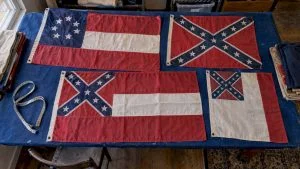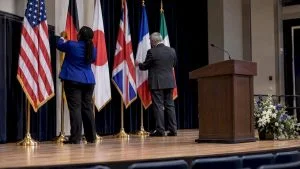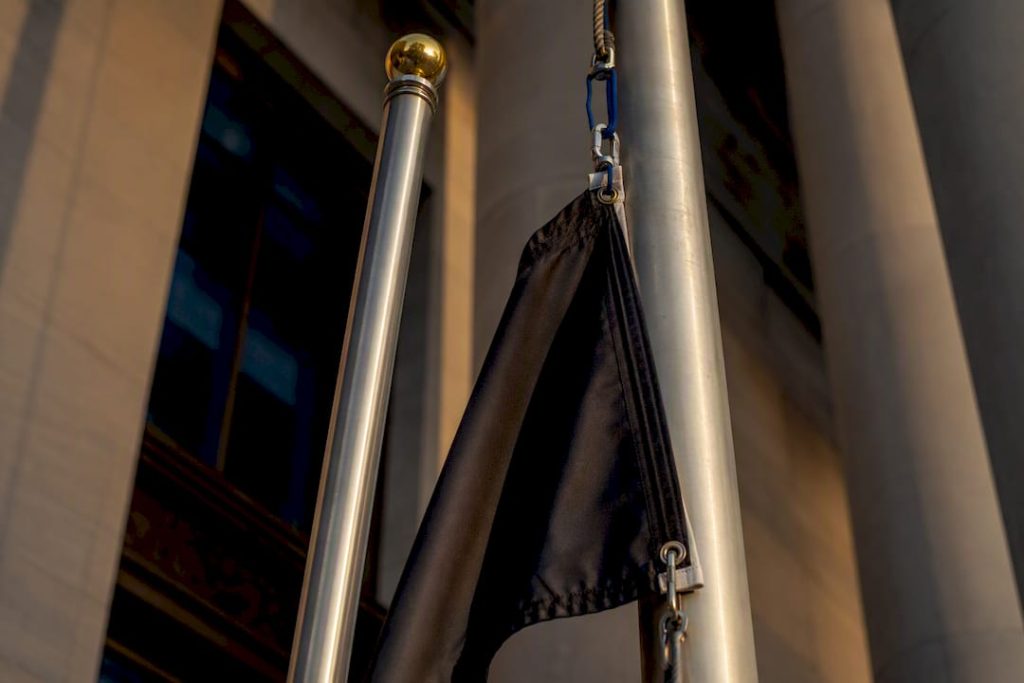
The POW/MIA flag always flies subordinate to the U.S. flag: below it on a single pole, no larger in size, and never in a position of equal or greater prominence. At federal buildings named in the National POW/MIA Flag Act, the black and white banner must be raised whenever the American flag is raised, not just on ceremonial days. Private citizens face no such mandate, but the National League of Families urges daily display anyway, provided the flag stays in respectable condition.
TL;DR:
- The POW/MIA flag must be flown below the U.S. flag on the same pole, and never larger than it, at all federally designated sites whenever the American flag is displayed.
- On a single pole, the U.S. flag always occupies the top position, with the POW/MIA flag directly beneath, and identical or smaller in size.
- Federal law requires the flag’s display at specific locations, including the White House, national cemeteries, military bases, VA medical centers, post offices, and certain government offices, whenever the American flag flies.
- The flag is to be replaced promptly if it becomes faded, frayed, or torn, with proper disposal methods including burning in a respectful ceremony.
- Private citizens can display the POW/MIA flag voluntarily, but should follow size, placement, and respectful handling guidelines to honor its significance.
Table of Contents
- When and Where POW/MIA Flag Display Rules Apply
- POW/MIA Flag Placement: Single Pole, Multiple Poles, and Processions
- Flag Size, Wear, and When to Retire It
- The Legal Basis Behind POW/MIA Flag Rules
- What Ultimate Flags Has Learned About Choosing the Right POW/MIA Flag
- Why Correct Display Still Matters
- Where to Find the Right POW/MIA Flag and Hardware
- Primary Documents and Official Resources
- Sources
- FAQ
When and Where POW/MIA Flag Display Rules Apply
The requirement to fly this flag isn’t a suggestion at certain sites. It’s federal law, and it names names.
Under 36 U.S.C. §902, the statute designates specific properties where the flag must appear, visible to the public, whenever Old Glory flies there. Those locations include:
- The White House
- The U.S. Capitol
- The Korean War Veterans Memorial and Vietnam Veterans Memorial
- Every national cemetery
- Major military installations designated by the Secretary of Defense
- All VA medical centers
- Every U.S. post office
- Offices of the Secretaries of State, Defense, and Veterans Affairs
Before the 2019 National POW/MIA Flag Act, federal sites only had to raise the flag on six designated observances: Armed Forces Day, Memorial Day, Flag Day, Independence Day, National POW/MIA Recognition Day, and Veterans Day. The 2019 law changed that standard entirely, tying the flag’s presence to the American flag’s presence rather than the calendar. If the U.S. flag goes up at a covered site, the POW/MIA flag goes up with it, every single day of the year that site is operating.
POW/MIA Flag Placement: Single Pole, Multiple Poles, and Processions
Getting the physical arrangement right separates respectful display from an honest mistake.
On a single flagpole, the sequence is fixed:
- The U.S. flag occupies the top position, always.
- The POW/MIA flag flies directly beneath it on the same halyard.
- The POW/MIA flag must be the same size as the American flag above it, or smaller. It should never be larger.
On multiple poles, the U.S. flag holds the center and highest position, or the position of honor on the observer’s left when poles are of equal height. When flying flags on separate poles, the American flag belongs to the right of all other flags from the viewer’s perspective facing the display. The POW/MIA flag commonly takes the next position of prominence among the group, though this practice draws more from tradition than from statute.
Order-of-precedence questions get murkier in mixed displays involving state or organizational flags. The Veterans of Foreign Wars gives the POW/MIA flag precedence over other subordinate flags on the same pole, but no single federal rule codifies that ranking government-wide. Half-staff actions should mirror whatever the U.S. flag does. When the American flag lowers for a day of mourning, the POW/MIA flag lowers with it.
Pro Tip: If your organization flies state, military, and POW/MIA flags together on a single pole cluster, treat VFW protocol as your default. It’s the most widely adopted convention among veterans’ groups and color guards nationwide.
Flag Size, Wear, and When to Retire It
Size compatibility keeps the arrangement looking intentional instead of mismatched. Because the POW/MIA flag must never exceed the American flag’s dimensions on a shared pole, most buyers pair standard sizes:
- A standard 3×5 foot U.S. flag with a POW/MIA flag of the same or smaller size for residential poles
- Larger pairings suitable for taller municipal and commercial poles
- Smaller sizes appropriate for shorter poles where halyard length limits banner size
Fading, fraying edges, and holes at the grommets signal it’s time to retire the flag, not patch it indefinitely. The National League of Families recommends replacing a worn flag promptly, since a tattered POW/MIA flag undercuts the very respect it’s meant to convey. Regular rinsing removes grit that accelerates fabric breakdown, and dry, ventilated storage prevents mildew between uses. For the retirement itself, follow the same respectful disposal methods used for the American flag. Burning in a dignified, private ceremony remains the traditional standard, though some VFW and American Legion posts also accept flags for collective retirement ceremonies. Full care instructions apply equally to POW/MIA flags as they do to the Stars and Stripes.
The Legal Basis Behind POW/MIA Flag Rules
The etiquette matters, but the law is what makes this different from ordinary flag courtesy. Two statutory sources anchor everything above.
36 U.S.C. §902 formally designates the POW/MIA flag as “the symbol of the Nation’s concern and commitment to resolving as fully as possible the fates of Americans still prisoner, missing, and unaccounted for.” The statute also carries a visibility requirement and a termination clause: mandatory display ends once the President formally determines that accounting efforts are complete, an event that has not occurred.
Neither the statute nor the National POW/MIA Flag Act forces private employees to raise or lower flags outside normal duties. The requirement binds the property, not individual staff schedules. For readers who want the primary language rather than a summary, four documents settle almost any dispute:
- The full text of 36 U.S.C. §902
- VA’s published guidance and pamphlet on the flag’s history and requirements
- The DPAA POW/MIA Day toolkit for event and observance coordination
- Policy explanations from the National League of Families
What Ultimate Flags Has Learned About Choosing the Right POW/MIA Flag
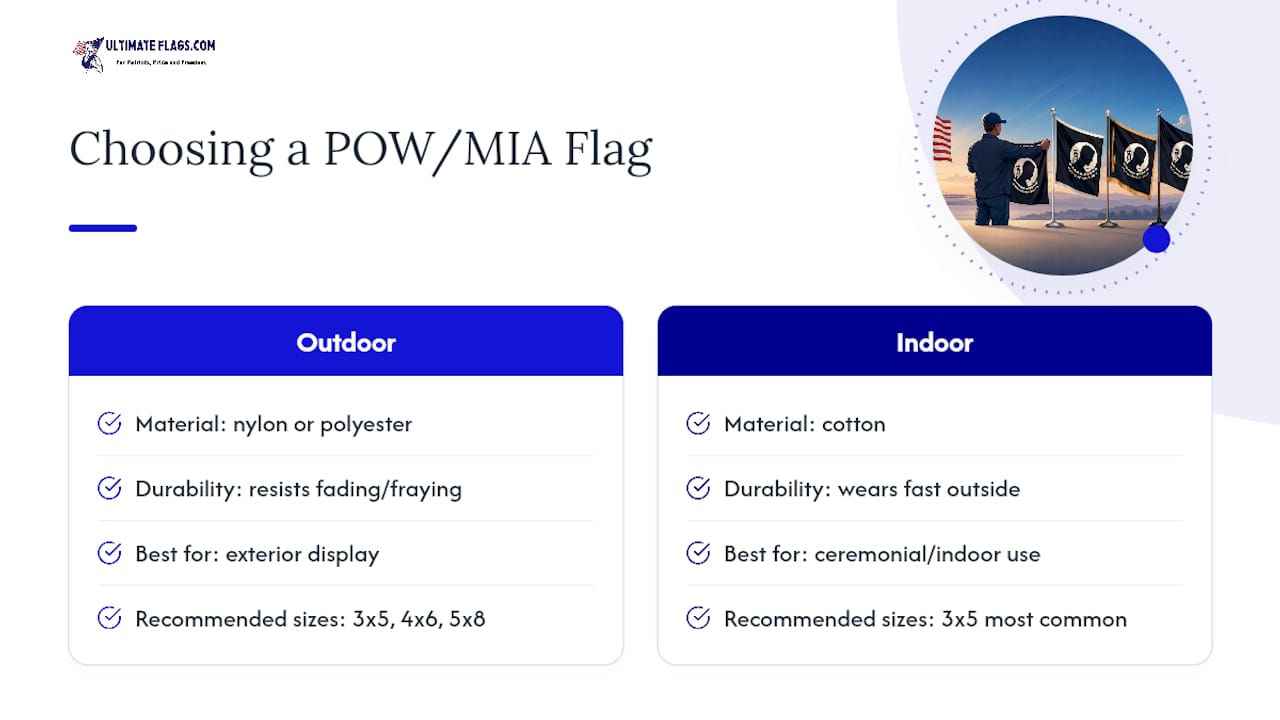
Material choice determines how long a flag holds its dignity in the elements. Outdoor-rated nylon or polyester resists fading and fraying far longer than cotton, which suits indoor ceremonial display but wears fast outside. Match sizes to your pole: a 3×5 foot pairing works for most residential setups, while taller commercial poles call for 4×6 or 5×8 combinations. Check halyards, snaps, and headers before each raising. Reinforced headers with proper grommet spacing prevent the tearing that typically starts at attachment points and the fly end. Browse flag collections built for exactly this kind of durability.
Pro Tip: Rotate flags on a schedule rather than waiting for visible damage. A backup flag on hand means you’re never caught flying a faded one on Veterans Day.
Why Correct Display Still Matters
Continuous visibility is the entire point of this flag. It exists as a promise, renewed daily, that the missing are not forgotten and their families are not carrying that weight alone. Getting the protocol right, size, position, condition, is a small act compared to what it represents, but small acts done consistently are how a national commitment stays real instead of symbolic. This guidance was shaped by extensive experience helping Americans understand and honor flag traditions. Fly the flag because it matters to someone, not because it photographs well.
— John Hough
Where to Find the Right POW/MIA Flag and Hardware
The catalog is built around detailed considerations like correct proportions, durable materials, and hardware designed to withstand outdoor conditions. Once you know the rules, the next step is making sure your flag and pole actually meet them.

Start with the flag collections page to find POW/MIA flags sized correctly against standard American flag dimensions, whether you need a 3×5 for a residential pole or a larger commercial pairing. If your current pole setup needs attention first, the guide on flagpole types and footing walks through choosing the right height and base for your property. And when a flag finally shows the wear that calls for replacement rather than repair, the flag care resources explain how to keep the new one looking sharp for years instead of months. Order today, and fly it right from day one.
Primary Documents and Official Resources
For readers who want to verify any rule directly against the source:
- 36 U.S.C. §902: the statute designating the flag and its required display locations
- VA’s POW/MIA guidance and pamphlet: federal history and display summary
- National League of Families protocol page: background on origin and private-display recommendations
- DPAA POW/MIA Day toolkit: event planning and observance guidance
- National POW/MIA Memorial & Museum history page: design origin and White House recognition
Sources
- 36 U.S.C. §902: National League of Families POW/MIA flag — US Code
- The POW/MIA Flag — U.S. Department of Veterans Affairs (VA)
- POW-MIA Day toolkit — Defense POW/MIA Accounting Agency (DPAA)
- POW/MIA flag history & protocol — National League of Families
FAQ
Can anyone fly a POW/MIA flag?
Yes. Private citizens, businesses, and non-federal organizations may display the POW/MIA flag whenever they choose, with no legal restriction on timing. The only expectations are basic respect: keep it below the U.S. flag on a shared pole, never larger, and replace it once it becomes worn or faded.
What is the controversy surrounding the POW/MIA flag?
Debate mostly centers on scope and permanence, questions about whether the flag’s continued mandatory display decades after the Vietnam War still fits its original purpose, and disagreements over exactly which federal sites owe it year-round display. The statute itself resolves some of this by tying mandatory display to a presidential determination that accounting efforts are complete, a determination that has not been made.
Can a U.S. post office fly a POW/MIA flag?
Post offices aren’t just permitted to fly it, they’re required to. Every U.S. post office is named among the federal locations where the flag must be displayed whenever the American flag is displayed, under the 2019 National POW/MIA Flag Act.
What are the basic rules for displaying the POW/MIA flag?
On a single pole, it flies directly beneath the U.S. flag and must be the same size or smaller. At federal sites named in 36 U.S.C. §902, display is mandatory whenever the American flag flies; everywhere else, display is voluntary but should follow the same size and position etiquette.
Where can I buy a correctly sized POW/MIA flag?
Ultimate Flags offers POW/MIA flags in sizes designed to pair correctly with standard American flag dimensions on the flag collections page. Current pricing and size options are listed directly on the site.