Only three authorities can order an official half-staff display: the President for the nation, a state governor within that state, and the Mayor of the District of Columbia within D.C. Memorial Day is flown at half-staff only during the morning hours, and after the death of a sitting or former president, the flag stays lowered for a month. The ritual itself never changes: hoist the flag briskly to the peak first, then lower it slowly to half-staff, and always raise it back to the peak before taking it down for the day.
TL;DR:
- Only the President, a state governor, or the Mayor of D.C. have legal authority to order flags at half-staff for their jurisdiction.
- Federal department heads can designate half-staff on specific properties without a presidential order, leading to potential local discrepancies.
- The duration at half-staff varies: 30 days for presidents, 10 days for vice presidents or Supreme Court justices, and only until burial for some officials.
- The proper sequence involves raising the flag briskly to the peak, lowering it slowly to half-staff, then raising it again before full regulation.
- Verification of official orders is essential, relying on government websites and primary sources, as unofficial reports may be inaccurate.
Table of Contents
- Who Has the Authority to Order Half-Staff Rules?
- When to Fly the Flag at Half-Staff: Fixed Dates and Triggering Events
- How Long Should the Flag Stay at Half-Staff?
- How to Fly a Flag at Half-Staff, Step by Step
- Half-Mast vs Half-Staff: Which Term Is Correct?
- What Happens to Other Flags When the U.S. Flag Is Lowered?
- How to Verify a Half-Staff Order Is Real
- Choosing Flags and Hardware Built for Repeated Half-Staff Duty
- Why Getting This Right Actually Matters
- Get the Flags and Hardware Half-Staff Rules Demand
- Sources
- FAQ
Who Has the Authority to Order Half-Staff Rules?
Half-staff observance is not a matter of personal taste or local custom, however deeply felt the impulse to lower a flag might be. The authority is narrow and specific, spelled out in U.S. Code Title 4, Section 7, the statute that governs the flag’s position and manner of display nationwide.
Three offices hold that power. The President can order flags lowered across the entire country, on every federal building, military post, and naval vessel, for a national tragedy or the death of a major official. A state governor holds that same authority within the borders of their state, honoring a fallen state legislator, a line-of-duty death, or a local catastrophe. The Mayor of the District of Columbia holds the identical power for flags flown on D.C. property. No other office, no matter how prominent, has that legal standing.
There is a second, quieter tier of authority worth understanding. Heads of federal departments and agencies may direct half-staff display on the specific properties under their jurisdiction, a courthouse, a federal building, a national cemetery, without a presidential order triggering it nationwide. This is why you might see one federal facility at half-staff while a flag down the street, on private or municipal ground, still flies full.
Here is where the rules soften considerably, and where most confusion actually lives:
- The Flag Code is advisory in nature and carries no criminal penalty for a private citizen who ignores it, according to the same federal statute.
- Homeowners, businesses, churches, and HOAs may voluntarily lower their own flags out of respect, even without an official order covering them.
- Public schools and municipal buildings typically follow the state or federal order that applies to their jurisdiction, since they operate as extensions of government.
- A business owner who wants to honor a local officer’s death with a half-staff flag, even absent a governor’s proclamation, is well within their rights to do so.
That last point matters more than most guides admit. The order compels compliance on government property and by government entities, but the deeper tradition of half-staff observance has always leaned on voluntary participation from ordinary Americans who feel the loss and choose to mark it. When you fly your own flag at half-staff without a formal proclamation, you are not breaking half staff protocol. You are extending it.
When to Fly the Flag at Half-Staff: Fixed Dates and Triggering Events
Some half-staff days arrive on the calendar every single year, locked in by statute or long-standing federal practice, and knowing them cold means never being caught off guard by a neighbor’s lowered flag.
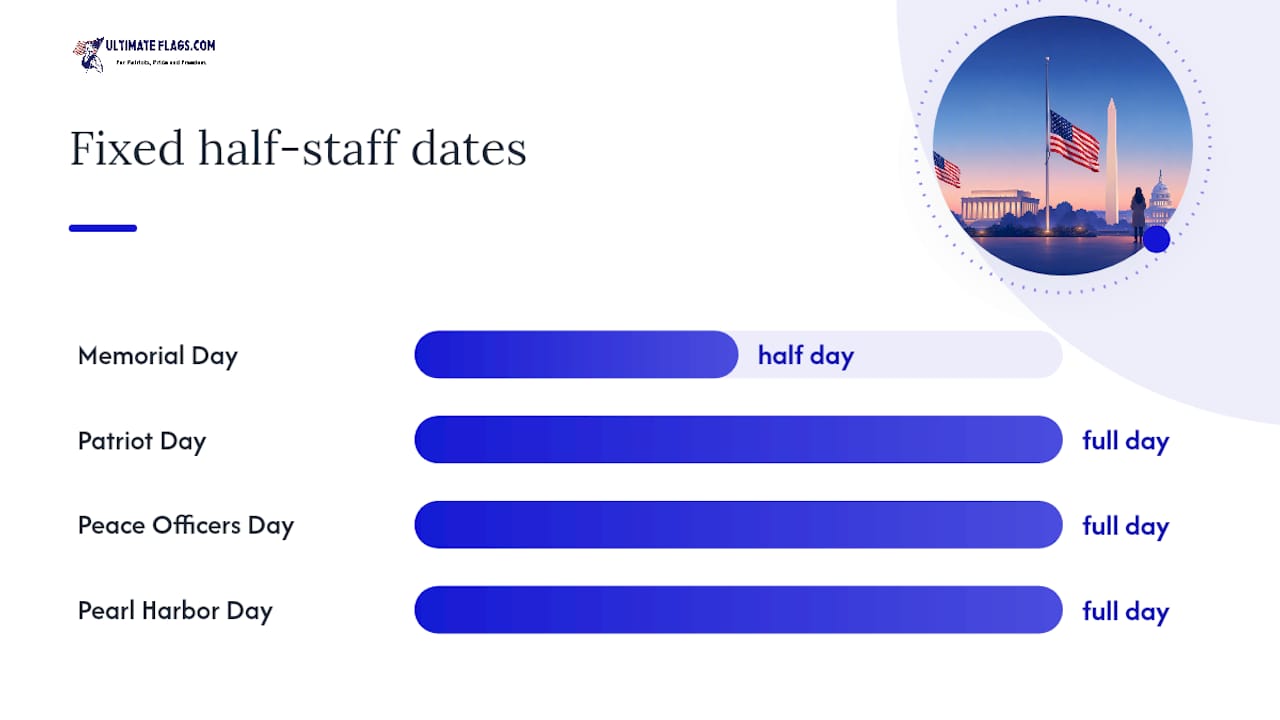
- Memorial Day (last Monday in May): the flag flies at half-staff from sunrise until noon only, then rises briskly to full staff. The VA’s guidance frames this as the year’s singular exception, a deliberate morning of mourning followed by an afternoon that honors the living nation those service members died defending. There are resources available that break down the exact Memorial Day flag etiquette if you want the minute-by-minute sequence.
- Patriot Day (September 11): sunrise to sunset, marking the anniversary of the 2001 terrorist attacks.
- Peace Officers Memorial Day (May 15): sunrise to sunset, unless that date coincides with Armed Forces Day, in which case the order is typically waived.
- Pearl Harbor Remembrance Day (December 7): sunrise to sunset, honoring the sailors and Marines killed in the 1941 attack.
- Fire Prevention Week includes recognition dates for fallen firefighters in many jurisdictions, though these vary by state proclamation rather than federal statute.
Beyond the fixed calendar, half-staff orders fall into a handful of recurring categories. The death of a sitting or former president triggers the longest and most solemn observance in the entire code. Other senior federal officials, cabinet secretaries, the Vice President, sitting members of Congress, generate their own duration rules, which the next section breaks down precisely. Members of the Armed Forces who die on active duty are frequently honored with state-level proclamations, particularly when the fallen service member hailed from that state. First responders killed in the line of duty often prompt a governor’s order limited to that state, sometimes limited further to a single county or department’s jurisdiction. National tragedies, mass casualty events, terrorist attacks, disasters that claim significant numbers of American lives, prompt presidential proclamations that apply nationwide, on every flagpole under federal control.
Presidential proclamations vary enormously in scope, and this is a subtlety Usa captures well. A proclamation following a national tragedy typically directs every federal flag in the country to half-staff for a set number of days. A proclamation honoring a single senator or governor’s death, by contrast, is often scoped narrowly, applying only to federal buildings in that person’s home state, or only for the day of the funeral. Reading the actual proclamation text, not just a headline claiming “flags at half-staff,” tells you whether the order applies to your flagpole at all.
How Long Should the Flag Stay at Half-Staff?
Duration rules carry the weight of precedent behind them, and the VA’s published guidance lays out specific windows depending on whose death triggered the order.
- 30 days: following the death of a current or former President of the United States, the longest mourning period the code recognizes.
- 10 days: following the death of a sitting Vice President, the Chief Justice or a retired Chief Justice, or the Speaker of the House of Representatives.
- From the day of death until interment: this applies to associate justices of the Supreme Court, cabinet secretaries, former Vice Presidents, and state governors, a window that closes once burial occurs rather than running a fixed number of days.
- Day of death and the following day only: this shorter window covers most sitting members of Congress, a distinction that surprises people who assume every federal official gets the same treatment.
Governors hold their own authority to set duration for state officials and events within their borders, and those proclamations frequently run shorter than federal timelines, a single day for a local ceremony, a week for a state legislator. Some proclamations are facility-limited rather than jurisdiction-wide. A federal building might be ordered to half-staff while state buildings two blocks away answer to an entirely separate governor’s order, or none at all, depending on whose jurisdiction that building falls under.
This layered structure is precisely why checking the actual proclamation matters more than trusting a lowered flag you happen to see on your commute. Two flagpoles a mile apart can be legitimately following two different rules on the very same day.
How to Fly a Flag at Half-Staff, Step by Step
The ceremony itself is simple once you know it, but the sequence carries real symbolic weight, and skipping steps is one of the most common half staff etiquette mistakes.
The core ritual, confirmed by both the VA’s official guidance and municipal protocols like Baltimore City’s, runs in this order:
- Hoist the flag briskly all the way to the peak of the pole first, even if it will only stay there for an instant.
- Lower it slowly and deliberately to the half-staff position.
- When the observance ends and you are ready to retire the flag for the day, raise it briskly back to the peak first.
- Only then lower it fully for storage or the night.
Skipping the peak entirely, running the flag straight to the halfway mark, is the single most common mistake. That momentary pause at full staff isn’t decorative. It signals the flag was raised in honor before being lowered in mourning, a distinction Baltimore’s own protocol treats as essential to the gesture’s meaning, not an optional flourish.
Positioning raises a practical question nearly every flag owner eventually asks: half-staff of what, exactly? The literal instruction is to lower the flag to the midpoint of the pole. On a full-sized government flagpole, that’s straightforward. On a shorter residential pole, or with an oversized flag, a literal midpoint can look wrong, sometimes crowding the flag uncomfortably close to the ground. A widely used practical workaround is to lower the flag by roughly one flag’s height, its hoist, rather than measuring a strict fifty percent. This preserves the visual space above the flag that gives the gesture its solemnity, especially on the shorter poles most homes use.
A few more operational details round out proper display:
- Flags that are not illuminated must be lowered at sunset; there is no half-staff exception to the general rule against flying an unlit flag overnight.
- If a half-staff order needs to remain in place overnight, either install pole lighting or plan to lower the flag at dusk and re-hoist it (to the peak, then to half-staff) the next morning.
- Wall-mounted flags on angled brackets can’t physically move to a half-staff position; the accepted alternative is either removing the flag for the duration or adding a black mourning streamer above it.
- Working at height on a residential pole carries real fall risk. Use a proper ladder, never overreach, and treat the halyard mechanism, not the pole itself, as your primary tool for repositioning the flag.
Pro Tip: Test your halyard and cleat before an observance actually begins. A frozen pulley or a jammed cleat turns a 30 second ritual into an embarrassing tangle right when neighbors are watching, and it’s the kind of thing you only notice at the worst possible moment.
Half-Mast vs Half-Staff: Which Term Is Correct?
Half-staff is the correct term for flags flown on land, on buildings, residential poles, and government facilities. Half-mast is reserved for flags flown aboard ships, where the vertical spar holding the flag is technically a mast, not a staff.
That distinction isn’t a pedantic technicality invented by grammar sticklers. It traces directly back to naval terminology, and the U.S. Code itself reflects the distinction by consistently using “half-staff” for the land-based ceremonial rules that govern most Americans’ daily experience of the flag.
- Half-staff: the correct term for any flag flown on a building, residential pole, vehicle staff, or non-maritime flagpole.
- Half-mast: reserved specifically for ships and other maritime vessels, where the flag flies from an actual mast.
- News broadcasts and casual conversation use the two terms interchangeably, and most listeners won’t notice or care about the swap.
- Formal writing, government communications, and anyone aiming for precision should default to “half-staff” unless the context is specifically nautical.
Other nations handle this distinction differently, and some, particularly in the British maritime tradition, use “half-mast” as the universal term regardless of whether the flag flies from a ship or a building. That international variation is part of why the terms drift together so easily in American usage, even though the formal domestic rule keeps them separate.
What Happens to Other Flags When the U.S. Flag Is Lowered?
A half-staff order rarely involves a single flagpole in isolation, and the rules for accompanying flags trip up more people than the primary ritual itself.
- Same halyard: when multiple flags fly from one rope on a single pole, with the U.S. flag at the top, lowering the U.S. flag to half-staff means every flag beneath it on that same halyard should be lowered proportionally or removed entirely.
- Adjacent staffs: when flags fly from separate poles positioned near one another, the U.S. flag is hoisted first and lowered last each day, and any state, municipal, or organizational flag on a neighboring pole should follow the same half-staff pacing rather than staying at full staff while the flag beside it mourns.
- Foreign flags: a foreign nation’s flag should not be lowered to half-staff on U.S. soil unless that specific country has declared its own period of mourning; American half-staff orders don’t automatically extend to other nations’ colors.
- State flags: these follow the governor’s own proclamation for that state, which may or may not align with a federal order running at the same time.
- Wall-mounted or angled poles: since these can’t physically drop to half-staff, remove the flag for the duration of the order or add a black mourning streamer as the accepted substitute.
The guiding principle across all of these scenarios is consistency of respect. If the flag representing the nation is lowered, the flags sharing its pole or its ceremonial company shouldn’t visually contradict that gesture by standing at full staff beside it.
How to Verify a Half-Staff Order Is Real
Confirming an order before you act on it, or before you correct a well-meaning neighbor, means going to primary sources rather than trusting a social media post or a headline glimpsed in passing.
- The White House issues presidential proclamations directly, and these are published on official government channels with the exact scope, start date, and duration spelled out.
- Governor’s office websites and press releases carry state-level proclamations, and most states publish these on their official .gov domains rather than through news aggregators.
- USA.gov’s flag guidance offers a public-facing, plain-language summary of current federal observances and the general categories that trigger half-staff orders.
- Federal agency directives apply to specific facilities, so a courthouse, VA hospital, or military installation may follow guidance issued by its own overseeing agency rather than a blanket presidential order.
When checking any order’s legitimacy, confirm three things: the issuing authority actually has jurisdiction over your location, the dates and times match what you’re seeing reported, and a second official source corroborates the first. Local news coverage and flag-tracking aggregator sites can be useful for a quick heads up, but treat them as secondary confirmation only, never as the final word. A proclamation’s own text on a .gov domain is the only source that settles the question definitively.
Choosing Flags and Hardware Built for Repeated Half-Staff Duty
A flag that spends its life being hoisted, lowered, raised again, and lowered once more takes real punishment at the grommets and along the fly edge, and the material you choose determines whether it survives a single mourning season or several years of them.
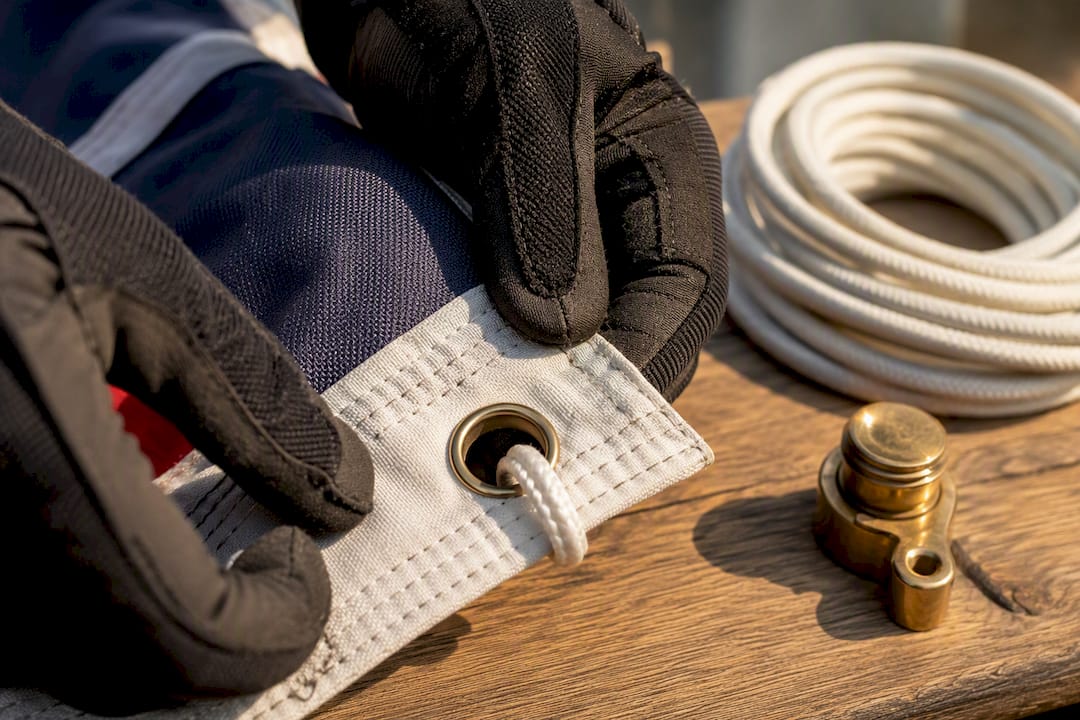
Heavier nylon and polyester blends generally hold up better to the friction of repeated halyard movement than lightweight cotton, particularly for outdoor poles exposed to wind. Sizing matters just as much as material: a flag proportioned correctly to its pole height reads as dignified at half-staff, while an undersized flag on a tall pole looks lost in all that empty space above it. Ultimate Flags’ flag collections carry U.S. flags in sizes suited to everything from a residential 20-foot pole to a full commercial installation.
Hardware deserves the same attention as the fabric itself. A halyard rated for your pole’s height and exposure, a cleat positioned within easy, safe reach, and, for anyone planning overnight half-staff coverage, dedicated pole lighting rather than a workaround of lowering and re-hoisting at dusk every single day. If your current setup makes any of that awkward, a look at flagpole types and footing options is worth the ten minutes it takes.
Retirement is the piece people forget until a flag is visibly frayed at the worst possible moment, mid-ceremony, in front of a crowd. Once fabric tears along the stripes or the union starts fraying at the corner, it’s time to consider proper retirement rather than one more repair. There are guides on flag retirement rules that walk through the respectful ways to retire a flag that has served its purpose.
Why Getting This Right Actually Matters
Half-staff observance survives as a ritual precisely because it asks so little of us procedurally while meaning so much symbolically. Hoist to the peak, lower slowly, raise before you retire it. That’s the entire mechanical demand. Yet get the sequence wrong, or fly a flag lowered for the wrong reason, and you’ve turned a gesture of collective grief into something that looks careless.
What people consistently underestimate is how much the verification step matters compared to the ritual itself. Everyone focuses on getting the hoist-and-lower sequence right, and that’s worth doing correctly. But the bigger failure mode I see is people reacting to a lowered flag they spotted somewhere, assuming it applies to them, and either copying it without confirming the order or, worse, criticizing a neighbor who’s actually following a legitimate state proclamation nobody else noticed. Check the source before you act. That habit matters more than memorizing every duration rule in the code.
Ultimate Flags publishes deeper guidance on proper display and flag respect for readers who want the full etiquette picture beyond half-staff specifically.
— John Hough
Get the Flags and Hardware Half-Staff Rules Demand
Compliance starts with equipment that actually performs the ritual correctly, and that means a flag built to survive repeated hoisting and a halyard system that won’t jam the moment an order comes down. There are long-standing flag retailers stocking sizes, materials, and hardware that make half-staff observance look as dignified as it’s meant to be, not improvised on the spot with whatever’s on hand.

Browse available flag collections to find a U.S. flag properly sized to your pole height, whether that’s a modest residential mount or a full commercial installation. If your current setup can’t handle a quick, smooth half-staff transition, check flagpole types and footing rules to see what upgrade might solve it before the next observance catches you unprepared.
Sources
- U.S. Code Title 4 §7 — Position and manner of display
- Flying the American Flag at Half Staff (VA Office of Public Affairs)
- Usa
- Basic rules for flying the flag at half-staff — Baltimore City
FAQ
Why Are Flags at Half-Staff on Specific Dates Each Year?
A flag at half-staff on a specific date usually traces to one of two causes: a fixed annual observance like Memorial Day or Patriot Day, or a presidential or gubernatorial proclamation issued for a recent death or tragedy. Checking the White House proclamation archive or your governor’s site tells you which one applies on any given day.
Can You Refuse to Fly a Flag at Half-Staff?
Private citizens, businesses, and organizations face no legal penalty for keeping a flag at full staff during a half-staff order, since the Flag Code is advisory rather than criminally enforceable for private property. Government buildings and officials, however, are expected to comply with an order that applies to their jurisdiction.
Can the President Order All Flags to Half-Staff?
The President can order half-staff display nationwide, but that authority technically applies to flags on federal property and by federal entities, not to every private flagpole in the country. Most Americans and businesses choose to follow a presidential order voluntarily out of respect, even though private compliance isn’t legally required.
Which Flag Is Never Flown at Half-Staff?
No U.S. flag is categorically exempt from half-staff display when a legitimate order applies to its location. The closest exception involves foreign flags flown alongside the U.S. flag: those should not be lowered unless the foreign nation itself has declared a period of mourning for that flag.
What’s the Difference Between Half-Mast and Half-Staff?
Half-staff is the correct term for flags flown on land, buildings, and standard residential or government poles, while half-mast is reserved specifically for flags flown aboard ships. The U.S. Code consistently uses “half-staff” for the land-based rules that govern almost every American flag display.