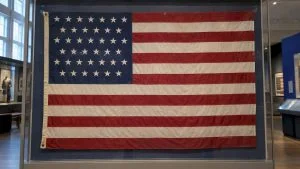
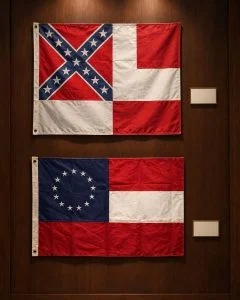
An outdoor flag is built to survive sun, rain and wind. An indoor flag is built to look dignified up close, with fringe, a pole sleeve and rich color. You can often hang an outdoor flag inside without a problem. Flying an indoor flag outside is where the trouble starts, because it will fade, fray and fail in a matter of weeks.
A flag is never just cloth. It is a banner that carries a story, and where you place it, and what it is made of, decides how long that story stays vivid. This guide walks through the real differences, the etiquette for each setting, and how to match a flag to the spot where it will live.
TL;DR
- Outdoor flags are made for weather: tougher fabric, reinforced stitching, and a canvas heading with brass grommets for hoisting on a pole.
- Indoor flags are made for display: a pole hem (sleeve) and often gold fringe, meant for stands, stages, halls and parades, not for wind.
- An outdoor flag works fine indoors. An indoor flag should stay indoors, and indoor or parade flags are best dry-cleaned.
- Fly an American flag at night only if it is lit, and take a non-all-weather flag down in rain, snow or storms.
- Even a good outdoor flag wears out: some sources put the average at about 90 days, so plan on replacing it.
Table of Contents
- What actually separates an indoor flag from an outdoor flag
- Fabric: nylon, polyester and cotton
- Can you use an outdoor flag indoors, and the reverse?
- Displaying a flag indoors
- Flying a flag outdoors
- How long does an outdoor flag last?
- Perspective: why we steer people to the right flag for the right place
- Choosing the right flag for your situation
- Where to find them
- FAQ
- Sources
What actually separates an indoor flag from an outdoor flag
Look at the edges first. Flags are specified differently depending on where they will serve, and public purchasing documents show it plainly. Pennsylvania’s state flag specification calls for pole-tunnel headings and gold bullion fringe on indoor and parade flags, and canvas headings with brass grommets on outdoor flags. That one sentence captures the whole design logic.
Here is the comparison at a glance.
| Feature | Outdoor flag | Indoor flag |
|---|---|---|
| Heading | Canvas heading with brass grommets | Pole sleeve (tunnel) |
| Edge | Reinforced, often with stitched fly end | Often gold fringe |
| Fabric priority | Weather and UV resistance | Look, drape and detail |
| Where it hangs | On an exterior pole or bracket | On a floor stand, wall or stage |
| Cleaning | Mild detergent, rinse well | Dry-clean |
| Typical lifespan | Months, depending on wind and sun | Years, with gentle care |
The fringe is the most visible clue. Gold fringe is ceremonial. It belongs on a flag standing in a courthouse, a school auditorium, a church, a veterans’ hall or an office. On a flagpole in a gale, that same fringe would tangle and shred.
The hardware tells the rest. Grommets let you clip a flag to a halyard and pull it high. A sleeve slides over a staff or horizontal rod, so the flag hangs steady and the union stays where it belongs.
Fabric: nylon, polyester and cotton
Material is where most buyers get stuck, and it is the question readers ask most: is nylon or polyester better? The honest answer is that each wins in a different setting.
- Nylon is light, smooth and takes bright color. It lifts in a gentle breeze and dries quickly, which is why it is the common choice for homes. It can struggle in constant, buffeting wind.
- Polyester is heavier and tends to hold up better in sustained, strong wind. It needs more breeze to unfurl, and it takes longer to dry after a soaking.
- Cotton has a classic, traditional look and suits indoor and historical display. It is not a good match for rain and sun, so keep it inside.
Indoors, the question changes. There is no wind or rain to fight, so fabric becomes a matter of look and feel. Knit polyester drapes well and shows color; nylon is smooth and light; cotton looks the most historic. Outdoor-grade polyester or nylon indoors is perfectly acceptable, because it is often the same cloth sold as an “indoor” flag, minus the fringe.
If you are choosing for a flagpole at home, our nylon embroidered and printed flags are a good place to start. They are made for everyday outdoor flying.
Can you use an outdoor flag indoors, and the reverse?
Outdoor flag indoors: yes. Hang it on a wall, in a den, a classroom or a garage. You lose nothing but the ceremonial fringe. Indoors it will last for years, because the things that destroy flags (UV light, wind, rain and pollution) are largely absent.
Indoor flag outdoors: not for long. The pole sleeve is not designed to carry the load of a halyard, the fringe catches and wears, and the fabric and dyes are chosen for appearance, not for months of sun. You might use one for a few hours at a parade or a ceremony on a calm day. Leaving it up for a season is asking for a ruined flag.

An easy rule: the flag moves indoors freely, but it only moves outdoors if it was made for it.
Displaying a flag indoors
Indoor display is quieter, but it has its own rules, and they matter just as much as they do outside.
On a wall
When the flag hangs flat against a wall, the union (the blue field) goes uppermost and to the observer’s left, whether the flag is hung horizontally or vertically. Never hang it so the union falls to the right or lower down.
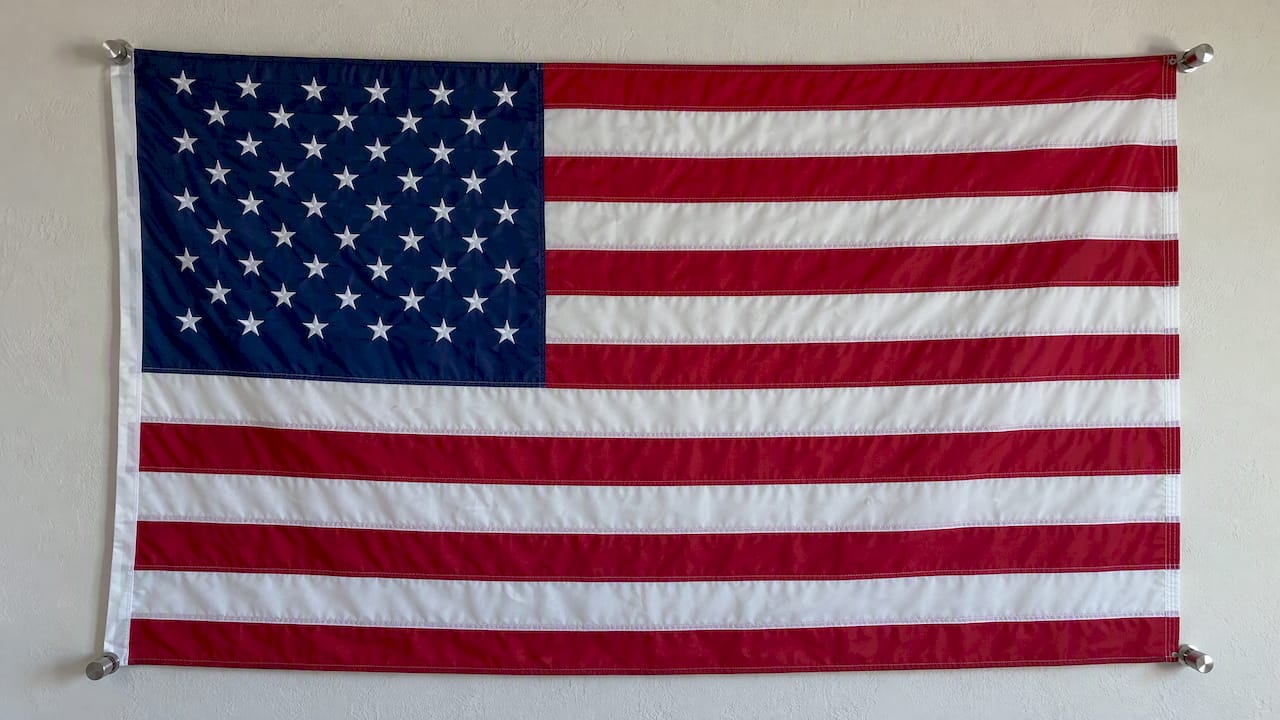
If the wall is an exterior one, add a little air. Museum guidance says that when a textile hangs on a wall, spacers between the wall and the cloth help prevent moisture buildup, especially on outside walls. A simple frame or standoff mount does the job.
On a stage or in a hall
On a platform, the flag goes above and behind the speaker. If it is mounted on a staff, it stands to the speaker’s right. That placement honors the flag as the leading emblem in the room, and it is why a floor stand with a fringed flag is a fixture in so many civic spaces.
Alongside other flags
When a state flag, a military flag or a company banner joins the U.S. flag, arrangement matters. Our guide to displaying multiple flags on one pole or separate staffs covers the common layouts. For ceremonial carrying, see our notes on parade flag etiquette.
Protect it from light
Light is the quiet enemy even indoors. The Smithsonian notes that all organic materials deteriorate with light, air, heat and moisture. The Star-Spangled Banner itself, the National Park Service says, suffered from decades of exposure to light, pollution and temperature swings. If a flag matters to you, an heirloom or a folded burial flag, keep it out of direct sun and away from heaters.
Flying a flag outdoors
Outdoor flags have to be treated like the working banners they are.
Day, night and light
Tradition calls for displaying the flag from sunrise to sunset. However, official guidance says it may be displayed at all times if properly illuminated during darkness. So flying at night is not disrespectful, but it should not be left in the dark. A small spotlight on the flag, even a solar one aimed at the cloth, satisfies the point.
Weather
The same federal guidance says flags should not be displayed in rain, snow or wind storms unless they are all-weather flags. In practice, that means bring in a standard flag when a storm rolls in, and never assume that “weather-resistant” means “storm-proof.” Even all-weather flags are best lowered during severe weather. This also answers a question readers raise about small garden flags with a spotlight: the same weather logic applies, so bring them in when conditions turn nasty.
Outdoor ceremonies pose their own challenges, from gusts to rain to the placement of the flag. If you are planning an outdoor event, this guide to American flag wedding rules shows how those display conditions play out at a ceremony.
Pole and placement
A flag that is too big for its pole whips itself to death, and a pole that is too short crowds the flag against the house. We have written about house flagpole size and flagpole types and footing rules to help you get the setup right. For the smallest spaces, a rotating anti-furl pole keeps the cloth from wrapping around itself.
How long does an outdoor flag last?
Sooner than most people expect. One veterans’ post puts it bluntly: the average outdoor flag lasts about 90 days, and worn flags should be disposed of properly. That figure is an average, and your results will swing widely.
What shortens a flag’s life:
- Constant wind. Edges fray first. The fly end, the part farthest from the pole, takes the beating.
- Strong sun. UV bleaches red and blue, and weakens thread.
- Rain and moisture. Wet cloth is heavier and more prone to mildew.
- Pollution and salt air. Grime and salt speed up wear.
- Wrong size or pole hardware. Rust, rough edges or a flag too large for the pole increase damage.
A tidy habit extends the life: inspect the fly end every week or two and trim and re-hem a frayed edge before the fraying spreads. See our deeper reading on how long flags last and how to care for a flag.
Cleaning
Most outdoor flags can be washed with mild detergent and thoroughly rinsed, while indoor and parade flags should be dry-cleaned. If your outdoor flag is merely dusty or grimy, our step-by-step guide shows how to wash an American flag with a short soak.
When it is time to retire it
When a flag is no longer a fitting emblem because of wear or damage, it should be destroyed in a dignified manner, preferably by burning. Many American Legion posts and VFW halls collect worn flags for respectful retirement ceremonies, so ask at the nearest one.
Perspective: why we steer people to the right flag for the right place
We have been selling flags online longer than anyone, and the most common heartbreak we hear is the same one. Someone buys a handsome flag for the porch, flies it through a hard winter, and finds a frayed ribbon of faded cloth by spring. A flag is a promise made in fabric, and it deserves a setting where it can keep that promise.
So we think in two categories. The flag that stands in the hall, beside the desk or behind the podium is a quiet witness, and it should be rich in detail and fringed with care. The flag that flies on the pole is a soldier. It stands up to the wind every day, and it will eventually fall in service. There is no shame in that, only a duty to replace it with honor and to retire the old one with respect.
This applies to every banner we carry: a Gadsden snake, a Betsy Ross circle of stars, a Revolutionary War standard, or a state flag. If it is going outside, buy the one made for the weather. If it is going on a wall, buy the one that makes the room feel like a place that remembers.
— John Hough
Choosing the right flag for your situation
Use this quick guide to decide.
| Your situation | Best choice |
|---|---|
| Front porch or yard flagpole, mild climate | Outdoor nylon flag with grommets |
| Windy, exposed site | Heavier outdoor flag, inspected often |
| Office, classroom, courthouse, church | Indoor flag with pole sleeve and fringe |
| Parade or ceremony | Indoor or parade flag, carried on a staff |
| Home den or wall display | Either; outdoor flag works well |
| Collector’s piece or heirloom | Indoor display, away from sun |
Then ask three questions before you buy: where will it hang, how much wind and sun will it face, and what size matches the pole or wall? A 3 x 5 ft flag is a common household size, but pole height and wall space should set the choice.
Where to find them
Our USA flag collection covers the American flag in the formats most households and halls need, and our military flags and state and historic flags round out a display. If you are building a full setup, browse flagpoles and hardware at the same time, so the pole, the halyard and the flag all work together. Ultimate Flags is America’s oldest online flag store, and our catalog is built for people who care about the details.
FAQ
Is nylon or polyester better for a flag?
Nylon is lighter, brighter and flies in a gentle breeze, so it suits most homes. Polyester is heavier and tends to cope better with constant strong wind, though it needs more breeze to unfurl. Pick by your site: calm and sheltered favors nylon, exposed and gusty favors polyester.
How should the American flag be displayed on a wall?
Hang it flat with the union (blue field) at the top and to the observer’s left, whether the flag runs horizontally or vertically. On an exterior wall, leave a small gap behind it so moisture does not build up. Keep it out of direct sunlight.
Is it disrespectful to fly a flag at night without a light?
Yes, by the guidance. The flag may fly around the clock, but it should be illuminated during the hours of darkness. A simple spotlight aimed at the flag solves it, and if you cannot light it, lower it at sunset.
How long should an outdoor flag last?
It varies with wind, sun and weather, and one veterans’ post cites about 90 days as an average. Inspect the fly end regularly and mend small tears early. Replace the flag when it is no longer a fitting emblem, and retire the old one respectfully.
Sources
- Pennsylvania flag specification (indoor and outdoor headings)
- Kentucky League of Cities: proper flag etiquette
- Smithsonian: guidelines for the preservation of flags
- National Park Service: preserving perishable materials
- U.S. Department of Veterans Affairs: guidelines for display of the flag
- American Legion Post 40: proper flag disposal
- Congresswoman Ann Wagner: ordering an American flag