A flag is a cloth symbol designed to fly on a pole and signal identity from a distance; a banner is a flat display surface, mounted or hung, built to carry a larger and more detailed message. The banner vs flag distinction comes down to movement and purpose: one is meant to move with the wind, the other to stay still and be read. Everything else, from fabric to hardware to where you hang it, follows from that single difference.
TL;DR:
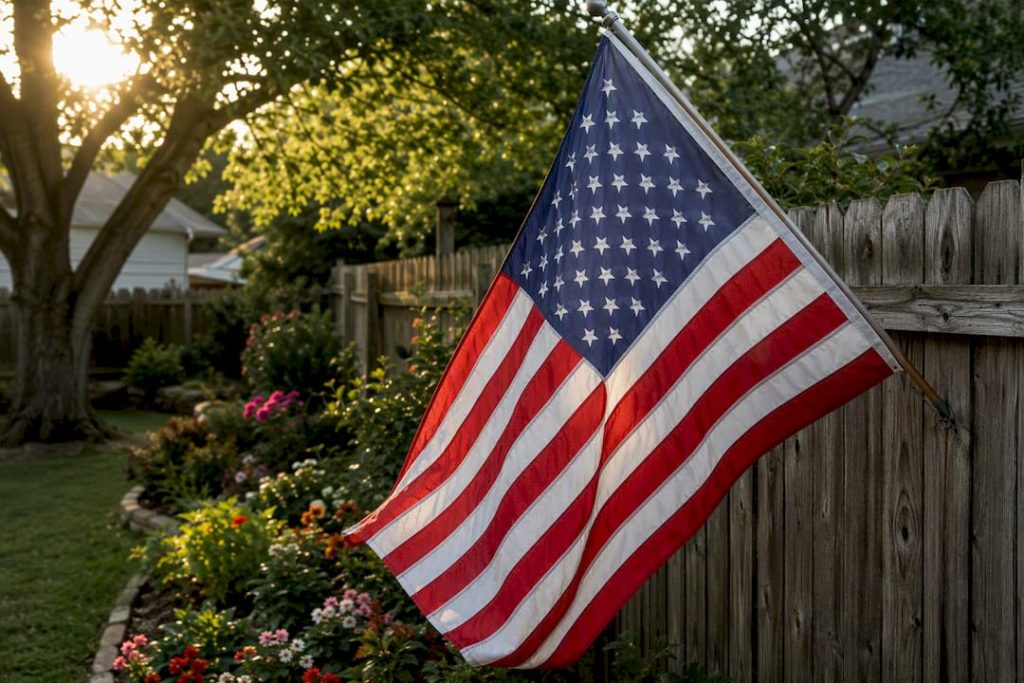
- Flags are designed to move with the wind and are mounted along their fly side, typically with sleeves or grommets for pole attachment.
- Banners are meant to stay flat for easy reading and hang from the top or grommets, often with reinforced hems for durability.
- The size and shape of banners allow for detailed messages, while flags feature simplified designs suitable for recognition from a distance.
- Proper selection depends on whether the display needs to be seen from afar or read up close, with flags suited for identity and ceremonies, and banners for messaging.
- Material choices vary: nylon and polyester for flags, vinyl and mesh for outdoor banners, with durability and environment exposure guiding the decision.
Table of Contents
- Banner vs Flag: How to Tell Them Apart by Sight and Mount
- Construction and Hardware Built for Each Job
- Flags vs Banners: When Each One Actually Works
- How Size and Shape Change What You Can Show
- Ceremonial and Symbolic Distinctions Worth Knowing
- A Buying and Display Checklist That Prevents Costly Mistakes
- Why Ultimate Flags’ Experience Matters Here
- What the Research Actually Tells Us About Choosing Right
- Find the Right Flag or Banner for Your Display
- Sources
- FAQ
Banner vs Flag: How to Tell Them Apart by Sight and Mount
Look at how the cloth attaches, and the answer usually reveals itself before you even read what’s printed on it. A flag mounts along its fly side, either through a pole sleeve or a header fitted with grommets, and that side-attachment is what lets it catch the wind and ripple. A banner, by contrast, typically hangs from a top sleeve or a row of grommets across the top edge, sometimes with a second row at the bottom to keep it flat and taut against a wall, fence, or stage backdrop.
Shape tells its own story too. National and state flags tend toward a compact rectangle, close to a 3:5 or 2:3 ratio, built for a bold emblem that reads clearly even in motion. Banners run longer and often narrower, shaped to fit a storefront window, a lamppost, or a fence line, because they need to fit copy a flag was never designed to hold. According to FlagWorld’s comparison of flag and banner design, flags favor movement and identity while banners favor a flat, readable surface.
A quick test that rarely fails:
- Does it need to catch wind and ripple to look right? That’s a flag.
- Does it need to stay flat so someone can read a paragraph of text? That’s a banner.
- Is it fixed at all four corners, or held tight by a frame? Almost certainly a banner.
Construction and Hardware Built for Each Job
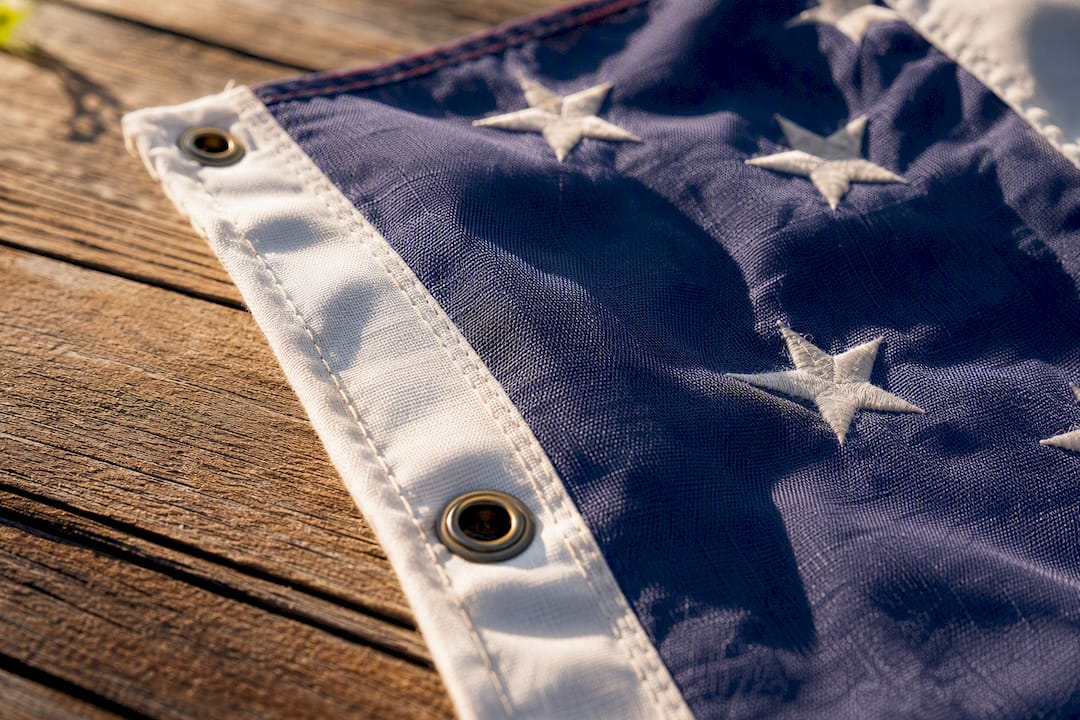
Flags are made to move, so their fabric has to be light. Nylon and woven polyester dominate the flag market because both dry quickly and catch even a modest breeze without sagging into a limp heap on the pole. Swirling Silks notes that flags typically use a fly-side sleeve specifically so they can move freely, while banners rely on grommets or a top sleeve meant to hold the fabric still.
Banners answer to a different set of demands. Vinyl dominates outdoor advertising because it resists rain and UV fading and keeps printed graphics sharp at a distance. Mesh banners solve a related problem: full vinyl acts like a sail in high wind, so mesh lets air pass through while keeping the message intact, a detail that matters far more than most first-time buyers expect. Fabric banners, meanwhile, show up indoors and at trade shows, where wrinkle resistance and a soft, professional look matter more than weatherproofing.
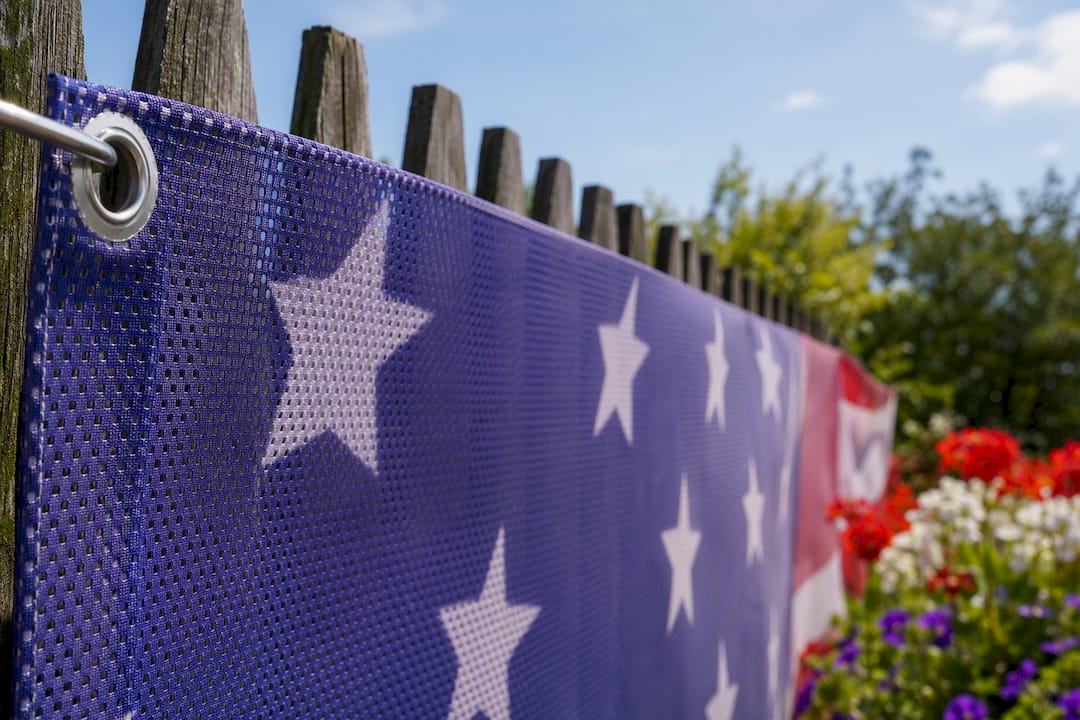
Hardware follows the fabric. Flags need a proper pole, whether that’s a residential mount, a boat rail bracket, or an in-ground pole with a topper. Banners depend on grommet spacing, sturdy brackets for street or lamppost mounting, and reinforced hems, often with bar-tack stitching at stress points, to survive wind gusts without tearing loose. Whichever you choose, plan to hose off dirt periodically and store the piece dry. UV exposure, not routine handling, is what shortens the life of either one.
Flags vs Banners: When Each One Actually Works
The right choice depends less on which word sounds fancier and more on three practical questions: how far away will people be standing, how much text do you need to show, and does the piece need to travel or stay put? FlagWorld’s guidance puts it plainly: decide where the piece will sit and how people will view it before deciding what to buy.
Flags earn their keep in identity and ceremony. A national flag outside a courthouse, a state flag at a fairground entrance, a military flag at a memorial service. All of these rely on instant recognition from a distance, not fine print, which is why flag designs stay simple: a few bold shapes, a limited palette, nothing that gets lost in the flutter.
Banners earn their keep wherever a message needs to be read, not just recognized. A few situations where a banner clearly outperforms a flag:
- Storefront promotion. A sale announcement with pricing and dates needs a flat surface people can actually read while walking past.
- Event entrances. A welcome banner with sponsor logos and event details works better hung across an archway than fluttering on a pole.
- Civic ceremonies. Here the two swap roles: flags represent nations, states, and branches of service, while a printed banner might announce the program or honor a specific unit.
If you’re standing at the shelf trying to decide, ask yourself whether a stranger fifty feet away needs to recognize what you’re showing in a glance, or read three sentences of copy. The first calls for a flag. The second calls for a banner.
How Size and Shape Change What You Can Show
A flag’s small, fixed proportions force restraint. Cram a paragraph onto a 3-foot by 5-foot flag and it becomes unreadable the moment wind moves it, so flag design sticks to a symbol, a few colors, and minimal text, if any at all.
Banners scale to the message. Street and lamppost banners run narrow and tall, built to clear pedestrian sightlines while announcing a season or event. Fence and wall banners stretch wide, ideal for sponsor logos or a storefront sale. Pull-up banners, the retractable kind you see at trade shows and registration tables, trade outdoor durability for portability and a quick setup indoors. FlagWorld identifies these as distinct subtypes precisely because each solves a different placement problem.
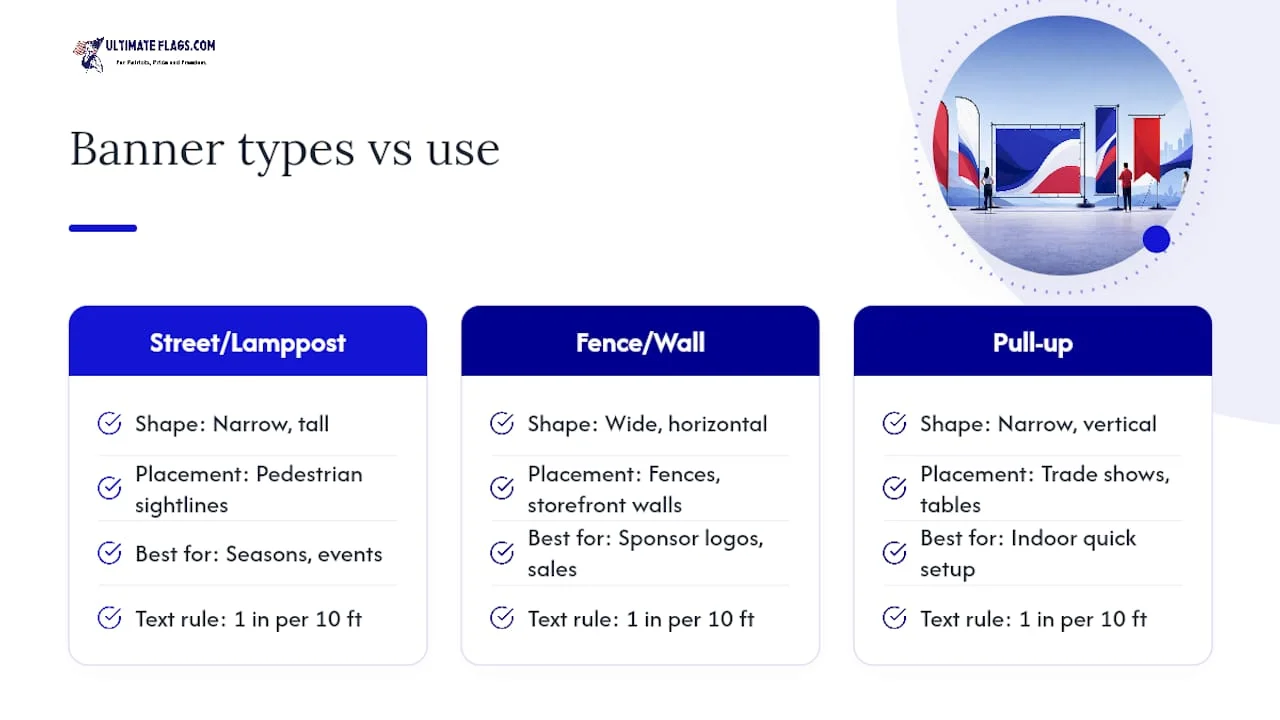
As a rule, figure that readable body text needs roughly one inch of letter height for every ten feet of viewing distance. For exact dimensions and printable area by banner type, Tekton LA’s banner size guide walks through the numbers in more depth than a quick rule of thumb can offer.
Ceremonial and Symbolic Distinctions Worth Knowing
Not every “banner” is a piece of advertising. In heraldry, a banner of arms displays the design from a coat of arms and carries institutional or family significance, distinct entirely from a vinyl sign outside a shop. Wikipedia’s entry on banners defines the term broadly as any flag or cloth bearing a symbol or message, but heraldic banners of arms occupy their own ceremonial category with rules that predate modern advertising by centuries.
Flags and standards carry similar weight in protocol. A regimental standard, a presidential flag, a state flag lowered to half-staff, each follows conventions tied to honor and remembrance rather than commerce. For museums, historical reenactment groups, and anyone handling official reproductions, that distinction is not academic. Calling a banner of arms a “banner” in the retail sense, or treating a ceremonial standard as interchangeable with a promotional flag, misrepresents what the object actually stands for.
A Buying and Display Checklist That Prevents Costly Mistakes
Before you order anything, walk through this sequence:
- Measure your viewing distance. This determines both size and how much text you can realistically include.
- Match material to environment. Nylon or polyester for flags that need to fly; vinyl or mesh for banners facing wind and rain; fabric for indoor use.
- Choose mounting hardware first, not last. A pole sleeve, a set of grommets, and street banner brackets are not interchangeable, and ordering the wrong one means a resized or reprinted order.
- Plan for wind exposure. Mesh vents a banner that would otherwise tear or bow; flags need enough breeze to fly without a stiff enough gust to fray the fly side.
On design: keep contrast high, keep fonts large enough to read at your measured distance, and place logos where they won’t fold into a grommet line. Dense paragraphs belong on a banner, never on a flag.
Pro Tip: If your display site sees strong, steady wind, a lighter woven flag or a vented mesh banner will outlast a heavier, solid-vinyl piece by a wide margin, even though the solid vinyl looks sharper on day one.
Why Ultimate Flags’ Experience Matters Here
Ultimate Flags has operated as one of the longest-running online flag retailers in the country, building a catalog that spans national flags, state flags, military and service flags, and historical reproductions built for accuracy, not just decoration. That range matters when the difference between a flag and a banner is not academic but a real purchasing decision.
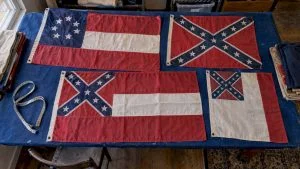
For readers weighing material choices on a Confederate flag or another historical reproduction meant for years of outdoor display, Ultimate Flags’ guide to outdoor flag materials covers the fabric tradeoffs in more depth. The Ultimate Flags blog also carries a running collection of historical pieces for readers researching ceremonial context before buying a reproduction.
What the Research Actually Tells Us About Choosing Right
Most confusion between these two formats doesn’t come from ignorance. It comes from vendors who use “flag” and “banner” loosely enough that shoppers start treating the words as synonyms rather than functional categories. That habit costs money: order a flag-weight nylon piece for a storefront banner application, or a stiff vinyl panel for a flagpole, and you’ll have wasted the purchase before it ever goes up.
The stronger approach, and the one this guide leans on, is to ignore the product name entirely and start with the physics. Does the piece need to move, or does it need to sit flat and stay legible? That question resolves nearly every edge case faster than reading a dozen product descriptions.
Where conventional advice tends to undersell the reader is on ceremonial terminology. A banner of arms is not a marketing term, and treating it as one, in a museum label or a reenactment display, gets the history wrong in a way that matters to the people who take it seriously. Precision here isn’t pedantry. It’s respect for what the object represents.
— Jonica
Find the Right Flag or Banner for Your Display
Ultimate Flags carries what most general signage shops don’t: a genuinely deep catalog of national, state, military, and historical flags built by people who understand why a fly-side sleeve matters and why a Confederate reproduction needs a different fabric than a backyard novelty piece. Whether you’re flying a flag for identity and ceremony or need a flat banner for an event or storefront, the material and hardware guidance above points to real products, not generic advice.

Readers drawn to the history behind these designs will find that story told in depth on the flag history and heritage page, where decades of American flag tradition are covered alongside the products themselves. If you already know which material and mounting style fits your space, browse the full flag and banner catalog and get the right piece ordered before your next event, ceremony, or storefront refresh.
Sources
- Banner — Wikipedia
- Flag vs Banner vs Teardrop Flag: Key Differences — FlagWorld
- Difference Between Flag and Banner — Swirling Silks
FAQ
Is a banner the same as a flag?
No. A flag attaches on its fly side and is built to move in the wind, while a banner typically hangs flat from a top sleeve or grommets and is meant to be read rather than watched flutter.
Is a standard a flag or a banner?
A standard is a type of flag, historically carried by military units or mounted on a pole for ceremonial display, and it follows flag conventions rather than banner conventions.
Is the American flag a flag or a banner?
The American flag is a flag in every functional sense: it mounts on a pole sleeve, flies in the wind, and represents national identity, none of which describes a commercial banner.
Why is it called a banner?
The term traces to any cloth bearing a symbol or message, a definition broad enough to cover both heraldic banners of arms and modern advertising banners, which is part of why the word gets used loosely today.
What’s the difference between a banner and a pennant?
A pennant is typically a small, tapered or triangular flag used for sports, decoration, or signaling, while a banner is a larger flat surface built to carry text or graphics rather than a simple symbol.