For most homes, the best flag mount angle is about 45 degrees. At that angle the flag clears the wall, porch rail and shrubs, and it still rides the breeze like a banner should. A 30 degree bracket suits tight spaces, a 90 degree (horizontal) bracket suits open walls and pole-style displays, and an adjustable bracket lets you decide once the flag is in your hand. The law gives you more freedom than you might expect: the U.S. Flag Code does not set a mounting angle. It cares about one thing, which is where the union sits.
A flag is more than fabric on a stick. It whispers a story to every neighbor who passes, and how it leaves your wall says something about the care behind it. Here is how to pick the angle, aim it correctly and fasten it so it stays put through the storms.
TL;DR
- 45 degrees is the all-round choice for porches, front doors and garages. Use 30 degrees under low eaves and 90 degrees on open walls with room to spare.
- The Flag Code sets no angle. When a U.S. flag flies from an angled staff, the union goes at the peak of the staff.
- Let the flag move. Pick an angle that lets it fly freely, not one that pins it flat against the siding.
- Anchor to structure. A bracket transfers wind load into your house, so screw it into a stud, header or solid backing, never siding alone.
- Adjustable brackets remove guesswork when your wall, eaves or sightlines are less than ideal.
Table of Contents
- What the flag mount angle actually controls
- Comparing 30, 45, 90 degrees and adjustable brackets
- What the U.S. Flag Code says about angled staffs
- Let the flag fly: why a steeper angle often looks more respectful
- Match the angle to where you are mounting
- How to choose your angle in five steps
- Mounting it so it stays up
- Our perspective
- An adjustable bracket for the flag you are flying
- Common mistakes to avoid
- FAQ
- Sources
What the flag mount angle actually controls
The angle is the tilt of the pole away from the wall or post, measured from the surface it is mounted on. A bracket at 90 degrees holds the pole straight out, perpendicular to the wall. A 45 degree bracket tips the pole up and outward. A 30 degree bracket leans it closer to the vertical, with the tip well above the mounting point.
Three things change with that number.
- Clearance. The flag hangs below the pole. A steeper tilt lifts the fabric away from the wall, railing and plants, so it flaps instead of clinging.
- Visibility. A flag on an angled pole reads from the street and from the side. One on a horizontal pole can disappear when you look at it from down the block.
- Load. The farther the pole reaches out, the more leverage the wind has on the bracket and its screws. More on that below.
Comparing 30, 45, 90 degrees and adjustable brackets
Here is how the common options stack up for a typical house flag of 3 by 5 feet on a pole of roughly five to six feet. These are practical guidelines from installing and selling flag hardware, not code requirements.
| Angle | Best for | Strength | Watch out for |
|---|---|---|---|
| 30 degrees | Low eaves, narrow porches, garage fronts | Pole sits close to vertical, so the flag hangs clear and takes less sideways reach | Tip rises high, so check overhead clearance and gutters |
| 45 degrees | Most porches, front doors and posts | Balanced look, strong flow, good street visibility | Needs room for the flag’s length to swing |
| 90 degrees | Open walls, deep porches, wide columns | Flag extends straight out and shows its full face | Longer reach on the bracket; the flag may wrap around the pole in light wind |
| Adjustable | Uneven sites, trial and error, shared walls | Set the angle on site, change it for the season | Make sure the pivot locks firmly and the fasteners are rated for outdoors |
If you cannot decide, start at 45 degrees. It is the angle most front-of-house displays settle on because it forgives mistakes in both directions.
What the U.S. Flag Code says about angled staffs
Many readers assume there is a mandated angle. There is not. The U.S. Flag Code, 4 U.S. Code § 7, says that when the flag is displayed from a staff projecting at an angle, from a window sill, balcony or building front, the union must be placed at the peak of the staff unless the flag is at half-staff. The statute gives the position of the union, not a number of degrees.
In practice that means:
- Pick any angle that suits your house.
- Make sure the blue field is nearest the top of the pole, not hanging at the free end.
- Do not let the flag touch the ground or the structure beneath it.
If you are hanging a flag vertically instead, flat against a wall or in a window, the rule changes. Our guide to vertical flag rules for the U.S., Canada and more explains how to keep the union at the observer’s left.
Let the flag fly: why a steeper angle often looks more respectful
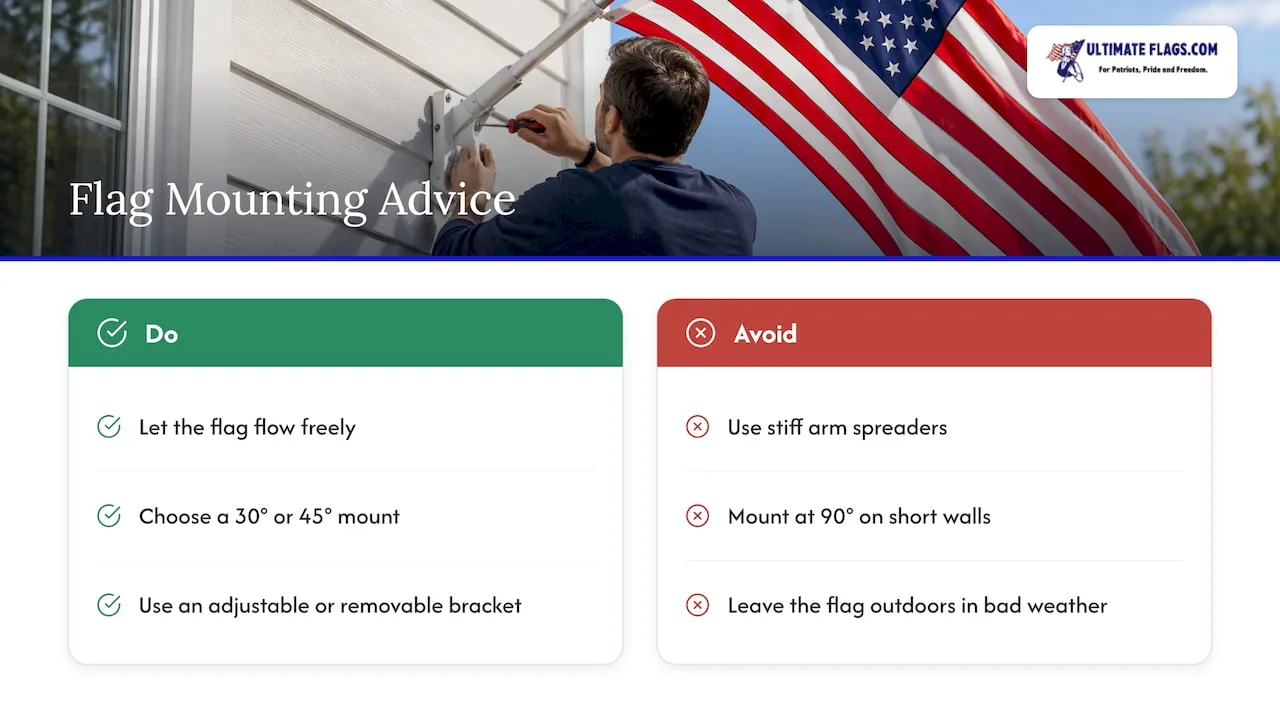
The U.S. Army’s guidance on displaying Old Glory makes a point worth remembering: the flag should flow freely in the wind. Hardware that holds it captive, such as stiff arm spreaders that stretch it taut, treats it like an advertising banner instead of a living symbol.
An angle that works with gravity and wind helps the flag do what flags have always done, from the Revolutionary War colors that rallied troops to the banners at your local post. At 45 or 30 degrees, the fabric drops and lifts naturally. At 90 degrees on a very short wall the same flag can bunch against the siding when the air goes still.
The same Army page also advises against leaving a flag outdoors in bad weather. If your region sees heavy storms, an adjustable or removable bracket makes it easier to take the flag in without a ladder drama.
Match the angle to where you are mounting
Front door and porch post
The traditional spot is on the right side of the door as you face the house, with the pole angled upward and the union kept uppermost. That puts the flag on the observer’s left as they approach. A 45 degree bracket on a porch post or door trim is the most common solution. Keep the bottom edge of the flag well above heads and the top of the doorway frame.
Under the eaves
Low eaves can trap the pole tip. In that case, move the bracket out onto a fascia or column, or use a 30 degree bracket so the pole tilts less and clears the roofline. Avoid mounting so close under the overhang that the flag chafes against it every time the wind shifts.
Garage fronts and wide walls
On the front of a garage, set the bracket on the side of the door nearest the street and a little above the door’s top edge. A 45 degree angle keeps the flag clear of the door panels when they roll up. For a long blank wall, 90 degrees can look sharp, because the flag shows its full width.
Second story and tall homes
Up high, the wind is stronger and the consequences of a loose bracket are bigger. Choose a robust bracket, mount it through to solid framing, and match pole length to the structure. Our house flagpole size guide and flagpole height chart with safety checks give the proportions to start from.
Posts, fences and commercial fronts
A bracket on a square post follows the same logic as a wall: 45 degrees for general use, 90 degrees if the flag needs to extend past the post’s face. For event banners and storefront flags, the choice is mostly about visibility down the street, so tilt the pole toward oncoming foot or car traffic.
How to choose your angle in five steps
- Measure the available space. Check the width from the mounting point to the nearest obstruction: a rail, a shrub, a gutter, a neighbor’s fence. A flag needs room roughly equal to its length when the wind turns.
- Check the overhead. Hold a broom handle at your candidate angle and see where the tip lands. Anything it touches, a flag will rub.
- Note the wind. If your wall faces a prevailing wind, a steeper tilt keeps the flag off the siding. Sheltered corners may benefit from a more horizontal pole so the flag catches what air there is.
- Decide how often you will change the flag. Seasonal and holiday flaggers should favor adjustable brackets and poles that are easy to reach.
- Mark and test. Tape a cardboard silhouette of the flag, 3 by 5 feet, to the wall, then step back to the street and see how it reads.
Mounting it so it stays up
A bracket is not decoration. Architectural metal guidance from the National Association of Architectural Metal Manufacturers notes that loads on a flagpole are resisted by the mounting and the building structure behind it. The wind pushes on the flag and pole, and the bracket carries that push into your wall.
A construction standard for wall-mounted poles spells out the practical consequence: the bracket should be anchored to structural backing capable of resisting the cantilever wind load. For a house, that means:
- Find the stud or header. Use a stud finder. Do not rely on siding, trim alone or hollow-wall anchors for anything but the lightest garden flag.
- Use all the mounting holes. Every hole shares the load.
- Use outdoor-rated fasteners in a material that will not streak or corrode against the bracket.
- Seal penetrations. A dab of exterior-grade sealant around each screw keeps water out of the wall.
- Retest after the first big wind. Tighten anything that has worked loose.
When the wall is brick, stucco or masonry, or when the flag is large, call a qualified contractor. If a pole is going near power lines, do not mount it at all without professional help.
Bracket angle also interacts with pole length. The longer the pole and the heavier the flag, the more leverage the bracket faces. Stay with a five to six foot pole on residential walls unless the structure is built for more. Our flagpole types and footing guide covers the alternatives when a wall mount is not the right answer.
Our perspective
We have sold flags for a long time, and the most common mistake we see is not a bad angle. It is a flag that never gets to move. People fix a bracket flat against a wall, hang a handsome 3 by 5, and then wonder why it droops like a tired curtain.
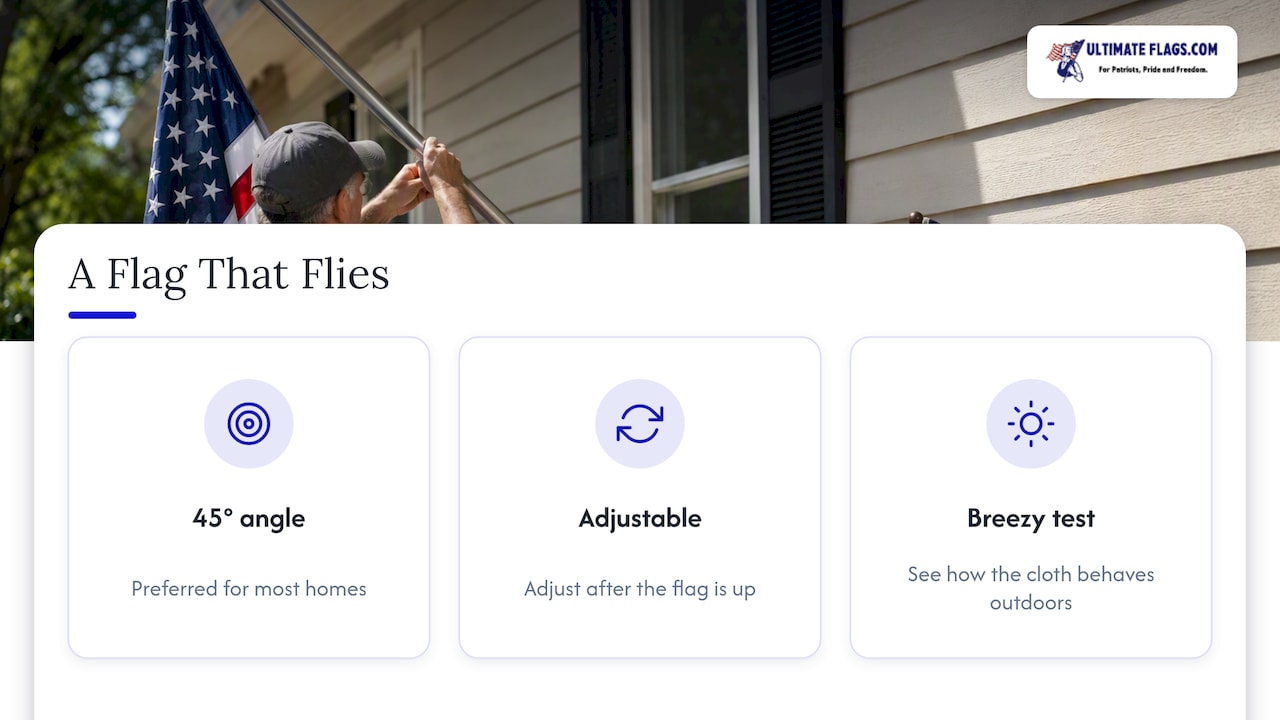
A flag is meant to fly. That is why we lean toward 45 degrees for most homes, and why we like brackets that can be adjusted after the flag is up. Every wall, porch and set of eaves is different, and the real test is how the cloth behaves on a breezy afternoon. If it flows, you have chosen well.
We also think of the bracket as part of the display’s dignity. A flag on a solid, well-anchored mount, hung with the union where it belongs, honors what it stands for, whether it is Old Glory, a state flag, a military banner or a Revolutionary War standard. Fasten it as if you intend it to fly for years, because it should.
— John Hough
An adjustable bracket for the flag you are flying
If your wall or porch does not offer an obvious angle, the Ultimate Adjustable Bracket in white, flat mounting is built to let you set the pole position on site. Pair it with a pole from our hardware and flagpoles collection, such as an aluminum anti-furl rotating pole, which helps the flag turn with the wind instead of wrapping itself around the staff.
Then choose the flag. Browse our full flag collections, from USA and state flags to military, historic war and political flags, and check the sizing advice in our flag buying guide. If you are hanging a flag with grommets, our notes on header and grommet spacing will help it sit evenly on the pole.
Common mistakes to avoid
- Mounting too low. A flag that brushes the porch rail or shrubs frays quickly.
- Forgetting the union. On an angled staff, the blue field belongs at the peak.
- Anchoring into siding. It looks fine on installation day and fails in the first strong gust.
- Choosing a bracket for the flag you wish you had. A 3 by 5 flag on an overbuilt reach is fine; a 4 by 6 on a light-duty bracket is not.
- Ignoring storms. Take the flag down in severe weather, as Army guidance advises for outdoor display.
- Skipping the test. Always check how it reads from the street, not just from the doorstep.
FAQ
What is the best angle for a house flag bracket?
For most front doors, porch posts and garage walls, 45 degrees is the best starting point. It gives the flag room to fly and shows well from the street. Use 30 degrees where eaves or overhead obstructions are low, and 90 degrees only where you have open space beside the flag.
Does the Flag Code require a specific angle?
No. 4 U.S. Code § 7 addresses the position of the union, not the degrees of tilt. When a U.S. flag is displayed from an angled staff, the union goes at the peak of the staff, except at half-staff.
Which side of the door should the flag go on?
The traditional placement is on the right side of the door as you face the house, with the pole angled upward and the union uppermost. That keeps the union on the observer’s left as they approach. If the layout makes that impossible, keep the union at the peak and choose the nearest practical side.
Can I mount a flag bracket on vinyl siding?
The bracket should not rely on siding. Wind load passes through the bracket into the wall, so it needs a stud, header or other structural backing. If you cannot locate solid framing, ask a qualified contractor to install it.
Sources
- 4 U.S. Code § 7, position and manner of display (govinfo.gov)
- Do’s and don’ts for displaying Old Glory (U.S. Army)
- Flagpoles, NAAMM architectural metal guidance (PDF)
- Flagpoles, construction standard, clause 14.6