A flagpole finial, sometimes called a topper, is the decorative cap fixed to the very peak of the pole. The three styles that dominate American flagpoles each carry their own weight: the gold ball speaks to unity and wholeness, the eagle to patriotic strength and service, and the spear or spire to vigilance and defense. Understanding which one belongs on your pole is part history lesson, part practical decision.
TL;DR:
- The size and threading of the finial must match your pole’s spindle exactly to ensure proper installation and function.
- Weather-resistant materials like aluminum or UV composites are recommended based on your climate, especially for outdoor poles exposed to salt or intense sun.
- The shape of the finial signals the property’s purpose: balls represent unity, eagles symbolize patriotism, and spears or crosses convey tradition or religion.
- Finials primarily serve a practical role by sealing moisture and debris from the pulley mechanism, with shape influencing flag wear and wind resistance.
- Cost varies widely depending on size, material, and craftsmanship, and buying from specialized vendors ensures proper fit and durable materials.
Table of Contents
- What Is a Flagpole Finial, and Where Does It Mount?
- What Do the Different Finial Styles Symbolize?
- Do Flagpole Finials Serve a Real Function, or Are They Just Decoration?
- How Do You Choose and Size the Right Finial?
- What Does a Flagpole Finial Cost, and Where Should You Buy One?
- How Do Flagpole Finial Traditions Differ Around the World?
- What’s the Right Finial for Your Flagpole?
- Sources
- FAQ
- Editorial Perspective: Choosing Symbolism That Fits Your Purpose
What Is a Flagpole Finial, and Where Does It Mount?
The word “finial” comes from architecture, where it has long marked the crowning ornament atop a spire, gatepost, or staircase newel. Applied to a flagpole, a finial is the ornament that caps the very top, threading onto a spindle mounted at the truck, the fitted assembly that also houses the pulley and halyard system.
That positioning is not accidental. The truck sits above the working hardware, so the finial functions as a crown sitting directly over the mechanism that raises and lowers the flag. Builders have dressed the tops of poles and standards this way for centuries, long before the American flag existed, which is part of why the gold ball feels so instantly recognizable even to people who never learned its name.
A few terms worth knowing before you go shopping:
- Truck: the cap assembly at the top of the pole that houses the pulley
- Halyard: the rope or cable used to raise and lower the flag
- Spindle: the threaded post protruding from the truck, where the finial screws on
What Do the Different Finial Styles Symbolize?
Three shapes dominate the American market, and each one signals something different about the property beneath it. According to industry guides on common flagpole toppers, the gold ball remains the most widely used, followed by the spread-wing eagle and the spear or spire.
The gold ball is the default choice for homes, schools, and municipal buildings across the country. Its round, unbroken form has long stood for unity, wholeness, and continuity, an idea old enough to predate the flag it now sits above. Practically speaking, the smooth surface sheds rain and snags nothing when the flag whips around in a strong wind, which is part of why it became the standard rather than an afterthought.
The eagle carries an unmistakable charge of patriotic strength and national service. It shows up most often on government buildings, veteran memorials, and ceremonial flagpoles where the symbolism needs to do real work. Etiquette guidance from flag specialists recommends orienting the eagle to face forward or outward when it’s mounted near a building, so the bird appears to be looking toward whoever approaches, not turned away in retreat. That small detail matters to veterans and civic groups who take the display seriously, and it’s an easy thing to get wrong if you install the topper without checking which way the eagle should face.
The spear or spire traces back to military and institutional tradition, where a pointed tip signaled readiness and vigilance long before it became decorative. You’ll still find it on courthouses, historic sites, and properties with a martial or heritage bent, standing in quiet contrast to the softer roundness of the ball.
Beyond the big three, a handful of other shapes fill specific niches:
- Cross: churches, religious schools, and memorial sites, signaling faith and remembrance
- Torch: educational institutions and some civic buildings, standing for knowledge and enlightenment
- Star: often paired with military or patriotic displays, sometimes custom ordered to match a unit insignia
- Custom shapes: state symbols, mascots, or organizational emblems for properties that want something distinctly their own
The setting usually decides the shape before the homeowner does. Residential poles most often default to the ball, ceremonial and government sites tend to choose the eagle, and memorial or heritage properties generally use the spear or cross to match the gravity of what they’re honoring.
Do Flagpole Finials Serve a Real Function, or Are They Just Decoration?
Finials earn their place beyond looks. Mounted directly over the truck, a finial caps the spindle and keeps rain, dust, and debris from working their way into the pulley mechanism below. Vendor documentation on the gold ball’s design confirms this dual role: decorative crown on top, functional seal underneath.

Shape affects flag wear more than most owners realize. A smooth, rounded ball gives the fabric nothing to catch on as it snaps in the wind, while a pointed spear or the outstretched wings of an eagle can occasionally nick or tear a flag that whips too close on a gusty day. If you fly your flag daily in an exposed, windy location, that’s worth weighing against the look you want.
Now for the myth that refuses to die: no, the gold ball does not contain a Bible, a match, and a bullet meant to help a lone defender survive a siege. That story has circulated for generations, but no installer, manufacturer, or historical record backs it up. Experienced pole installers point instead to the ball’s real job, capping the spindle and sealing out moisture, which is a far less dramatic story but the true one.
Pro Tip: If someone tells you the ball on their flagpole is hollow and full of survival gear, ask to see it opened. In decades of installations, nobody ever has.
How Do You Choose and Size the Right Finial?
Getting the fit right matters more than picking the prettiest shape, since a finial that doesn’t thread onto your spindle is useless no matter how good it looks in the catalog photo. Here’s how to approach it step by step:
- Measure your spindle. Check the threading on the post protruding from your truck, or pull the specification sheet that came with your pole, since thread size varies by manufacturer.
- Match diameter to pole height. Sizing guidance from flagpole specialists recommends scaling ornament diameter to pole height, larger poles need proportionally larger toppers, or the finial looks lost against the mast.
- Pick a material suited to your climate. Aluminum resists corrosion and stays lightweight, brass offers a richer look but needs more upkeep, and UV-resistant composites hold color better in intense sun than cheaper plated metals.
- Confirm orientation before installing an eagle. Mount it facing forward or outward if it’s near a building entrance, following the same etiquette civic and veteran groups favor.
A quick etiquette note worth settling before you buy: the U.S. Flag Code governs how the flag itself is displayed and handled, but it says nothing about which finial style you choose. Ball, eagle, spear, cross, they’re all equally proper under the Code. Indoor display poles often favor smaller, lighter finials since wind resistance isn’t a factor, while outdoor poles benefit from sturdier, weather-rated materials.
Before you check out, run through this list:
- Thread size matches your spindle exactly
- Diameter suits your pole height
- Finish is rated for your climate (coastal properties need extra corrosion resistance)
- Warranty and return policy are clearly stated in case the fit is off
Mismatched threading is, by a wide margin, the most common reason flagpole toppers get returned, so double check that measurement before you commit to a purchase.
What Does a Flagpole Finial Cost, and Where Should You Buy One?
Price climbs with size, material, and craftsmanship. A small residential ball finial in aluminum typically sits at the low end of the range, while a large eagle or a custom spear in solid brass runs considerably more, and custom shapes built to match a specific emblem or insignia cost more still.
Where you buy matters almost as much as what you buy. Mass-market retailers tend to stock basic ball finials at lower prices, fine for a standard residential setup where fit tolerances are forgiving. Specialty flag vendors, on the other hand, carry larger sizes, custom fabrication, and detailed thread guides, which matters if your pole is older, imported, or simply nonstandard.
Before you hand over payment, run through a short checklist:
- Confirm the thread size in writing, not just in a product photo
- Ask directly about finish and whether a warranty covers corrosion or fading
- Verify the return policy in case the fit doesn’t match your spindle
A few extra minutes on these questions saves the hassle of shipping a mismatched finial back across the country.
How Do Flagpole Finial Traditions Differ Around the World?
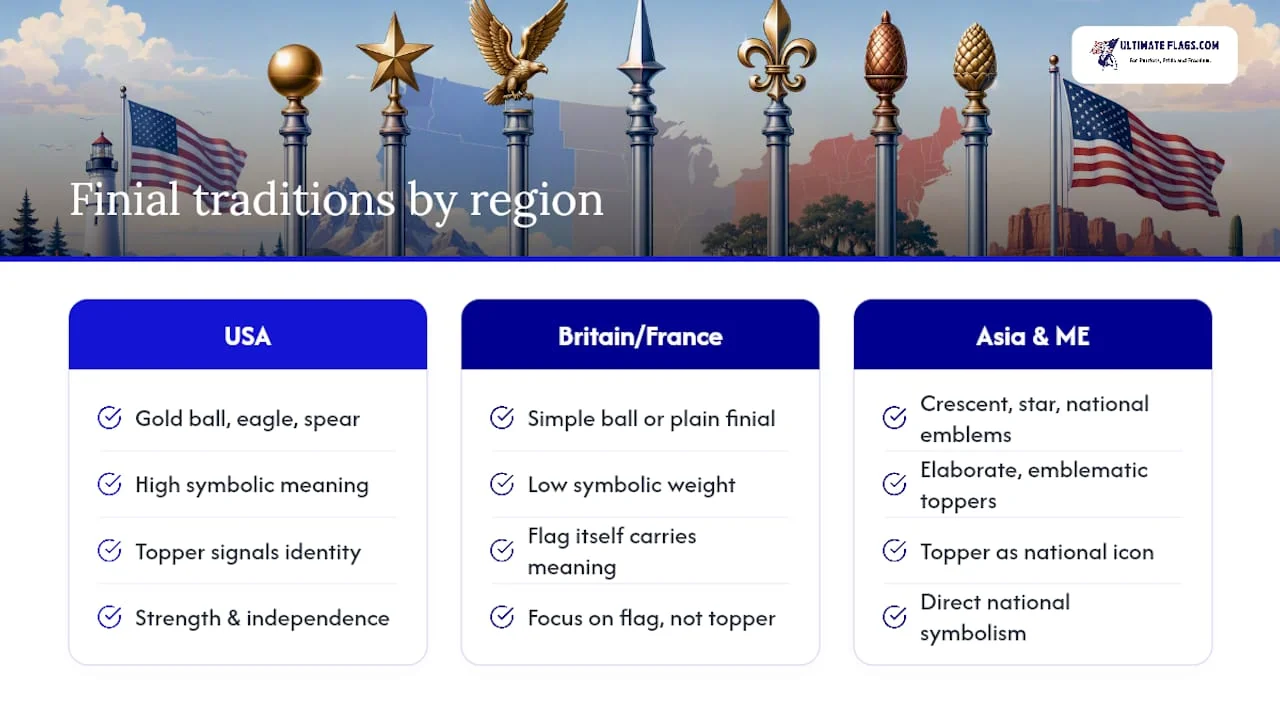
American flagpole tradition leans heavily on the gold ball, eagle, and spear, but the crowning ornament tells a different story depending on where in the world you look. British flagpoles historically favored the simple ball or a plain finial with far less symbolic weight attached, reflecting a monarchy and heraldic tradition where the flag itself, not the topper, carries the meaning. French civic poles often go bare or use a modest ball, keeping the visual focus on the tricolor rather than the ornament above it.
Nations with strong martial or imperial histories tend toward more elaborate toppers. Some Asian and Middle Eastern traditions incorporate crescents, stars, or national emblems directly into the finial rather than defaulting to a generic shape, turning the topper itself into a piece of national iconography rather than a neutral cap. Vatican and religious state flagpoles frequently use cross finials as a matter of course, an extension of the same logic that puts crosses atop American church poles.
The common thread across every tradition is that the finial reflects what a nation or institution wants to say before anyone reads the flag itself. Americans gravitate toward the eagle because it says strength and independence in a single silhouette. Other cultures reach for crescents, crosses, or national emblems for the same reason: the topper is often the first thing a passerby notices, well before the details of the flag below register.
What’s the Right Finial for Your Flagpole?
Ultimate Flags has spent decades helping Americans display their flags with pride, and the finial question comes up more often than you’d expect. Our take is straightforward: match the topper to the setting, not the trend. Residential poles do best with a gold ball, civic and ceremonial installations call for the eagle, and memorial or heritage properties often look right with a spear or cross.
Whatever you choose, measure your spindle first, confirm the thread matches, and pick a finish rated for your climate. For guidance on matching pole types to footing and hardware, our flagpole types and footing guide walks through the details. And if the eagle’s story speaks to you, our piece on Cher Ami, the heroic bird of war, captures why that symbol carries so much weight. Browse our collection, including pieces like The Patriot Marksman, for flags and accessories built to stand up to the elements.
Sources
- Finial — Wikipedia
- Flagpole Finials and Toppers Explained
- Flagpole Finials: Eagles, Balls, Spears, and More — Americana Flag Poles
- Senate
FAQ
What is the ball at the end of a flagpole called?
It’s called a finial or topper, and the gold ball design is the most common style used on residential and municipal flagpoles across the country.
What does the gold ball on top of a flagpole mean?
The gold ball traditionally symbolizes unity and wholeness, and it also serves a practical purpose by capping the spindle to keep moisture and debris out of the pulley mechanism below.
Is it illegal to fly a flag at night without a light?
The U.S. Flag Code recommends flying the flag only during daylight unless it’s illuminated at night, but this is guidance rather than a federally enforced law in most circumstances; local ordinances vary, so check with your municipality if you plan to fly around the clock.
What does “flagpole” mean in slang?
In some regional slang, “flagpole” or “flagpoling” refers to a brief errand or trip across a border and back, unrelated to the physical pole; in everyday use, though, it simply means the pole that flies a flag.
Editorial Perspective: Choosing Symbolism That Fits Your Purpose
Most guides on this topic treat finial selection like a fashion choice, pick whatever looks sharp against your roofline. That undersells what’s actually happening when someone chooses an eagle over a ball, or a spear over a cross. The finial is the one part of the display a passerby notices before they even register the flag’s design, which means it’s doing symbolic work the flag itself can’t do alone.
I’d push back gently on the instinct to default to the eagle just because it feels like the “most patriotic” option. A gold ball on a well-maintained residential pole, flown properly and cared for, communicates plenty of pride without trying to make a ceremonial statement it doesn’t need to make. Save the eagle for the settings where its orientation and gravity actually matter: memorials, government buildings, veteran properties. Overusing it dilutes the very weight that makes it meaningful in the first place.
The myths around the gold ball also deserve a harder look than most articles give them. The survival kit story persists not because anyone has evidence for it, but because a sealed metal sphere sitting unreachable at the top of a pole practically invites speculation. That’s a lesson in how symbolism and mystery feed each other, even when the actual explanation, keeping water out of a pulley, is almost aggressively mundane by comparison.
— Jonica