The Alabama state flag is a crimson diagonal cross on a field of white, adopted by the Alabama Legislature through Act 383 on February 16, 1895, with the design credited to Representative John W. A. Sanford Jr. Historians still debate its deeper origins, weighing Confederate battle flag influence against older Spanish and heraldic traditions, a debate this history sets out to untangle with the surviving evidence.
TL;DR:
- The flag’s design likely draws influence from the Confederate battle flag’s diagonal cross, with some also speculating links to the Spanish Cross of Burgundy, though evidence is inconclusive.
- The original 1895 model was lost, leaving historians to interpret the flag’s origins based on descriptions, circumstantial links, and existing accounts, not definitive proof.
- The 1987 legal ruling clarified the flag’s shape as rectangular, aligning with current practice, although the original act left shape and proportions ambiguous.
- The blue term “St. Andrew’s cross” is technically imprecise since it traditionally refers to a different heraldic pattern, but the description has persisted for over a century.
- Variants such as the secession banner, governor’s flag, and other commemorative banners add complexity to Alabama’s visual history beyond the official 1895 design.
Table of Contents
- From secession banner to statehouse statute: a timeline
- What the statute actually says about the design
- Confederate battle flag or older influence: the origin theories
- The 1987 ruling on shape and where the flag must fly
- The secession banner, the governor’s flag, and other variants
- Where to dig deeper: archives, images, and research gaps
- A researcher’s note on contested symbolism
- A living catalog for collectors and Southern heritage enthusiasts
- Sources
- FAQ
From secession banner to statehouse statute: a timeline
Alabama’s relationship with flags did not begin in 1895. It began three decades earlier, in the fevered days of secession, when the state needed a symbol worthy of its break from the Union.
In January 1861, delegates at the Secession Convention commissioned a banner sometimes called the “Republic of Alabama” flag. It carried symbolic imagery including the Goddess of Liberty with sword, and a coiled rattlesnake with a cotton plant, a defiant image meant to declare independence before the ink on the secession ordinance had dried. That flag flew only briefly over the capitol before weather and time took their toll, and it was eventually returned to state care, where the Alabama Digital Archives now preserves photographic records of it and other historical state flags. Archivists have documented that the original banner was formally returned to the Department of Archives and History in 1939, closing the loop on a symbol that had spent decades scattered between private hands and public memory.
Between the Civil War and the turn of the century, Alabama had no official state flag at all. Confederate banners and informal state emblems filled the gap, but no statute defined a symbol for the state itself, a striking absence for a state so steeped in flag imagery during the war years. That changed when Sanford introduced legislation calling for an official design. The resulting act described a crimson cross on white and specified that the bars forming the cross should be of a significant width as specified by the legislature, but it left the overall shape of the flag unaddressed, an omission that would surface again nearly a century later. Sanford submitted a physical model of the flag alongside the bill, and according to Wikipedia’s account of the flag’s adoption, that model was later lost, leaving historians to reconstruct the legislature’s exact intent from secondary accounts rather than the object itself.
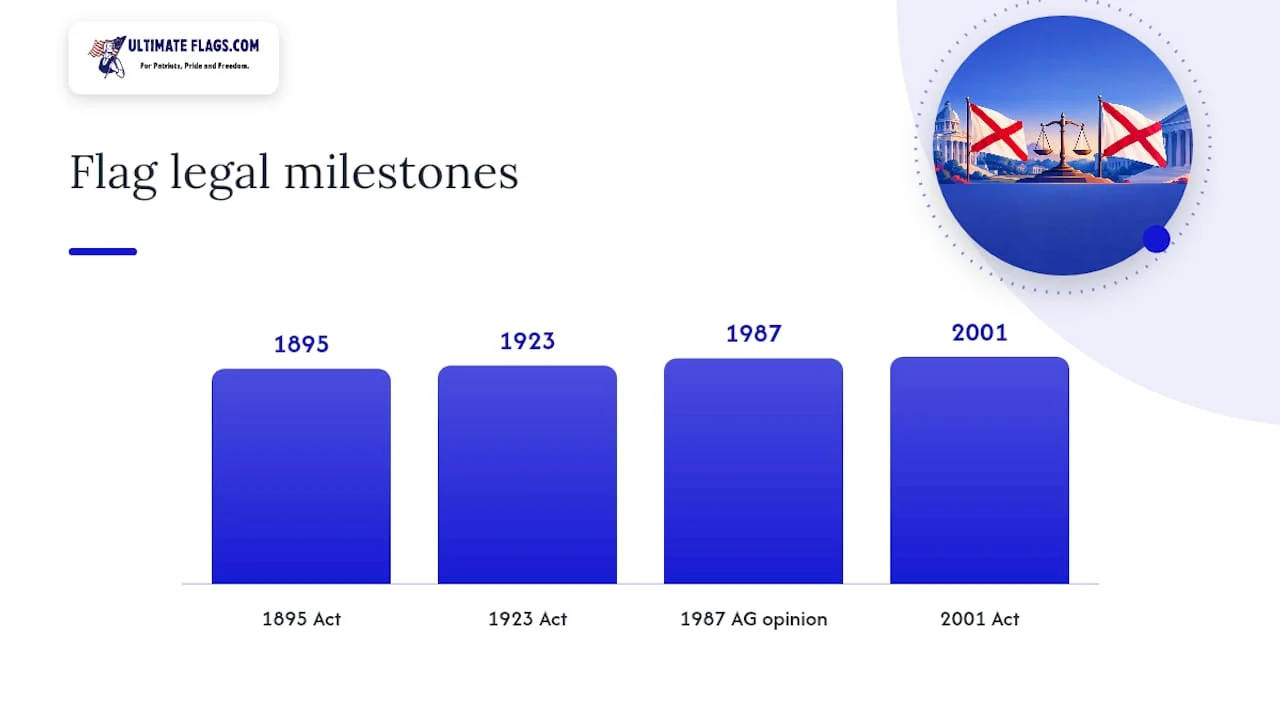
The story does not end at adoption. Alabama lawmakers returned to the flag question twice more in the twentieth and twenty-first centuries:
- An act passed in 1923 required the state flag to be displayed at certain public buildings, formalizing its civic presence beyond ceremonial use.
- A 2001 act expanded those display requirements, broadening where the flag must appear across state and local government facilities.
- In 1987, the Alabama Attorney General weighed in on the question the original act never settled: whether the flag should be square or rectangular.
Each of these moments reflects a state institution circling back to fill gaps left by the original 1895 statute, evidence that the flag’s legal identity was built in layers rather than settled all at once. The Alabama Department of Archives and History still lists the flag among the state’s official emblems, citing 1895 as its adoption year, the same date this timeline traces from secession banner to statehouse statute.
What the statute actually says about the design
Act 383 is precise in some ways and frustratingly vague in others, a combination that has fueled more than a century of interpretation. The law describes the flag as a “crimson cross of St. Andrew” on a field of white, with bars “not less than six inches” wide, language preserved in the Alabama Department of Archives and History’s archived flag description.
That single sentence carries more nuance than it first appears to hold:
- The word “crimson” describes a deep, vivid red, but surviving flags and reproductions show real variation in exact shade, and many modern versions favor a darker red closer to the hue used in the national flag rather than a brighter crimson pigment.
- Calling the design a “St. Andrew’s cross” is technically imprecise. Traditional Scottish heraldry reserves that term for a white saltire on a blue field, the reverse of Alabama’s red-on-white arrangement, a distinction Britannica’s entry on the flag notes when explaining why vexillologists prefer the more neutral term “saltire.”
- The statute never specifies overall proportions, leaving flag makers for decades to choose between square and rectangular formats.
A single legislative sentence from 1895 has governed the flag’s legal description for more than a century, and its silence on shape eventually required an official opinion to resolve, a gap this history returns to in the next section. Reproductions sold today generally follow rectangular proportions similar to the national flag, a practical convention rather than a strict legal requirement, since the original act simply never addressed the question.
Confederate battle flag or older influence: the origin theories
No question about Alabama’s flag generates more disagreement than where the design actually came from. Three theories compete for primacy, and none rests on airtight documentary proof.
The strongest circumstantial case points toward Confederate battle flag influence. Sanford himself had Confederate ties, and early state archivist Thomas M. Owen, writing not long after the flag’s adoption, concluded that the design preserved distinctive features of the Confederate battle flag’s diagonal cross pattern, an assessment repeated in later historical accounts on Wikipedia’s summary of the flag’s history. That reading fits the cultural moment of 1895, when former Confederate states across the South were formalizing symbols that echoed wartime iconography.

A second theory looks further back, to the Cross of Burgundy flown by Spanish colonial forces across the Gulf Coast, including territory that later became Alabama. The visual resemblance, a diagonal cross on a plain field, is real, but the evidentiary trail connecting Spanish colonial banners directly to Sanford’s 1895 design is thin at best, resting on visual similarity rather than any documented statement of intent.
A third, more cautious position simply notes that the lost model makes certainty impossible:
The submitted design accompanying the 1895 bill was never preserved, leaving historians to work from newspaper accounts, legislative language, and later recollection rather than the object itself.
That gap in the record is the central problem. Britannica’s treatment of the flag urges a balanced reading, noting that several plausible influences exist without a surviving artifact to confirm any single one. The Confederate theory has the strongest circumstantial support, given Sanford’s background and Owen’s contemporary assessment, while the Spanish colonial theory remains the weakest, more visual echo than documented lineage. What stays genuinely unsettled is Sanford’s own stated reasoning, which no surviving record captures in his own words.
The 1987 ruling on shape and where the flag must fly
The 1895 act described color and cross width but never settled whether the flag should be square or rectangular, an ambiguity that persisted for ninety-two years before the state addressed it directly.
- In 1987, the Alabama Attorney General issued a formal opinion concluding that, absent further legislative direction, established precedent and practice supported a rectangular flag rather than a square one, a ruling documented in the Archives’ summary of the flag’s legal history.
- The 1923 act had already required the flag’s display at designated public buildings, a mandate the 2001 act later broadened to cover a wider range of state and local facilities.
- At the Capitol and other state buildings, the choice between flying the national flag and the state flag follows standard protocol observed across government facilities, with the national flag holding precedence in joint display.
For museums, reenactment groups, and collectors assembling a historically grounded display, the shape question still matters more than most casual observers assume. A square reproduction evokes the flag’s earliest decades before the 1987 opinion, while a rectangular version reflects the standard now recognized under state guidance.
Pro Tip: When sourcing a reproduction for research or display, choose rectangular proportions to match current official guidance, and note the square variant separately if your purpose is historical reenactment predating 1987.
The secession banner, the governor’s flag, and other variants
The 1895 design is not the only flag Alabama has flown. Several related banners carry their own symbolism and their own archival trail, and researchers tracing the state’s visual history benefit from knowing where each fits.
- The 1861 Secession Convention banner, sometimes called the Republic of Alabama flag, featured the Goddess of Liberty and a coiled rattlesnake, imagery meant to project the fledgling republic’s independence and readiness to defend itself.
- The governor’s flag is a distinct variant bearing the state coat of arms alongside a military crest, reserved for use in connection with the office of the governor rather than general civic display.
- Various unofficial and commemorative flags, including anniversary designs marking milestones in state history, appear in archival photographs held by the Alabama Digital Archives, though they carry no statutory standing.
Readers researching Alabama’s Civil War-era banners in more depth may find useful context in a search for Alabama’s Civil War flag, which traces the archival hunt for the original secession-era banner.
Where to dig deeper: archives, images, and research gaps
Serious research on the Alabama flag has to reckon with an incomplete record, since the physical model Sanford submitted in 1895 no longer exists. Historians fill that gap with newspaper coverage, legislative text, and the recollections of early archivists rather than the object itself.
- The Alabama Digital Archives holds a photographic record of the state flag, part of a broader collection documenting Alabama’s historical banners.
- The Alabama Department of Archives and History maintains an emblems and symbols reference confirming the flag’s official description and adoption year.
- Readers interested in the wartime banners that preceded the 1895 design can consult a companion piece on Alabama’s Confederate flag, which examines the broader Confederate-era symbolism that shaped the state’s visual identity.
A researcher’s note on contested symbolism
History rarely hands us a tidy answer, and Alabama’s flag is no exception. The lost 1895 model means every origin theory rests on inference rather than proof, and that gap deserves honesty rather than confident overstatement.
Weigh circumstantial evidence, like Sanford’s Confederate ties or the visual echo of the Cross of Burgundy, against what the primary record actually confirms. Consult the Archives directly when the stakes of your research demand certainty, and let the surviving statute, not speculation, anchor your conclusions.
— John Hough
A living catalog for collectors and Southern heritage enthusiasts
Alabama’s flag carries a story still unfolding in archives and legislative records, and a certain online flag store has documented the layered history across the flags Southerners have carried into battle, statehood, and remembrance. This retailer offers a catalog of Historic War Flags, US State Flags, and Southern heritage banners reflecting respect for provenance that drives serious research, so collectors can find flags built to honor the record, not just decorate a wall.
Whether assembling a research-grade display of Alabama’s saltire or looking to add a piece of Southern heritage to a collection, the state and historical flag collections from an online retailer offer flags with proportions and craftsmanship that match the history behind them. Explore the available catalog to find a flag that belongs in your own story.
Sources
- Alabama Department of Archives and History — State Flag (archived)
- Flag of Alabama — Wikipedia
- State Flag of Alabama — Alabama Digital Archives (photo record)
- Flag of Alabama — Britannica
- Alabama Department of Archives and History — Fast Facts (Emblems & Symbols)
FAQ
What flag did Alabama’s design supposedly copy?
Historians most often point to the Confederate battle flag’s diagonal cross as an influence, an interpretation early archivist Thomas M. Owen offered shortly after the 1895 adoption. Others note a visual resemblance to the Spanish Cross of Burgundy, though the documentary link to that older flag is far weaker.
What US state has the oldest state flag?
Flag histories vary by state and by how “oldest” is defined, whether by first adoption, current design, or continuous use, so no single answer applies universally. Alabama’s own flag dates to 1895, making it one of the older Southern state designs still in use today.
What are Alabama’s five state symbols?
Alabama’s official emblems include the state flag, described as a crimson cross of St. Andrew on white, along with other designated symbols listed in the state’s official emblems reference. The full roster covers items like the state bird, flower, and tree alongside the flag itself.
When exactly was the Alabama flag adopted?
The Alabama Legislature adopted the current state flag through Act 383 on February 16, 1895. The act specified a crimson cross on a white field with bars at least six inches wide, but left the flag’s overall shape undefined until a 1987 Attorney General opinion addressed the question.
Why does the Alabama flag look similar to the Confederate battle flag?
The resemblance stems from the shared diagonal cross pattern, and designer John W. A. Sanford Jr.’s Confederate background lends weight to that connection, as does early archivist commentary noted on Wikipedia’s history of the flag. The submitted 1895 model was later lost, so no document records Sanford’s own explanation for the choice.