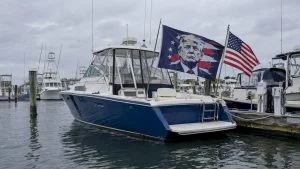
In U.S. waters, both the 50-star national ensign and the 13-star yacht ensign are acceptable on recreational vessels, but the yacht ensign must never leave domestic waters. Fly it at the stern staff, or on a sailboat at the gaff or upper leech of the aftermost sail. Size it at about one inch of fly per foot of vessel, and show it from 0800 to sunset.
TL;DR:
- Under sail, fly the ensign from the aftermost sail’s gaff or upper leech; under power or at anchor, use the stern staff.
- The one inch of fly per foot guideline is customary, not a legal mandate for recreational boats; round up when crowded harbors make visibility difficult.
- Before leaving U.S. waters, use the national ensign; raise the Q flag in foreign territorial waters until clearance, then fly the host country’s courtesy flag.
- Club guidance treats ordinary placement, sizing, and timing as custom, but documented vessels and extended voyages warrant checking current Coast Guard requirements directly.
Table of Contents
- Where to fly the ensign on a power or sailing vessel
- How big should your ensign be?
- Which ensign: national or yacht?
- When to fly the ensign: colors, night display, and half-staff
- Order and precedence: courtesy flags, burgees, and the Q flag
- Mounting tips and hardware that keep your ensign flying
- Your pre-departure ensign checklist
- What happens if you display the ensign incorrectly?
- Does the U.S. Coast Guard regulate yacht ensign use?
- Domestic versus international waters: how the rules change
- The history behind the U.S. yacht ensign
- Why we take ensign etiquette seriously
- Where to find ensigns and flag hardware
- FAQ
- Sources
Where to fly the ensign on a power or sailing vessel
The ensign is the most senior flag aboard, and it belongs as close to the stern as possible. On a powerboat, that means the stern staff or the taffrail, the aftmost railing. Sailboats play by a slightly different rulebook. While the taffrail is commonly cited, many sources prefer the gaff or the upper third of the leech of the aftermost sail, where the flag stays visible under sail.
Here is how the positions break down:
- Powerboat underway or at anchor: stern staff, as close to centerline and the stern as you can mount it.
- Sailboat under sail: gaff or upper leech of the aftermost sail, clear of the backstay.
- Sailboat at anchor or under power: move the ensign back to the stern staff.
- Multi-mast vessels: the ensign flies from the aftermost mast; spreader halyards are reserved for subordinate flags such as courtesy flags.
Watch for anything that can blanket the flag: a bimini top, a radar arch, a whip antenna, a flapping genoa. If rigging constantly fouls the ensign, shift it. A stern staff is a practical fix for boats with no permanent mount, and it lets you keep the flag clear of dock lines and fenders.
Pro Tip: Stand astern of your boat at a distance and look at the flag from another skipper’s point of view. If you cannot read it at a glance, move it.
How big should your ensign be?
The long-standing rule is simple: about one inch of fly, the horizontal length, for every foot of overall vessel length. This is a generally accepted nautical guideline, not a strict legal mandate for recreational craft. Many yacht clubs repeat it in their own protocols, as Seattle Yacht Club does, and note that other flags aboard should be smaller than the ensign.
Hoist is the vertical dimension at the staff; fly is the length streaming away from it. Run the math on your own deck:
Match the fly measurement to the overall length of your vessel.
Ratios vary, so check the fly measurement on the product rather than assuming. If you cruise crowded harbors or run a larger hull, round up. A flag that vanishes against a busy marina backdrop does little to announce your nationality.
Which ensign: national or yacht?
For U.S. recreational vessels in domestic waters, both the 50-star national ensign and the 13-star yacht ensign are accepted. The yacht ensign carries 13 white stars around a fouled anchor in a blue canton. Maryland’s flag protocol treats the two as interchangeable on recreational boats in U.S. waters.
The limit is jurisdictional. The yacht ensign holds no status as a national flag, so it has no international standing. Here is the practical rule set:
- In U.S. waters, fly either the 50-star national ensign or the yacht ensign.
- Outside U.S. domestic waters, fly the 50-star national ensign only.
- After clearing customs in a foreign port, add the host country’s courtesy flag.
- Never substitute the yacht ensign for the national ensign when nationality recognition matters.
The U.S. yacht ensign has no international standing and must never be flown outside U.S. domestic waters. Abroad, the 50-star national ensign is the flag that identifies your vessel.
The Flag and Etiquette Committee of the United States Power Squadrons says the same: no yacht ensign in international waters, and a courtesy flag once customs has cleared you in a foreign port.
When to fly the ensign: colors, night display, and half-staff
Ensigns are ordinarily shown from 0800 to sunset. Making colors, the hoisting ritual, follows a simple routine:
- Hoist the ensign at 0800 when you are in company or near land.
- Keep it flying through daylight hours, especially when near other vessels or shore.
- Lower it at sunset, handling the flag cleanly so it never touches deck or water.
- At night, show the ensign only when entering or leaving port, for identification.
- For half-staff, hoist to the peak first, then lower the flag. Raise it to the peak again before taking it down.
Half-staff observances follow official proclamations, with Memorial Day the one most boaters know. When you are alone on the hook at anchor in a remote cove, no one expects a full dress ritual, but the habit is worth keeping.
Order and precedence: courtesy flags, burgees, and the Q flag
Flag seniority runs in a fixed order. The ensign comes first at the stern, followed by the foreign ensign (courtesy flag), the club burgee, organizational flags, and private signals.
- Ensign: stern staff or gaff, always the senior flag.
- Courtesy flag: the host nation’s flag, flown from the starboard spreader or another prominent subordinate position, after you clear customs.
- Burgee: your club’s pennant, usually at the masthead on a sailboat.
- Association flags and officer flags: below the burgee in rank.
- Private signals and other signals: lowest in the hierarchy.
The Q flag is the exception to the “after clearing customs” rule. It is a plain yellow flag hoisted when entering a foreign country’s territorial waters to request free pratique, and it must remain hoisted until customs and immigration grant clearance. In practice, that means the yellow flag goes up before you drop anchor and comes down only after the officials sign off. Then the courtesy flag replaces it.
Mounting tips and hardware that keep your ensign flying
Removable stern staffs are fine for weekend boats and trailerable craft; permanent staffs make sense on larger vessels where the flag stays up for long cruises. A gaff or spreader halyard suits sailboats that want the ensign high and clear of the deck clutter.
- Stainless hardware: salt air eats cheap fittings, so pick a stainless staff and fasteners.
- Halyards: use proper line, sized for the flag, with no chafe points at the sheave.
- Anti-furl poles: flagpoles can help keep a flag from wrapping itself around the staff in light, shifting air.
- Replacement schedule: inspect weekly for UV fade, frayed fly ends, and torn stitching, and replace a tired flag promptly.
A soaked or tattered flag signals a skipper who does not care; see our detailed guide to flag patch placement and respectful display for best practices. For washing, drying, and storage, our guide on how to care for a flag covers the basics.
Pro Tip: Buy two ensigns. Fly one while the spare dries or waits in the locker, and you will never be caught without a clean flag.
Your pre-departure ensign checklist
Run through this before you cast off:
- Right ensign for the waters: national ensign abroad, national or yacht ensign at home.
- Right size: about one inch of fly per foot of boat.
- Secure mounting: staff seated, halyard clear, nothing fouling the flag.
- Courtesy flag ready: and a Q flag aboard for any foreign landfall.
- Flag condition: no fraying, no fade.
- Timing: plan to make colors at 0800 and strike at sunset.
Common mistakes to avoid: flying a yacht ensign overseas, leaving a ragged flag aloft, and hoisting a burgee above the ensign.
What happens if you display the ensign incorrectly?
For ordinary recreational boaters, the practical penalty for sloppy ensign etiquette is social, not legal. The sizing rule is customary, not law. Flying a faded or misplaced flag will draw a raised eyebrow at the yacht club, not a ticket. The sources we reviewed describe etiquette, not fines for common mistakes.
The serious exposure lies with privileged or special ensigns. In the UK, the Blue and White Ensigns are strictly regulated and require warrants or specific authorization, and unauthorized display can violate law. If you charter or cruise in British waters, do not improvise with a special ensign you have no warrant for.
Abroad, the stakes rise because a flag is how an officer identifies your vessel’s nationality. Flying the yacht ensign, which has no international standing, instead of the 50-star national ensign muddies that identification. Port officials in any country can take a dim view of confusing or improper colors, and the details vary by nation. We cannot point you to a single U.S. penalty schedule for ensign misuse, so treat the national ensign as your default whenever you leave domestic waters and ask the local authority or your cruising club if you are unsure.

Does the U.S. Coast Guard regulate yacht ensign use?
None of the references we reviewed cite a Coast Guard rule that sets the size, placement, or timing of a recreational yacht’s ensign. What they describe is a body of custom, kept alive by the Cruising Club of America, the United States Power Squadrons, and yacht clubs. The state protocols we reviewed, such as Maryland’s, likewise treat the matter as protocol and guidance.
That is not the same as a free-for-all. Flag law for documented vessels and the national ensign’s role as proof of nationality sit in a different corner of maritime law, and we would not tell you what a specific federal regulation says without a primary source in front of us. If your vessel is documented, or you plan an extended voyage, check current Coast Guard documentation requirements directly with the agency, and confirm any inspection or boarding expectations before you go.
What the club guidance does give you is a dependable standard that officers and fellow skippers recognize. Following it keeps your flag use unremarkable, which is exactly what you want when a patrol boat comes alongside.
Domestic versus international waters: how the rules change
At home, you have a choice. The 50-star national ensign and the 13-star yacht ensign are both accepted on recreational vessels in U.S. waters. Abroad, you have one option: the national ensign.
The reason is nationality. The ensign’s primary purpose is to signal the vessel’s nationality and country of registry. The yacht ensign was designed as a recreational flag, not a nationality marker, so it does not do that job outside U.S. waters.
The international routine runs in order. Switch to the 50-star national ensign before you leave U.S. waters. Hoist the yellow Q flag when you enter foreign territorial waters. Keep it up until customs and immigration clear you. Then lower the Q and raise the host country’s courtesy flag, as the Flag and Etiquette Committee advises.

Crossing back works the same way in reverse. Once you are back in U.S. waters and cleared in, you can return to the yacht ensign if you prefer it. Many cruisers simply keep the national ensign up year-round to avoid the swap.
The history behind the U.S. yacht ensign
The U.S. yacht ensign carries a deep maritime tradition: 13 white stars arranged around a fouled anchor on a blue canton, a design that nods to the original thirteen colonies and the seafaring heritage of American yachting. Its look is distinctive, and it has long been associated with recreational boating rather than commerce or the military.
Its proportions have shifted over time. The yacht ensign traditionally had a 10:19 hoist-to-fly ratio, and today you commonly find it in 2:3 or 3:5 ratios. That drift is why measuring the fly on a new flag matters more than trusting a label.
Historical detail beyond that, such as who first authorized the flag and when, is not something our reviewed sources document, and we would rather leave it unstated than guess. What the sources do establish is its significance today: a recognized mark of American recreational boating, honored in yacht clubs and protocol guides, but a flag that stays home, with no standing abroad.
Why we take ensign etiquette seriously
Flying the right flag the right way is more than ceremony. It tells a harbor master, a patrol officer, or a skipper in the next slip that you know what you are doing and respect the water you share. Misunderstandings at a port of entry often start with a flag that says something you did not mean. Our own passion for flags is why we publish guidance like this: so the flag you hoist speaks well of you before you say a word.
— John Hough
Where to find ensigns and flag hardware
We carry the flags and gear this guide covers: national ensigns, courtesy flags, staffs, and mounting hardware. Browse our boat flag collection for nautical flags, or see all our flag collections for national and international flags, plus flagpoles and hardware. Not sure how to match material to marine use? Our flag qualities and uses guide helps you choose before you order.

FAQ
Do all ships have to be flagged?
Vessels customarily show an ensign to signal their nationality and country of registry. For recreational boats, the practice is governed largely by custom, and the ensign is flown from 0800 to sunset. At night, it is shown mainly when entering or leaving port.
What size boat flag should I use for my boat?
Use about one inch of fly for every foot of overall vessel length, per Cruising Club of America guidance. Choose a flag with a fly near that measurement. Size up in busy ports for visibility.
Who is entitled to fly a blue ensign?
Special ensigns such as the Blue and White Ensigns in the UK are strictly regulated and require a warrant or specific authorization, according to the RYA. Unauthorized display can violate law. If you are not sure you qualify, ask the issuing authority first.
Can I fly the yacht ensign when I visit another country?
No. The yacht ensign has no international standing, so fly the 50-star national ensign abroad. Add the host country’s courtesy flag after you clear customs.
Sources
- CCA Flag and Burgee Etiquette | Cruising Club of America
- Flag Etiquette | Regulations
- Flag and Etiquette Committee