A U.S. flag draped over a closed casket is placed lengthwise with the union, the blue field of stars, at the head and resting over the deceased’s left shoulder. At the close of the service, funeral honors personnel fold the flag into its traditional triangle, stars showing, and present it to next of kin using language the Department of Defense standardized in 2012. Eligible veterans receive one burial flag from the Department of Veterans Affairs at no cost.
TL;DR:
- The flag is always draped lengthwise over the left shoulder with the union at the head, and it must never touch the ground or be lowered into the grave.
- During open casket services, the flag is folded into a triangle and placed in the raised cap above the left shoulder; the full drape is reserved for closed caskets.
- The standardized folding process produces a triangle with the union visible, and a specific script is recited when presenting the flag to the next of kin since 2012.
- Eligibility for a burial flag includes veterans discharged under conditions other than dishonorable, active-duty service members, and certain reservists and National Guard members meeting service requirements.
- Burial flags are made of lightweight cotton, requiring careful handling to prevent damage during transport, display, and retirement, with options for long-term display or respectful retirement.
Table of Contents
- Draping the flag on a closed or open casket: exact placement and cardinal rules
- Folding and presentation: the military fold, its symbolism, and the required words
- Who is entitled to a burial flag and how to get one
- Handling, transport, and care for the burial flag before and after the service
- Ceremony protocol: mourner conduct, timing, and what families should expect
- Common mistakes and misconceptions families should avoid
- Practical advice from Ultimate Flags: choosing a respectful display flag and caring for it
- Differences in flag etiquette based on branch of military or veteran status
- Honoring service while offering practical help to families
- A respectful option for lasting flag display
- Sources
- FAQ
Draping the flag on a closed or open casket: exact placement and cardinal rules
The union, that constellation of stars against blue, always rests at the head of the casket and falls across what would be the deceased’s left shoulder. This is not a matter of preference. Service manuals and state National Guard guidance describe the placement as fixed, with the flag laid lengthwise over the full casket so its stripes trail toward the foot, and they reiterate that the flag must never touch the ground or be lowered into the grave.
Open casket and half-couch arrangements call for a different approach. Instead of draping the full casket, the flag is folded into its triangular form and placed in the casket’s raised cap, positioned above the left shoulder where mourners naturally look when paying final respects.
A few practical points matter as much as the ceremonial ones:
- Never let the flag drag or lower into the grave, a prohibition repeated across service branch guidance and state directives.
- Pin the flag lightly if wind or handling threatens to shift it, taking care not to pierce the fabric near the union.
- Iron on low heat only if wrinkled, since burial flags are typically a lighter cotton blend that scorches easily.
- Watch the weather. Rain or high wind before the service can warrant a brief indoor staging area to protect the flag until placement.
Folding and presentation: the military fold, its symbolism, and the required words
The fold that follows a graveside service produces the familiar triangle, a shape born of thirteen careful folds that leaves only the union visible, no red or white stripe showing. Arlington National Cemetery’s own materials walk through this sequence, describing how the flag is folded after Taps and presented to the next of kin in one continuous, deliberate motion.
The order runs roughly like this:
- The flag is lifted from the casket by the honor detail once Taps has finished playing.
- Two members fold it lengthwise, then in half again, before beginning the triangular folds from the striped end toward the union.
- The completed triangle is held at waist height, straight edge facing the recipient, and carried to the family.
- A member of the detail kneels or stands before the next of kin and recites the mandated presentation words, inserting the deceased’s branch of service.
- If no next of kin is present, the flag may be retained by the cemetery or handed to a designated representative rather than left unpresented.
Since 2012, the Department of Defense has required one standardized script for this moment, replacing the patchwork of unofficial wording once used at gravesides, a change confirmed in federal funeral honors guidance. Whether a uniformed honor guard or the funeral director performs the presentation, the same measured cadence and phrasing apply, honoring the fallen with words meant to steady grieving hands rather than complicate them.
Who is entitled to a burial flag and how to get one
Eligibility for a government-issued burial flag reaches further than many families expect. Veterans discharged under conditions other than dishonorable qualify, as do service members who die on active duty, along with certain reservists and National Guard members who meet minimum service requirements.
Requesting one rarely requires more than a phone call or a short trip:
- Ask the funeral director first. They routinely file VA Form 27-2008 on the family’s behalf and know the fastest local channel.
- Visit a VA regional office if the funeral home cannot assist directly.
- Check a local post office. Many accept the completed form and issue a flag on the spot, part of a distribution network the VA maintains for rapid turnaround.
- Do not delay the service waiting on paperwork. Funeral homes and VA staff generally recommend proceeding with ceremony planning while the flag request moves in parallel.
The government issues only one burial flag per veteran, a rule worth understanding before the service, since replacement after loss or damage is not automatic.
Handling, transport, and care for the burial flag before and after the service
Burial flags are typically made of a lighter cotton or cotton blend, chosen for the dignity of the fold rather than years of outdoor exposure. That material choice matters once the service ends: this is not the flag to run up a backyard pole through summer storms and winter ice.
During the ceremony, keep the flag shielded from rain, dirt, and rough handling. A protective sleeve or simple wrapping during transport to the gravesite prevents creasing that fights against a clean fold later.
Afterward, families have dignified options rather than a single mandate. A display case preserves the triangular fold indefinitely and suits a mantel or shelf. Indoor mounting on a wall works for those who want the flag visible daily. When a flag is too worn to display, veterans’ organizations such as The American Legion can guide a family through respectful retirement.
Ceremony protocol: mourner conduct, timing, and what families should expect
Military funeral honors follow a rhythm that repeats with quiet consistency across cemeteries nationwide, and knowing the sequence beforehand steadies a family through an otherwise disorienting hour. The casket moves to the gravesite, Taps sounds, the flag comes off the casket and into the fold, and only then does presentation happen.
Mourners are expected to stand at attention during the folding and stand or sit respectfully through Taps, removing hats unless weather makes that impractical. MilitaryOneSource notes that funeral honors require a minimum of two uniformed service members to perform the folding and playing of Taps, with individual branches sometimes adding a firing party, a color guard, or additional elements depending on rank and circumstance.
A few things to keep in mind as the moment approaches:
- Taps signals the fold is about to begin, so this is the cue to prepare emotionally for the flag’s removal from the casket.
- The presentation typically goes to the closest next of kin, though families can designate another relative in advance if needed.
- Additional honors like a rifle volley depend on eligibility and branch, not every service includes them.
Pro Tip: Ask the funeral director in advance who in the family will receive the flag, so there’s no confusion or hesitation in the moment itself.
Common mistakes and misconceptions families should avoid
A few myths surface again and again at gravesides, and clearing them up ahead of time spares families needless worry.
- Myth: a lost burial flag gets replaced automatically. The VA issues one flag per veteran, so loss or damage means turning to a retail replacement rather than a government reissue.
- Myth: the flag can never be used again. Respectful display in a case or on a wall honors the service member; reuse becomes a concern only when the flag is treated carelessly.
- Mistake: letting the flag brush the ground during transport. Assign one honor guard member or funeral staffer specifically to carry and steady it during movement.
- Mistake: lowering the flag into the grave. It is removed and folded before the casket descends, never left to go down with it.
Practical advice from Ultimate Flags: choosing a respectful display flag and caring for it
A government burial flag and a durable outdoor display flag serve different purposes, and mixing them up leads to disappointment. The lightweight cotton burial flag is built for one solemn fold, not for years on a pole through wind and rain. Families wanting a lasting outdoor tribute typically choose a heavier nylon or polyester flag instead, paired with a display case or protective sleeve for the burial flag itself. Ultimate Flags’ care and retirement guidance walks through both paths step by step.
Differences in flag etiquette based on branch of military or veteran status
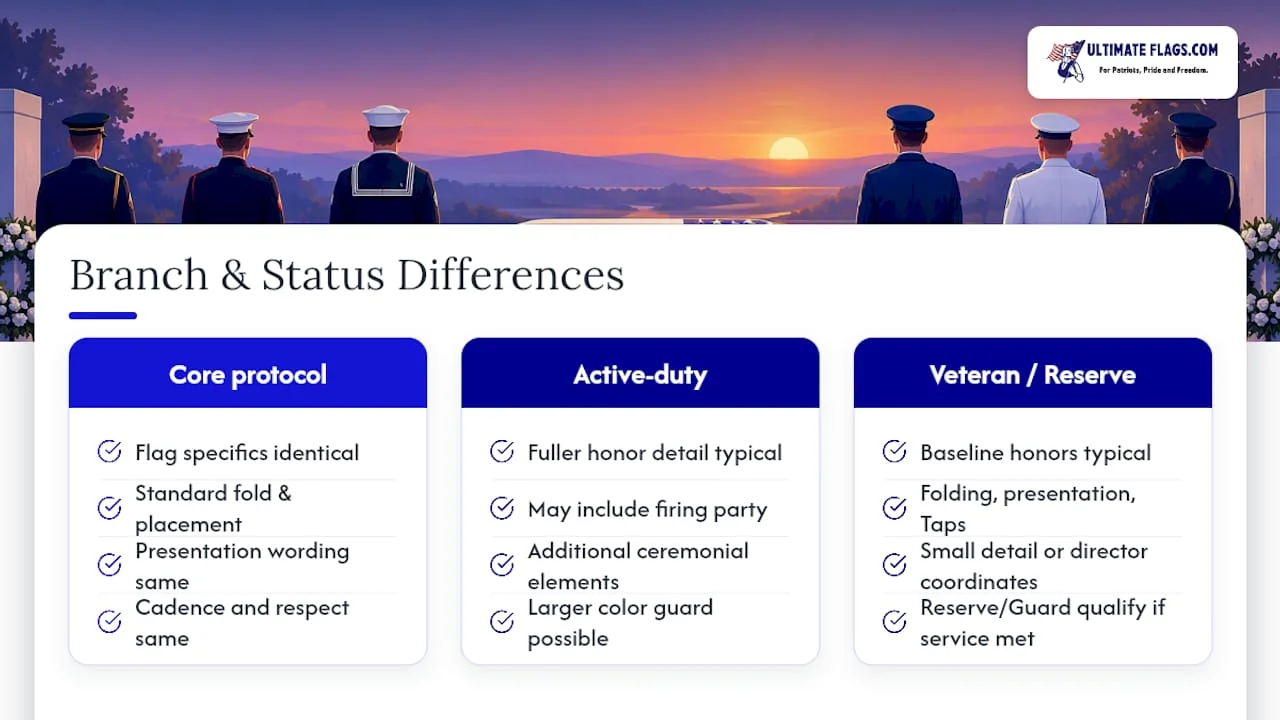
Core protocol, the drape, the fold, the presentation words, stays consistent regardless of which uniform the deceased wore. What changes are the additions layered on top by individual branches and by the nature of a veteran’s service.
An active-duty death typically brings a fuller honor detail, sometimes including a firing party and additional ceremonial elements beyond the federal minimum of two service members and Taps. A veteran who served but died long after discharge often receives the baseline honors: folding, presentation, and Taps, performed by a small detail or, when no honor guard is available, coordinated respectfully by the funeral director.
Rank can also shape the ceremony’s scale, with higher-ranking service members sometimes receiving expanded honors such as a larger color guard, though the flag itself, its placement, its fold, and its presentation wording, remains identical no matter the rank or branch insignia the deceased carried. Reserve and National Guard members who meet minimum service requirements qualify for the same burial flag and presentation as full-time veterans, a point families sometimes assume incorrectly does not apply to them.
The wording recited during presentation inserts the specific branch, Army, Navy, Air Force, Marine Corps, Space Force, or Coast Guard, but the surrounding language, the cadence, and the respect behind it never shift from one branch to the next.
Honoring service while offering practical help to families
Few moments carry more weight than watching that triangle of stars pass into a trembling hand. This guide exists to steady families through the protocol itself, not to replace the guidance of a funeral director or the VA, both of whom know the particulars of a given service far better than any article can. Whatever comes next, a display case, a quiet retirement, a wall in the family home, let it be handled with the same care shown at the graveside.
— John Hough
A respectful option for lasting flag display
Once the burial flag rests safely home, some families want a second flag built for years outdoors rather than a single fold. That’s a different flag entirely from the one just presented, and Ultimate Flags’ flag collections offer the heavier fabrics suited to a pole or porch bracket.

This isn’t a substitute for the government burial flag, only an honest option for the display that follows it.
| Need | Best fit |
|---|---|
| One-time ceremonial fold | Government-issued cotton burial flag |
| Long-term outdoor display | Retail nylon or polyester flag |
| Preserving the folded triangle | Display case or wall mount |
Explore the flag collections page to find a display flag suited to daily weather, or read what comes next after receiving a burial flag.
Sources
- Military Funeral Honors for Veterans (CRS report)
- Elements of military funerals (Arlington National Cemetery)
- VA memo on burial flag issuance and distribution
- What to expect during military funeral honors (MilitaryOneSource)
FAQ
How should a flag be placed on a casket?
On a closed casket, the flag is draped lengthwise with the union at the head, over the deceased’s left shoulder. On an open casket, the flag is folded into the triangle and placed in the raised cap above the left shoulder.
Is it appropriate to fly a casket flag?
The burial flag itself is meant for the fold and presentation, not for flying outdoors, since its cotton material isn’t built for weather exposure. Families who want a flag to fly typically purchase a separate durable flag for that purpose.
Who is entitled to have an American flag on their casket?
Veterans discharged under conditions other than dishonorable, service members who die on active duty, and certain reservists or National Guard members who meet minimum service requirements all qualify for a VA burial flag. A funeral director can confirm eligibility and file the paperwork.
What does it mean to have a folded flag on a casket?
The triangular fold, with only the star field visible, represents the completed presentation of the flag after military funeral honors. It’s placed in the casket cap or presented to next of kin as the final ceremonial gesture, following the sequence Arlington National Cemetery outlines.