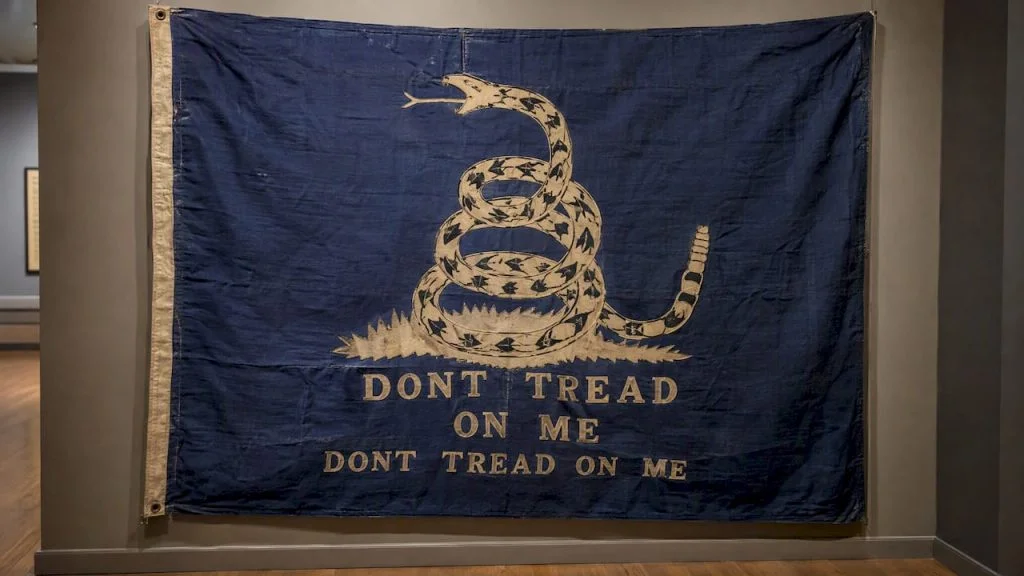
The Culpeper Minutemen flag is a white, rattlesnake banner from 1775 bearing the unit name and the mottos “Liberty or Death” and “Don’t Tread on Me,” signaling colonial resistance and a pledge to liberty. Raised by Virginia frontiersmen on the eve of revolution, it stands as one of the better documented banners of the independence movement, a defiant symbol born from local militia and sharpened by republican conviction.
TL;DR:
- For a historically faithful reproduction, choose a white field with a black snake and lettering, preserve the three text lines, and omit the apostrophe in DONT.
- The unit organized in July 1775 at Clayton’s Old Field and served with the 1st Virginia Regiment at Hampton and the Battle of Great Bridge.
- Unlike the Gadsden Flag’s broader colonial symbolism, this banner identified a county militia through its white field, unit name, and separate Liberty or Death motto.
- For outdoor display, check stitching and fabric resistance to wind and sun, and confirm that the lettering will not crack or fade quickly.
Table of Contents
- Design and Exact Wording: Colors, Layout, and Emblem Details
- Origins and Historical Context: Who Raised It, When, and Why
- Symbolism: Rattlesnake Imagery and the Mottos’ Intellectual Roots
- How the Culpeper Flag Differs From and Relates to the Gadsden Flag
- Why Collectors and Reenactors Value Historically Accurate Reproductions
- How the Culpeper Flag Is Used in Current Patriotic Commemorations
- Why the Culpeper Flag Still Matters
- Where to Find Historically Styled Culpeper and Liberty or Death Flags
- FAQ
- Sources
Design and Exact Wording: Colors, Layout, and Emblem Details
The original Culpeper flag presents on a white field, a choice that let the coiled rattlesnake and its surrounding text read clearly from a distance, even on a smoke-filled field. Most faithful reproductions keep a 2:3 aspect ratio, the proportion common to Revolutionary-era militia colors, and modern Culpeper and Liberty or Death flag versions follow that same layout.
Three lines of text frame the serpent, each carrying its own weight of meaning. According to Americanrevolution, the banner displays the following in its traditional arrangement:
- “THE CULPEPER MINUTE MEN” arches across the top like a banner of identity.
- “LIBERTY OR DEATH” runs along one side, a vow rather than a slogan.
- “DONT TREAD ON ME” anchors the bottom, apostrophe intentionally absent in the historical lettering and in most faithful reproductions today.
Color choices have drifted over time. Where the original kept to white and black, today’s market offers black-on-white renditions alongside yellow and gold variants that borrow the Gadsden Flag’s palette for visibility rather than historical accuracy. Collectors who want the look closest to 1775 generally favor the white-field version with black snake and lettering.
Origins and Historical Context: Who Raised It, When, and Why
Virginia’s path toward armed resistance moved quickly in the summer of 1775, and the Culpeper Minutemen formed at the center of that mobilization. Local militia measures called citizen soldiers to arms across the colony, and Culpeper County answered with a unit whose identity became inseparable from the flag it carried.
- The Culpeper Minutemen organized in July 1775 under an oak tree at Clayton’s Old Field, a formation documented by the Museum of Culpeper History.
- The unit joined the 1st Virginia Regiment’s broader defense efforts, including the movement toward Hampton and the engagement at the Battle of Great Bridge.
- The adoption of “Liberty or Death” on the unit’s banner reflected the influence of Patrick Henry, whose rhetoric had already set Virginia’s political temperature rising.
That oak at Clayton’s Old Field carried symbolic weight well beyond 1775. The same site served as a rallying point again in 1860, when local memory of the Minutemen resurfaced during a later reorganization, a continuity the Museum of Culpeper History records as evidence of how deeply the unit’s identity took root in the county. Local, frontier-bred men, suspicious of distant authority and proud of their self-reliance, found in the rattlesnake banner a fitting voice for both grievance and resolve.
Symbolism: Rattlesnake Imagery and the Mottos’ Intellectual Roots
Benjamin Franklin did more than any other figure to turn the rattlesnake into a distinctly American emblem, using it in political cartoons to argue that the colonies, like the snake, struck only when provoked. That framing gave “Don’t tread on me” its particular edge: not an aggressive boast but a warning, a line drawn before a strike. The phrase itself carries a lineage stretching back through older Latin and Gospel-adjacent warnings against unprovoked harm, repurposed by colonial writers for a new political moment.
- The rattlesnake’s coiled stance signaled readiness rather than hostility, a creature that gives fair notice before it bites.
- “Don’t tread on me” translated that natural behavior into a political statement aimed squarely at Parliament and the Crown.
- “Liberty or Death” carried Patrick Henry’s own rhetorical stamp, echoing 18th-century republican literature such as the play Cato, which shaped much of the revolutionary generation’s language of sacrifice and resolve.
According to Military, historians trace “Liberty or Death” to 18th-century republican literature and to Patrick Henry’s 1775 speech, which popularized the phrase in Virginia’s political culture. That pairing of literary influence and local oratory explains why a county militia banner could carry language as weighty as any continental proclamation.
How the Culpeper Flag Differs From and Relates to the Gadsden Flag
Both banners share the coiled rattlesnake and the warning legend, which has led many casual observers to treat them as the same flag with different names. They are not. The Gadsden Flag emerged from a broader naval and continental context, a generalized symbol meant to represent resistance across the colonies rather than any single unit.
- Shared elements: a coiled rattlesnake and the “Don’t tread on me” legend appear on both designs.
- Key differences: the Culpeper flag adds a white field, the unit’s own name, and the separate “Liberty or Death” motto, marking it as a localized regimental banner rather than a continental emblem.
- Modern use: both images circulate widely in political and commemorative contexts today, which sometimes blurs the historical distinction between a county militia’s colors and a naval ensign.
That localized character, the Ammo notes, is precisely why specialists treat its provenance differently than they do more broadly mythologized Revolutionary symbols. It was never meant to represent all thirteen colonies. It represented Culpeper County, and it still does.
Why Collectors and Reenactors Value Historically Accurate Reproductions
Buyers who care about accuracy check three things first: correct placement of the three text lines, a snake posture that matches the coiled, alert stance of the original, and proportions that echo period militia colors rather than modern novelty flags. Material matters just as much as design. A flag meant for regular outdoor display needs stitching and fabric that hold up to wind and sun without the lettering cracking or fading within a season, a detail we weigh carefully across our Culpeper and Liberty or Death product lines.

Pro Tip: Check that the apostrophe is omitted from “DONT TREAD ON ME” if you want a historically faithful reproduction rather than a modern stylization.
How the Culpeper Flag Is Used in Current Patriotic Commemorations
The Culpeper flag has found a steady second life in commemorative and educational settings rather than fading into obscurity. Reenactment groups carry it at Revolutionary War living history events, pairing it with period uniforms and equipment to recreate the look of a 1775 Virginia militia muster. Local historical societies in Culpeper County display it during civic observances tied to the county’s founding history, treating it as a piece of regional identity rather than a generic Revolutionary symbol.

The flag also appears in classrooms and museum exhibits as a teaching tool, useful precisely because its documented provenance lets instructors discuss symbolism, rhetoric, and militia organization with a concrete example rather than a vague gesture at “colonial flags” in general. Civic parades on Independence Day and similar occasions sometimes feature it alongside more widely recognized Revolutionary banners, a nod to local heritage amid national commemoration.
Beyond organized events, individual collectors and history enthusiasts fly reproductions at home, often choosing the flag specifically because its backstory, tied to a named county, a named militia, and a documented battle, offers a more grounded alternative to flags whose origins are murkier or more contested. That specificity is part of its appeal: it is not an abstract symbol of revolution but a record of one county’s answer to a call to arms.
Why the Culpeper Flag Still Matters
We find something worth preserving in a banner whose history holds up to scrutiny rather than relying on legend. Accurate reproductions, paired with honest citation of their sources, keep that local Revolutionary story intact for the next reader who asks what it means.
— John Hough
Where to Find Historically Styled Culpeper and Liberty or Death Flags
We carry historically styled reproductions built for display and reenactment alike, so you can fly a design rooted in documented 1775 Virginia history rather than a loosely inspired knockoff.

- Browse our black Culpeper Liberty or Death flag for a traditional black-on-white rendition.
- Consider our yellow and gold Liberty or Death flag for a brighter, more visible display option.
- Explore our full flag collections for other Revolutionary War and historic designs.
Check availability now and bring a well documented piece of Virginia’s fight for liberty to your own flagpole.
FAQ
What Is the Original Meaning of the American Flag?
The thirteen stripes and stars of the first American flags represented the original thirteen colonies united in their break from Britain, a symbol of collective identity rather than any single region. The Culpeper flag, by contrast, represented one county’s militia and carried its own distinct mottos and imagery.
Did George Washington Live in Culpeper, Virginia?
George Washington did not live in Culpeper, Virginia, though the region sat within the broader Virginia frontier where he served as a young surveyor and later as a military leader. The Culpeper Minutemen’s history stands on its own local footing, tied to Patrick Henry’s influence and county militia organization rather than to Washington directly.
What Does a Black Flag With One Red Stripe Mean?
A black flag with a single red stripe is not part of the documented Culpeper or Revolutionary War flag tradition, and definitions for that specific design vary widely depending on context. If you encounter this question in relation to Revolutionary symbolism, it likely refers to a modern or unrelated design rather than a historical militia banner.
What State Has the Flag That Says “Don’t Tread on Me”?
No single state officially adopted “Don’t tread on me” as part of its state flag. The phrase appears instead on historical militia and naval banners like the Culpeper flag and the Gadsden Flag, both tied to the Revolutionary era rather than to any one state’s official symbol.
Sources
Few Revolutionary banners rest on documentation as solid as the Culpeper flag’s. The Museum of Culpeper History preserves formation records tying the unit directly to Clayton’s Old Field and to service at the Battle of Great Bridge, where Virginia militia helped check a British and Loyalist advance in late 1775.
- Americanrevolution
- Culpeper History: A Short Outline | Museum Of Culpeper History
- Military
- The Culpeper Minutemen Flag: The Forgotten History of the Banner Flown by a Militia of Patriots
That caution matters. A banner’s reputation for accuracy rests on how closely its modern description tracks primary and institutional sources rather than how often a version circulates online.