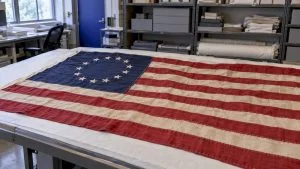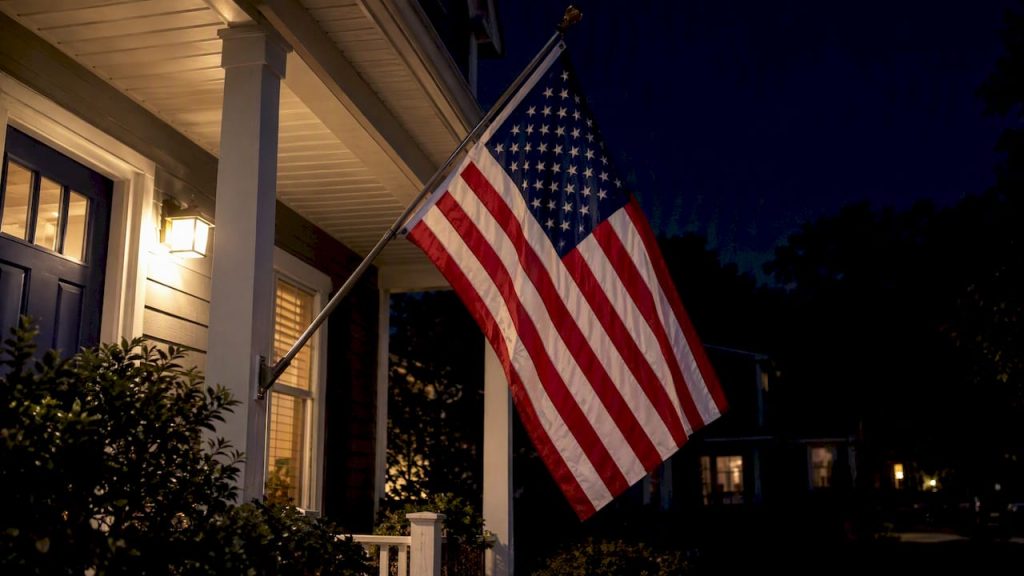
The U.S. flag flies from sunrise to sunset on July 4 unless it is properly illuminated, in which case a 24-hour display is permitted. We follow 4 U.S.C. and VA guidance on conduct: face the flag, place a hand over the heart or render a salute, never let it touch the ground, and retire a worn flag with dignity rather than tossing it aside.
TL;DR:
- For overnight displays, a porch light or dedicated flagpole spotlight meets the illumination standard; otherwise, lower the flag at sunset.
- On walls or windows, keep the union in the observer’s upper left; with other nations’ flags, use separate staffs of equal height.
- Flags not designed for all weather should come down before rain, snow, or high winds, because wet or whipping fabric tears faster.
- When displaying at half height under an order, raise the flag to the peak first, lower it halfway, then return it to the peak before lowering.
- Burning is the traditional retirement method, but check local fire and environmental rules first; American Legion posts, VFW chapters, and scout troops may host ceremonies.
Table of Contents
- Quick Dos and Don’ts for Independence Day Display
- When to Display: Sunrise to Sunset, Night Lighting, and Half-Staff Procedure
- Position and Manner of Display
- Conduct During Hoisting, Lowering, the Pledge, and Parades
- Weather, Flag Condition, and When to Take It Down
- Flag Retirement: A Dignified Ceremony for Worn Flags
- Displaying Multiple Flags at an Event
- Small Handheld Flags, Parades, and Children
- Why Flag Etiquette Matters, and What to Check Locally
- A Few Honest Words on Flying the Flag Well
- Where to Find Durable Flags and Flagpole Accessories for July 4
- FAQ
- Sources
Quick Dos and Don’ts for Independence Day Display
Before the grills are lit and the parade route fills in, a quick review of the fundamentals saves you from the small missteps that chip away at an otherwise proud display. The Flag Code treats these as recommended conduct, and we have always believed that honoring them is part of what makes the day feel right.
Do these things:
- Hoist the flag briskly at sunrise and lower it ceremoniously at sunset, or illuminate it properly for an overnight display.
- Inspect the flag and hardware, fabric, grommets, halyard, and pole, before the event begins.
- Orient the union in the upper left from the observer’s view for wall or window displays.
- Follow the Flag Code’s grouping rules when flying the flag with others or mounting it on a speaker’s platform.
Don’t do these things:
- Let the flag touch the ground, floor, or water at any point.
- Wear it as clothing, use it as drapery, or print advertising on it, prohibitions laid out directly in 4 U.S.C. §8.
- Dip the U.S. flag to any person or object. Regimental colors, state flags, and organizational banners may dip in salute; the national flag never does.
- Drape it in folds or festoon it for decoration. Bunting, striped red, white, and blue, is the proper choice for general decoration.
Carrying a flag aloft calls for a steady grip and an upright staff, never dragging the fabric or letting it brush against furniture, fencing, or the ground as you walk. When children ask why we treat a piece of fabric with such care, the honest answer is that the flag stands for the country itself, and the small habits, standing straight, holding it high, handling it gently, teach that respect without a lecture.
Pro Tip: Keep a spare flag on hand for the holiday weekend; a sudden gust or a sprinkler left running can end a display early, and a backup means you never have to fly a torn or soaked flag out of convenience.
When to Display: Sunrise to Sunset, Night Lighting, and Half-Staff Procedure
The Flag Code’s default rule is straightforward: the flag flies from sunrise to sunset. For an evening cookout or a nighttime fireworks display, 4 U.S.C. §6 allows the flag to remain up around the clock as long as it is properly illuminated, a porch light or dedicated flagpole spotlight both satisfy the standard.
The statute also names Independence Day specifically among the days the flag should be displayed, placing July 4 alongside other dates of national significance rather than leaving it to informal custom.
Half-staff display follows its own sequence, and while July 4 itself is not typically a half-staff occasion, the procedure matters whenever a proclamation calls for it during the same season:
- Raise the flag briskly to the peak first, even when the intent is to display it at half-staff.
- Lower it slowly to the half-staff position, roughly the midpoint of the pole.
- Before lowering for the evening, raise it back to the peak momentarily, then lower it ceremoniously.
The display keeps the gesture visible and deliberate rather than treating the flag as if it were simply being hung at a lower point.
Position and Manner of Display
Where the flag sits relative to a wall, a window, a crowd, or a line of other flags changes the rule, and the Flag Code is specific about each case.
For a flag displayed flat against a wall or in a window, the union belongs in the upper left from the observer’s position, the same orientation whether the display is horizontal or vertical. When the flag projects from a staff mounted on a building, the union moves to the peak of the staff itself.
Group displays follow a hierarchy:
- The U.S. flag occupies the position of honor when grouped with other flags.
- The U.S. flag’s position of honor signals precedence without a word spoken.
- Flags of other nations fly from separate staffs of the same height, never sharing a halyard with the U.S. flag.
- On a speaker’s platform, the U.S. flag stands at the speaker’s right, which places it to the audience’s left when everyone is facing forward.
These placement rules exist less as bureaucratic formality and more as a shared visual language. Anyone walking past a city hall, a VFW post, or a backyard gathering on July 4 can read the arrangement and immediately understand which flag holds the place of honor.
Conduct During Hoisting, Lowering, the Pledge, and Parades
How people behave around the flag during a ceremony says as much as the display itself. The expectations differ slightly depending on who is standing where, but the spirit is the same for everyone present.
- Uniformed personnel render the traditional military salute during hoisting, lowering, and whenever the flag passes in a parade or review.
- Veterans in civilian clothes may render the same salute as a matter of long-standing custom, even without a uniform.
- Civilians face the flag, stand at attention, and place the right hand over the heart; a person wearing a non-religious hat removes it with the right hand and holds it at the left shoulder.
- Guests who are citizens of other countries stand at attention as a courtesy, since respectful attention does not require U.S. citizenship.
- During a parade, spectators maintain this posture only while the flag is actually passing, then relax once it has moved on.
The same conduct applies during the Pledge of Allegiance and the national anthem at outdoor evening ceremonies, where illuminated flags often remain aloft well past sunset. Nobody needs to memorize a script. Facing the flag, standing still, and placing a hand over the heart covers nearly every situation a Fourth of July host or guest will encounter.
Weather, Flag Condition, and When to Take It Down
A flag that looks sharp from the curb can hide a frayed edge or a cracked grommet up close, and the holiday is a good excuse to check before you hoist it.
Walk through a short inspection before the display goes up: look at the fabric for tears or fading, check the stitching and grommets, run a hand along the halyard for fraying, and confirm the pole or wall bracket is secure. Flags not built for all-weather use should come down ahead of rain, snow, or high wind rather than riding it out, since wet or wind-whipped fabric tears faster than most people expect. If a storm rolls in mid-barbecue, lower the flag promptly and wait for clearer skies.

Once a flag is torn, badly faded, or no longer a fitting emblem, the practical move is a replacement rather than continued display, paired with a dignified retirement for the one coming down. A flag in that condition has earned better than a trash bin.
Flag Retirement: A Dignified Ceremony for Worn Flags
When a flag has reached the end of its service, burning remains the traditional and most widely recommended method of retirement, provided it is done in compliance with local fire and environmental rules. Some municipalities restrict open burning or require a permit, so a quick check before the ceremony saves everyone a headache.
- Inspect and assess the flag to confirm it is genuinely unserviceable rather than simply dirty or faded, since a wash or repair may be the better option.
- Cut the flag into sections using a method that keeps the blue union intact as one piece, a detail Scouting’s retirement guidance treats as essential to the ceremony’s meaning.
- Burn the flag in a controlled fire, maintaining a respectful vigil until the fabric is fully consumed.
- Extinguish the fire completely and bury or collect the ashes, closing the ceremony with the same care it began with.
A simple version of this ceremony works for a family backyard; a fuller version can include posting of the colors, the Pledge of Allegiance, a short reading, and a bugle call, elements many veterans’ organizations include in formal retirements. Either way, the goal stays the same: complete, dignified destruction, never a flag left to rot in a drawer or a landfill.
Pro Tip: If you would rather not manage a burn yourself, many American Legion posts, VFW chapters, and scout troops hold scheduled flag retirement ceremonies, a straightforward way to retire a flag properly without arranging the fire yourself.

Displaying Multiple Flags at an Event
Independence Day gatherings often fly more than one flag, a state flag alongside the national colors, or a run of nations’ flags at a community festival, and the rules for that arrangement are specific.
- Use separate staffs, not a shared halyard, whenever a state, municipal, or organizational flag flies alongside the U.S. flag.
- When flags of other nations are involved, give each its own staff of equal height, with every flag approximately the same size.
- The U.S. flag occupies the position of honor whenever it shares a display with other flags.
- Among a group of flags, the U.S. flag takes the position of honor, never a subordinate spot.
- When displayed with flags of other nations, the flags should be at the same height, avoiding a subordinate position for any nation’s flag.
Event planners juggling several flagpoles can find the one pole versus separate staffs question answered in more detail, useful for anyone setting up a town square display or a multinational Fourth of July celebration.
Small Handheld Flags, Parades, and Children
Small handheld flags carried in a parade crowd or handed out at a block party follow a lighter version of the same etiquette. Civilians holding these flags do not salute as it passes by, since the salute is reserved for uniformed personnel and veterans; instead, simply hold the flag upright and still.
- Teach children to face the flag and stand quietly when it passes, rather than waving it wildly or letting it drag.
- Hold small flags by the staff, upright, never dragging the fabric on the ground or stuffing it in a back pocket.
- Distribute flags at the start of an event so everyone has a moment to settle before the procession begins.
- Retire torn or soiled small flags the same way as a full-size flag, rather than discarding them in the trash.
A paper plate of hot dogs and a fistful of small flags is as much a part of July 4 as any formal ceremony, and the same respect applies at any size.
Why Flag Etiquette Matters, and What to Check Locally
The Flag Code functions mainly as recommended national conduct. Check local rules around public display or disposal. Before a large public event or an open burn for a retirement ceremony, a quick check of local fire codes and any state-specific flag statute is worth the five minutes it takes.
What stays consistent everywhere is the federal guidance itself: 24-hour display is fine when the flag is properly illuminated, and Independence Day is one of the dates the U.S. Code names outright for flying the flag. For the fullest detail, the Flag Code itself and VA guidance remain the two sources worth bookmarking, long after the fireworks are over.
A Few Honest Words on Flying the Flag Well
We help people replace flags that gave their best years to a windy porch or a sun-bleached pole, and the pattern we see is the same: people care more about doing this right than any etiquette guide gives them credit for. The checklist above covers the mechanics, timing, placement, conduct, and retirement, but the instinct behind it is simpler than any statute. You want the flag to look like it belongs there, flying straight, handled with care, taken down with the same attention it went up with.
If your flag has earned its retirement this season, or your pole, halyard, or hardware needs a refresh before the Fourth, treat that as part of the holiday prep, not an afterthought. A tired flag undersells a proud display, and a sturdy new one tends to outlast the problem for years.
— John Hough
Where to Find Durable Flags and Flagpole Accessories for July 4
A flag that stays sharp through a long weekend of sun, wind, and sprinklers starts with the right material. For a 24-hour illuminated display or an evening cookout that runs past sunset, we carry outdoor flags built for display.

Before the holiday, it is worth checking flag size against your pole height and making sure the halyard and clips are rated for the flag’s weight, details our flag qualities and uses guide walks through if you are unsure what to look for. If you are hosting a larger gathering and want coordinated event merchandise alongside your flag display, Pulse Merch’s custom Fourth of July apparel and banners is worth a look for matching shirts or signage that holds up outdoors.
- Browse our flag collections for replacement U.S. flags, state flags, and themed options in a range of sizes.
- Check our flagpole types and footing guide before installing new hardware for the season.
- Review flag qualities and uses to match fabric and size to your specific display.
A flag that is ready before sunrise on the Fourth makes the whole display easier, start with our flag collections and get everything set before the holiday weekend arrives.
FAQ
Is the U.S. flag supposed to be on the right or left?
For a flat display against a wall or in a window, the union sits in the upper left from the observer’s point of view. When the flag shares a platform or stage with a speaker, it stands at the speaker’s right, which appears on the audience’s left.
What are the 7 rules of flag etiquette?
The Flag Code does not number its guidance into exactly seven rules, but the core principles cover timing (sunrise to sunset, or 24 hours if illuminated), proper union placement, hoisting it first and lowering it last among grouped flags, never letting it touch the ground, avoiding its use as clothing or advertising, rendering proper respect during the Pledge and anthem, and retiring a worn flag with dignity. These themes run throughout 4 U.S.C. rather than appearing as a strict numbered list.
What are five things not allowed under the flag code?
4 U.S.C. §8 prohibits letting the flag touch the ground, floor, or water, using it as clothing or drapery, printing advertising on it, displaying it with the union down except as a distress signal, and using it as a receptacle for carrying anything. Bunting, not the flag itself, should be used for general decoration.
What are three things one should never do out of respect to the flag?
Out of respect, never let the flag touch the ground, never dip it to any person or object, and never leave a torn or badly worn flag on display instead of retiring it properly. These three habits cover the most common missteps people make even with good intentions.