For most parades, a 4’x6’ flag on a staff is the size color guards carry, and a 3’x5’ is the next step down for smaller groups, scout troops and walking units. No law fixes a parade flag size. The choice comes down to visibility, the weight of the pole and the strength of the person who will carry it for the whole route.
A flag in a parade is no mere decoration. It moves through the crowd as the nation’s symbol, and every person on the curb reads it in a few seconds. Here is how to size it so it is seen, stays dignified and does not exhaust the bearer by the second mile.
TL;DR
- The U.S. Flag Code sets no mandatory parade flag size. Common practice for color guards is a 4’x6’ flag, with 3’x5’ as the smaller, lighter choice.
- Heavier and larger is not better. A flag too big for the pole and the bearer becomes a burden over a long route.
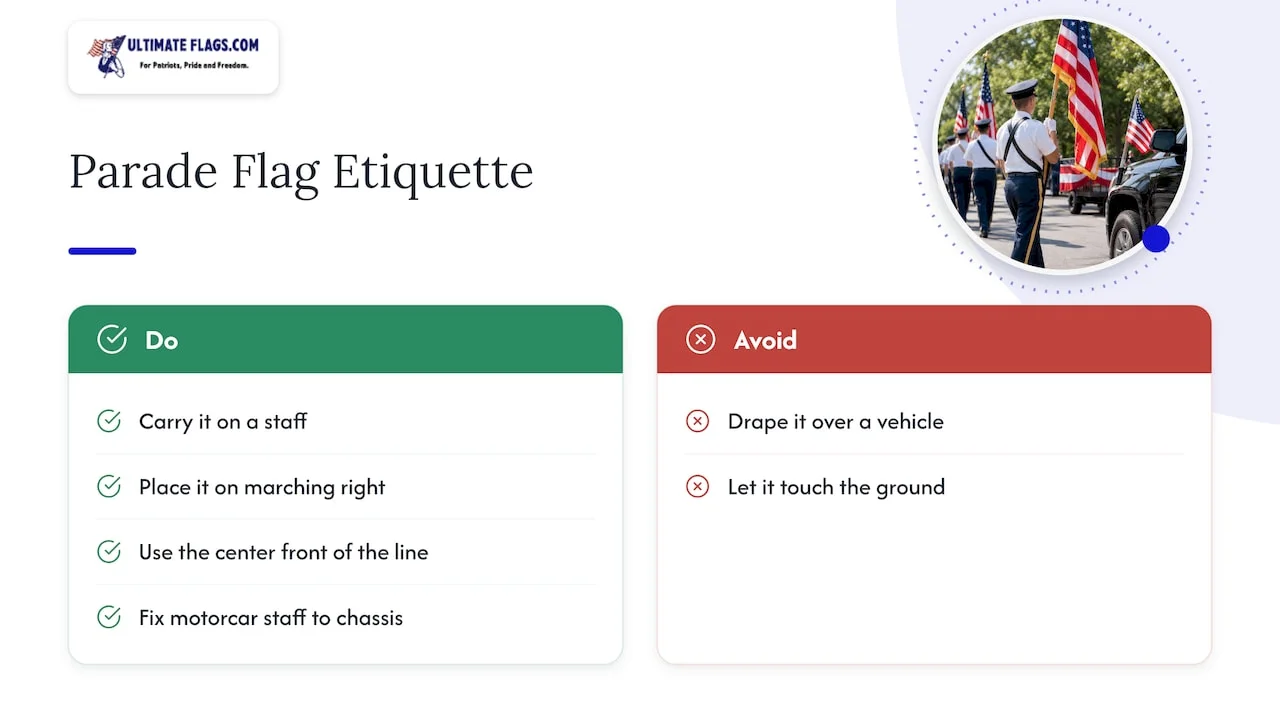
- In a parade, the flag belongs on a staff. Federal code says it should not be displayed on a float except from a staff and should never be draped over a vehicle.
- Match the staff, the fringe and the mounting to the flag. Indoor and parade flags are mounted differently than house flags.
Table of Contents
- Why there is no official parade flag size
- The sizes that matter on a parade route
- Match the flag to the bearer, not just the crowd
- Pole, staff and mounting: the other half of the size question
- The rules that matter more than size
- Worked examples
- Fabric, finish and care
- Our perspective: why the right size honors the flag
- Ready to outfit your unit
- FAQ
- Sources
Why there is no official parade flag size
People often assume a rule exists. It does not. Title 4 of the U.S. Code fixes the proportions of the flag, a 1.9 length-to-width ratio, and Executive Order 10834 lists authorized sizes for federal executive agencies. Those sizes run from the giant 20 by 38 foot flag down to small ones, and they serve government buildings, not marching units.
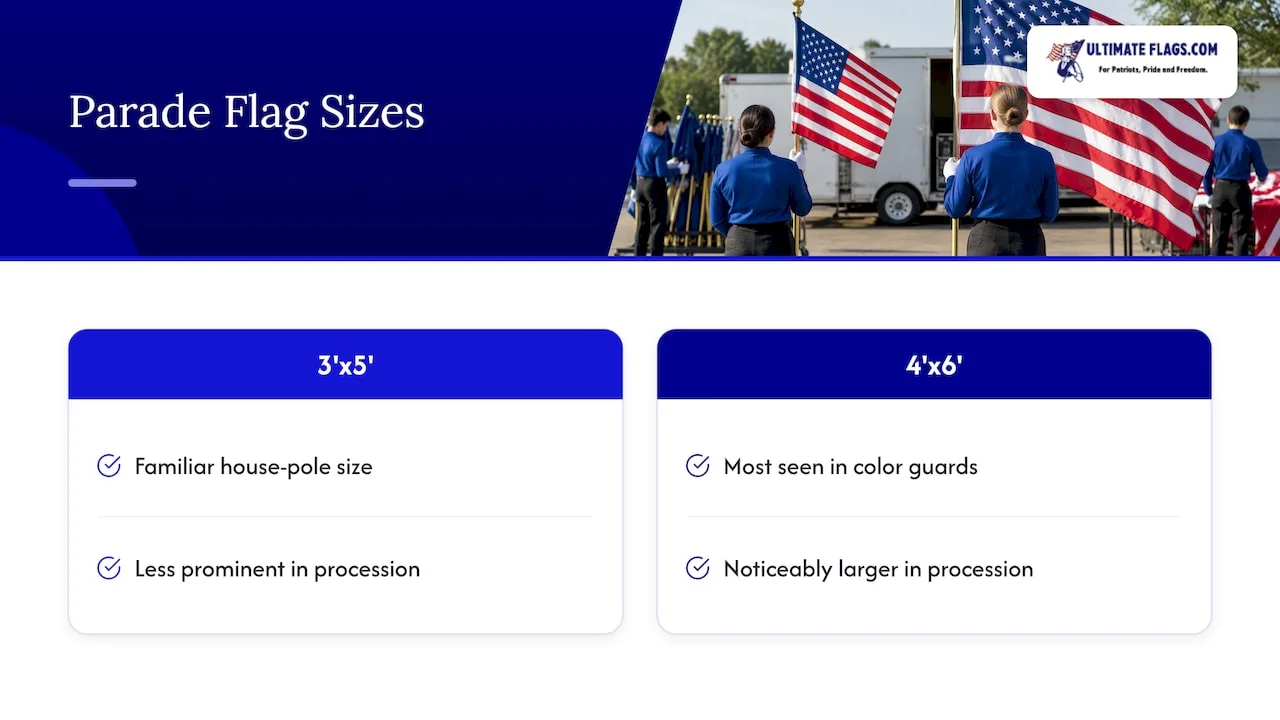
That leaves parade organizers to follow custom. The tradition that has settled in is clear enough: the 4’x6’ is the size most often seen in color guard units, and it reads well in a processional because it is noticeably larger than the 3’x5’ that flies on a house pole.
The lack of a rule is freedom, and it is also a responsibility. You are choosing for your own group, your own bearer and your own route.
The sizes that matter on a parade route
Think of the choice as a ladder with four rungs. Each suits a different kind of unit.
| Flag size | Best for | Strengths | Watch out for |
|---|---|---|---|
| 2’x3’ | Younger marchers, small hand-carried displays, vehicles | Light and easy to control | Hard to read from a distance |
| 3’x5’ | Scouts, school groups, community organizations, walking units | Familiar, manageable, works on a standard parade staff | Can look small beside a larger color guard |
| 4’x6’ | Color guards, veterans’ units, formal processions | Commanding presence, common practice for parading | Needs a sturdy staff and a strong bearer |
| 5’x8’ and larger | Stationary displays, large venues, flagpoles | Visible from a great distance | Usually too heavy and wind-catching to carry on foot |
The table is our own summary of common practice, not an official standard. Use it as a starting point, then test the flag with the actual bearer.
The 3’x5’: the workhorse
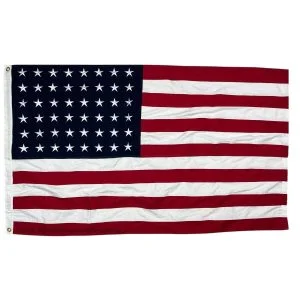
The 3’x5’ is the size most Americans recognize, because it is the standard for a house pole. Guidance on pole sizing lists it for a 20-foot pole, and the same flag works well on a parade staff. For a troop, a school band’s color party or a small veterans’ post, it is a sensible choice because almost anyone can carry it comfortably.
If you want to see the full range of dimensions side by side, our flags by size collection lays them out.
The 4’x6’: the parade standard
Common practice in military color guards is a 4’x6’ flag, and civilian units that want a formal look tend to follow. It is large enough to be clearly visible in processionals and gives a more professional presence than a house flag. The same guidance flags the trade-off: the flag has to be matched to the weight and balance of the pole, because a flag that is too large or heavy causes fatigue on a long route.
Larger flags: know the limit
Flags in the 5’x8’ range and above make sense for tall poles and big spaces. For a walking parade they are rarely practical. Wind loads rise with fabric area, and the person at the bottom of the staff feels every gust. If you want a large flag in a parade, ask whether a float, a vehicle with a properly fixed staff or a stationary display at the reviewing stand would serve better.
Match the flag to the bearer, not just the crowd
The temptation is to buy the largest flag you can afford, because visibility feels like the goal. Experienced color guard leaders see it differently. Even the smallest ceremonial flags in the military have strictly defined dimensions and mounting requirements, and the Marine Corps manual treats organizational guidons as measured, regulated items. The principle carries over to civilian units: a flag that is too big for its pole is a physical burden over a long route and can undercut the professionalism the parade is meant to show.
Before you commit to a size, walk through this short test with your bearer:
- Carry it for ten minutes. Hold the staff upright in carry position, then at parade rest. If the bearer’s arm trembles, the flag is too heavy.
- Test it in a breeze. Wind turns a 4’x6’ into a sail. Take it outside on a windy day rather than discovering this on parade morning.
- Check the turns. Practice the corners of your route. A long flag needs room to swing.
- Watch for low branches and wires. A taller staff plus a large flag can foul on anything overhead.
- Plan relief. On a long route, name a second bearer who can step in without breaking the formation.
Pole, staff and mounting: the other half of the size question
A parade flag is only as good as the staff beneath it. The flag should hang naturally, not bunch or slide. On indoor and parade poles, mounting hardware differs from the house-pole kit:
- On wooden staffs, only the top Velcro tab is typically required.
- On aluminum staffs, both top and bottom tabs are often used so the flag does not slide or bunch.
- A bottom eye screw on aluminum poles lets you tension the flag so it falls cleanly and does not look sloppy in motion.
Pole height follows the same proportional thinking as any flag display. The general rule for in-ground poles is that the fly of the flag should be at least one quarter of the pole height, and no more than one third. A parade staff is far shorter than a house pole, so that rule is a reminder of balance rather than a specification. Keep the flag in proportion to its staff, and the staff in proportion to the person.
If you are also outfitting a building, our guides to house flagpole size and flagpole types and footing rules cover the fixed-pole side of the question.
The rules that matter more than size
Size gets the search traffic, but etiquette decides whether your unit looks like it knows what it is doing. Three points from federal flag law bear directly on parades.
Carry it on a staff. The code says the flag should not be displayed on a float in a parade except from a staff. It should not be draped over the hood, top, sides or back of a vehicle, a train or a boat. When it is displayed on a motorcar, the staff is fixed firmly to the chassis or clamped to the right fender.
Position it correctly in the line. In a procession with other flags, the U.S. flag goes on the marching right, which is the flag’s own right, or in front of the center of the line if there is a line of other flags. Military drill and ceremony guidance, TC 3-21.5, treats the flag’s role as ceremonial rather than decorative, and that discipline is worth borrowing.
Never let it touch the ground. This is the basic courtesy of flag handling. A bearer who tires and lets the flag droop is a bearer who needed a smaller flag.
For a fuller walk through the rules, see our flag etiquette guide. Those who wear flag-themed clothing to parades will also find a useful rundown of veteran and firefighter rules for U.S. flag apparel, which touches on proper conduct and mounting at parades.
Flying other flags beside it
Most parades feature more than one flag: state, branch, organizational. The rule of thumb is that the U.S. flag leads, and the others follow at an equal or lesser prominence. Our guide on displaying multiple flags explains when to use one pole and when to use separate staffs. Keep the flags of a similar size so the group looks deliberate, though the U.S. flag should not be dwarfed by anything beside it.
Worked examples
Each scenario here is an illustration of how to reason through the choice, not a record of any real event.
A Boy Scout troop in a Memorial Day march. The bearers are teens of varying size, the route is about a mile and the pace is slow. A 3’x5’ on a parade staff keeps the flag steady and the carriers comfortable.
A veterans’ post color guard at a Veterans Day parade. The unit drills, carries in formation and wants a formal look. A 4’x6’ flag matches what military guards carry and fills the visual space at the head of the line. Add a second trained bearer so the rotation is smooth.
A community float for the Fourth of July. Here the flag is mounted on the float, so it needs a staff, not a drape. A 3’x5’ or 4’x6’ on a securely braced staff works, and the staff must be anchored so it will not shift on bumpy streets.
A school band with a color party. Younger marchers need lighter gear. Consider a 3’x5’ or smaller, and rehearse in the real wind conditions of your field.
Fabric, finish and care
Parade flags see sun, wind and the occasional rain. Nylon flags are widely chosen for outdoor movement, and our flag qualities and uses guide explains the differences between printed polyester, sewn nylon and other options so you can match material to use.
After the event, care matters. Federal guidance on the flag notes that indoor and parade flags should be dry-cleaned, while most outdoor flags can be washed in mild detergent and rinsed thoroughly. Store a parade flag folded or on its staff in a dry place, away from damp, so the colors last for years of marches.
Our perspective: why the right size honors the flag
As America’s oldest online flag store, we have watched the same story repeat for years. A group orders a flag in the spring, chooses on enthusiasm, and learns on parade day that the size they picked does not suit the person holding it. The flag is a symbol of resolve, and it deserves to be carried by someone who can hold it high from the first block to the last.
So we tell customers this: pick the flag your bearer can carry proudly, not the one that sounds most impressive on paper. A 3’x5’ carried with steady hands outshines a 5’x8’ that sags. Choose the 4’x6’ when your unit is formal, drilled and ready for it. Choose the 3’x5’ when you need something every marcher can manage. And always give the flag a proper staff, because the staff is where reverence becomes practice.
A flag is a story told in cloth, and the parade is where that story walks down Main Street. Tell it well.
— John Hough
Ready to outfit your unit
If you are planning a march, browse our full range of USA flags and flag collections, from sewn nylon American flags to state, military and historic designs, alongside flagpoles and hardware. You can also shop by dimension in our flags by size collection, or look at our 2 x 3 foot flags for smaller marchers and our 3 x 5 foot standard flags for the classic choice.
FAQ
What size flag is used in a parade?
There is no mandated size. A 4’x6’ flag is the common practice among military color guards and is often chosen for formal civilian processions. A 3’x5’ is a popular lighter alternative for scouts, schools and community groups.
Can you fly a 4×6 flag on a 20 foot pole?
Pole-sizing guidance pairs a 20-foot pole with a 3’x5’ flag, and a 25-foot pole with a 4’x6’. A 4’x6’ on a 20-foot pole would be out of proportion by the usual quarter-of-the-pole rule, so stay with the 3’x5’ for a pole that height.
What are the measurements of a casket flag?
The official casket flag used in military funerals is the size (5) flag in the federal schedule, 5.00 feet on the hoist and 9.50 feet on the fly. It is a folding flag, not a parade flag. If you are preparing a display, see our guide to flag case size for burial flags.
Can a flag be carried on a parade float without a staff?
No. The U.S. Code says the flag should not be displayed on a float in a parade except from a staff, and it should never be draped over a vehicle. Mount the staff firmly so it holds through turns and bumps.
Sources
- 4 U.S. Code § 7, Position and manner of display (Cornell LII)
- Title 4 U.S. Code, Flag and Seal (GovInfo)
- Flag display questions and answers (Senate)
- Appropriate flag sizes for outdoor poles (Glendale)
- Selecting the correct flag size for a flagpole (American Legion Post 46)
- United States Marine Corps Flag Manual
- TC 3-21.5 Drill and Ceremonies (U.S. Army)
- Our Flag, H. Doc. 100-247 (National Park Service history site)