A political rally flag is a banner carried or flown to show who stands together and what they stand for. It can be a party standard, a candidate’s colors or a historic emblem revived for a cause. Choosing well means knowing what the design says, how it will be seen across a crowd, what it is made of and which local rules apply where you gather. This guide walks through all four, from the long history of rallying symbols to the practical details organizers tend to miss.
TL;DR
- Rally flags do more than decorate: researchers describe them as a way for crowds to make shared identity visible, alongside clothing, songs and slogans.
- Party flags, campaign flags and movement flags carry different jobs. Match the type to your message before you match the color.
- Historic designs such as the Gadsden and Betsy Ross flags can be read in more than one way, so know the history before you fly them.
- Choose size and material for the wind, the distance and the number of events you expect to use the flag.
- Permit rules vary by city. Check your local office before the event, and care for the flag afterward.
Table of Contents
- Why flags matter at a rally
- Party, campaign and movement flags: three different jobs
- Colors and symbols: the shorthand of a crowd
- Shapes and formats you will see at a rally
- Size, material and durability
- Permits and local rules
- Carrying, displaying and caring for the flag
- Our view: a flag is a promise you hold in your hands
- Outfit your rally with Ultimate Flags
- FAQ
- Sources
Why flags matter at a rally
Walk into any large gathering and the first thing you see is cloth in motion. Before a single word is spoken from the stage, the flags have already told the crowd who is here.
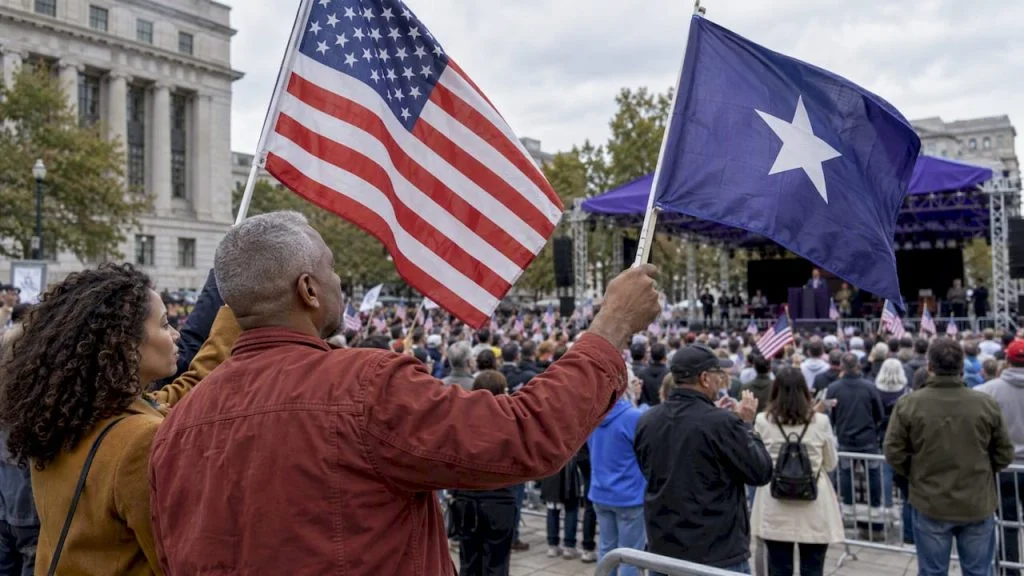
That is not just a feeling. In a study of campaign rallies, researchers Dan Paget, Nicole Beardsworth and Gabrielle Lynch found that audience identities are expressed through symbols borne aloft or inscribed on banners and flags, while speakers, notables and media help shape the message at the same time. In other words, a rally is a production in which the crowd is an author, and its flags are part of the script.
There is a practical side too. A museum resource on nonviolent action explains that flags and colors give instant visibility and build solidarity among strangers, and that they work as a form of symbolic speech. A person standing at the back of a crowd of thousands cannot hear every word, but can always see the banner at the front.
The same research also reminds us that meaning is never fixed. Author Tim Marshall argues in Worth Dying For that a flag’s meaning comes from the emotion it inspires, and that emotion can differ from one person to the next. The flag you raise will be read by supporters, opponents and passersby, each with their own history.
Party, campaign and movement flags: three different jobs
The phrase “political flag” covers several things that behave differently on the ground. Sorting them out first saves you from ordering the wrong flag.
Party flags
A party flag is a standing identity. It carries the party’s emblem or colors and is meant to be recognized year after year. A European survey of party flags, colors and logos describes designs as specific as Labour’s red flag with a rose and the word “Labour” and a white flag with five yellow stars in a red circle for Italy’s Five Star Movement. Both are built to be identified at a glance, with a logo and a name working together.
Campaign flags
A campaign flag is temporary by design. It carries a candidate’s name, slogan or logo for one election cycle. Because it is tied to a single race, campaign flags are usually produced in quantity, handed out at events and flown from porches, vehicles and stages. Consistency matters more than heirloom quality: every flag in the crowd should look like part of the same operation.
Movement and cause flags
Movement flags stand for an idea rather than a person or a party. They are often adopted, not designed: a crowd takes an existing symbol and gives it a new job. Research on the 2020 Belarusian protests found that the white-red-white flag shifted from an opposition-associated symbol into a broader emblem of freedom, change and democracy. Hong Kong’s Umbrella Movement offers a different example: researchers found that repeated visual symbols, including flags and colors, branded protest space and helped build a recognizable collective identity.
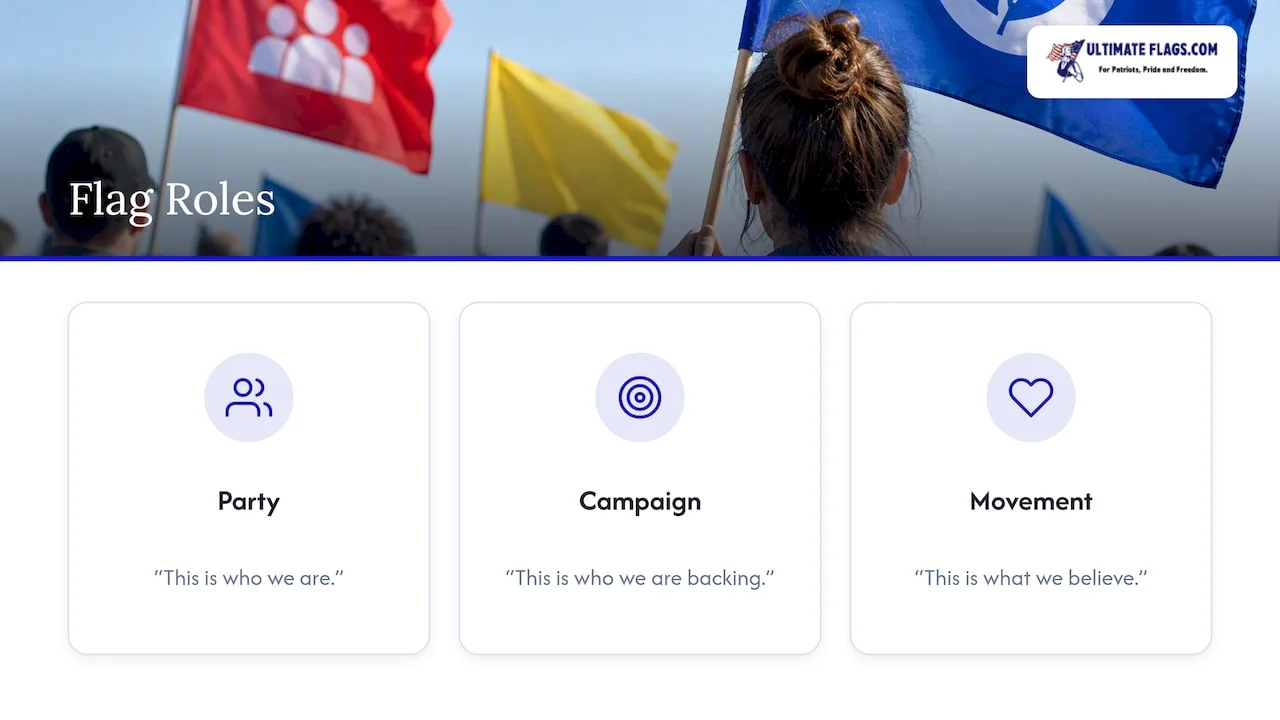
In short, a party flag says “this is who we are,” a campaign flag says “this is who we are backing,” and a movement flag says “this is what we believe.” Most rallies fly all three together.
Colors and symbols: the shorthand of a crowd
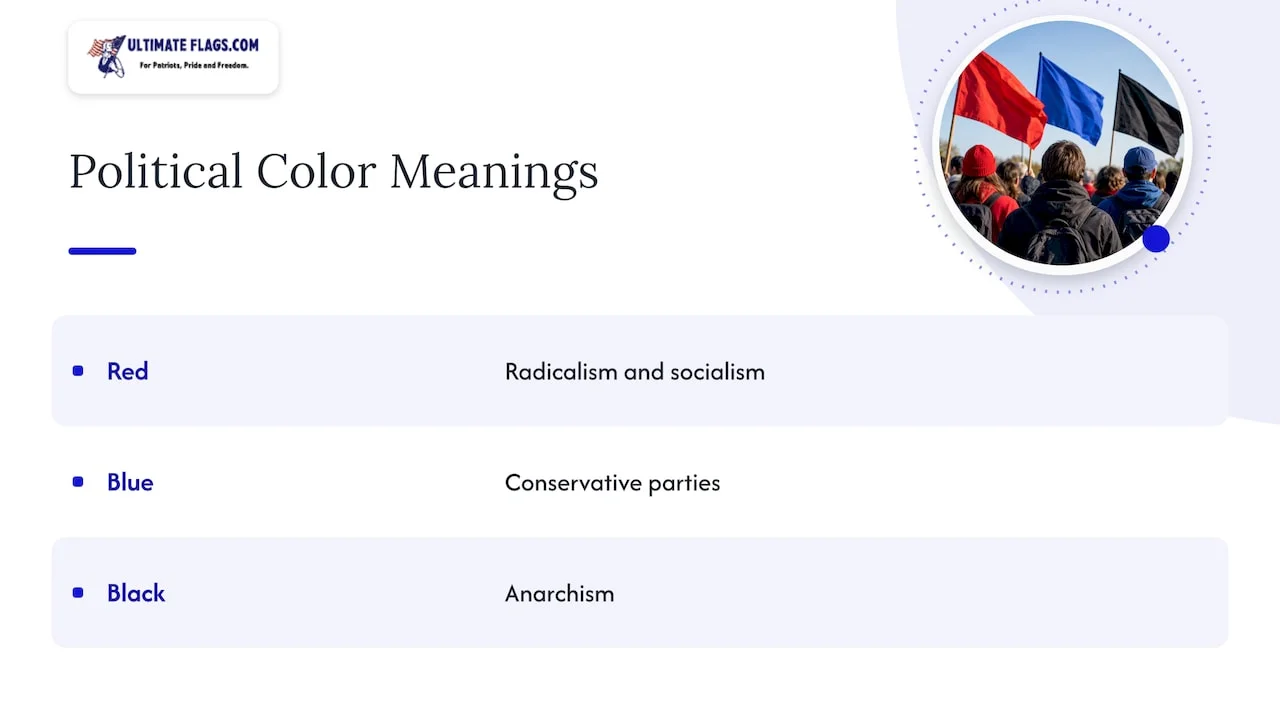
Color is the oldest political shorthand there is. A paper delivered in the Australian Senate’s lecture series notes that red has been used for radicalism and socialism, blue for conservative parties and black for anarchism, and that such colors have long signaled identity, emotional unity and values. That pairing of red for the left and blue for the right is common in some countries, but it is not universal, and the meaning of a color always depends on the place and the moment.
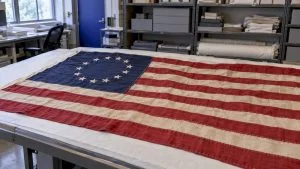
American rallies add a deep layer of historical imagery. The Revolutionary War gave us the coiled rattlesnake, the Betsy Ross circle of thirteen stars and the stripes of the early republic. Later struggles added their own banners. Each carries a story, and the crowd that raises it is borrowing that story on purpose.
Researchers studying modern demonstrations observe that flags at rallies may combine, modify or appropriate varied historical symbols, texts and logos to express a personal connection to a historical figure or a grievance. That creativity is part of the tradition, and it is also why you should know exactly what you are flying.
Know the history before you fly it
Symbols can be claimed by more than one group. Reporting in the Columbia Journalism Review noted that the Gadsden and Betsy Ross flags were appropriated by libertarian and extreme-right groups, though not everyone using them was associated with extremist movements. The lesson is not to avoid history. It is to carry it with open eyes. If you want to understand where a banner began, our guides on the Betsy Ross flag and the Revolutionary War, the origins of the 2nd Amendment flag and six Civil War flags and their provenance trace the stories behind the cloth.
Shapes and formats you will see at a rally
A crowd needs different flags for different jobs, and a well-run event usually mixes several formats.
- Hand-held flags. Small flags on short staffs, meant for the crowd to wave. They are inexpensive, easy to hand out and create the sea of color that cameras love.
- Pole flags. Rectangular flags on a full-length pole, carried by a color guard or volunteer at the front, or planted behind the speaker. This is the classic format for a national, state or party flag.
- Banners. Wide, horizontal pieces hung from a stage, fence or building to carry a name, slogan or date.
- Pennants and triangle shapes. Tapered flags that read well from a distance and suit a string or a vehicle. A canvas pennant flag is one example of how fabric choice and shape can change the look of a simple triangle.
- String flags. Lines of small flags used to dress a venue, a street or a parade route, such as our string flags.
- Digital and printed colors. Flags are not only cloth. They also appear as colors and emblems on posters, clothing, websites and social-media graphics, so keep your palette consistent across all of them.
For a stage with more than one flag, arrangement matters. Our guide to displaying multiple flags on one pole or separate staffs explains how to avoid the common mistakes.
Size, material and durability
The right flag is the one that suits where it will be seen and how often it will be used. A few working rules from years of outfitting displays:
- Think about distance. A flag meant to be read from the back of a crowd needs bold shapes and fewer words. Fine print vanishes at fifty feet. A 3 x 5 foot flag is the standard size for a staff or house pole, and a larger one suits a stage or a tall pole.
- Match fabric to weather. Outdoor flags that will see wind and sun are usually made from nylon or polyester, which dry quickly and resist fading better than cotton. Indoor and ceremonial flags can use heavier fabrics because they never meet a storm. Even official guidance elsewhere in the world calls for weather-resistant cloth such as polyester or heavy nylon and for inspection after intense storms, which is a sensible habit for any organizer.
- Check the edges and stitching. Wind punishes the fly end first. Look for reinforced stitching on the outer edge and a strong header with grommets or a pole sleeve.
- Plan for the pole. A flag that wraps around its pole looks limp in a photograph. A rotating anti-furl pole, like our aluminum anti-furl rotating pole, keeps the cloth open in changing wind. Browse our full range of flagpoles and hardware, and see our guide to flagpole types and footing rules if you plan a permanent installation.
- Order early and in quantity. For campaigns, uniformity counts. Buy the full number of flags you need at once so colors match.
Permits and local rules
Before the first flag goes up, find out what your city requires. Rules differ from place to place, and no single national answer covers them.
As one example, Charlottesville, Virginia states that events on City property generally require a permit, with exceptions, and applications must describe banners, placards and signs along with times and locations. Other cities will have their own versions, so call the parks, special events or city clerk office that handles your venue.
Outside the United States the rules can be stricter still. Croatia’s government portal, for instance, says organizers must keep peace and order, ensure participants do not carry weapons or objects that could cause injury, and prohibit insignia promoting war, violence, hatred or intolerance. The same page sets advance reporting periods for public gatherings. We mention it to show how widely requirements range, not because it applies to American readers.
Practical questions to settle with the local office:
- Is a permit needed for the location, the crowd size or the use of amplified sound?
- Are there limits on pole length, pole material or what a staff may be made of?
- Are there rules about banners hung on fences, lampposts or buildings?
- Who is responsible for safety, first aid and emergency access?
Our guide for organizers, Rally Flags for Organizers, covers protocol and safety gaps in more depth.
Carrying, displaying and caring for the flag
A flag in a crowd is a symbol and a physical object at once. Treat both seriously.
If your rally includes the Stars and Stripes, follow the customs for it. Our pages on how to properly display and respect the American flag and parade flag etiquette for carrying Old Glory explain positions, order and handling. Where foreign flags join the line, see international flag etiquette for ceremonies.
A few habits protect people as much as cloth:
- Keep staffs pointed up and away from other people, and never use a pole as a weapon or a prop.
- Do not carry a flag through a crowd where the pole could strike someone. Hand-held flags on short staffs are safer in tight spaces.
- Dry a wet flag before folding it, and store it out of direct sun. Our guide to caring for a flag covers washing, mending and storage.
- Retire a tattered flag rather than flying it. A frayed banner sends the wrong message and a torn one can tangle in wind.
Our view: a flag is a promise you hold in your hands
We have sold flags since the early days of the internet, and we have watched what people do with them. The ones that last are not the loudest. They are the ones carried by someone who knows the story.
A flag is a vow made visible. When a crowd gathers under the same banner, it is saying that the argument matters enough to stand in public for it. That is a right worth honoring, and it deserves cloth that will not give up halfway through the speech.
We also believe in knowing your history. America’s flags were born in argument: colonists against a crown, states against one another, citizens against their own government. Every banner in our catalog, from the coiled snake to the Stars and Stripes, carries a chapter of that argument. Whether you fly a party colors, a candidate’s name or an old revolutionary standard, learn what it meant to those who raised it first. You will carry it better.
And care for it. The flag that waved at one rally can wave at the next if you dry it, fold it and store it well.
— John Hough
Outfit your rally with Ultimate Flags
As America’s oldest online flag store, we carry the flags a rally calls for: political flags, USA flags, state flags, historic war flags, military and service flags, plus the poles and hardware to fly them. If you need a bold solid color for a banner project or a color guard, our red flag in solid nylon is available in a 3 x 5 foot outdoor size, and the smaller 12 x 18 inch version suits hand-held use.

Browse the full range in our flag collections and pick the flags, poles and hardware that fit your event.
FAQ
What is the best flag size for a political rally?
It depends on where the flag will be seen. A 3 x 5 foot flag is the standard size for a hand-carried staff or a house pole, and larger flags suit stages and tall poles. Smaller flags, such as 12 x 18 inches, work well as hand-held flags for a crowd.
What color are political party flags?
Colors vary by country and party. Research on political color notes that red has often been linked to socialism and radicalism, blue to conservative parties and black to anarchism, though these associations differ by place. In the United States, red and blue are widely tied to the two major parties.
Do I need a permit to hold a rally with flags?
Often you do, especially on city property. Rules differ by city, so contact the office that manages your venue, such as parks or special events. Charlottesville, for example, requires permits for most events on City property and asks applicants to describe banners and signs.
What material is best for outdoor rally flags?
Nylon and polyester are common choices for outdoor flags because they handle wind and sun better than cotton. Choose reinforced stitching on the fly end and match your pole hardware to the flag. For repeated use, buy sturdier flags and keep them clean and dry between events.
Are historic flags like the Gadsden flag political symbols?
Yes, and their meaning can be contested. Reporting notes that the Gadsden and Betsy Ross flags were adopted by libertarian and extreme-right groups, though not all users were extremists. Learn the origin of any historic flag before you display it.
Sources
- Campaign rallies and political meaning-making
- Nonviolent action: Displays of flags and symbolic colors
- Party flags, colours and logos in the 8th European Parliament
- Belarusian national identity: what did the 2020 protests demonstrate
- Itineraries of Protest Signage: Semiotic Landscape
- The Flags That Flew on January 6th
- The Tow Center COVID-19 Newsletter: Political Symbols at Demonstrations
- Political Flag Day
- Visual Identity Guidelines: The UAE Flag
- Charlottesville Special Event Regulations
- Prijava javnog okupljanja, gov.hr