A 2nd Amendment flag is a visual declaration of support for the individual right to keep and bear arms, most often expressed through symbols like the Roman numeral “II,” the Gadsden rattlesnake, or the Gonzales cannon reimagined as a rifle. The dominant meaning is patriotic and constitutional: a stand for personal liberty rooted in the Founders’ own words. But not every version reads the same way to every viewer, and a few design variants carry contested or politically charged undertones worth understanding before you fly one.
TL;DR:
- Flags with Roman numeral “II” and thirteen stars are seen as legitimate constitutional symbols rooted in the Founders’ legacy, not militia or fringe groups.
- Modern adaptations, like replacing a cannon with an AR-15 silhouette on the Come and Take It flag, shift the message from local defiance to broader gun-rights resistance.
- Court rulings in 2008 and 2022 establish the Second Amendment as protecting individual self-defense rights, which underpins the legal protection for flying these symbols.
- Slight visual modifications, such as added slogans or altered star counts, can change a flag’s meaning and risk unintended associations with militia or extremist groups.
- Properly understanding a symbol’s origin, intent, and context helps display it responsibly, avoiding misinterpretation or controversy among diverse audiences.
Table of Contents
- The Meaning Behind 2nd Amendment Flag Symbols
- How Revolutionary and Republic-Era Flags Became Modern Symbols
- The Legal Ground These Symbols Stand On
- When Similar Symbols Send Very Different Messages
- Choosing and Displaying a 2nd Amendment Flag the Right Way
- Why Ultimate Flags’ Historical Archive Backs These Interpretations
- A Final Word on History and Responsible Display
- Find Your Flag at Ultimate Flags
- Sources
- FAQ
The Meaning Behind 2nd Amendment Flag Symbols
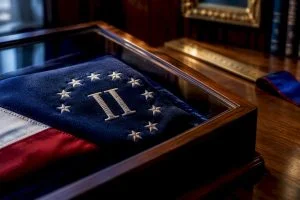
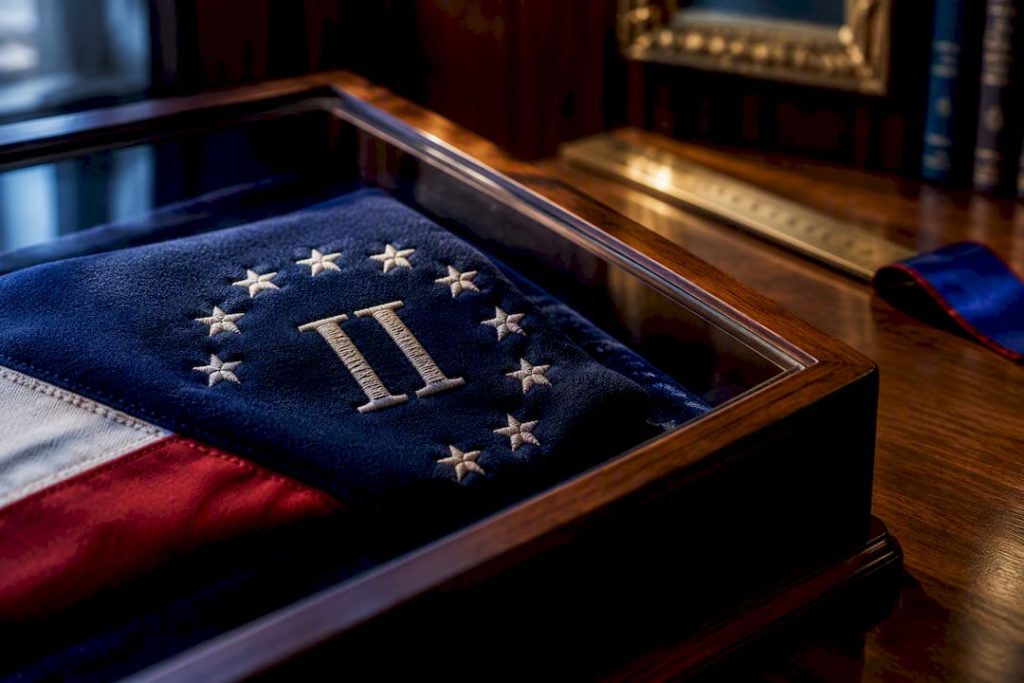
Every symbol on a modern 2nd Amendment flag carries a lineage, and once you know how to read that lineage, the flag stops being decoration and starts being a statement with a documented pedigree. The most recognized emblem is the Roman numeral “II,” typically ringed by thirteen stars. That numeral is not stylistic flourish. Designers chose it deliberately to evoke the Bill of Rights itself, while the thirteen stars root the image in the original colonies, giving the whole design a sense of inherited legitimacy from the founding generation.
The shorthand “2A” works the same way in text form, a compressed reference that lets a bumper sticker or a flag corner say “Second Amendment” without spelling it out.
Pro Tip: If a flag pairs “2A” with thirteen stars but no other markings, it’s almost always a straightforward constitutional statement, not tied to any particular militia or political faction.
Beyond the II, four other symbols dominate the category:
- Gadsden flag (“Don’t Tread on Me”): a coiled rattlesnake on a yellow field, originally a Revolutionary War warning and now widely read as a firearm-rights and general anti-government-overreach emblem.
- Come and Take It flag: born from the 1835 Gonzales standoff, now frequently updated with an AR-15 silhouette replacing the original cannon, turning a local Texan defiance into a national gun-rights slogan.
- Molon Labe: Greek for “come and take them,” a phrase attributed to a Spartan commander at Thermopylae and adopted as classical shorthand for refusing disarmament.
- AR-15 silhouettes: standalone or layered over stars and stripes, signaling a more contemporary, often more assertive reading than the II or Gadsden designs.
The design choice matters more than people assume. A II inside a star ring reads as constitutional and historical. An AR-15 silhouette alone, stripped of any founding-era imagery, reads as more modern and, to some viewers, more confrontational. Neither is “more correct,” but they land differently depending on who is looking.
How Revolutionary and Republic-Era Flags Became Modern Symbols
The Second Amendment itself dates to 1791, ratified as part of the Bill of Rights after debates the Library of Congress’s Constitution Annotated project documents in detail. The symbols now associated with it are older or younger than that text by decades in either direction, and their journeys into modern gun-rights iconography followed distinct paths.
- 1775: Christopher Gadsden’s rattlesnake flag flies as a warning to the British Crown, decades before the Bill of Rights existed.
- 1791: The Second Amendment is ratified, giving later generations a constitutional anchor for firearm-rights symbolism.
- 1835: Gonzales settlers raise a flag reading “Come and Take It” over a small cannon, daring Mexican troops to disarm them, a local skirmish over a single piece of artillery.
- 2000s to present: Designers swap that cannon for an AR-15, transforming a hyperlocal 19th century dispute into a national symbol of resistance to modern gun-control proposals.
That last shift is worth sitting with. The original Gonzales flag was about one cannon and one town’s refusal to hand it over. The rifle-bearing version circulating today speaks to a much broader debate over federal firearm policy, and that’s a deliberate act of iconographic updating rather than organic drift. Somebody decided the cannon no longer carried enough weight for the argument being made, and redrew it.
The same logic applies to the Roman numerals and star rings on II flags. Nobody in 1791 designed a flag around the amendment’s number. That visual language emerged later, built specifically to borrow the Founders’ authority for a modern cause, and it works precisely because it looks old even when it isn’t.
The Legal Ground These Symbols Stand On
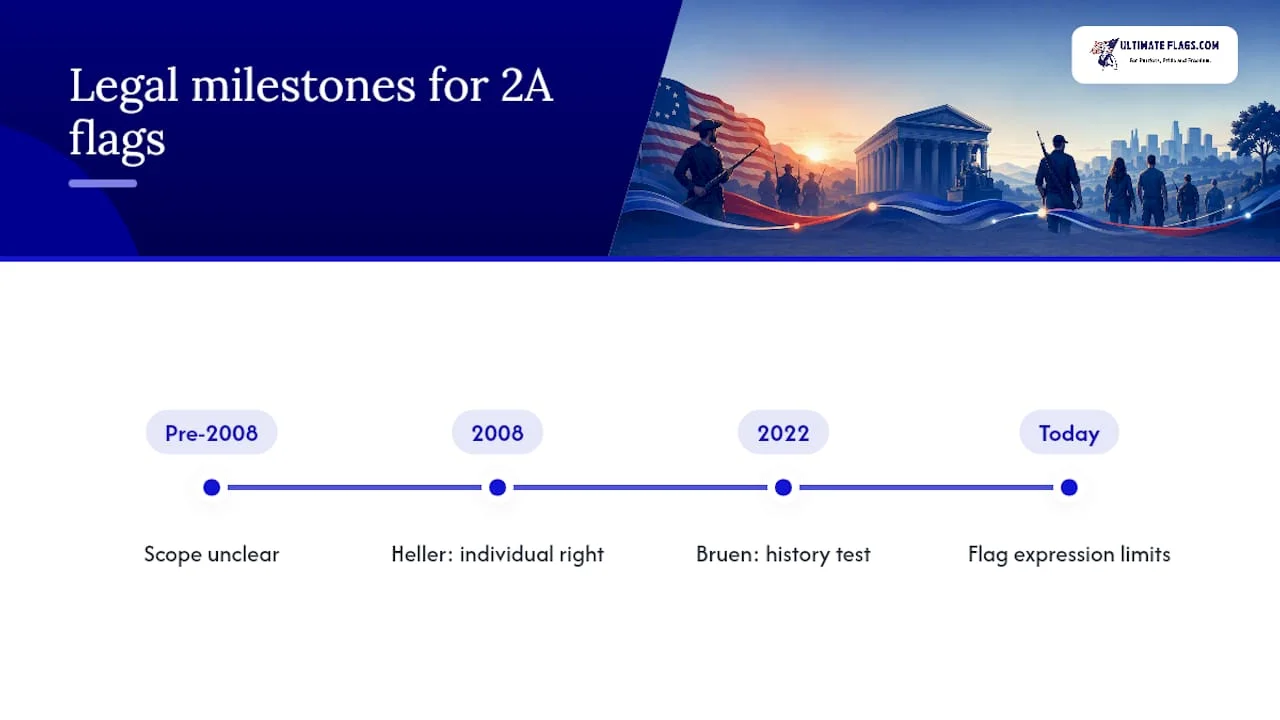
Second Amendment flags carry real weight because the courts have given the underlying right substantial legal definition in the past two decades. Before 2008, the scope of the amendment was murkier than most flag owners probably assume.
District of Columbia v. Heller settled that the Second Amendment protects an individual right to possess firearms for lawful purposes, including self-defense in the home, not merely a right tied to militia service.
That 2008 ruling reframed the entire cultural conversation, and it’s the legal backbone most modern 2A symbolism implicitly references. Fourteen years later, New York State Rifle & Pistol Association v. Bruen (2022) went further, establishing that firearm regulations must align with the nation’s historical tradition of arms regulation to survive constitutional scrutiny. Together, Heller and Bruen give the flags flying today a legal foundation that earlier generations of gun-rights advocates didn’t have.
Flying the flag itself is generally protected as expressive conduct under the First Amendment, the same doctrine that shields political signs and protest banners. That protection isn’t absolute. Government buildings, certain workplaces, and some publicly controlled spaces can restrict symbolic displays without violating anyone’s rights, which matters if you’re weighing whether to fly one somewhere other than your own front porch.
When Similar Symbols Send Very Different Messages
Here’s where good-faith flag owners get tripped up. A design that looks almost identical to a mainstream 2A symbol can carry a completely different, and sometimes unwelcome, association.
- Three vertical bars or roman numerals styled a certain way can echo Three Percenter militia imagery rather than general Second Amendment support.
- Added text, altered star counts, or unfamiliar color combinations can shift a flag’s reading toward a specific fringe group rather than a broad constitutional statement.
- Small visual tweaks, extra bars, rearranged stars, or unfamiliar slogans, are often enough to cause accidental association with militia or extremist branding, even when the buyer had no such intent.
Pro Tip: Before buying, search the exact design online. If a flag surfaces alongside militia group names or extremist forums in the results, that’s a strong signal the design carries baggage beyond simple gun-rights advocacy.
Most people flying a Gadsden or Come and Take It flag mean exactly what the design’s history suggests: support for individual gun ownership and a wariness of government overreach. Critics sometimes read the same imagery as coded militia signaling. Both readings are honest reactions to the same cloth, and that gap is exactly why knowing a design’s origin protects you from being misunderstood.
Choosing and Displaying a 2nd Amendment Flag the Right Way
Getting this right takes a few minutes of homework before you order anything.
- Define your intent first. Are you making a constitutional statement, honoring Texas history, or expressing something more pointed? The design should match the message.
- Check who will see it. A front yard in a politically mixed neighborhood calls for different judgment than a private hunting cabin or a collector’s display case.
- Verify the artwork. Compare the exact star count, bar count, and wording against known extremist variants before buying.
- Ask about provenance. A seller who can explain a design’s history, Gadsden 1775, Gonzales 1835, or the modern II shorthand, is more trustworthy than one who can’t.
| Display context | Best-fit symbol | Consideration |
|---|---|---|
| Private residence | Gadsden or Come and Take It | Broad recognition, minimal ambiguity |
| Collector or historical display | Original Gonzales cannon design | Honors the 1835 source material |
| Civic or workplace setting | Check local policy first | Government spaces may restrict displays |
Why Ultimate Flags’ Historical Archive Backs These Interpretations
Ultimate Flags has built its reputation as one of America’s longest-standing online flag retailers by treating history as a discipline, not decoration. The Come and Take It flag’s journey from an 1835 cannon standoff into a modern firearm-rights emblem gets the same documentary care as our coverage of star ring conventions and design lineage in the American flag itself. That archive exists so buyers can trace a symbol back to its source before they ever fly it, and readers curious about modern firearm imagery in patriotic design can dig deeper into contemporary marksman iconography as well.
A Final Word on History and Responsible Display
History gives these symbols their weight, and that weight comes with responsibility. Understanding where the II, the Gadsden snake, and the Gonzales cannon actually came from arms you to make an informed choice rather than an impulsive one. Before you raise a flag with this much cultural charge, take a moment to consider your neighborhood, your intent, and whether the design says what you actually mean.
— John Hough
Find Your Flag at Ultimate Flags
This online flag retailer emphasizes the importance of designs that trace back to documented origins, avoiding knockoffs redrawn for quick sales. Browse the full flag collections to compare historically grounded Gadsden, Come and Take It, and II-style designs side by side, and once your flag arrives, check the flagpole hardware and footing guidance to make sure it’s displayed the way the design deserves. Ready to add a piece of documented history to your porch or collection? Visit the flag collections page today and place your order.
Sources
- Amendment 2 Symbols: Flags, Phrases, and Shorthand – LegalClarity
- Historical Background on Second Amendment | Constitution Annotated | Congress.gov | Library of Congress
- The “Come and Take It” Flag Now Symbolizes Something Very Different – Texas Monthly
FAQ
Is the 2nd Amendment About Guarding Against a Tyrannical Government?
Many supporters read the Second Amendment as a check against government overreach, but the modern legal standard rests on individual self-defense. Heller confirmed the right centers on personal use, including self-defense in the home, rather than framing it purely around resisting tyranny.
What Do White Flags at Rallies or Protests Typically Signal?
A plain white flag traditionally signals surrender or a truce and isn’t a recognized Second Amendment symbol at all. If you see one paired with gun-rights imagery, it’s likely a separate, unrelated statement rather than part of established 2A shorthand like the II, Gadsden, or Come and Take It designs.
What Does the 2nd Amendment Mean in Simple Terms?
The Second Amendment protects an individual’s right to keep and bear arms, a reading the Supreme Court confirmed in Heller and refined further in Bruen. Flags referencing “2A” or the Roman numeral II point directly back to that constitutional text.
Where Can I Buy a Historically Accurate 2nd Amendment Flag?
Ultimate Flags carries designs rooted in documented origins, including Gadsden and Come and Take It variants, through its flag collections. Current pricing and available sizes are listed directly on the site.
Why Do Some 2A Flag Designs Cause Controversy?
Small design changes, extra bars, altered star counts, or unfamiliar slogans, can accidentally echo militia or extremist branding rather than mainstream gun-rights advocacy. Checking a design’s documented history before buying helps avoid that kind of misread.