Flying a flag from your truck is generally not illegal in the United States, but no single national law governs it. Two very different kinds of flag ride on trucks. One is the banner you choose to fly out of pride. The other is the red or fluorescent orange warning flag the law requires when a load sticks out. Your state sets the rules for the first. Federal and state rules together set them for the second.
A flag is a promise made visible. It tells the road who you are and what you honor. It also becomes a piece of equipment the moment you bolt it to a vehicle moving at highway speed, and that is where the law, and plain good sense, begins.
TL;DR
- No federal law bans a patriotic or heritage flag on a private pickup. Rules come from your state, and they focus on securement, driver visibility and a legible license plate.
- A commercial truck whose load extends more than 4 inches past the sides or more than 4 feet past the rear needs red or orange fluorescent warning flags, each at least 18 inches square.
- Warning flags are safety equipment, not decoration. Never swap a tribute flag in for one, and never let a tribute flag hide a required one.
- Speed is the real enemy of a flag. Fly large flags at parade pace, and take them down for the interstate.
- Before you travel, read the vehicle code of every state on your route, or call the state patrol.
Table of Contents
- Two Kinds of Truck Flags, Two Sets of Rules
- Is It Legal to Fly a Flag From a Moving Truck?
- How a Flag Must Be Attached
- Size, Speed and the Parade Exception
- When a Flag Is Required: Projecting Loads
- Why Warning Flags Matter
- Consequences of Getting It Wrong
- A Word From Us on Flying Flags the Right Way
- Find a Flag Built for Your Truck
- How to Check the Rules Before You Drive
- FAQ
- Sources
Two Kinds of Truck Flags, Two Sets of Rules
Search for truck flag laws and you will find two conversations tangled together. They deserve to be pulled apart.
Display flags are the American flag, the state flag, a POW/MIA banner, a service flag or a Gadsden banner flown from a bed mount, a fender clamp or a tailgate pole. They are expressions of belief and heritage. States rarely mention them by name. They govern them indirectly through general equipment and safety law.
Warning flags are the bright squares of cloth that mark lumber, pipe, steel, machinery or any cargo that reaches beyond the vehicle’s body. These are named, measured and mandated.
Knowing which kind you are flying settles most questions before they start.
Is It Legal to Fly a Flag From a Moving Truck?
In most states, yes, with conditions. Coverage of this question in states such as Washington has come to the same practical answer: a flag that is securely installed, not too tall and does not block the driver’s view is generally fine. Florida coverage reaches a similar conclusion and adds a point many owners miss: flags and other items must not obscure a vehicle’s license plate, which has to stay clearly legible (Click Orlando’s explainer on flags on cars in Florida).
So the working test, in nearly every state, comes down to four questions:
- Is it secure? A flag, pole and mount that can come loose become a projectile.
- Does it block your view? Nothing may interfere with the windshield, mirrors or rear window sight lines.
- Is the plate visible? Plate, tail lamps, brake lights and turn signals must remain clear.
- Does it overhang or stick out? If it extends beyond the vehicle’s sides or rear, the rules for projecting loads may apply.
The jurisdiction that matters is the one you are driving in at that moment. A flag mount that is perfectly acceptable at home can draw a stop two states away. That is why the last section of this guide shows you how to check.
How a Flag Must Be Attached
Securement is where nearly every real-world problem starts. Fabric whipping at 60 miles per hour shreds in minutes, and a loose pole is a hazard to the driver behind you.
For required warning flags, the language is explicit. New York’s certified escort manual says warning flags must be mounted on staffs and securely fastened to the vehicle or load, typically at the extremities or corners so they show the overall width and length (New York State DOT Certified Escort Manual, 2025).
Your display flag deserves the same discipline, even where no statute spells it out:
- Use a purpose-built truck mount, bed rail bracket or fender clamp rather than tape, zip ties or a pole wedged against the tailgate.
- Choose a pole with a firm base that will not bend back toward the cab glass.
- Check hardware before every long trip, and again at fuel stops.
- Keep the flag clear of tail lamps and the plate, and out of the driver’s mirror sight lines.
Our truck flags collection is built around this reality: flags sized and finished for vehicle display, with hardware that matches. If you fly from an RV as well, our guide to RV flagpole setup walks through mounting and securing in detail.
Two Flags on One Vehicle
When you fly the Stars and Stripes alongside a state flag, order matters. Texas Government Code Section 3100.064 provides that when both the U.S. flag and the state flag are displayed on a vehicle, the U.S. flag staff is clamped to the right fender and the state flag staff to the left (Tex. Gov’t Code Section 3100.064). The principle, the national colors in the place of honor on the right, echoes the traditions our guide on displaying multiple flags lays out for homes and businesses.
Size, Speed and the Parade Exception
Most states do not publish a maximum size for a display flag. They simply hold you to the general standards of safe equipment, clear vision and secure loads. That leaves judgment to the officer and to you.
Here is the judgment we would offer, from a company that has handled flags for a long time:
- Small and medium flags, such as 12 by 18 inches or 3 by 5 feet on a rigid truck mount, are the common choice for daily driving. Choose heavier woven fabrics and sturdy hardware.
- Very large flags, 5 by 8 feet and up, belong at parade speed. At 5 to 10 miles per hour, a big banner on a staff is a spectacle that thrills the sidewalk. At 65, it is a danger and it will not survive.
- Highway driving is hard on any flag. Wind load climbs steeply with speed, and the cloth frays at the fly end first. Many owners keep a highway-rated, smaller flag for travel and save the big one for the Fourth of July, Memorial Day and Veterans Day processions.
If you are driving in a parade, check the organizers’ rules too. Many require flags to be carried or mounted in specific ways, and some ask vehicles to keep decorations within the vehicle’s footprint.
When a Flag Is Required: Projecting Loads
Now the other kind of truck flag, the one nobody chooses for its beauty and everybody should respect.
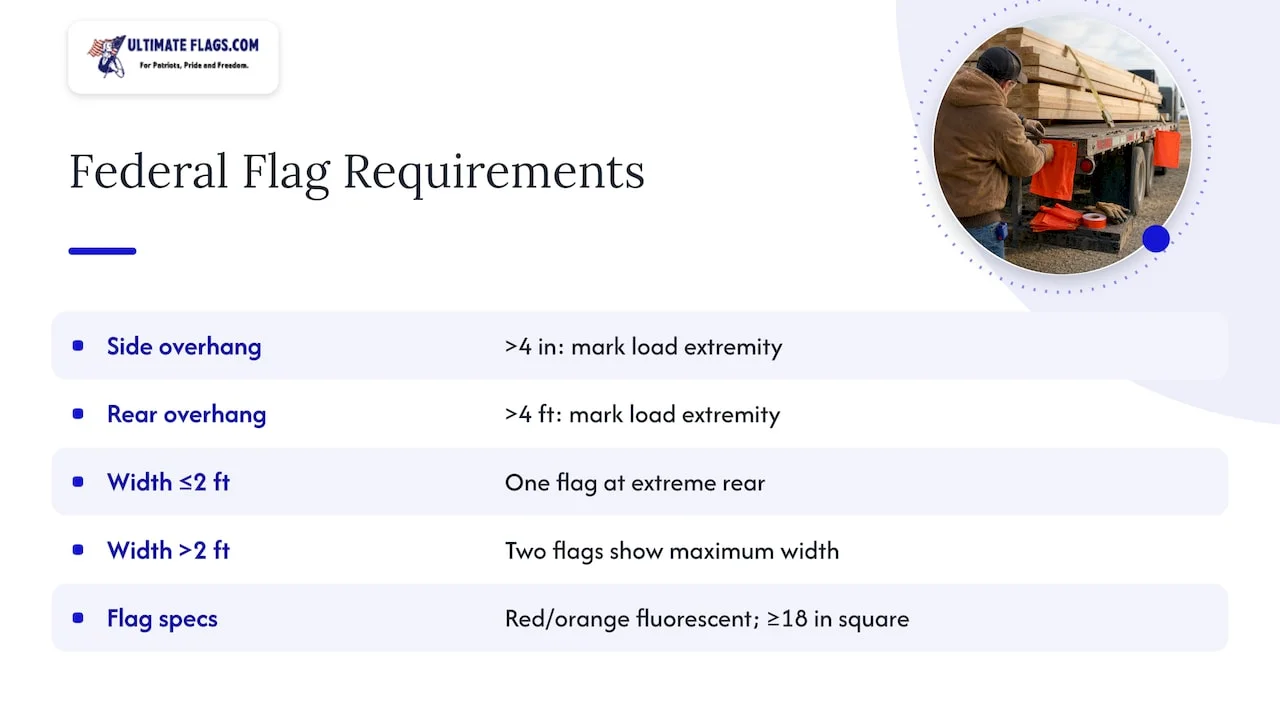
Under the federal motor carrier safety regulations, any commercial motor vehicle carrying a load that extends more than 4 inches beyond the sides or more than 4 feet beyond the rear must mark the extremities of that load with red or orange fluorescent warning flags, each at least 18 inches square (49 CFR 393.87). The same rule sets the count: one flag at the extreme rear if the projecting load is two feet wide or less, and two flags if it is wider, placed to show the maximum width of the load.
That regulation governs commercial motor vehicles. Private pickups hauling lumber, ladders or pipe are covered by state law, and state law often looks much the same: a red flag or cloth of a stated minimum size hung at the extreme rear of any load that overhangs. Dimensions differ from state to state, and some states set a lower trigger distance or a different size, so read your own state’s vehicle code instead of assuming.
What the Flag Must Look Like
In New York’s rules, warning flags must be red or fluorescent orange and at least 18 inches square. Oversize-load signs carry a highway-yellow background with black lettering, must be at least 7 feet long and 18 inches high, and must be reflective for night moves (New York State DOT Certified Escort Manual, 2025). The same manual requires certified escorts for loads wider than 12 feet, at least 80 feet long, or at least 14 feet high.
A quick comparison shows the pattern:
| Item | Federal rule (commercial vehicles) | New York permitted oversize loads |
|---|---|---|
| Flag color | Red or orange fluorescent | Red or fluorescent orange |
| Minimum flag size | 18 inches square | 18 inches square |
| Mounting | Positioned at the load’s extremities | On staffs, securely fastened |
| Oversize sign | Not part of this rule | Highway yellow, black letters, 7 ft by 18 in, reflective |
Rules Abroad
Because our readers fly flags worldwide, a word on other countries. They are not the American rule and should never be assumed to match it. Queensland, Australia, requires a warning device on loads projecting more than 1.2 metres from the rear, and where it is not easily visible, a 450 mm square coloured flag by day and a red light or reflectors at night (Queensland Government). South African rules for abnormal loads call for bright red flags of at least 600 mm by 600 mm at the extreme corners (TRH 11, Gauteng Roads and Transport). Crossing a border means reading a new rulebook.
Why Warning Flags Matter
A red square at the end of a pipe is the only thing telling the driver behind you that the load is longer than the truck. Australia’s national load restraint guide notes that loads must be placed to preserve the vehicle’s stability, steering and braking, and that dangerous projections should be positioned to limit the risk if the load shifts in braking or a collision (National Transport Commission, Load Restraint Guide). The same guide reminds readers that common law imposes liability for negligent acts that injure or damage others.
That last point carries over to the United States in spirit. A citation for a missing flag is the smaller risk. The larger one is a collision that a bright flag would have prevented.
If you carry long loads, a plain red flag in the right size is an inexpensive piece of insurance. Our 12 by 18 inch solid red nylon flag and 3 by 5 foot solid red nylon flag are options in the plain red category. Before you buy, match the size to what your state or the federal rule requires for your vehicle and load. Many states and the federal rule for commercial vehicles call for 18 inches square, which is larger than the 12 by 18 inch size.
Consequences of Getting It Wrong
Penalties vary by state and by vehicle type. Typical outcomes include a fix-it order, a fine, and, for commercial drivers, a roadside inspection violation that follows the carrier. In a crash, a missing warning flag or an unsecured load can weigh against you when fault is decided. We will not guess at amounts here. Your state’s vehicle code or the highway patrol will give you the current figures.
A Word From Us on Flying Flags the Right Way
We have spent our working lives around flags, and we believe the people who fly them on trucks are doing something worth honoring. A flag on a tailgate says that a driver is proud, remembers someone, or stands for something. That deserves a flag that is built for the job.
Our view is simple. Fly your colors, and fly them well. Choose a flag sized for the vehicle and the speed you actually drive. Mount it on hardware made to hold it. Keep the plate and lights clear. Keep warning flags and tribute flags separate, so that each does its work. When a flag is made of durable fabric with strong stitching, it lasts through more miles, and a worn banner can be retired with dignity under the guidance in our flag etiquette article.
That is why we carry a full range of American, state, military and heritage flags along with poles and hardware: so a driver can pick the right flag and the right way to carry it.
— John Hough
Find a Flag Built for Your Truck
Whether you are flying the Stars and Stripes to the county fair or carrying a service flag in a Memorial Day convoy, start with our truck flags collection. If you want to browse the whole catalog, from USA and state flags to military flags, flagpoles and hardware, visit our flag collections.

For proper handling of the Stars and Stripes, our guides on how to properly display and respect the American flag and the 2005 flag law for homeowners are good companions.
How to Check the Rules Before You Drive
Because the rules are local, a few minutes of homework prevents a roadside surprise.
- Read your state’s vehicle code. Search your state legislature’s website for terms such as “projecting load,” “red flag” and “obstructed view.” Many state codes are searchable online.
- Check each state on your route. Rules for width, length and overhang differ, and an overhang that is legal at home may need a flag next door.
- Call the state patrol or department of transportation. They answer these questions every day and can tell you the current requirement.
- For commercial vehicles, start with the federal rule, 49 CFR 393.87, then check state additions. For oversize permits, the permit issuer’s manual governs.
- Ask event organizers about flag rules for parades and convoys before the day.
Rules change, so treat any summary, ours included, as a starting point and confirm with the official source.
FAQ
Is it illegal to fly a flag on the back of a pickup truck?
Generally no. No federal law prohibits it, and most states allow it when the flag is secure, does not block the driver’s view and leaves the license plate and lights visible. Your state’s vehicle code has the final word, so check it before a long trip.
How big must a truck warning flag be?
For commercial motor vehicles under the federal rule, at least 18 inches square, in red or orange fluorescent material. New York’s permit rules use the same minimum. Other states and countries may set different sizes, so confirm locally.
When do I need a flag on a load sticking out of my truck?
For commercial vehicles, when the load extends more than 4 inches past the sides or more than 4 feet past the rear. Private pickups follow state law, which often requires a red flag on any rear overhang. Your state patrol can confirm the trigger distance.
Can I fly a big flag on the highway?
We advise against it. Large flags belong at parade speeds, because wind force rises quickly with speed and can tear the flag or loosen its mount. Use a smaller, well-secured flag for highway miles.
Which flag goes on the right side of the truck?
Where a state addresses it, such as Texas, the U.S. flag goes on the right fender and the state flag on the left. Even where no law applies, the same order is customary.
Sources
- 49 CFR 393.87, Warning flags on projecting loads
- New York State DOT Certified Escort Manual, 2025
- Tex. Gov’t Code Section 3100.064
- Can you legally fly a flag on your car in Florida? (Click Orlando)
- Projecting loads (Queensland Government)
- TRH 11 Dimensional and mass limitations (Gauteng, South Africa)
- Load Restraint Guide (National Transport Commission)