Posted on

Best military flags for a home flagpole display

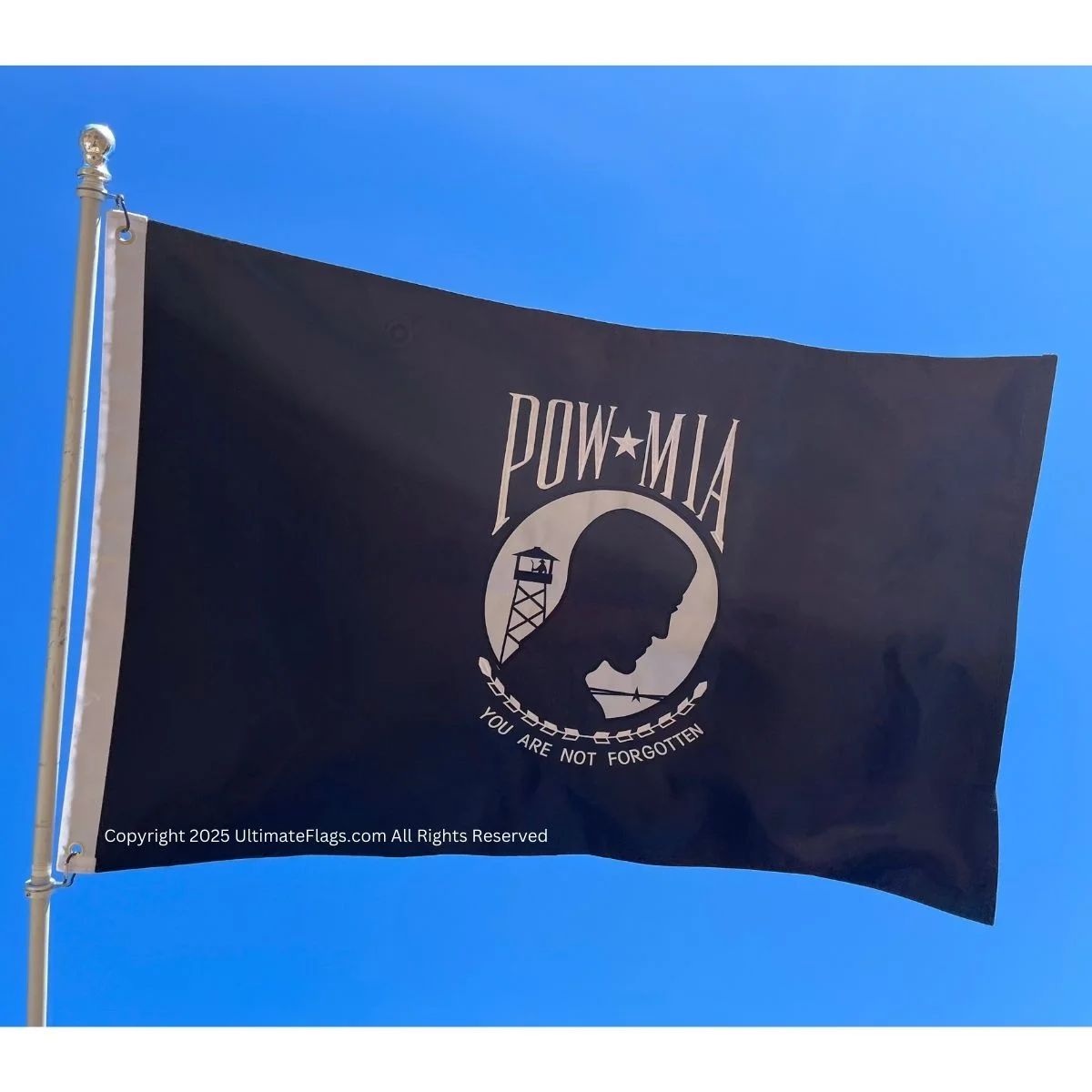
Double-sided sewn POW/MIA flag with embroidered details flying on a pole outdoors

Best overall for a home flagpole: the sewn double-sided POW/MIA flag in heavy double-nylon. Best branch pick: the US Army flag in the classic 3×5 ft size. Best statement banner: the double-sided Home of the Free Because of the Brave flag. Military flags for sale really split into two camps — heavy sewn and embroidered flags built for an all-weather pole, and lighter printed flags that shine for fair-weather and seasonal display. The right pick depends on how long your flag stays up each week and how much wind your yard gets, not just which branch you cheer for.

Quick answer
  • Best overall: the sewn double-sided POW/MIA flag for an all-weather pole.
  • A 3×5 ft flag suits the 20-foot residential pole most homes run.
  • Printed branch flags are the lighter, budget-friendly fair-weather pick.
  • Double-sided flags carry two panels with a blocker layer — heavier but readable both ways.
  • Sewn and embroidered flags hold up to sun and wind far longer than printed ones.

Ultimate Flags flag sale banner

Why this matters for a home display

A military flag on a home pole works harder than almost any other flag you can fly. It hangs in the sun all summer, whips in the same storms your roof takes, and it carries a meaning your family and your neighbors read every day. Pick a flag built for that job and it stays sharp for seasons; pick a light one for a windy corner and it frays before the first holiday is over. The difference usually comes down to three things you can check before you buy: the fabric, the sidedness and the size match to your pole.

What makes the best military flag for a home pole

  • Fabric. Sewn double-nylon and embroidered flags are the toughest construction for permanent outdoor display. Printed polyester and nylon flags look crisp and cost less, but they fade and fray faster in direct sun and steady wind.
  • Sidedness. A double-sided flag uses two panels with a light blocker between them, so the design reads correctly from both sides of the pole. Single-sided flags show a reversed, see-through image from the back.
  • Size. A 3×5 ft flag matches the 20-foot in-ground pole most homes run. Bigger flags need taller poles — a 4×6 ft flag starts making sense around a 25-foot pole.
  • Attachment. Heading and grommets fit standard halyard poles and house mounts. Check that the grommets are reinforced; that is the first point of failure in the wind.
  • Wind exposure. An open yard takes the full breeze. A screened porch or a sheltered courtyard does not. Match the fabric to the wind, and no flag gets blamed for a location problem.

The best military flags for a home flagpole at a glance

Flag Best for Standout feature Key limitation
POW/MIA flag, sewn double-sided double-nylon All-weather display on an open pole Heaviest sewn construction in the military lineup Heavier fabric needs a solid pole and clips
US Army flag, 3×5 ft standard Army households and everyday flying Classic white service design with the Army seal Standard weight suits fair-to-moderate weather
US Navy flag, 3×5 ft nylon printed, double-sided Navy display readable from the street Double-sided print at a midweight build Printed design fades sooner than sewn work
Home of the Free Because of the Brave, 3×5 ft double-sided Patriotic statement banner Bold two-sided lettering on black Dark fabric shows sun fade first
20th Maine Volunteer Infantry flag, double-nylon embroidered Civil War collectors and history displays Embroidered regimental design in sewn double-nylon A historical pick, not a branch service flag

1. POW/MIA flag: best military flag for all-weather display

The POW/MIA flag in sewn double-sided double-nylon is the toughest flag in the military lineup, and it is the one we recommend first for an exposed home pole. The design — a silhouette, a watchtower and the words You Are Not Forgotten — reads clearly from both sides thanks to the two-panel build, and the double-nylon fabric with embroidered detailing is the same construction the store rates for armed-conflict and all-weather ship display. On a house mount or a 20-foot pole, it flies with real weight instead of snapping itself to pieces.

POW/MIA flag pros:

  • Sewn double-nylon (2-ply) construction, the store's toughest rated build
  • Double-sided: correct reading from both sides of the pole
  • Embroidered detailing with reinforced grommets
  • Suited to permanent outdoor display in all weather

POW/MIA flag cons:

  • Heavier fabric than a standard printed flag — a weak house bracket will notice
  • A display flag of remembrance, so some buyers want a branch flag flying above it instead

Best for: an open, windy pole that flies every day.

2. US Army flag: best branch flag for everyday flying

The US Army flag in 3×5 ft is the classic pick for Army families, veterans and anyone who wants a service flag that flies light and looks official. The white field carries the Army seal in blue with the United States Army banner and the 1775 founding date, and the standard-weight build attaches to any ordinary pole with heading and grommets. It is the easiest flag in this list to live with: light enough for a gentle-breeze day, official enough for a veteran's birthday or Memorial Day.
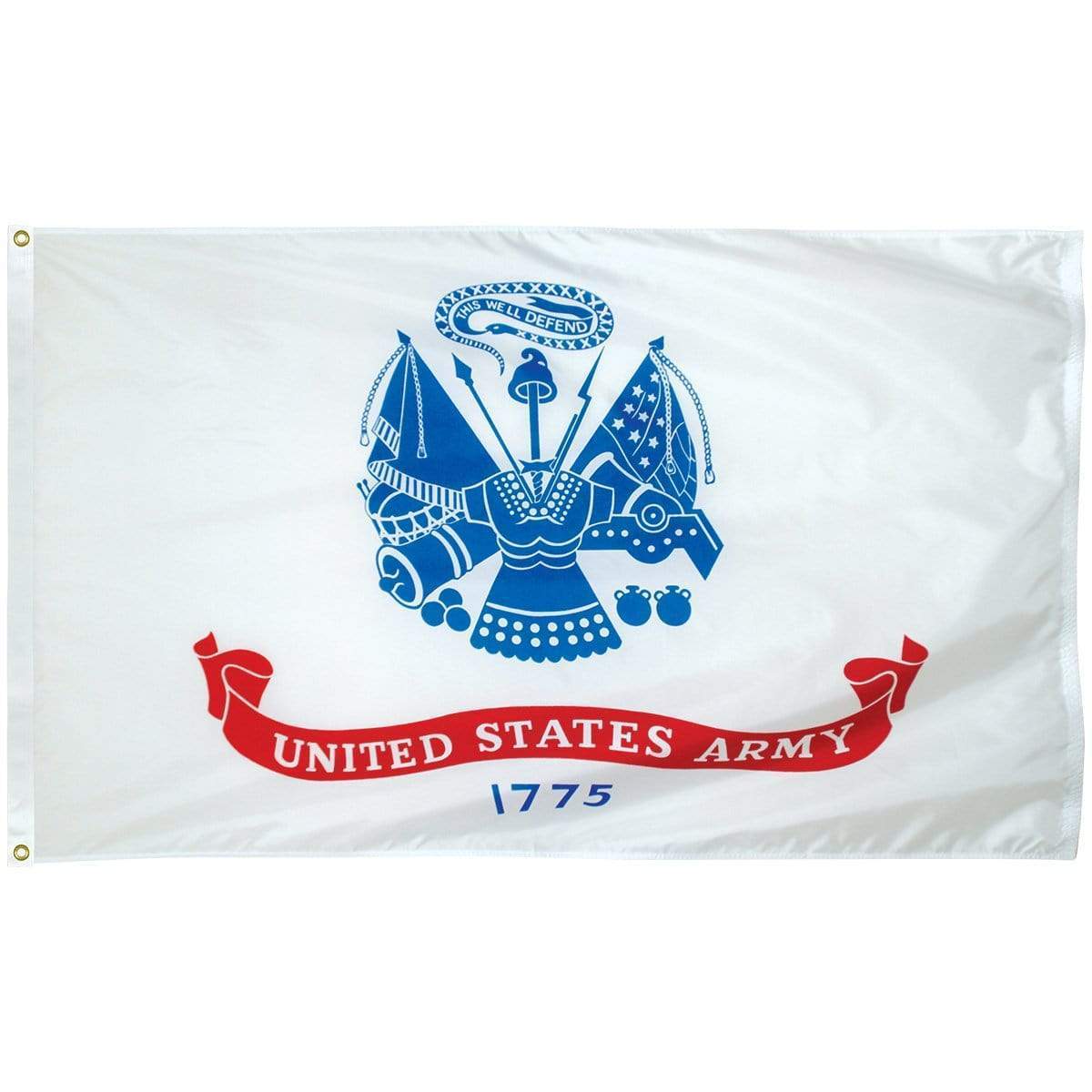

US Army flag 3x5 ft with the Army seal and 1775 banner shown flatShop Now
The US Army flag in the classic 3×5 ft size, ready for a standard pole.

US Army flag pros:

  • Recognized official service design with the Army seal
  • Light standard weight flies in the mildest breeze
  • Standard 3×5 ft size fits residential poles and house mounts
  • Among the most affordable ways to fly a branch color

US Army flag cons:

  • Standard weight is a fair-weather build, not the store's heaviest
  • The white field shows grime faster than dark flags — plan on an occasional wash

Best for: Army households that want an everyday flag at a friendly price.

3. US Navy flag: best for a display that reads both ways

The US Navy flag in 3×5 ft nylon printed double-sided splits the difference between the heavyweight sewn flags and the light standards. A printed double-sided build puts a correct-facing Navy design on both panels, so the ship-and-eagle crest reads properly from the street and from the porch. It is a midweight flag for a midwind yard — steadier in the breeze than a thin single-sided print, easier on the clips than the 2-ply sewn flags.

US Navy flag pros:

  • Double-sided print reads correctly from both directions
  • Midweight nylon balances flyability and durability
  • Distinctive Navy crest that stands out beside an American flag

US Navy flag cons:

  • Printed designs fade sooner than sewn or embroidered work in full sun
  • Priced above the standard single-sided branch flags

Best for: Navy families on a typical residential pole in moderate wind.

4. Home of the Free Because of the Brave: best statement banner

Not every flag on a home pole is a branch flag. The Home of the Free Because of the Brave banner in 3×5 ft double-sided is the one that makes the whole yard's point in five words, with stars-and-stripes lettering on a black field. The double-sided build keeps the words readable from either direction, which matters for a banner — half the people who see it will see the back. It pairs naturally with an American flag on the same pole setup for holidays.


Home of the Free Because of the Brave double-sided flag 3x5 ft shown flatBuy This Flag- Click Here
The double-sided Home of the Free Because of the Brave banner in 3×5 ft.

Home of the Free banner pros:

  • Bold lettering that reads at a distance, both sides
  • Double-sided build with a blocker layer
  • Works as a daily flag or a holiday banner

Home of the Free banner cons:

  • The black field is the first place sun fade shows
  • A statement banner, not a branch or national colors — some flag etiquette purists fly it below the US flag

Best for: patriotic households that want the message, not just the colors.

5. 20th Maine Volunteer Infantry flag: best historic regimental pick

For the collector's eye, the 20th Maine Volunteer Infantry regimental flag in double-nylon embroidered brings Civil War history to a home display. The 20th Maine held the left flank on Little Round Top at Gettysburg in July 1863, and the regimental design carries that story. Embroidered double-nylon is the same heavy build as the POW/MIA pick, so this one is genuinely an outdoor flag, though most buyers fly it for reenactments, memorial displays and history weekends rather than every day of the year.

20th Maine flag pros:

  • Embroidered sewn double-nylon, built for outdoor use
  • A documented regimental design with a real battle story
  • A collector's piece that still flies like a working flag

20th Maine flag cons:

  • A Union regimental flag, not a modern branch service flag
  • Heavier and pricier than the standard printed flags

Best for: Civil War collectors and reenactment households.

How we ranked these military flags

The ranking starts with construction, because that is what survives on a home pole: sewn double-nylon first, then double-sided printed nylon, then light standard prints. Sidedness came next, since a flag that reads correctly both ways serves a home display better. Size fit — the 3×5 ft standard for a 20-foot residential pole — and the intended job, from daily all-weather flying to holiday display to historical collecting, settled the order. Every flag here is a real design in the current Ultimate Flags lineup, checked against the store's own construction ratings.

Which military flag should you choose?

Fly the sewn double-sided POW/MIA flag if your pole takes weather every day and you want one flag to last. Fly the US Army flag or the Navy flag if the branch is the point and your display is fair-weather. Pick the Home of the Free banner for a statement piece, and the 20th Maine if a documented Civil War regiment belongs in your yard. When you are ready to Shop Ultimate Flags, the military collection lines up every branch from Army to Space Force alongside the POW/MIA and service banners.

FAQ

What size military flag fits a home flagpole?

A 3×5 ft flag fits the 20-foot in-ground pole most homes run. Larger 4×6 ft flags start making sense on poles of about 25 feet or on wide house mounts.

What does double-sided mean on a military flag?

Two full panels with a light-blocking layer between them, so the design reads correctly from both sides of the pole. A single-sided flag shows a reversed, see-through image from the back.

Which military flag material lasts longest outdoors?

Sewn double-nylon (2-ply) with embroidered detailing is the most durable construction for permanent outdoor display, followed by printed nylon. Printed designs fade sooner in full sun than sewn or embroidered work.

Is a POW/MIA flag appropriate to fly at home?

Yes. The POW/MIA flag is flown across the United States, including at government buildings and private homes, to honor prisoners of war and service members missing in action. Many homes fly it below the American flag.

Can you fly a branch flag with the American flag?

Yes, on separate poles or on the same halyard below the US flag. Flag custom calls for the American flag to fly highest when flags share a pole.

How do I keep a military flag from fraying?

Match the fabric to your wind, check the reinforced grommets, and bring the flag in during severe storms. Sewn flags with double and quad stitched edges resist fraying longest.

One last thing

The heaviest flag is not automatically the right flag. A 2-ply sewn flag on a bracket meant for a lightweight standard can drag on a calm day and work the mounting loose — weight is a feature only when the pole can carry it. Match the build to the hardware first, then pick the design.

Related guides

Posted on

Best Texas flags for a ranch or home display

buy tx flag for sale state of texas sewn flag poly max heavy duty outdoor all weather flag

A sewn-and-embroidered Lone Star nylon flag in 3×5 ft is the best overall Texas flag for a ranch or home display. A tough double-nylon version wins at a windy ranch gate, and a cotton sewn flag is the right pick for an indoor room.

TL;DR
  • Best overall: a sewn, embroidered nylon Lone Star flag in 3×5 ft.
  • Best for high wind: the double-nylon Outdoor Tough Texas flag.
  • Best for indoor display: a cotton sewn Texas flag.
  • Best historical statement: the Texas M4 Come and Take It flag.
  • Best for a Six Flags display: the Burnet Republic of Texas flag.
Ultimate Flags flag sale banner

Why this matters

A ranch display and a living room wall punish the wrong flag in different ways. Sun, grit and wind shred a light printed flag on a gate line in a single season, while the same heavy flag hung indoors can look stiff and dull under lamplight. Texas flags also carry more design history than most state flags: the current Lone Star flag is a real historical design, and the state's earlier banners are their own collecting field.

This guide ranks the Texas flag options Ultimate Flags carries for ranch and home buyers, explains what separates a porch flag from a gate flag, and shows where a historical design belongs. Every recommendation is built on the same three checks: the design is documented, the construction matches the setting, and the size fits the pole or wall.

What makes the best Texas flag for a ranch or home

  • Documented design. The Lone Star layout adopted in 1839, or a named historical design with a source behind it.
  • Construction that matches the setting. Sewn and embroidered fabric for outdoor daily display; cotton where the flag stays indoors.
  • The right size for the pole. A 3×5 ft flag suits most porch brackets and house mounts; larger sizes need taller poles.
  • Hardware that fits. Grommets for clips and hooks; a pole sleeve for indoor display poles.
  • A design you can explain. If a visitor asks what the flag means, you should be able to answer in one sentence.

Texas flags for a ranch or home at a glance

Flag Best for Standout feature Main limitation
Sewn and embroidered nylon Lone Star (State of Texas flags) Overall porch and yard display Embroidered star, sewn stripes, 2×3 through 5×8 sizes Needs a tidy hem check after storm seasons
Outdoor Tough double-nylon embroidered Texas flag High-wind ranch gates and open pasture Two layers of nylon around the embroidered star Heavier fabric wants a sturdier pole
Cotton sewn Texas flag Indoor rooms and collector display Traditional woven texture with sewn detail Not built for repeated outdoor rain
Texas M4 Come and Take It flag Barns, gates and shop walls Gonzales history on a bold modern layout Statement design, not a neutral state flag
Burnet Republic of Texas flag Six Flags and Republic-era displays The plain blue 1836 design with a gold star Requires a caption so the design is understood

1. Sewn and embroidered nylon Lone Star flag: best overall for porch and yard

This is the current Texas state flag done the traditional way: a sewn blue panel and stripes with an embroidered white star, offered in sizes from 12×18 inch sticks through 2×3, 3×5, 4×6 and 5×8 ft. The proportions follow the design Texas adopted in 1839 as its national flag and kept as its state flag: a field two units tall and three long, a blue vertical stripe one-third of the length, white over red, and the star centered with one point up.

That documented layout is why this flag takes the top spot. It reads clearly from the road, it is the design neighbors and guests expect on a Texas ranch or porch, and the sewn construction gives the flag body and motion that a thin printed flag cannot match.

Best for: the front porch, a yard flagpole, or anywhere you want the recognizable state flag that lasts.

Pros:

  • Embroidered star and sewn stripes hold their shape in daily wind.
  • Full size run, so the flag can match a house bracket or a taller pole.
  • The 3×5 ft size is the standard fit for porch mounts and 20 ft home poles.

Cons:

  • Costs more than a printed flag of the same design.
  • Like any outdoor flag, it needs a seasonal hem and fly-end check.

Buy this one if you want one Texas flag that handles the everyday job. You can Shop Ultimate Flags for this Lone Star design and compare the size options side by side.

2. Outdoor Tough double-nylon embroidered Texas flag: best for high wind

Open pasture and a gate line are the hardest places a flag can live. The Outdoor Tough version builds the Lone Star design from two layers of nylon with the star embroidered through both, which is the construction flag fliers reach for when a single-thickness flag starts fraying at the fly end within a year.

Best for: ranch entrances, gate lines and any pole that stands in open country wind.

Pros:

  • Double-thickness nylon resists fraying at the fly end.
  • Embroidered detail stays crisp where a printed star would blur.
  • Sized for serious poles, up to 3×5 ft standard.

Cons:

  • Heavier than a single-ply flag, so it wants a strong pole and good hardware.
  • Overkill for a sheltered porch.

Buy this one if your flag lives where the wind does not quit. Pair it with rotating clips and check the heading after the worst storms.

3. Cotton sewn Texas flag: best for indoor display

Cotton is the traditional flag fabric, and indoors it shows. A cotton sewn Texas flag has the weight and texture of a flag made for a hall or a study rather than a rainstorm, which is exactly the point: the fabric drapes with a heavier hand and photographs with a depth that nylon cannot copy.

Best for: den and office walls, honor displays, and collection shelves.

Pros:

  • Traditional look and feel for indoor rooms.
  • Sewn construction on a design that dates to 1839.
  • Sizes from 12×18 inch through 8×12 ft for large walls.

Cons:

  • Cotton holds moisture and should not ride out repeated outdoor rain.
  • Heavier storage and care than nylon.

Buy this one for the room where the flag will hang for years, and keep it out of the weather.

4. Texas M4 Come and Take It flag: best for barns, gates and shop walls

The Come and Take It flag is Texas's most famous rebel banner. In October 1835, Gonzales colonists refused to return a small cannon to Mexican troops and raised a flag with the cannon painted on it and the words Come and Take It. The modern versions sold today carry that story forward, and the M4 layout swaps the 1835 cannon for a modern rifle in the same bold white-on-black frame.

This flag says something specific, which is why it ranks as the statement pick rather than the default. On a barn, a gate or a shop wall it reads instantly from a distance.

Best for: ranch outbuildings, truck stops of the home variety, and anyone who wants the Gonzales story on display.

Pros:

  • Direct line to a documented 1835 Texas event.
  • High-contrast design that reads at long range.
  • Standard 3×5 ft fit for most mounts.

Cons:

  • It is a statement flag, not a neutral state flag for every setting.
  • The modern rifle layout is a 21st-century adaptation, not the 1835 artwork.

Buy this one when you want the display to start a conversation about Texas independence.

Texas M4 Come and Take It flag 3x5 ft with a modern rifle and white letteringFlag Sale – Shop Now!

5. Burnet Republic of Texas flag: best for a Six Flags display

Before the Lone Star design there was the Burnet: a plain blue field with a single gold five-pointed star, adopted in 1836 during the Republic's first year and named for ad interim president David G. Burnet. Collectors building a Six Flags over Texas display, Spain, France, Mexico, the Republic of Texas, the Confederacy and the United States, reach for it to represent the Republic era alongside the later 1839 flag.

Best for: history timelines, Republic-era displays and classroom collections.

Pros:

  • A documented Republic of Texas design from 1836.
  • Simple, striking layout that pairs well with the 1839 flag.
  • Standard 3×5 ft polyester construction for indoor display.

Cons:

  • Visitors will not recognize it without a caption.
  • Indoor-first flag; treat it gently outdoors.

Buy this one when the display tells the Republic's story and a caption can tell visitors what they are seeing.

Burnet Republic of Texas flag with a single gold star on a blue fieldClick Here-Shop Now

How we ranked

Every flag on this list comes from the Ultimate Flags Texas flag collection, and the ranking weighs three things in order. First, whether the design is documented, starting with the 1839 Lone Star layout described by the Texas State Library and Archives Commission. Second, whether the construction matches the setting a ranch or home buyer actually has: wind exposure, pole size, indoor versus outdoor. Third, whether the size run and hardware fit a standard home mount without special orders.

Which Texas flag should you choose?

For most ranch and home buyers, the sewn and embroidered nylon Lone Star flag in 3×5 ft is the answer, and the Outdoor Tough double-nylon version is the same answer for open-country wind. Choose cotton for indoors, the M4 Come and Take It when the display should say something specific, and the Burnet when the story is the Republic itself. One flag, one documented design, mounted on hardware that fits: that is a Texas display that lasts.

FAQ

What size Texas flag is best for a home porch?

A 3×5 ft Texas flag is the standard size for porch brackets and most house-mounted poles. Larger 4×6 and 5×8 ft flags need taller poles.

What are the official proportions of the Texas state flag?

The Texas flag is two units tall and three units long, with a blue vertical stripe one-third of the length, white over red, and a white star centered in the blue panel, per the Texas State Library and Archives Commission.

When was the Lone Star Texas flag adopted?

The Lone Star design was adopted in 1839 as the national flag of the Republic of Texas and remains the state flag today.

What is the Burnet Texas flag?

The Burnet flag is a plain blue field with a single gold star, adopted in 1836 during the first year of the Republic of Texas and named for ad interim president David G. Burnet.

Is a cotton Texas flag good for outdoor use?

Cotton is best kept indoors. It absorbs moisture, so repeated outdoor rain and sun wear it far faster than nylon or polyester.

What flag material lasts longest in high wind?

A heavy double-ply nylon or 2-ply polyester flag with sewn construction holds up best in sustained wind, and it should be checked at the hem and fly end each season.

What does the Come and Take It Texas flag mean?

It refers to the October 1835 Gonzales episode, when colonists refused to return a cannon to Mexican troops and raised a flag with the cannon and those words painted on it.

One last thing

The Texas flag you already recognize is also the historical one. The Lone Star design went up in 1839 and never left, so the porch flag and the history shelf can carry the same layout. Historical basis: Texas State Library and Archives Commission state flag description, and the Texas State Historical Association entries on the Burnet flag and the Gonzales Come and Take It banner, consulted for this guide.

Related guides

Posted on

Best truck flags for trucks and off-roading

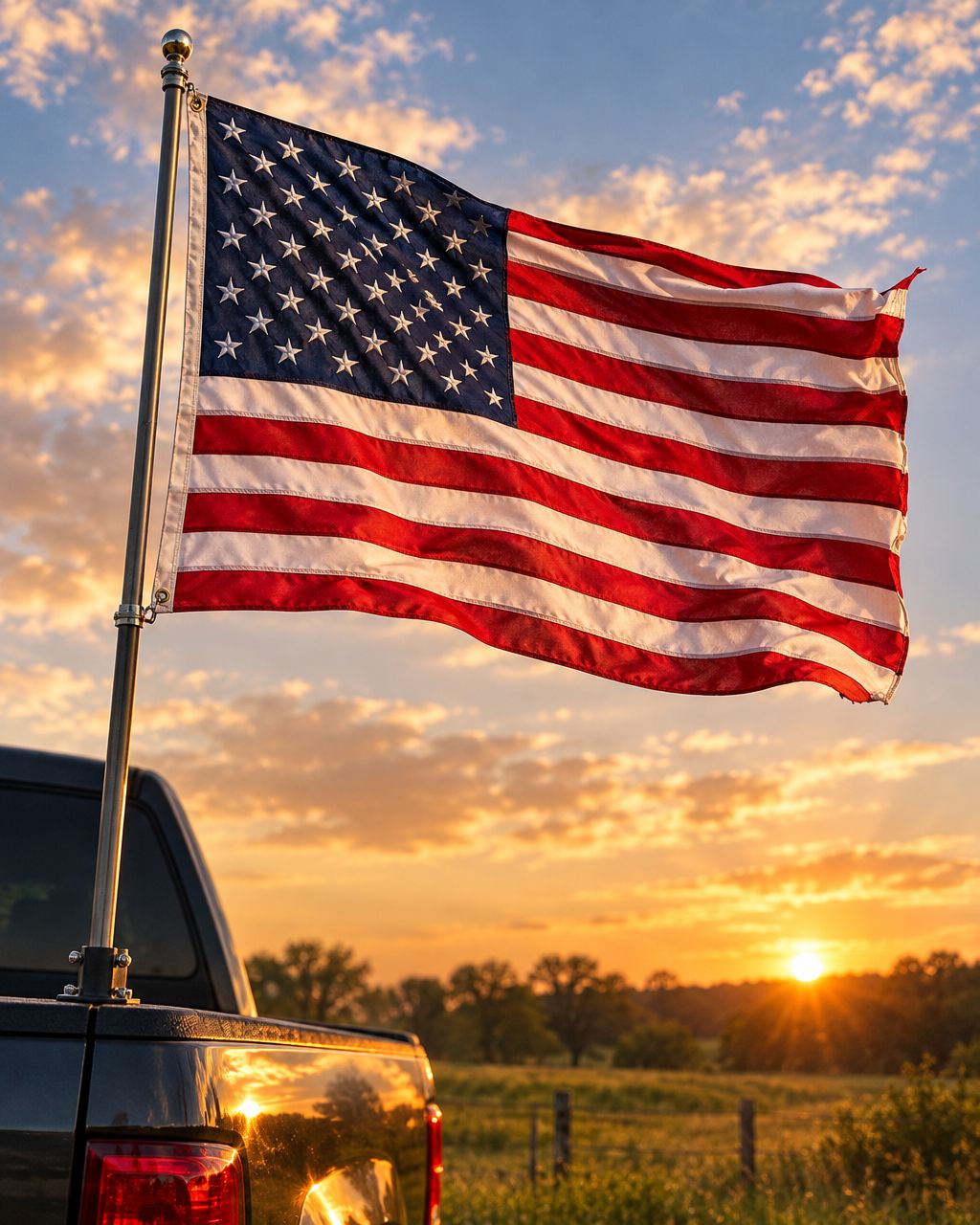
Sewn American flag with embroidered stars flying from a pole mounted in a pickup truck bed at sunset

A truck flag lives a harder life than any porch flag. It sits in a wind stream that never quits, flutters over every pothole, and gets judged by everyone behind you at the red light. Today the right answer is a stitched flag on a stout mount — and after walking the Ultimate Flags truck flags lineup, here is the ranking. Best overall: the Commercial 2-ply Poly Embroidered USA flag for a truck you drive daily at highway speed. Best for lighter parade duty: the Outdoor Nylon Embroidered USA flag. Best for Texas trucks: the Poly-Max Commercial Texas flag. Best double-sided: the Gadsden Don't Tread on Me double-embroidered flag.

TL;DR
  • Commercial 2-ply poly embroidered USA flag is the best overall truck flag for highway speed.
  • Outdoor nylon embroidered USA flag is the lighter pick for parades and slow drives.
  • Poly-Max commercial Texas flag carries state pride and shrugs off high wind.
  • Gadsden double-embroidered flag reads correctly from both sides of the road.
  • Sewn construction beats printed flags on a truck — stitching, not surface ink, survives the wind.
Ultimate Flags flag sale banner

Why this matters

A flag on a pickup is on display every mile it rolls. Highway wind snaps and saws at the fly end of a flag all day, and a cheap printed flag starts fraying and fading long before a sewn one does. The store's own truck flags collection notes that most of its truck flags are sewn double-nylon embroidered flags — thick and strong for durability, yet light enough to fly in a breeze — and it posts a caution about flying a flag at highway speed right on the collection page. That is the honest starting point: pick a construction built for the wind, mount it right, and drive accordingly. Today every flag below is stitched, not printed.

What makes the best truck flag

Rank these before you look at any listing:

  • Sewn stripes and embroidered stars. Stitched construction holds its weight and color in constant wind; printed ink sits on the surface and wears through.
  • Fabric weight matched to your driving. Heavy 2-ply polyester stands up to sustained highway wind; lighter nylon flies prettier at parade speed.
  • Reinforced fly end. The fly end takes all the abuse on a moving vehicle — multiple rows of stitching and reinforced corners are the standard you want.
  • Solid hardware. Brass grommets with reinforced holes tie down to a bed-mount pole without tearing out.
  • A mount that fits the truck. Bed-rail pole mounts are the common setup; match the flag's heading and grommets to the mount.
  • Honest expectations. No flag lasts forever at 70 mph — plan on inspecting the fly end regularly and retiring a worn flag with dignity.

Best truck flags at a glance

Flag Best for Standout feature Key limitation
Commercial 2-ply Poly Embroidered USA Daily highway driving Heavy 2-ply polyester that resists high wind, UV and fraying Heaviest option; needs decent wind to fly well
Outdoor Nylon Embroidered USA Parades and everyday display Lightest flyer — shows colors in a light breeze Wears faster than 2-ply at sustained speed
Poly-Max Commercial Texas Texas trucks and job sites Two-ply polyester built for outdoor durability One design — it is the Lone Star or nothing
Gadsden Double-Embroidered 3×5 Double-sided display Sewn and embroidered on both sides, nothing reads backwards Heavier than single-sided printed flags

1. Commercial 2-ply Poly Embroidered USA: best truck flag for highway speed

This is the flag for a truck that actually gets driven. It is built from 2-ply polyester bunting — the same construction the store sells for commercial and government poles — with sewn stripes, embroidered stars and a fly end finished with multiple rows of stitching. Polyester 2-ply resists high wind, UV damage and fraying, which is exactly the job description for a flag living in a truck's slipstream. It is made in America and carries brass grommets for a solid tie-down to the mount.

The trade-off is weight. A heavy 2-ply flag hangs limp in still air, so on a slow cruise through town it will not snap and wave the way a lighter nylon does. For a work truck or a daily driver that spends real time above 55 mph, that trade is worth making.

Pros:

  • Heavy 2-ply polyester built for high wind and outdoor durability
  • Embroidered stars and sewn stripes, nothing printed
  • Reinforced fly end and brass grommets
  • Made in America

Cons:

  • Needs a breeze or road speed to fly — hangs limp in still air
  • More flag than a once-a-year parade needs

Best for: daily drivers, work trucks and anyone flying at highway speed.

2. Outdoor Nylon Embroidered USA: best for parades and light wind

Nylon is the workhorse fabric of American flags, and on a truck it is the pretty flyer. It is a made-in-America embroidered nylon with sewn stripes and brass grommets, and because nylon is light, it lifts and shows its colors in the faintest breeze — the flag that photographs well rolling slow in a parade or parked at a tailgate. Sizes run from a 12 by 18 inch truck-and-boat size up through 3 by 5 feet and beyond.

The honest limit is wear. Light fabric in a constant wind stream works harder than the same flag on a porch, so at sustained highway speed the fly end ages faster than 2-ply polyester would. If your flag days are mostly parades, shows and around town, the nylon is the better-looking choice and the easier flyer.

Pros:

  • Lightest flying embroidered flag — colors show in a light breeze
  • Sewn stripes, embroidered stars, brass grommets
  • Runs in a 12 by 18 inch size that suits smaller mounts
  • Made in America

Cons:

  • Fly end wears faster than 2-ply at sustained highway speed
  • Lighter fabric is not the match for big-rig wind exposure

Best for: parade trucks, show trucks and around-town display.

3. Poly-Max Commercial Texas: best for a Texas truck

For a Texas truck, nothing else will do. This is the Lone Star flag in Poly-Max — a two-ply heavy-duty polyester the store describes as built for outdoor durability, resisting high wind, UV damage and fraying, and rated for commercial and government use. It runs in sizes from 3 by 5 up through 6 by 10 feet, all USA made, with the stitched construction that survives a job site or a long highway pull.

Like the 2-ply American flag above, it is a heavy fabric that wants wind or speed to fly. That is the right trade on a truck that works. Pair it with a stout bed mount and check the grommets after the first few runs — then let it fly.

Pros:

  • Two-ply polyester built for high wind and UV resistance
  • Commercial-grade construction, USA made
  • Sizes from 3 by 5 to 6 by 10 feet

Cons:

  • Heavy fabric hangs in still air
  • One design — a Texas flag only

Best for: Texas trucks, job sites and pride-of-state displays that fly every day.

4. Gadsden Don't Tread on Me Double-Embroidered: best double-sided truck flag

A single-sided flag reads backwards from the passenger side of the road. This Gadsden solves it: the rattlesnake and the words are sewn and embroidered on both sides of the flag, so nothing reads backwards, and the construction is heavy outdoor nylon built for tough duty. At 3 by 5 feet with grommets, it is sized for a standard bed mount.

The Gadsden design has been flying since 1775, when it served as one of the first flags of the Continental Navy, and it reads just as sharp on a truck today. Because both sides are fully embroidered rather than printed, it carries the weight and texture of a real sewn flag — and the price of that construction is extra weight in still air.

Pros:

  • Sewn and embroidered on both sides — correct reading from either side
  • Heavy outdoor nylon built for tough duty
  • Historic 1775 design with real weight and texture

Cons:

  • Double embroidery adds weight that hangs in calm air
  • Bright yellow shows road grime faster than darker flags

Best for: truck owners who want the design right from both lanes. When you are ready to pick one up, Shop Ultimate Flags and choose the double-embroidered 3 by 5.

How we ranked

Every flag here is a real listing in the Ultimate Flags truck flags collection, and the ranking follows the job a truck flag actually does. Sustained highway wind came first, which put the two-ply polyesters on top; parade looks and light-air flying came second, which kept the nylon in the mix; design pride and double-sided reading filled out the rest. Construction — stitched rather than printed — was the gate every flag had to pass, and none of the four wins every use.

Which truck flag should you choose?

If your truck sees highway miles every week, buy the Commercial 2-ply Poly Embroidered USA flag and check the fly end monthly. If your flag flies at parades and around town, the Outdoor Nylon Embroidered is the prettier, easier flyer. Texas truck, no debate — the Poly-Max Commercial Texas flag. And if you want the design right from both sides of the road, the Gadsden double-embroidered is the one. For the mount itself, match the flag's heading and grommets to the pole hardware — our guide to flag attachments and which one fits your pole walks through it.

Questions about truck flags

What is the best flag to fly on a truck?

For regular highway driving, a heavy 2-ply polyester flag with sewn stripes and embroidered stars is the best truck flag. It resists the high wind, UV exposure and fraying that destroy lighter flags in a truck’s slipstream.

Do truck flags shred at highway speed?

Any flag wears faster at highway speed — the wind stream works the fabric constantly. Heavy 2-ply polyester with a reinforced fly end lasts longest, and the store itself posts a caution about highway-speed flag flying on its truck flags collection page. Inspect the fly end regularly and retire the flag when it frays.

What size flag is right for a truck?

A 3 by 5 foot flag is the standard truck size on a bed-rail pole mount, and 12 by 18 inch flags suit smaller mounts and lighter poles. Bigger flags on a small mount overload the hardware and tear out grommets.

Is nylon or polyester better for a truck flag?

Polyester 2-ply is better for sustained highway speed because it is heavier and more abrasion resistant. Nylon is lighter and flies beautifully in a light breeze, which makes it the better parade and around-town flag.

How do I mount a flag on my truck?

The common setup is a pole mounted to the truck bed rail, with the flag attached by its brass grommets to the pole’s clips or halyard. Match the flag’s heading and grommets to the mount hardware and check the tie-downs after the first few drives.

How long does a flag last on a truck?

It depends on speed, weather and fabric — there is no fixed number. A sewn flag inspected and cared for regularly outlasts a printed one by a wide margin, and any flag flown daily on a moving vehicle will eventually need retiring.

One last thing

The truck flags collection carries more than the four ranked here — double-nylon sewn versions of the USMC flag, the Christian flag, POW/MIA, the Zavala Texas independence flag and a Confederate collectors edition fly from the same heavy construction, and the collection is worth a scroll if your loyalties run to a different design. And the same care rules apply to every one of them: after a rainy run, dry the flag fully before storing it — our guide to caring for a flag after rain covers the routine that stops mildew and fading. Today the rule that matters most has not changed: stitched construction and honest expectations beat every printed shortcut.

Posted on

Best embroidered American flags for government buildings

usa flag poly max embroidered heavy duty military grade outdoor flags for sale MADE in USA quality flags

A government building asks more of its flag than a front porch does. It flies all day in front of visitors, and every frayed edge shows. An embroidered American flag — sewn stripes and individually stitched stars — is the construction that holds up to that kind of scrutiny, and three versions do the job well. Best overall: the Commercial 2-ply Poly Embroidered flag for permanent outdoor poles. Best for everyday civic display: the Outdoor Nylon Embroidered flag. Best for indoor ceremonies: the 50-Star Cotton Sewn flag.

TL;DR
  • Commercial 2-ply poly embroidered is the best overall flag for permanent government poles.
  • Outdoor nylon embroidered spans sizes from 12 by 18 inches up to 30 by 50 feet.
  • 50-star cotton sewn flags fit indoor ceremonies, lobbies and memorial displays.
  • Check for four rows of stitching on the fly end and solid brass grommets.
  • Match flag fly length to pole height: roughly one quarter.
Ultimate Flags flag sale banner

Why this matters

A flagpole outside a courthouse, city hall, school or veteran service office is public display, not decoration. The flag is seen at close range by people who know what a real sewn flag looks like, and it often flies around the clock under lighting, which doubles the wear a home flag sees. Printed flags put the design on the surface of the fabric; embroidery and sewn construction put it into the fabric, which is why stitched flags keep their weight, color and shape long after a print starts to look tired. Choosing the right construction for the building's pole is a one-time decision that saves years of replacements, and every flag below is stitched, not printed.

What makes the best embroidered American flag for a government building

Rank these before you look at any listing:

  • Sewn stripes and embroidered stars. Stitched construction reads properly on both sides and carries the texture people expect on an official display.
  • Weight matched to the wind. An open-weave 2-ply polyester sheds gusts on tall exposed poles; lighter nylon flies better in a gentle breeze.
  • Fly-end reinforcement. The fly end takes the beating — four rows of stitching plus reinforced corners is the standard you want.
  • Solid hardware. Solid brass grommets with reinforced holes; a pole sleeve for indoor poles.
  • Size range. Civic poles run from a 20-foot pole with a 3 by 5 flag up to large building displays measured in tens of feet.
  • American-made fabric. Many government purchasers specify domestic flags, and the two outdoor lines below are made in America.

Best embroidered American flags for government buildings at a glance

Flag Best for Standout feature Key limitation
Commercial 2-ply Poly Embroidered Permanent outdoor poles, high wind Open-weave 2-ply bunting with a four-row fly end Heaviest option; more than a short-term display needs
Outdoor Nylon Embroidered Everyday civic display Size range from 12 by 18 inches to 30 by 50 feet Lighter fabric than 2-ply on exposed coastal sites
50-Star Cotton Sewn Indoor ceremonies and lobbies Traditional cotton look, grommets or pole sleeve Cotton is not an all-weather outdoor fabric

1. Commercial 2-ply Poly Embroidered: best for permanent outdoor poles

This is the flag for the pole that never comes down. It is built from 2-ply polyester bunting with an open weave that reduces wind resistance, so it handles high-wind locations and commercial flagpoles instead of fighting them. Each star is embroidered and every stripe is sewn — nothing is printed — and the fabric holds its color under constant sun with strong UV and tear resistance. Sizes run from 12 by 18 inches all the way to 30 by 50 feet, with three or more grommets on 8 by 10 foot flags and larger.

The finishing is what separates it from lesser flags Today: a double edge fold all around, four rows of stitching on the fly end where the wear concentrates, reinforced stitching at the fly corners, a white poly-cotton header, and solid brass grommets. Ultimate Flags lists government buildings among the recommended uses for this exact flag, and it is the one we point counties and school districts to first.

Pros:

  • Embroidered stars and sewn stripes, fully stitched on both sides
  • Open-weave 2-ply construction for high wind and permanent display
  • Four-row fly end with reinforced corners and brass grommets
  • Sizes from 12 by 18 inches to 30 by 50 feet, made in America

Cons:

  • The heaviest of the three, so it needs steady wind to fly well
  • More flag than a porch, a parade or a one-day event needs

Best for: courthouse, city hall and school poles that fly around the clock in open-country wind.

2. Outdoor Nylon Embroidered: best for everyday civic display

Nylon is the workhorse of American flags, and this line is the one most municipal buildings actually want. It is an American-made heavy duty embroidered nylon with sewn stripes, solid brass grommets and extra stitching in the fly corners, and it is a store best seller. Because nylon is light, it lifts and shows its colors in a light breeze when heavier fabric hangs limp — and that matters on a pole where the flag is the building's greeting. The size list is the widest available: 12 by 18 inches, 2 by 3, 3 by 5, 4 by 6, 5 by 8, 6 by 10, 8 by 12, 10 by 15, 12 by 18 feet, 15 by 25, 20 by 30 and up to 30 by 50 feet.

The construction details match the commercial flag: embroidered stars on both sides, double and quad stitched edges, and reinforced grommet holes with metal rings. Where it differs is weight and weave — nylon is waterproof, dries fast and treats daily raising and lowering kindly. For a pole that flies from sunrise to sunset with a staff that takes the flag down in storms, this is the right flag.

Pros:

  • Lightest flying embroidered flag — shows its colors in a light breeze
  • Widest size range of any American flag line, 12 by 18 inches to 30 by 50 feet
  • Sewn stripes, embroidered stars, brass grommets, reinforced corners
  • Made in America

Cons:

  • Lighter fabric wears faster than 2-ply polyester on exposed coastal or high-wind sites
  • Not the choice for a pole that never takes the flag down

Best for: municipal offices, fire stations and veteran service buildings on standard 20 to 35 foot poles.

3. 50-Star Cotton Sewn: best for indoor ceremonies

Cotton is the traditionalist's fabric, and indoors it is unbeatable. This 50-star cotton flag is fully sewn with embroidered stars, available with grommets or a pole sleeve in sizes from 2 by 3 up to 6 by 10 feet, and it is the flag that looks right hanging in a lobby, standing on an indoor ceremonial pole, or draped in a memorial display. Cotton holds deep colors and a matte finish that photographs well behind a podium — the reason it remains the standard for indoor official ceremonies. For a full walkthrough of sizes and indoor pole setups, see our guide to American flags for indoor ceremony displays.

Keep cotton inside or under cover: it is not an all-weather fabric, and an outdoor cotton flag fades and breaks down faster than nylon or polyester. When you are ready to pick one, Shop Ultimate Flags Store and choose grommets for an outdoor-style halyard or a pole sleeve for an indoor stand.

Pros:

  • Traditional cotton look and feel for indoor ceremony
  • Fully sewn with embroidered stars
  • Choice of grommets or pole sleeve
  • Sizes from 2 by 3 to 6 by 10 feet

Cons:

  • Not for permanent outdoor display
  • Needs more careful storage than synthetic flags

Best for: lobby displays, ceremonial indoor poles and memorial presentations.

How we ranked

Every flag here is a real Ultimate Flags listing, and the ranking follows the job: permanence first, everyday flying second, indoor tradition third. We weighted construction — embroidered stars, sewn stripes, fly-end stitching count — then hardware such as brass grommets and reinforced holes, then size coverage for civic poles, then made-in-America sourcing. Each construction wins the use where it outlasts the other two, and none of the three wins every use.

Which embroidered American flag should you choose?

If the flag flies 24 hours a day on a permanent pole, buy the Commercial 2-ply Poly Embroidered and size it to the pole. If the building's staff raises and lowers it daily on a standard pole, the Outdoor Nylon Embroidered is the better match — it is the store's best seller for a reason. If the flag lives indoors for ceremonies, the 50-Star Cotton Sewn is the one that looks the part. All three are made in America and carry the same stitched construction standard, so the smart way to shop is to pick by where the flag will live, not by the label on the box.

Questions about embroidered American flags

What is the best American flag for a government building?

For a permanent pole that flies around the clock, a commercial 2-ply polyester embroidered flag with sewn stripes is the best overall choice. For daily raising and lowering, an outdoor embroidered nylon flies better in a light breeze, and for indoor ceremonies a sewn cotton flag is the traditional standard.

What size American flag fits a 20 foot pole?

A 3 by 5 foot flag fits a 20 foot pole. The store rule of thumb puts the flag’s fly length at about one quarter of the pole height, so a 20 foot pole takes a 3 by 5 and a 32 foot pole takes a 5 by 8.

What is the difference between an embroidered flag and a printed flag?

An embroidered flag has stitched stars and sewn stripes, so the design is built into the fabric with weight and texture on both sides. A printed flag puts the design on the surface of the fabric, which costs less but looks flatter and fades sooner in constant sun.

Are the stars embroidered on both sides of the flag?

Yes. On both the 2-ply polyester and the nylon lines the design is embroidered on both sides — it reads properly on the front and reversed on the reverse, which is correct flag construction.

Can a nylon American flag stay outside in the rain?

Yes for ordinary rain — the nylon is waterproof, tear and fray resistant, and dries fast. Most display staff still take the flag down in severe storms, which is standard flag etiquette and the biggest factor in how long any flag lasts.

How big do American flags get for large buildings?

Both outdoor lines run up to 30 by 50 feet, with common large-building sizes such as 10 by 15, 15 by 25 and 20 by 30 feet. Flags 8 by 10 feet and larger carry three or more grommets for added support.

One last thing

Measure before you order. The quarter rule — flag fly length about one quarter of the pole height — is the sizing standard the store uses on every American flag listing, and it is the difference between a flag that snaps proudly and one that looks lost on a tall pole. And when a government flag finally retires, give it a dignified end: most American Legion posts and scout troops run flag retirement collections year-round, and a worn flag turned in properly is part of the same respect you showed it on the pole.

Posted on

Is it legal to display a Confederate flag on private property?

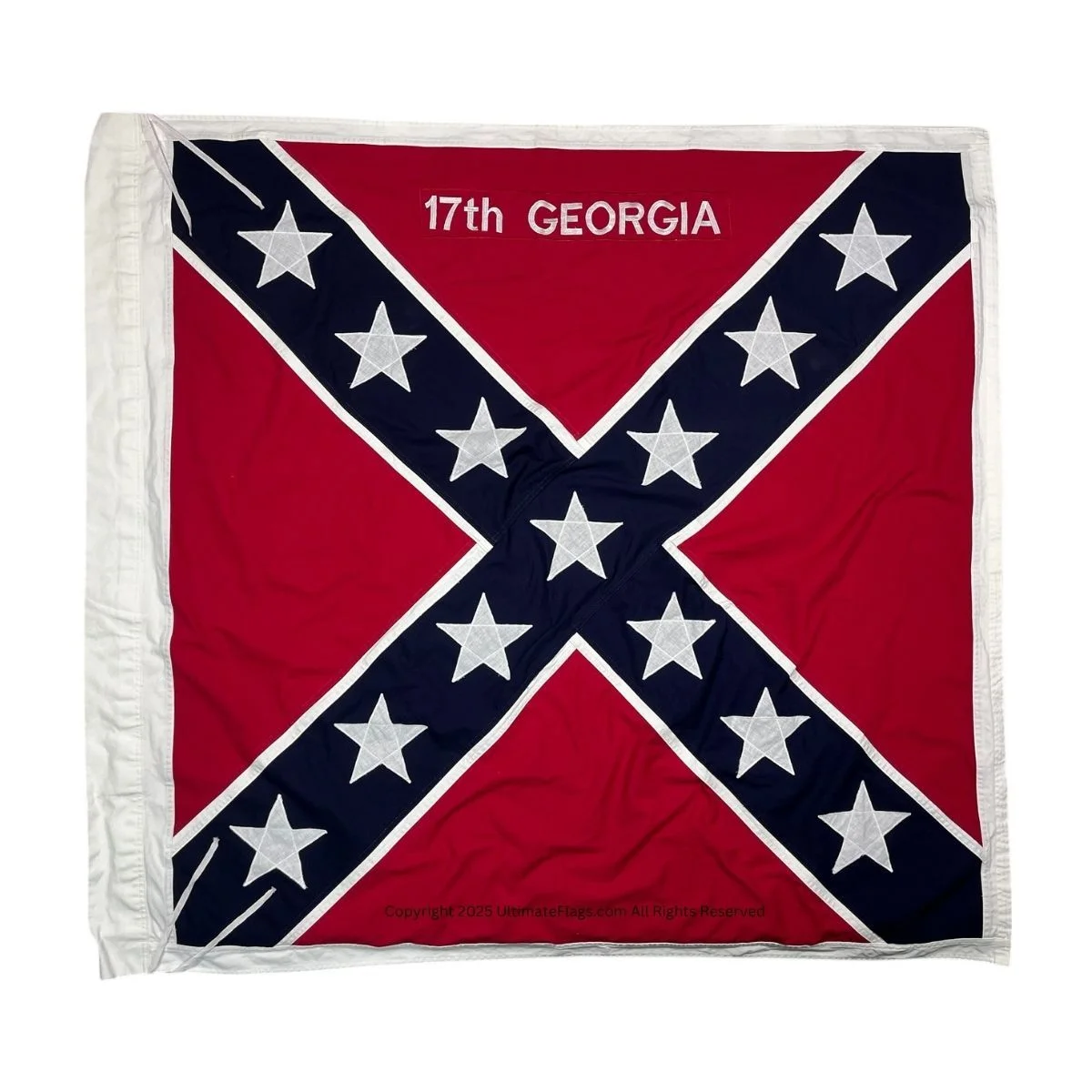
17th Georgia Confederate infantry battle flag replica in 52 by 52 inch cotton with pole sleeve and ties

Yes — there is no federal law and no state law in the United States that makes it illegal to display a Confederate battle flag on property you own or rent as your home. The First Amendment keeps the government from banning a flag because of its message, and no statute has ever criminalized the design itself. The catch is that homeowners associations, landlords and private employers are not the government, and their rules can still cost you — the federal law that shields the American flag from an HOA ban does not cover the battle flag. If you’re still choosing a flag, see our full range of rebel flags for sale.

TL;DR
  • No federal or state law bans the design on your own property.
  • Government may only apply neutral rules like pole height or setbacks.
  • HOAs can restrict it: the 2005 federal act protects only the U.S. flag.
  • Leases and employer policies can force removal — they are private rules.
  • Texas v. Johnson (1989) and Virginia v. Black (2003) anchor the legal backdrop.
Ultimate Flags flag sale banner

Is it legal to display a Confederate flag on private property?

Yes, on the law as it currently stands. Neither Congress nor any state legislature has passed a statute that forbids the design, and the courts have held for decades that the government cannot punish a flag for the message it carries. Your obligations come from elsewhere: private agreements you signed and neutral local rules that treat every flagpole in town the same.

Here is who can and cannot stop you:

Who Can they make you take it down?
Federal government No — no federal law bans the design on private property
City or county Only neutral rules that apply to every flag: pole height, setbacks, permits
HOA or condo association Yes, for the battle flag — the 2005 act protects only the U.S. flag
Landlord Yes, if the lease bans flags or specific designs
Employer Usually yes on company property, because the company is a private party

What the First Amendment actually protects

The Supreme Court has treated flags as speech since long before today's debates. In Texas v. Johnson (1989), the Court held that even burning the American flag is protected symbolic speech — the government may not punish a person for the message an act or object communicates. In Virginia v. Black (2003), the Court struck down a Virginia law against cross burning to the extent it was written to single out one viewpoint, holding that a law aimed at a particular message fails where a neutral, generally applicable rule would serve. And in Walker v. Texas Division, Sons of Confederate Veterans (2015), the Court held that state-issued specialty license plates are government speech, so Texas could refuse the battle flag design on its own plates.

Read together, the three cases draw one clean line that still holds Today: the government cannot make an example of your flag because of what it stands for, but it can enforce rules that apply to every flag and every pole equally — and it keeps full control over what appears on government property and state-issued materials.

The Freedom to Display the American Flag Act of 2005 — and where it stops

Congress did pass one flag law aimed at homeowners associations: the Freedom to Display the American Flag Act of 2005 (Public Law 109-243). It stops an HOA or condo association from adopting or enforcing rules that prevent a resident from displaying the American flag outdoors on residential property.

Notice what the law does not say. It protects the flag of the United States and no other design. A battle flag, a state historical flag, a Gadsden or a Bonnie Blue — all of them sit outside the act, which means your association is free to allow the U.S. flag and prohibit every other banner, and many do.

That 52 by 52 inch cotton replica, like the regimental flags carried in the 1860s, is the pattern most collectors display indoors — which is also where association rules bite hardest, in hallways, balconies and shared walls.

Where the rules bite: HOAs, leases and employers

Private restrictions do the work that the law cannot. In practice, removal demands almost always trace back to one of these:

  • HOA covenants. Most associations can ban exterior flagpoles outright, cap pole height, or limit flags to the American flag and seasonal banners. Those rules are contracts you agreed to when you bought.
  • Lease clauses. A landlord can write flags out of the lease entirely. If you signed it, the ban is enforceable between private parties no matter what the First Amendment says about the government.
  • Condo documents. Balconies, entry doors and windows facing shared elements are usually governed by association rules even inside your own unit.
  • Employer policies. On company property — office, worksite, company vehicle — the employer is a private party and can set its own display rules.
  • Rental communities and campgrounds. The same logic applies: private management, private rules.

The practical move is the same one a flag store owner would give you at the counter: read the covenants or lease before you dig the post hole, not after the certified letter arrives.

Zoning and flagpole rules that apply to any flag

Local governments regulate poles, not messages. Typical content-neutral rules cover pole height caps, side-yard setbacks, and building permits above a certain height. A rule like "no pole over 25 feet in a residential district" is lawful because it applies to the American flag, the state flag, and every other banner equally.

Size the flag to the pole while you are at it. The quarter rule is the store standard: the flag's fly length should be roughly one quarter of the pole height, so a 20-foot pole calls for a flag with about a 5-foot hoist — a 3 by 5 foot flag flies well on a 20-foot pole, and a 5 by 8 goes up as the pole grows. Get that ratio right and a neutral pole rule will rarely bother you.

The same display logic holds across the historical families: a Bonnie Blue in double-nylon suits an outdoor pole in all weather, while cotton and fringed replicas belong indoors or under cover.

Displaying it well: plain advice for collectors

Whatever you fly, fly it accurately. The rectangular battle flag most people picture was never one single design — the Army of Northern Virginia carried square patterns while the western armies carried rectangles, and our guide to why Confederate battle flags have different shapes walks through the differences. Knowing which pattern you have matters to collectors and keeps a reproduction honest about what it is.

A reproduction sold today is a modern sewn copy, not a wartime relic, and labeling it that way — indoors on a stand, in a case, or on a pole in the yard — is both good history and good neighbor practice. At Ultimate Flags, cotton 52 by 52 inch replicas with pole sleeves and ties are built for indoor ceremonial display, while double-nylon embroidered flags are the all-weather choice for a yard pole. If you are still choosing the piece itself, see our 51 x 51 inch cotton infantry battle flag and match the fabric to where it will hang.

Why the answer varies

Same flag, same street, different outcomes — the variables that decide it:

  • Who is the enforcer. Government is bound by the First Amendment; an HOA, landlord or employer is not.
  • Which flag. The U.S. flag carries statutory protection in HOAs; every other design relies on your private agreements.
  • Where on the property. A pole in your yard is governed differently from a balcony door, a window, or a shared clubhouse.
  • State add-ons. Several states layer extra protections on top of the 2005 act for the U.S. flag in condominium settings — again, that protection does not extend to historical battle flags.
  • The paperwork you signed. Covenants, lease clauses and employee handbooks do the enforcing.

Related questions about flag display rules

Can my HOA make me take down a Confederate flag?

Yes. The Freedom to Display the American Flag Act of 2005 protects only the U.S. flag from HOA bans, so an association can prohibit every other design. The ban runs through the covenants you agreed to, not through criminal law.

Is it legal to display a Confederate flag on private property?

Yes. No federal or state law bans the design on private property. Your only limits are private rules like HOA covenants and leases, plus neutral zoning rules that apply to every flagpole.

What did the Supreme Court decide about Confederate flag license plates?

In Walker v. Texas Division, Sons of Confederate Veterans (2015), the Court held that specialty plates are government speech. A state can refuse the design on its own plates while you remain free to fly it at home.

Does the U.S. Flag Code make any flag display illegal?

No. The Flag Code is advisory etiquette with no penalties, and it addresses the American flag only. It has never been enforceable law against a private citizen.

Can my landlord ban flags at a rental house?

Yes. A lease is a private contract, and a landlord can restrict flag display within it. The First Amendment limits the government, not private parties.

Can I fly a Confederate flag at a courthouse or public school?

Generally no. Display on government property is government speech, and public agencies control it. The legal freedom discussed here applies to your own private property.

One last thing

The flag on the pole and the law on the books changed at different speeds. The battle flag most people picture was a military banner adopted in 1861-1862, not a national flag, and the legal landscape around it has stayed essentially unchanged since the 2015 license-plate decision — private property display remains lawful, and private rules remain the real gatekeeper. State and city codes do get amended, so before you set the pole, give your local code a fresh read for anything new, and label every reproduction for what it honestly is.

Posted on

Best 48 star flags for collectors

Best 48 star flags for collectors in 2026

Best overall: the sewn 2-ply double nylon 48 star flag — embroidered stars on both sides and the closest thing on the market to the flag that flew over America from 1912 to 1959. Best for ceremonial and indoor displays: the sewn cotton 48 star flag in 3×5, 4×6 and 5×8 ft sizes. Best budget option: the printed 3×5 ft standard polyester 48 star flag. All three sit in the Ultimate Flags 48 star flag lineup, and each one answers a different collecting question, so the right 48 star flag depends on where it will fly and who will see it.

Quick answer
  • The sewn 2-ply double nylon 48 star flag wins overall: embroidered stars, all-weather, longest lasting.
  • Sewn cotton is the collector and ceremony pick; it is not made for year-round outdoor weather.
  • Printed standard polyester is the budget pick for fair-weather porches, parades and events.
  • The 48 star design was official from 1912 to 1959 — 47 years, the longest any US flag design has served.
  • Buy by display, not by habit: nylon outdoors, cotton indoors, polyester on a budget.

Ultimate Flags flag sale banner

What makes the best 48 star flag for collectors

Six checks settle it before any comparison table:

  • Correct star field. 48 stars in six staggered rows of eight — the exact pattern President Taft's 1912 executive order standardized. A flag with a wrong arrangement is not a 48 star flag, whatever the label says.
  • Construction that matches the display. Embroidered stars and sewn stripes for collections and ceremonies; through-printed polyester for everyday fair-weather flying.
  • Fabric honesty. Cotton looks and feels period-correct but should not live outside; nylon sheds rain; polyester trades lifespan for price.
  • Sizes that fit the pole or the room. 3×5 ft suits most home mounts; 4×6 and 5×8 ft fill larger rooms, stages and bigger poles.
  • Accurate proportions. The same 1912 order set the flag's proportions, so a well-made reproduction keeps them.
  • Documentation. A store that dates the design (1912 to 1959) and explains its history is easier to trust than one that does not.

48 star flags at a glance

Flag Best for Standout feature Key limitation
Sewn 2-ply double nylon 48 star flag All-weather outdoor display 48 embroidered stars on both sides Highest cost of the three
Sewn cotton 48 star flag Ceremonial and indoor displays Traditional cotton with embroidered stars Not built for extended outdoor exposure
Printed 3×5 ft standard polyester Budget and fair-weather display Light weight, flies in a slight breeze Printed, not sewn; shorter outdoor life

1. Sewn 2-ply double nylon 48 star flag: best for outdoor display

This is the working replica. The double-nylon version at Ultimate Flags uses two plies of nylon with 48 embroidered stars on both sides, sewn — not printed — stripes, two brass grommets, quad-stitched seams and a reinforced fly end. That is the construction list of a flag meant to spend its life on a pole, and it is the one to hang outdoors if you want a 48 star flag that outlasts the seasons.


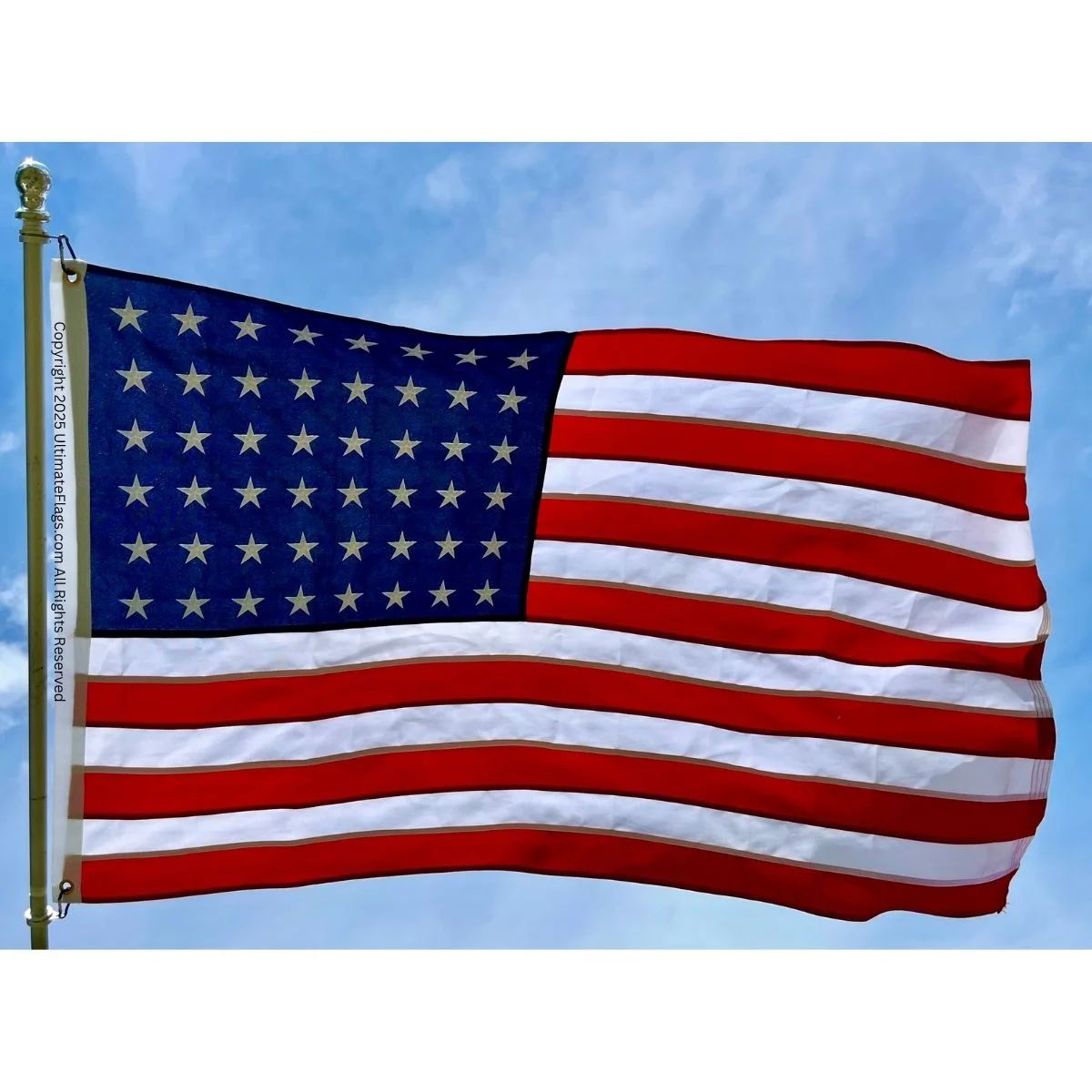
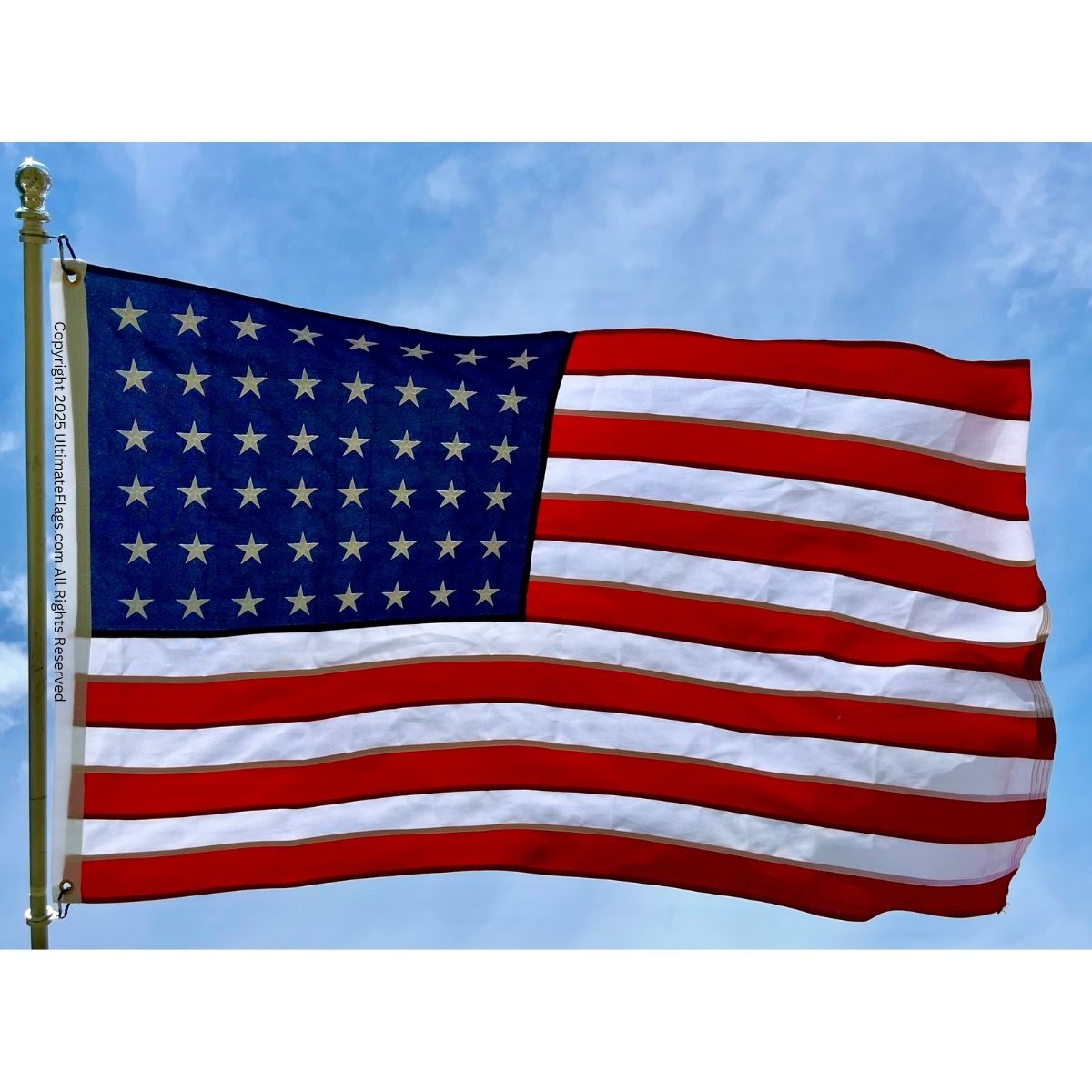
48 star American flag in sewn 2-ply double nylon with embroidered stars flying on a pole against a blue skyBuy This Flag- Click Here
The store’s 3 × 5-foot sewn double-nylon 48 star flag flying outdoors — embroidered stars on both sides and a reinforced fly end for wind.

Sewn 2-ply double nylon 48 star flag pros:

  • Embroidered stars on both sides; stripes sewn, not printed
  • Double-ply nylon sheds rain and resists fading and tearing
  • Quad-stitched seams and a reinforced fly end handle steady wind
  • Weight and drape come closest to a period 48 star flag

Cons:

  • Costs more than the other two versions
  • Heavier fabric needs a reasonable breeze to fly at full stretch

Best for: outdoor poles, veteran memorials and year-round display.

2. Sewn cotton 48 star flag: best for ceremonial and indoor displays

Cotton is the traditionalist's fabric, and this version covers the sizes collectors actually ask for: 3×5, 4×6 and 5×8 ft. The stars are embroidered and the stripes sewn, the mounting is brass grommets, and the seams are double-stitched. The store's own product guidance is blunt about the trade: cotton flags are not designed for extended outdoor exposure, so plan this one for indoor and ceremonial duty.


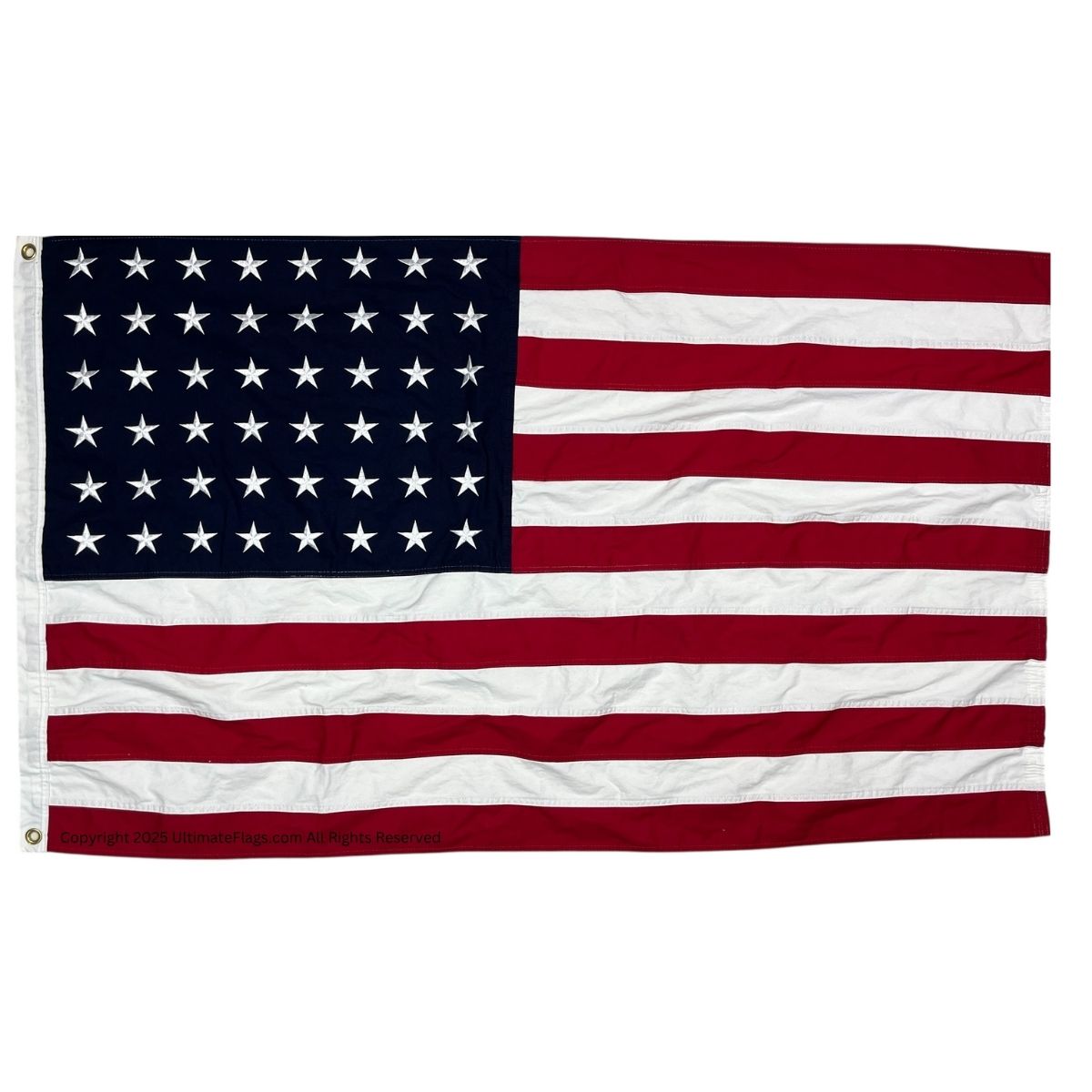
Sewn cotton 48 star American flag with embroidered stars and sewn stripes, shown flatShop Now
The sewn cotton 48 star flag, shown flat: embroidered stars on genuine cotton, made in 3 × 5, 4 × 6 and 5 × 8 ft sizes for indoor and ceremonial use.

Sewn cotton 48 star flag pros:

  • Embroidered stars and sewn stripes on thick premium cotton
  • Three sizes — 3×5, 4×6 and 5×8 ft — for rooms, stages and large poles
  • The traditional look museums, schools and honor guards expect
  • Brass grommets and double-stitched seams for careful handling

Cons:

  • Not made for extended outdoor exposure
  • Heavy when wet and slower to dry than nylon
  • Needs gentler care than the synthetic versions

Best for: classrooms, museums, reenactment camps, ceremonies and framed collector displays.

3. Printed 3×5 ft standard polyester 48 star flag: best budget pick

The standard version is printed rather than sewn, but it is printed through, so the design reads correctly on both sides. The fabric is a 100% synthetic, waterproof super-weave polyester with bright, fade-resistant inks, double-stitched edges all around and reinforced grommet holes with metal rings. Because it is light, it flies well even in a slight breeze — the store lists it as its most popular quality level, and for good reason Today: it is the easy choice for parades, events, seasonal porch display and gifts.

Printed standard polyester 48 star flag pros:

  • The lowest-cost way to own a correct 48 star design
  • Light weight flies in the slightest breeze
  • Through-printed, so the design shows on both sides
  • Waterproof synthetic material with reinforced metal grommets

Cons:

  • Printed, not sewn — collectors will notice at close range
  • Fair-weather construction; not for year-round storms
  • Shortest outdoor lifespan of the three

Best for: parades, events, seasonal display and first-time buyers on a budget.

How we ranked these 48 star flags

The six criteria above did the sorting. All three flags carry the correct six-by-eight star field, so construction and fabric fit decided the order. The double nylon wins on durability and authenticity of feel, the cotton wins on tradition and ceremony, and the polyester wins on price. No printed flag outranks a sewn one for a collection, and no cotton flag belongs at the top of an outdoor ranking — which is why the three sit in this order rather than a different one.

A short history worth knowing before you buy

The 48 star flag became official on July 4, 1912, after New Mexico and Arizona pushed the state count to 48, and it served until July 3, 1959 — 47 years, longer than any other American flag design until the 50-star flag passed it in 2007. President Taft's executive order of June 24, 1912 standardized both the staggered six-by-eight star pattern and the flag's proportions, which is why accurate reproductions share the same clean geometry. This is the flag that flew during World War I, World War II — including the one raised on Mount Suribachi at Iwo Jima in 1945 — and the Korean War. For the etiquette side of flying one today, the guide Can you fly a 48 star flag today? covers lighting, weather and half-staff rules in detail.

Which 48 star flag should you buy?

Buy the sewn 2-ply double nylon if the flag will live outdoors. Buy the sewn cotton if it will hang indoors, travel to reenactments or headline a ceremony — the 4×6 and 5×8 ft sizes fill a large room in a way a 3×5 printed flag cannot. Buy the printed standard polyester if you want a correct 48 star flag for a parade, a fair-weather porch or a budget gift. When you are ready to Shop Ultimate Flags Store, all three versions sit side by side in the 48 star flag category, which makes comparing fabric and size in one place simple.

FAQ

What years was the 48 star flag official?

July 4, 1912 to July 3, 1959. It followed New Mexico and Arizona statehood and gave way to the 49-star flag after Alaska joined the Union — 47 years in total, the longest run of any US flag design until the 50-star flag passed it in 2007.

How are the 48 stars arranged?

In six staggered rows of eight — 6-8-6-8-6-8. President Taft’s June 24, 1912 executive order set that pattern and the flag’s proportions.

Which 48 star flag is best for outdoor use?

The sewn 2-ply double nylon version. It has embroidered stars on both sides, sewn stripes, quad-stitched seams and a reinforced fly end for all-weather flying.

Can a cotton 48 star flag fly outside?

Not for extended periods. The store’s own guidance says cotton flags are for indoor and ceremonial use; for permanent outdoor display choose the double-nylon version.

What size 48 star flag should I buy?

3×5 ft fits most home poles and standard displays. Choose 4×6 or 5×8 ft cotton for large rooms, stages and ceremonies where the flag is the centerpiece.

Was the Iwo Jima flag a 48 star flag?

Yes. The flag raised on Mount Suribachi in February 1945 carried 48 stars — the design had been official since 1912 and served through World War II.

Is a printed 48 star flag acceptable to display?

Yes, for parades, events and fair-weather display. Collectors and ceremonies generally prefer sewn and embroidered versions for their look and durability.

One last thing

One detail even careful buyers miss: the 1912 executive order set the flag's proportions as well as its star pattern, so a 48 star flag that looks slightly too long or too square is drifting from the documented design. Check the geometry, then buy the fabric that matches where the flag will actually fly — that single decision matters more than any other on this page.

Posted on

Best state flags for indoor office displays

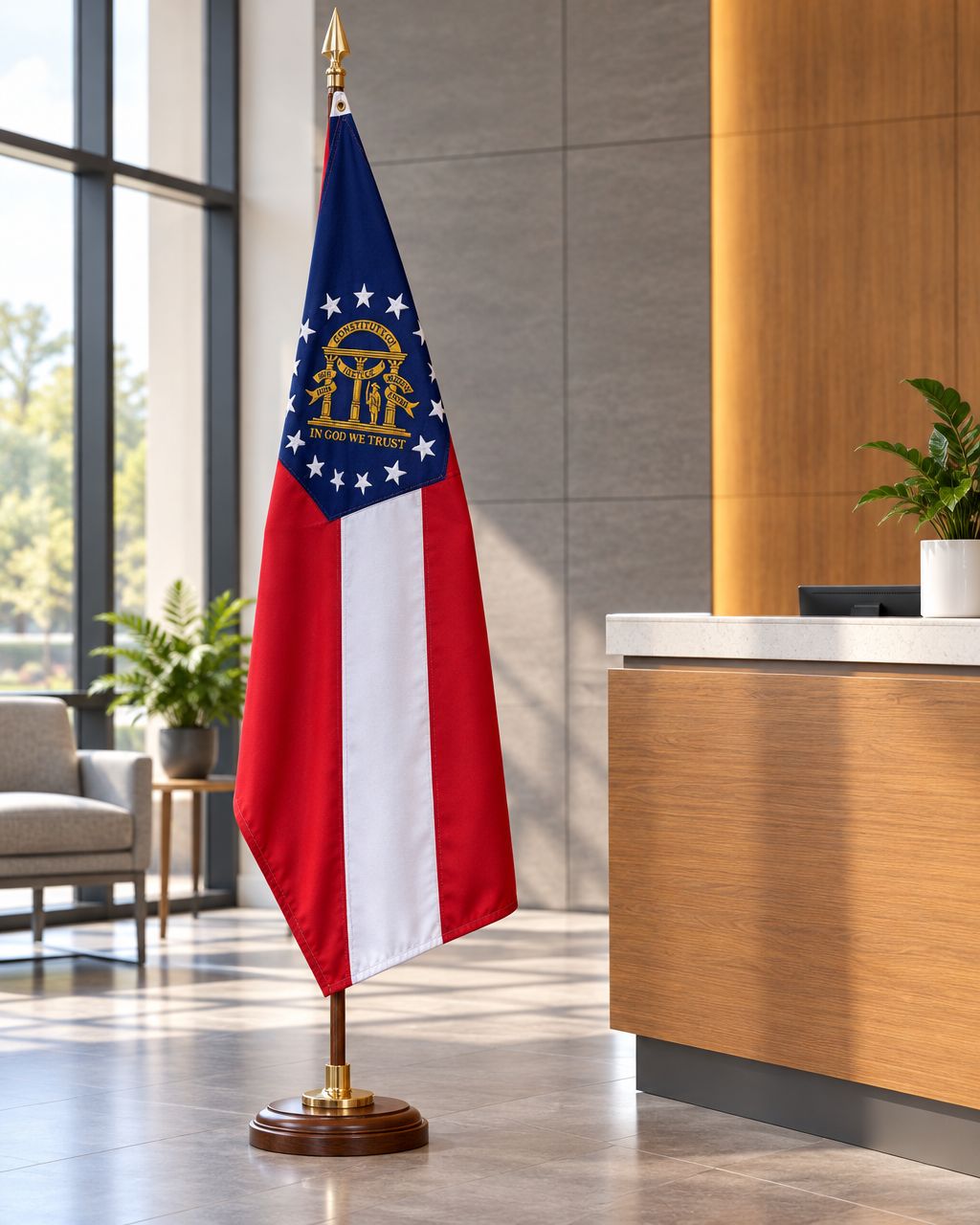
Current Georgia state flag in sewn fabric hanging on an indoor flagpole beside a modern office lobby reception desk

The best state flag for an indoor office display is a sewn 3×5 ft double-nylon flag with a pole sleeve: it hangs straight without any wind, reads clearly across a lobby, and stands up to years of handling. The best budget pick is a printed 3×5 ft polyester flag for smaller offices. The most formal pick is embroidered cotton for executive suites, and the best heritage pick is a historical state design chosen deliberately and labeled for what it is.

TL;DR
  • A sewn double-nylon 3×5 ft flag with a pole sleeve is the best overall office display pick.
  • Printed 3×5 ft polyester is the budget choice for cubicles and small offices.
  • Embroidered cotton is the most formal option for executive suites and ceremonial rooms.
  • Match the design to the state’s official flag — current and historical versions are not interchangeable.
  • Ultimate Flags sells current and historical state flags with grommet or pole-sleeve finishes.

Ultimate Flags flag sale banner

Why an office wall is a different flag job

Outdoors, a flag has wind doing half the work: the breeze lifts the fabric and shows the design. Indoors, nothing moves the cloth at all, so the flag has to hold its shape on its own. A limp printed flag that looks fine in a product photo can hang like a wet towel on an office wall, and a shiny fabric can wash out under fluorescent light.

Offices also add rules that porches never see. A display in a lobby or reception area represents the organization to every visitor, so the flag needs to be the correct current design, hung at a sensible height, and kept clear of furniture and doorways. None of that is hard — it just changes what "best" means when you are shopping for state flags for sale.

What makes the best indoor office state flag

  • Size that fits the wall. A 3×5 ft flag suits most offices; anything larger needs a tall wall and a bigger pole.
  • Fabric that hangs straight without wind. Heavier sewn fabrics drape better indoors than thin printed ones.
  • An attachment that matches the pole. A pole sleeve gives the cleanest indoor hang; grommets suit clip-style hardware.
  • Artwork readable from across the room. Detailed seals can turn to mush at a distance — check the viewing distance before choosing.
  • The correct current design. Match the artwork to the state's official flag, especially when a store also sells historical versions.
  • A finish that suits the lighting. Matte cotton and sewn nylon photograph better under office lighting than glossy printed film.

Best state flags for indoor office displays at a glance

Option Best for Standout feature Key limitation
Sewn double-nylon 3×5 ft Lobbies, reception areas, open offices Embroidered artwork that holds its shape with no wind Costs more than printed flags
Printed polyester 3×5 ft Cubicles, small offices, temporary displays Lightest and most affordable indoor option Less depth and texture up close
Embroidered cotton Executive suites, ceremonial rooms Richest traditional look under indoor lighting Needs dry, careful storage
Historical state design Heritage displays and collector offices Represents a specific earlier design Must be identified clearly, never passed off as the current flag

1. Sewn double-nylon 3×5 ft: best overall for lobbies and open offices

A sewn flag is built from cut-and-stitched panels with embroidered or appliqued artwork, and that construction is exactly what an indoor display needs. Without wind to unfurl it, a heavier sewn fabric still falls in soft, defined folds instead of clinging to the pole, and embroidered details keep their shape when a printed flag would blur. Nylon adds a practical bonus: it is light enough for a standard indoor pole and resists the wrinkles that come out of a storage bag an hour before a meeting.

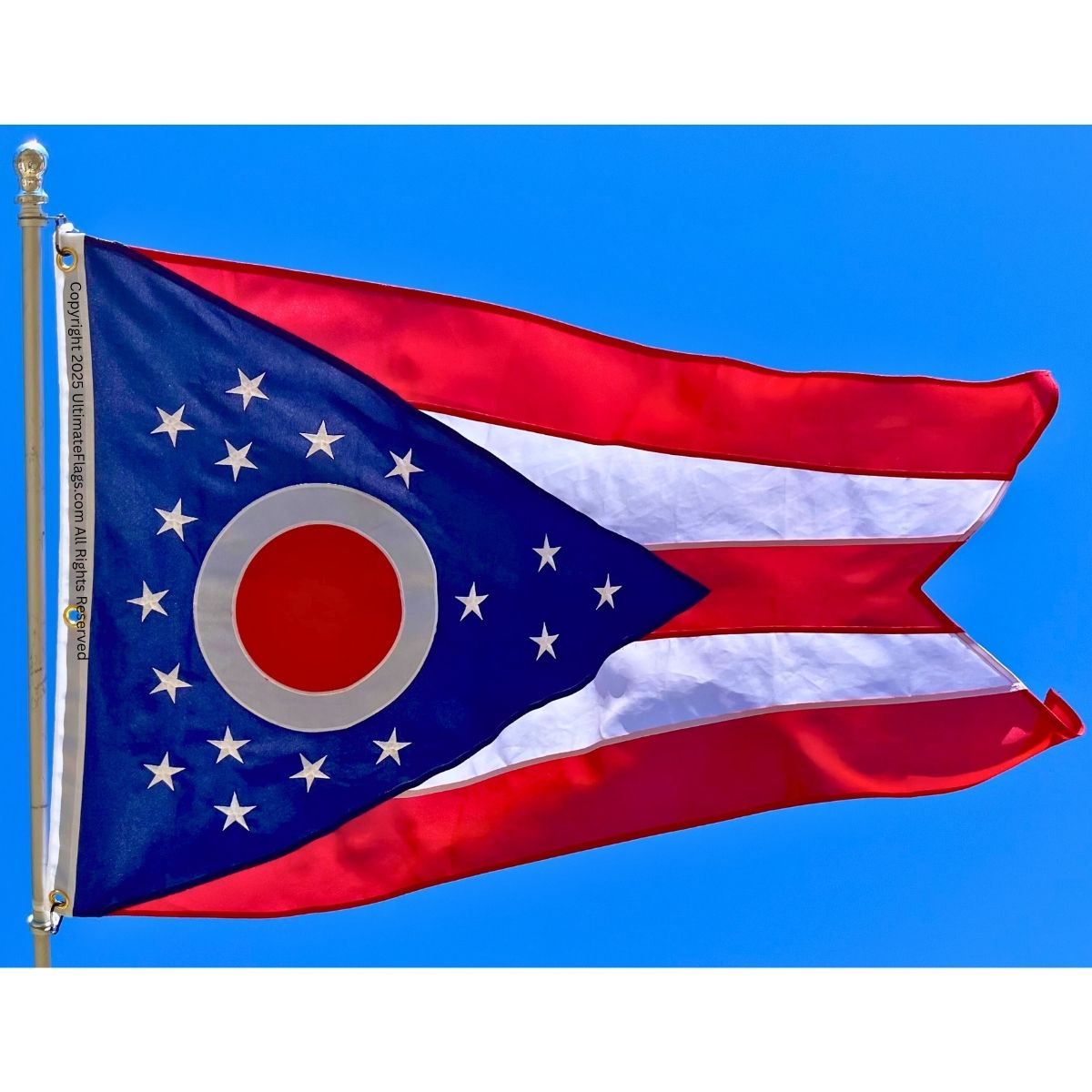
Ultimate Flags' sewn double-nylon state flags, like the Ohio flag below, are finished for heavy-duty use and can be matched to your pole hardware.

Sewn double-nylon embroidered Ohio state flag flying against a bright blue skyShop Now
Sewn double-nylon Ohio state flag with embroidered stars — Ohio’s swallowtail burgee design dates to 1902.

Where it shines:

  • Holds a crisp shape indoors with no breeze to help it
  • Embroidered artwork stays sharp from across a large room
  • Light enough for standard indoor poles and frequent rehanging
  • Durable enough for daily office display year after year

Where it falls short:

  • Costs more than a printed flag of the same size
  • Nylon's slight sheen reads a touch less formal than cotton

Best for: the lobby, reception desk or main hall of almost any office.

2. Embroidered cotton: best for executive suites and ceremonial rooms

Cotton is the traditionalist's fabric. A sewn cotton flag has a heavyweight drape and a matte finish that flatters indoor lighting, which is why courtrooms, city halls and formal conference rooms still favor it. In an executive suite or a room used for ceremonies and photographs, cotton is the flag that looks the part.

The trade-off is care. Cotton must stay dry — a flag stored even slightly damp can mildew, and mildew will not wash out of embroidered stitching. If your office flag comes down for storage regularly, cotton needs a proper routine: dry it fully, store it flat or rolled loosely, and keep it out of sealed plastic bins.

Where it shines:

  • The richest, most formal appearance under indoor lighting
  • Heavy drape that hangs in clean folds on a pole
  • The classic choice for rooms used for ceremonies and photos

Where it falls short:

  • Demands dry storage and careful handling
  • Heavier fabric needs a sturdy pole and stand

Best for: executive suites, boardrooms and any room where the flag appears in formal photographs.

3. Printed 3×5 ft polyester: best budget pick for cubicles and small offices

A printed flag gets its design from dye printed onto the fabric in one pass, which keeps the cost down and the weight light. For a cubicle wall, a small branch office, a trade-show booth or a temporary display, printed 3×5 ft polyester does the job at the lowest price in the lineup.

Be honest about the setting, though. Up close — the distance of a desk or a hallway — a printed flag shows its flatness next to a sewn one, and it hangs with less body when the air is still. In a small office where visitors stand a few feet away, that difference is noticeable. Rule of thumb: printed for distance and budget, sewn for close viewing.

Where it shines:

  • Lowest cost of any construction
  • Lightest fabric, easy to hang and store
  • Fine for backdrops, booths and temporary displays

Where it falls short:

  • Flat, single-layer look up close
  • Less body and drape than sewn flags on a still wall

Best for: small offices, temporary displays and anyone buying several flags at once.

Check which design is actually current

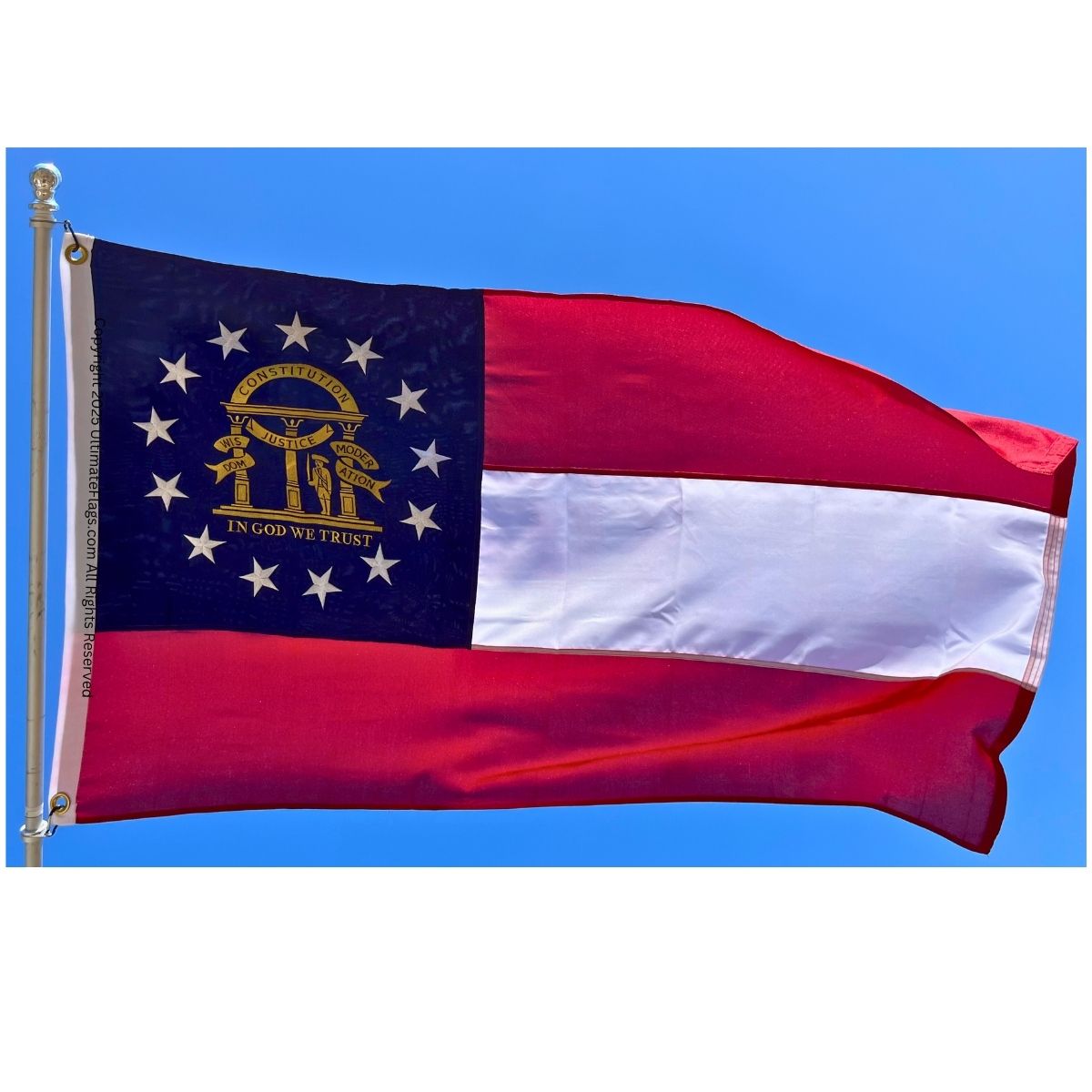
Before any purchase, match the flag's artwork to the state government's official design. All 50 states have revised their flags at some point, and several did so recently: Georgia adopted its current flag in 2003, and Mississippi adopted its new design in 2020. A listing photo or a familiar image is not proof a flag is current — compare the emblem, lettering and layout against the official reference rather than trusting the product title.

Current Georgia state flag in sewn heavy-duty nylon with embroidered coat of arms, flying outdoors against blue skyBuy This Flag- Click Here
Georgia’s current official flag, in use since 2003, with the state coat of arms surrounded by 13 stars.

This matters double in an office, where the flag speaks for the organization. A historical design belongs in a clearly labeled heritage display — never as an accidental stand-in for the state's present flag.

4. Historical state designs: best for heritage and collector offices

Some offices — law firms with deep local roots, historical societies, military recruiters, insurance agencies that have served a town for generations — display a historical state flag deliberately, as a nod to the past. Done right, it is a striking display: an older Georgia or Mississippi design, or a state's flag from a century ago, framed by a short caption card naming the design and its years of use.

Done carelessly, it reads as a mistake or worse, because many historical state designs carry imagery with real historical weight. If you go this route, choose the design on purpose, verify its dates from a reliable source, and label the display so no visitor mistakes it for the current flag. Ultimate Flags carries a range of historical state designs alongside the current ones, which makes the deliberate choice easier — but the identification is still yours to make.

Where it shines:

  • A distinctive, conversation-starting display for the right office
  • Deepens a heritage or local-history theme
  • Pairs well with framed documents and historical photos

Where it falls short:

  • Requires accurate identification and clear labeling
  • The wrong setting can send the wrong message

Best for: historical societies, museums, and offices with a deliberate heritage theme.

How we ranked

The ranking weighs four things, in order: how the flag hangs indoors without wind, how the artwork reads at office viewing distances, how much care the fabric demands in a working office, and how well the construction suits each budget. Sewn double-nylon wins overall because it is the only option that scores well on all four at once. Cotton ranks above printed polyester despite the care it needs because formality is worth real money in the rooms it serves. Historical designs rank last for everyday use only because they carry an identification duty the others do not.

Which state flag should your office choose?

Default pick for most offices Today: a sewn double-nylon 3×5 ft flag with a pole sleeve. It hangs well, reads well and lasts. Step up to embroidered cotton if the room is formal or photographed often, step down to printed polyester if the display is small or temporary, and reserve historical designs for labeled heritage displays.

Whatever you choose, measure the wall and confirm the pole's flag-size guidance before ordering — Shop Ultimate Flags for the full range of current and historical state flags.

Common mistakes indoor office buyers make

  • Buying a 4×6 ft or larger flag for a standard wall. A 3×5 ft flag is the indoor workhorse; anything bigger needs a tall wall, a taller pole and the ceiling clearance to match.
  • Ordering grommets for a dedicated indoor pole. Clips show and the flag twists; a pole sleeve hangs flat and clean.
  • Guessing at the design instead of checking it. Compare the listing with the state's official reference — several states changed their flags within the last two decades.
  • Displaying a historical design without a label. In an office, an unlabeled historical flag reads as an error, not a statement.
  • Letting the flag touch the floor during setup. Plan the pole height so the bottom hem clears the floor with room to spare.

FAQ

What size state flag is best for an office display?

A 3×5 ft flag is the standard indoor office size, fitting most walls and standard indoor poles. Larger rooms with tall ceilings can step up to 4×6 ft, but measure the wall and pole guidance first.

Should an office flag have grommets or a pole sleeve?

A pole sleeve is the cleanest indoor attachment because the flag slips over the pole and hangs flat with no clips showing. Grommets suit poles with clip hardware or flags that share duty between stands.

Is a printed state flag good enough for an office?

For small offices, backdrops and temporary displays, a printed 3×5 ft flag is a sensible budget pick. For lobbies and reception areas viewed up close, a sewn flag holds its shape and shows far more detail.

How do I know a state flag design is current?

Compare the listing’s artwork with the state government’s official flag description. Georgia’s current flag dates to 2003 and Mississippi’s to 2020, so a familiar older image is not proof a flag is current.

Can I fly a state flag indoors next to the American flag?

Yes. Under the U.S. Flag Code (Title 4, Section 7), the American flag sits at the peak or the honor position, with the state flag below or beside it, never above or to its right.

Does Ultimate Flags sell both current and historical state flags?

Yes. Ultimate Flags carries current official state flags and a range of historical state designs, including older Georgia and Mississippi flags, so a heritage display can be chosen deliberately and labeled accurately.

One last thing

Before you order, stand where your visitors will stand and look at the wall. That single check settles the three questions no listing photo can: whether a detailed seal reads at that distance, whether the pole height clears the furniture, and whether a 3×5 ft flag fills the space or needs the next size up. A two-minute walk around the room prevents the most common office flag regret.

Related guides

Posted on

How do you store historical flag reproductions between displays?

A folded historical reproduction flag with embroidered stars resting on acid-free tissue paper in an archival storage box, ready for display

Storing a historical flag reproduction between displays comes down to one rule: never fold it the same way twice, and never let fabric rest against fabric without a clean layer between. Museums either lay flags flat in shallow boxes padded with acid-free tissue or roll them around a wide tube, because folds are where old cloth breaks. Whether your reproduction is a sewn cotton battle flag or an embroidered unit banner, the same five steps keep the fabric, the stitching and the colors ready for the next display.

TL;DR
  • Flat storage is safest; roll large flags around a padded tube instead of folding.
  • Pad every fold with unbuffered, acid-free tissue — never plain cardboard or wood.
  • Keep storage near 70°F and 40-50% relative humidity, away from light.
  • Unfold and inspect stored flags every 6 months; refold along new lines.

Ultimate Flags flag sale banner

Ultimate Flags flag sale banner

Why storage matters for historical flags

A reproduction spends most of its life off the pole. The sun gets the blame for flag wear, but a flag in a drawer faces the slower damage: creases that become permanent, fibers stressed along the same lines year after year, and dye that transfers where fabric presses against fabric. Textile conservators treat folds as the enemy for exactly that reason — the National Park Service's curatorial care guidance tells collections staff to fold textiles as little as possible because textiles tend to break along fold-lines in time.

The good news is that museum practice scales down to a spare closet shelf. Nothing below requires special equipment beyond acid-free tissue paper, a cardboard tube and a box or two. The habits matter more than the gear.

How do you store historical flag reproductions between displays?

Work the five steps in order. Each one removes a specific way a stored flag gets damaged.

Step What to do Damage it prevents
1 Clean and fully dry the flag first Mildew and set-in stains
2 Lay it flat, or roll it around a padded tube Fold-line breaks
3 Separate layers with unbuffered, acid-free tissue Dye transfer and creasing
4 Box it in an inert container, off wood and cardboard Acid migration and pests
5 Store cool, dark and dry — then check every 6 months Fading, mold, unnoticed tears

Step 1: Clean and dry the flag before it goes away

Never store a flag with dirt, salt spray or dampness in the fibers. Soil attracts pests, and moisture trapped in a closed box grows mildew within weeks. Air-dry a wet flag completely flat before it is put away — never on a radiator or in direct sun, which cooks the fibers and fades the dye. If the flag needs washing, follow the fabric-safe washing method for nylon flags rather than machine-drying a delicate reproduction on heat.

A flag that will not come fully clean by gentle hand washing is a flag for the shelf, not the box — display it or store it loosely rolled until it can be looked at properly.

Step 2: Choose flat storage, or roll instead of folding

Flat is the safest rest for a flag: no folds at all, no stress points. Lay the flag out in a shallow box, drawer or shelf lined with clean tissue or washed muslin, and give it room so nothing sits on top of it.

A 52-inch square cotton battle flag reproduction laid flat, the safest way to rest a flag between displays

Square cotton reproduction flags like this 52-inch battle flag are made for flat storage — the size the Army of Northern Virginia issued to infantry regiments from 1861.

When a flag is too large to lay flat — and some collector pieces run 4 by 6 feet or more — roll it around a tube instead. The tube should extend past the flag on both ends so the roll never rests on the fabric itself, and the wider the tube's diameter, the gentler the curve. Pad the tube with unbuffered tissue, roll the flag around it, then wrap the whole roll in a clean sheet of tissue or washed muslin. Set the finished roll on cradle supports so its weight never presses on the cloth.

Step 3: Pad folds and separate every layer with acid-free tissue

If a flag must be folded for the season — a shallow closet, a small box — pad every fold with crumpled unbuffered, acid-free tissue so the crease never closes on itself, exactly the way the Smithsonian's flag-preservation guidelines describe for museum collections. Then place tissue or washed muslin between fabric layers so the front of one flag never touches the back of another.

Embroidered reproduction unit flag with sewn lettering, stored flat between displays

Embroidered and sewn-lettering reproductions like this unit flag hold up best rolled or laid flat, where stitched lettering never carries a crease.

Why unbuffered tissue in particular? Buffered tissue is treated to neutralize acid in paper, and that treatment can harm some protein fibers like silk — the conservator's default for mixed flag collections is unbuffered, acid-free tissue throughout.

When you are ready to Shop Ultimate Flags for the next display piece, pick flags whose construction you can see clearly in the listing — sewn stripes, embroidered stars and honest finishing photos — because flags built with visible stitching are the same flags that tolerate careful handling and storage best.

Step 4: Box the flag in inert materials, away from wood

The container matters as much as the fold. Ordinary cardboard and bare wood both carry acids that migrate into fabric over months, and both can host pests. Use an archival textile box, or line a clean plastic tub with washed muslin. Keep every wooden shelf, pine chest and cedar-lined drawer out of direct contact with the flag — a layer of muslin or a polyethylene barrier between the wood and the box is the minimum.

One caution from museum practice: skip the mothballs. Their fumes settle into fibers, and the smell is nearly impossible to remove from a display flag later. Clean storage, sealed boxes and occasional inspection do the pest-control work instead.

Step 5: Store cool, dark and dry — and refold on new lines every 6 months

Light fades dyes even in a box, so store flags in a dark interior closet or cabinet, not an attic or garage. Attics swing from freezing to baking; basements grow mold in humid weather. The practical targets are steady room temperature — around 70°F — and relative humidity near 40-50%, the range textile conservators aim for in general collections storage.

Then put inspection on the calendar. The Smithsonian's guidance for folded textiles is to open them every six months, check for damage or changes, and refold along new lines so the same fibers never carry the crease twice. Six months is also the right rhythm to catch a pest problem while it is still a problem and not a loss.

Flat or rolled: matching the method to the flag

Flag Best storage method Why
Sewn cotton battle flag, about 52 inches square Flat in a shallow archival box Heavy fabric; folds stress the seams
Large 4×6 or 5×8 ft sewn flag Rolled around a padded tube Too big to lie flat in most homes
Embroidered nylon reproduction Flat or loosely rolled Nylon springs back, but creases can set
Printed lightweight polyester Flat with tissue between layers Lightest fabric; creases show first
Silk or fragile antique textiles Flat, unsupported handling kept to a minimum Most fragile material in any collection

One more rule from the museum shelf: if flags must be stacked, the heavy wool goes on the bottom and the light, fragile silk on top, with tissue between every layer. Weight is damage in slow motion.

Setting up a seasonal rotation

Collectors who display flags through the year — battlefield anniversaries in spring, heritage events in summer, holidays in fall — do best with a simple rotation cycle rather than a permanent shelf:

  • One flag out at a time. A flag on display picks up dust and light exposure; the rest of the collection rests. Rotate rather than hang the whole collection.
  • Rest periods equal to display periods. If a flag hangs for a month in the spring, it rests at least a month before the next event.
  • The 6-month inspection doubles as the swap point. Open, inspect, air out, refold on new lines — then decide which flag comes out next.
  • Keep the travel roll ready. A tube padded with tissue doubles as safe transport to an event, so the flag never travels folded.

A rotation also spreads wear across the collection instead of concentrating it on the favorite piece, which is how a two-flag collection quietly becomes a twelve-flag collection.

How often should you check a stored flag?

Every six months, on the calendar — not "whenever you think of it." Open folded flags fully, look along the old fold lines first, check hems and hoists for stress, and refold in a new area before the flag goes back. Rolls get unrolled partway and inspected at both ends. Six months matches the interval museum conservators use for folded textiles, and it is frequent enough to catch mold, pests or a small tear while the fix is still easy.

Common storage mistakes to avoid

“Fold lines, not sunlight, are where a stored flag dies — pad every crease and refold on new lines every six months.”

  • Storing a flag damp. Mildew sets within weeks in a closed box; dry completely first.
  • Folding the same way every time. The same fibers carry the crease until they break — refold on new lines each season.
  • Contact with wood or plain cardboard. Both leach acid into fabric; use archival boxes or a muslin barrier.
  • Attic or garage storage. Heat swings and humidity are the two fastest ways to age cloth; choose an interior closet.
  • Plastic wrap touching the flag. Sealed plastic traps moisture; if plastic tubs are used, the flag rides in muslin, and the lid stays loose enough to breathe.

What a small collection actually needs

The supply list for a home collection is short: unbuffered acid-free tissue paper, a few shallow archival boxes or a lined plastic tub, one or two cardboard tubes wider than a mailing tube, washed muslin for layering, and a closet shelf out of the light. Check current pricing on archival supplies from a preservation supplier — none of it is specialty equipment, and the whole setup costs less than the reproductions it protects.

The alternative — flags folded into a cedar chest in the attic — is how embroidered stars and sewn battle honors quietly pick up permanent creases between the good years. Ten minutes of setup buys decades of clean displays.

Related questions about storing flag reproductions

Is it bad to fold a flag for storage?

Folding is the least safe option — folds concentrate stress and textiles tend to break along fold-lines over time. If space forces a fold, pad every crease with crumpled unbuffered acid-free tissue, refold on new lines every six months, and lay the flag flat rather than hanging it folded.

Can I store a flag in a plastic bin?

Yes, with a barrier. Line the bin with washed muslin or acid-free tissue so the fabric never touches the plastic directly, and leave the lid loose enough for air movement. A sealed, airless container traps moisture — the mildew risk museum guidance warns about most.

How do museums store their historic flags?

Flat in shallow boxes padded with acid-free tissue, or rolled around wide padded tubes with the roll supported on cradles — never hanging, which stretches the fabric over the years. Collections open and inspect folded textiles every six months and refold them along new lines.

FAQ

How do you store a historical flag reproduction between displays?

Lay it flat in a box lined with unbuffered acid-free tissue, or roll it around a padded tube if it is too large to lie flat. Keep it cool, dark and dry, and open and inspect it every six months, refolding along new lines.

Should I fold, roll or hang a reproduction flag?

Flat is best, rolled is second, hanging is worst for long-term storage — gravity stretches the hoist over months. Fold only when space demands it, and pad every fold with tissue.

What kind of tissue paper is safe for flag storage?

Unbuffered, acid-free tissue. It pads folds and separates layers without the acid migration of newspaper or the buffering treatment that can harm silk and other protein fibers.

What temperature and humidity are best for stored flags?

Steady room temperature around 70°F and relative humidity near 40-50%, in the dark. Attics, garages and damp basements all swing outside that range, which is why interior closets win.

How often should a stored flag be inspected?

Every six months. Open it fully, check old fold lines and hems, look for pests or mildew, and refold along new areas so the same fibers never carry the crease twice.

Can a cotton battle flag be stored in a cedar chest?

Not in direct contact — bare wood, cedar included, carries acids that migrate into fabric. Line the chest with washed muslin or use an archival box inside it, and pad any folds with tissue.

One last thing

The 48-inch-square infantry flags the Army of Northern Virginia issued from 1861 were built to survive a campaign and come home folded over a color bearer's arm — but the originals that survived into museums did it on the strength of flat shelves and padded rolls, not more folding. Your reproductions ask for the same treatment: a clean layer between the fabric and the world, and a new fold line every season.

Posted on

American flags for sale for indoor ceremony displays

50 star cotton American flag with embroidered stars and sewn stripes laid flat, the traditional ceremonial size used for indoor displays

Indoor ceremony American flags for sale do a different job from the flag flying on your porch pole: a ceremony flag has to hang straight, photograph cleanly, and read clearly from across a room full of people. This guide is written for the folks outfitting classrooms, churches, Scout courts of honor, VFW posts, funeral homes and event stages — how to pick the right size, fabric and attachment for an indoor display, with real examples pulled from the Ultimate Flags catalog.

TL;DR
  • A 3×5 ft flag fits most classrooms and stages; 5×9.5 ft is the formal ceremony size.
  • Cotton gives the richest indoor look; embroidered nylon holds up to repeated handling.
  • A pole sleeve is the cleanest indoor attachment; grommets suit clip-on poles.
  • A 50-star cotton sewn flag with pole sleeve is the classic indoor ceremony pick at Ultimate Flags.
  • Never let a ceremony flag touch the floor — plan your pole height before you buy.
Ultimate Flags flag sale banner

Why indoor ceremony flags are different

The American flag outdoors fights sun and wind, so outdoor buyers shop by durability. Indoors, the fight is with lighting, distance and dignity. A flag that never catches a breeze will not billow and hide its own stars, so the weave, the stitching and the drape matter more than tear strength. Cotton shows its texture under stage light, which is why so many formal displays use it. Nylon hangs crisper and weighs less, which helps when the same flag gets set up and taken down week after week.

There is also etiquette to respect. The flag should never touch the floor, never drape over furniture, and when it hangs flat on a wall the union — the blue field of stars — goes to the observer's left. Those rules come straight from the U.S. Flag Code, and they shape every choice below, from pole height to attachment style.

Step 1: Match the flag size to the room

Buying the wrong size is the most common indoor mistake, and it usually goes one of two ways: a 3×5 ft flag lost at the back of a fellowship hall, or a huge flag that drags the floor at a graduation. Walk the room first, then buy to the pole and the space.

  • 3×5 ft — classrooms, offices, Scout meetings, most stage backdrops. The workhorse size for indoor ceremony displays.
  • 4×6 ft and 5×8 ft — churches, lodge halls, funeral home chapels where the flag stands beside a podium.
  • 5×9.5 ft — the formal ceremonial and memorial size. This is the proportion used for color guards, military funerals and flag presentation cases, and it is the flag draped over a casket and folded for the next of kin.
  • 6×10 ft and larger — civic auditoriums, gymnasiums and convention floors with 20-foot-plus ceilings.

A good starting rule: the flag's length should be roughly one-quarter to one-third of your pole height indoors. A standard 8-foot indoor parade pole carries a 3×5 ft flag beautifully; a 12-foot pole steps up to 5×9.5 ft. Measure before you order, not after.

Embroidered nylon American flag flying on a pole against a blue skyFlag Sale – Shop Now!

Embroidered nylon American flags come in a dozen sizes, from 12×18 inch up to 30×50 ft, all sewn in America.

Step 2: Choose cotton or nylon for indoor use

The two fabrics earn their places differently indoors, and neither is wrong — they serve different ceremonies.

Cotton is the traditionalist's choice. A sewn cotton flag has a heavyweight drape that hangs in soft folds on a pole and a matte finish that photographs warm under indoor lighting. It is the fabric of historic reproductions and formal presentations, and it is what most people picture when they imagine a flag on a church stage. Cotton's one demand: keep it dry and store it carefully, because damp storage is what ruins it. The 50-star cotton sewn flag at Ultimate Flags is made in the USA with embroidered stars and sewn stripes, and it can be ordered with grommets or a pole sleeve — the sleeve being the classic indoor attachment.

Nylon is the practical workhorse. An embroidered nylon flag is lighter, resists the wrinkles that come out of a storage bag an hour before the ceremony, and survives repeated setup and teardown without fraying at the fly end. If your flag travels between a school, a veterans hall and a community center every month, nylon earns its keep.

50 star cotton American flag with embroidered stars and sewn stripes laid flat, the traditional ceremonial size for indoor displaysBuy This Flag- Click Here

50-star cotton sewn American flag with embroidered stars, available with grommets or a pole sleeve, made in the USA.

Step 3: Pick grommets or a pole sleeve

This is the attachment decision, and indoors it matters more than outdoors.

  • Pole sleeve (also called a pole hem) — the flag's heading is sewn into an open-ended tube that slips over the pole. Nothing clips, nothing clanks, and the flag hangs in one smooth plane. This is the standard for indoor ceremony and color guard work.
  • Heading and grommets — a reinforced canvas strip with brass grommets that attach to clips or hooks. This is the universal outdoor attachment, and it works indoors on poles with clip hardware or when one flag needs to move between stands.

If the flag lives on its own dedicated indoor pole, order the sleeve. If it shares duty between an indoor stand and an outdoor pole, order grommets and accept the small compromise.

Step 4: Decide on fringe, finials and hardware

Gold fringe on a ceremony flag is optional, traditional and perfectly proper — the Flag Code does not prohibit it, and it appears on countless courtroom and honor-guard flags. What the fringe does is add weight to the bottom edge, which helps the flag hang flat instead of curling. Pair a fringed flag with a pointed eagle finial on the pole and a weighted base, and you have the standard formal display set most organizations expect. Indoor poles are typically 8 or 9 feet tall, so confirm your ceiling clearance before ordering hardware alongside the flag.

Step 5: Light it if it never comes down

Some flags hang only for the ceremony and come down with the chairs. Others — in lobbies, courtrooms and memorial rooms — stay up year-round. The Flag Code says the flag may be displayed 24 hours a day if it is properly illuminated after dark, and that applies indoors too: a flag displayed in a window or a dark lobby overnight needs a dedicated light on it. A small LED spotlight aimed at the union solves it for a few dollars and keeps your display within custom.

Step 6: Store it right between ceremonies

Ceremony flags are folded, not crammed. The ceremonial method folds the flag lengthwise, then into a tight triangle, ending with only the union showing — the same fold used on burial flags at military funerals. If your organization receives a folded ceremonial flag from a veteran's service, it is meant to stay folded and be displayed case-first; an unfolded presentation flag for regular ceremonies is a separate purchase. Between uses, store a dry flag flat or rolled loosely around a tube — never in a plastic bag where moisture can condense — and refold along different lines occasionally so permanent creases do not set into the fabric.

Which flag for which indoor job

Option Best for Key limitation
50-star cotton sewn, pole sleeve Formal ceremonies, churches, presentation displays Heaviest fabric; must stay dry and stored flat
Embroidered nylon, heading and grommets Color guard duty, schools and halls with frequent events Brighter sheen reads slightly less formal than cotton
Printed poly-cotton, 3×5 ft Budget classroom and office displays Less texture and depth up close than sewn flags

The default pick for most organizations Today: a 50-star cotton sewn flag with a pole sleeve. It is the flag that looks right at the front of a room, and the sleeve means it hangs straight on any standard indoor pole.

Common mistakes indoor buyers make

  • Buying a 3×5 ft flag for a large hall because it is the familiar size. In a room with a 20-foot ceiling, a 3×5 ft flag looks like a hand towel on a stage. Step up to 5×8 ft or the ceremonial 5×9.5 ft.
  • Ordering grommets for a dedicated indoor pole. The clips show, the flag twists, and the corners wrinkle. Spend the extra moment selecting the pole sleeve option.
  • Hanging the flag backward on a wall. When displayed flat, the union goes on the observer's left — the flag's own right, as if it were marching.
  • Letting the flag touch the floor during setup. It is the single most common breach of flag etiquette at indoor events, and it is always a height problem, not a carelessness problem.
  • Storing a barely-damp flag in a sealed bin. Cotton mildews, and mildew does not wash out of embroidered stars. Air-dry fully first.

FAQ

What size American flag should I use for an indoor ceremony?

A 3×5 ft flag suits most classrooms, offices and small stages, while 5×9.5 ft is the formal ceremonial size used by color guards and at military funerals. For church halls and large rooms, 4×6 ft or 5×8 ft is the comfortable middle.

What is the difference between a ceremony flag and a burial flag?

They share the same 5×9.5 ft proportion, but a burial flag is the one draped over a casket at a veteran’s funeral and folded into a triangle for the next of kin. A ceremony flag is a working display flag you can order with a pole sleeve for regular indoor use.

Can I display an American flag indoors without a light?

Yes, as long as it is taken down at night or the room it hangs in stays lit. The Flag Code’s after-dark rule applies to flags displayed around the clock, indoors or out, so a permanent lobby display needs illumination after dark.

Should an indoor ceremony flag have grommets or a pole sleeve?

A pole sleeve is the standard indoor attachment because the flag slips over the pole and hangs flat with no clips showing. Heading and grommets are the outdoor attachment and suit poles with clip hardware or flags that move between stands.

Is gold fringe on the American flag allowed?

Yes. Gold fringe is a traditional indoor embellishment used on courtroom and honor-guard flags, and the Flag Code does not prohibit it. The added weight along the bottom edge helps the flag hang flat.

Where can I buy American flags for indoor ceremony displays?

Ultimate Flags stocks sewn cotton and embroidered nylon American flags from 12×18 inch up to 30×50 ft, including a 50-star cotton sewn flag made in the USA that can be ordered with grommets or a pole sleeve for indoor poles. The store has been family-owned in O’Brien, Florida since 1997.

One last thing

The 5×9.5 ft ceremonial size exists for a reason beyond looks: it is proportioned so that when it is folded into the ceremonial triangle at a military funeral, the finished fold shows only the union — the stars — on top, which is why families remember the fold long after the service. If your organization presents flags at veterans' services, that proportion is not a preference; it is the standard the moment depends on.

Related guides

Posted on

Can you fly a 48 star flag today?

48 star American flag with six rows of eight embroidered stars and sewn stripes flying on a flagpole against a blue sky

Yes — you can fly a 48 star flag today. No federal law restricts which historical American flag designs you display, and the 48-star design was the official U.S. flag from July 4, 1912, through July 3, 1959. What matters on a flagpole is how you treat the flag, not which era it came from. Collectors, veterans' groups and history-minded families fly the 48-star design all across the country.

TL;DR
  • You can legally fly a 48 star flag today — no U.S. law limits which historical designs you display.
  • The 48 star flag was the official U.S. flag from July 4, 1912 to July 3, 1959 — 48 stars in 6 rows of 8.
  • For outdoor poles, a weatherproof nylon 48 star flag holds up; cotton suits indoor and ceremonial display.
  • Treat a 48 star flag with the same respect as today’s 50 star flag — same courtesies apply.

Ultimate Flags flag sale banner

Why this matters

The 48 star flag covers a bigger stretch of American history than most people realize. It flew through World War I, World War II, the Korean War and the early Cold War — four decades when this design was the flag soldiers carried, ships raised and families hung on the porch. When you fly one today, you are flying the flag of that era exactly as it looked.

Plenty of folks also inherit a 48 star flag from a grandparent or find one in an attic, and the first question is usually whether it is somehow out of date. It is not out of date in any legal sense. Older designs do not retire; they simply stop being the current design.

If you are sorting out whether the one in your family is an old original or a newer copy, our guide on how to distinguish a 48 star flag replica from an antique walks through that separately.

Can you fly a 48 star flag today?

You can, and people do. Three things settle the question:

  1. No law restricts historical U.S. flag designs. United States flag law, including the Flag Code, describes how to display and respect the flag. It does not require the current 50-star design, and it does not prohibit older ones.
  2. The design is clearly dated. The 48-star design was official from July 4, 1912, through July 3, 1959, per the Smithsonian's published U.S. flag chronology. Flying it reads as a nod to that period, not as a mistake.
  3. The same display courtesies apply. A 48 star flag is still a U.S. flag, so the everyday manners — keep it off the ground, take it down in rough weather unless it is built for outdoor use, light it or bring it in at night — are the same as for any American flag.

One honest note: flying a 48 star flag instead of the current 50-star flag is a statement about history, not about current allegiance. Most displays pair the two or fly the 48-star design for an anniversary, a memorial or a themed room rather than replacing the current flag at the top of the pole.

When the 48 star flag was official

The dates are simple and worth knowing before you buy or display one:

Date What happened
January 6, 1912 New Mexico becomes the 47th state
February 14, 1912 Arizona becomes the 48th state
July 4, 1912 48-star design becomes official — 6 rows of 8 stars
January 3, 1959 Alaska statehood sets up the 49-star flag
July 4, 1959 49-star design replaces the 48 star flag
July 4, 1960 50-star design takes over after Hawaii's 1959 statehood

So a flag with 48 stars in 6 rows of 8 represents the design used from 1912 to 1959 — the span covering both world wars and Korea. That is why veterans' organizations, museums and reenactment groups reach for this design when they want the flag that matches those years. The memory trick is easy: 48 stars, 6 rows of 8, 1912 to 1959.

Flying a 48 star flag with today's 50 star flag

There is no special rulebook for historical American flags — the same courtesies that apply to the current flag apply to the 48 star flag. A few practical points from experience:

  • Give the U.S. flag the top position. On a single pole, a 48 star flag flies above state, military and organizational flags, exactly like any American flag would.
  • Size it to the pole. A 3×5 ft flag suits most home displays; larger 4×6 ft and 5×8 ft sizes belong on taller poles and in halls.
  • Match the material to the weather. Cotton flags are made for indoor and ceremonial use. For a pole that stays up through rain and sun, a weatherproof nylon version is the sensible choice.
  • Keep the courtesies. Bring it in during storms unless it is rated for all-weather display, and light it at night or take it down at sunset.

The most common pairing we see is a 48 star flag displayed indoors or on a second position while the current 50-star flag holds the primary spot outdoors. That keeps the historical design visible without any confusion about which flag is current.

Why collectors and families still fly the 48 star flag

The 48 star flag earns its spot on a pole or a wall for real reasons:

  • World War II and Korean War commemorations — it is the correct design for those years, so anniversaries, memorial services and school programs use it deliberately.
  • Veterans' honors — families with a relative who served between 1912 and 1959 often want the flag of that service era, not a modern stand-in.
  • Reenactments and living history — a period-correct flag is the difference between a display that teaches and one that does not.
  • Collections and heritage rooms — star-count displays that show how the flag grew state by state rely on the 48-star design to bridge the first half of the 20th century.

The design itself is handsome, too. Forty-eight stars pack tightly into 6 rows of 8, giving the canton a dense, even look that reads clearly at a distance.

48 star American flag with embroidered stars and sewn stripes in cotton, official U.S. flag design from 1912 to 1959

Cotton 48 star flag with embroidered stars and sewn stripes — the official U.S. design from 1912 to 1959, made in 3×5, 4×6 and 5×8 ft sizes.

Choosing a 48 star flag that fits your display

The material decision matters more than any other choice, and it is easy to get right:

  • Cotton gives you thick, textured fabric with embroidered stars and sewn stripes — the traditional look for indoor displays, ceremonies, memorial settings and classrooms. Cotton is not designed for extended outdoor exposure, so keep it out of the rain.
  • Nylon is the weatherproof option. A well-made nylon 48 star flag handles outdoor poles, dries fast and keeps its colors through sun and storm.
  • Sizes run from 3×5 ft for most home setups up to 4×6 ft and 5×8 ft for taller poles, halls and post buildings.
  • Attachments on traditional reproductions are brass grommets, which fit standard clip and hook hardware.

For a cotton sewn version in the traditional sizes, you can Shop Ultimate Flags and match the size to your pole before you order. Check the listing description for the fabric on each specific flag — that one detail decides indoor versus outdoor duty.

The 48 star flag also pairs naturally with earlier American designs. A 13-star Betsy Ross flag next to a 48-star flag shows the flag's growth from the founding era through the 20th century, which is a favorite classroom and den pairing.

Betsy Ross 13 star American flag reproduction, an earlier historical U.S. design commonly flown alongside the 48 star flag

Betsy Ross 13-star flag — the founding-era design collectors pair with the 48 star flag to show the flag’s growth over time.

How do you display a 48 star flag respectfully?

Exactly as you would today's flag. The 48 star flag is an American flag, so the standard courtesies cover it: it never touches the ground, it flies above state and organizational flags on the same pole, and a worn-out flag is retired respectfully rather than thrown away. If you display one indoors on a staff, the same custom applies — flag at the peak, nothing above it.

For everyday flying, match the fabric to the exposure. A cotton flag on a covered porch is fine; the same cotton flag on an open pole through a wet winter is not. That single match-up keeps the colors bright for years.

Related questions

Is it legal to fly an older American flag?

Yes. Older official designs — 48 stars, 49 stars or earlier — can be flown legally anywhere a current flag can be flown. The Flag Code governs how a flag is treated, not which star count it carries.

What years did the 48 star flag fly?

The 48 star flag was the official design from July 4, 1912, through July 3, 1959. It covers World War I, World War II, the Korean War and the first stretch of the Cold War.

Is a 48 star flag worth anything?

It depends on the specific flag, not the star count. Age, maker's marks, condition and documented history drive any collector value, and many 48 star flags were made in huge numbers during four decades of official use. If you are evaluating an inherited flag, document what you can see before drawing conclusions.

FAQ

Can you fly a 48 star flag today?

Yes. No U.S. law restricts historical American flag designs, and the 48 star flag was the official design from July 4, 1912, through July 3, 1959. It is treated like any other U.S. flag.

What is the star pattern on a 48 star flag?

48 stars in 6 rows of 8. That layout became official on July 4, 1912, after New Mexico and Arizona joined the Union in 1912.

Why did the flag change from 48 stars?

Alaska’s January 1959 statehood brought a 49-star flag on July 4, 1959, and Hawaii’s August 1959 statehood brought the 50-star design on July 4, 1960.

Can a 48 star flag be flown outdoors?

A weatherproof nylon version can. Cotton versions are made for indoor and ceremonial use and are not designed for extended outdoor exposure.

Does flying a 48 star flag signal anything political?

The design marks a historical period, 1912 to 1959, and is flown by collectors, veterans’ groups, museums and schools for anniversaries, memorials and displays.

How should a 48 star flag be displayed with a 50 star flag?

With the same rules as any two U.S. flags: give the primary or highest position to the flag of your choosing, keep both off the ground, and follow the standard courtesies for each.

What sizes does a 48 star flag come in?

Traditional reproductions are made in 3×5 ft, 4×6 ft and 5×8 ft sizes, usually with brass grommets for standard pole hardware.

One last thing

The 48 star flag had the longest uninterrupted run of any 20th-century design — 47 years, from 1912 to 1959. Only the current 50-star design, at 66 years and counting, has lasted longer. When someone tells you the 48 star flag is out of date, the honest answer is that it outlasted every design between it and today's flag.

Historical basis: Smithsonian Institution, Facts about the United States Flag, chronology prepared by the Armed Forces History Collections (revised September 2001). Display guidance follows general U.S. flag etiquette and the construction details stated on the product pages, framed for today’s readers.

Related guides
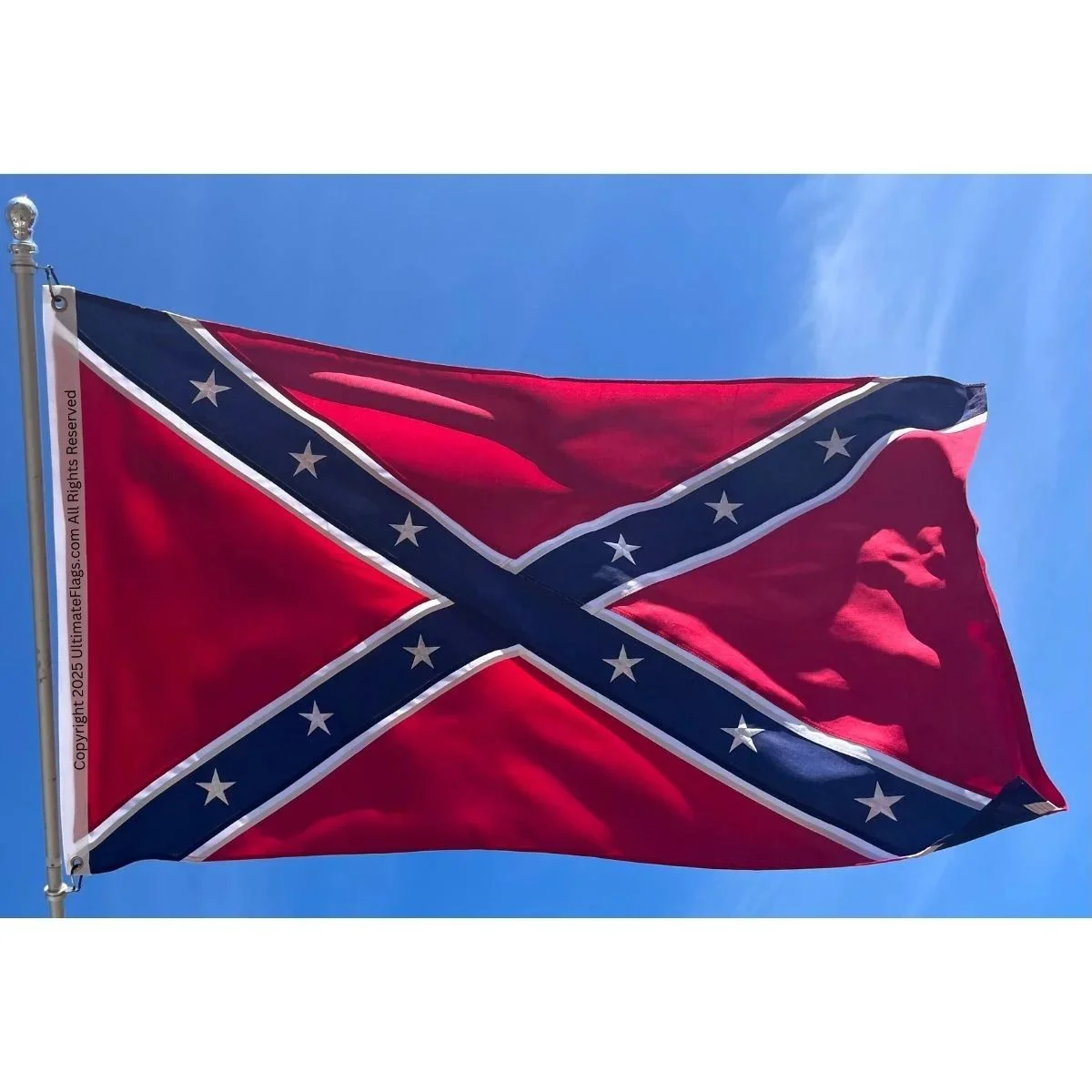
Posted on

How do you research regimental Confederate battle flags?

12-star Forrest Confederate battle flag reproduction in sewn double-nylon flying on a pole against a blue sky

Researching a regimental Confederate battle flag comes down to three trails, worked in order: the flag's own design details, the unit's surviving service records, and period photographs or captured-flag paperwork that tie the two together. The design usually dates a flag to an army and a rough year all by itself. The records confirm which regiment carried it, and the photos or receipts prove the connection. Work all three and you can document a flag the way a museum does — and, nearly every record you need is online and free.

TL;DR
  • Design first: star count, shape and border usually date a battle flag to its army and year.
  • Match the flag to a regiment through Compiled Service Records and National Archives material.
  • Period photos and captured-flag reports turn a good guess into real documentation.
  • Reproductions are honest when labeled — photograph stitching, hoist and lettering when you document one.
  • Battle flag designs come in printed nylon, sewn cotton and embroidered versions for display or study.
Ultimate Flags flag sale banner

How do you research regimental Confederate battle flags?

The work breaks into five steps. A careful researcher can finish the first two in an evening and the rest over a couple of weekends.

  1. Date the design. Star count, shape and border usually place a flag with an army and a year range before you read a single record.
  2. Identify the pattern family. Square or rectangular, issue pattern or field variation — this narrows the list of units fast.
  3. Follow the regiment through service records. Muster rolls and service files tell you where the unit served and who it served under.
  4. Find a period photograph or captured-flag report. This is the step that turns a good guess into documentation.
  5. Write down what the flag is — and what it isn't. A documented modern reproduction is worth more than a vague "authentic" claim.

Step 1: Date the design

The flag most people picture — a red field with a blue saltire crossed by white stars — was designed for the Confederate Congress by William Porcher Miles of South Carolina. Miles pushed it as the national flag in early 1861, and the Congress passed him over for the Stars and Bars. The design found its real life in the field: the Army of Northern Virginia adopted it as a battle flag in November 1861, precisely because the first national flag looked so much like the United States flag that gunners couldn't tell friend from foe at distance.

The common pattern carries 13 white stars — eleven for the seceded states plus Kentucky and Missouri — though earlier issue flags sometimes show 11 or 12. Watch the saltire's border and the field's proportions too. Army of Northern Virginia flags carry a white border on all four sides; many western-theater flags do not. Small details like these are how you date a flag before you ever open an archive.

When you're ready to compare sizes and fabrics side by side, you can Shop Ultimate Flags and see every battle flag design in one place.

Step 2: Identify the pattern family

Shape is the fastest clue. The Army of Northern Virginia issued its battle flags square — infantry flags ran about 48 inches on a side, with smaller squares for artillery and cavalry — while the Army of Tennessee and the naval service used rectangular versions. The rectangular flag most folks fly today descends from that second, naval tradition, which is why the long version is properly called the Confederate naval jack even though it shares the battle flag's design.

Field variations tell their own stories. Some generals removed stars; some added battle honors stitched directly onto the cloth. General Nathan Bedford Forrest's escorts carried a 12-star version with the center star deliberately left out, so any opposing soldier who saw it knew exactly whose lines he was facing — psychological warfare, and by every period account it worked.

12-star Forrest battle flag reproduction in sewn double-nylon flying on a pole against a blue skyBuy This Flag- Click Here

General Forrest’s 12-star battle flag — the center star was left off so opposing troops would know whose lines they faced. Sewn double-nylon reproduction shown flying.

Step 3: Follow the regiment through service records

Start with the National Park Service's Soldiers and Sailors database, which indexes Confederate soldiers by name and unit as of 2026. It's free and it gets you the regiment's full organization in minutes. From there, move to the Compiled Service Records at the National Archives — muster cards that show when a soldier enlisted, where he served, and when he left the rolls.

The unit's history matters as much as any single soldier's. A regiment's muster rolls place it inside a brigade and division, and each of those formations used particular flag depots and issue patterns. Quartermaster and ordnance receipts, where they survive, can show a flag being issued, repaired or replaced on a date. State archives hold much of this paper — Alabama, Virginia, North Carolina and Tennessee all have strong Confederate records collections — and county-level muster books sometimes survive when the central files don't.

Step 4: Find a period photograph or captured-flag report

The strongest evidence ties a named flag to a named unit on a known date. Two places to look:

  • Captured-flag reports. When a Federal unit took a Confederate flag, it was reported to the War Department and the flag was sent to Washington. Those reports survive, and they list the regiment, the action and the date.
  • Period photographs. Studio portraits of soldiers with their colors, and later reunion photographs, are scattered through state archives, library digital collections and unit history reprints.

The American Civil War Museum in Richmond holds the single largest Confederate flag collection in the country — more than 500 flags, many with issue and capture paperwork attached. Its catalog entries show exactly how museum staff document a flag, and they're a free masterclass in method for a researcher working from home.

Step 5: Write down what the flag is — and what it isn't

Whether you're documenting an heirloom or a reproduction you bought to fly, photograph the same things a curator would: obverse and reverse, the hoist edge and its attachments, the stitching along the fly, and the construction of the stars — embroidered, appliquéd or printed. Measure the flag in inches and note the fabric.

Then label it honestly. A sewn, embroidered reproduction built to the 48-inch infantry pattern is a display flag, and a good one; it becomes a problem only when somebody quietly lets "reproduction" turn into "wartime issue" on a shelf card or a listing. Collectors trust documentation more than adjectives, and the habit of writing the truth down is what separates a collection from an attic.

Nylon embroidered Confederate battle flag reproduction with stitched stars laid flat for documentationShop Now

A stitched-star nylon embroidered battle flag reproduction. Embroidery, sewn stripes and a reinforced hoist are the exact details to photograph when documenting a flag.

Why regimental flag records vary

Two researchers can follow the same flag and hit different walls, and it isn't anybody's fault:

  • Records burned. Some Confederate quartermaster and ordnance files were destroyed at the war's end, so issue paperwork simply doesn't exist for every unit.
  • Flags were replaced, not retired. Battle-worn flags went home with veterans or were replaced by issue depots, so one regiment may connect to several patterns across 1861–1865.
  • Surviving flags lost their paperwork. A flag in a museum case may have arrived by donation decades after the war, with nothing but the donor's word.
  • Field variations were never standardized. Generals altered designs on their own authority, and those changes appear in photos and memoirs more often than in official records.
  • Postwar memory blurred. Veterans' reunion accounts are heartfelt and useful, but they were written fifty years after the fact and need cross-checking.

What's the difference between a battle flag and a Confederate national flag?

The Confederacy had three official national flags — the Stars and Bars (1861–1863), the Stainless Banner (1863–1865) and the Blood-Stained Banner (March–April 1865) — and the battle flag was never one of them. The battle flag was a field device, adopted by armies to tell friend from foe. Its design was folded into the second and third national flags as the canton, which is why the two families get confused.

Were all Confederate battle flags square?

No. The Army of Northern Virginia's issue flags were square, with infantry flags at roughly 48 inches on a side and smaller squares for artillery and cavalry. The Army of Tennessee carried rectangular versions, and the rectangular pattern also served as the naval jack. Both shapes are historically correct — they just belong to different services and theaters.

How do you document a reproduction battle flag responsibly?

Photograph the construction, measure it, and record where and when it was made if the maker marked it. Then keep "reproduction" in the label. A well-made sewn flag flying on a pole tells the same design story a curator tells — it just does it in nylon instead of silk, and saying so is what keeps the display honest.

Frequently asked questions

How many stars did a Confederate battle flag have?

The common pattern has 13 stars — eleven seceded states plus Kentucky and Missouri. Some early issue flags show 11 or 12 stars, and General Forrest’s pattern carried 12 with the center star deliberately removed.

Where can I look up Confederate soldier records for free?

The National Park Service’s Soldiers and Sailors database indexes Confederate soldiers by name and unit. The Compiled Service Records at the National Archives go deeper, and state archives hold muster rolls and unit papers.

What size were Army of Northern Virginia battle flags?

They were square. Infantry flags ran about 48 inches on a side, with smaller squares issued to artillery and cavalry units.

Is a rectangular Confederate battle flag historically correct?

Yes. The Army of Tennessee and the naval service used rectangular versions, and the rectangular flag is properly the Confederate naval jack. Square and rectangular patterns are both period-correct.

How do I know if a battle flag is a wartime original?

Assume reproduction unless there is documented provenance — issue records, capture reports or an unbroken ownership trail. Wartime originals sit in museums and serious private collections, and they come with paperwork.

What size battle flag should a collector display?

A 3×5 ft flag suits most outdoor poles, while square 48-inch patterns suit reenactment and museum-style displays. Match the size and shape to the pattern family you’re honoring.

One last thing

The 12-star Forrest flag is a reminder that these designs were working tools, not wallpaper. Leaving a star off so the enemy would recognize the general who'd beaten them four times is the kind of detail no official record captures — it survives because a color sergeant told somebody, who told somebody else. When you document a flag, you're keeping that chain of memory unbroken, and a well-made reproduction from Ultimate Flags is a perfectly honest way to fly the pattern forward.

Related guides
Posted on

How do you wash a nylon American flag safely?

Nylon American flag with embroidered stars being washed by hand in a basin of lukewarm soapy water

A nylon American flag washes safely by hand in lukewarm water with a small amount of mild soap, then air dries draped wide — that is the whole method, and it takes about fifteen minutes of real work. Machine washing is fine too when the cycle is gentle, the water is cool and the flag goes in alone. What damages nylon is not soap but heat, bleach and hard scrubbing, so a safe wash is always a gentle wash.

Quick answer
  • Hand wash nylon flags in lukewarm water with mild soap; skip bleach.
  • Machine wash only on gentle, cool water, flag alone, in a mesh bag.
  • Air dry draped wide — a hot dryer is the fastest way to ruin nylon.
  • Rinse until no suds remain, then check the fly end before rehanging.
  • A flag that flies year-round needs a wash about twice a year, plus after messy weeks.

Ultimate Flags flag sale banner

How do you wash a nylon American flag safely?

Hand washing is the safe default for any nylon flag, embroidered or printed, and it is gentle enough for the stitched stars on a sewn one. Work through six steps and the flag comes out clean with the colors and stitching intact.

  1. Fill a basin with lukewarm water and mild soap. A bathtub handles a 3 x 5-foot flag easily. Dish soap or a gentle laundry detergent both do the job.
  2. Submerge the flag and swish it gently. Two or three minutes of easy movement in the water lifts most dust and grime.
  3. Work the soiled spots with your fingers or a soft cloth. Bird droppings and road dust usually release without any real scrubbing.
  4. Give stubborn spots a short soak. Ten to fifteen minutes in the soapy water is plenty; a long soak does not clean any better.
  5. Rinse in clean, cool water until no suds remain. Leftover detergent dries into a film that attracts the next layer of dirt twice as fast.
  6. Air dry the flag draped wide. Never twist or wring it — wringing stresses the seams and distorts the fly end.
Nylon embroidered American flag with embroidered stars flying against a blue skyShop Now
An embroidered nylon American flag — the stitched stars survive a gentle hand wash, and the fabric dries fast after it.

Why nylon needs a gentler wash than cotton

Nylon is a synthetic fabric, and two of its properties decide the whole washing routine. It melts or deforms at temperatures that would not bother cotton, which is why every hot step — hot water, hot dryer, hot iron — stays off the table. It is also smooth, so most dirt sits on the surface rather than grinding into the weave, which is why gentle finger pressure outperforms scrubbing.

Embroidered nylon flags add one more consideration: the stars and lettering are stitched on top of the fabric, and aggressive brushing catches those threads and pulls them loose. A wash that treats the embroidery as the most fragile part of the flag treats the whole flag right. The practical routine is the same whether the flag is printed or sewn — mild soap, lukewarm water, patient hands.

Can you machine wash a nylon American flag?

Yes, when the flag's care instructions allow it and you set the machine up gently. Use the delicate or gentle cycle, cool water and a mild detergent, and put the flag in a mesh laundry bag so the grommets and stitching cannot catch. Wash the flag by itself — a load of towels grinds dirt back into the cloth and pounds the fabric.

Skip the fabric softener and the bleach drawer entirely, and cut the spin cycle short if you can: pull the flag out damp and drape it to dry. A front-loading machine is easier on a flag than a top-loader with an agitator, which can tangle and twist the cloth. One rule has no exception in any year — no dryer. Nylon is heat sensitive, and dryer heat can melt, shrink or permanently wrinkle the fabric and the embroidery. Air drying only.

How do you get stains out of a nylon flag?

Match the treatment to the stain, and keep every treatment gentle. Nylon accepts water-based cleaning well, but harsh chemicals eat it.

Stain What works What to avoid
Bird droppings Lukewarm soapy water and gentle finger pressure Dry scrubbing, which grinds the mess into the weave
Mildew (gray specks, musty smell) Mild soap wash, then a full day drying in open sunlight Chlorine bleach — it weakens fibers and yellows the white stripes
Road grime and dust The standard gentle hand wash above Pressure washers and stiff brushes
Yellowing near the grommets A gentle wash to keep it from spreading; replace the flag when it spreads Rust removers and stain chemicals, which eat nylon

Mildew deserves one extra note. Sunlight is the mildew killer: after a soap wash, dry the flag spread out in the sun rather than in the shade. A musty smell that survives a wash and a sunny dry-down means the mildew has rooted into the fibers, and the honest move is to plan a replacement.

Drying a nylon American flag the right way

Air only, and spread wide. Drape the flag over a clean railing or a clothesline so air moves through the whole cloth, or lay it flat. On a breezy day a nylon flag dries in a few hours — nylon absorbs very little water, which is one of the reasons it is the go-to outdoor fabric in the first place.

The habits that damage flags at the drying stage are always the same three: a hot dryer, wringing the water out, and folding or bunching the flag before it is bone-dry. A damp flag folded into a drawer grows mildew, and mildew eats fabric.

What never to do when washing a nylon flag

  • No chlorine bleach, ever. It weakens nylon fibers and can yellow the white stripes you are trying to brighten.
  • No hot water and no dryer. Nylon is heat sensitive; hot water relaxes the weave and dryer heat can melt embroidery.
  • No wringing or twisting. Press water out with your hands or roll the flag in a clean towel, then drape it.
  • No stiff brushes, scouring pads or pressure washers. They chew the embroidered stars and fray the fly end.
  • No harsh stain chemicals or solvents. If a stain needs a chemical attack, the flag has bigger problems than the stain.

When washing is not the answer

Sometimes the flag's problem is not dirt. Fading comes from the sun, not the wash — if the red has gone pink on one side, the flag has spent its seasons in full sun and no gentle wash brings the color back. A frayed fly end, worn grommets or holes at the hoist are the same story: washing a flag in that condition finishes it off, because wet fabric is at its weakest.

Heavy-duty 2-ply poly embroidered American flag with sewn stripes flying on an outdoor poleBuy This Flag- Click Here
For comparison: a heavy 2-ply poly embroidered construction. It washes by the same gentle routine and takes longer to dry than nylon.

For a porch or pole display, the routine is simple: wash an always-flying flag a couple of times a year and after any visibly messy week, inspect it at every wash, and replace it when the damage is structural rather than cosmetic. If a flag wears out faster than the washing explains, the fabric is probably mismatched to your weather — the guide to is a nylon American flag right for your flagpole? covers how nylon, 2-ply polyester and cotton behave outdoors.

When you are ready to Shop Ultimate Flags, the embroidered nylon and 2-ply polyester outdoor flags are the two constructions that handle repeat washing and weather best, and both come in the standard home sizes.

Related questions about washing nylon flags

How often should you wash a nylon American flag?

A flag that flies year-round needs a wash about twice a year, plus a cleaning after any week when it took on bird droppings, dust or pollen. Grime holds moisture against the fabric, so a clean flag keeps its color longer.

Can you iron a nylon American flag?

Yes, carefully, on the lowest heat setting with a pressing cloth between the iron and the flag — and never let the iron touch the embroidered stars or the hems directly. Most flags do not need ironing at all if they are dried draped wide.

Does washing fade the embroidered stars?

No. The stars are stitched thread, and a gentle wash in mild soap does not lift stitching. Fading on a nylon flag comes from sunlight exposure, not washing — which is why the sun side and the shade side of an old flag can be different colors.

FAQ

How do you wash a nylon American flag safely?

Hand wash it in lukewarm water with a small amount of mild soap, work the soiled spots gently with your fingers, rinse until no suds remain, and air dry the flag draped wide. Skip bleach, hot water, dryers and scrubbing.

Can you put a nylon flag in the washing machine?

Yes, when the care instructions allow it: gentle cycle, cool water, mild detergent, the flag alone in a mesh laundry bag. Pull it out damp and air dry — never machine dry a nylon flag.

What soap should you use to wash a flag?

Mild dish soap or a gentle laundry detergent. Avoid bleach, fabric softener and harsh stain chemicals, which weaken nylon fibers and can yellow the white stripes.

How do you get mildew out of a nylon flag?

Wash gently with mild soap, then dry the flag spread out in open sunlight, which kills mildew. A musty smell that survives a wash and a sunny dry-down means the mildew has rooted into the fibers and the flag should be replaced.

Can you iron a nylon flag?

Yes, on the lowest heat setting with a pressing cloth, and never directly over embroidered stars or hems. A flag dried draped wide usually needs no ironing at all.

How long does a nylon flag take to dry?

A few hours on a breezy day when draped wide. Nylon absorbs very little water, so it dries far faster than heavier polyester or cotton.

How often should an outdoor flag be washed?

About twice a year for a flag that flies year-round, plus after any visibly dirty week. Grime holds moisture against the fabric and speeds up fading, so regular gentle washing extends the flag’s life.

One last thing

The rinse is where most people quit too early. Leftover soap dries into a dull film that collects the next season's grime twice as fast, so keep rinsing until the water runs completely clear and no suds show when you squeeze the cloth. Ultimate Flags buyers who wash gently, rinse fully and dry wide routinely add seasons to the same flag — and when the fly end finally frays past a trim, a fresh nylon flag costs less than another summer of looking tired on the pole.