Researching a regimental Confederate battle flag comes down to three trails, worked in order: the flag's own design details, the unit's surviving service records, and period photographs or captured-flag paperwork that tie the two together. The design usually dates a flag to an army and a rough year all by itself. The records confirm which regiment carried it, and the photos or receipts prove the connection. Work all three and you can document a flag the way a museum does — and, nearly every record you need is online and free.
- Design first: star count, shape and border usually date a battle flag to its army and year.
- Match the flag to a regiment through Compiled Service Records and National Archives material.
- Period photos and captured-flag reports turn a good guess into real documentation.
- Reproductions are honest when labeled — photograph stitching, hoist and lettering when you document one.
- Battle flag designs come in printed nylon, sewn cotton and embroidered versions for display or study.

How do you research regimental Confederate battle flags?
The work breaks into five steps. A careful researcher can finish the first two in an evening and the rest over a couple of weekends.
- Date the design. Star count, shape and border usually place a flag with an army and a year range before you read a single record.
- Identify the pattern family. Square or rectangular, issue pattern or field variation — this narrows the list of units fast.
- Follow the regiment through service records. Muster rolls and service files tell you where the unit served and who it served under.
- Find a period photograph or captured-flag report. This is the step that turns a good guess into documentation.
- Write down what the flag is — and what it isn't. A documented modern reproduction is worth more than a vague "authentic" claim.
Step 1: Date the design
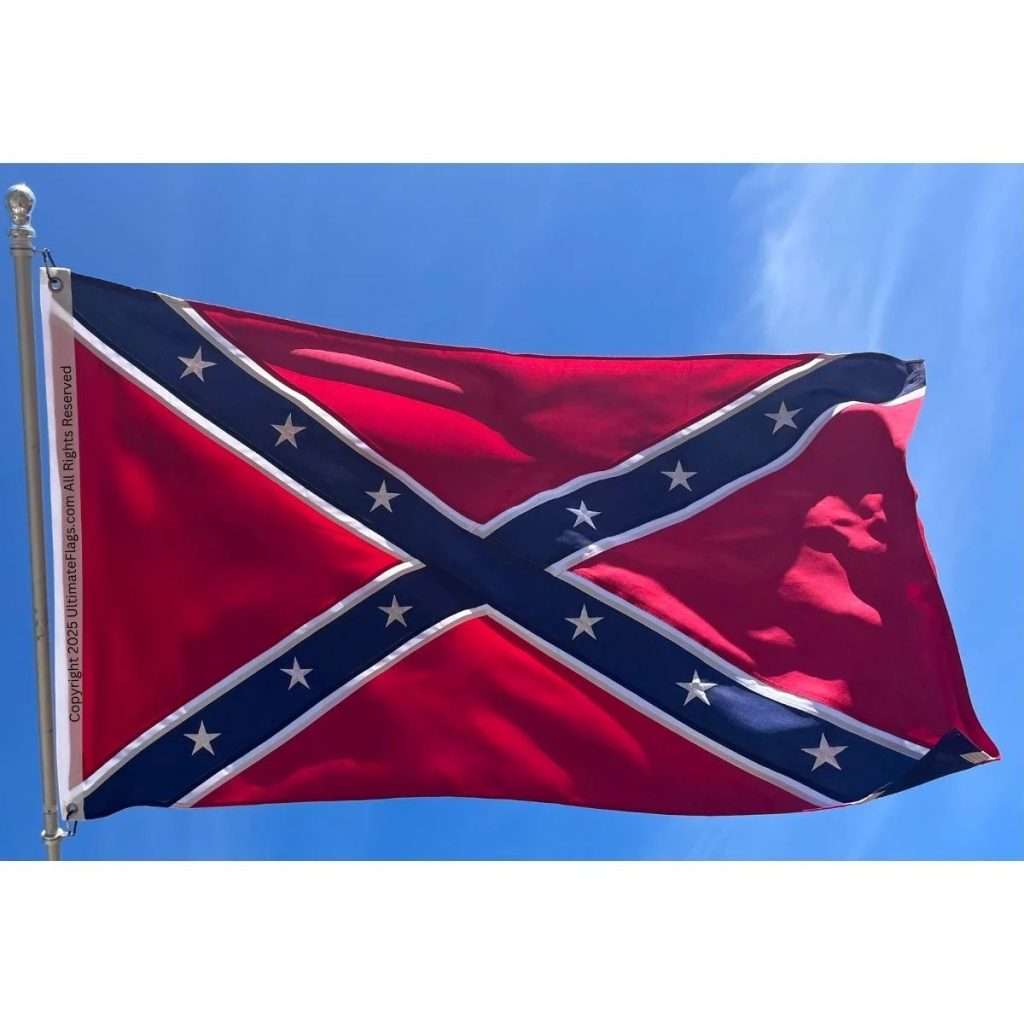
The flag most people picture — a red field with a blue saltire crossed by white stars — was designed for the Confederate Congress by William Porcher Miles of South Carolina. Miles pushed it as the national flag in early 1861, and the Congress passed him over for the Stars and Bars. The design found its real life in the field: the Army of Northern Virginia adopted it as a battle flag in November 1861, precisely because the first national flag looked so much like the United States flag that gunners couldn't tell friend from foe at distance.
The common pattern carries 13 white stars — eleven for the seceded states plus Kentucky and Missouri — though earlier issue flags sometimes show 11 or 12. Watch the saltire's border and the field's proportions too. Army of Northern Virginia flags carry a white border on all four sides; many western-theater flags do not. Small details like these are how you date a flag before you ever open an archive.
When you're ready to compare sizes and fabrics side by side, you can Shop Ultimate Flags and see every battle flag design in one place.
Step 2: Identify the pattern family
Shape is the fastest clue. The Army of Northern Virginia issued its battle flags square — infantry flags ran about 48 inches on a side, with smaller squares for artillery and cavalry — while the Army of Tennessee and the naval service used rectangular versions. The rectangular flag most folks fly today descends from that second, naval tradition, which is why the long version is properly called the Confederate naval jack even though it shares the battle flag's design.
Field variations tell their own stories. Some generals removed stars; some added battle honors stitched directly onto the cloth. General Nathan Bedford Forrest's escorts carried a 12-star version with the center star deliberately left out, so any opposing soldier who saw it knew exactly whose lines he was facing — psychological warfare, and by every period account it worked.
 Buy This Flag- Click Here
General Forrest’s 12-star battle flag — the center star was left off so opposing troops would know whose lines they faced. Sewn double-nylon reproduction shown flying.
Step 3: Follow the regiment through service records
Start with the National Park Service's Soldiers and Sailors database, which indexes Confederate soldiers by name and unit as of 2026. It's free and it gets you the regiment's full organization in minutes. From there, move to the Compiled Service Records at the National Archives — muster cards that show when a soldier enlisted, where he served, and when he left the rolls.
The unit's history matters as much as any single soldier's. A regiment's muster rolls place it inside a brigade and division, and each of those formations used particular flag depots and issue patterns. Quartermaster and ordnance receipts, where they survive, can show a flag being issued, repaired or replaced on a date. State archives hold much of this paper — Alabama, Virginia, North Carolina and Tennessee all have strong Confederate records collections — and county-level muster books sometimes survive when the central files don't.
Step 4: Find a period photograph or captured-flag report
The strongest evidence ties a named flag to a named unit on a known date. Two places to look:
- Captured-flag reports. When a Federal unit took a Confederate flag, it was reported to the War Department and the flag was sent to Washington. Those reports survive, and they list the regiment, the action and the date.
- Period photographs. Studio portraits of soldiers with their colors, and later reunion photographs, are scattered through state archives, library digital collections and unit history reprints.
The American Civil War Museum in Richmond holds the single largest Confederate flag collection in the country — more than 500 flags, many with issue and capture paperwork attached. Its catalog entries show exactly how museum staff document a flag, and they're a free masterclass in method for a researcher working from home.
Step 5: Write down what the flag is — and what it isn't
Whether you're documenting an heirloom or a reproduction you bought to fly, photograph the same things a curator would: obverse and reverse, the hoist edge and its attachments, the stitching along the fly, and the construction of the stars — embroidered, appliquéd or printed. Measure the flag in inches and note the fabric.
Then label it honestly. A sewn, embroidered reproduction built to the 48-inch infantry pattern is a display flag, and a good one; it becomes a problem only when somebody quietly lets "reproduction" turn into "wartime issue" on a shelf card or a listing. Collectors trust documentation more than adjectives, and the habit of writing the truth down is what separates a collection from an attic.
 Shop Now
A stitched-star nylon embroidered battle flag reproduction. Embroidery, sewn stripes and a reinforced hoist are the exact details to photograph when documenting a flag.
Why regimental flag records vary
Two researchers can follow the same flag and hit different walls, and it isn't anybody's fault:
- Records burned. Some Confederate quartermaster and ordnance files were destroyed at the war's end, so issue paperwork simply doesn't exist for every unit.
- Flags were replaced, not retired. Battle-worn flags went home with veterans or were replaced by issue depots, so one regiment may connect to several patterns across 1861–1865.
- Surviving flags lost their paperwork. A flag in a museum case may have arrived by donation decades after the war, with nothing but the donor's word.
- Field variations were never standardized. Generals altered designs on their own authority, and those changes appear in photos and memoirs more often than in official records.
- Postwar memory blurred. Veterans' reunion accounts are heartfelt and useful, but they were written fifty years after the fact and need cross-checking.
What's the difference between a battle flag and a Confederate national flag?
The Confederacy had three official national flags — the Stars and Bars (1861–1863), the Stainless Banner (1863–1865) and the Blood-Stained Banner (March–April 1865) — and the battle flag was never one of them. The battle flag was a field device, adopted by armies to tell friend from foe. Its design was folded into the second and third national flags as the canton, which is why the two families get confused.
Were all Confederate battle flags square?
No. The Army of Northern Virginia's issue flags were square, with infantry flags at roughly 48 inches on a side and smaller squares for artillery and cavalry. The Army of Tennessee carried rectangular versions, and the rectangular pattern also served as the naval jack. Both shapes are historically correct — they just belong to different services and theaters.
How do you document a reproduction battle flag responsibly?
Photograph the construction, measure it, and record where and when it was made if the maker marked it. Then keep "reproduction" in the label. A well-made sewn flag flying on a pole tells the same design story a curator tells — it just does it in nylon instead of silk, and saying so is what keeps the display honest.
Frequently asked questions
How many stars did a Confederate battle flag have?
The common pattern has 13 stars — eleven seceded states plus Kentucky and Missouri. Some early issue flags show 11 or 12 stars, and General Forrest’s pattern carried 12 with the center star deliberately removed.
Where can I look up Confederate soldier records for free?
The National Park Service’s Soldiers and Sailors database indexes Confederate soldiers by name and unit. The Compiled Service Records at the National Archives go deeper, and state archives hold muster rolls and unit papers.
What size were Army of Northern Virginia battle flags?
They were square. Infantry flags ran about 48 inches on a side, with smaller squares issued to artillery and cavalry units.
Is a rectangular Confederate battle flag historically correct?
Yes. The Army of Tennessee and the naval service used rectangular versions, and the rectangular flag is properly the Confederate naval jack. Square and rectangular patterns are both period-correct.
How do I know if a battle flag is a wartime original?
Assume reproduction unless there is documented provenance — issue records, capture reports or an unbroken ownership trail. Wartime originals sit in museums and serious private collections, and they come with paperwork.
What size battle flag should a collector display?
A 3×5 ft flag suits most outdoor poles, while square 48-inch patterns suit reenactment and museum-style displays. Match the size and shape to the pattern family you’re honoring.
One last thing
The 12-star Forrest flag is a reminder that these designs were working tools, not wallpaper. Leaving a star off so the enemy would recognize the general who'd beaten them four times is the kind of detail no official record captures — it survives because a color sergeant told somebody, who told somebody else. When you document a flag, you're keeping that chain of memory unbroken, and a well-made reproduction from Ultimate Flags is a perfectly honest way to fly the pattern forward.
Related guides