Posted on

Military flags for VFW posts and veteran halls: complete 2026 guide

Military flags for VFW posts and veteran halls: complete 2026 guide

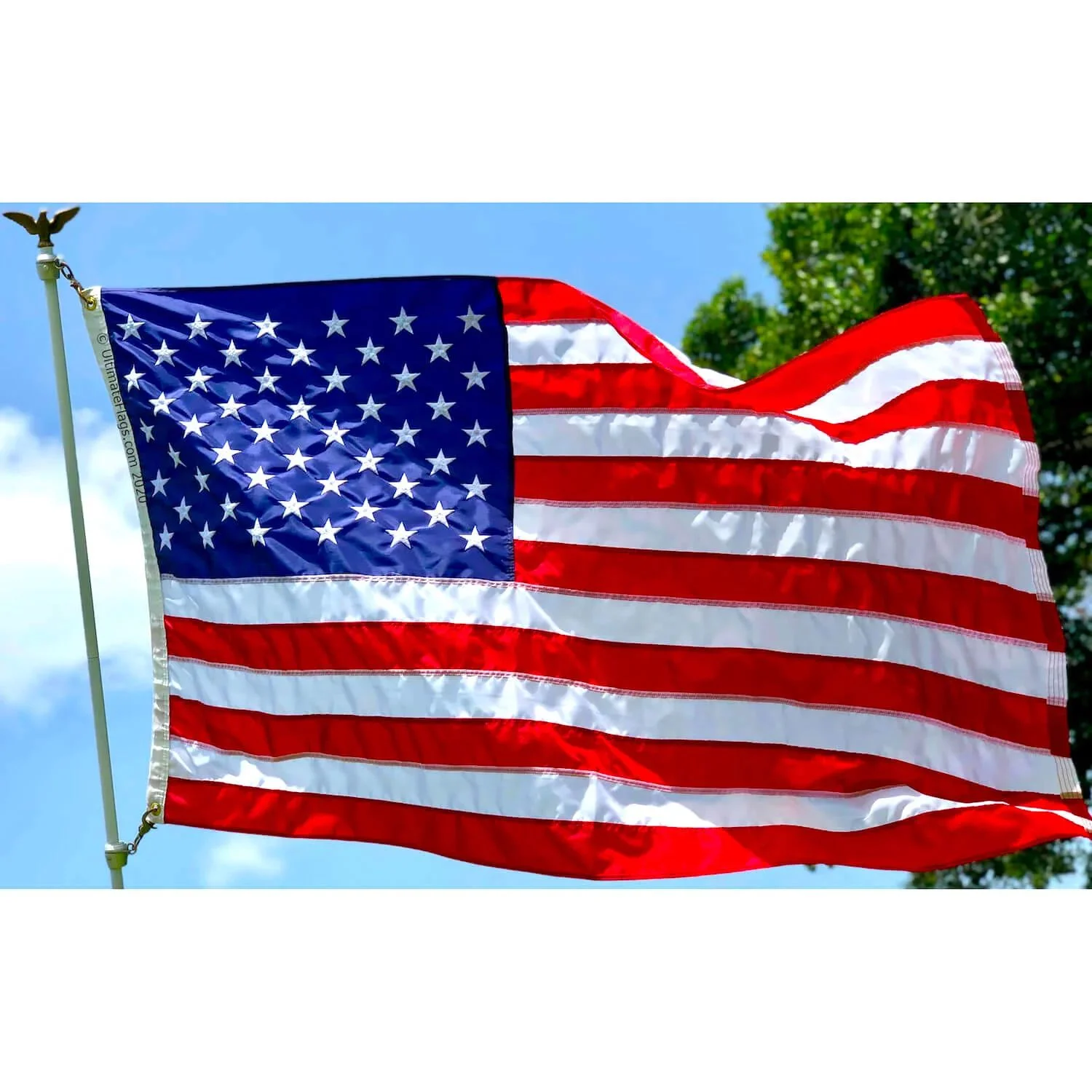
Military flags for VFW posts are the American flag, the POW/MIA flag and the service-branch banners a veterans hall flies indoors and out, and getting that lineup right honors members and tells the post's story to everyone who walks in. Every VFW hall carries the same core duty — the U.S. flag flies highest, above every other banner in the room — but the exact mix of Army, Navy, Marine Corps, Air Force, Coast Guard and Space Force flags is different at every post. This guide walks through how a post sizes, orders, displays and cares for its flags in 2026, with a lineup checklist you can bring to your next trustees meeting.

If the post is outfitting a hall from scratch, start with the best military flags for a home flagpole display — the sewn and printed builds that hold up on an outdoor home pole are the same builds that hold up on the pole out front of the post.

TL;DR
  • Fly the U.S. flag highest and first in every VFW hall and on the outdoor pole.
  • Hang the POW/MIA flag directly below the U.S. flag — never above it.
  • Use 3×5 ft flags with pole sleeves indoors and 3×5 ft or 4×6 ft grommeted flags outdoors.
  • Order sewn or embroidered service flags for outdoor poles; printed builds fade faster in direct sun.
  • Retire tattered or faded flags with a dignified retirement ceremony, not the trash.

Why military flags matter for VFW posts

The Veterans of Foreign Wars was founded in 1899 by Spanish-American War veterans, and proper flag display has been part of post life ever since. A well-ordered flag set does three jobs at once in a hall: it meets the U.S. Flag Code, it honors members from every branch of service, and it gives funeral honors, award ceremonies and recruitment events the right backdrop. Visitors judge a post by its hall, and the flag set is the first thing they read.

Posts are also harder on flags than almost any other flag buyer. The outdoor flag flies day after day in all weather, indoor ceremony flags get handled at every funeral detail, and casket flags carry the weight of a member's final honors. Fabric choice, size and display order all matter more at a post than at a residence — a faded or wrongly ordered lineup reflects on the whole post, not on one member.

Map your post's flag lineup

Walk the hall and write down every place a flag flies or stands. Most posts land on five groups:

  • One U.S. flag for the outdoor pole and one indoor ceremonial flag for the stage
  • One POW/MIA flag for below the U.S. flag
  • Branch service flags for the branches your members served in
  • One state flag, especially where the post hosts state officials or sits near the state line
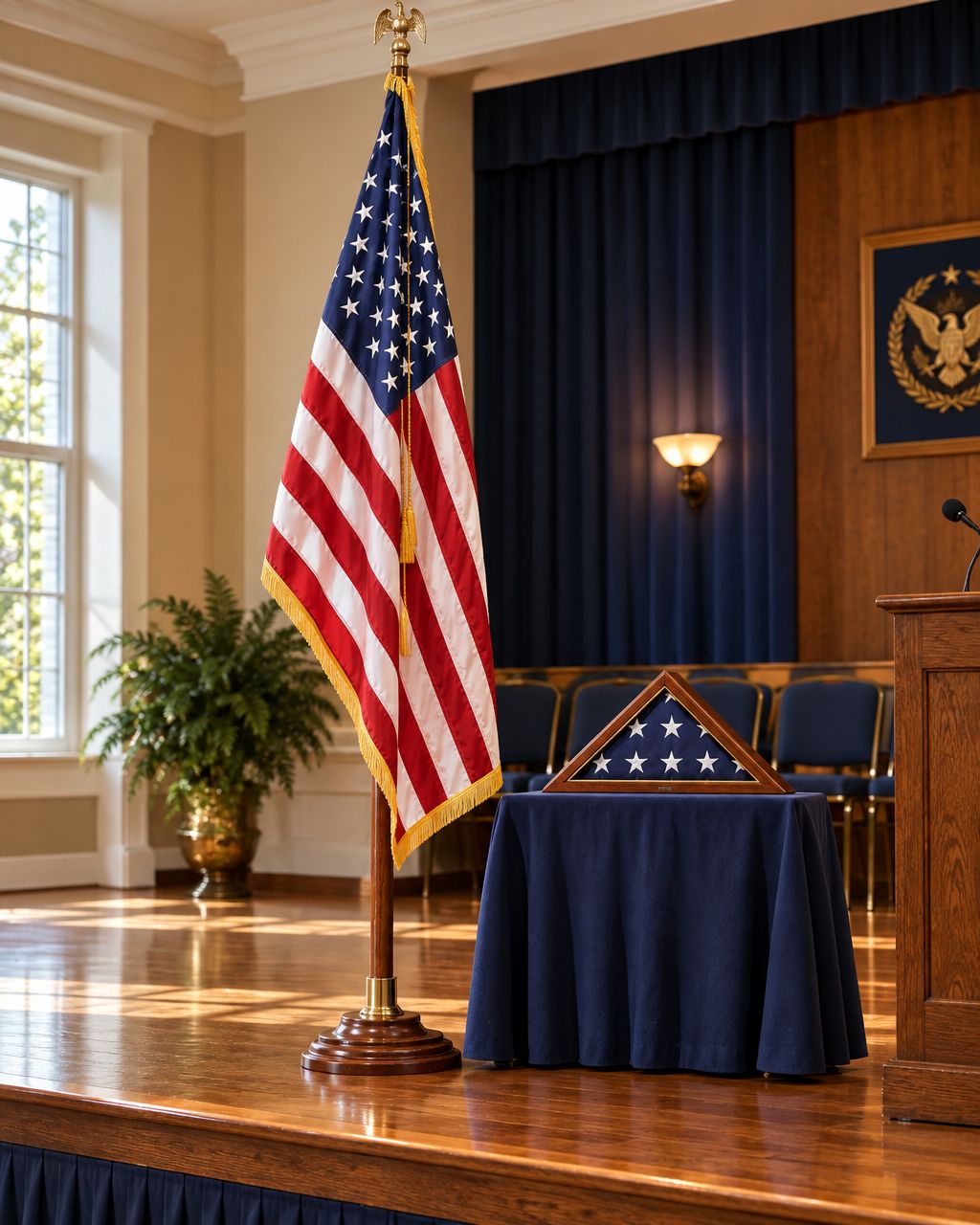
  • A burial flag set and folded-flag display case for funeral honors

The written list prevents the two most common ordering mistakes posts make: duplicate flags and missing sizes. It also tells you which flags can wait for the next budget cycle and which need to be on the wall before the next funeral detail.

Choose the right sizes

The 3×5 ft flag is the workhorse for VFW posts in 2026 — it fits most indoor poles, most funeral detail sets and most outdoor poles up to about 25 feet. Halls with a tall exterior pole or a large stage move up to a 4×6 ft or 5×8 ft flag. Burial and casket flags are a fixed 5×9.5 feet, the only size that folds correctly into the traditional triangle presented to the next of kin.

Attachment follows location. Indoor ceremonial flags are sewn with a pole hem sleeve, often finished with gold fringe, so they slide onto an indoor pole and hang straight; outdoor flags get a heading and brass grommets that clip to a halyard. Mixing the two up is a visible mistake — a grommeted flag bunched on an indoor sleeve pole looks wrong at eye level. If you are not sure which mounting a given pole needs, the guide to which American flag attachment fits your pole walks through the match pole by pole.

Pick materials that match the job

Flag option Best for Key limitation
Embroidered or sewn nylon Daily outdoor flying at the post Fades after seasons of direct sun; costs more than printed
2-ply sewn polyester Windy or coastal post locations Heavier fabric needs a stronger pole and better hardware
Printed polyester Budget replacements and parade spares Shorter outdoor life; the design reads fully on one side
Pole-sleeve indoor flag Stage sets, ceremonies and funeral details Not built to take outdoor wind

For the outdoor pole, sewn or embroidered nylon is the standard at posts that fly daily — the fabric dries fast, and embroidered stars hold their shape in weather that flattens printed ones. Posts that want the crisp, official look inside the hall often pick the same embroidered American flags used for government buildings, and for good reason: sewn construction reads well from across a room, which is exactly where a post's audience stands. Printed flags belong in the parade closet as spares, not on the post's main pole. Ultimate Flags sews and embroiders all three builds, so a post can match fabric to each location on one order. If a nylon flag has already faded, careful washing extends its life a little — sun fading cannot be washed back.

Get the display order right

The U.S. Flag Code settles most of the order questions a hall has:

  • The U.S. flag flies at the center and highest point when displayed with other flags on staffs
  • When crossed with another flag, the U.S. flag sits on its own right with its staff in front
  • Flags of other nations fly at equal height with the U.S. flag — never below, never above
  • State, branch and organizational flags fly below the U.S. flag

Branch flags follow the Department of Defense order of precedence: Army, Marine Corps, Navy, Air Force, Space Force, then Coast Guard. Posts that display a state flag hang it below the U.S. flag alongside the branch colors, and sewn state flags like those chosen for indoor office displays hold their shape better under hall lighting than thin printed versions. Order matters as much as the flags themselves — members and visiting officials notice a wrong arrangement immediately, and fixing it costs nothing but a few minutes with a stepladder.

Fly the POW/MIA flag on its designated days

The POW/MIA flag, designed by Newt Heisley in 1971, carries the silhouette of a prisoner and the words "You Are Not Forgotten." Federal law directs federal buildings to fly it on six designated days: Armed Forces Day, Memorial Day, Flag Day, Independence Day, National POW/MIA Recognition Day (the third Friday of September) and Veterans Day. Most VFW posts go further and fly it every day, directly below the U.S. flag — the custom in the overwhelming majority of halls, and a visible statement of the post's mission. In 2026 the flag remains one of the most recognized banners in the country, and a post that flies it daily rarely has to explain why.

Care for the flags and retire worn ones properly

Inspect the outdoor flag monthly: fraying at the fly end is the first sign of wear, and trimming a fray early adds months of life. Wash indoor flags by hand with mild soap and hang them to dry — never machine-dry a sewn flag, which twists the heading and loosens the stitching. Between ceremonies, store ceremonial flags flat or loosely rolled rather than bunched in a closet. When a flag is beyond repair, retire it in a dignified ceremony; many posts run retirement programs with local Scout troops, and worn flags collected from the community are a steady source of goodwill and new members alike.

Common mistakes VFW posts make

  • Flying the POW/MIA flag above the U.S. flag. It always flies below the U.S. flag on the same pole or staff.
  • Using an outdoor flag indoors. A grommeted flag looks wrong on an indoor pole; use a pole-sleeve ceremonial flag with fringe.
  • Displaying branch flags level with the U.S. flag. In a row of staffs, the U.S. flag stands at the center and the highest point.
  • Letting a faded flag represent the post. A bleached-out flag on the front pole is the first thing visitors see.
  • Skipping the state flag. It completes the standard hall lineup and costs little.

FAQ

What flags should a VFW post display?

A standard VFW lineup is the U.S. flag highest, the POW/MIA flag below it, branch service flags for the branches members served in, and the state flag. Burial flags and folded-flag cases round out funeral honors.

Can the POW/MIA flag fly above the American flag?

No. The POW/MIA flag flies directly below the U.S. flag on the same pole or staff. Federal law requires it on designated days, and most posts fly it daily below the U.S. flag.

What size flag is used for a military funeral?

Burial flags are 5×9.5 feet, the only size that folds correctly into the traditional triangle. The flag is presented to the next of kin after the 13-fold ceremony.

What order do military branch flags go in?

Follow Department of Defense order of precedence: Army, Marine Corps, Navy, Air Force, Space Force, then Coast Guard. All of them fly below the U.S. flag.

What size flag should fly on a post’s outdoor pole?

A 3×5 ft flag fits most post poles up to about 25 feet. Taller poles and large stages move up to 4×6 ft or 5×8 ft.

How should a VFW post retire an old flag?

Hold or join a dignified flag retirement ceremony, commonly run with local Scout troops. Never discard a worn U.S. flag in the trash.

Does the state flag go above branch flags?

Both fly below the U.S. flag, and neither outranks the other. Most posts hang them at the same height in the same row.

What days must the POW/MIA flag be flown?

Federal buildings fly it on Armed Forces Day, Memorial Day, Flag Day, Independence Day, National POW/MIA Recognition Day and Veterans Day. VFW posts usually fly it every day.

One last thing

Keep a dedicated folded-flag display case in the hall. A 5×9.5 ft burial flag folds into the traditional triangle that fits a standard memorial case, and those folded flags carry more meaning per square inch than anything else in the building — members' families regularly ask whether the post can display one after a service. A case near the stage, with the member's name and dates on a small plaque, turns a funeral detail into a permanent tribute. Ultimate Flags carries sewn and embroidered builds in every size covered above, so a post can order its full 2026 lineup — outdoor, indoor, branch and burial flags — from the Ultimate Flags store in one pass.

Related guides
Posted on

Flags for HOAs and community associations: complete 2026 guide

Embroidered nylon state flag flying on an outdoor entrance pole

Flags for HOAs and community associations are the American and state banners a neighborhood raises at its entrance, clubhouse and memorial corner, picked to look sharp for years and to stay inside the rules a homeowners association can legally set. This 2026 guide covers the federal law behind those rules, the right sizes for entrance poles, fabric choices and the display etiquette that keeps a shared flag respectful.

TL;DR
  • Federal law since 2005 stops an HOA from banning the US flag on a member’s own property.
  • Match flag to pole: a 20-25 ft entrance pole takes a 4×6 ft flag.
  • Embroidered nylon is the outdoor pick; cotton belongs inside the clubhouse.
  • Boards may set reasonable time, place and manner rules — size, pole height, lighting.
  • Retire worn flags with honors; keep a half-staff calendar for Memorial Day and Patriot Day.
Ultimate Flags flag sale banner

Why flags matter in an HOA

A community association flies its flags more publicly than almost any single homeowner does. The entrance pole is the neighborhood's handshake, the clubhouse colors frame every meeting, and a veterans memorial corner sets the tone for the whole street. Shared displays also raise the stakes: a faded or crooked flag at the gate is noticed by every resident and every visitor.

The segment differs from a single-home display in three ways:

  • The entrance pole flies daily. A flag that lives outdoors year-round needs stitched construction, not a printed banner.
  • The board sets the rules, but not all of them. Federal law limits what an association can prohibit, and the rules it can set are narrower than most boards assume.
  • Several flags share the display. The US flag, the state flag and sometimes a military or POW/MIA flag fly together, and the order of those flags is fixed by custom and the U.S. Flag Code.

What the law says an HOA can and cannot do

The key statute is the Freedom to Display the American Flag Act of 2005. Congress passed it after years of disputes between homeowners and their boards, and it says a homeowners association, condominium association or residential real estate management organization cannot prohibit a member from displaying the American flag on property the member owns or has exclusive rights to use.

The right to fly the flag is not unlimited. The Act lets a board adopt reasonable restrictions on the time, place and manner of display — and the U.S. Flag Code itself sets standards any rule can reference:

  • Hours: the flag flies from sunrise to sunset on an outdoor pole unless it is properly illuminated after dark.
  • Weather: a flag comes down in inclement weather unless it is an all-weather flag.
  • Condition: a flag that is torn, faded or dirty should be cleaned, repaired or retired with honors.

So a board can lawfully write rules about pole location, maximum pole height, structural safety and lighting — but it cannot simply ban the American flag from the community. State law can add protections or extra limits, so associations should check their own state's statute alongside the federal Act before finalizing covenants.

Match the flag to the entrance pole

The single biggest sizing mistake in community displays is putting a big flag on a short pole or the reverse. A flag that is too small disappears at a distance; one that is too large thrashes itself to pieces and frays within a season or two. The quarter rule the store uses on every American flag listing keeps the match simple: flag fly length about one quarter of the pole height.

  • 15-20 ft pole: 3×5 ft flag
  • 20-25 ft pole: 4×6 ft flag
  • 25-30 ft pole: 5×8 ft flag
  • 30 ft and taller: 6×10 ft and up

Most subdivision entrance poles sit between 20 and 30 feet, which puts a 4×6 ft or 5×8 ft American flag in the sweet spot. Check the pole height with the grounds crew before ordering, and size the state flag one step smaller so the US flag keeps its position of honor.

An embroidered state flag on an outdoor pole — many communities raise the state flag beside Old Glory at the entrance, one size smaller than the American flag.

Choose the fabric that survives an entrance display

Fabric is where associations save or waste money. A community entrance pole flies more hours than any home pole, and the wrong weave fades or shreds within a season. The choices break down cleanly:

  • Embroidered nylon is the standard outdoor pick. It is light enough to fly in a faint breeze, it dries fast after rain, and embroidered stars with sewn stripes hold their stitching through daily hoisting.
  • Heavy 2-ply polyester suits exposed entrances with constant wind. The two-ply weave is heavier and more abrasion-resistant, at the cost of needing more breeze to fly fully.
  • Cotton sewn flags belong indoors — the clubhouse lobby, the meeting hall, the memorial display case. Cotton soaks up rain and mildews, so it never lives on an outside pole.
  • Printed polyester is the budget line for holiday weekends and temporary displays, not for a pole that flies every day.

Whatever the fabric, inspect the fly end monthly. The fly end is where a flag wears out first, and a fraying hem caught early is repairable.

Plan the display order around the US flag

When several flags share a community entrance or clubhouse, the arrangement follows rules most residents half-remember and boards should get exactly right:

  1. The US flag holds the position of honor — on its own right, or above any other flag on the same pole.
  2. The state flag flies at the same height or lower on a separate pole, never higher than the US flag and never to its right.
  3. Hoist the US flag first and lower it last when the poles are raised in sequence.
  4. Light the flag if it flies at night. A spotlit entrance pole is the cleanest way to satisfy the Flag Code's after-dark requirement.
  5. Take it down in severe storms unless the flag is an all-weather build, and let it dry fully before refolding or restowing.

A POW/MIA or military service flag at a veterans memorial corner flies below the US flag on the same or adjacent pole, and it deserves the same lighting and fabric care.

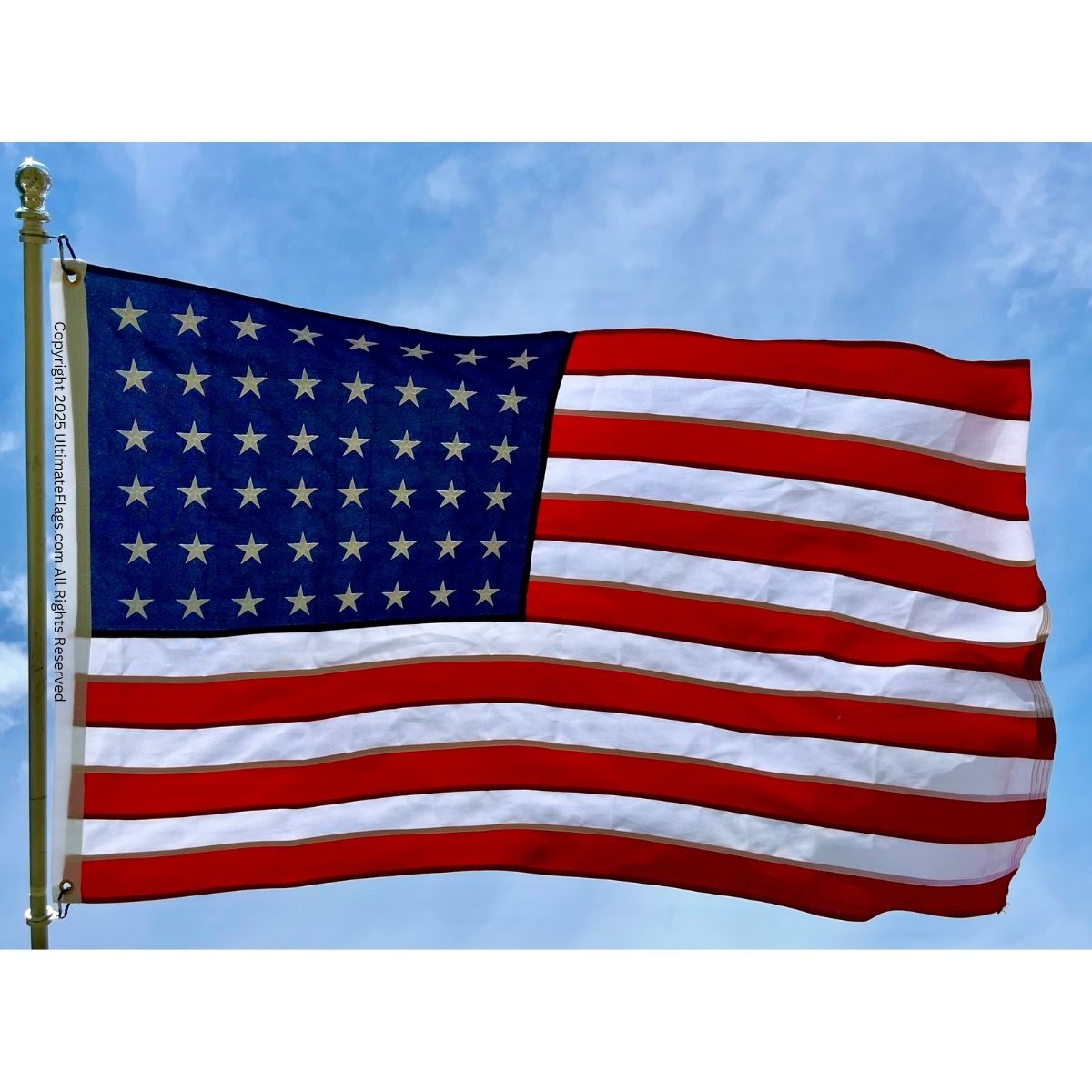
A sewn 48-star American flag — the design that flew from 1912 to 1959 — a fitting choice for a community veterans memorial or heritage corner.

Write the flag rules into the covenants

Vague rules breed disputes. A board that writes its display standards into the architectural guidelines settles most questions before they start, and every item on the list below is a lawful time, place or manner rule:

  • Size limits: the maximum flag size per lot, tied to the pole height by the quarter rule.
  • Pole rules: one pole per lot, a maximum height, and setbacks from property lines for structural safety.
  • Lighting: flags flying after dark must be illuminated.
  • Condition: flags must be clean and serviceable; tattered displays get a repair-or-retire notice, not a fine.
  • Holiday exceptions: seasonal and celebration flags allowed on named dates, so enforcement stays consistent.

Keep the rules to how, where and when. A covenant that tries to prohibit the American flag outright contradicts the 2005 Act and will not hold up.

Set the community half-staff calendar

A shared flag brings shared obligations. The U.S. Flag Code directs the flag to half-staff on the days a community flies it in mourning, and an association that posts the calendar avoids every argument about when and why:

  • Memorial Day: half-staff from sunrise until noon, then briskly to the top for the rest of the day.
  • Patriot Day, September 11: half-staff for the day.
  • Peace Officers Memorial Day, May 15: half-staff, where the community observes it.
  • National mourning proclamations: follow the presidential proclamation's stated duration.

Raising a flag to half-staff means first hoisting it to the peak, then lowering it to half the pole's height; retiring it means raising it to the peak again before lowering.

Common mistakes HOAs make with flags

  • Printed flags on a permanent pole. A printed flag flying daily fades and frays within a season or two; stitched construction is the fix.
  • Oversizing for the pole. A 5×8 ft flag on a 20 ft pole beats itself apart at the fly end; match size to height instead.
  • No night lighting. An unlit flag that stays up after sunset violates the Flag Code's display rule even when the board meant well.
  • Staging the state flag wrong. Above the US flag or on its right are both errors on US soil, however symmetric the entrance looks.
  • Writing a ban instead of a rule. Boards cannot prohibit the American flag; they can only govern the time, place and manner, per the 2005 Act.
  • Skipping retirement. A worn flag goes to a dignified retirement ceremony, often run with a local American Legion post — never into a dumpster.

Flags for community associations at a glance

Flag Best for Standout feature Key limitation
Outdoor embroidered nylon US flag Daily entrance-pole flying Embroidered stars, sewn stripes, flies in light wind Lighter weave wears faster in sustained high wind
Heavy 2-ply polyester US flag Windy, exposed entrances Abrasion-resistant two-ply weave Needs more breeze to fly fully
Embroidered state flag Entrance and clubhouse display Official state-adopted design, stitched detail Size it one step below the US flag
Cotton sewn US flag Indoor clubhouse and memorial displays Traditional weave and drape Never for outdoor or wet use
Historic reproduction flag Veterans memorial and heritage corners Dated designs such as the 48-star flag A display piece, not a daily flyer

FAQ

Can an HOA prohibit homeowners from flying the American flag?

No. The Freedom to Display the American Flag Act of 2005 stops homeowners associations from prohibiting members from displaying the US flag on property they own or have exclusive rights to use. Boards may still set reasonable time, place and manner rules.

What flag rules can an HOA legally enforce?

Reasonable rules on pole location, maximum pole height, size limits tied to pole height, lighting for night display and flag condition. The board governs how, where and when — not whether — the American flag flies.

What size flag does a community entrance pole need?

Follow the quarter rule: flag fly length about one quarter of the pole height. A 20-25 ft entrance pole takes a 4×6 ft flag, and a 25-30 ft pole takes a 5×8 ft.

Should an HOA buy a nylon or polyester American flag?

Embroidered nylon for most entrances — it flies in light wind and dries fast. Choose heavy 2-ply polyester for exposed, high-wind entrances where abrasion resistance matters more than a light breeze lift.

Can the state flag fly at the same height as the US flag?

Yes, on a separate pole of equal height — but never higher and never to the US flag’s right on US soil. Hoist the US flag first and lower it last.

Does the community flag need to come down at night?

Only if it is not illuminated. The Flag Code allows a flag displayed 24 hours a day when a proper light shines on it, which is standard practice on lit entrance poles.

When does the flag fly at half-staff in a community?

Memorial Day until noon, Patriot Day on September 11, and any presidential proclamation of national mourning. Raise the flag to the peak first, lower it to half the pole height, and return it to the peak before lowering.

Where do worn community flags go?

To a dignified retirement, preferably by burning, often run jointly with a local American Legion or scout troop. Collecting residents’ worn flags is an easy association service project.

One last thing

Order replacement flags before the summer holidays instead of after them. Memorial Day, Flag Day on June 14 and the Fourth of July run back-to-back, and an entrance pole caught mid-season with a faded flag looks worse than no flag at all. Browse the Shop Ultimate Flags American flag collection a few weeks ahead and schedule the swap for the week before Memorial Day.

For a deeper look at outdoor fabric choices, see our guide to the best nylon American flags for commercial storefronts — the same daily-flying demands apply to a community entrance.

Historical sources consulted for this 2026 guide: the Freedom to Display the American Flag Act of 2005, the U.S. Flag Code on display hours, weather and half-staff protocol, and the flag-size guidance used on Ultimate Flags product listings.

Posted on

American and state flags for scout troops: complete 2026 guide

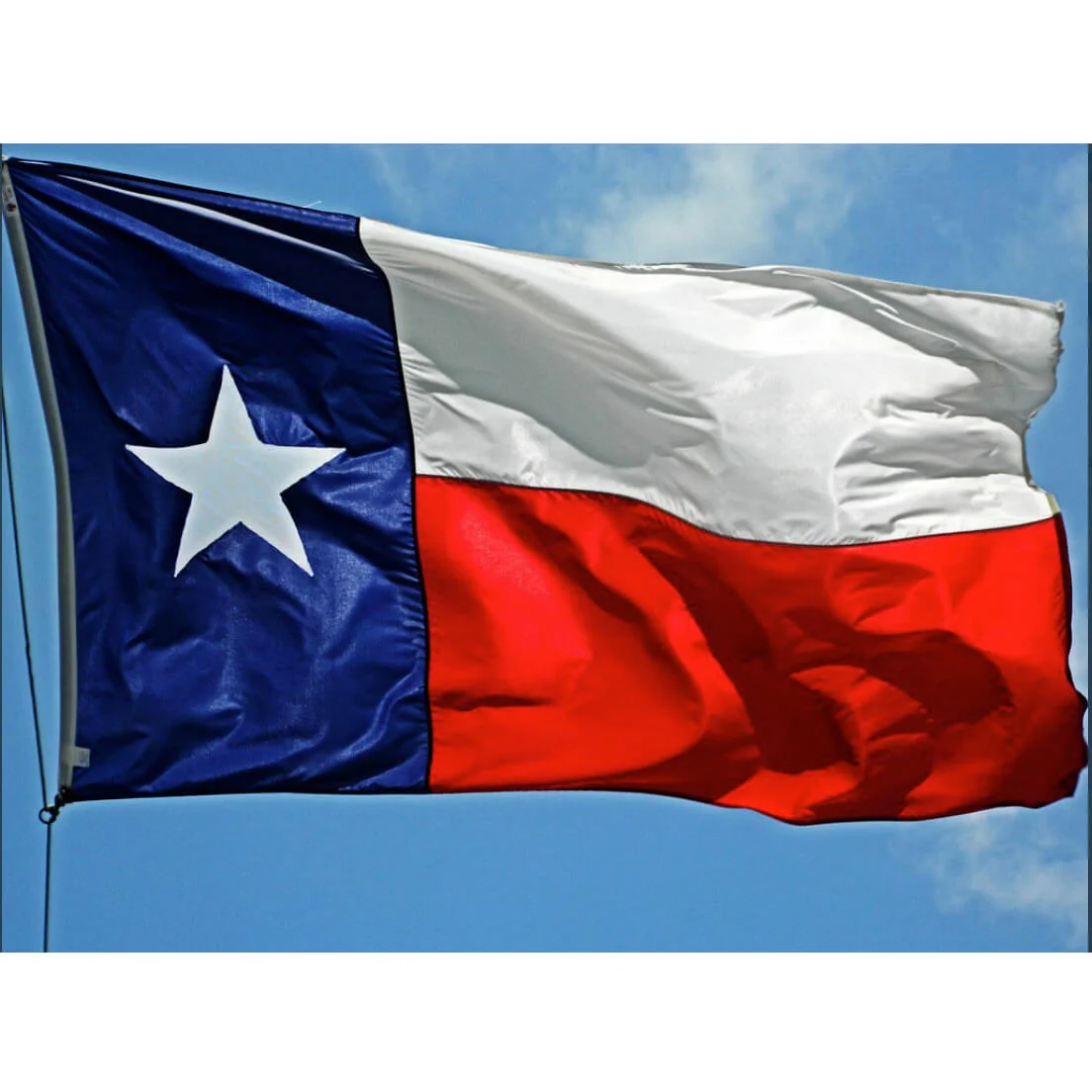
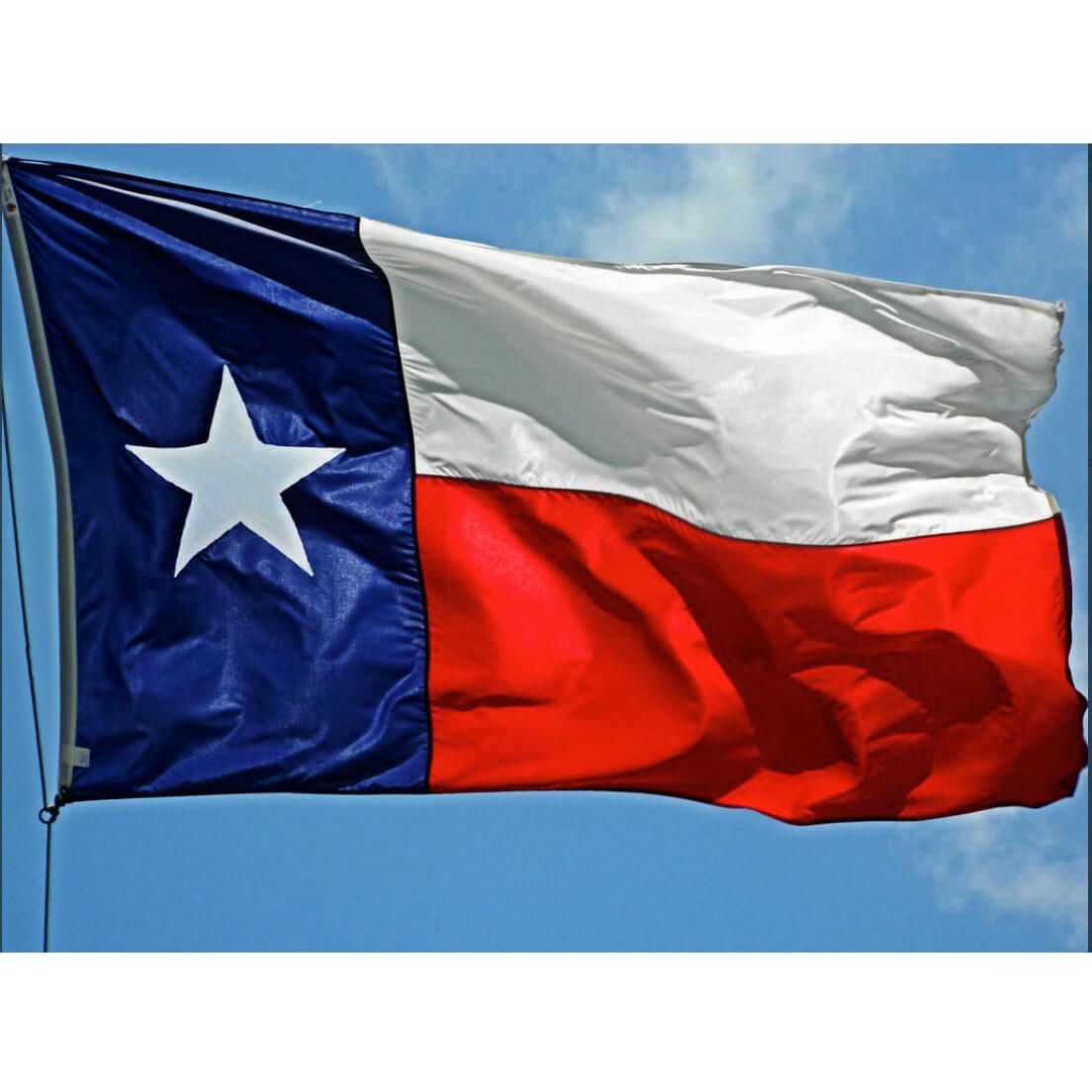
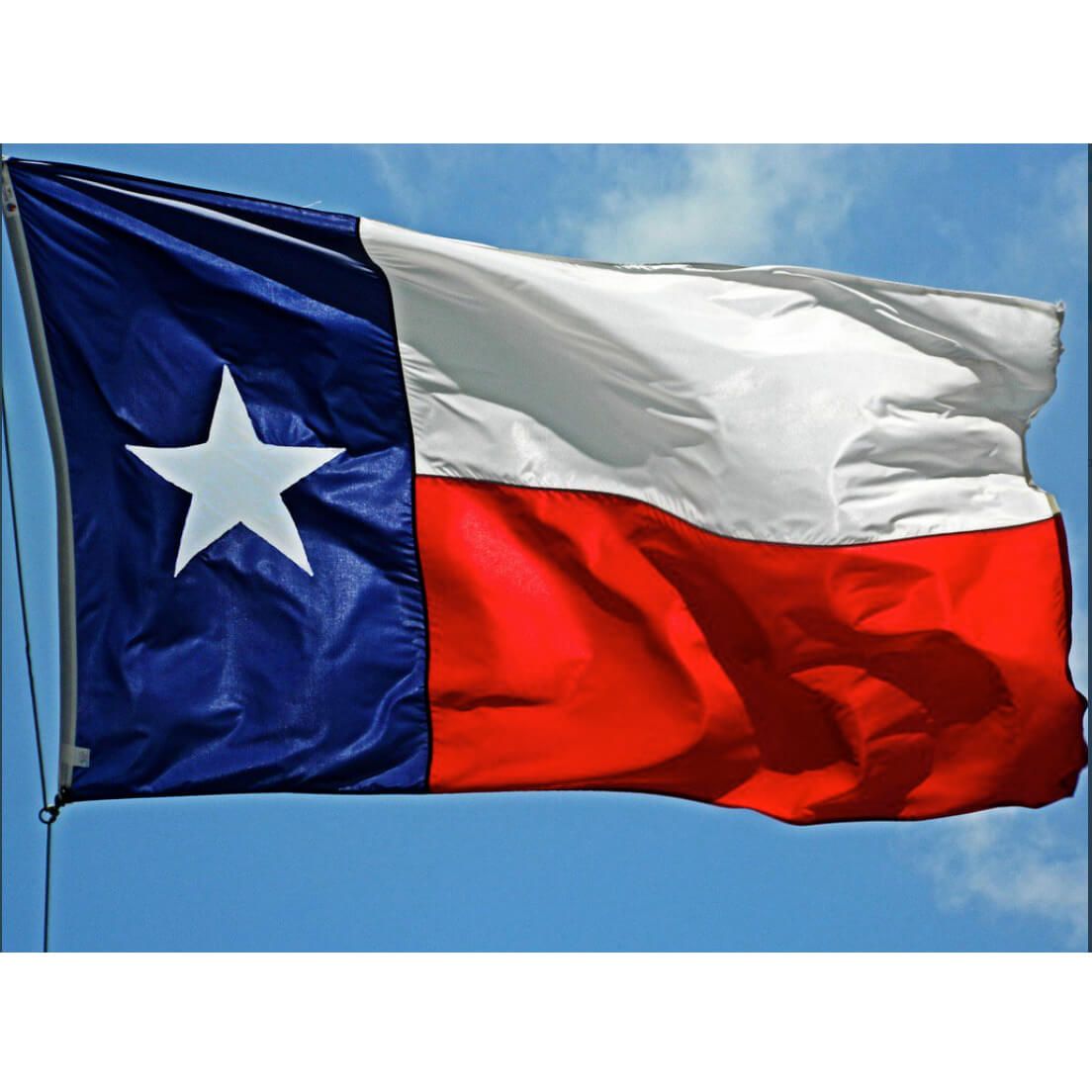
Embroidered nylon Texas Lone Star state flag flying on an outdoor pole

Scout troop flags are the American and state banners a pack or troop flies at meetings, carries in color guards and retires with honors, and the right picks do two jobs at once: they teach flag respect and survive years of scout handling. This 2026 guide walks a leader through sizes, fabrics, state flag choices and retirement etiquette, built on flags Ultimate Flags actually carries.

TL;DR
  • Start with a 3×5 ft American flag — the standard size for scout color guards.
  • Outdoor poles take sewn-and-embroidered nylon; indoor ceremonies suit cotton.
  • Add state flags for your scouts’ home states and the charter organization.
  • Never fly the US flag lower than a state flag, and never let it touch the ground.
  • Retire worn flags with honors — scout troops and American Legion posts do this together.
Ultimate Flags flag sale banner

Why flags matter in a scout troop

A scout troop touches its flags more often than almost any family does. Most packs and troops open meetings with a flag ceremony, carry the colors in parades and camp openings, and take part in retirement ceremonies when flags wear out. That frequency is the whole buying problem: a flag that sits on a porch pole can coast, but a flag handled by twelve sets of hands every week needs construction that forgives it.

The segment differs from a home display in three ways:

  • Indoor handling dominates. Most scout flags live on indoor stands and poles, which changes the right fabric and attachment.
  • State flags carry real meaning. Troops represent their home state and their charter organization, so the state flag is not decoration — it is part of the ceremony.
  • Retirement is a duty, not an option. The U.S. Flag Code says a flag too worn to serve as a fitting emblem should be destroyed in a dignified way, preferably by burning, and scout troops are among the groups that lead those ceremonies.

Start with the American flag your troop will carry

The workhorse for a scout color guard is a 3×5 ft American flag. It is the size that fits standard indoor parade poles, it folds into the traditional triangle at a manageable size, and it matches the quarter rule the store uses on every American flag listing: flag fly length about one quarter of the pole height, so a 20 ft outdoor pole takes a 3×5 ft or 4×6 ft flag.

For construction, pick by where the flag lives. An outdoor pole wants a sewn-and-embroidered nylon flag: embroidered stars, sewn stripes, brass grommets and reinforced fly ends that shrug off weather and weekly hoisting. An indoor ceremony flag wants cotton: the traditional weave has the weight and drape that reads well behind a podium, and it is available with a pole sleeve for indoor stands instead of grommets.

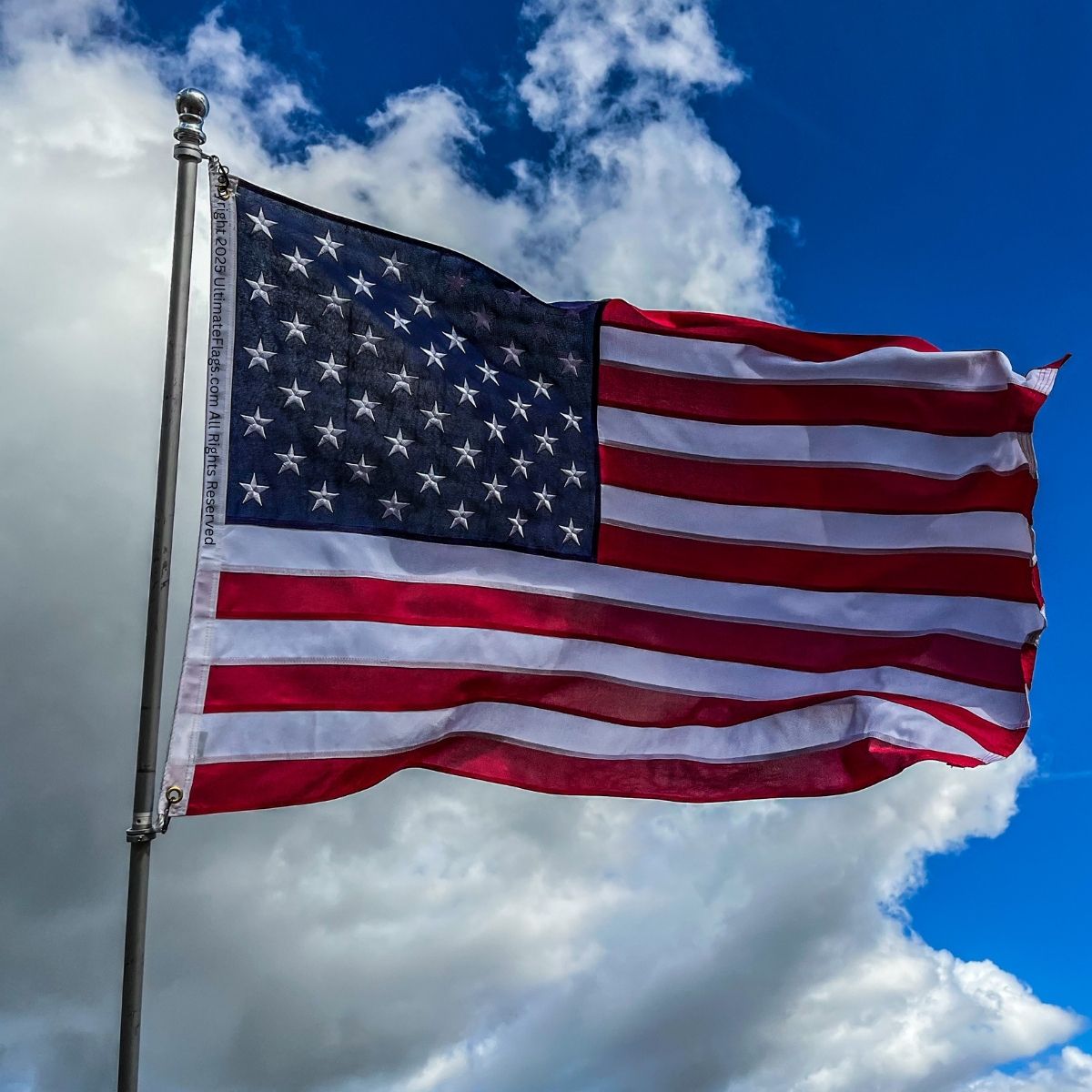
Sewn and embroidered American flag flying outdoors — the construction that survives a troop's weekly handling.

Add the state flags that match your scouts

Every scout troop is a local thing, and the state flag makes that visible. The practical setup is two state flags: the home state for the chartered community, and the state where the troop's charter organization sits if the two differ. A troop near a state line can add the neighbor's flag and turn it into a teaching moment about state adoption dates and designs.

Ultimate Flags carries all 50 states and the US territories in its Shop Ultimate Flags state flag collection, in standard printed polyester, sewn and embroidered builds and heavier Poly-Max constructions. The designs follow the official state-adopted layouts — the current Texas flag adopted January 25, 1839, the magnolia flag Mississippi adopted in 2020, and every other design as each state's legislature set it.

An embroidered nylon Texas state flag on an outdoor pole — the Lone Star design Texas adopted in 1839.

Choose the fabric for the way your troop meets

Fabric is the decision leaders get wrong most often, and it is a two-line answer:

  • Nylon is the outdoor and high-handling choice. It is light, so it flies in a faint breeze, it dries fast after a rain-soaked campout, and embroidered nylon builds keep their stitching through weekly ceremonies.
  • Cotton is the indoor and ceremonial choice. The weave looks and moves the way a traditional flag should in a lodge or a courtroom, and it takes a deeper color under indoor light. Cotton soaks up rain, so it never lives on an outdoor pole.
  • Printed polyester is the budget line for parades, theatrical use and giveaways. It is through-printed so the design shows on both sides, and it is the right pick when a flag is more prop than heirloom.

Set up the indoor ceremony display

A scout meeting opens with the colors in a specific order, and the hardware should support it. Use these steps:

  1. Put the US flag on the speaker's right — the position of honor whether it is carried or staged.
  2. Fit cotton flags with a pole sleeve for indoor stands; grommets and clips belong on outdoor halyards.
  3. Stage state flags at the same height or lower, never higher than the US flag, and never to its right.
  4. Add the 5×9 1/2 ft ceremonial size for memorial and eagle court-of-honor displays where a larger casket-size flag is traditional.
  5. Assign the color guard by name before the meeting, so nobody improvises with the colors.

Plan the outdoor pole and flag sizes

If the troop's charter organization raises a flag outside — many meet at schools, churches and civic halls — match the flag to the pole before buying:

  • 15-20 ft pole: 3×5 ft flag
  • 20-25 ft pole: 4×6 ft flag
  • 25-30 ft pole: 5×8 ft flag
  • 30 ft and taller: 6×10 ft and up

An embroidered nylon flag is the standard choice on these poles because it flies in the light breezes that leave heavier weaves hanging limp. Take the flag down in severe storms; the fly end is where a flag wears out first, and a monthly look at the hem catches fraying while it is still repairable.

Teach the handling rules that come with the flag

Flag care is the curriculum that rides along with the purchase, and a few rules cover what scouts need in 2026:

  • The flag never touches the ground or anything beneath it.
  • It flies from sunrise to sunset on an outdoor pole unless illuminated after dark.
  • No flag flies above the US flag or to its right in a display on US soil.
  • A worn flag is retired with honors — the Flag Code's dignified destruction, preferably by burning — never thrown away.

Scout troops have run flag retirement ceremonies alongside American Legion posts for generations, and collecting worn flags from the community is one of the easiest service projects a troop can run.

A sewn 48-star American flag — the design that flew from 1912 to 1959 — a natural show-and-tell piece for a troop's history segment.

Scout troop flags at a glance

Flag Best for Standout feature Key limitation
Outdoor nylon embroidered US flag Weekly ceremonies and outdoor poles Embroidered stars, sewn stripes, flies in light wind Lighter fabric wears faster in sustained high wind
Cotton sewn US flag Indoor ceremonies and court of honor Traditional weave and drape with a pole sleeve option Not for outdoor or wet use
Standard printed state flag Meeting displays and teaching Official state design at the everyday price point Print looks flat next to stitched detail
Sewn or embroidered state flag Outdoor poles and permanent displays Stitched detail that holds up through seasons Heavier build costs more than printed

Common mistakes scout troops make with flags

  • Buying printed for a permanent pole. A printed flag on a pole that flies daily fades and frays within a season or two; stitched construction is the fix.
  • Oversizing the flag for the pole. A 5×8 ft flag on a 20 ft pole thrashes itself to pieces; follow the quarter rule instead.
  • Sending cotton outdoors. Cotton absorbs rain and mildews; keep it inside and let nylon handle weather.
  • Staging the state flag higher than the US flag. The US flag holds the position of honor on US soil, every time.
  • Throwing a worn flag in the trash. Retirement with honors is the respectful end, and it doubles as a public service project.

FAQ

What size American flag is best for a scout troop?

A 3×5 ft American flag is the standard size for scout color guards, indoor ceremony poles and parades. For an outdoor pole, match the flag to the pole height — about one quarter of the pole’s above-ground length.

Should a scout troop buy a nylon or cotton American flag?

Nylon for outdoor poles and weekly handling — it flies in light wind and dries fast. Cotton for indoor ceremonies, where its traditional weave and drape look right behind a podium.

What state flags should a scout troop fly?

Most troops fly their home state’s flag beside the US flag, and add the charter organization’s state flag when it differs. All 50 states and the US territories are available in official designs.

How do you display state flags with the US flag?

State flags fly at the same height or lower than the US flag, never higher, and never to the US flag’s right. On separate poles of equal height, hoist the US flag first and lower it last.

Do scout troops retire American flags?

Yes. Scout troops have partnered with American Legion posts on flag retirement ceremonies for generations. The Flag Code calls for a worn flag to be destroyed in a dignified way, preferably by burning.

What is the ceremonial size American flag?

The 5×9 1/2 ft flag is the traditional ceremonial and casket size, used for memorial displays and formal ceremonies. Cotton sewn builds carry this size.

Can a scout troop fly a historic 48-star flag?

Yes, as a modern reproduction. The 48-star design flew from 1912 to 1959, and sewn reproductions are popular for troop history segments and vintage displays.

When was the American flag adopted?

The Continental Congress passed the Flag Resolution on June 14, 1777, which is why June 14 is Flag Day. The 50-star design has flown since July 4, 1960.

One last thing

Turn Flag Day into your troop's buying day. June 14 marks the 1777 Flag Resolution, and it is the natural date to retire last year's worn flags with honors and raise a fresh set of colors. Order the American and state flags a few weeks ahead, and the ceremony writes itself.

Historical sources consulted for this 2026 guide: the U.S. Flag Code on display and retirement, the Continental Congress Flag Resolution of June 14, 1777, and the official state flag adoption records for the 50 states.

Posted on

Custom flags for real estate offices: complete 2026 guide

Custom flags for real estate offices: complete 2026 guide

Custom flags for a real estate office are made-to-order banners bearing the brokerage's own design — a logo, a commemorative pattern or a custom stock flag — flown to make an office easy to spot from the road and to mark open houses, grand openings and anniversaries. This 2026 guide walks brokers and office managers through the whole job: which sizes fit which poles, what artwork the flag maker needs, which material survives a full year of sun and wind, and how long the made-to-order process really takes.

TL;DR
  • A 3 x 5 ft. flag fits most office poles in the 20 to 25 ft. range.
  • Custom flags are made to order; production takes about 10-14 days.
  • Nylon is the standard outdoor material — it flies in light wind and dries fast.
  • Ultimate Flags’ art department can work from a rough sketch, even a stick-figure drawing.
  • Order early for grand openings and America’s 250th anniversary events in 2026.
Ultimate Flags flag sale banner

Why custom flags matter for real estate offices

An office flag works the way a yard sign wishes it could. It sits high, it moves in the breeze, and it catches the eye of every car that passes the lot — every single day, without a re-order of sign panels. A brokerage that flies a clean, well-made banner reads as established and cared for; one flying a shredded, sun-bleached flag reads the opposite way, and clients notice before they ever walk in the door.

Real estate is also a segment with needs a general retailer rarely stocks. A brokerage flag is, by definition, a one-off design, and commemorative dates like America's 250th anniversary in 2026 have spawned designs no big-box store carries. Ultimate Flags solves both problems the same way: it makes custom flags to order — from small 12 x 18 inch handheld flags all the way up to 20 x 30 feet, large enough to be seen from a highway — and its art department has built finished designs from nothing more than a client's stick-figure sketch.

What real estate offices actually use custom flags for

Most brokerages land on two or three flags, not a full flagyard. Start with the jobs your office genuinely needs covered.

  • The everyday office flag. A single banner on the office pole, flown every business day. Many brokerages keep the American flag here and let a custom flag carry the branding at open houses and events.
  • Open house and event flags. Handheld 12 x 18 inch flags and 3 x 5 ft. banners that mark a listing, a model home or a community event.
  • Grand openings and anniversaries. A made-to-order flag with the brokerage's own design, flown on the day and kept as a keepsake afterward.
  • Commemorative and patriotic displays. Designs like the America 250 flag marking the nation's 250th anniversary in 2026, or stock city, state and USA flags that show local pride without any customization.

How to order custom flags for your office: step by step

Step 1: Decide where each flag will fly

Walk the property before you order anything. A flag on a pole by the road needs to read from a distance; a flag beside the front door is seen up close, where a finer design shows; an indoor lobby display lives on a presentation pole. Each location changes the size, the material and the finish you order, so list the locations first and buy to that list rather than to impulse.

Step 2: Size the flag to the pole

Flag size follows pole height, and this is the sizing question real estate offices ask most. Standard industry sizing charts run roughly like this for a single flag on a pole: a 20 to 25 ft. pole carries a 3 x 5 ft. flag, a 30 to 40 ft. pole carries a 4 x 6 ft. flag, and poles of 50 ft. and up take a 5 x 8 ft. flag or larger. A flag that is too small looks lost on a tall pole; one that is too big strains the pole in wind. For most office poles, the 3 x 5 ft. size is the workhorse.

Step 3: Get the artwork ready

This is the step that stops most people, and it should not. The Ultimate Flags art department works from whatever you have: a finished logo file, a business card, or a hand sketch — the store's own copy promises it has taken stick-figure drawings and created exactly what the customer wanted, and a proof is settled before anything goes to production. Two design rules still help. First, simple and bold beats detailed: a flag is read while fluttering at distance, so a big emblem in two or three colors outperforms fine print nobody can read from the road. Second, decide what the flag must say before you order — a brokerage name, a commemorative message or just a striking design.

America 250 anniversary custom flag with a Betsy Ross star circle and 250 in the cantonBuy This Flag- Click Here

The America 250 flag — a custom nylon commemorative design Ultimate Flags makes to order in 3 x 5 ft. and larger sizes for the 2026 anniversary.

Step 4: Choose the material for the location

The material decides how long the flag lives, so take this step seriously.

  • Nylon is the standard outdoor choice: lightweight, it flies in a light breeze and dries quickly after rain. For a flag that stays up all year, sewn and embroidered nylon is the quality level to pick.
  • 2-ply polyester is heavier and tougher, suited to high-wind or coastal office locations.
  • Printed super-weave polyester is a budget-grade, fair-weather material — fine for events and seasonal display, not for a flag left up through storms.
  • Cotton is for indoor and ceremonial use only. Rain ruins it.

One honest division of labor works well for brokerages: let a stock commercial American flag handle everyday duty on the main pole, and put your custom design on the flag that flies for events, open houses and the lobby. Custom work costs more than stock, so many offices reserve it for where the branding actually earns its keep.

Embroidered nylon American flag flying on an office flagpole against a blue skyShop Now

An embroidered nylon American flag on daily duty — the stock workhorse many offices fly while saving the custom banner for events.

Step 5: Plan the timeline, not just the order

Custom flags are made to order, just for you — the store asks for roughly 10 to 14 days of production, depending on its workload when the order lands. That number is the whole planning calendar for a grand opening or an anniversary event: order at least three weeks ahead so a proof revision or a shipping delay does not leave the pole bare on the big day. Stock flags, by contrast, ship like any other product, which is another reason the everyday-plus-events split in Step 4 works so smoothly.

Step 6: Care for the flag and retire worn ones

An outdoor flag wears out — that is what outdoor flags do. Inspect the fly end monthly for fraying, take the flag down during named storms, and wash a dirty nylon flag gently by hand with mild soap before air-drying it. When the flag is torn past mending, retire it with dignity: many American Legion posts and scout troops hold flag retirement ceremonies and accept worn American flags. A custom brokerage flag that has faded can quietly move to the lobby as an indoor display piece.

Custom flag options at a glance

Option Best for Construction Watch out for
Made-to-order custom flag (3 x 5 ft. and up) Your own design or logo Nylon, printed to order, Made in USA About 10-14 days production time
America 250 commemorative flag 2026 anniversary displays Nylon, Made in USA, 3 x 5 ft. and larger Fixed design — it is not your brokerage's logo
Commercial embroidered USA flag Everyday outdoor duty Embroidered nylon Stock design, not custom
City and state flags Local pride displays Printed or embroidered nylon Stock designs

Common mistakes real estate offices make with custom flags

  • Ordering too late. A made-to-order flag needs about 10-14 days of production. Ordering a week before the grand opening is how offices end up with a bare pole.
  • Oversizing the flag for the pole. A 5 x 8 ft. banner on a 20 ft. pole overloads it in wind. Match the size chart to the pole, not to enthusiasm.
  • Choosing artwork that only works up close. Fine lettering and thin lines turn to mush the moment the wind picks up. Bold emblems and two or three colors read from the road.
  • Flying cotton outdoors. Cotton is a ceremony fabric. One good rain ruins the drape and the weave, and the flag never looks right again.
  • Using one flag for both jobs. An outdoor flag attaches with grommets; an indoor lobby set needs a pole hem and fringe. The two are not interchangeable.

If the shopping list is short, start with one honest outdoor banner. The America 250 Flag, a custom-made nylon commemorative banner offered in 3 x 5 ft. through 6 x 10 ft. sizes, is a ready example of the custom work Ultimate Flags produces, and you can Shop Ultimate Flags to see every custom size and option in one place.

FAQ

What size custom flag does a real estate office need?

A 3 x 5 ft. flag fits most office poles in the 20 to 25 ft. range. A 30 to 40 ft. pole takes a 4 x 6 ft. flag, and poles of 50 ft. or more take 5 x 8 ft. or larger.

How long does a custom flag take to make?

Custom flags are made to order and production takes roughly 10-14 days, depending on the maker’s workload when the order is placed. Order at least three weeks before an event.

Can I put my brokerage’s logo on a flag?

Yes. Ultimate Flags makes custom flags with your own design, and its art department can build a finished design from a logo file, a business card or even a hand-drawn sketch, with a proof settled before production.

What material is best for an outdoor office flag?

Nylon is the standard outdoor choice because it flies in light wind and dries fast after rain. 2-ply polyester suits high-wind or coastal sites, and cotton should never be flown outdoors.

How large can a custom flag be made?

Ultimate Flags makes custom printed flags from small 12 x 18 inch handheld flags up to 20 x 30 feet — stadium or freeway-size banners.

How much does a custom flag cost?

Pricing depends on size and material, and it is not listed here. Check the current price on the Ultimate Flags custom flag collection before ordering.

How do I care for a custom nylon flag?

Inspect the fly end monthly for fraying, take the flag down during named storms, and wash it gently by hand with mild soap before air-drying. Retire it with dignity when it is torn past mending.

One last thing

The year 2026 marks America's 250th anniversary, and that date is already reshaping what brokerages fly: commemorative 250 designs, anniversary open houses and community celebrations all call for flags that no big-box store stocks. A custom flag ordered in 2026 is not just signage — for a lot of offices it becomes the keepsake that marks the year the brokerage celebrated the nation's 250th on its own pole.

Related guides

Posted on

Christian and ceremonial flags for churches: complete 2026 guide

Christian and ceremonial flags for churches: complete 2026 guide

Church flag displays are the American, Christian and ceremonial banners a congregation flies outside the sanctuary and carries in worship, and choosing them well keeps a church looking dignified without wasting the building fund. This 2026 guide walks pastors, trustees and building committees through the whole job: which flags a church actually needs, what size fits a steeple pole, which material survives year-round weather, and how to arrange the Christian flag beside the American flag the way long-standing display customs expect.

TL;DR
  • Every church needs two core flags: the American flag and the Christian flag.
  • Nylon handles year-round outdoor weather; cotton is indoor and ceremonial only.
  • 3 x 5 feet is the standard size for most steeple and churchyard poles.
  • The US flag holds the position of honor; the Christian flag flies on the opposite side.
  • Order indoor flags with a pole hem and fringe, outdoor flags with grommets.
Ultimate Flags flag sale banner

Why flag choices matter for churches

A church flag is one of the first things a visitor reads about a congregation, long before the bulletin is handed over. Get it right and the building looks cared for from the road; get it wrong — a shredded banner on the steeple, a cotton flag sagging in the rain — and the whole property reads as neglected. Flags also carry weight inside the sanctuary, where an indoor display set is carried in processions, presented at dedications and draped at memorial services.

Churches are also a buying segment with specific, hard-to-find needs. The official 1942 design of the Christian flag in sewn nylon, appliqué indoor versions with pole hems, and heavyweight cotton ceremony flags are not items a general retailer stocks in every size. Stores that specialize in flags — Ultimate Flags among them — carry these designs across the full size range, which matters when a building committee needs a 4 x 6 ft. banner to match an existing pole rather than whatever is on the shelf.

The flags a church actually needs

Most congregations land on three or four flags, not a dozen. Start with this list and add only what your services genuinely use.

  • The American flag. Flown outside on its own pole and carried in civic processions. Every rule of church flag display starts from the American flag's position of honor.
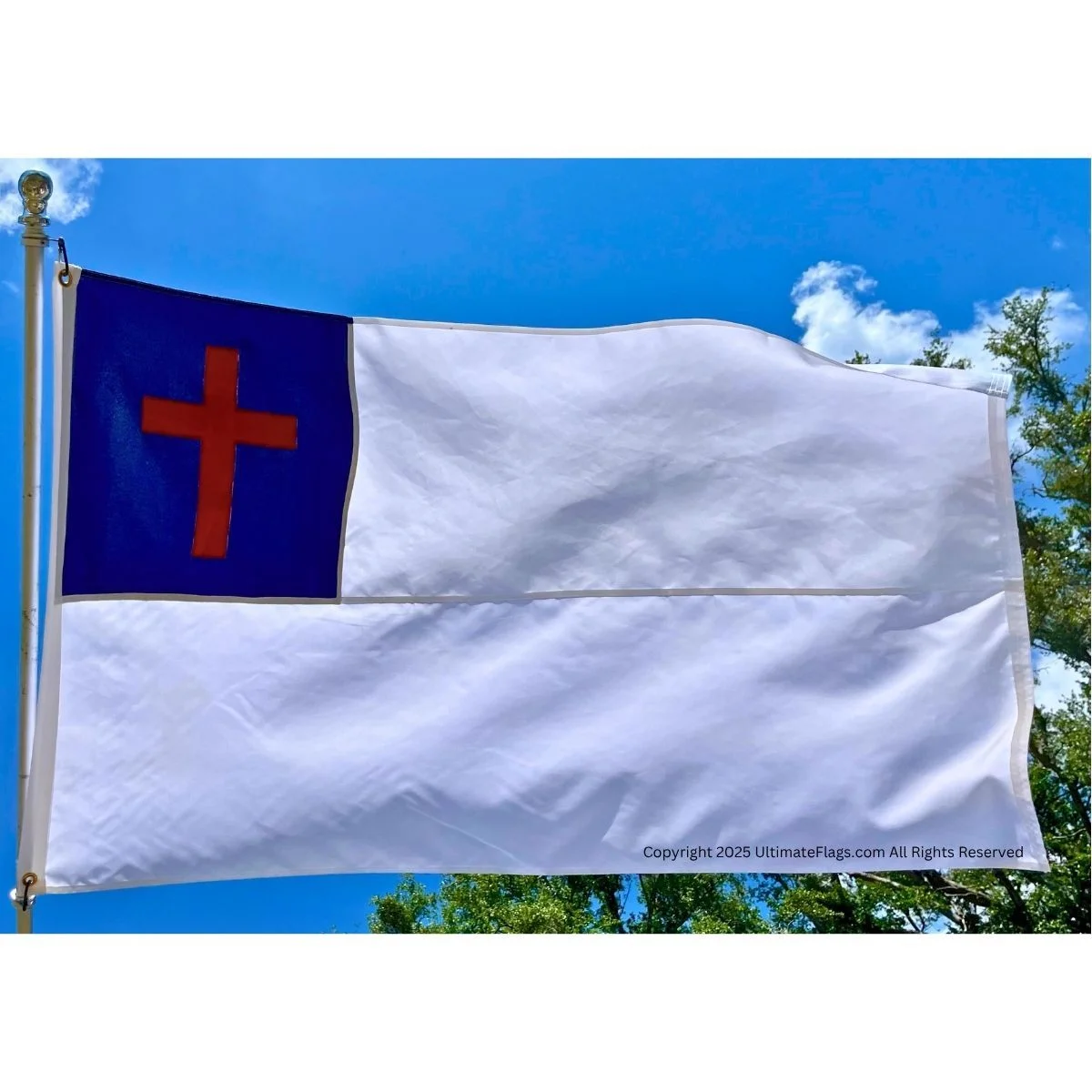
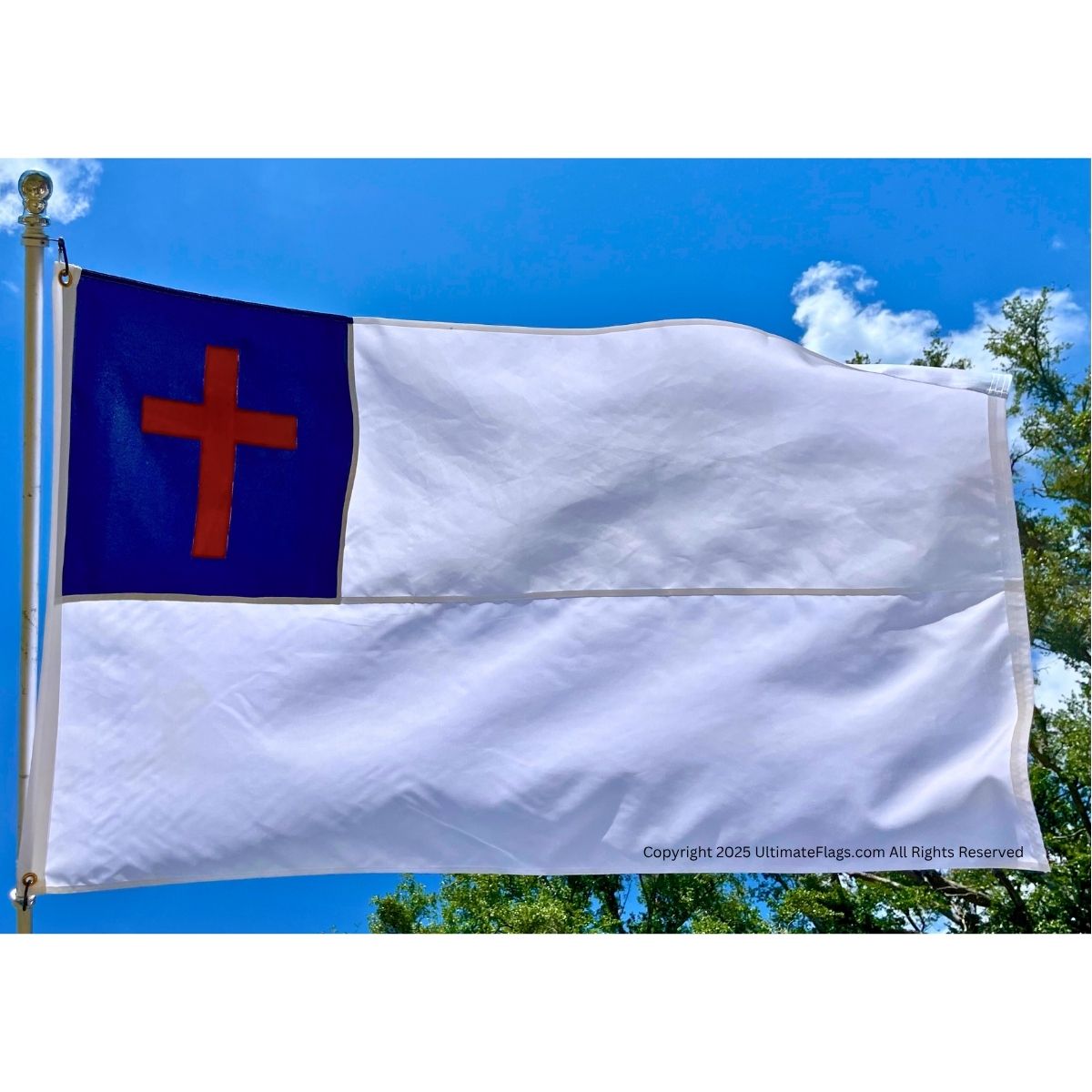
  • The Christian flag. The white banner with a red Latin cross on a blue canton. It was first raised at Brighton Chapel on Staten Island in 1907, and the design used today — credited to Charles C. Overton with Ralph Eugene Diffendorfer — was formally adopted in 1942. In the usual reading of the colors, the red cross stands for the blood of Christ, the blue canton for his kingship, and the white field for purity.
  • Ceremonial and denominational banners. Some congregations add a Vatican flag, a denominational banner or an Israel flag for special services. These are flown or carried only when the service calls for them.
  • An indoor display set. A 3 x 5 ft. flag with a pole hem and fringe, mounted on an indoor pole with an ornamental finial, for the sanctuary chancel or processional use.

How to choose church flags: step by step

Step 1: List the flags your services actually use

Walk through a normal year before you buy anything. Sunday worship, patriotic holidays, funerals, weddings, scout troop visits and community events each call for different flags. Write down which services need which banner, indoors and out, and buy to that list rather than to impulse. A church that never holds outdoor ceremonies may need nothing beyond the two steeple flags and one indoor set.

Step 2: Size each flag to its pole

Flag size follows pole height, and this is the most common sizing question churches ask. Standard industry sizing charts run roughly like this for a single flag on a pole: a 20 to 25 ft. pole carries a 3 x 5 ft. flag, a 30 to 40 ft. pole carries a 4 x 6 ft. flag, and poles of 50 ft. and up take a 5 x 8 ft. flag or larger. A flag that is too small looks lost on a tall pole; one that is too big strains the pole in wind. For most church steeples and churchyard poles, the 3 x 5 ft. size is the workhorse.

Step 3: Match the material to the location

This decision determines how long the flag lasts, so take it seriously.

  • Nylon is the standard outdoor choice: lightweight, it flies in a light breeze and dries quickly after rain. Sewn and embroidered nylon is the quality level to pick for a flag that stays up permanently.
  • 2-ply polyester is heavier and tougher, suited to high-wind or coastal locations.
  • Printed super-weave polyester is a budget-grade, fair-weather material — fine for events and seasonal display, not for a flag left up through storms.
  • Cotton is for indoor and ceremonial use only. A sewn cotton flag looks and moves beautifully in a sanctuary or at a memorial service, but cotton flags are not made for outdoor or wet use, and rain will ruin one.
Double nylon sewn Christian flag with a red cross on a blue canton flying on an outdoor church flagpoleFlag Sale – Shop Now!

A double nylon fully sewn Christian flag flying outdoors — the quality level built for a permanent churchyard or steeple display.

Step 4: Choose grommets or a pole hem and fringe

Outdoor flags attach to a pole with grommets — reinforced metal rings at the hoist — and clip to halyard snaps. Indoor and processional flags use a pole hem, a sewn sleeve that slides over the indoor pole and holds a decorative fringe edge. Buy the finish that matches the hardware: a fringe flag on an outdoor halyard tears at the sleeve, and a grommet flag looks wrong on an indoor pole. If the church is buying its first indoor set, the pole, finial, base and fringe flag are usually sold as separate pieces, so list the hardware before ordering.

Step 5: Position the flags correctly

Display customs here are settled and easy to follow. The American flag always holds the position of honor: when two flags fly on one pole, the US flag is on top, and when each flag has its own pole, the American flag's pole stands in the honorable position — to the flag's own right, which is the observer's left. Most sanctuaries give each flag its own pole, placing the American flag on the honorable side of the chancel and the Christian flag on the opposite side. When flags are carried into the sanctuary in procession, the American flag leads in the position of honor and the Christian flag follows on the opposite side. These arrangements come from long-standing US flag display custom, and following them keeps a church out of conversations nobody wants to have.

Step 6: Plan for seasons, ceremonies and memorials

Church flag needs spike around the calendar. Patriotic holidays put the American flag front and center; Easter and Christmas services may call for the sanctuary's indoor set to be refreshed; memorial services and funerals are where a cotton ceremonial flag earns its cost. Some congregations keep a dedicated indoor Christian flag used only for services, which preserves it for decades. Decide now which flags are everyday workhorses and which are reserved for the altar, and store the reserved ones folded or rolled in a dry closet rather than left on the pole.

Indoor Christian flag with an applique red cross on a blue canton, finished with a pole hem for sanctuary displayShop Now

An indoor Christian flag with appliqué work and a pole hem — the finish sanctuary and processional sets require.

Step 7: Care for the flags and retire worn ones

An outdoor flag wears out — that is what outdoor flags do. Inspect the fly end monthly for fraying, take the flag down during named storms, and wash a dirty nylon flag gently by hand with mild soap before air-drying it. When a flag is torn past mending, retire it with dignity: many American Legion posts and scout troops hold flag retirement ceremonies and will accept a worn American flag. A cotton or indoor flag that has faded simply moves to storage or gets replaced quietly.

Church flag options at a glance

Flag option Best for Construction Watch out for
Printed 3 x 5 ft. standard Events, seasonal display Super-weave polyester, printed Fair-weather material; not for permanent poles
Nylon printed 3 x 5 ft. Everyday outdoor use All-weather printed nylon Lighter look than sewn versions
Nylon embroidered 3 x 5 ft. Permanent outdoor display Embroidered nylon, stitched edges Costs more than printed
Double nylon fully sewn Churchyard showpiece Two-layer sewn nylon, appliqué cross Heaviest and most expensive outdoor option
Cotton sewn 3 x 5 ft. Sanctuary and ceremonies Embroidered cotton Never for outdoor or wet use
Indoor fringe flag Processional sets Appliqué nylon, pole hem and fringe Indoor hardware required

Common mistakes churches make with flags

  • Flying cotton outdoors. Cotton is a ceremony fabric. One good rain ruins the drape and the weave, and the flag never looks right again.
  • Oversizing the flag for the pole. A 5 x 8 ft. banner on a 20 ft. pole overloads it in wind. Match the size chart to the pole, not to enthusiasm.
  • Placing the Christian flag in the superior position. The American flag holds the position of honor in US display custom, indoors and out. Side-by-side poles should reflect that.
  • Using one flag for both jobs. An outdoor flag has grommets and no fringe; an indoor set needs a pole hem. The two are not interchangeable.
  • Expecting lettering to read correctly on both sides. Properly constructed embroidered flags read correct on the front and mirrored on the reverse — that is standard flag construction, not a defect.

If the shopping list is short, start with one honest outdoor banner. The Christian Nylon Embroidered Flag 3 x 5 ft. from Ultimate Flags is stitched for permanent churchyard display, and you can Shop Ultimate Flags to compare every size and construction level of Christian flags in one place.

FAQ

What is the Christian flag and what do its colors mean?

The Christian flag is a white banner with a red Latin cross on a blue canton, first raised in 1907 and formally adopted in 1942. The red cross traditionally stands for the blood of Christ, the blue canton for his kingship, and the white field for purity.

What size flag does a church need?

A 3 x 5 ft. flag fits most church steeple and churchyard poles in the 20 to 25 ft. range. A 30 to 40 ft. pole takes a 4 x 6 ft. flag, and poles of 50 ft. or more take 5 x 8 ft. or larger.

Which material is best for an outdoor church flag?

Sewn or embroidered nylon is the standard outdoor choice because it flies in light wind and dries fast after rain. 2-ply polyester suits high-wind or coastal sites, and cotton should never be flown outdoors.

Should the Christian flag fly above or below the American flag?

Neither above on the same pole — the American flag holds the position of honor under long-standing US display custom. Most churches fly each flag on its own pole, with the American flag on the honorable side.

What is an indoor church flag set?

An indoor set is a 3 x 5 ft. flag finished with a pole hem and fringe, mounted on a pole with an ornamental finial and base, used in the sanctuary and carried in processions.

Can a church fly its flags at night?

Custom calls for flags to be taken down at dusk unless a light shines on them through the night. A flag left up in the dark without illumination wears faster and draws criticism from flag-care traditionalists.

How do you retire a worn church flag?

Take the flag down, inspect whether it can be mended, and if not, retire it with dignity. American Legion posts and scout troops commonly hold flag retirement ceremonies and accept worn American flags.

One last thing

The Christian flag is older than many of the denominations that fly it: its first public raising in 1907 came more than a century after some congregations had already organized. When a church orders its banner in 2026, it is joining a display tradition that has outlasted building campaigns, pastors and generations of weather — which is exactly why it is worth buying the sewn, quality version instead of the cheapest one on the page.

Related guides

Posted on

Best historic Mississippi state flags for a collection

Best historic Mississippi state flags for a collection 2026

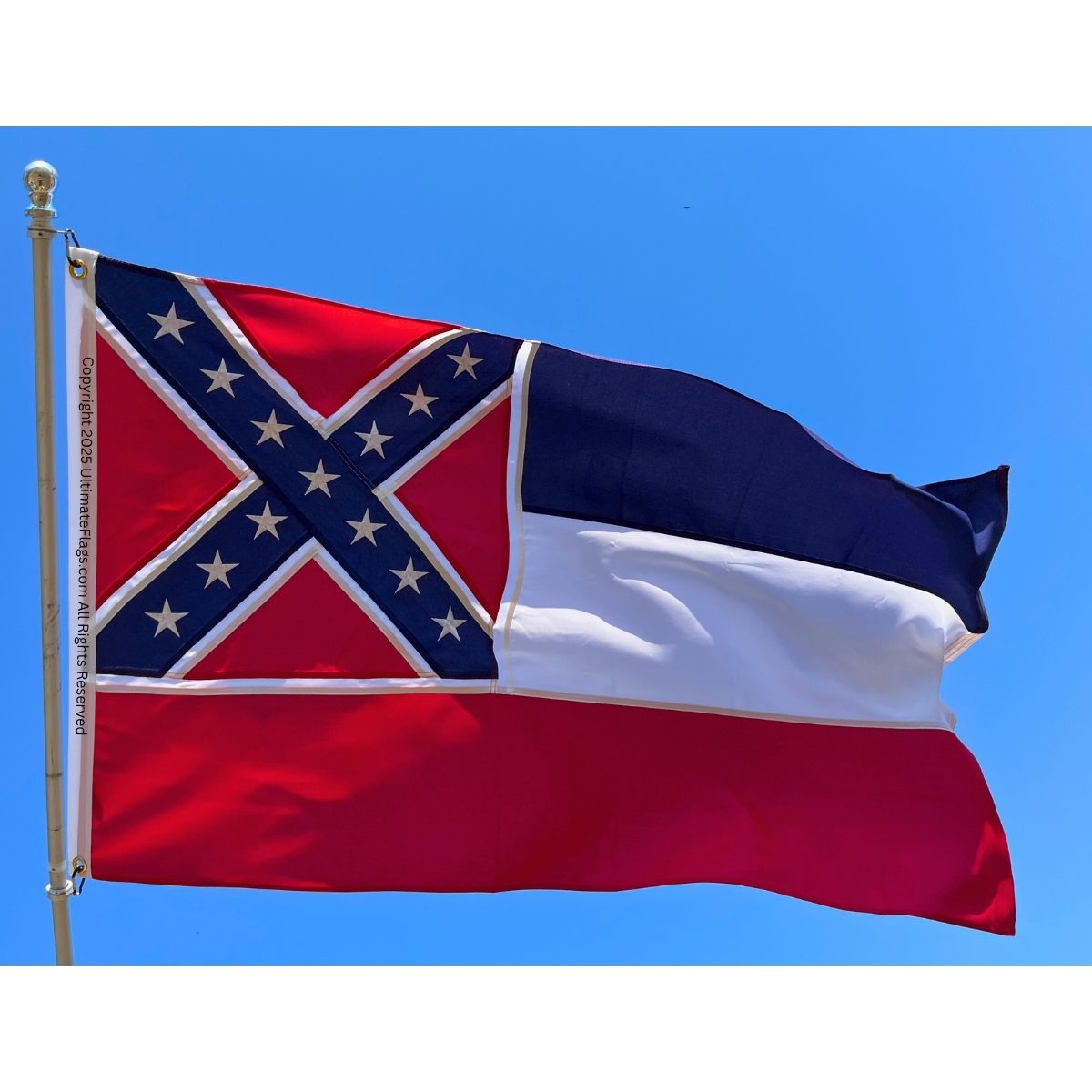
The best historic Mississippi state flag for a collection is the 1894-2020 old Mississippi flag in double nylon embroidered fabric — it flies outdoors year-round, reads sharp from either side of the pole, and comes in sizes from 2×3 ft up to 6×10 ft. For indoor displays, ceremonies and honor work, the sewn cotton embroidered version is the right build. And if your collection wants Mississippi's earliest flag story, the Bonnie Blue flag that flew at secession in 1861 is the natural companion piece. The 1894 design served as the official state flag for 126 years, longer than any other Mississippi flag, and it remains one of the most requested historic state flags at Ultimate Flags.

TL;DR
  • Best overall: the 1894-2020 old Mississippi flag in double nylon embroidered for outdoor flying.
  • Best for indoor and ceremonial displays: the sewn cotton embroidered old Mississippi flag.
  • Best companion pick: the Bonnie Blue flag, Mississippi’s first secession-era banner.
  • The 1894 design flew for 126 years, from February 1894 to June 30, 2020.
  • Every flag here is a modern reproduction, not an antique original.
Ultimate Flags flag sale banner

Why the 1894 flag still anchors a Mississippi collection

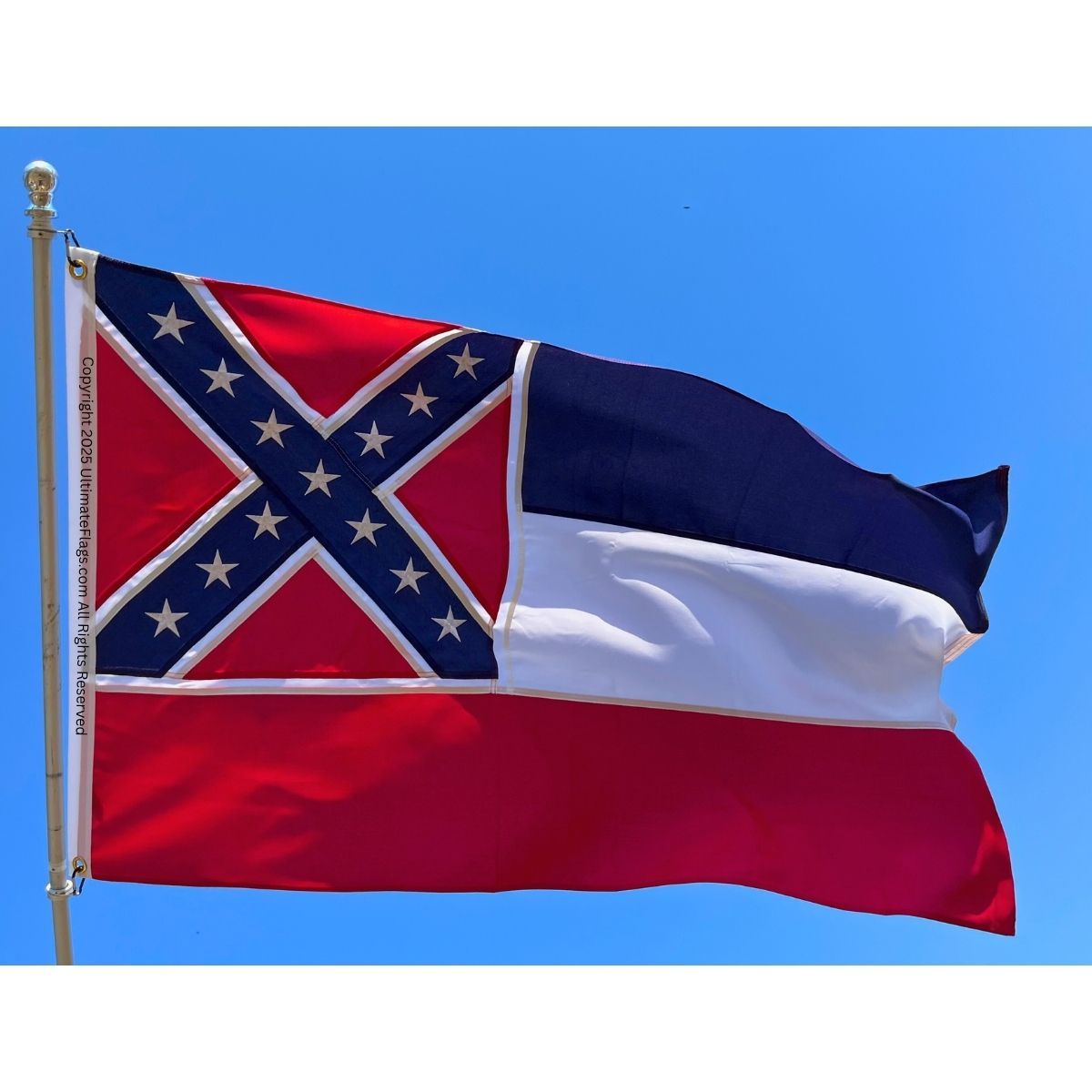
Mississippi adopted the 1894 design on February 7, 1894, replacing the Civil War-era Magnolia Flag that had served from 1861 to 1865. Designer Edward N. Scudder laid out three horizontal stripes of blue, white and red and set the Confederate battle flag in the canton, the upper left corner. The statute behind it stated that the thirteen white stars represented the number of the original states of the Union. It is a straightforward, striking design, which is exactly why it photographed and flew so well for more than a century.

The flag's legal history has a quirk collectors enjoy. In 1906 Mississippi enacted a revised code of laws, and through an oversight the statute establishing the official flag was repealed — yet the design kept flying as the state's de facto banner for decades afterward. In April 2001, a statewide referendum asked voters whether to keep the 1894 flag or adopt a new design, and roughly 65 percent voted to keep it. It flew on until June 30, 2020, when the legislature retired it, making Mississippi the last state to fly an official flag containing the Confederate battle emblem. Voters approved the current magnolia "In God We Trust" flag that November with 73 percent of the vote, and it was adopted on January 11, 2021.

Collecting or flying the 1894 design today is about history and heritage display, not politics — that is the spirit this guide keeps. It served longer than any other flag in Mississippi's history, and reproductions let families, museums and reenactors tell that 126-year story accurately.

What makes the best historic Mississippi state flag

  • An accurate design. The real 1894 flag has a blue-white-red triband and a square battle-flag canton with thirteen stars. A reproduction that blurs either detail is not worth hanging.
  • Fabric matched to the setting. Nylon handles rain and sun outdoors; cotton belongs indoors, on a wall or in a ceremony.
  • A size that fits the display. A 3×5 ft flag suits most residential poles; the cotton line adds a 5×9 1/2 ft ceremonial casket size.
  • Stitching that survives. Quad-stitched fly ends, embroidered cantons and reinforced brass grommets separate a flag you fly for years from one you replace every season.
  • An honest reproduction. Every flag in this guide is a modern reproduction, and we say so plainly — no antique originals are involved.

The best historic Mississippi flags at a glance

Flag Best for Standout feature Key limitation
1894 Mississippi flag, double nylon embroidered Year-round outdoor display Embroidered canton, sizes 2×3 to 6×10 ft Heaviest and most expensive build
1894 Mississippi flag, sewn cotton Indoor and ceremonial displays Authentic cotton weave, 5×9 1/2 ft ceremonial size Not for outdoor or wet use
Bonnie Blue flag, double nylon embroidered Early Mississippi history collections The single-star banner of 1861 secession A plain design, and a different flag era

1. 1894 Mississippi flag, double nylon embroidered: best for year-round outdoor flying

This is the flag we point Mississippi families to first. Two layers of heavy 600D double-ply nylon carry an embroidered battle canton and sewn stripes, waterproof and UV-resistant, with quad-stitched edges and reinforced brass grommets. Sizes run from 2×3 ft up through 4×6, 5×8 and 6×10 ft, so it works on a suburban pole, a ranch gate or a commercial mast. The design reads correctly on the front, with the traditional mirrored reverse, and it is built for permanent all-weather display.

1894 double nylon embroidered pros:

  • Embroidered canton and sewn stripes, not printed
  • Sizes from 2×3 ft up to 6×10 ft
  • Quad-stitched edges and reinforced brass grommets
  • Waterproof, UV-resistant 600D double-ply nylon

Cons:

  • The heaviest, costliest build of the three
  • Large sizes want a sturdy pole and hardware

Best for: a permanent outdoor pole where the flag stays up through every season.

The 1894 Mississippi flag in double nylon embroidered flying on an outdoor pole — embroidered canton, sewn stripes.

2. 1894 Mississippi flag, sewn cotton: best for indoor and ceremonial displays

Cotton is what a turn-of-the-century Mississippi flag actually felt like, and that matters on a wall. The cotton version is fully sewn with embroidered designs and comes in 2×3, 3×5, 4×6, 5×8, 6×10 ft and one size the nylon line does not offer: 5×9 1/2 ft, the traditional ceremonial casket size used by honor guards and funeral details. It hangs beautifully in a den, a museum case or a memorial display, and the weave looks, feels and moves the way period flags did. The tradeoff is simple: cotton soaks up rain and mildews, so this flag belongs indoors. If your display sees weather, choose the double nylon build above.

1894 sewn cotton pros:

  • Authentic cotton weave that looks, feels and moves right
  • Embroidered designs with real depth and texture
  • The full size run including the 5×9 1/2 ft ceremonial casket size

Cons:

  • Not for outdoor or wet use
  • Too heavy for long-term marching

Best for: indoor displays, museums, honor guards, casket and memorial ceremonies.

The sewn cotton 1894 Mississippi flag with its embroidered thirteen-star canton — sizes 2×3 through 6×10 ft plus the 5×9 1/2 ft ceremonial.

3. Bonnie Blue flag: best companion for Mississippi's earliest flag history

Want to tell the whole story instead of just the 1894 chapter? When Mississippi seceded in January 1861, the Bonnie Blue flag — a single white star on a blue field — flew briefly as the state's banner before the first official Magnolia Flag was adopted later that year. The store's double nylon embroidered Bonnie Blue comes in 3×5, 4×6, 5×8 and 10×15 ft, so it can fly outdoors beside the 1894 flag or anchor a timeline wall. As a collecting pair, the two flags cover Mississippi's flag history from secession to statehood's longest-serving banner, and neither duplicates the other's era.

Bonnie Blue double nylon embroidered pros:

  • The design Mississippi actually flew at secession in 1861
  • Sewn double-nylon construction in sizes up to 10×15 ft
  • Pairs naturally with the 1894 flag in a timeline display

Cons:

  • A plain single-star design — some collectors want more color
  • Belongs to a different flag era than the 1894 state banner

Best for: timeline displays and collectors of Mississippi's earliest flags.

A quick timeline of Mississippi's flags

  • January 1861: Mississippi secedes and briefly flies the Bonnie Blue.
  • 1861-1865: The Magnolia Flag serves as the state's first official flag.
  • February 7, 1894: The legislature adopts the Scudder design with the battle-flag canton.
  • 1906: A code revision accidentally repeals the flag law; the design keeps flying anyway.
  • April 2001: Voters keep the 1894 flag by roughly 65 percent in a statewide referendum.
  • June 30, 2020: The legislature retires the 1894 flag after 126 years.
  • January 11, 2021: The current magnolia "In God We Trust" flag is adopted.

How to display a historic Mississippi flag

A reproduction deserves honest context. Label the display with the dates the design actually flew — February 1894 to June 2020 — so visitors know exactly which era they are seeing. Fly it with the same care as any state flag: keep it off the ground, bring cotton versions indoors before rain, and retire a tattered one respectfully. In a public space, lead with the facts: the 1894 adoption, the 1906 repeal quirk, the 2001 referendum and the 2020 retirement. A dated plaque turns a flag into an exhibit, and the facts keep the conversation calm.

How we ranked these historic Mississippi flags

We ranked on the criteria above: design accuracy, fabric matched to the setting, size range and stitching quality. All three flags come from Ultimate Flags' verified Old Mississippi collection, and each earned a distinct use-case slot so you can match the flag to the way you actually display. Every one is a quality modern reproduction, and none is sold as a wartime original.

Which historic Mississippi flag should you choose?

If the flag flies outdoors year-round, buy the double nylon embroidered 1894 flag. Wall display, ceremonies or a memorial detail? The sewn cotton version, and take the 5×9 1/2 ft ceremonial size if the display calls for one. Building a full Mississippi timeline? Add the Bonnie Blue beside it for the 1861 chapter. When in doubt, start in the Shop Ultimate Flags Old Mississippi collection and pick the fabric that matches your pole.

FAQ

What did the old Mississippi flag look like?

The old Mississippi flag has three horizontal stripes of blue, white and red, with the Confederate battle flag — a red field, blue saltire and thirteen white stars — in the upper left canton.

When was the old Mississippi flag used?

It was adopted on February 7, 1894 and flew until June 30, 2020 — 126 years, the longest of any Mississippi state flag. The current magnolia flag was adopted on January 11, 2021.

Why was the 1894 Mississippi flag retired?

In June 2020 the Mississippi legislature retired the design because of the Confederate battle emblem in its canton. Voters approved the current flag that November with 73 percent of the vote.

Did Mississippi vote to keep the old flag?

Yes. In an April 2001 statewide referendum, roughly 65 percent of voters chose to keep the 1894 design over a proposed replacement.

Is it legal to fly the old Mississippi flag?

Yes. Private citizens may fly the old Mississippi flag anywhere in the United States. It is simply no longer the official state flag.

What is the Bonnie Blue flag?

The Bonnie Blue is a single white star on a blue field. Mississippi flew it briefly at secession in January 1861, before adopting the Magnolia Flag later that year.

What size old Mississippi flag should I fly at home?

A 3×5 ft flag suits most homes and residential poles. Move up to 5×8 ft or 6×10 ft only when your pole is tall and sturdy enough to carry it.

Which old Mississippi flag is best for outdoor use?

The double nylon embroidered version — waterproof, UV-resistant 600D nylon with quad-stitched edges — is built for year-round outdoor flying. Cotton versions are for indoor display.

One last thing

The strangest chapter in this flag's history is legal, not visual. From 1906 onward, the 1894 flag was technically not the official state flag at all — the statute establishing it had been repealed by accident in a code revision, and nobody corrected it for decades. The flag flew over Mississippi for most of its 126-year run on custom and habit alone, which is about as fitting a backstory as a collector could ask for.

Posted on

Best historic Georgia state flags for a heritage display

Best historic Georgia state flags for a heritage display 2026

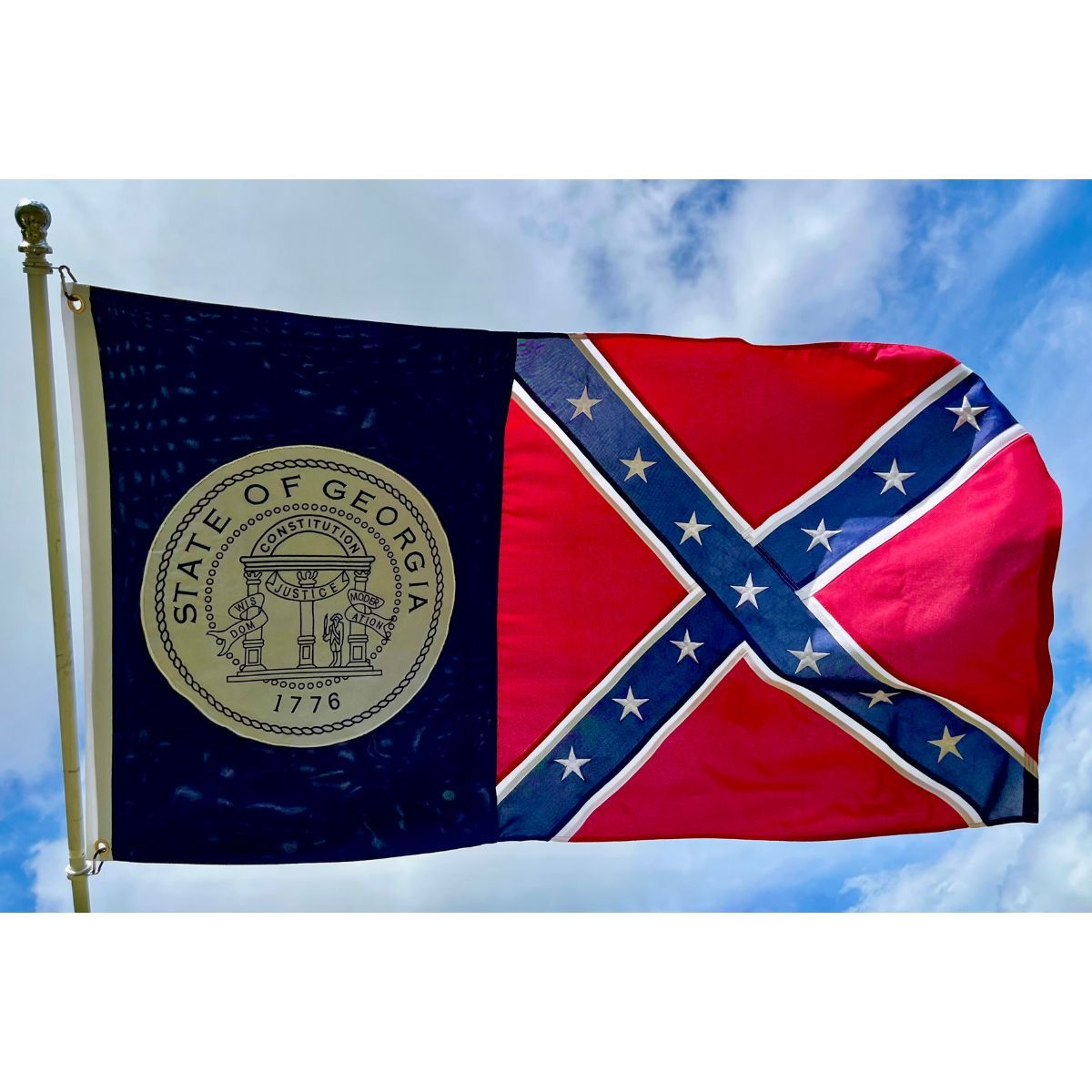
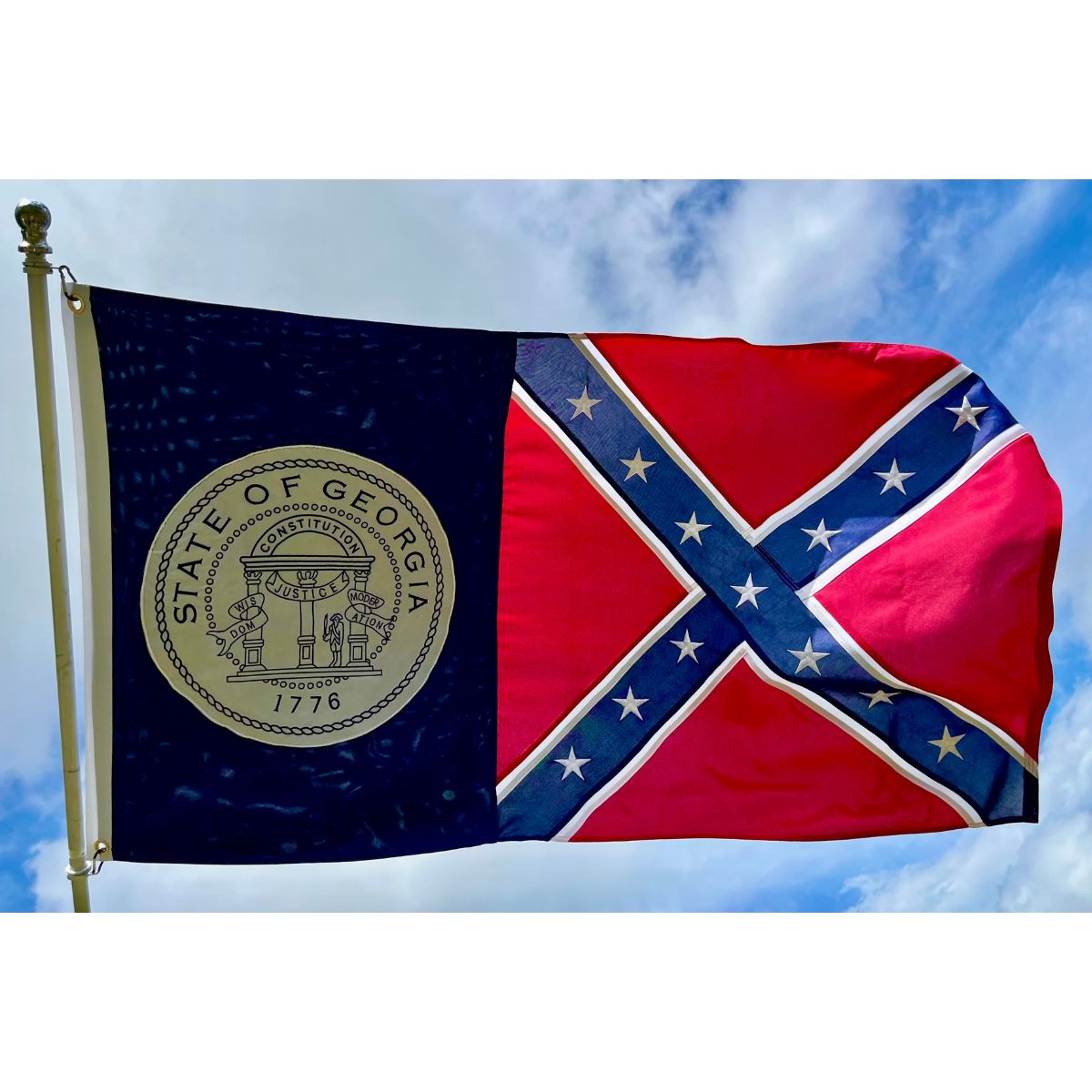
The best historic Georgia state flag for a heritage display is the 1956-2001 Old Georgia flag in double nylon embroidered fabric — it reads correctly from both sides, handles year-round weather, and comes in sizes from 3×5 ft up to 10×15 ft. If you want the same look for less, the 3×5 ft standard double-sided polyester version is the smart buy for a light-wind pole. And for a museum-style indoor display, nothing beats the sewn cotton embroidered version. Georgia flew the 1956 flag longer than any design before or since — 45 years, from February 1956 until January 2001 — which is exactly why collectors and Georgia families still ask for it first.

TL;DR
  • Best overall: the 1956-2001 Old Georgia flag in double nylon embroidered for year-round outdoor display.
  • Best budget pick: the 3×5 ft standard double-sided polyester Old Georgia flag for light-wind poles.
  • Best for indoor collections: the sewn cotton embroidered Old Georgia flag.
  • Georgia flew the 1956 flag for 45 years — February 1956 to January 2001.
  • Every flag here is a modern reproduction, not a wartime original.
Ultimate Flags flag sale banner

Why the 1956 flag still anchors a Georgia heritage display

The 1956 design put the Georgia state seal on a vertical blue band at the hoist and the Confederate battle flag across the right two-thirds of the field. The Georgia General Assembly adopted it in February 1956, two years after the U.S. Supreme Court's Brown v. Board of Education decision, and historians widely tie the redesign to the fight over school desegregation. It flew over the state capitol, courthouses and schools until January 2001, when legislation replaced it. That 2001 replacement proved so unpopular it lasted barely two years before Georgia adopted its current flag in 2003.

Displaying the 1956 design today is a statement about Georgia history and collecting, not politics — and that is the spirit this guide keeps. Families fly it for its 45-year run, reenactors use it for period accuracy, and collectors value it as the most recognizable Georgia state flag ever made.

What makes the best historic Georgia state flag

  • An accurate design. The real 1956 flag carries the state seal on the blue band and a 13-star battle emblem on the red field. A reproduction that blurs either detail is not worth hanging.
  • Fabric matched to the setting. Nylon and polyester handle rain and sun outdoors; cotton belongs indoors.
  • Reads correctly from both sides. A double-sided or double-nylon build shows the seal right-reading from either direction.
  • A size that fits the pole. A 3×5 ft flag suits most residential poles; larger flags need taller, heavier-duty poles.
  • Stitching that survives. Quad-stitched fly ends and reinforced metal grommets separate a flag you fly for years from one you replace every season.

The best historic Georgia flags at a glance

Flag Best for Standout feature Key limitation
1956-2001 Old Georgia flag, double nylon embroidered Year-round outdoor display Embroidered on both sides, sizes 3×5 to 10×15 ft Heaviest and most expensive build
1956-2001 Old Georgia flag, 3×5 ft standard double-sided Budget and light-wind poles Two flags sewn back to back with a liner Best in fair weather
1956-2001 Old Georgia flag, sewn cotton Indoor and collector displays Authentic cotton weave with embroidered design Not for outdoor or wet use
Georgia 1902-1906 state flag Early Georgia history displays Pre-1956 design with the state coat of arms Made in 5×8 ft only

1. Old Georgia double nylon embroidered: best for year-round outdoor display

This is the flag we point Georgia families to first. The 1956 design is embroidered into two layers of double-ply nylon, with the seal sewn on both sides so nothing reads backward on the reverse. Sizes run from 3×5 ft up through 10×15 ft, so it works on a suburban pole or a commercial mast. Quad-stitched edges and brass grommets are built for permanent display — the kind where the flag stays up through rain, sun and wind.

Old Georgia double nylon embroidered pros:

  • Embroidered design on both sides, not printed
  • Sizes from 3×5 ft up to 10×15 ft
  • Double- and quad-stitched edges, reinforced grommets
  • UV-stable, waterproof nylon built for permanent display

Cons:

  • Heavier fabric needs a decent breeze to fly its best
  • The largest sizes call for heavy-duty poles and hardware

Best for: a permanent outdoor pole where the flag stays up day after day.

The Old Georgia double nylon embroidered flag flying outdoors — seal and battle emblem both right-reading.

2. Old Georgia 3×5 ft standard double-sided: best budget heritage flag

If your pole sees light to moderate wind, or you simply want the 1956 look without spending much, the standard polyester version earns its keep. Two flags are sewn back to back with a liner between them, so the seal reads correctly from either side. The dye goes through the weave and resists fading, the edges are double stitched with a quad-stitched fly end, and reinforced metal grommets attach to any standard pole.

Old Georgia 3×5 ft standard double-sided pros:

  • True double-sided construction with a liner
  • Bright, fade-resistant through-dye
  • The most affordable of the three 1956 builds

Cons:

  • Suited to fair-weather display rather than year-round storms
  • Printed dye rather than embroidery

Best for: seasonal displays, events, parades and light-wind residential poles.

The 3×5 ft double-sided Old Georgia flag on an outdoor pole in full sun.

3. Old Georgia sewn cotton embroidered: best for indoor and collector displays

Cotton is what a mid-century Georgia flag actually felt like, and that matters on a wall. The cotton version of the Old Georgia flag is embroidered, full-textured and made in 2×3, 3×5 and 4×6 ft sizes. It hangs beautifully in a den, a museum case or an honor display, and it is the build reenactors reach for when the camera matters. The tradeoff is simple: cotton soaks up rain and mildews, so this flag belongs indoors. If your display sees weather, choose the nylon or polyester builds above.

Old Georgia sewn cotton pros:

  • Authentic cotton weave that looks, feels and moves right
  • Embroidered design with real depth and texture
  • Made in 2×3, 3×5 and 4×6 ft sizes

Cons:

  • Not for outdoor or wet use
  • Too heavy for long-term marching

Best for: indoor displays, museums, honor guards and collections.

4. Georgia 1902-1906 flag: best for early Georgia history

Want to tell a longer story than the 1956 era? Georgia's flag from 1902 to 1906 carried the state coat of arms on a blue field — no battle emblem at all. The store's 5×8 ft nylon embroidered version is a single-size specialty piece, and it pairs well with the 1956 flag in a timeline display: coat of arms era, then battle emblem era, then the current 2003 design. It is a narrower pick, but for a heritage wall covering Georgia's whole flag history, it fills a gap nothing else does.

Georgia 1902-1906 flag pros:

  • Pre-1956 design with the state coat of arms
  • Embroidered nylon with double- and quad-stitched edges
  • Outdoor-capable fabric

Cons:

  • Made in 5×8 ft only
  • Harder to source than the 1956 designs

Best for: timeline displays and early-state-history collectors.

A quick timeline of Georgia's state flags

  • 1879: Georgia adopts its first official state flag.
  • 1902-1906: The state coat of arms joins the blue field.
  • February 1956: The General Assembly adopts the design with the battle emblem across two-thirds of the field.
  • January 2001: The 1956 flag is retired and replaced by a blue design bearing seals and ribbons.
  • 2003: Georgia adopts its current flag, based on the First National "Stars and Bars" layout, with the state coat of arms and the words "In God We Trust."

How to display a historic Georgia flag

A reproduction deserves honest context. Label the display with the dates the design actually flew — February 1956 to January 2001 — so visitors know exactly which era they are seeing. Fly it with the same care as any state flag: keep it off the ground, bring cotton versions indoors before rain, and retire a tattered one respectfully. In a public space, lead with the history — the dates, the 2001 retirement and the 2003 replacement. Facts keep the conversation calm, and a dated plaque turns a flag into an exhibit.

How we ranked these historic Georgia flags

We ranked on the criteria above: design accuracy, fabric matched to the setting, two-sided readability, size range and stitching. All four flags come from Ultimate Flags' verified Old Georgia collection, and each earned a distinct use-case slot so you can match the flag to the way you actually display. No wartime originals are involved — these are quality reproductions, and we say so plainly.

Which historic Georgia flag should you choose?

If the flag flies outdoors year-round, buy the double nylon embroidered Old Georgia flag. If it flies in fair weather or you want the lowest cost, the 3×5 ft double-sided standard is the pick. Wall display or collection? Cotton. And if you are building a full Georgia timeline, add the 1902-1906 coat of arms flag beside it. When in doubt, start in the Shop Ultimate Flags Old Georgia collection and pick the fabric that matches your pole.

FAQ

What is the old Georgia flag?

The old Georgia flag is the state flag Georgia flew from 1956 to 2001: a blue band with the state seal at the hoist and the Confederate battle flag across the right two-thirds of the field. It served as the official state flag for 45 years.

Why did Georgia change its flag in 1956?

The Georgia General Assembly adopted the new design in February 1956, two years after the Brown v. Board of Education decision. Historians widely tie the redesign to the era’s fight over school desegregation.

When was the old Georgia flag retired?

In January 2001, when legislation replaced it with a new design. That 2001 replacement itself lasted only until 2003.

What flag does Georgia fly now?

Georgia’s current flag, adopted in 2003, is based on the First National Confederate ‘Stars and Bars’ layout, with the state coat of arms in a circle of thirteen stars and the words ‘In God We Trust.’

Can I still buy the old Georgia flag?

Yes. Reproductions are sold in standard polyester, double nylon embroidered and sewn cotton builds, in sizes from 2×3 ft up to 10×15 ft. Ultimate Flags stocks the full range in its Old Georgia collection.

Does any city still fly the 1956 Georgia flag?

Yes. Trenton, Georgia, adopted the 1956 design as its official city flag after the state retired it.

What size old Georgia flag should I fly at home?

A 3×5 ft flag suits most homes and residential poles. Move up to 4×6 ft or larger only when your pole is tall and sturdy enough to carry it.

Is the old Georgia flag the same as the Confederate battle flag?

No. The battle emblem fills only the right two-thirds of the 1956 flag; the hoist third is a blue band carrying the Georgia state seal.

One last thing

The shortest-lived official Georgia flag is not the one you think. The 2001-2003 design — a blue field crowded with inlaid seals and ribbon banners — was replaced after barely two years, the quickest retirement in the state's flag history. If your collection wants that transitional design too, it exists as its own chapter alongside the 1956 and current flags.

Posted on

Best Stainless Banner Flags for a Civil War Collection

Stainless Banner second national Confederate flag flying on a pole with a square battle flag canton on a plain white field

The Stainless Banner was the second national flag of the Confederacy, adopted by the Confederate Congress on May 1, 1863, and it pairs a plain white field with the square battle flag in the canton. Reproductions on the market run from full-size flying flags to printed nylon companions of the canton design, so the right pick depends on whether the flag flies on a pole or anchors a display case. Best overall for a Civil War collection: the full-size Stainless Banner flying flag, the design shown exactly as soldiers saw it in 1863. Best companion pick: the printed nylon battle flag in sizes from 12×18 inches to 6×10 ft, the design the canton carries. Best format pick for the end of the line: the printed nylon third national, the March 1865 redesign that fixed the white field. You can compare every one of them in our Confederate and rebel flags collection.

TL;DR
  • The Stainless Banner was the Confederacy’s second national flag, adopted May 1, 1863.
  • Its plain white field carries the square battle flag in the canton — a design that lasted just under two years.
  • Best overall: the full-size Stainless Banner flying flag, photographed on a pole exactly as the 1863 design read.
  • Best companion: the printed nylon battle flag, 12×18 inches up to 6×10 ft, the canton design at full size.
  • Pair it with the third national, adopted March 4, 1865, which added a red bar to end the flag-of-truce problem.

Ultimate Flags flag sale banner

Why this matters

The Stainless Banner is the least-remembered of the Confederacy's three national flags, and that is exactly why it interests collectors. The Stars and Bars is widely reproduced, the third national lasted barely a month of the war, and the second national sits between them: one year and ten days of official service, a distinctive all-white field, and a canton that explains why the battle flag spread across the South.

The nickname comes from the white field itself — period criticism and later histories alike refer to the "stainless" white banner. That white field is also the flag's documented weakness: from a distance, on a calm day, a hanging white flag could read as a flag of truce. Units in the field dealt with it in a blunt, well-documented way — many simply cut the white fly shorter, which is why shortened second nationals turn up in surviving accounts. The 1865 third national answered the problem officially by adding a red bar on the fly.

What makes a good Stainless Banner for a collection

Four things separate a useful reproduction from a disappointing one:

  • The canton matches the Army of Northern Virginia battle flag — a blue saltire with white stars on a red field, squared rather than rectangular.
  • The proportions follow the 1863 flag act — the law set the flag at twice the width of the canton, so the white fly runs roughly twice as long as the canton square.
  • The white field is genuinely white — clean edges and even color are the fastest quality check on a white-field design.
  • The right construction for the job — a flying version for a pole, smaller formats for cases, shelves and gifts.

The picks at a glance

Three pieces cover today’s market for this design:

Flag Best for Standout detail Key limitation
Full-size Stainless Banner flying flag Outdoor poles and large displays The design as it flew from May 1863 All-white fly shows soil sooner than striped flags
Printed nylon battle flag, 12×18 to 6×10 ft Companion display of the canton design Documented printed-nylon size range Companion piece, not the national flag itself
Printed nylon third national, 3×5 ft Completing the three-flag set The March 1865 red-bar redesign Marks the war's final weeks, not the 1863-65 period

1. Full-size Stainless Banner flying flag — best overall pick

The full-size second national is the pick that tells the whole story at a glance. Shown flying on a pole, the flag reads exactly as the 1863 law described: the square battle flag canton at the hoist and a long white field stretching to the fly. That proportion — flag twice the canton's width — is what separates a faithful second national from decorative approximations, and it is the first thing a serious collector checks.


Stainless Banner second national Confederate flag flying on a pole, a plain white field with the square battle flag cantonBuy This Flag- Click Here
The second national as it flew from May 1863: the square battle flag canton on a plain white field. Check the Civil War flags collection at Ultimate Flags for current sizes.

Pros:

  • The documented 1863 proportions, with the squared canton and long white fly
  • Reads clearly at distance, the way the design was meant to be seen
  • Anchors a display the same way the original anchored the second national period, May 1863 to March 1865

Cons:

  • The white field needs more washing care than any striped flag
  • A large white flag wants a pole and space to display honestly

Best for: collectors building an indoor Civil War display or flying the full three-national sequence outdoors. Ready to shop? shop Confederate flags for sale and compare the national-flag reproductions side by side — the Ultimate Flags flag store groups the first, second and third nationals with the battle flag designs.

2. Printed nylon battle flag, 12×18 inches to 6×10 ft — best companion pick

The Stainless Banner's canton is the battle flag, and the printed nylon battle flag lets a display show both at full size: the national design above, the field design below. The store's printed nylon version runs from a 12×18 inch stick flag through 2×3, 3×5, 4×6, 5×8 and 6×10 ft, so the same design covers a desk and a tall pole.


Rectangular Confederate battle flag printed on nylon flying outdoors, the design carried in the Stainless Banner's cantonFlag Sale – Shop Now!
The battle flag in rectangular form, printed on nylon — the design the 1863 canton squared down. Pairing the two flags shows exactly what the second national borrowed.

Pros:

  • Explains the canton at full size, next to the national flag
  • The widest documented size range of the companion picks, 12×18 inches up to 6×10 ft
  • Printed nylon holds sharp detail on the saltire and stars

Cons:

  • The rectangle reads differently from the square canton — caption the pair so visitors know which is which
  • Not a substitute for the national flag in a three-flag display

Best for: displays that teach the relationship between the battle flag and the second national, and for anyone who wants the canton design at full size rather than canton size.

3. Printed nylon third national, 3×5 ft — best pick for completing the set

The third national is the natural third piece, and the printed nylon 3×5 ft version is its standard format. Adopted on March 4, 1865, it kept the battle-flag canton and added a vertical red bar on the fly — the official fix for the white-field truce problem. A shelf or wall that holds the first, second and third nationals in order tells the whole national-flag story of the war in one glance.

Pros:

  • Completes the three-national sequence with the documented 1865 redesign
  • The red bar makes the 1865 fix visually obvious to visitors
  • Standard 3×5 ft format fits the same poles and walls as the other nationals

Cons:

  • Served only the war's final weeks, so it dates a narrow window
  • Often overlooked — many collectors stop at the second national and miss the set

Best for: collectors finishing the three-flag sequence or dating a display to the war's final months.

How we ranked

The ranking follows the job each flag does in a collection. Design accuracy came first: every pick reproduces a documented design — the 1863 second national with its squared canton, the battle flag the canton carries, and the 1865 third national with its red bar. Purpose came second, split between flying, teaching the canton relationship and completing the set. Size range broke the ties.

Dating and identifying the Stainless Banner

The second national is the easiest of the three national flags to date on sight:

  • May 1, 1863: the flag act replaced the Stars and Bars with a white field twice the width of the battle flag canton.
  • 1863 to 1865: the design served as the national flag; unlike the first national, its star count never changed.
  • In the field: units commonly shortened the white fly — period accounts record the truce-flag worry and the practical fix.
  • March 4, 1865: the third national added a red bar on the fly and replaced the Stainless Banner weeks before the war ended.

Buy the format that matches the story next to the flag: the full-size flying version for the 1863-65 period, the battle flag companion for the canton design, and the third national beside it to show how the white-field problem ended.

FAQ

What is the Stainless Banner flag?

The Stainless Banner was the second national flag of the Confederacy, adopted May 1, 1863. It carries the square battle flag in the canton on a plain white field and served until March 4, 1865.

Why is it called the Stainless Banner?

The nickname refers to its plain white field, read at the time as a symbol of purity. Critics quickly noted the practical flaw: a hanging white flag could be mistaken for a flag of truce.

Why did Confederate soldiers cut the Stainless Banner shorter?

Because the long white fly risked reading as a truce flag at a distance. Shortening the fly was a common field modification, and shortened second nationals appear in period accounts.

What flag replaced the Stainless Banner?

The third national flag, adopted March 4, 1865. It kept the battle flag canton and added a vertical red bar on the fly to end the flag-of-truce confusion.

How is the Stainless Banner different from the battle flag?

The battle flag was a field flag, never a national flag. The Stainless Banner was a national flag whose canton carried a squared version of the battle flag design on a white field.

What size Stainless Banner should a collector buy?

A full-size flying version for a pole or a large wall, and smaller formats for cases and shelves. Match the proportion, not just the design: the white fly runs about twice the canton’s width.

How do you care for a white-field flag outdoors?

Take it down in foul weather, let it dry fully before storage and wash it gently when soil appears — a white flag shows dirt sooner than any striped design, so prompt care keeps it display-ready.

One last thing

The Stainless Banner lasted one year and ten days as an official flag, yet its canton outlived it: the third national kept the battle-flag canton, and the design remains the most recognized Southern symbol of the war. Collect the second national and you are really collecting the moment the battle flag went national.

Related guides

Posted on

Best Stars and Bars flags for a Civil War collection

Best Stars and Bars flags for a Civil War collection 2026

The Stars and Bars was the first national flag of the Confederacy, adopted in March 1861, and it remains one of the most collected early Civil War designs. Reproductions on the market run from sewn cotton display flags to heavy double-nylon outdoor flags sized from 2×3 up to 10×15 ft, so the right pick depends on whether the flag flies outside or anchors a display case. Best overall for a Civil War collection: the 13-star sewn cotton Stars and Bars in 3×5 ft, the classic construction for a wall or case. Best outdoor pick: the 13-star double-nylon embroidered flag, built for daily flying. Best regimental pick: the 11th Mississippi first-national-pattern cotton flag for collectors documenting a specific unit. See all of them in our Confederate flags collection.

TL;DR
  • The Stars and Bars was the Confederate first national flag, adopted in March 1861 with seven stars.
  • Star counts grew from 7 to 11 to 13 as the war began; 13-star versions suit most collections.
  • Best overall: the sewn cotton 13-star Stars and Bars in 3×5 ft for a display case or wall.
  • Best outdoor: the double-nylon embroidered 13-star flag, sized from 2×3 up to 10×15 ft.
  • The 11th Mississippi first-national-pattern flag fits collectors documenting one regiment.

Ultimate Flags flag sale banner

Why this matters

The nickname trips up new collectors: the Stars and Bars is not the familiar crossed-star battle flag. It is the first national flag — three horizontal stripes of red, white and red with a blue canton carrying a circle of white stars — and it served as the official flag of the Confederacy from March 1861 until May 1863.

It earned its nickname because its stars-and-bars layout so closely resembled the United States flag that soldiers at First Manassas in July 1861 struggled to tell the two apart at a distance. That confusion pushed the armies toward a crossed battle flag, but the Stars and Bars never stopped being the national flag. For a collection, it documents the war's first years in a way no later design does.

What makes a good Stars and Bars for a collection

Before comparing specific flags, here is what separates a good first-national reproduction from a disappointing one:

  • Accurate star count for the period — seven stars at adoption in March 1861, thirteen by late 1861; pick the count that matches the date or unit you document.
  • Sewn or embroidered construction — stitched stars and stripes hold sharp detail and read honestly up close, where printed ink looks flat.
  • Fabric suited to the job — cotton for indoor display, sewn double nylon for a pole outdoors.
  • Documented design lineage — a reproduction should match a recorded historical pattern, not a decorative mash-up.
  • The right size for the space — 3×5 ft suits most home displays; larger sizes fit poles, camps and halls.

The picks at a glance

Three constructions cover today’s market for this design:

Flag Best for Standout detail Key limitation
13-star sewn cotton Stars and Bars, 3×5 ft Display cases and walls Traditional sewn finish, period drape Indoor fabric; not built for weather
13-star double-nylon embroidered flag Outdoor poles, 2×3 to 10×15 ft Heavy sewn double-nylon outdoor build Heavier fabric wants steady wind
11th Mississippi pattern, sewn cotton 3×5 ft Regiment-specific collections Documented first-national regimental variant One unit's design, not the standard national flag

1. 13-star sewn cotton Stars and Bars — best display pick

Ultimate Flags' sewn cotton 13-star version is the classic collector's format Today: embroidered stars on a cotton field, available from 2×3 ft up through 3×5, 4×6, 5×8 and a 5×9.5 ft ceremonial size. Cotton gives the flag a heavy, period-correct drape that reads well behind glass or on a wall, and the 13-star canton matches the settled late-1861 design.

Pros:

  • Sewn, embroidered construction holds crisp detail up close
  • Full size range from 2×3 to 5×9.5 ft
  • Cotton drape suits display cases, framing and heritage rooms

Cons:

  • Cotton is an indoor fabric; rain and full sun age it quickly
  • The heavier weave wants more wind than nylon if flown outdoors

Best for: collectors building an indoor Civil War display or documenting the 1861-1863 national-flag period. A printed 13-star nylon version is the budget route for casual or seasonal display.

2. 13-star double-nylon embroidered outdoor flag — best outdoor pick

If the flag flies on a pole rather than resting in a case, the double-nylon embroidered 13-star flag is the tougher instrument. It is sewn from two layers of outdoor nylon with embroidered stars, sized from 2×3 ft up through 3×5, 4×6, 5×8, 6×10, 8×12 and 10×15 ft, so one design covers a porch pole and a large camp display alike.


13-star Stars and Bars first national Confederate flag in sewn double nylon flying on a pole against a blue skyFlag Sale – Shop Now!
The store’s 13-star first national flag in sewn double nylon, photographed flying outdoors.

Pros:

  • Double-nylon sewn construction handles outdoor weather
  • Embroidered stars keep the canton crisp at distance
  • The widest size range of the three picks, up to 10×15 ft

Cons:

  • Heavier than printed flags, so it wants steady wind to fly well
  • More construction than a casual porch display needs

Best for: heritage displays, memorial flyings and anyone keeping the flag up through a season. Ready to shop? shop Stars and Bars flags and compare the sewn and printed first-national patterns side by side — the Ultimate Flags flag store carries the design in cotton, nylon and double-nylon builds.

3. 11th Mississippi first-national-pattern flag — best regimental pick

Some regiments built their own variants on the first-national pattern, and the 11th Mississippi's is the best-known example at Ultimate Flags: a sewn cotton 3×5 ft flag with a cross of thirteen stars laid across the blue canton and the regiment's name worked into the stripe. It documents how soldiers personalized the national design rather than replacing it.


11th Mississippi Infantry first-national-pattern regimental flag reproduction in sewn cotton with a cross of thirteen stars and regimental letteringBuy This Flag- Click Here
The 11th Mississippi regimental variant: a first-national pattern with a cross of thirteen stars and the regiment’s name in the stripe, reproduced in sewn cotton.

Pros:

  • Ties a display to one documented regiment
  • Sewn cotton stars and lettering, faithful to the variant
  • Pairs naturally with battle-flag displays from the same unit's history

Cons:

  • Represents one regiment's pattern, not the standard national flag
  • Sewn cotton 3×5 ft only — no outdoor nylon build in this pattern

Best for: collectors and descendants documenting the 11th Mississippi Infantry or first-national regimental variants generally.

How we ranked

The ranking follows the job the flag does. Construction accuracy came first: Ultimate Flags reproduces the first national with sewn or embroidered detail rather than a flat print on every pick here. Purpose came second, split between indoor display, outdoor flying and unit-specific collecting, since a flag that lives in a case has different demands from one that flies all season. Size range broke the ties.

Dating your flag: star counts and bars

The star count is the fastest dating tool on a first national flag, and you can buy reproductions of every count:

  • March 1861: the flag act set seven stars on three stripes — red, white and red — for the first seven seceded states.
  • Through 1861: star counts climbed as more states seceded, and 11-star patterns appeared by the summer of 1861.
  • May 1861: Congress set the count at thirteen stars, covering the eleven seceded states plus Kentucky and Missouri, which never seceded.
  • Later in 1861: some patterns gained additional red and white bars, pushing the proportions further from the United States flag.
  • May 1863: the second national flag replaced the Stars and Bars, and the first national retired from official use.

Buy the star count that matches the story next to the flag. A 7-star version dates a display to the war's opening months; a 13-star version covers the settled design most collectors recognize. No count is wrong on its own — mismatched context is what reads false.

FAQ

Why is it called the Stars and Bars?

The nickname came from its layout: white stars on a blue canton over red and white bars, closely parallel to the United States flag. Soldiers found the two hard to tell apart at a distance, and the name stuck.

Is the Stars and Bars the same as the Confederate battle flag?

No. The Stars and Bars was the Confederacy’s first national flag, adopted in March 1861. The crossed battle flag was approved for field use in September 1861 precisely because the national flag looked too much like the Stars and Stripes.

What star count should a reproduction have?

Match the count to the period you document: seven stars for March 1861, eleven for mid-1861, thirteen for the settled design from late 1861 through May 1863. Thirteen is the most common on reproductions today.

Who designed the Stars and Bars?

The design is credited to Nicola Marschall, a Prussian-born artist working in Marion, Alabama, and the Confederate Congress adopted it as the first national flag in early March 1861.

Can a Stars and Bars flag fly outdoors?

Yes, if it is built for it. The sewn double-nylon embroidered version is made for outdoor poles and runs up to 10×15 ft, while cotton versions are best kept indoors or reserved for short ceremonies.

What size works for a home collection display?

A 3×5 ft flag suits most walls and display cases. Larger 4×6 and 5×8 ft sizes fill bigger rooms or camp displays, and smaller 2×3 ft flags fit shelves and offices.

How do I avoid buying a bad reproduction?

Check three things: the star count matches a documented period, the construction is sewn or embroidered rather than a flat print, and the description ties the design to a real historical pattern instead of decorative guesswork.

One last thing

The Stars and Bars outlived its own replacement in one respect: the crossed battle flag borrowed its star count, and the 13-star canton shows up on battle flags, naval jacks and later national designs alike. Buy the first national with its star count in mind, and it quietly dates every display it joins.

Related guides
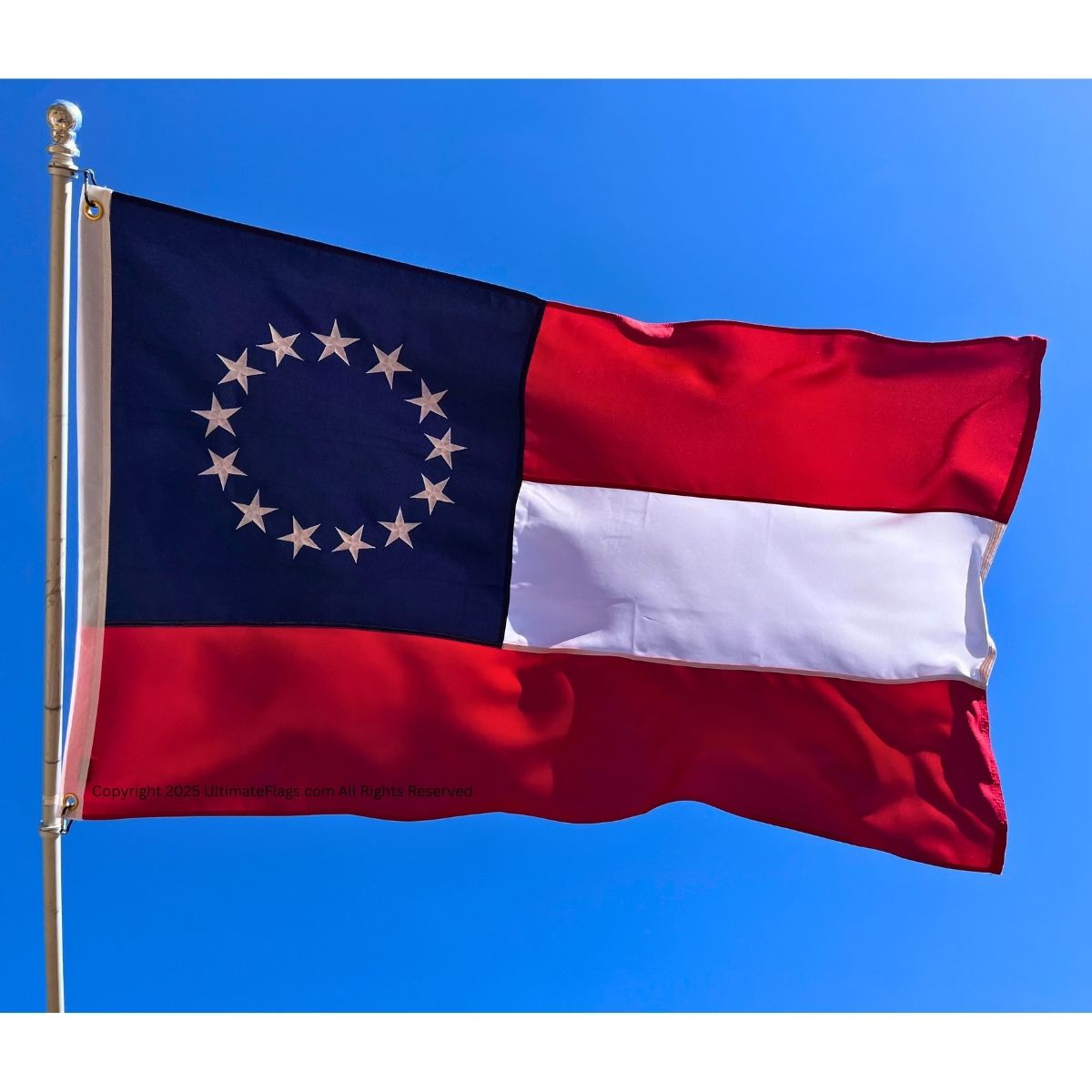
Posted on

Best Come and Take It cannon flags for a Texas patriot

gonzales flag come and take it flags cannon historic texas flags sewn outdoor double nylon embroidered 3 x 5 ft.

The Come and Take It cannon flag is the most recognizable banner of the Texas Revolution: a white field, a single black star, a black cannon, and four words daring an army to come take it. For a Texas patriot, the best Come and Take It cannon flag is the Gonzales cannon design in the standard 3×5 ft size for a heritage display, a modern rifle version for everyday flying, and the black Molon Labe Spartan banner if you want the phrase in its original form.

TL;DR
  • Best overall: the Gonzales Come and Take It cannon flag in 3×5 ft — the historic October 1835 design.
  • Best modern take: the Rebel Come and Take It flag, with an M4 carbine in place of the 1835 cannon.
  • Best for the original phrase: the black Molon Labe Spartan flag.
  • Match the design to the display: historic cannon for heritage, modern versions for daily flying.

Gonzales Come and Take It cannon flag with black star and cannon on a white field

Why this matters

The design carries a story worth knowing before you hang it. In 1831, the Mexican government loaned the settlers of Gonzales a small cannon for defense against Comanche raids. By the autumn of 1835, authorities wanted it returned. The settlers refused, and the cannon was dug up from where it had been hidden to face the troops sent to collect it. On October 2, 1835, a band of Texian volunteers met a Mexican detachment on the west bank of the Guadalupe River under a white flag painted with a star, the cannon, and the words COME AND TAKE IT. The Mexicans withdrew. The skirmish became known as the Lexington of Texas, the first military engagement of the Texas Revolution.

The phrase itself is older than Texas. It traces to molon labe — the reply King Leonidas I of Sparta gave when the Persian envoy demanded his army's weapons at Thermopylae, an exchange recorded by the ancient writer Plutarch. Come and take them, in other words, before it was come and take it.

That is why the design still earns its place on a pole Today: you are flying a flag with both a Texas story and a 2,500-year-old punchline behind it.

What makes the best Come and Take It cannon flag

  • Design accuracy — the historic Gonzales version shows a single black star, a black cannon on a wheeled carriage, and the motto in bold black letters on a white field.
  • Size matched to the display — 3×5 ft is the standard outdoor size for a house or ranch pole; smaller versions suit porches, offices and desks.
  • Lettering that reads from distance — thick block lettering carries from the street; thin script disappears past twenty feet.
  • Fabric suited to the wind — lightweight printed polyester flies in a faint breeze but fades sooner in hard sun; heavier sewn or double-sided builds last longer on an outdoor pole.
  • Honest construction — heading and brass grommets for a pole mount, reinforced corners for anything flown daily.

The picks at a glance

Flag Best for Standout feature Key limitation
Gonzales Come and Take It cannon flag, 3×5 ft Historic Texas Revolution display The original 1835 star-and-cannon design A white field shows dirt sooner than darker flags
Rebel Come and Take It flag, 3×5 ft Everyday patriotic and 2A display An M4 carbine replaces the 1835 cannon Modern rifle design, not the historic image
Molon Labe Spartan flag, 3×5 ft The phrase in its original Greek form Leonidas' come-and-take-them on a black field No Texas imagery, no star or cannon

1. Gonzales cannon flag, 3×5 ft — best overall for a Texas patriot

This is the flag the history books show. The white field, the single black star above the cannon, the black carriage and the motto across the middle reproduce the design raised at Gonzales on October 2, 1835. The best-known account says the women of Gonzales painted it on silk; every version sold today is a faithful reproduction of that 1835 artwork, and Ultimate Flags carries it in the standard 3×5 ft size.

At 3×5 ft it fits the house-mount or ranch pole most patriots already own, and it hangs comfortably beside the rest of the Texas Revolution set — the Burnet flag, the Alamo 1824 flag, the Bonnie Blue. For an anniversary display on October 2 or a Texas Independence Day fly on March 2, this is the design that starts conversations.

Pros:

  • The authentic historic cannon design, the one a collector or history buff recognizes on sight
  • Standard 3×5 ft sizing fits common house and ranch poles without adapters
  • Pairs naturally with other Republic of Texas banners in a collection display

Cons:

  • The white field shows dust and mildew sooner than a dark flag and wants an occasional gentle wash
  • Printed versions fade faster than sewn work in hard Texas sun, so check it each season

Best for: heritage displays, collectors, ranch gates and anyone who wants the actual 1835 design. Shop the Texas lineup at Shop Ultimate Flags Store to pair it with the Burnet and Alamo 1824 flags.

2. Rebel Come and Take It flag — best modern 2A take

Swap the 1835 cannon for a modern M4 carbine and you get the Rebel Come and Take It flag, offered in the store's 3×5 ft standard outdoor version. The layout keeps the come-and-take-it spirit and updates the punchline: the rifle stands in for the cannon, and the motto reads the same. It is the version you see at ranges, on truck tails and at Second Amendment rallies.

Pros:

  • Reads instantly as a Second Amendment statement without a word of explanation
  • Lightweight outdoor polyester flies readily in a light breeze
  • Sits naturally beside the rest of the 2nd Amendment lineup — Gadsden, Bear Arms quote flags and the rest

Cons:

  • It is a modern design, not the historic Gonzales artwork, so history displays should use the cannon version
  • Lighter polyester wears faster than heavier sewn flags in sustained wind

Best for: everyday flying, range days and 2A displays. Browse the Shop Ultimate Flags collection to see it next to the other Second Amendment designs.

3. Molon Labe Spartan flag — best for the phrase's original spirit

Before Texas, before the American Revolution, there was Thermopylae. The Molon Labe Spartan flag carries the Greek words Leonidas gave the Persian envoy — molon labe, come and take them — on a black field with Spartan imagery. If you want the phrase rather than the 1835 Texas artwork, this is the one.

Pros:

  • The original form of the phrase, in Greek, on the flag's home turf
  • The black fabric hides road grime and wear better than the white Gonzales field
  • Distinctive on a flag wall already crowded with red, white and blue

Cons:

  • No star, no cannon, no Texas imagery — it is a Greek story, not a Texas one
  • The Greek lettering draws blank looks from neighbors who know only the Texas version

Best for: phrase purists, history-minded 2A displays and garage or gym walls where a black banner holds up.

How we ranked

The ranking follows what a Come and Take It flag has to do on a Texas pole Today: carry the design accurately, fit standard 3×5 ft hardware, and hold up outdoors. Historic accuracy came first, so the Gonzales cannon design leads. Everyday practicality put the M4 version second, and the phrase's original Greek form rounded out the list in third.

Display and size tips

A few habits make any of these flags last longer for years to come:

  • Match size to pole. 3×5 ft suits a 5 to 6 ft house-mount pole; go 2×3 ft for a porch rail or office wall.
  • Fly a double-sided build where both sides show. A single-layer printed flag reads washed out from the reverse; a two-ply double-sided version keeps the cannon and motto sharp from the street and the gate alike.
  • Wash the white field gently. Mild soap, lukewarm water, air dry — never a hot dryer on printed fabric.
  • Bring it down in severe weather. Sustained wind and storms fray fly ends; the Gonzales white field suffers most.
  • Rotate flags for long seasons. Swapping between two flags every couple of months lets each rest and stretches both.

Which Come and Take It flag should you fly?

For most Texas patriots the answer is the Gonzales cannon flag in 3×5 ft — it is the design the date belongs to, and it reads clean from the street. Add the M4 carbine version if you fly daily and want a darker, more modern statement, and keep the Molon Labe Spartan banner for the phrase in its original Greek. Whichever you choose, Ultimate Flags carries all three families across its Texas, 2nd Amendment and Come and Take It collections, and every one of them flies under the same story: come and take it.

FAQ

What does the Come and Take It flag mean?

It repeats the challenge the settlers of Gonzales gave Mexican troops in October 1835, who demanded the return of a loaned cannon. The flag answered: come and take it.

When was the Come and Take It flag first flown?

October 2, 1835, at the Battle of Gonzales — the first military engagement of the Texas Revolution, remembered as the Lexington of Texas.

What size Come and Take It flag should I buy?

The 3×5 ft standard fits most house and ranch poles. Go 2×3 ft for a porch or office wall; smaller stick flags suit parades and desks.

What is on the historic Gonzales cannon flag?

A white field with a single black star, a black cannon on a wheeled carriage, and the words COME AND TAKE IT in bold black letters.

Is the Come and Take It flag the same as the Gadsden flag?

No. The Gadsden flag is the 1775 yellow rattlesnake banner. Both trace to the same Spartan origin, molon labe, but the designs are different.

What does Molon Labe mean?

It is Greek for come and take them — the reply King Leonidas I of Sparta gave the Persian demand for his army’s weapons at Thermopylae, as recorded by Plutarch.

Can a Come and Take It flag stay outside year-round?

An all-weather flag can, but bringing it down in severe wind and storms stretches its life. Wash the white Gonzales field gently when it shows dirt.

One last thing

Put two dates on the calendar: October 2 for the Battle of Gonzales and March 2 for Texas Independence Day. They are the natural fly days for the cannon flag, and a fresh 3×5 ft Gonzales hoisted on either one tells the whole story without a single word of explanation.

Related guides
Posted on

Best nylon American flags for commercial storefronts

Sewn American flag with embroidered stars flying on a pole against a blue sky

Nylon American flags are the default storefront choice: the fabric is light enough to fly in a faint breeze off a sidewalk, it dries fast after a morning rain, and its colors read bright from across a parking lot. For a commercial front, start with the Ultimate Flags USA flag collection, which carries outdoor embroidered nylon flags in sizes from 12"x18" up to 15×25 ft and bigger.

TL;DR
  • Best overall: the Outdoor Nylon Embroidered American flag — flies in light wind and dries quickly.
  • Best budget: the 50 Star Nylon Printed flag for short-run promotions and seasonal displays.
  • Best heritage look: the sewn cotton-and-nylon traditional American flag for classic storefronts.
  • Match flag size to pole height before fabric; a flag too big for the pole wears out fast.

Ultimate Flags flag sale banner

Why this matters

A storefront flag works about eight hours a day, every day, in sun, wind and rain. Nylon earns its keep there because it is the lightest of the common flag fabrics, so it stays animated when heavier polyester hangs limp. It also holds dyed color well, which is what keeps red looking red instead of pink after a summer on an east-facing wall.

The flip side: nylon is lighter weight, not tougher weight. On a pole hammered by steady high wind, a heavy 2-ply polyester flag generally outlasts nylon. Pick nylon when your location gets breezes rather than gales, and inspect the fly end monthly.

What makes the best storefront flag

Before comparing specific flags, here is what separates a good commercial display flag from a disappointing one:

  • Fabric weight suited to the wind — nylon for light-to-moderate breeze; heavier 2-ply polyester only for exposed, high-wind sites.
  • Embroidered or sewn details — stitched stars and sewn stripes hold up and look sharp up close, where printed ink can look flat.
  • Size matched to pole height — a common starting point is roughly 1/4 to 1/3 of the pole's above-ground height; a 20 ft pole takes a 4×6 or 5×8 ft flag well.
  • Heading and grommets built for daily use — brass grommets and a reinforced heading endure constant hoisting better than light plastic hardware.
  • Bright, dye-based color — nylon takes dye deeply, which keeps the field and stripes vivid at street distance.

The picks at a glance

Flag Best for Standout feature Key limitation
Ultimate Flags Outdoor Nylon Embroidered American flag Everyday storefront display in most wind Embroidered stars, sewn stripes, many sizes Lighter fabric wears faster in sustained high wind
50 Star Nylon Printed flag, 3×5 ft Budget promotions and seasonal displays Sharp printed color at a low cost Print fades sooner than stitched detail
Traditional sewn American flag Heritage or historic-themed storefronts Classic sewn construction and finish Heavier on the pole; wants a bit more breeze

1. Outdoor Nylon Embroidered American flag — best overall for storefronts

This is the workhorse. It is made in America in outdoor nylon with embroidered stars and sewn stripes, and the size list runs from 12"x18" and 2×3 ft up through 3×5, 4×6, 5×8, 6×10, 8×12, 10×15 and beyond. A storefront running a 20 ft pole usually lands on the 4×6 or 5×8 ft size; a taller municipal-style pole can step up to 6×10 or 8×12.

Pros:

  • Flies readily in light wind thanks to nylon's light weight
  • Embroidered stars read sharply from sidewalk distance
  • Broad size range, so one flag line covers porch poles and tall commercial poles alike
  • Quick-drying fabric shrugs off morning dew and rain

Cons:

  • Lighter fabric means more motion, which wears fly ends sooner than a heavier flag
  • In sustained strong wind, a 2-ply polyester flag is the tougher long-run choice

Best for: shops, restaurants and offices that want a bright, always-moving flag on a standard commercial pole. This is the flag most storefronts should start with. Shop the full range of American flags to match your pole height.

2. 50 Star Nylon Printed flag, 3×5 ft — best budget pick

Not every storefront flag flies year-round. For a Fourth of July promotion, a grand opening, or a seasonal window display, a printed nylon flag does the job at a fraction of the sewn-flag cost. The 3×5 ft printed nylon design is the standard size for these runs, and the dye work on nylon keeps the colors honest in person.

Pros:

  • Lowest-cost way to fly an accurate 50-star flag
  • Light nylon printed fabric flies easily even on short pole kits
  • Fine for rotating holiday displays where the flag comes down after the season

Cons:

  • Printed stars and stripes lack the dimensional look of embroidery up close
  • Not the flag to fly 365 days a year in full sun; expect faster fade than stitched work

Best for: temporary campaigns and budget displays. Buy it for the event, not for the decade. Browse the quality level collection to compare printed and sewn flags side by side.

3. Traditional sewn American flag — best heritage look

Some storefronts want a flag that reads old-fashioned: a bank, a law office, a hardware store with a wooden sign out front. A traditionally sewn flag with embroidered stars delivers that heavier, richer drape. The trade-off is weight — sewn construction is thicker than printed nylon, so it wants a touch more breeze to spread out fully.

Pros:

  • Classic sewn finish suits historic buildings and traditional storefronts
  • Stitched construction holds detail up close
  • Dries reasonably fast for a sewn flag when built on nylon

Cons:

  • Needs slightly more wind than a lighter printed flag to look its best
  • Costs more than printed alternatives

Best for: heritage businesses that want the flag to look as established as the building. See the sewn and embroidered options in the Ultimate Flags USA flag collection.

How we ranked

The ranking follows what a storefront flag actually endures: daily hoisting, sun exposure, and whatever wind the street delivers. We weighted flyability in light wind first, then construction quality (embroidered and sewn over printed for permanent installs), then the range of sizes to match different pole heights. Budget flexibility came last, handled by the printed pick.

Match the flag to your pole before you buy

The most common storefront mistake is not fabric — it is size. A flag bigger than the pole's rating thrashes itself to pieces; a flag too small looks lost above the sign. Use pole height to choose:

  • 15-20 ft pole: 3×5 ft flag
  • 20-25 ft pole: 4×6 ft flag
  • 25-30 ft pole: 5×8 ft flag
  • 30-40 ft pole: 6×10 to 8×12 ft flags

Also check the attachment. Most commercial poles take a flag with heading and brass grommets; a house-mounted pole with a fixed sleeve needs a pole-hem flag instead. Getting this right matters as much as the fabric choice.

Sewn 50-star American flag with embroidered stars flying from a pole against blue sky

Flag Sale – Shop Now!

Care tips that double a storefront flag's life

Nylon is low-maintenance, but a few habits stretch its service life noticeably:

  • Take it down in severe weather. Sustained high wind and storms are what fray fly ends, not everyday breeze.
  • Wash it when it looks dirty. Mild soap and lukewarm water, then hang to dry; never put a nylon flag in a hot dryer.
  • Rotate two flags. Swapping between two flags every couple of months lets each rest and makes both last longer than one flown continuously.
  • Inspect the fly end monthly. Early fraying is repairable; a shredded corner is not.

Historic 48-star American flag in sewn double nylon flying on a pole

Buy This Flag- Click Here

Which flag should your storefront fly?

For most businesses, the answer is simple: the Outdoor Nylon Embroidered American flag in the size matched to your pole. It flies when nothing else will, its stitched detail reads well from the street, and the size range fits everything from a 15 ft porch kit to a 30 ft commercial pole. Keep a printed 3×5 ft flag on hand for promotions, and step up to a traditional sewn flag only when the storefront's character calls for it.

FAQ

What size American flag is best for a storefront pole?

A common starting point is a flag one-quarter to one-third of the pole’s above-ground height: a 3×5 ft flag for a 15-20 ft pole, 4×6 ft for 20-25 ft, and 5×8 ft for 25-30 ft.

Is nylon or polyester better for an outdoor American flag?

Nylon is the better choice for most storefronts because it flies in light wind and dries quickly. Heavy 2-ply polyester outlasts nylon only in sustained high-wind locations.

Are embroidered flags better than printed flags?

For a permanent display, yes: embroidered stars and sewn stripes hold up longer and look sharper up close. Printed nylon flags are the budget pick for seasonal or promotional displays.

Can a nylon American flag stay out in the rain?

Nylon dries quickly, so brief rain is not a problem, but the U.S. Flag Code recommends taking the flag down in severe weather unless it is an all-weather flag.

How long does a nylon American flag last on a storefront pole?

There is no fixed lifespan; exposure, wind and care decide it. Inspecting the fly end monthly and rotating two flags between poles noticeably extends service life.

What attachment does a storefront flag need?

Most commercial poles take a heading-and-grommet flag with brass grommets. House-mounted poles with a fixed sleeve need a pole-hem flag instead.

One last thing

Before ordering, walk your block and look at the flags already flying. The ones flying bright on a still afternoon are almost always nylon; the ones hanging limp are the heavy weaves. That single observation tells you more about what your storefront needs than any fabric chart.

Related guides
Posted on

Is a double-sided flag necessary for outdoor display?

Sewn American flag with embroidered stars flying on a residential flagpole against a blue sky

No — a double-sided flag is not necessary for most outdoor flagpoles, but it is the right call whenever a design carries text, lettering or a one-directional emblem that has to read correctly from the back. A standard single-layer flag shows a mirror image of the design on its reverse, which is fine for symmetrical flags viewed at a distance. A true double-sided flag uses two full panels sewn back to back with a blockout liner between them, so both faces read correctly and hold full color up close. Pick by what your flag says, not just how it flies.

TL;DR
  • Most outdoor flags fly fine single-sided; the back shows a mirrored, lighter design.
  • Go double-sided when text or emblems must read correctly up close.
  • True double-sided means two panels plus a blockout liner, not just thicker fabric.
  • 2-ply embroidered flags read reversed on the back, by traditional construction.
  • Double-sided flags weigh more, so match your pole and hardware to the load.

Ultimate Flags flag sale banner

Why this matters when you are buying

Side one or side two, a flag is still one purchase, and the construction decides whether people can read it from the street. Buy a printed banner for a storefront without a blockout liner and every customer walking past sees a backwards logo. Buy a true double-sided flag for a tall pole nobody sees up close and you paid for weight you did not need. Neither mistake breaks the display — but one of them wastes the money, and this page keeps you on the right side of that line.

Is a double-sided flag necessary for outdoor display?

Only when the reverse side is actually read at close range. A double-sided flag is necessary for flags with wording, directional designs or crests displayed near eye level — house and garden flags by the mailbox, storefront banners, vertical displays on a building face — because a mirrored image undermines the whole message. For flags flying high on a pole, where viewers see the general shape and color rather than the fine print, a standard single-layer flag does the job and flies easier in light wind.

The three constructions you will see are worth separating before you compare listings:

Construction What the back shows Best for
Single-layer flag Mirror image of the front; fainter on printed fabric Symmetrical designs on poles viewed from a distance
2-ply sewn and embroidered Design embroidered on both faces; words read reversed Traditional sewn flags, all-weather pole display
True double-sided with blockout liner Same as the front, reading correctly Text, logos, street-view and storefront displays

Read the table by the middle column and the decision makes itself: if a reversed or fainter image on the back does not bother you, save the money; if it does, pay for the second panel.


Close-up of a double-sided flag edge showing the two sewn panels and blockout layerShop Now
The layers that make it work: two flag panels sewn back to back around a blockout liner, so the reverse reads like the front.

When a double-sided flag is worth the money

The added panel and liner earn their keep in specific situations:

  • The flag carries words. A name, a motto or a house number reads backwards from the back of any single-layer flag. If people see the reverse at reading distance, two-panel construction is the only fix.
  • The emblem is one-directional. Seals, crests and logos with a definite left and right look wrong mirrored. Symmetrical designs — many state flags, most stars-and-stripes layouts — do not have this problem.
  • The display is vertical. A banner hung flat on a building or a street-side sign gets read from both sides at close range. This is the strongest case for double-sided, since a mirror image on one face undoes the display.
  • The reverse faces the street, not the sky. Garden flags by a sidewalk and house flags on a porch sit where neighbors read them. Tall poles put the back 20 feet in the air, where nobody checks.
  • Both sides carry the message for an event or storefront. When the flag is doing advertising work, a faded mirror image on the customer-facing side costs more than the second panel ever will.

When a standard flag does the job just fine

Most American, state and military flags flown on residential poles fall in this camp. A single-layer flag is lighter, so it lifts in a breeze that leaves a heavier two-panel flag hanging limp. The reverse shows a mirror image, but with a design that reads the same flipped — stars, stripes, most simple emblems — nobody notices at flying height. For seasonal displays, temporary setups and any budget-conscious purchase where the flag is seen mostly from one side, spending the difference on a better single-layer flag in heavier fabric buys more visible quality than a second panel would.

The trade-offs: weight, wind and cost

A true double-sided flag roughly doubles the fabric in the flag and adds a liner, and all of it hangs on the same hoist. The extra weight matters most in light wind — the flag needs a stronger breeze to fly — and the greater surface load matters most in strong wind, where hems, grommets and pole hardware take more strain. A well-made double-sided flag accounts for this with reinforced headings and stronger stitching, but a cheap one on a light house pole will show its seams before a single-layer flag would. Match the hardware to the construction: brass grommets in a reinforced canvas header at 3×5 feet and above, and a pole rated for the load.

Price follows the construction for the same reason. Two printed panels plus a liner cost more to make than one, so a true double-sided flag sits above its single-layer twin at any size. That premium buys correct-reading reverses and blockout opacity — worth it exactly when the back gets read, wasteful when it does not.

Double-sided or 2-ply embroidered — what is the difference?

This one trips buyers, and the flag industry uses the words loosely. A true double-sided flag is a printed construction: two separately made faces with a blockout liner between them, so the back reads exactly like the front. A 2-ply embroidered flag is a sewn construction: the design is embroidered into two layers of fabric, and per traditional flag construction the design and words appear reversed on the reverse face — the same behavior as any traditional sewn flag, in a heavier, longer-wearing build.

Ultimate Flags' double nylon embroidered line works this way: the Gadsden Don't Tread on Me flag, for example, is embroidered on both sides in double-ply nylon, in sizes from 12×18 inches up to 5×8 feet, with the design reading reversed on the back. That is the honest description of what you are buying, and it is the right construction for an all-weather sewn flag. If a listing claims embroidered embroidery "reads correct on both sides," read the fine print twice — fully sewn traditional flags show the reverse reversed.


Sewn double nylon embroidered Gadsden Don't Tread on Me flag flying on a flagpoleBuy This Flag- Click Here
A 2-ply embroidered example: the double nylon Gadsden flies from 12×18 inches to 5×8 feet, with the design embroidered on both sides and reading reversed on the reverse face, as traditional sewn flags do.

When you are ready to compare constructions side by side, the double-sided printed Shop Ultimate Flags Gadsden banner in 3×5 feet sits next to the embroidered line above, and seeing both in one order settles the question faster than any listing description.

How to pick the right construction for your display

  1. Look at the design first. Symmetrical emblem with no words — a standard flag flies fine single-sided. Words, a seal or a directional logo — plan on two-panel construction.
  2. Walk to where the back will be seen. Stand where a passerby stands. If the reverse is readable at arm's length, buy double-sided; if it is 20 feet up, do not bother.
  3. Check the pole and hardware. Double-sided flags are heavier. Reinforced headings, metal grommet rings and a pole rated for the load keep the extra fabric from finding your hardware's weak point.
  4. Read the construction, not the label. "Double-sided" on a listing can mean a blockout liner, two sewn panels or just a heavier print. Ask what the reverse shows and buy on the answer.

Related questions about double-sided flags

What is the difference between double-sided and 2-ply?

Double-sided means two printed panels with a blockout liner, so the back reads correctly. 2-ply means two layers of fabric — often embroidered — with the design showing reversed on the reverse face, per traditional sewn-flag construction. The first reads correct from both sides; the second is heavier and longer-wearing but mirrored on the back.

Does a double-sided flag fade faster?

No faster than the same fabric in a single-layer flag — fading is driven by sun exposure, wind and the ink or dye, not the panel count. What double-sided construction does change is weight: a heavier flag in light wind flies less, and the extra surface takes more wind load at the hems.

Do double-sided flags come in large sizes?

Yes. In the store's sewn line, double nylon embroidered flags run from 12×18 inches up to 5×8 feet, and true double-sided printed flags are made in the standard outdoor sizes — the practical ceiling is your pole's load rating, not the construction.

FAQ

Is a double-sided flag necessary for outdoor display?

No — only when the reverse is read at close range or the design has text or a directional emblem. On a tall pole viewed from a distance, a standard single-layer flag works fine and flies easier in light wind.

What does the back of a normal flag look like?

A single-layer flag shows a mirror image of the front — clearly reversed on sewn fabric and fainter on printed flags. Symmetrical designs hide this; words and seals do not.

What makes a flag truly double-sided?

Two full panels sewn back to back with a blockout liner between them. The liner stops each side’s color bleeding through, so both faces read correctly with full color.

Is a 2-ply embroidered flag the same as double-sided?

No. A 2-ply embroidered flag has the design embroidered into two layers, and the design reads reversed on the back, as traditional sewn flags always have. It is heavier and more durable, but it is not a correct-reading double-sided flag.

Do double-sided flags need a stronger pole?

They need hardware matched to the weight. A double-sided flag carries roughly twice the fabric plus a liner, so reinforced headings, metal grommets and a pole rated for the load matter most at 3×5 feet and above.

What sizes do double-sided flags come in?

Standard outdoor sizes are all available. In the store’s sewn line, double nylon embroidered flags run from 12×18 inches through 5×8 feet, and printed double-sided flags come in the common residential and commercial sizes.

One last thing

The Oregon state flag is the only U.S. state flag with different designs on each side — a seal on the front, a beaver on the back — and every one of them is made as a true two-sided flag, because the reverse is part of the design. Your flag almost certainly is not Oregon. But the test it teaches is the right one: if the back of your flag is meant to say something, build it so it says it correctly; if the back is just the back, spend the money on fabric and hardware instead.

Related guides