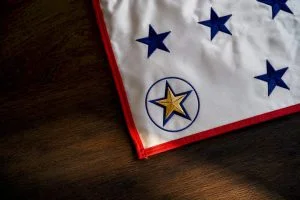
A true double-sided flag consists of two separately printed panels sewn back-to-back, typically with a blockout liner between them, so the design reads correctly and with full color fidelity from both sides. If your flag carries a logo, text, or asymmetrical imagery, a true two-panel construction is the right choice. For large outdoor fly flags viewed from a distance, or for temporary and budget-conscious displays, a single-sided flag with bleed-through print is often sufficient.
When a true double-sided flag is the right choice:
- Your design includes text, a directional crest, or a logo that would appear mirrored on the reverse of a single-sided flag
- The flag will hang vertically or be displayed where both faces are equally visible at close range
- You need premium color fidelity for a storefront, ceremonial display, or long-term installation
The main tradeoffs to weigh:
- True double-sided construction costs more, weighs more, and places greater stress on pole hardware and mounting points
- Single-sided bleed-through flags are lighter, less expensive, and perfectly serviceable for many outdoor applications
For custom sizing, U.S. production, and pre-production proofs, Ultimateflags is a trusted starting point.
Key Takeaways
True double-sided flags require two separately printed panels with a blockout liner, and that construction decision should be made before artwork is finalized, not after.
| Point | Details |
|---|---|
| When to choose true double-sided | Any design with text, a logo, or asymmetrical imagery needs two-panel construction with a blockout liner. |
| Material selection | 200-denier or heavier polyester with UV-resistant inks is the correct specification for prolonged outdoor exposure. |
| Finishing and hardware | Match grommets, headers, and pole hardware to the heavier weight of double-sided construction, especially at 3’ x 5’ and above. |
| Ordering checklist | Submit vector files in CMYK, include bleed, and always approve a proof showing both panel faces before production begins. |
| Ultimateflags | A long-standing U.S. flag retailer offering custom double-sided flags with pre-production proofs, custom sizing, and U.S. production. |
Table of Contents
- What are double sided flags and how are they built?
- Which materials and printing methods work best for your flag?
- How do size and finishing choices affect your display?
- What lifespan and colorfastness should you expect?
- Which use cases call for true double-sided construction?
- How to care for and maintain your double-sided flag
- How does ordering a custom double-sided flag work?
- What to know about warranties, returns, and delivery inspection
- How Ultimateflags approaches quality for custom orders
- An honest perspective on buying double-sided flags
- The detail most buyers overlook until it’s too late
- Ultimateflags makes custom double-sided flags straightforward
- Sources
What are double sided flags and how are they built?
Most commercial flags are produced as single-sided prints because it is cheaper and simpler. Commercial printers commonly default to single-sided sublimation, where ink migrates through the fabric so a faint mirror image appears on the reverse. That approach works for symmetrical designs, but it fails the moment your artwork includes readable text or a one-directional crest.
A true double-sided flag solves this with a three-layer construction: an outer printed panel, a blockout liner in the center, and a second printed panel on the inside face. The blockout layer, typically a woven opaque fabric, prevents each panel’s colors from showing through to the other side. Both panels are then sewn together along all four edges, with reinforced hems at the fly end and a finished heading or canvas header at the hoist.
An alternative approach omits the blockout liner entirely and sews two panels directly back-to-back. This reduces weight slightly but allows some color bleed between layers in bright sunlight. For most outdoor applications where color accuracy matters, the three-layer blockout construction is the more reliable choice.
A specialty category worth knowing: patented reversible flag designs join two panels into a pouch that can be turned inside-out to display alternative artwork on demand. These are engineered for rally or handheld flags and are not the same as a standard sewn outdoor double-sided flag.
Pro Tip: Ask your supplier whether the blockout liner is sewn as a separate layer or bonded. A sewn-in liner holds up far better through repeated washing and extended outdoor exposure than a bonded or glued version.
Which materials and printing methods work best for your flag?
The fabric you choose shapes how long your flag lasts and how vivid it looks after months of outdoor exposure.
Nylon is the traditional choice for outdoor flags. It is lighter than polyester, dries quickly, and produces exceptionally vivid color saturation because dye-sublimation ink bonds deeply into nylon fibers. Its main vulnerability is abrasion: nylon frays faster than polyester in high-wind environments.
Polyester offers greater abrasion resistance and holds its shape better in sustained winds. A 200-denier polyester is standard for house and garden flags; heavier 300-denier or 600-denier weaves are used for large outdoor flags expected to fly continuously. Denier is simply the weight of the fiber per unit length — a higher number means a denser, more durable weave.
For printing, the options break down as follows:
- Single-sided dye sublimation pushes ink through the fabric, creating a mirror bleed on the reverse. Acceptable for symmetrical designs; not suitable for text or logos.
- Double-sided printed panels with blockout liner prints each panel separately, then assembles the three-layer construction. This is the standard for true two-sided promotional flags and ceremonial pieces.
- UV-resistant and water-resistant inks are applied during the sublimation or direct-print process and are the correct specification for any flag intended for prolonged outdoor exposure.
For coastal or high-UV environments, specify 200-denier or heavier polyester with UV-certified inks. Indoor displays tolerate lighter nylon with standard sublimation. Vexillology resources confirm that cost and manufacturing complexity are the primary reasons most flags default to single-sided production, which reinforces why specifying the right material from the start matters for any custom order.
How do size and finishing choices affect your display?
Size and finish are not independent decisions. The heavier construction of a double-sided flag changes what hardware and mounting you need.
| Flag size | Common use | Recommended finish | Hardware note |
|---|---|---|---|
| — | Garden stake, decorative | Pole pocket or sleeve | Lightweight garden pole |
| 2’ x 3’ | House flag, porch display | Canvas header with grommets | Standard pole |
| 3’ x 5’ | Outdoor residential, event | Reinforced canvas header, brass grommets | Heavy-duty 1" pole recommended |
| 4’ x 6’ | Storefront, ceremonial | Double-stitched header, large brass grommets | Commercial flagpole, weighted base |
| Custom banner | Trade show, vertical display | Pole pocket top and bottom | Tension or banner stand |
Double-sided construction adds meaningful weight compared to a single-panel flag of the same size. A 3’ x 5’ three-layer flag can weigh significantly more than its single-sided equivalent, which places real stress on snap hooks, halyards, and pole hardware. Reinforced headings, bar-tacked grommets, and a pole rated for the added load are not optional at sizes of 4’ x 6’ and above.
For very large custom double-sided banners, wind load is the critical variable. Flags above 4’ x 6’ in a sustained-wind environment benefit from a perforated or mesh blockout liner, which reduces wind resistance without sacrificing the opacity needed to prevent bleed-through.
What lifespan and colorfastness should you expect?
Outdoor lifespan for a well-constructed double-sided flag depends primarily on UV exposure, wind frequency, and proximity to salt air. A quality 200-denier polyester flag with UV-certified inks, flown in a moderate-wind inland environment, typically lasts considerably longer than a lightweight nylon flag in a coastal or high-wind setting. No manufacturer can guarantee a specific number of months because environmental variables differ so widely.
The factors that shorten life most quickly are continuous flying in high winds, salt spray, and direct UV without UV-resistant ink. The following steps extend useful life significantly:
- Specify UV-resistant and water-resistant inks at the time of order, not as an afterthought.
- Choose reinforced double-stitched hems on all four edges, with bar-tacked corners.
- Match pole hardware to the flag’s weight; an undersized snap hook is the most common failure point.
- Bring the flag indoors during severe weather, ice storms, and sustained winds above 30 mph.
- Inspect seams and hems monthly; catching a loose stitch early prevents a full tear.
- Wash the flag every few months to remove abrasive particulate that accelerates fiber wear.
Warranty coverage from reputable suppliers typically covers manufacturing defects, seam failure at delivery, and color accuracy against the approved proof. It does not cover normal weathering, fading from UV exposure over time, or damage from improper mounting. The Oregon state flag is a well-known U.S. example of a two-sided official flag, with different imagery on each face, and it illustrates why production quality matters: a flag meant to carry distinct, readable designs on both sides demands precise construction from the start.
Which use cases call for true double-sided construction?
The decision between true double-sided and single-sided bleed-through comes down to three factors: visibility distance, design complexity, and display orientation.
True two-panel construction with blockout liner is the right choice when:
The flag carries text, a directional logo, or a crest that would appear reversed on the back of a single-sided print. Vertical hanging is another clear trigger: a flag displayed lengthwise on a building face or trade show banner stand is read from both sides at close range, and a mirror image on one face undermines the entire display. Premium storefront signage and ceremonial flags also belong in this category, where color fidelity and professional appearance justify the added cost.
Single-sided bleed-through is acceptable when:
The design is symmetrical, the flag flies horizontally at a height where the reverse is rarely scrutinized, or the application is temporary. Large outdoor fly flags for festivals, budget promotional events, or short-term campaigns often work well with single-sided sublimation. The color on the reverse will be a faded mirror image, but at 20 feet in the air, most viewers will not notice.
Double-sided garden flags occupy a middle ground. A decorative seasonal garden flag with a symmetrical floral or holiday design reads acceptably as a single-sided print. A garden flag with a family name or house number, however, genuinely needs two-panel construction so the text reads correctly from the street.
How to care for and maintain your double-sided flag
Proper care is straightforward, but a few specific practices make a meaningful difference in how long a double-sided flag holds its color and structural integrity.
Washing and drying:
- Hand wash in cold water with a mild, non-bleach detergent for best results; machine wash on a gentle cycle if hand washing is impractical.
- Never use bleach, fabric softener, or hot water, as these degrade both the blockout liner and the sublimated ink.
- Air dry flat or hang loosely; never put a flag in a dryer, as heat distorts the blockout layer and weakens seam adhesion.
Storage:
- Store clean and completely dry; moisture trapped in the blockout layer promotes mildew and weakens the liner over time.
- Roll rather than fold for long-term storage to avoid permanent crease lines across the printed panels.
- Keep stored flags away from direct sunlight and heat sources.
Pro Tip: Before storing a flag for the season, inspect every corner and hem under good light. A fraying corner caught early can be re-stitched in minutes; the same corner ignored for another season often means replacing the entire flag.
Replacement indicators: persistent color fading that no longer represents the original design, fraying along more than one hem edge, or visible separation between the two panels at any seam. When a flag reaches this point, retiring it with dignity and replacing it honors both the display and the message it carries.
How does ordering a custom double-sided flag work?
The ordering flow for a custom two-sided flag follows a clear sequence: upload artwork, receive a digital proof, approve production, then ship. Lead times for custom double-sided flags vary by supplier and order volume, but a standard custom order typically requires several business days for production after proof approval, plus shipping time.
Artwork requirements to prepare before you order:
- Vector files (AI, EPS, PDF) are preferred; high-resolution raster files (300 DPI at print size) are acceptable for photographic designs.
- Submit files in CMYK color mode, not RGB, to ensure accurate color matching in production.
- Include a bleed of at least 0.25" beyond the finished edge on all sides.
- Keep critical text and logos within a safe zone at least 0.5" from any finished edge.
- Confirm that any text is converted to outlines so font substitution cannot occur during production.
Pricing for custom double-sided flags is driven by size, material choice, number of layers (two panels plus blockout versus two panels only), finishing options such as grommets or pole pockets, order quantity, and any rush production fees. Larger sizes and lower quantities carry the highest per-unit cost. Shipping weight also increases with double-sided construction, so factor freight into your total budget, particularly for large or heavy orders.
Always request a digital proof before approving production. A proof confirms color placement, text orientation, and sizing before any fabric is cut. Price calculators or quote request forms let you model cost scenarios before committing to an order.
What to know about warranties, returns, and delivery inspection
Warranty coverage for double-sided flags from reputable U.S. suppliers generally addresses manufacturing defects: incorrect sizing, seam failure present at delivery, and color output that deviates materially from the approved proof. Normal weathering, gradual UV fading, and damage from improper mounting or extreme weather are standard exclusions.
On delivery, inspect your order for:
- Correct finished dimensions against your order confirmation
- Artwork accuracy and color match against your approved proof
- Visible defects in stitching, hems, or the blockout layer
- Correct finishing hardware (grommets, pole pocket, canvas header) as specified
- Any damage from shipping, including creasing that affects the blockout liner
Report any defects or discrepancies to the supplier within the window specified in their return policy, typically within a few days of delivery. Photograph defects immediately; clear documentation speeds resolution.
For heavy or oversized flags, rolled packaging in a tube protects the blockout liner better than folded packaging. If you are ordering multiple large flags, confirm with the supplier whether the shipment qualifies for freight rather than standard parcel service, and consider adding shipping insurance for high-value custom orders.
How Ultimateflags approaches quality for custom orders
Ultimateflags is one of America’s longest-standing online flag retailers, with a catalog spanning national, state, military, historical, and custom flags. That depth of experience across flag categories translates directly into production knowledge: understanding how a Civil War regimental flag differs in construction from a modern promotional banner, for instance, informs material selection and finishing decisions for every custom order.
Quality assurance in custom flag production covers material sourcing to specification, stitch and hem inspection before shipment, color proof review against submitted artwork, and sample checks for large runs. Pre-production proofs are provided before any fabric is cut, giving buyers the opportunity to confirm color, placement, and text orientation.
Pro Tip: Request that your proof be reviewed against both the obverse and reverse panel layouts simultaneously. A proof that shows only one face can miss orientation errors on the second panel, which only become visible after production.
An honest perspective on buying double-sided flags
The detail most buyers overlook until it’s too late
The single most common mistake in ordering custom two-sided promotional flags is approving a proof without verifying the reverse panel orientation independently. A proof image that looks correct for the front face can still carry a mirrored or misaligned design on the back panel, and that error only becomes visible when the finished flag arrives. The fix costs nothing at the proof stage; it costs the full order price after production.
On the question of balancing budget and durability: the temptation to save money by ordering a single-sided bleed-through flag for a display that genuinely needs two-panel construction is one of the more reliable ways to waste the entire budget. A flag with a reversed logo on the back face does not serve its purpose at half price. Spend the difference on proper construction, specify UV-resistant inks, and match the pole hardware to the flag’s weight. Those three decisions account for the majority of the gap between a flag that lasts a season and one that lasts several years.
Ultimateflags makes custom double-sided flags straightforward
Ordering a custom double-sided flag through Ultimateflags means working with a U.S.-based retailer that has spent decades understanding what makes a flag worthy of display. The process is direct: upload your artwork, receive a pre-production proof for both panel faces, confirm the design, and move to production with full transparency on lead time.

Ultimateflags supports custom sizing, a range of finishing options including grommets and pole pockets, and U.S. production with material specifications suited to outdoor durability. Whether you need a single ceremonial flag or a run of two-sided promotional flags for an event, the quote and ordering process is designed to give you confidence before a single yard of fabric is cut. Visit Ultimateflags to explore the full range of flag options and request a custom quote.
Sources
- Flags with different reverses
- Can I print my flags on both sides? | PrintSimple
- US20090095210A1 – Reversible rally flag – Google Patents
- Oregon State Flag | Double Sided – Belson Outdoors