The Stars and Bars was the first national flag of the Confederacy, adopted in March 1861, and it remains one of the most collected early Civil War designs. Reproductions on the market run from sewn cotton display flags to heavy double-nylon outdoor flags sized from 2×3 up to 10×15 ft, so the right pick depends on whether the flag flies outside or anchors a display case. Best overall for a Civil War collection: the 13-star sewn cotton Stars and Bars in 3×5 ft, the classic construction for a wall or case. Best outdoor pick: the 13-star double-nylon embroidered flag, built for daily flying. Best regimental pick: the 11th Mississippi first-national-pattern cotton flag for collectors documenting a specific unit. See all of them in our Confederate flags collection.
- The Stars and Bars was the Confederate first national flag, adopted in March 1861 with seven stars.
- Star counts grew from 7 to 11 to 13 as the war began; 13-star versions suit most collections.
- Best overall: the sewn cotton 13-star Stars and Bars in 3×5 ft for a display case or wall.
- Best outdoor: the double-nylon embroidered 13-star flag, sized from 2×3 up to 10×15 ft.
- The 11th Mississippi first-national-pattern flag fits collectors documenting one regiment.

Why this matters
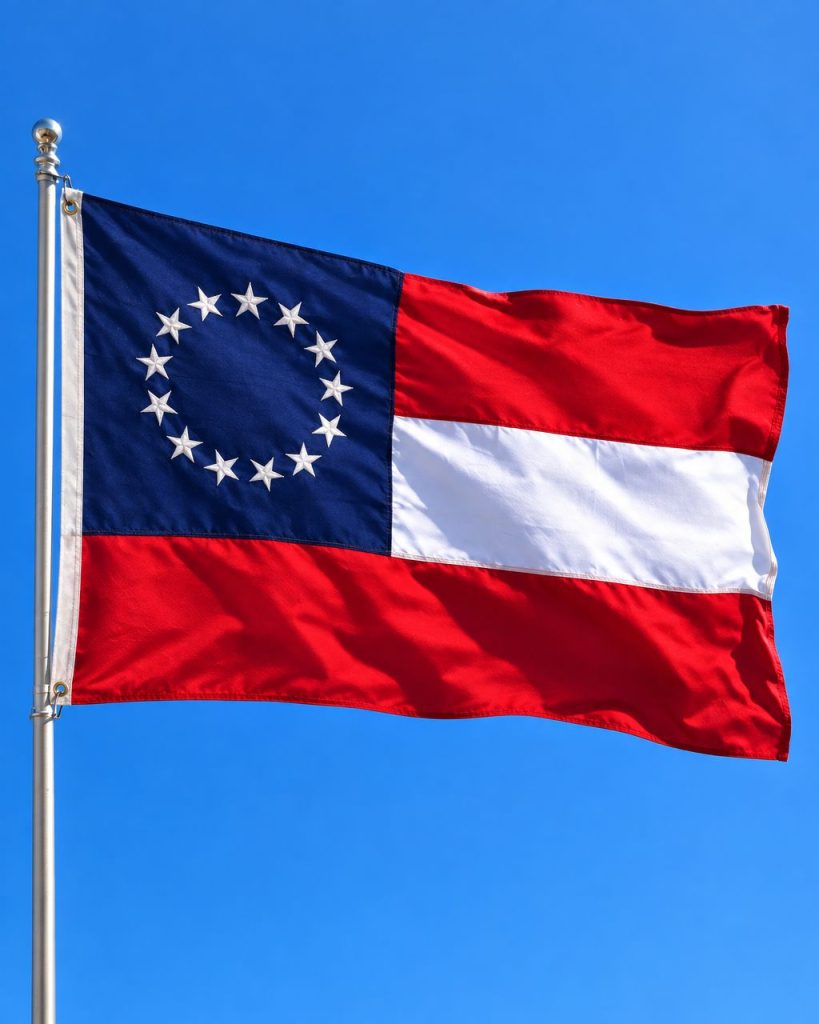
The nickname trips up new collectors: the Stars and Bars is not the familiar crossed-star battle flag. It is the first national flag — three horizontal stripes of red, white and red with a blue canton carrying a circle of white stars — and it served as the official flag of the Confederacy from March 1861 until May 1863.
It earned its nickname because its stars-and-bars layout so closely resembled the United States flag that soldiers at First Manassas in July 1861 struggled to tell the two apart at a distance. That confusion pushed the armies toward a crossed battle flag, but the Stars and Bars never stopped being the national flag. For a collection, it documents the war's first years in a way no later design does.
What makes a good Stars and Bars for a collection
Before comparing specific flags, here is what separates a good first-national reproduction from a disappointing one:
- Accurate star count for the period — seven stars at adoption in March 1861, thirteen by late 1861; pick the count that matches the date or unit you document.
- Sewn or embroidered construction — stitched stars and stripes hold sharp detail and read honestly up close, where printed ink looks flat.
- Fabric suited to the job — cotton for indoor display, sewn double nylon for a pole outdoors.
- Documented design lineage — a reproduction should match a recorded historical pattern, not a decorative mash-up.
- The right size for the space — 3×5 ft suits most home displays; larger sizes fit poles, camps and halls.
The picks at a glance
Three constructions cover today’s market for this design:
| Flag | Best for | Standout detail | Key limitation |
|---|---|---|---|
| 13-star sewn cotton Stars and Bars, 3×5 ft | Display cases and walls | Traditional sewn finish, period drape | Indoor fabric; not built for weather |
| 13-star double-nylon embroidered flag | Outdoor poles, 2×3 to 10×15 ft | Heavy sewn double-nylon outdoor build | Heavier fabric wants steady wind |
| 11th Mississippi pattern, sewn cotton 3×5 ft | Regiment-specific collections | Documented first-national regimental variant | One unit's design, not the standard national flag |
1. 13-star sewn cotton Stars and Bars — best display pick
Ultimate Flags' sewn cotton 13-star version is the classic collector's format Today: embroidered stars on a cotton field, available from 2×3 ft up through 3×5, 4×6, 5×8 and a 5×9.5 ft ceremonial size. Cotton gives the flag a heavy, period-correct drape that reads well behind glass or on a wall, and the 13-star canton matches the settled late-1861 design.
Pros:
- Sewn, embroidered construction holds crisp detail up close
- Full size range from 2×3 to 5×9.5 ft
- Cotton drape suits display cases, framing and heritage rooms
Cons:
- Cotton is an indoor fabric; rain and full sun age it quickly
- The heavier weave wants more wind than nylon if flown outdoors
Best for: collectors building an indoor Civil War display or documenting the 1861-1863 national-flag period. A printed 13-star nylon version is the budget route for casual or seasonal display.
2. 13-star double-nylon embroidered outdoor flag — best outdoor pick
If the flag flies on a pole rather than resting in a case, the double-nylon embroidered 13-star flag is the tougher instrument. It is sewn from two layers of outdoor nylon with embroidered stars, sized from 2×3 ft up through 3×5, 4×6, 5×8, 6×10, 8×12 and 10×15 ft, so one design covers a porch pole and a large camp display alike.

Pros:
- Double-nylon sewn construction handles outdoor weather
- Embroidered stars keep the canton crisp at distance
- The widest size range of the three picks, up to 10×15 ft
Cons:
- Heavier than printed flags, so it wants steady wind to fly well
- More construction than a casual porch display needs
Best for: heritage displays, memorial flyings and anyone keeping the flag up through a season. Ready to shop? shop Stars and Bars flags and compare the sewn and printed first-national patterns side by side — the Ultimate Flags flag store carries the design in cotton, nylon and double-nylon builds.
3. 11th Mississippi first-national-pattern flag — best regimental pick
Some regiments built their own variants on the first-national pattern, and the 11th Mississippi's is the best-known example at Ultimate Flags: a sewn cotton 3×5 ft flag with a cross of thirteen stars laid across the blue canton and the regiment's name worked into the stripe. It documents how soldiers personalized the national design rather than replacing it.

Pros:
- Ties a display to one documented regiment
- Sewn cotton stars and lettering, faithful to the variant
- Pairs naturally with battle-flag displays from the same unit's history
Cons:
- Represents one regiment's pattern, not the standard national flag
- Sewn cotton 3×5 ft only — no outdoor nylon build in this pattern
Best for: collectors and descendants documenting the 11th Mississippi Infantry or first-national regimental variants generally.
How we ranked
The ranking follows the job the flag does. Construction accuracy came first: Ultimate Flags reproduces the first national with sewn or embroidered detail rather than a flat print on every pick here. Purpose came second, split between indoor display, outdoor flying and unit-specific collecting, since a flag that lives in a case has different demands from one that flies all season. Size range broke the ties.
Dating your flag: star counts and bars
The star count is the fastest dating tool on a first national flag, and you can buy reproductions of every count:
- March 1861: the flag act set seven stars on three stripes — red, white and red — for the first seven seceded states.
- Through 1861: star counts climbed as more states seceded, and 11-star patterns appeared by the summer of 1861.
- May 1861: Congress set the count at thirteen stars, covering the eleven seceded states plus Kentucky and Missouri, which never seceded.
- Later in 1861: some patterns gained additional red and white bars, pushing the proportions further from the United States flag.
- May 1863: the second national flag replaced the Stars and Bars, and the first national retired from official use.
Buy the star count that matches the story next to the flag. A 7-star version dates a display to the war's opening months; a 13-star version covers the settled design most collectors recognize. No count is wrong on its own — mismatched context is what reads false.
FAQ
Why is it called the Stars and Bars?
The nickname came from its layout: white stars on a blue canton over red and white bars, closely parallel to the United States flag. Soldiers found the two hard to tell apart at a distance, and the name stuck.
Is the Stars and Bars the same as the Confederate battle flag?
No. The Stars and Bars was the Confederacy’s first national flag, adopted in March 1861. The crossed battle flag was approved for field use in September 1861 precisely because the national flag looked too much like the Stars and Stripes.
What star count should a reproduction have?
Match the count to the period you document: seven stars for March 1861, eleven for mid-1861, thirteen for the settled design from late 1861 through May 1863. Thirteen is the most common on reproductions today.
Who designed the Stars and Bars?
The design is credited to Nicola Marschall, a Prussian-born artist working in Marion, Alabama, and the Confederate Congress adopted it as the first national flag in early March 1861.
Can a Stars and Bars flag fly outdoors?
Yes, if it is built for it. The sewn double-nylon embroidered version is made for outdoor poles and runs up to 10×15 ft, while cotton versions are best kept indoors or reserved for short ceremonies.
What size works for a home collection display?
A 3×5 ft flag suits most walls and display cases. Larger 4×6 and 5×8 ft sizes fill bigger rooms or camp displays, and smaller 2×3 ft flags fit shelves and offices.
How do I avoid buying a bad reproduction?
Check three things: the star count matches a documented period, the construction is sewn or embroidered rather than a flat print, and the description ties the design to a real historical pattern instead of decorative guesswork.
One last thing
The Stars and Bars outlived its own replacement in one respect: the crossed battle flag borrowed its star count, and the 13-star canton shows up on battle flags, naval jacks and later national designs alike. Buy the first national with its star count in mind, and it quietly dates every display it joins.
Related guides